Specs are compiled from manufacturer listings and verified buyer reviews and can change over time — please confirm the key details on the product page before buying.
Workwear fails in the same predictable places: the knees, the crotch seam, and the zipper — usually three weeks into a job you cannot pause. So the short answer is this: buy a Carhartt hoodie for layering warmth, a Dickies bib for all-day bending, and a real FR shirt only if your site demands flame resistance. Everything below explains which of these nine pieces earns its place on your back, and which one quietly solves the fit problem that keeps most workwear in the closet.
This guide is built by comparing the manufacturers’ published specifications and the patterns across verified customer reviews, so you get each pick’s real strengths and trade-offs instead of marketing spin.
Layering matters more than any single garment, because a jacket you can open beats a coat you overheat in by eleven in the morning. Below you will find honest notes on fabric weight, cut, and safety ratings to match workwear and gear.
Top Picks


How To Choose The Best Workwear and Gear
Start with the job, not the brand. A welder, a framer, and a warehouse picker need three different garments, and buying outside your actual task is the fastest way to waste money on a jacket that hangs in the truck.
Match the fabric to the season
A cotton-poly blend in a midweight knit traps warmth without bulk, which is why a 10.5-ounce hoodie covers cold mornings and cool evenings in one garment. Heavier duck canvas resists abrasion and snags but holds heat, so it belongs on a winter site, not a July one.
Decide if you need a safety rating
Flame-resistant clothing carries a rating you can read — the BOCOMAL shirt lists an Arc Rating ATPV of 11.6 calories/cm² and meets NFPA 2112 and CAT II standards. Visibility gear is separate: a Class 3 hi-vis jacket keeps you seen near traffic, but it is not a fire rating. Do not substitute one for the other.
Check the cut where it fails
Fit problems in this category cluster at the waist and the inseam. Roomy cuts let you squat and reach, but a loose fit that runs long will bunch over your boots. Look for adjustable shoulder slides on bibs and knee-pad pockets on pants if you spend the day on your knees.
Side-by-Side Comparison
| Model | Best For | Garment Type | Key Material or Rating | Defining Feature | Amazon |
|---|---|---|---|---|---|
| Carhartt K288 Logo Sweatshirt★ Best Overall | Cold-morning layering | Hooded sweatshirt | 10.5 oz, 50/50 cotton-poly | Three-piece hood | Amazon |
| BOCOMAL FR Crewneck ShirtSafety Rated | Flame-rated site work | FR work shirt | 7 oz, ATPV 11.6 cal/cm² | NFPA 2112 / CAT II | Amazon |
| TICONN Hi Vis Bomber JacketRoadside Ready | Traffic and roadside work | Insulated safety jacket | ANSI Class 3 | Stowable hood | Amazon |
| Dickies Bib Overall | All-day bending without a belt | Bib overall | Cotton duck or denim | Adjustable shoulder slides | Amazon |
| Dickies Tough Max Duck Double Knee Pant | Kneeling and crouching | Double-knee work pant | Duck canvas | Double-knee reinforcement | Amazon |
| HISEA Sherpa Work Jacket | Cold weather canvas wear | Sherpa-lined jacket | Canvas shell, water resistant | 3 inner and outer pocket zones | Amazon |
| DEWALT Protradesman Work Pants | Tool-heavy trades | Stretch work pant | 60% cotton / 38% poly / 2% elastane | Holster pockets | Amazon |
| Wrangler Riggs Ranger Pant | Everyday site and yard work | Utility work pant | 100% cotton ripstop | Room2Move fit | Amazon |
| Carhartt Washed Duck Bartlett Jacket | Deep winter jobsite | Insulated duck jacket | Washed duck, sherpa lining | Cordura reinforcement | Amazon |
Detailed Reviews
1. Carhartt Men’s Iconic K288 Logo Sweatshirt
Our pick — 4.5+★ from 52,500+ verified ratings; the strongest balance of quality and price.
The midweight layer that turns a cold morning into a normal one
Here is the piece most working people reach for first, and the numbers explain why. It weighs 10.5 ounces per square yard in a 50% cotton / 50% polyester blend — heavy enough to hold warmth, light enough that you are not stripped down by ten in the morning. The rating backs the reputation: 4.5+ stars from a very large body of owners, and quality is the thing they praise most, with fit close behind.
Triple-stitched seams take the abuse where sweatshirts normally split, and spandex-reinforced rib-knit cuffs and waistband keep their shape after repeated washes instead of going floppy. The three-piece hood gives you quick coverage when wind picks up on a roof or a dock, and the front hand-warmer pocket does the obvious job without adding bulk. A logo patch is sewn to the pocket and the Carhartt logo prints down the sleeve.
The honest catch is sizing, which is the one mixed signal in an otherwise clean picture — the loose cut runs generous, so try your normal size before assuming you need to size up. Compare it with the BOCOMAL FR shirt below and you get a clear split: that one carries a flame rating for regulated sites, this one carries warmth and softness for everything else.
The case for pulling it on
- 10.5 oz weight balances warmth against overheating indoors
- Triple-stitched seams survive hard wear and repeated washes
- Three-piece hood stays put instead of pulling flat
- Spandex-ribbed cuffs and waistband resist stretching out
Where it wants your attention
- Loose fit runs roomy, so the cut may surprise you
- No flame-resistant rating, so it is not a substitute for site-rated gear
Reach for this if: you want one layer that covers cold mornings, cool evenings, and the truck cab in between.
Look elsewhere if: your site requires documented flame resistance — the BOCOMAL shirt below carries that rating.
2. BOCOMAL Men’s FR Shirts 7oz
A shirt with a real rating sheet, not a safety-sounding logo
If you are welding, working near energized equipment, or signing into a plant that checks your PPE at the gate, the paper trail is the product. This shirt meets or exceeds HRC2 with an Arc Rating ATPV of 11.6 calories/cm² — the ATPV being the measured energy a flame-resistant garment can take before the wearer risks injury. It also claims compliance with NFPA 2112 for flash fire protection, plus NFPA 70E, ASTM F1506, and CAT II.
At 7 ounces it is a heavyweight knit, so it behaves like durable workwear rather than thin safety gear. The crew and henley two-tone styling reads as a normal shop shirt, and the design draws steady approval — quality and fit are the two things that carry it, with value for money close behind.
Two things deserve honesty up front. The length runs long for several buyers, and the flame resistance itself has drawn disagreement, including reports of holes burning through. Treat that as a sign to confirm your employer’s exact standard before you rely on it for arc flash work, and check sizing against a shirt you already own rather than guessing.
What the rating buys you: a documented ATPV figure and a stated standards list, which is exactly what a gate check asks for.
What to verify first: the reported burn-through experience and the long cut — both are worth testing against your own site rules and your own shoulders.
Suits: anyone whose job requires documented flame-resistant clothing with a usable stretch of fabric at 7 oz.
Not the pick: casual weekend wear — the fabric weight alone makes this a workday garment.
3. TICONN Hi Vis Safety Bomber Jacket
Visibility, fleece, and rain cover in one bomber cut
Class 3 hi-vis is the level built for workers who need to be spotted against a busy backdrop, and it is the core of this jacket. The fleece lining does the cold work, the water-resistant shell keeps you dry in rain, and the retractable hem and windshield-grade zipper-and-snap front close the gaps that let weather in.
Two details earn their keep on a real jobsite. The stowable hood disappears when you do not need it, and there is a mic strap — small thing, real thing, if you carry a radio all shift. Fit and value are what buyers talk about most, and visibility and water resistance follow right behind. One buyer described shoveling snow in the street as exactly the setup it fits.
Size is the single point to plan around. Reports split hard in both directions — some find it huge, others find it runs small — so measure your chest and check the size chart rather than trusting habit. Beyond that, the practical note is that a fleece-lined shell this warm is a cold-weather tool, not a year-round one.
The standout: ANSI Class 3 visibility paired with genuine water resistance and a fleece lining — three jobs in a single jacket.
The one to watch: sizing feedback contradicts itself, so verify your measurement before ordering.
Built for: road crews, lot attendants, and anyone working near moving vehicles in cold wet weather.
Skip the guesswork: order by measured chest size, not your usual jacket size.
4. Dickies Men’s Bib Overall

The belt-free approach to a full day of bending and reaching
Pants ride down when you squat. Overalls do not, because the straps hold them up — and that single mechanical fact is why so many trades keep a pair in rotation. This one comes in durable cotton duck or finely-woven cotton denim, built to resist snags and tears with triple-stitching throughout and a beltless roomy fit.
Details that matter over a ten-hour shift: plenty of pockets, adjustable shoulder slides so you can dial the strap length, shoulder loops, and two-button closures at the sides. The stonewash look and the substantial denim feel are what people call out most, with the overall construction and material close behind. It is worn by ironworkers, which says something about the abuse it tolerates.
Fit is the area to slow down on. Multiple buyers report tightness at the waist and an inseam that runs long, so plan on possibly hemming. That is a sizing quirk, not a durability problem — the shell itself holds up.
For the long squat-and-lift day: triple-stitched cotton duck or denim with adjustable straps, so nothing slips mid-task.
Adjust your expectations on length: the inseam runs generous and the waist runs snug — order with hemming in mind.
Best fit for: framers, farmers, and mechanics who want their waistline handled without a belt digging in.
Think twice if: you want an exact off-the-rack length — budget for a hem.
5. Dickies Mens Tough Max Duck Double Knee Pant

Reinforcement exactly where a kneel wears through first
Duck canvas earns its name from density, and the double-knee reinforcement here is the whole argument for the pant. If your day involves dropping to a knee on concrete, gravel, or a truck bed, the wear point is not the thigh — it is the knee, and this pant reinforces it. Triple-needle seams and reinforcement throughout back that up.
The cut sits slightly below the waist in a regular fit with a straight leg, and the Tough Max treatment is aimed at repeated hard use. Quality leads what people say about it, with the stretchiness a distant but real second — enough give to flex through real work rather than fighting you when you crouch. It runs from garden duty to construction without complaint.
Two fair warnings. The waist runs a touch snug for some, and pockets have drawn complaints — so if you carry a lot in your pockets, check the layout against what you actually haul. Seam durability has also split opinion, worth knowing if you are hard on the inseam.
Why it earns a slot: a double-knee duck canvas pant with triple-needle seams is the cheapest insurance against worn-out knees on a job site.
Measure before you buy: the waist runs snug and the pockets are not generous — plan your carry accordingly.
Pick it for: kneeling work — plumbing, flooring, landscaping, or any trade that lives on one knee.
Look past it if: you need a roomy waist and deep pockets as your top priorities.
6. HISEA Men’s Sherpa Work Jacket

A canvas coat that shrugs off snow and keeps a radio pocket handy
Cold-weather workwear has one job: keep you outside longer than the weather wants you to stay. This canvas shell is water resistant and hooded, with sherpa lining for warmth, and it carries a smart pocket layout — one chest pocket, two hand pockets, and three inner pockets for phone, wallet, and radio.
Construction and fit are where it earns its keep, and the winter-suitability angle is real: one owner used it through a harsh winter and came out the other side. The XXL fit was called out as spot-on. It runs across a range of sizes and reads as a work coat rather than a fashion jacket.
The zipper is the weak spot to know about, with repeated complaints about quality — so treat it gently and do not yank it. Weight gets mixed feedback too: some find it light to wear, others call it heavy. That is a preference call, not a defect.
What it does well: sherpa warmth inside a water-resistant canvas shell, with six pockets counting the inner ones.
The weak link: the zipper deserves a slow, careful pull every time.
Worth it for: outdoor winter shifts where you need warmth, a hood, and pockets you can reach with gloves on.
Not for: anyone who wants a featherweight shell — this leans substantial.
7. DEWALT Protradesman Work Pants
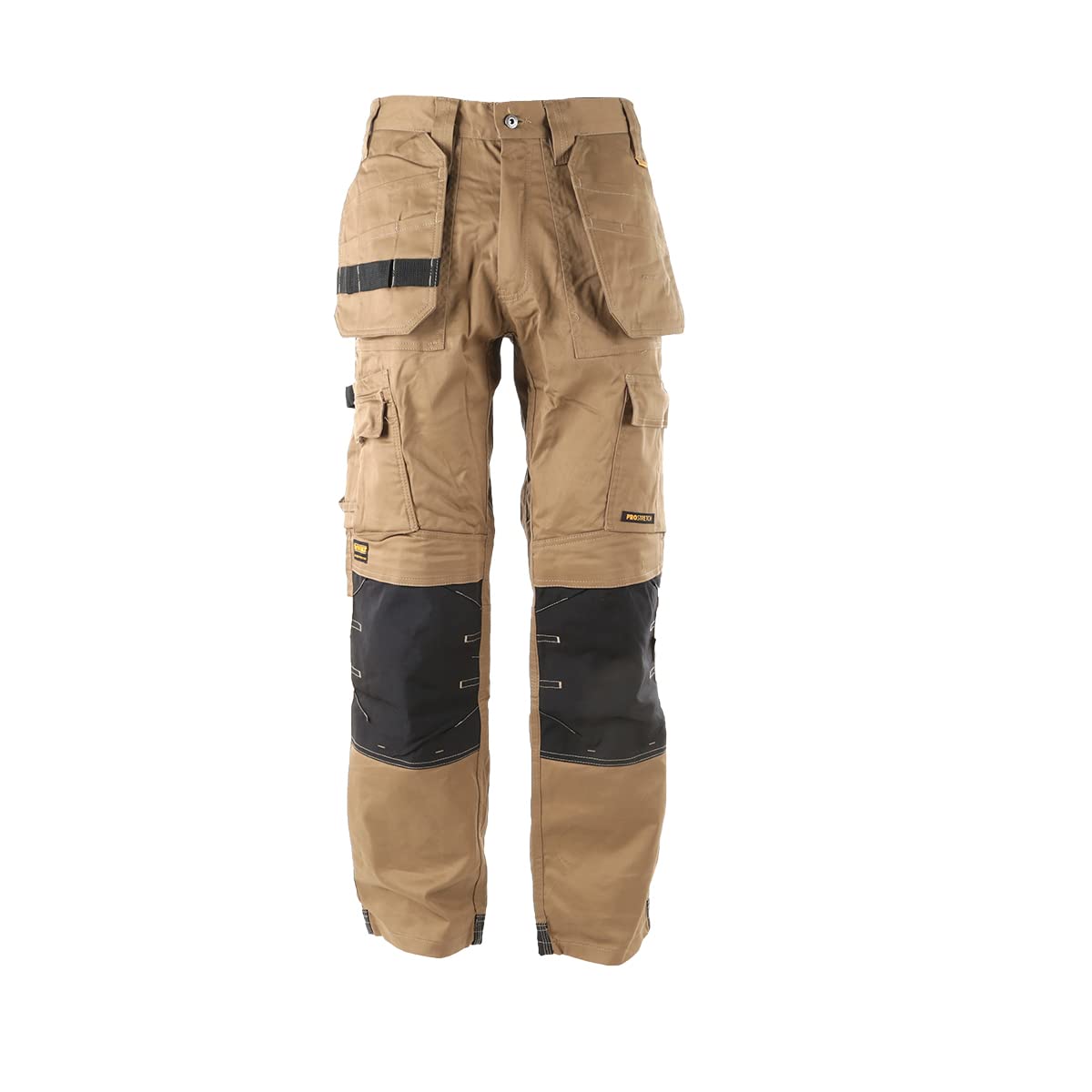
Eleven pockets and holster access — a tool belt without the belt
The fabric is the tell: 60% cotton, 38% polyester, and 2% elastane, which is the recipe for stretch that recovers. That 2% elastane is what lets the pant flex when you kneel or climb, and it holds its shape instead of bagging out by afternoon. Loose fit through the leg adds room to move.
Then there is the pocket count — eleven, including holster pockets, cargo, front, back, cell phone, and reinforced knee-pad pockets. The holster placement is the headliner: it puts your most-used tools at arm’s reach so you stop patting yourself down mid-task. Fit is what people call out most, with the pockets right behind, and one buyer described the built-in tool belt as working great.
Durability is the split point. Some describe strong stitching and well-made construction; others report tearing. That gap suggests the pant rewards a fit that is not straining at the seams, so get the size right rather than sizing down.
The reason to pick this one: eleven pockets plus holster access turn a pair of pants into a carrying system, and the 2% elastane keeps the fabric from fighting you on a kneel.
The variable: durability reports run both ways, so a correctly fitted pair matters more than usual here.
This is your pant if: you carry a lot of small tools and want them reachable without a separate belt.
Look at the Dickies double-knee instead if: sheer abrasion resistance on the knees is the whole point for you.
8. Wrangler Riggs Workwear Mens Ranger Work Utility Pants

Ripstop cotton with triple-needle stitching, built to be worn hard
Ripstop is a weave that resists a tear spreading once it starts, and here it is 100% cotton — breathable, quiet, and comfortable against the skin all day. Triple-needle stitching and added reinforcement in high-wear areas handle the abrasion side. The Room2Move fit is the design answer to range of motion, so you can reach overhead or squat without the waistband fighting back.
The storage story is strong: generous pockets with a lot of room, useful on the job site and perfectly fine for mowing the lawn or camping afterward. Durability and quality lead the conversation, with pockets and value close behind. It comes in big and tall sizing, which helps if standard cuts always run short on you.
Waist fit is where opinions split — some find it great, others say it runs small, so measure rather than assume. Beyond that, the cotton build means it is not a water-resistant pant; it is an everyday workhorse.
Where it shines: ripstop cotton plus triple-needle stitching gives you a pant that resists snags and still feels like fabric, not armor.
The watch-out: the waist runs small for some — check your measurement first.
Count on it for: everyday site work, yard work, and weekends — one pant that crosses over without looking out of place.
Look elsewhere if: you need water resistance or a stretch blend for constant kneeling.
9. Carhartt Men’s Washed Duck Bartlett Jacket

The one you wear when the forecast stops being a suggestion
Washed duck is the same dense cotton canvas that has made this category what it is, softened in the wash so it does not fight you on day one. Sherpa lining adds warmth without a quilted bulk, and cordura reinforcement at the wear points handles the abrasion that kills lesser coats. The attached hood stays with the jacket instead of dangling.
Roomy through the body with deep hand pockets for gloves or cold hands, this is a layering jacket — wear a hoodie underneath and you are set for the worst of it. It held up to a rainy winter day while shoveling snow, and the fleece lining makes it a true cold-weather piece rather than a shoulder-season jacket.
The trade-off is bulk and weight: a sherpa-lined duck jacket is not a light layer, so save it for genuinely cold days. Compared with the midweight Carhartt hoodie in position one, this is the outer shell that goes over it, not the replacement for it.
What it is: a sherpa-lined washed duck jacket with cordura reinforcement and an attached hood — the winter outer layer.
The honest limit: heavyweight construction and warmth make it a cold-weather-only garment.
Made for: winter jobsite shifts where the cold is the main obstacle to getting the work done.
Not needed if: your winters are mild or you already layer a hoodie under a shell.
Know the Specs
Fabric Weight in Ounces
Fabric weight is measured in ounces per square yard — a heavier number means denser, warmer, and more abrasion-resistant cloth. A 10.5-ounce knit hoodie feels substantial but still breathes; a 7-ounce heavyweight knit shirt behaves like everyday workwear. Heavier duck canvas holds heat and shrugs off snags, which is why it belongs on winter sites.
Arc Rating and ATPV
An Arc Rating is a measured energy figure — the ATPV — telling you how much heat a flame-resistant garment can absorb before the wearer risks a burn injury. The BOCOMAL shirt lists an ATPV of 11.6 calories/cm² and states compliance with NFPA 2112, NFPA 70E, ASTM F1506, and CAT II. Confirm your employer requires these standards before relying on any garment.
ANSI Class and Visibility
ANSI Class 3 hi-vis is a visibility level, not a fire rating. It means the garment is designed to make you seen against complex backgrounds, which is why road crews wear it. A Class 3 jacket keeps you visible in traffic; it does nothing for arc flash. Do not swap one standard for the other.
Stretch and Fit Blends
Elastane content is what gives a work pant stretch that recovers — the DEWALT pant lists 2% elastane in a cotton-poly blend. Ripstop cotton resists a tear spreading but offers no stretch. A Room2Move or loose fit adds range of motion through the cut rather than the weave, which matters when you are kneeling, reaching overhead, or climbing.
Common Questions
What does an ATPV of 11.6 calories/cm² actually mean for my safety?
Is ANSI Class 3 hi-vis the same as flame resistant?
Why do work pants with a double knee cost more than standard work pants?
Do bib overalls run true to size?
How heavy is a sherpa-lined duck jacket in daily wear?
What is the difference between ripstop cotton and duck canvas?
Will a loose-fit work pant with holster pockets still fit over boots?
Can I wear a flame-resistant crewneck shirt as a regular shirt?
Why do work jackets need a stowable rather than fixed hood?
The Bottom Line
For most people, the workwear and gear worth buying is the Carhartt K288 Logo Sweatshirt. One layer of 10.5-ounce cotton-poly (a cotton and polyester blend) keeps you warm from a cold morning through a cool evening. Triple-stitched seams (three rows of stitching for extra strength) hold up through the washes that wear out cheaper hoodies. It is the crowd favorite by a wide margin, with 4.5+ stars across 52,000+ owners. Check the fit before you commit, since that is the one thing that varies.
If your site requires a documented flame rating, grab the BOCOMAL FR crewneck instead, since it states an ATPV of 11.6 calories/cm² and compliance with NFPA 2112. If you spend the day carrying tools, the DEWALT Protradesman pant with its eleven pockets and holster access is the one to reach for — just get the size right, because that is where durability reports diverge.
When the forecast turns genuinely hostile, the Carhartt Washed Duck Bartlett Jacket is the outer layer the rest of this list sits underneath. Sherpa lining (a soft, fuzzy fleece inside) traps warmth, cordura reinforcement (a tough, abrasion-resistant fabric) guards the high-wear spots, and an attached hood keeps your head covered without a separate hat.
How we choose
We do not accept paid placement. Every pick is matched to a real buyer and a real use-case; we do not hands-on test units.
Sources
Specifications: manufacturer listings and product documentation. Review insights: verified customer reviews, as of November 2026. Pricing: not shown on this page (it changes often); check the current price via the retailer link.
As an Amazon Associate, Tactical Gear Guy earns from qualifying purchases. This does not affect which products we feature.