Specs are compiled from manufacturer listings and verified buyer reviews and can change over time — please confirm the key details on the product page before buying.
If you want one straight answer: a workstation desktop earns its place by one thing — the amount of work it finishes while you sit in front of it. The tough part is that “workstation” gets slapped on everything from a retired office tower with a fresh drive to a tiny box with 24 processing cores, and the label tells you nothing. This guide separates the real machines from the renamed leftovers, so you know which box actually holds up under a full day of rendering, compiling, or model running.
This guide is built by comparing the manufacturers’ published specifications and the patterns across verified customer reviews, so you get each pick’s real strengths and trade-offs instead of marketing spin.
Every pick below is here because its specs make sense for a specific kind of heavy work, not because it looks impressive on a box. Read on to find the workstation desktop computer that matches the load you actually put on your desk.
Top Picks
How To Choose The Best Workstation Desktop Computer
Start with the job you run every day, because a workstation is a tool and the tool has to fit the task. A video editor chasing faster exports needs different hardware than an engineer running simulation passes overnight, and both need different hardware than someone testing AI models locally. Get that match right and the rest of the spec sheet sorts itself out.
Pick your processor by workload shape, not by the biggest number
A CPU with more cores (the individual processing units inside the chip) splits rendering, compiling, and simulation work into more parallel chunks — so a 24-core chip can chew through a batch export in a fraction of the wall-clock time a 4-core chip needs. But core count only pays off if the chip can hold its clock speed for hours. Look for a stated sustained power figure, like a TDP (thermal design power, the heat load the cooler must handle continuously) that the chassis is built to absorb.
Treat RAM as your project ceiling
Memory is what decides whether a project opens at all. Virtual machines, large datasets, and local AI models each reserve a big block of RAM before anything else runs, so capacity is a hard ceiling rather than a nice-to-have. ECC memory (error-correcting memory that catches and fixes small data errors) matters when a corrupted calculation means a wasted overnight run rather than a minor glitch.
Check the expansion slots before you commit
A workstation is bought for what it can become. A full-length PCIe x16 slot (the long slot where a graphics card or accelerator goes) lets you drop in a desktop-class GPU later, and open drive bays mean you can add storage without replacing the whole machine. Machines with no free slots are the ones you end up replacing early.
Side-by-Side Comparison
| Model | Best For | Processor | Memory | Storage | Amazon |
|---|---|---|---|---|---|
| MINISFORUM MS-02 Ultra★ Best Overall | Quiet all-round AI and media work | Intel Core Ultra 9 285HX (24C/24T) | 32GB DDR5 (4 slots, up to 256GB) | 1TB SSD (4 M.2 slots) | Amazon |
| MINISFORUM MS-02 Ultra (MS-02 config)Desktop Class | Fast local model work on a desk | Intel Core Ultra 9 285HX (24C/24T) | 32GB DDR5 (4 slots, up to 256GB) | 1TB SSD (4 M.2 slots) | Amazon |
| Dell Pro Tower PlusDaily Driver | Clean daily business machine | Intel Core Ultra 5 235 | 16GB DDR5 | 1TB SSD | Amazon |
| Lenovo ThinkStation P520 | Quad-display CAD on a budget tier | Intel Xeon W-2123 (4-core, 3.60GHz) | 128GB DDR4 | 512GB NVMe M.2 SSD | Amazon |
| Dell Precision T7810 | Maximum raw threads for the money | 2x Intel Xeon E5-2670 v3 (12-core each) | 128GB DDR4 | 480GB SSD | Amazon |
| Dell Precision Tower 5820 | Entry-level workstation that boots ready | Intel Xeon W-2123 (4-core, 3.6GHz) | 64GB RAM | 1TB NVMe SSD | Amazon |
| HP Z240 Tower | Bulk storage and multitasking | Intel Core i7-6700 (up to 4 GHz) | 32GB DDR4 | 1TB SSD + 2TB HDD | Amazon |
| Dell 20-Core i7-14700 Tower | Heavy codebases and virtual machines | Intel Core i7-14700 (20C/28T) | 64GB DDR5 | 4TB PCIe SSD | Amazon |
| BOSGAME M5 AI PC | 128GB unified memory for big models | AMD Ryzen AI Max+ 395 (16C/32T) | 128GB LPDDR5x | 2TB SSD (listed) | Amazon |
| GEEKOM A9 Mega | Private offline AI studio setup | AMD Ryzen AI Max+ 395 (16C/32T) | 128GB LPDDR5X | 2TB PCIe Gen4 NVMe SSD | Amazon |
Detailed Reviews
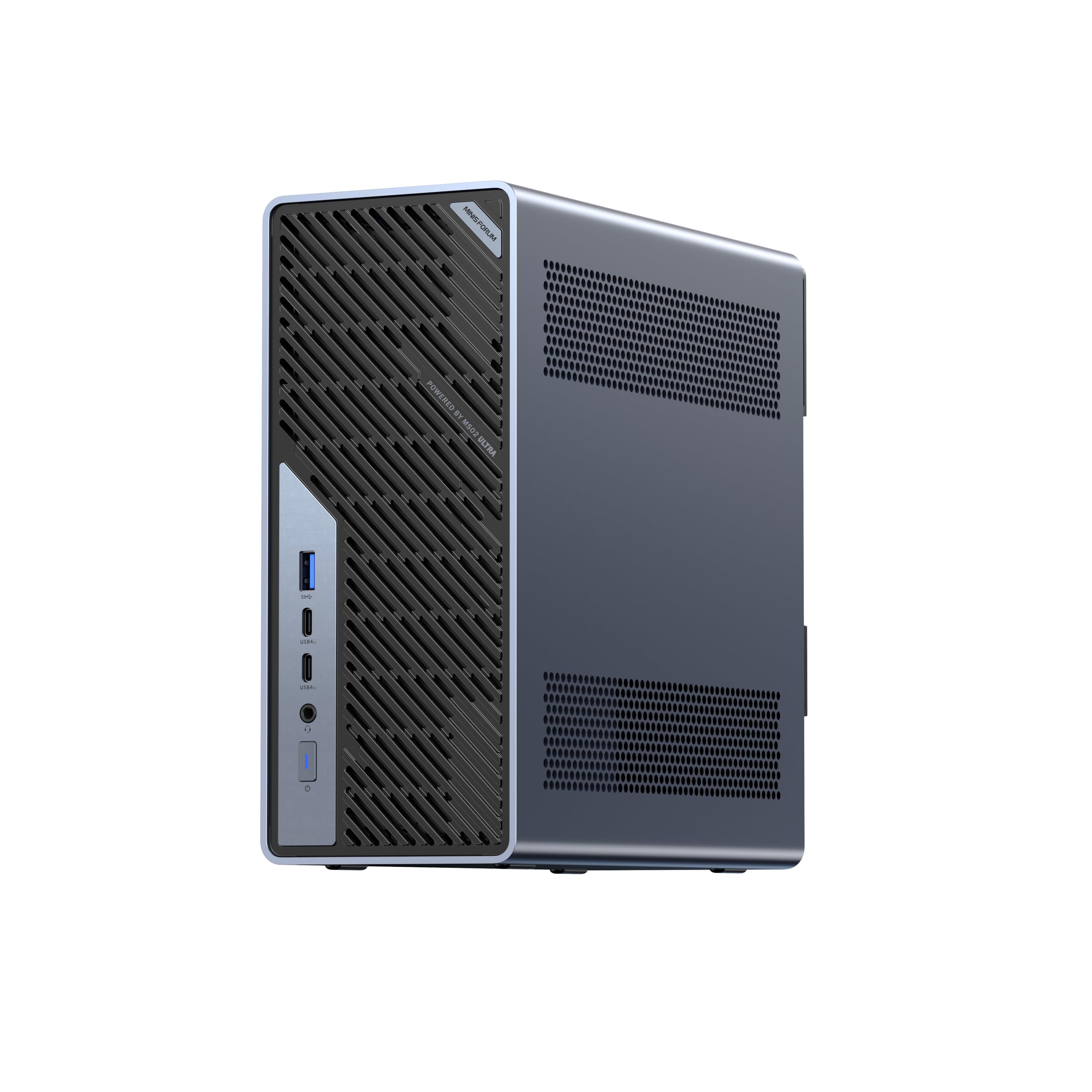
1. MINISFORUM MS-02 Ultra Workstation Core Ultra 9 285HX
Our pick — 4.0+★ from 80+ verified ratings; the strongest balance of quality and price.
Twenty-four cores at up to 5.5 GHz in a chassis that holds 36 dB under load.
The Intel Core Ultra 9 285HX inside this thing carries 24 cores and 24 threads and boosts up to 5.5 GHz, which is the kind of parallel horsepower that turns a batch render into a coffee break instead of an afternoon. That is 5.5 GHz against the 3.1 GHz ceiling of the dual-Xeon Dell further down this list — the MINISFORUM leads on clock speed while doing it in a chassis small enough to sit beside a monitor.
What makes it hold that speed is the thermal design, not the spec sheet. Six heat pipes and dual fans pull up to 140W of Turbo heat while sustaining a 100W TDP load, and the noise figure sits at just 36 dB — roughly the level of a quiet room, so you can record voiceover or take a call next to it without asking anyone to hold. An integrated 350W power supply feeds the whole thing, which is modest next to the 900W unit in the Lenovo ThinkStation P520 but matches what this hardware actually draws.
The networking is where this pick embarrasses full towers. Two 25G SFP+ ports each move data at 25 Gbps and support link aggregation (bonding two cables into one fatter pipe), so pulling a project off a network storage array is not the bottleneck of your day. Add one 10G and one 2.5G RJ45 port and you can keep the fast backbone and the ordinary office network on separate lines. Memory and storage expand generously too — four DDR5 SODIMM slots take you to 256GB with ECC support (error-correcting memory that catches small data faults), and four M.2 PCIe 4.0 slots handle RAID 0/1/5/10.
What wins people over is reliability in day-to-day use, with performance close behind, and the build feels denser and more substantial than its size suggests. The honest catch: the performance picture is mixed rather than universal — some configurations reportedly fail to boot as shipped. The maker’s own guidance points at why: if you add memory yourself, modules must go in the CPU-side slots first or the system will not start. Buy it with RAM pre-configured and you skip the slot-order trap entirely.
Where this box pulls ahead
- 24 cores at up to 5.5 GHz with a 100W sustained TDP
- Runs at 36 dB — quiet enough for a shared room
- Dual 25G SFP+ plus 10G and 2.5G RJ45 network ports
- Four DDR5 slots up to 256GB with ECC support
Before you hit buy
- Memory installation order matters or it will not boot
- Performance feedback is mixed across configurations
Reach for this if: you want maximum cores and fast networking in a chassis you never hear.
Think twice if: you plan to fit your own RAM sticks rather than taking it pre-configured.
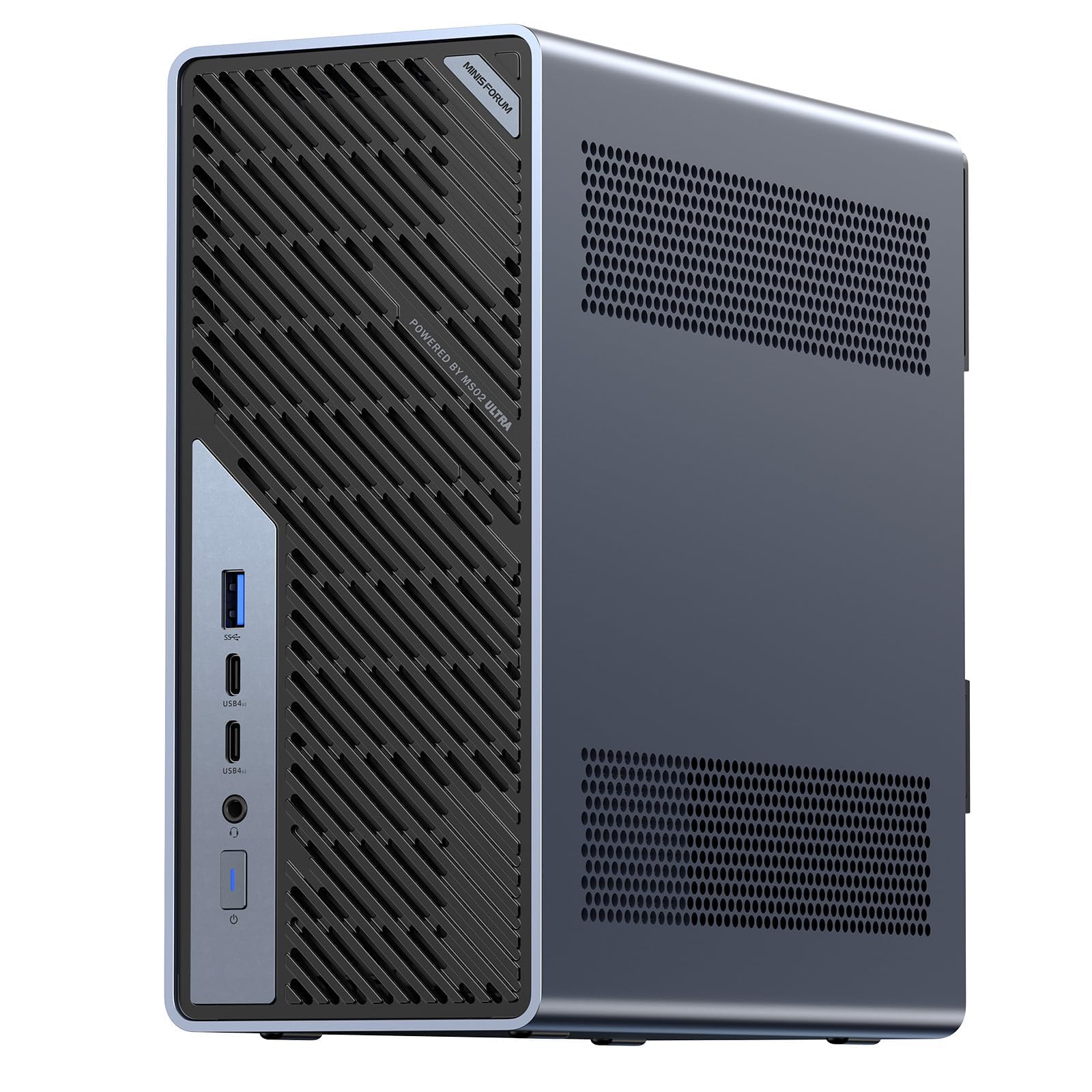
2. MINISFORUM MS-02 Ultra Workstation Mini PC (PCIe 5.0 x16)
Same 24-core silicon as the Best Overall pick, plus a full-length PCIe 5.0 x16 slot for a discrete GPU.
Here is the configuration question that decides between the two MS-02 listings: this version carries a full-length PCIe 5.0 x16 slot, the long expansion socket where a desktop-class GPU can live. If your work grows toward model training or GPU-accelerated rendering, that slot is the difference between upgrading a box and replacing it.
The core hardware is the same story as the Best Overall pick — Intel Core Ultra 9 285HX with 24 cores and 24 threads up to 5.5 GHz, plus a 13 TOPS NPU (a small dedicated AI chip rated at 13 trillion operations per second) for inference and media tasks. Four DDR5 SODIMM slots go to 256GB with ECC, and four PCIe 4.0 M.2 slots reach up to 24TB with RAID 0/1/5/10. Its 36 MB cache is one of the larger pools in this roundup.
Ports are the quiet hero here — the 10GbE and 2.5GbE network connections earn steady praise, and the four DDR5 slots get called out by people who actually open the case. Reliability and performance both sit at the top of what owners talk about, and the machine reportedly boots in under two minutes from cold. Installation is the split opinion: adding hardware is straightforward, while a Windows Server 2025 install gave at least one buyer trouble. Compactness and cooling both read as mixed rather than ecstatic.
Compared with a full tower of similar core count, this fits where a tower will not — 8.94 x 8.66 x 3.7 inches, small enough to sit beside a display or tuck under a riser. The trade-off to plan around is configuration, not horsepower: memory fit follows the same strict slot-order rule as its sibling, so buy it assembled unless you enjoy troubleshooting a machine that refuses to POST.
The expandability argument: a PCIe 5.0 x16 slot plus 256GB RAM headroom means this box can grow with your workload instead of capping it.
The honest limit: it is a mini PC, so cooling and compactness draw mixed reactions rather than universal praise.
Best match for: AI and rendering work that will eventually want a discrete GPU bolted in.
Less ideal for: anyone who wants to install server operating systems without a fuss.
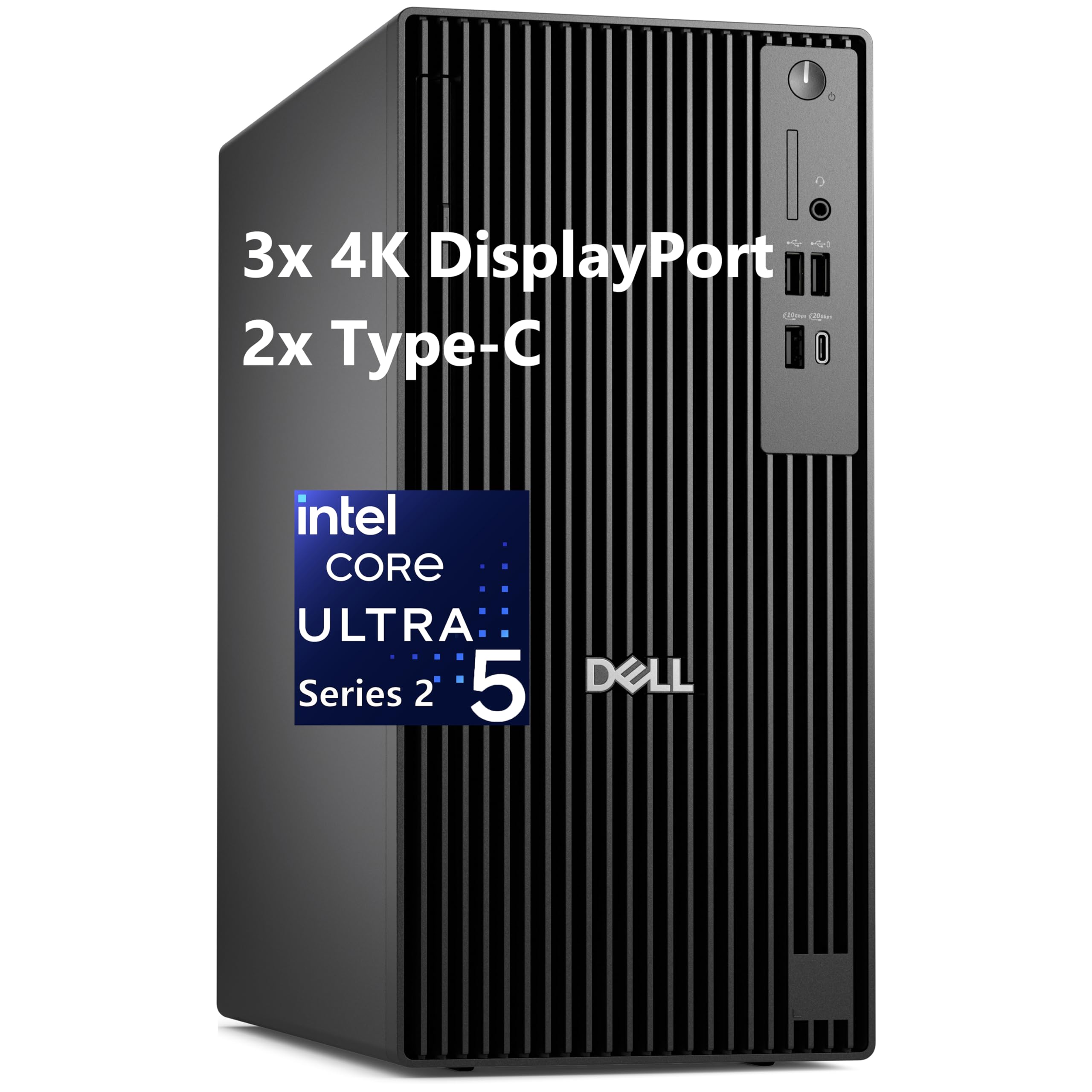
3. Dell Pro Tower Plus Business Desktop
A brand-new Core Ultra 5 tower for office multitasking and triple 4K displays, not rendering.
Most buyers searching for a workstation are really buying a fast, stable office computer that will not be obsolete in a year. This Dell fits that brief cleanly: an Intel Core Ultra 5 235 with a 13 TOPS NPU handles AI-assisted features in Adobe, Zoom, and Office, and 16GB of DDR5 RAM keeps ordinary multitasking smooth. Its 24 MB cache is smaller than the MINISFORUM chips, but so is the job it is asked to do.
Two things make it genuinely useful as a work machine. First, it drives three 4K displays at once, which is a real productivity upgrade if you keep code, reference, and output side by side. Second, it ships with Windows 11 Pro already installed alongside a DVDRW drive, so it is productive the moment you plug it in. Gigabit Ethernet keeps video calls and cloud access steady, though note that this system does not include built-in Wi-Fi — plan a wired drop or a USB adapter.
Storage is a single 1TB SSD versus the 4TB inside the i7-14700 tower, but it is enough for documents, code, and a moderate media library. The 16GB DDR5 is the smallest pool in this roundup, so this is not the box for VMs or large local models. Owners describe it as flawless in daily use and strong value, and the performance focus shows up most in exactly that — steady, unremarkable, dependable.
Why it earns a slot: brand-new hardware, a preinstalled Pro OS, and triple 4K output cover the actual weekday needs of most buyers.
What it will not do: 16GB of RAM caps serious virtual-machine or rendering work before it starts.
Pick this one when: you want a fresh machine with no refurbishment questions and a three-monitor desk setup.
Look past it when: your projects routinely need more than 16GB of memory.
4. Lenovo ThinkStation P520 Workstation (Renewed)

Four DisplayPort outputs off a Quadro M2000 and a 900W Platinum supply — built to drive four monitors at once.
If your workstation drives a trading desk, a CAD station, or an editing bay, screen count is the spec that matters first. The Quadro M2000 here carries 4GB of graphics memory across four DisplayPort outputs — against the 1GB in the T7810 below — so you can run four monitors at once without adding a second card.
Under the hood sits an Intel Xeon W-2123, a 4-core chip running at 3.60GHz, paired with 128GB of DDR4 in this configuration. That memory figure is the headline: 128GB against the 16GB in the Dell Pro Tower Plus, and it is what lets simulation and large assemblies stay resident in memory instead of hitting the disk. Storage is a 512GB NVMe PCIe M.2 SSD, with two 3.5-inch bays free for more drives later.
That headroom dwarfs the 350W in the MINISFORUM mini workstations and is what makes a heavy add-in card an option rather than a gamble. Windows 11 Pro is preinstalled, and the front panel gives you four USB 3.1 ports plus another four around the back alongside dual 1GB Ethernet.
The caveat is plain and it is not a defect: this is a renewed unit, and no keyboard or mouse is included, so budget for both. Its 4-core Xeon also lags the 24-thread MINISFORUM on parallel batch work — this machine’s strength is memory capacity and display outputs, not raw thread count.
Fits best in: a studio or office with four screens and memory-hungry assemblies.
Worth knowing: keyboard and mouse are not in the box, so plan those in.
5. Dell Precision T7810 Workstation, Dual Xeon E5-2670 v3

Two twelve-core Xeons and 128GB of DDR4 — 24 physical cores for the lowest outlay here.
A pair of Intel Xeon E5-2670 v3 chips, each with 12 cores at 2.3GHz and a 3.1GHz turbo ceiling, gives you 24 physical cores in a single tower. That is the mirror image of the MINISFORUM’s 24 cores at 5.5 GHz — the Dell trades clock speed for Xeon memory channels and a 685W supply, and it wins on sheer parallel capacity per purchase tier.
The 128GB of DDR4 is confirmed in real hands — buyers report the full capacity actually shows up in the system, which is worth stating because refurbished machines sometimes ship short. Its 1GB Quadro NVS 315 graphics card is the weak link for anything visual; the four-display Quadro M2000 in the P520 above carries 4GB. Budget for a GPU swap if rendering is your job.
Performance is overwhelmingly what people talk about with this machine, with value for money a clear second — you are getting dual-socket server silicon at desktop prices, and it shows. The known snag is connectivity: the NVS 315 outputs through DMS-59, a compact connector that needs an adapter cable before it will talk to a normal HDMI or DisplayPort monitor. The machine also ships with no operating system, so you supply and install that yourself.
For batch jobs that run all night — video encoding, simulation sweeps, compilation farms — this is the most threads you will get for a modest outlay. Just go in knowing it is a project box, not a plug-and-play machine.
Why builders like it
- 24 physical cores across two Xeon processors
- 128GB DDR4, full capacity confirmed on delivery
- 685W power supply with room for upgrades
- Server-class cost-efficiency for parallel workloads
Setup reality check
- No operating system included — you install it
- DMS-59 video output needs an adapter cable
Go for it if: your work is batch processing and you can handle a setup session.
Leave it if: you need a machine to boot straight to a desktop with a standard monitor cable.
6. Dell Precision Tower 5820 Workstation (Renewed)
A 4-core Xeon tower with Windows 11 Pro preinstalled and standard DisplayPort and HDMI outputs.
The entry point into genuine workstation hardware is usually a question of hassle, and this Precision Tower answers it: Intel Xeon W-2123 at 4 cores and 3.6GHz, 64GB of RAM, a 1TB NVMe SSD, and Windows 11 Pro already installed. It is a refurbished unit from a Microsoft Authorized Refurbisher, so it arrives ready to boot rather than as a bare box.
Where the 5820 wins is daily reality. It has a preinstalled OS, working WiFi and Bluetooth, standard DisplayPort and HDMI outputs, and a 1TB NVMe boot drive big enough for the OS, applications, and a working project library.
Owners describe it as doing exactly what it says and performing well — one comparison drawn is that it runs like a server rather than a desktop. That tracks with the Xeon platform: it prioritizes stability over peak speed. Sixty-four gigabytes of RAM is also a comfortable working figure for photo libraries and multi-tab research, though well short of the 128GB in the ThinkStation P520 a couple of spots up.
The 3.6GHz ceiling will feel slow next to a modern high-clock chip on single-threaded tasks like opening large documents. Treat it as a dependable workhorse for office, photo, and light development rather than a rendering engine.
The case for it: preinstalled Windows, working wireless, and standard video ports turn a refurb into a five-minute setup.
The trade: 4 cores at 3.6GHz cannot match a modern 20-core chip on heavy parallel work.
Pick it up if: you want a workstation platform with zero assembly friction.
Pass on it if: your software scales with core count.
7. HP Z240 Tower Workstation, 32GB RAM, 1TB SSD + 2TB HDD

Two drives, one for speed and one for bulk — a media librarian’s setup.
Some buyers need a place to put things more than they need raw compute. This HP splits storage into a 1TB NVMe SSD for the operating system and applications plus a 2TB HDD for archives, footage, and project backups — three terabytes total across two drives.
The Intel Core i7-6700 runs up to 4 GHz with 32GB of DDR4 alongside it, and the NVIDIA GT 1030 with 2GB of graphics memory handles display output without trying to be a rendering card. Built-in WiFi 6E (the newer 6 GHz wireless band, which is less crowded in busy buildings) makes this one of the few tower picks here with fast wireless from the start.
Quality is what buyers are pleased with. Reliability is the split note, and it is the more-discussed topic of the two — so treat this as a machine to buy with a clear return window rather than blind trust. It is a refurbished unit, and it ships with a wireless keyboard and mouse plus a mouse pad, so there is nothing else to buy.
Where it loses ground: a 2015-era i7-6700 and a GT 1030 will not render modern 3D scenes or run sizeable local models. This is a document-and-media workstation, not a compute one.
Right for you if: storage volume and fast wireless matter more than core count.
Wrong for you if: you render, simulate, or train models on the machine itself.
8. Dell Desktop Computer
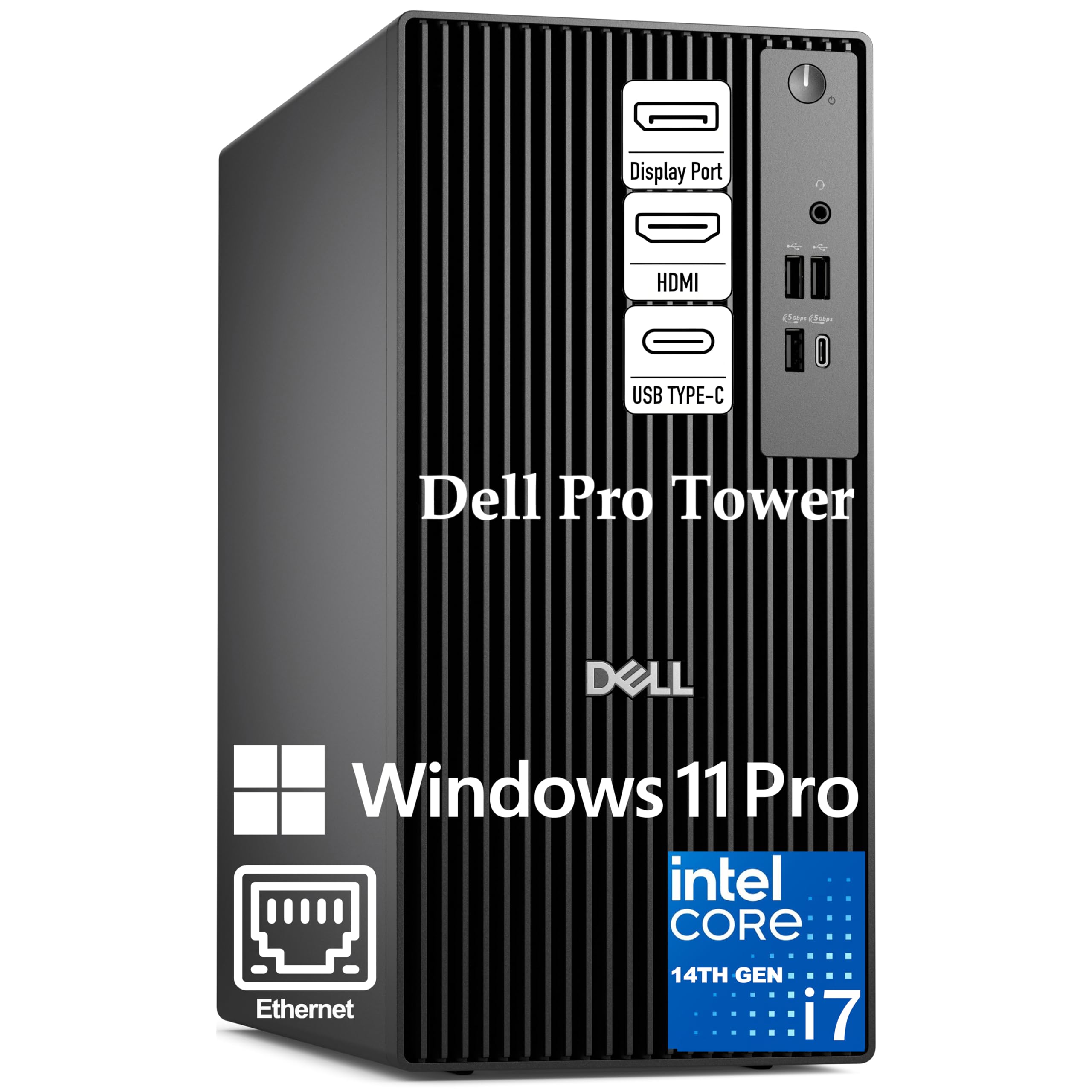
Twenty cores, twenty-eight threads, four terabytes — enough to run your VMs and keep them there.
A modern Intel Core i7-14700 with 20 cores and 28 threads and a 33MB cache is the shape of chip that eats software development workloads without complaint. Running several IDEs, Docker containers, and virtual machines at once is a memory and thread problem, and this machine has both answered: 64GB of DDR5 RAM and a 4TB PCIe SSD.
Compare that with the Xeon towers further up the list: the i7-14700 has 20 cores against the ThinkStation’s 4, and its 4TB SSD sits against the 480GB drive in the T7810 or the 1TB boot drive in the Precision 5820. For codebases, datasets, and container images, that is a lot of room to work before you ever clean a drive.
Windows 11 Pro comes preinstalled with BitLocker encryption and remote desktop, which matters if you handle client data or log in from elsewhere. Dual 4K monitor support covers a two-screen desk, and USB-C connectivity plus a broad port selection means docks, webcams, and peripherals connect without hunting for adapters. Be aware it does not include built-in Wi-Fi, so a wired connection or a USB adapter is required.
This is the strongest choice for professional software work among the tower-style picks, and its 28 threads beat the 24-thread Core Ultra 9 while sitting in a chassis that has more room to cool. The limit is graphics: Intel UHD Graphics 770 is integrated only, so gaming and GPU rendering are out of scope without adding a card.
What sells it
- 20 cores and 28 threads for parallel dev workloads
- 64GB DDR5 plus a 4TB PCIe SSD
- Windows 11 Pro with BitLocker and remote desktop
- Dual 4K display support and USB-C
Where it stops
- No built-in Wi-Fi — wired or adapter needed
- Integrated graphics only, no dedicated GPU
Choose this if: your day is containers, VMs, and a big codebase.
Skip past it if: you need discrete graphics for rendering or play.
9. BOSGAME M5 AI PC MAX+ 395, 128GB LPDDR5x

Up to 96GB of that memory can become video memory — the number that matters for big models.
On the AMD Ryzen AI Max+ 395 platform, the difference here is memory: this unit carries 128GB of LPDDR5X against the 64GB in the MINISFORUM MS-S1 MAX. Through AMD’s Variable Graphics Memory technology, up to 96GB of that shared pool can be assigned as dedicated video memory, which is what lets it run 4-bit quantized models up to 128 billion parameters without a professional studio GPU.
In practical terms, that turns a desktop into a machine that runs models locally that would otherwise need cloud access. The 16-core, 32-thread processor runs up to 5.1GHz with an 80MB cache, and the maker rates it at over 40 tokens per second on 128B models like GPT-OSS-120B and 15 tokens per second on 235B MoE models. Audio is handled quietly: a copper vapor chamber and a large fan keep it under 25 dB during office tasks and under 38 dB under a full 240W workload.
The port selection suits media work directly — dual USB4 ports at 40Gbps each carry data, video, and power, while a front SD 4.0 slot supports SDXC cards up to 300MB/s so photographers and videographers can offload without a hub. Wi-Fi 7 and Bluetooth 5.4 cover wireless, and a 2.5G Realtek Ethernet port handles wired transfers from a NAS.
Performance is what buyers focus on here, with value and compact size following — three displays running off one small box is a common observation. The memory split is the honest wrinkle: the shared pool enables huge model loads, yet customers note it is not ideal for the very largest models, so check your target size before committing.
Made for: running large local AI models and offloading camera cards on one machine.
Look elsewhere if: your model sizes push past what a 128GB shared pool supports.
10. GEEKOM A9 Mega AI Workstation PC, Ryzen AI Max+ 395

Built to run AI work offline, with the data never leaving the desk.
Where the BOSGAME chases raw token throughput, the A9 Mega leans toward privacy and quiet reliability. The AMD Ryzen AI Max+ 395 pairs a 16-core, 32-thread CPU with a Radeon 8060S GPU and a 126 TOPS AI configuration, backed by 128GB of LPDDR5X at 8000 MT/s. Up to 96GB of that shared memory can go to the GPU under supported settings.
The pitch is local control: build private knowledge bases, generate images with Stable Diffusion, and automate tasks on-device. After setup and model downloads, supported workflows run without cloud fees or uploading sensitive data, which matters for developers, creative studios, and anyone handling client material. Storage is a 2TB PCIe Gen4 NVMe SSD, with dual M.2 slots supporting up to 8TB total (4TB per slot).
Cooling is handled by IceBlast 5.0 — a full-coverage vapor chamber under dual turbo fans — to support up to 120W sustained power with a stated 140W maximum dissipation. Connectivity covers dual 2.5GbE LAN for NAS and office networks, plus four displays up to 8K through dual 40Gbps USB4 and dual HDMI 2.1 ports. Wi-Fi 7 rounds out the wireless side.
Reliability shows up as the second-most-discussed strength, right behind performance — this is a machine people leave running for long jobs. It carries a 3-year limited warranty and compliance with CE, FCC, CB, and RoHS. The practical limit is that 128GB of memory supports models up to 128B parameters in 4-bit form; beyond that, you are back to a data centre. Note also that it runs a full-size desktop AI workload in a small chassis, so plan for real ventilation around it.
Best of both: 128GB unified memory plus a 2TB PCIe Gen4 drive keeps full AI projects resident with room to spare.
Consider carefully: quad 8K display support and dual 2.5GbE add up to a lot of cable management on a small desk.
Belongs on your desk if: you need offline AI work and long-run stability with warranty cover.
Better to skip if: your models exceed 128B parameters in 4-bit form.
Know the Specs
Core and thread count
Cores and threads are the workers inside the processor, and more of them means a batch job splits into more parallel pieces. A 24-core chip like the Core Ultra 9 285HX finishes a long render in far less wall-clock time than a 4-core Xeon, but only if the cooler keeps up.
Memory capacity and ECC
RAM is your project ceiling. Virtual machines, large datasets, and local AI models each claim a big block before anything else runs, and 128GB leaves far more headroom than 16GB.ECC memory (error-correcting memory that catches small data faults) protects an overnight calculation from a silent error.
Thermal design and sustained power
A TDP (thermal design power) figure tells you the heat load the cooler must handle continuously, not in a short burst. The MS-02 Ultra sustains a 100W TDP load and pulls 140W in Turbo, which is why a small chassis can hold speed for hours instead of throttling.
Expansion slots and PCIe generations
A PCIe x16 slot is the long socket where a graphics card or accelerator lives, and a PCIe 5.0 version carries more bandwidth than PCIe 4.0. Buying a box with a free slot means you can add a desktop-class GPU later instead of replacing the whole machine.
Network port speed
25G SFP+ ports move data at 25 Gbps each, while a 10G RJ45 port moves 10 Gbps over a standard cable. If your projects live on a network storage array, port speed decides whether loading a scene takes seconds or minutes.
Unified memory for local AI
Unified memory means the processor and graphics unit draw from one shared pool instead of separate banks. That removes the copy step between system and video memory, so large models load and keep running without a bottleneck.
Common Questions
Is a mini PC workstation actually as powerful as a full tower workstation?
What does renewed or refurbished mean on a workstation desktop?
How much RAM do I need for virtual machines and containers?
Can I run large AI models locally on a workstation desktop?
Do I need ECC memory in a workstation?
Will a renewed workstation work with my existing monitor and cables?
Is a Xeon processor better than a Core i7 for workstation work?
How loud does a workstation desktop run under a long load?
Can I add a graphics card to a small workstation later?
Does a workstation desktop include Wi-Fi and an operating system?
The Bottom Line
For most buyers, the workstation desktop computer worth owning is the MINISFORUM MS-02 Ultra — 24 cores at up to 5.5 GHz, dual 25G SFP+ networking, four DDR5 slots with ECC support, and a 36 dB noise floor that lets it live in the same room as you. It is the pick that balances raw parallel power with expandability and quiet operation.
If your work is software development at scale, the Dell 20-Core i7-14700 brings 28 threads, 64GB of DDR5, and a 4TB SSD to a tower that cools without strain. And if local AI models are the point, the BOSGAME M5 turns 128GB of unified memory into up to 96GB of video memory for large model loads on a desk. Budget-focused buyers who want server-class threading for less should look at the Dell Precision T7810 — just factor in an operating system and a video adapter cable.
How we choose
We do not accept paid placement. Every pick is matched to a real buyer and a real use-case; we do not hands-on test units.
Sources
Specifications: manufacturer listings and product documentation. Review insights: verified customer reviews, as of November 2026. Pricing: not shown on this page (it changes often); check the current price via the retailer link.
As an Amazon Associate, Tactical Gear Guy earns from qualifying purchases. This does not affect which products we feature.