Specs are compiled from manufacturer listings and verified buyer reviews and can change over time — please confirm the key details on the product page before buying.
The hardest part of buying a workout watch for a man is not finding one that counts steps — it is finding one that survives your training without dying on the charger or lying about your heart rate. This list covers eleven watches that actually track heart rate and GPS, sorted by what each one is genuinely good at, so you can pick the one that fits your wrist and your sport instead of the one with the loudest advertising.
This guide is built by comparing the manufacturers’ published specifications and the patterns across verified customer reviews, so you get each pick’s real strengths and trade-offs instead of marketing spin.
You will see how battery claims hold up in GPS mode, which screens stay readable in direct sun, and where the rugged versus ultralight trade-off actually bites. Here are the workout watches for men that hold their own when the training gets serious.
Top Picks
How To Choose The Best Workout Watches for Men
Start with the number that decides whether the watch survives your week: GPS battery hours, not smartwatch-mode days. A watch that runs for 20 days between charges may still give you only a handful of hours when the GPS chip is burning power on a long run. Check both figures before you fall for a big day-count on the box.
GPS Hours Versus Smartwatch Days
The day figure describes light use — notifications, step counting, the odd workout. The GPS figure is the one that matters when you are navigating a trail course. One watch here is rated at up to 41 hours of continuous GPS use and another at up to 12 hours in GPS performance mode. Read both lines on the spec sheet.
Screen Type And Sunlight
An AMOLED display (a bright, saturated panel like a phone screen) looks superb indoors and eats battery. A MIP display (memory-in-pixel, a low-power LCD that reflects sunlight) looks dimmer in a shop but stays readable in full sun and sips power. If you train outdoors all day, the MIP route stretches battery. If you want wrist notifications that pop, AMOLED wins.
Build And Water Rating
For trail running and gym work, a fiber-reinforced polymer or aluminum case keeps weight down. For climbing and water sports, you want a titanium or steel case and a higher water rating. A 10 ATM rating (withstands pressure equivalent to 100 meters of depth) covers swimming and showers; 100m water resistance does the same job in different wording. Match the case material to what you actually put the watch through.
Side-by-Side Comparison
| Model | Best For | Battery (Daily Use) | GPS / Activity Battery | Case Material | Amazon |
|---|---|---|---|---|---|
| Garmin Forerunner 570, 47mm★ Best Overall | Serious runners tracking recovery | 11 days | 18 hours in GPS mode | Aluminum | Amazon |
| Google Fitbit Inspire 3Everyday Value | Everyday movement and sleep | 10 days | — | Resin | Amazon |
| Amazfit Bip MaxBig Screen Pick | Big screen, long battery | 20 days | — | Aluminum alloy | Amazon |
| CARBINOX Blaze | Rugged daily wear plus calls | 15 days | — | Alloy steel | Amazon |
| Mibro AeroPace | Coached run training on a budget | 8 days | Up to 12 hours GPS mode | Glass fiber reinforced nylon | Amazon |
| COROS PACE 4 | Ultralight racing and all-day wear | 19 days | 41 hours continuous GPS | Silicon | Amazon |
| Garmin Instinct 3 Solar, 45mm | Off-grid and rough terrain | 28 days | Unlimited with solar in 50,000 lux | Fiber-reinforced polymer | Amazon |
| Casio G-Shock Move DW-H5600 | Gym work with a classic look | About 1 week per charge | — | — | Amazon |
| COROS APEX 4, 46mm | Alpine and trail endurance | — | 65 hours all-systems GPS | Titanium | Amazon |
| Samsung Galaxy Watch Ultra, 47mm | Android users wanting a smart watch | — | — | Titanium | Amazon |
| Apple Watch Ultra 4, 49mm | iPhone users doing long distance | — | 45 hours extended workout | Titanium | Amazon |
Detailed Reviews
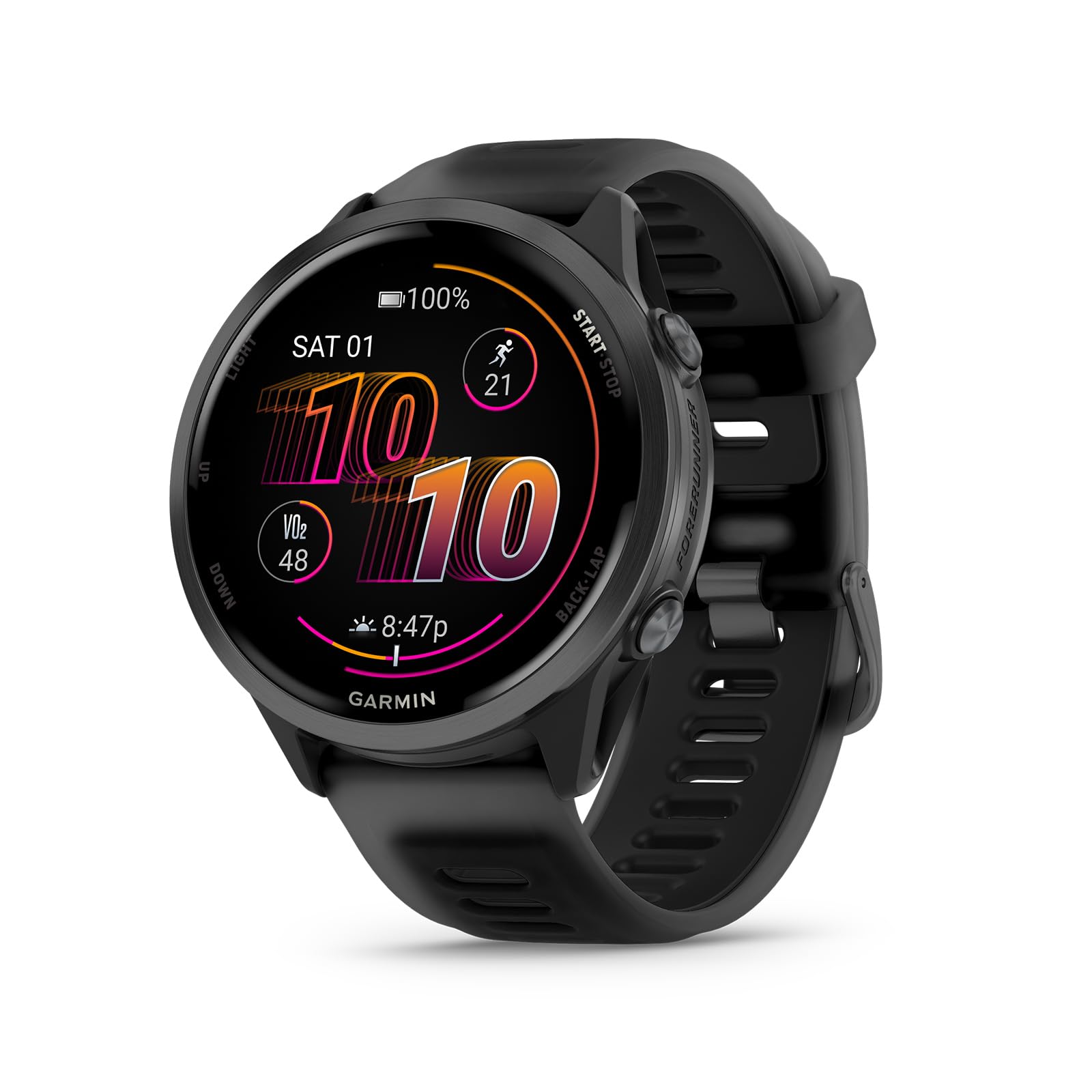
1. Garmin Forerunner® 570, 47mm, Aluminum, Black
Our pick — 4.5+★ from 600+ verified ratings; the strongest balance of quality and price.
The running partner that tells you when to back off, not just how far you went.
A training watch only earns its place on your wrist if it tells you something your own body hasn’t already told you. The Forerunner 570 does that with a training readiness score, which blends your sleep quality, recovery, training load and HRV status (heart rate variability — the small gaps between beats that show how recovered you are) into a simple read on whether you should go hard today. It pairs that readiness score with an 11-day smartwatch battery and up to 18 hours of continuous GPS use.
For a long weekend race, 18 hours of GPS is a comfortable buffer. For the rest of the week, the 11-day figure means you are charging about once a week, not every night. The aluminum bezel and 47mm case give it a sturdy feel without going full brick, and the button controls alongside the AMOLED (bright phone-style display) touchscreen mean you can still stop a lap with wet or muddy hands.
What doesn’t get quite as much love is the value equation — some people feel the price is a lot to swallow for a watch with no cellular connection. The built-in speaker and microphone do let you take calls from your wrist when paired to your phone, which softens that complaint. Buyers report the battery and setup side glow, with one noting it “only requires charging every 9 or 10 days.”
What Earns The Top Spot
- Training readiness score pulls in sleep, load and HRV so rest days are earned, not guessed
- 11-day smartwatch battery with 18 hours of GPS mode for long runs
- 30+ activity profiles including triathlon and open-water swimming
- Garmin Coach plans adapt to how you actually perform
What You Should Know
- No cellular connection — calls only work when paired to your phone
- Some owners feel the price sits high for a non-cellular fitness watch
The right wrist: Runners and triathletes who want to know when to push and when to rest, day after day.
Look past it if: You need a watch that works without a phone for calls and texts.
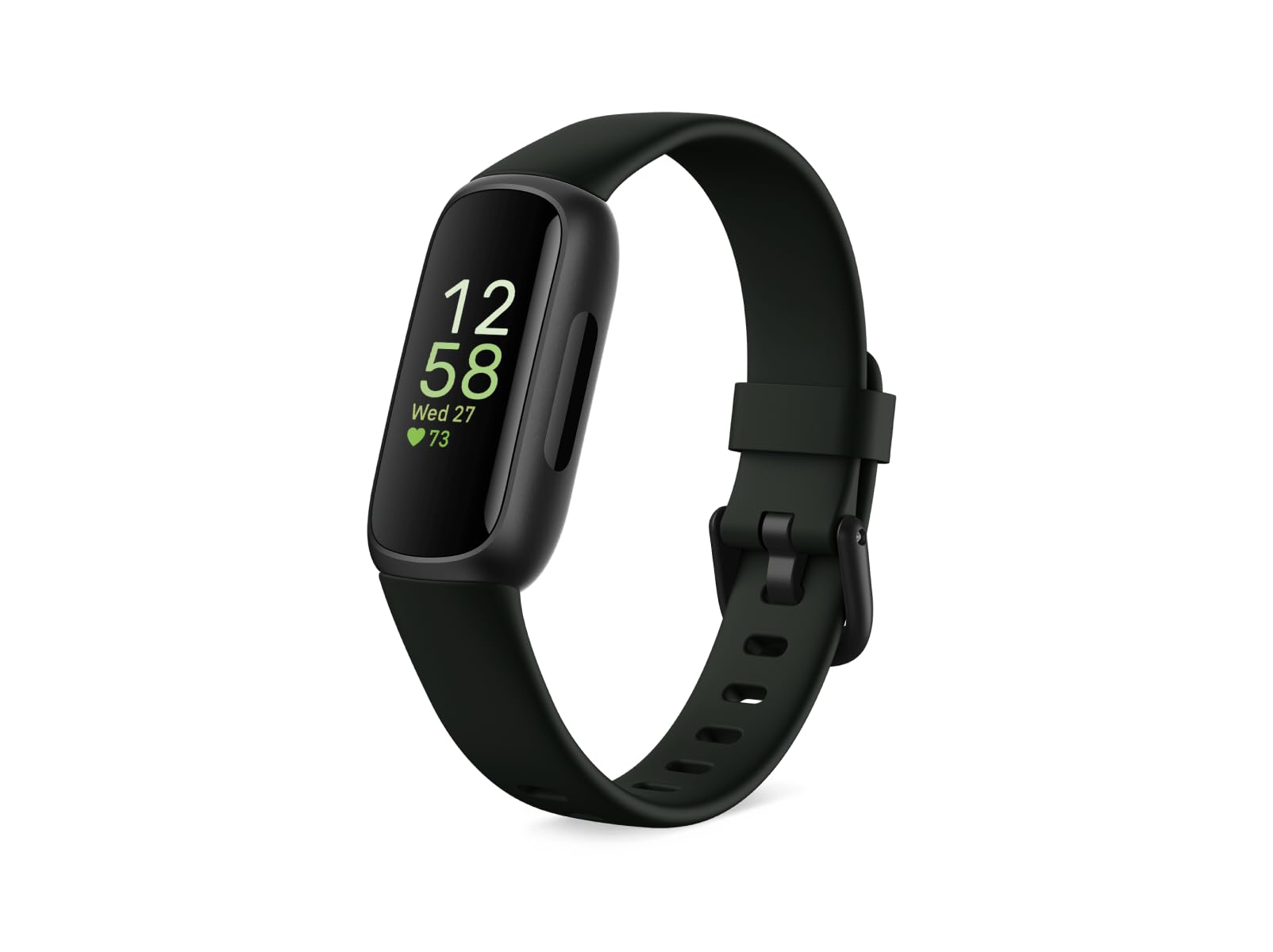
2. Google Fitbit Inspire 3 – Midnight Zen/Black
The light, slim tracker that keeps you moving without pretending to be a race machine.
Not every man training wants a chunky GPS watch dragging on his wrist. The Inspire 3 is the opposite approach: a slim silicone band that tracks 24/7 heart rate, steps and sleep, with 40+ exercise modes and automatic exercise tracking so you don’t have to remember to start a session. It runs on a 10-day battery and charges in about 2 hours, and it covers Apple iOS 16.4 and Android 11.0 and higher.
Where it earns its keep is the everyday wellness layer — a Daily Readiness Score, a daily Stress Management Score, SpO2 (blood oxygen) readings and a daily Sleep Score with a vibrating wake alarm. For a man who lifts, walks and wants his health data in one place, that is a lot of coverage in a small band.
The honest caveat is longevity on the charging side. The mood around the battery is split — some find it generous, while others report the unit stops charging after a couple of months. That is worth weighing if you want a decade-long device. For most men starting a fitness habit, it does the job quietly.
Where it shines: A 10-day battery with 24/7 heart rate and automatic exercise tracking, in a band you forget you’re wearing.
Read the fine print: The charging story is mixed over the long run, so keep the warranty handy.
Reach for it if: You want step, sleep and stress data without a heavy training watch on your wrist.
skip it if: You rely on GPS route tracking — this watch is built for daily movement, not trail navigation.
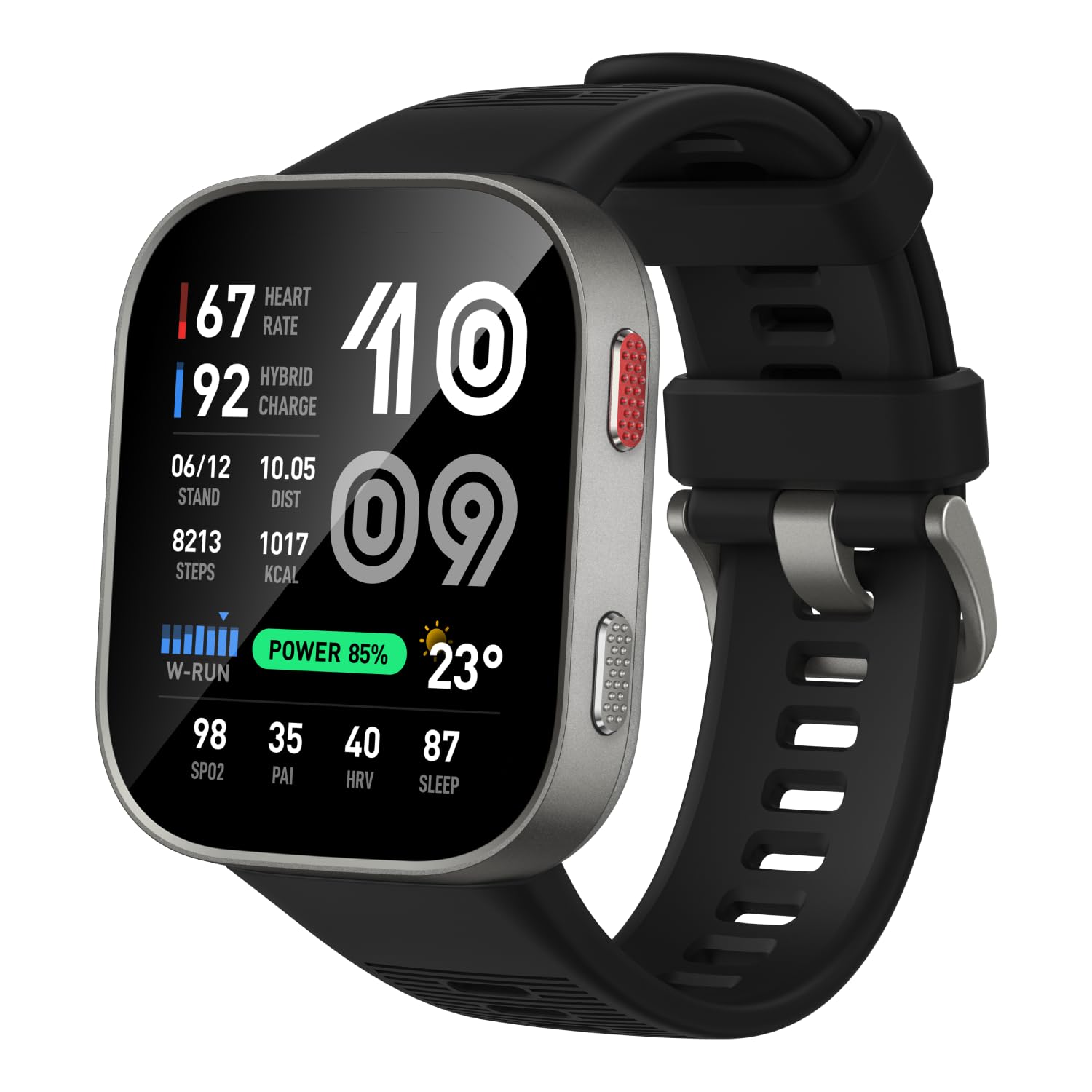
3. Amazfit Bip Max Smart Watch, 2.07″ AMOLED Display
A tablet-sized screen on a training watch, with a battery that skips nightly charging.
The Bip Max leads with its 2.07-inch AMOLED screen, and that size is the whole pitch — a display that stays readable mid-run without squinting. Its battery is rated at up to 20 days, against 10 days for the Fitbit Inspire 3. A 4GB onboard storage bank means you can carry offline maps on your wrist, and GPS tracking backed by 5 satellite systems keeps your route locked in.
Training coverage is deep for the category. There are 150+ sports modes including HYROX and strength training, a Zepp Coach that adapts your routine, and BioCharge recovery monitoring that scores your energy from sleep, workouts and stress. The 22mm silicone band and aluminum alloy body keep it comfortable for daily wear.
The catch is the maps and media experience — downloading detailed maps and using the storage features works best with the Zepp App ecosystem, and the magnetic charging base is not a standard USB-C cable, so you need to keep track of it. If you want the biggest screen and the longest battery in the mid-range, this pairing is hard to argue with.
Big Reasons To Like It
- 20-day battery against 10 days for the Fitbit
- 2.07-inch AMOLED display stays easy to read on the move
- 4GB storage holds offline maps so you can leave the phone behind
- 150+ sports modes with Zepp Coach and BioCharge recovery scoring
The Trade-Off
- Charging uses a magnetic base, not a standard USB-C cable
- Big-screen appeal comes with a larger footprint on the wrist
Best match for: Men who want a huge, clear screen and a battery measured in weeks, not days.
Think twice if: You prefer a compact, unobtrusive watch for sleep tracking.
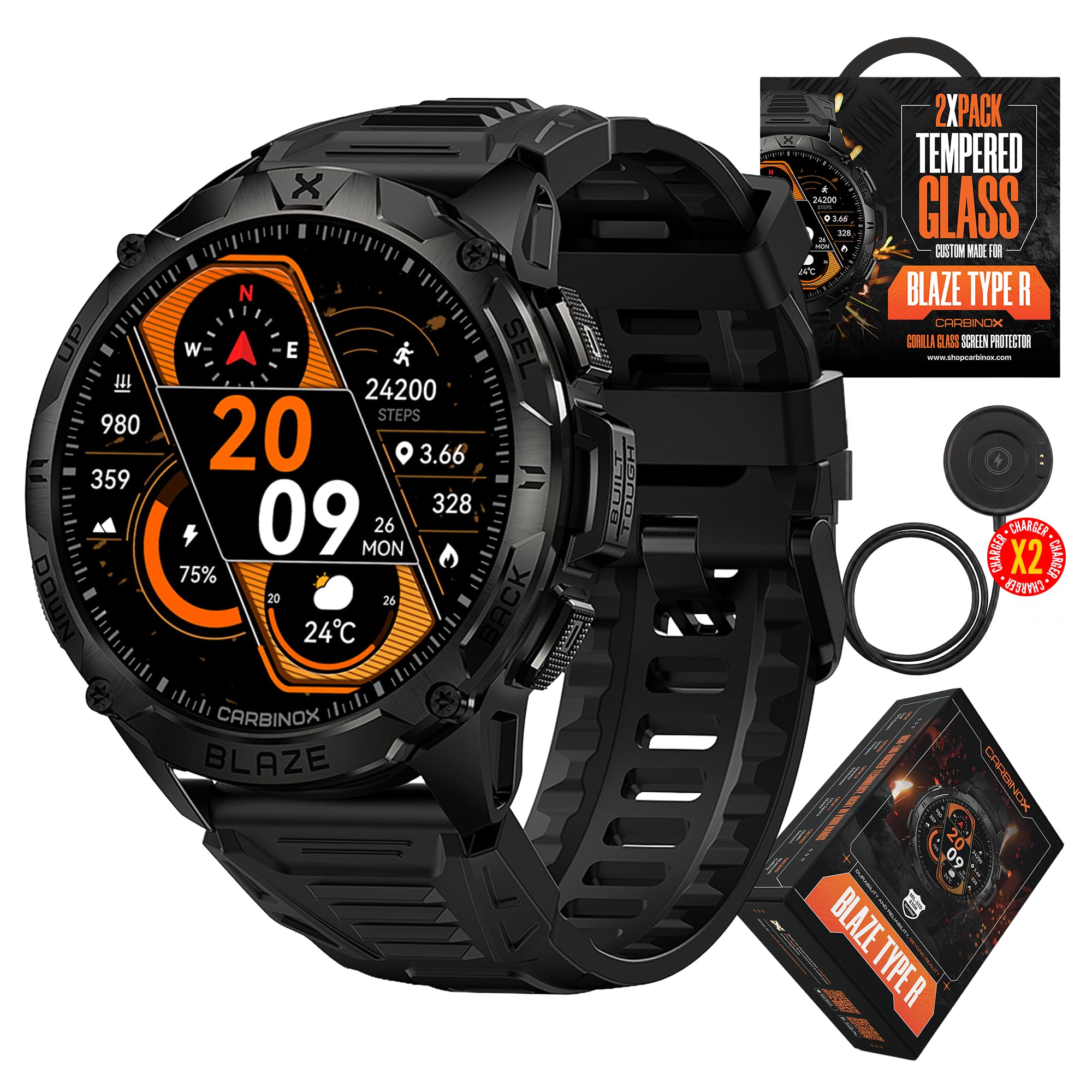
4. CARBINOX Blaze Rugged Smart Watch for Men
Built like a field tool — steel, Gorilla Glass and a battery that outlasts the competition.
Some men want a watch that looks like it belongs on a job site and can take a hit. The Blaze is that watch. It carries MIL-STD-810H testing (military-standard drop and shock testing) with an alloy steel case and Gorilla Glass display, plus IP69K sealing that handles water and mud. That is more capacity than the Forerunner 570 offers, in a case built for abuse.
Coverage runs to 170+ sports modes with continuous heart rate, SpO2 and stress tracking, and the dual GPS works across 7 outdoor modes with compass, altimeter and barometer sensors for trails. The AMOLED touchscreen sits under Gorilla Glass.
The reliability side is the one to weigh. The mood on this watch is split — a chunk of owners call it a “beast of a watch,” while others have hit units that quit early. For a workout watch you plan to take into mud and rain, treat the purchase as one to check over carefully on arrival.
Rugged appeal: Alloy steel, Gorilla Glass, IP69K sealing and 480 mAh of battery make it a genuinely tough package.
On reliability: The track record is mixed, so a careful unboxing and a warranty check are worth the effort.
Designed for: Men who want a steel-strong watch that takes calls and survives the elements.
Consider elsewhere if: You want a proven long-term reliability record above everything else.
5. Mibro AeroPace GPS Running Watch
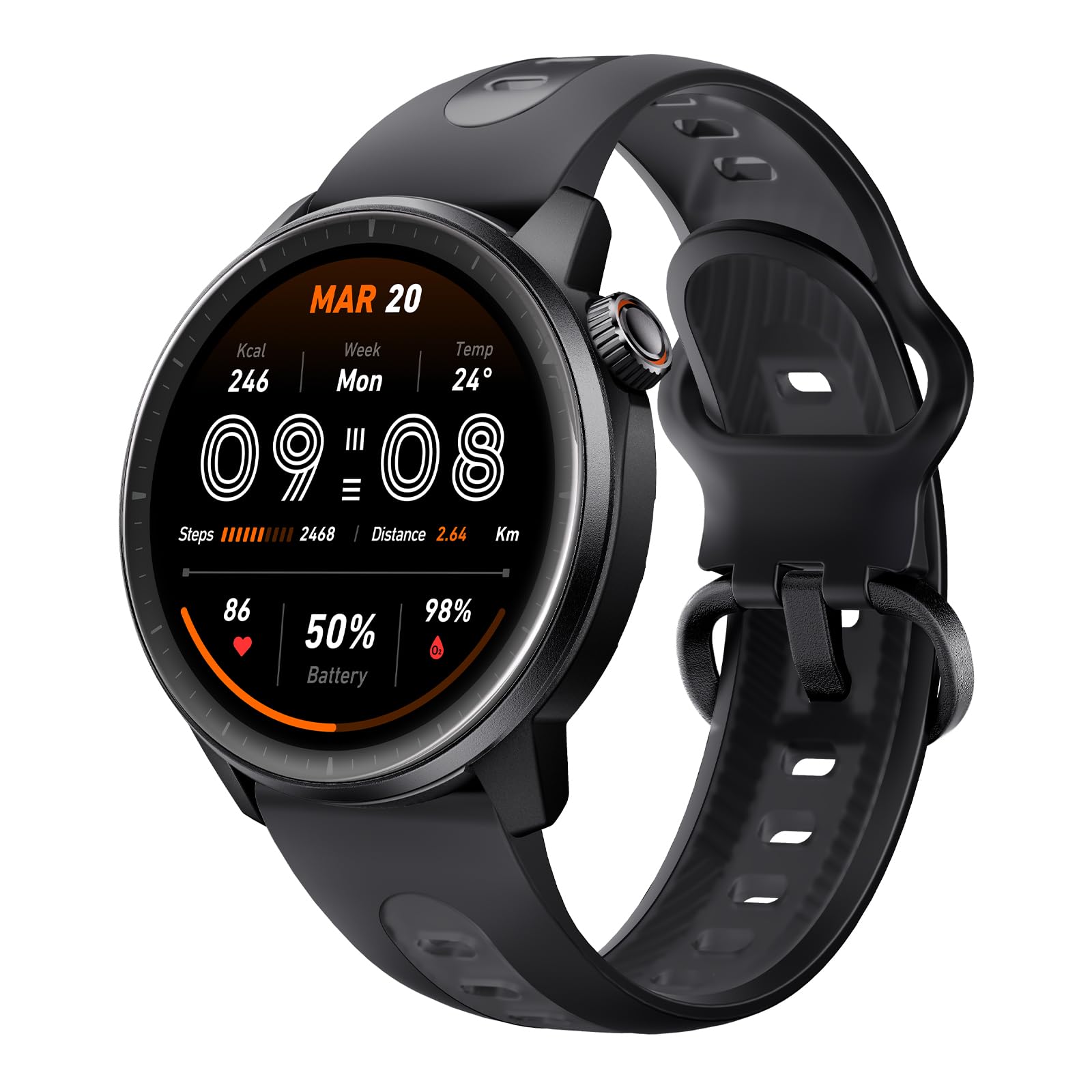
A running watch light enough to forget, with a coach that talks back.
At 32g with the woven strap and just 9.2mm thin, the AeroPace is the lightest option on this list, so it disappears on the wrist during a long run. It is a proper running watch underneath that weight, with dual-band, five-system GNSS (the satellite systems that pin your route) and free global vector maps that support offline route following, off-course alerts and return navigation without a phone.
The training toolkit is unusually deep for the price tier. Mibro Coach builds personalized 4-to-20-week plans and you can correct it as it learns your routines — though that feature carries a 30-day free trial and requires a subscription afterward. The 1.32-inch AMOLED screen pushes 2000-nit peak brightness (2,000 nits — bright enough for sunlight) with a 466×466 resolution and 60fps refresh for a crisp read.
Battery is the trade you make for that lightness. A single charge gives up to 8 days of daily use, but GPS Performance Mode lasts up to 12 hours — that is a long run, not a multi-day expedition. The 230 mAh battery is the smallest here. If you train in short, hard bursts rather than all-day adventures, the low weight is worth it.
Why Runners Will Notice It
- 32g weight with the woven strap keeps it invisible on the wrist
- Dual-band five-system GNSS with offline maps and return navigation
- 2000-nit AMOLED display with 466×466 resolution for bright days
- Personalized 4-to-20-week plans with a coach you can correct
What Limits It
- 12 hours of GPS performance mode is modest for ultra-distance
- Coach features need a subscription after the 30-day trial
Built for: Runners who want a light, bright, map-capable watch and short GPS sessions.
Better choices if: You need a GPS watch to last through a multi-day event.
6. COROS PACE 4 Ultralight Sport GPS Watch
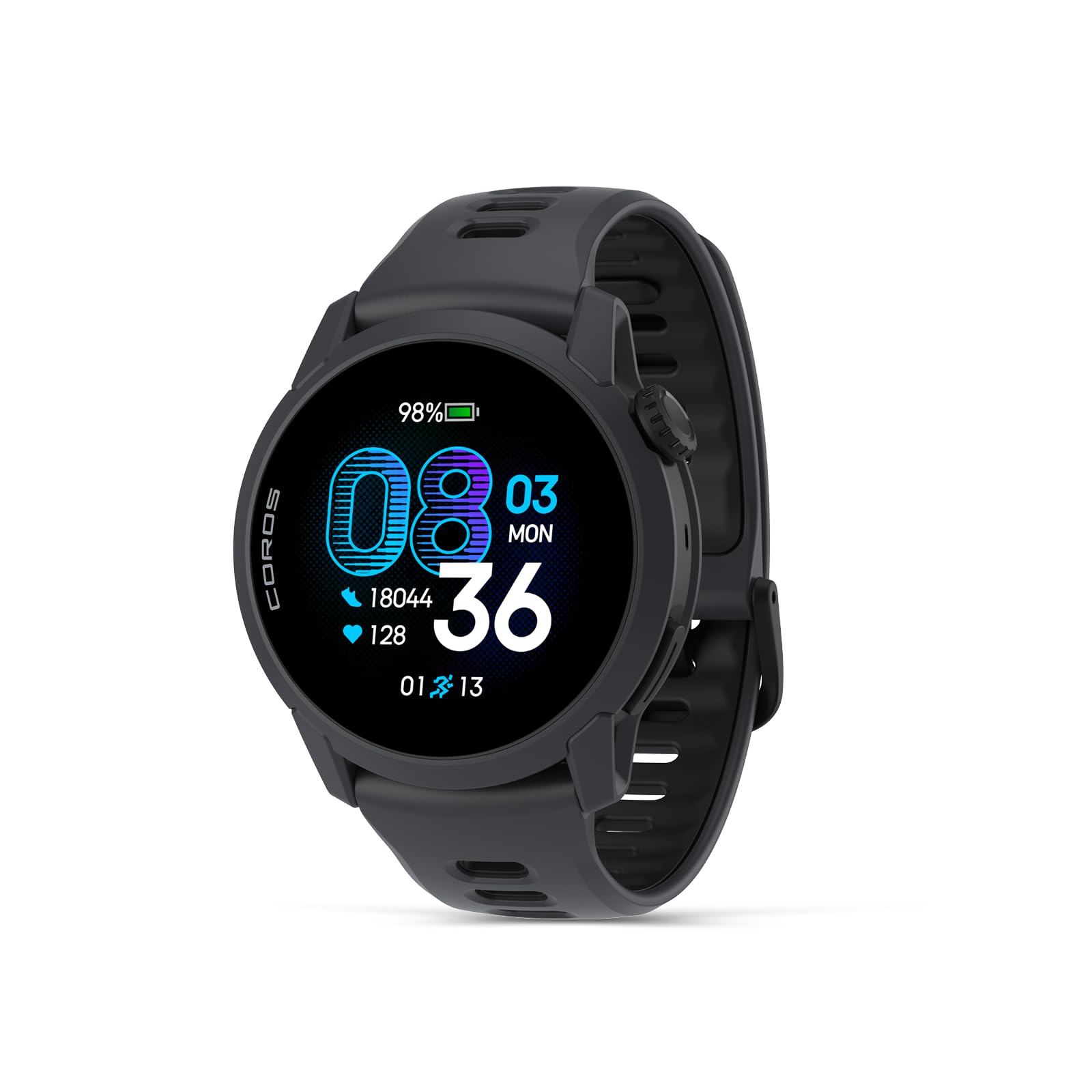
A racing watch that goes 41 hours on GPS, then keeps going for weeks.
Battery is the story here — 41 hours of continuous GPS use and up to 19 days of daily battery, a combination that crushes the Mibro AeroPace’s 12-hour GPS mode and its 8-day daily figure. That gap is the difference between a watch for short training runs and one for a hundred-mile race. It stays ultralight at 32g with the nylon band and 11.8mm thin, so the battery does not come at the cost of a heavy case.
The 1.2-inch AMOLED screen auto-adjusts brightness so it stays readable outside, and it hits a higher resolution than its predecessor — COROS claims 164% higher than the PACE 3, which is a maker figure rather than a tested one. Voice Pins let you record where you were and how you felt during a workout, and the COROS app tracks recovery time, sleep stages, HRV and menstrual cycles.
The interface is tactile rather than purely touch — a digital crown, two buttons and a touchscreen together, with a customizable Action Button for one-tap navigation. The one thing to note is screen size: at 1.2 inches it is smaller than the 2.07-inch Bip Max, so if wrist visibility matters more than race battery, look elsewhere.
The lead spec: 41 hours of GPS and 19 days of daily use at 32g.
What to keep in mind: The 1.2-inch display is compact next to the big-screen picks, so text is tighter.
The smart buy for: Racers and long-distance runners who want GPS battery to spare.
Look elsewhere if: You want the biggest possible screen for checking data on the move.
7. Garmin Instinct® 3 Solar, 45mm

A field watch with a flashlight and a solar lens, built for days with no outlet in sight.
If your training happens far from a charger, this is the spec that matters: unlimited battery life with solar charging, assuming all-day wear with 3 hours a day outside in 50,000 lux conditions. Even without the sun, it manages 28 days per charge from the 300 mAh battery. The 45mm fiber-reinforced polymer case with a metal-reinforced bezel keeps it light enough to wear 24/7 while surviving trail abuse.
The outdoor toolkit is generous. A built-in LED flashlight with variable intensities and strobe modes, a 3-axis compass, barometric altimeter and multi-band GPS with SatIQ technology for positioning that adapts to conditions. It is rated 10 ATM for water and designed to MIL-STD-810 for thermal and shock resistance.
The trade is display simplicity — a 0.9-inch screen is compact for a watch this capable. If you want a big readable screen for maps, the Bip Max beats it there. If you want a watch that outlasts a week in the backcountry without a charger, this is the one.
Where It Wins
- Unlimited battery with solar charging in strong sun, or 28 days without
- Built-in LED flashlight with strobe modes for dark trails
- Multi-band GPS with SatIQ and 3-axis navigation sensors
- 10 ATM water rating and MIL-STD-810 thermal and shock design
Where It Trades Off
- 0.9-inch display is small next to the big AMOLED picks
- Solar gain depends on outdoor light — indoor training won’t top it up
Made for: Hikers, trail runners and field workers who go days between chargers.
Not your pick if: You want a large screen for reading maps and stats mid-run.
8. Casio Men’s G-Shock Move DW-H5600 Series

The original 5600 shape, now with a heart rate sensor underneath.
This is the watch you buy if you grew up wanting a G-Shock and now want it to train with. The DW-H5600 keeps the iconic octagonal case and slim memory-in-pixel LCD (a low-power display that stays readable in daylight), then adds an optical heart-rate sensor on the back and an accelerometer for step counting. Pair it with a phone and GPS adjusts the distance data captured by the accelerometer.
Where the training side gets interesting is the analysis — training and recovery features powered by Polar’s algorithms, covering four activity modes: running, walking, gym workouts and interval training. Solar-assisted charging means the time display runs on light alone even when the battery is low, while the training and smart functions need USB top-ups, and about an hour of use a day gets roughly a week per charge.
Two things to weigh honestly: the companion app draws negative feedback from owners, and some owners have hit charging and power issues. For a classic-looking gym watch, the octagonal build and sensor quality are the draw — the smartphone experience is where it stumbles.
The draw: Classic G-Shock octagonal looks with an optical heart-rate sensor and Polar-powered training analysis.
The limitation: The companion app is the weak link, and charging has been an issue for some.
Right for: Men who want a gym-capable watch that still looks like a G-Shock.
Weigh the app: If you want a polished phone-side experience, this one may frustrate.
9. COROS APEX 4 (46mm) GPS Watch

A titanium trail watch that keeps a map on your wrist for two and a half days straight.
The APEX 4 targets men who climb, ski-tour and run mountain trails far from help. Its headline number is 65 hours of all-systems GPS — enough for a full loop of Mont Blanc — paired with dual-frequency GPS and vertical algorithms built for dense forests and steep terrain. The case is titanium with reinforced lugs, and the display uses sapphire glass (scratch-resistant crystal) with a 1.3-inch always-on memory-in-pixel LCD.
The mapping is where it separates from the pack. Topographic and landscape maps with trail and street names, turn-by-turn satellite navigation and hydro maps work without cell service, and the maker claims 30x faster map and graphic rendering than its predecessor. A microphone and speaker let you record Voice Pins or take hands-free calls.
The honest catch is display brightness — some owners find it disappointingly dim, which is the price of that low-power always-on panel. At 64g it is no featherweight either. For multiday mountain objectives where battery and durability matter most, it earns its place.
Mountain-Ready Strengths
- 65 hours of all-systems GPS for multi-day mountain routes
- Titanium case, reinforced lugs and sapphire glass for real abuse
- Topographic and hydro maps with turn-by-turn navigation offline
- Microphone and speaker for Voice Pins and hands-free calls
What To Accept
- Display brightness draws complaints from some owners
- At 64g it is heavier than the 32g ultralight race watches
Built for: Trail runners, ski tourers and climbers who need maps and battery in the mountains.
Pass if: A bright, punchy display matters more to you than all-day battery.
10. Samsung Galaxy Watch Ultra, 47mm LTE
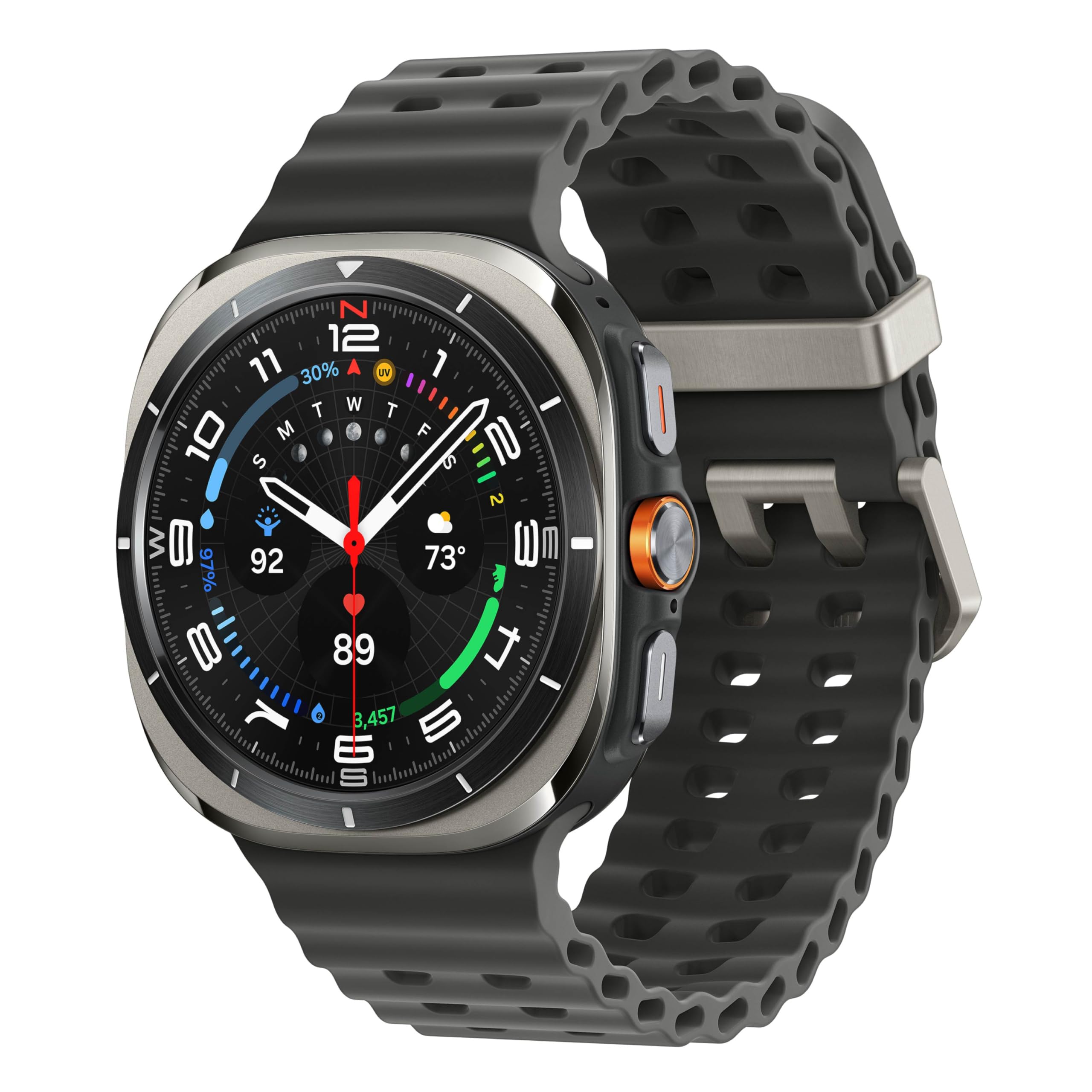
The Android smartwatch for men who want calls, coaching and a titanium shell together.
The Galaxy Watch Ultra is a smartwatch first and a training device second, and it does both well. Its 590 mAh battery is the largest here — bigger than the 480 mAh in the CARBINOX Blaze — and the titanium case with 10 ATM water resistance is built to take ocean swims and dust. LTE means it stays connected without your phone.
Training coverage includes a Personalized Running Coach that analyzes your age, weight, oxygen levels and heart rate, dual-frequency GPS, and an Energy Score that summarizes yesterday’s sleep, activity and heart rate using Galaxy AI. Advanced Sleep Coaching and blood pressure calibration (cuff sold separately) round out the health side, and it pairs with Samsung phones and other Android phones.
The battery and value stories are the ones to weigh. Some owners find the battery incredible, while others report charging every couple of days when using demanding features, and the value question draws disagreement. The titanium build and big screen are the rewards; the charging routine is the toll.
The pull: Titanium, 10 ATM, LTE and a 590 mAh battery make it the most complete Android pick.
The honest side: Heavy use shortens the time between charges, and value opinions are split.
Ideal for: Android users who want a smart watch and a training watch in one titanium body.
Not ideal if: You want the simplicity of a pure fitness tracker.
11. Apple Watch Ultra 4 GPS + Cellular 49mm
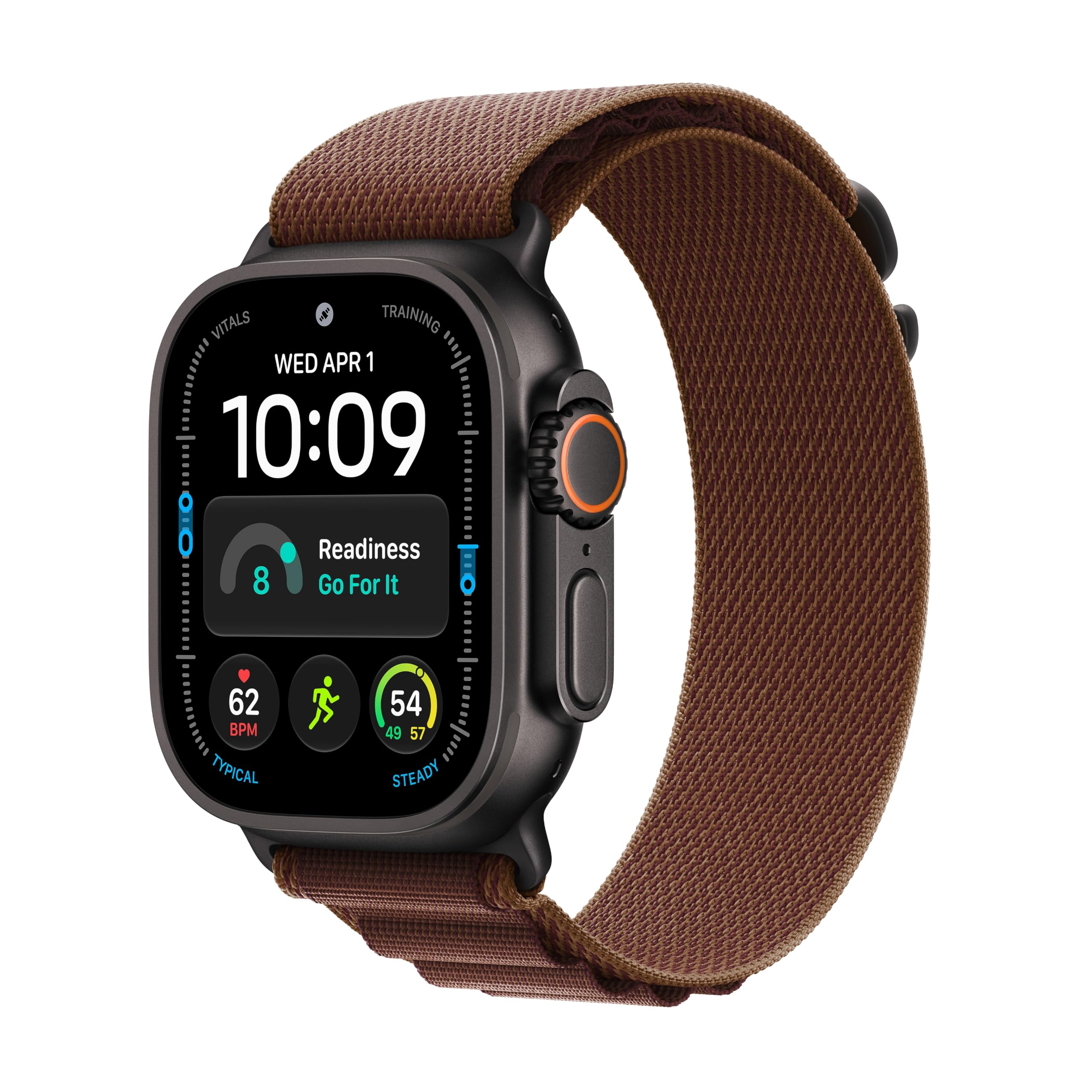
A titanium iPhone companion that can text for help when there is no signal.
The Ultra 4 is the obvious pick for a man already inside the Apple ecosystem, and it earns it on the safety side. Built-in satellite communications let you text emergency services when there is no cell service or Wi-Fi, and it can detect a hard fall or severe car crash. The titanium case and sapphire crystal display are rated to 100m water resistance, so swimming and diving pose no problem.
Training coverage is deep: precision dual-frequency GPS, Pacer, Heart Rate Zones, Custom Workouts and training load. Up to 45 hours of Max Extended Workout tracking covers ultramarathon distances, and a 15-minute fast charge gives up to 18 hours of use. Heart rate sensing runs background readings every five seconds, with HRV measured as often as every five minutes for stress and recovery insights.
The caveat is the price and the ecosystem. Value for money draws mixed feelings, and with just 150+ owners on record against the Fitbit’s 28,310, its long-term reliability is far less tested — often the toll for being the newest premium option. Cellular freedom is the reward.
Where it stands alone: Satellite emergency texting plus a titanium, sapphire, 100m-rated body make it the safest smartphone companion here.
The cost of entry: Value is the most contested part of the reception, and it demands you already own an iPhone.
Best fit for: iPhone owners who want top-tier training metrics and satellite safety in one device.
Step back if: You are on Android — this watch is built around Apple’s ecosystem.
Know the Specs
Battery: Days Versus GPS Hours
The daily-use figure describes how long the watch lasts with notifications, step counting and the occasional workout — think of it as your week between charger visits. The GPS figure is the number that matters on a long run or a race day, because the satellite chip drains power fast. A watch rated for 20 days of daily use may still only hold 12 hours in GPS performance mode, so read both before you commit.
Heart Rate And HRV
An optical heart rate sensor (LEDs that read blood flow changes through the skin) gives you real-time effort data. HRV, or heart rate variability, measures the tiny gaps between beats and is used to score recovery and readiness. A watch that reports HRV frequently gives you more useful rest guidance — the Forerunner 570 and Apple Watch Ultra 4 both use HRV status as part of their readiness scoring.
GPS And Mapping
Dual-band GPS (using two signal frequencies at once) holds a position better in dense trees and steep terrain than single-band. Offline maps stored on the watch let you follow a route without a phone signal. The AeroPace, APEX 4 and Bip Max all support stored maps, so if you run unfamiliar trails, this is the spec worth checking.
Case Material And Water Rating
Aluminum keeps a watch light and strong enough for daily running. Fiber-reinforced polymer is lighter still, which is why the Instinct 3 Solar wears well all day. Titanium and alloy steel are for watches that will hit rock. Water ratings follow the same logic: 10 ATM and 100m water resistance both cover swimming and showers, while a lower rating is fine for gym use only.
Common Questions
Will a workout watch for men track heart rate during heavy lifting?
How many hours of GPS do I need for a marathon?
Do I need a phone with me if the watch has GPS?
Can I shower or swim with these workout watches?
Do any of these watches make calls without a phone?
Is a MIP display better than AMOLED for outdoor training?
How long does the battery actually last between charges?
What is HRV and why does my watch track it?
Are these watches compatible with both iPhone and Android?
Do I need a subscription to get coaching on these watches?
Will a rugged watch like the Instinct 3 Solar feel too heavy for running?
The Bottom Line
For most men training seriously, the workout watches for men winner is the Garmin Forerunner 570, because it turns your sleep, training load and HRV into a plain yes-or-no on whether today is a hard day — and backs it with 11 days of smartwatch battery and 18 hours of GPS. It holds 4.5+ stars across 600+ ratings, the strongest review record of any GPS watch here.
If long GPS sessions matter more than coaching depth, grab the COROS PACE 4 with its 41 hours of continuous GPS and 19-day daily battery at just 32g. If you run mountain trails and need maps offline, the COROS APEX 4 is the one to reach for, with 65 hours of all-systems GPS and a titanium, sapphire build.
And if your phone is an iPhone and safety off-grid matters, the Apple Watch Ultra 4 adds satellite emergency texting and a 100m water rating to 45 hours of extended workout tracking. One nudge before you decide: the Fitbit Inspire 3 carries 28,000+ owner reviews, more than any pick here, so if you want the crowd-tested everyday tracker, that volume is worth a look alongside the top pick.
How we choose
We do not accept paid placement. Every pick is matched to a real buyer and a real use-case; we do not hands-on test units.
Sources
Specifications: manufacturer listings and product documentation. Review insights: verified customer reviews, as of November 2026. Pricing: not shown on this page (it changes often); check the current price via the retailer link.
As an Amazon Associate, Tactical Gear Guy earns from qualifying purchases. This does not affect which products we feature.