Specs are compiled from manufacturer listings and verified buyer reviews and can change over time — please confirm the key details on the product page before buying.
You can get a full cable gym without giving up half your garage floor by mounting a pulley station on the wall. But the picks below are not interchangeable. Your right choice depends on how heavy you actually pull, whether your wall is wood studs or poured concrete, and if you need a squat rack in the same frame. For most people, the strongest all-rounder is the Valor Fitness BD-62, a 4.5+ star unit with the deepest track record in this lineup.
This guide is built by comparing the manufacturers’ published specifications and the patterns across verified customer reviews, so you get each pick’s real strengths and trade-offs instead of marketing spin.
You will see exactly where each machine tops out in load, how many pulley heights it gives you, and which ones fold flat against the wall when the session ends. Here is the honest breakdown of the best workout wall machine for a real garage or basement setup.
Top Picks
How To Choose The Best Workout Wall Machine
Start with your wall, not the machine. Every one of these stations hangs off studs, masonry, or a compatible power rack, so the mounting surface decides which models are even possible in your space. A concrete basement wall opens up almost everything. A rented drywall garage narrows you toward lightweight frames and models that do not need floor anchors.
Load capacity and cable ratio decide how heavy it feels
Load capacity is the ceiling on resistance the frame and cables are rated to take. A 2:1 cable ratio halves the weight you feel at the handle, so a light plate feels lighter but moves twice as far. A 1:1 ratio gives you the exact plate weight you load, which makes tracking progress honest. Serious lifters want 1:1 or a machine that switches between both.
Pulley height positions and reach
More height holes mean more exercises fit your body — lat pulldowns from high, rows and curls from low, flys from mid. Check the rail length too, because a longer rail supports a fuller stretch and a longer rowing stroke. If you are tall, a station with a short track will leave you cramped at the top of a pulldown.
Footprint, folding, and floor space
Wall-mounted stations still take floor area when the footplate and base extend out. Look for a footprint figure in square feet and check whether the footplate flips up or the whole unit folds flat. For a shared garage, a folding design that stows against the wall in under a minute is worth more than an extra attachment.
Side-by-Side Comparison
| Model | Best For | Max Load | Pulley Positions | Footprint / Weight | Amazon |
|---|---|---|---|---|---|
| Valor Fitness BD-62★ Best Overall | Most home gyms | 200 lbs | 16 | 62 lbs | Amazon |
| Mikolo Wall Mount Cable StationBest Value | Heavy loads on a budget | 400 lbs | 19 | 25.6″D x 26.9″W x 82″H | Amazon |
| ER Kang Cable StationCompact Pick | Tight corners | 400 lbs | 18 | 27.2″L x 18.1″W x 81.9″H | Amazon |
| Goimu WM1 Cable Station | Dual-ratio training | 300 lbs | 17 | 81.4 lbs | Amazon |
| GMWD Cable Machine G7 Pro | Foldable crossover | 350 lbs | 26 holes / 13 angles | 165 lbs | Amazon |
| Titan Fitness Pulley Tower | Rack mounters | 350 lbs | Adjustable trolley | 65 lbs | Amazon |
| Mikolo Folding Squat Rack | Full rack plus cables | 1000 lbs | 15 | 150 lbs | Amazon |
| GarveeLife 19-Position Cable Machine | Angle flexibility | 400 lbs | 19 | 79.4 lbs | Amazon |
| VIVITORY Lat Pull Down & Low Row | Corner placement | 400 lbs | 16 | 46.9″D x 37.4″W x 83.5″H | Amazon |
| RC01 2-in-1 Rowing Cable Machine | Rowing plus cables | 730 lbs | 16 | 82.68″D x 24.8″W x 79.76″H | Amazon |
Detailed Reviews
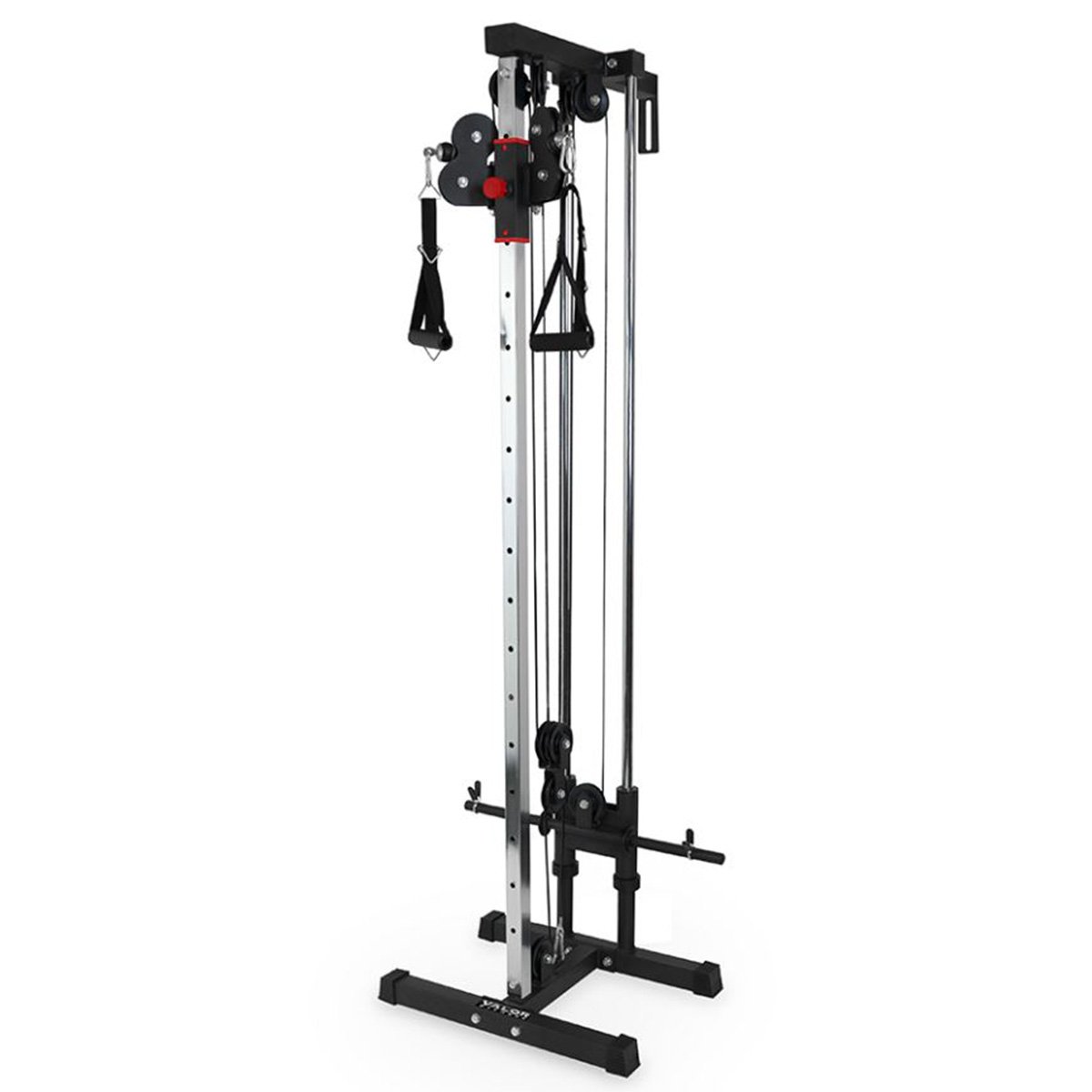
1. Valor Fitness Wall Mounted Cable Machine BD-62
Our pick — 4.5+★ from 650+ verified ratings; the strongest balance of quality and price.
A 62-lb wall-mounted cable station that bolts to two studs and leaves your floor clear.
The BD-62 is a compact wall-mounted cable station built to turn dead wall space into a lat pulldown, seated row, tricep pushdown, and face pull station. It gives you 16 pulley height positions (the hole settings that let you raise or lower the cable to match each exercise), so you can pull from high for pulldowns and from low for curls off one frame. The pulley sits in a housing that swivels, and the cables run through nylon (a smooth plastic) pulleys for a consistent feel through the rep.
The Valor beats the RC01 rower on footprint: the rower stretches to a 82.68-inch depth, while the Valor sits at 25 inches deep, so it hugs the wall instead of jutting into your car bay. At 62 lbs it is also lighter than the 81.4-lb Goimu WM1, which matters when two people lift it onto studs during install.
The honest limitation is the 200-lb load ceiling — the lowest in this lineup, and half the 400-lb rating on the Mikolo and GarveeLife stations. It also needs an adapter (sold separately) before it will take 2-inch Olympic plates, and the assembly instructions have drawn complaints. It is also the crowd favorite here, with 600+ owners and the deepest quality reputation in the group.
What earns it the top spot
- Owners consistently praise the frame’s commercial feel at a mid-range price.
- 16 pulley heights cover pulldowns, rows, curls, and flys from one wall station.
- 25-inch depth means it stays tight to the wall in a shared garage.
Where it asks you to compromise
- 200-lb ceiling — the lowest here, and you need an adapter for Olympic plates.
- Assembly is a mixed bag; the instruction sheet is the weak link.
Reach for it if: you pull moderate weight and want a proven, space-tight station that fits between studs.
Pass if: you load past 200 lbs or only own 2-inch Olympic plates and do not want to buy an adapter.
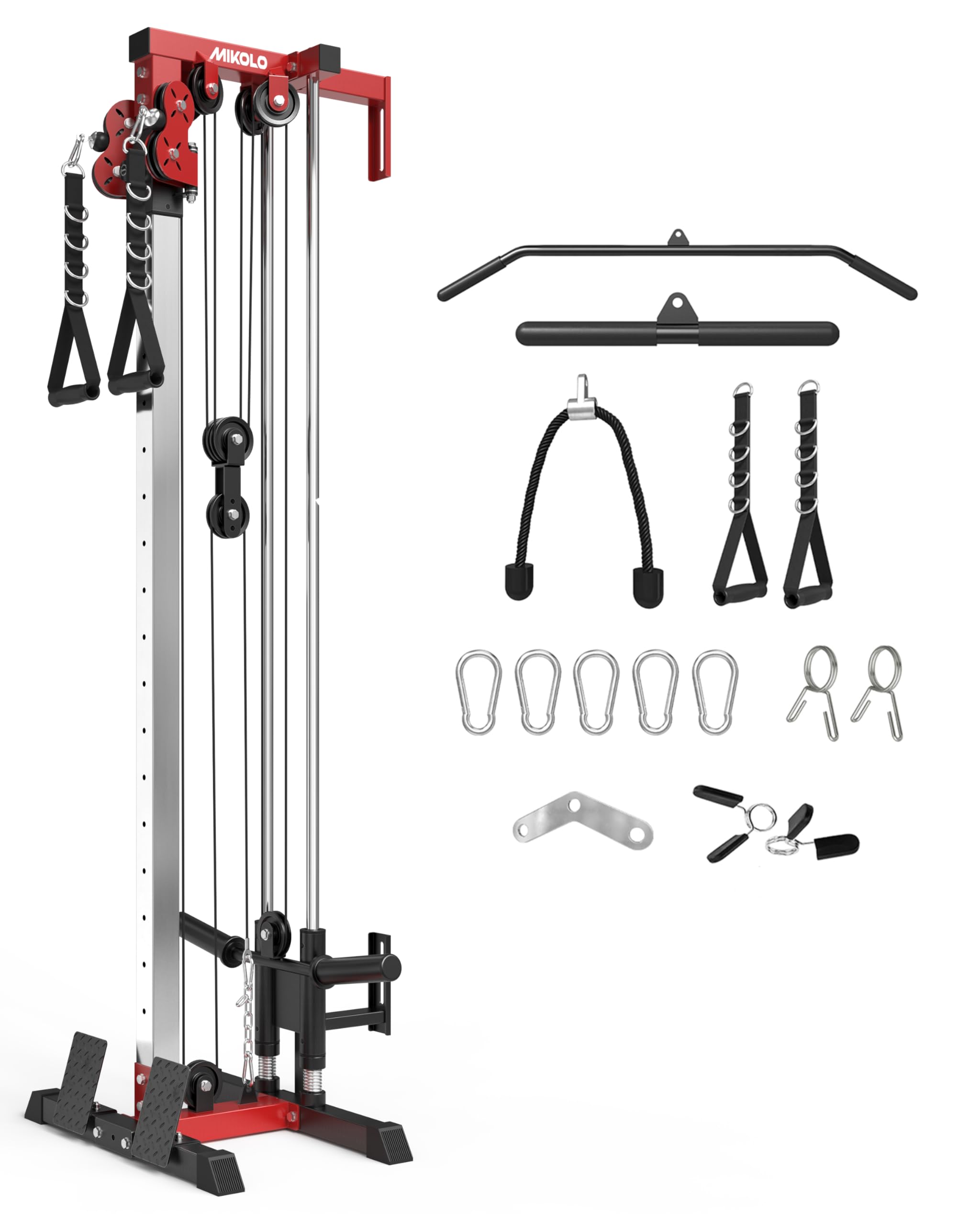
2. Mikolo Wall Mount Cable Station M-G3
A 400-lb-rated crossover frame that fits in a corner and assembles without a fight.
You can lift heavy without paying a premium with the M-G3, which gives you a 400-lb maximum load capacity on a 14-gauge powder-coated steel frame. The caveat most people miss is cable ratio (how much of the loaded weight reaches your hands): with a 1:1 ratio each handle feels the exact plate weight you load, so 200 lbs on the peg is 200 lbs in your hand. But pulling both handles at once roughly halves the felt resistance per arm. That is fine for supersets; just know your true numbers before you load up.
The build numbers are serious: nylon-coated aircraft-quality cables rated to 2200 pounds of tensile strength (the breaking point, far above the 400-lb working load), plus an H-shaped base to kill the shake you get on flimsier wall units. You get 19 height positions, detachable sleeves for both 1-inch and 2-inch plates, and three attachments — a lat bar, cable bar, and tricep rope. The large footboard makes seated rows comfortable, and the weight pegs tilt up 10 degrees so plates stay put.
What wins people over: it is the one pick here with a 400-lb ceiling that still assembles quickly and tucks into a corner, with utility and smoothness earning steady praise.
Keep in mind: a minority of owners find the cable pull less than glass-smooth compared to pricier units, and the smoothness question is a fair one to weigh if you are used to commercial gym feel.
Best for: the lifter who wants a heavy-duty 400-lb rating and Olympic-plate compatibility from the start.
Not ideal for: someone chasing commercial-gym-smooth cable glide above all else.
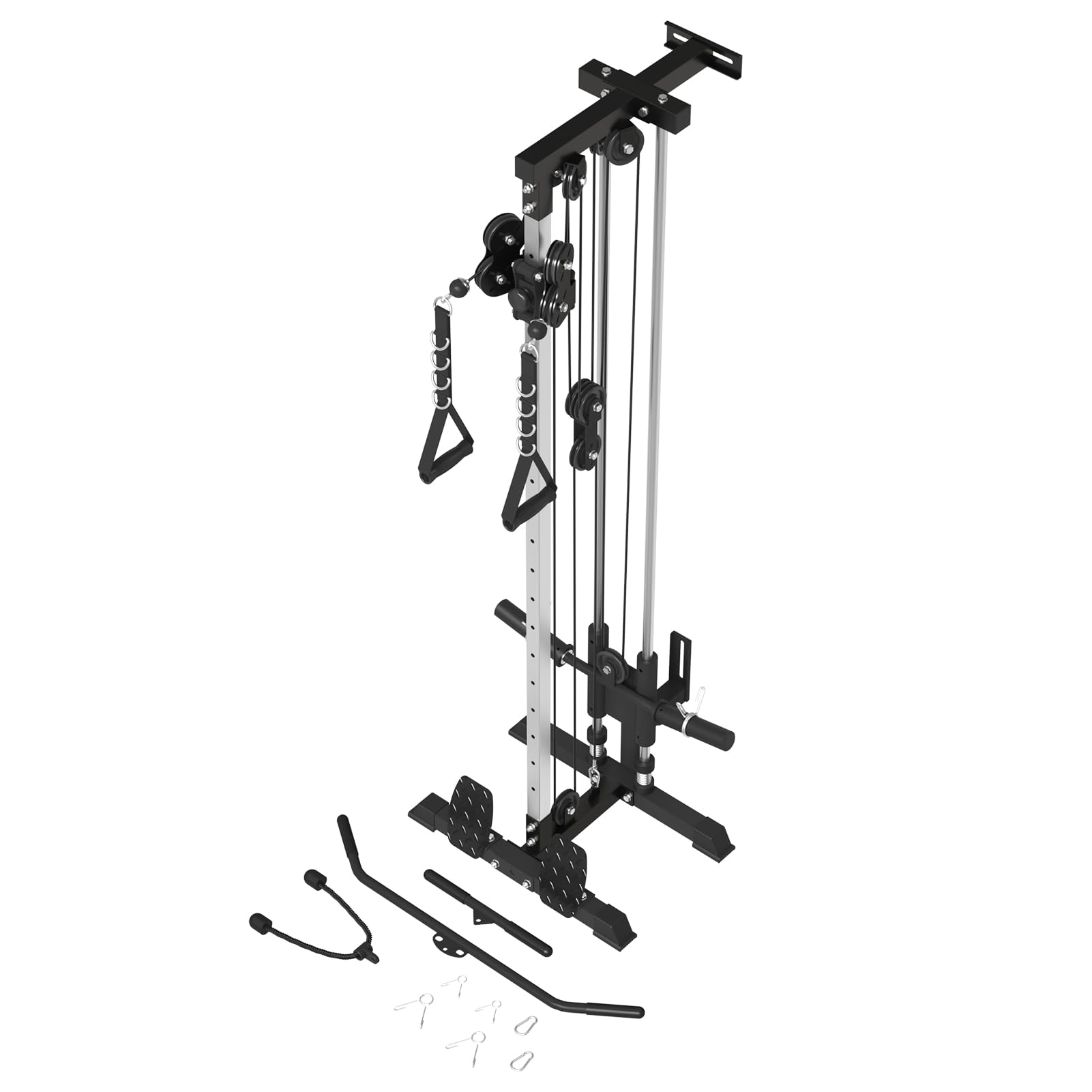
3. ER Kang Cable Station Wall Mount
A slim 18.1-inch-wide tower that hides in a corner when the session is done.
The ER Kang is the space-saver of the group — 18.1 inches wide, so it hugs into a garage corner without eating a walkway. It pairs that slim frame with a 400-lb maximum load on an 11-gauge powder-coated steel build, and nylon-coated cables rated to 2200 pounds of tensile strength. The dual pulley sleeve offers 18 height positions for unilateral or bilateral work, and a rotating pulley bracket widens your training angles so flys and woodchops are not locked to one plane.
Against the Goimu WM1 below, the ER Kang carries a 400-lb ceiling versus 300 lbs, so heavier lifters get more headroom for the same wall space. You also get a big footboard for seated rows, weight pegs with a 10-degree upward tilt to stop plates sliding off, and sleeves that take both 1-inch and 2-inch plates. Three attachments come in the box: lat bar, cable bar, and tricep rope.
The real draw: value and build are what buyers call out — a sturdy, well-finished tower that handles Olympic weights without drama.
The catch: durability gets mixed notes, with minor scratches reported after light use, so inspect the frame on arrival and keep the cables clean.
Right choice for: a narrow corner where width is the constraint, not load.
Look elsewhere if: you want a heavier-than-400-lb rating or a folding design to stow completely out of sight.
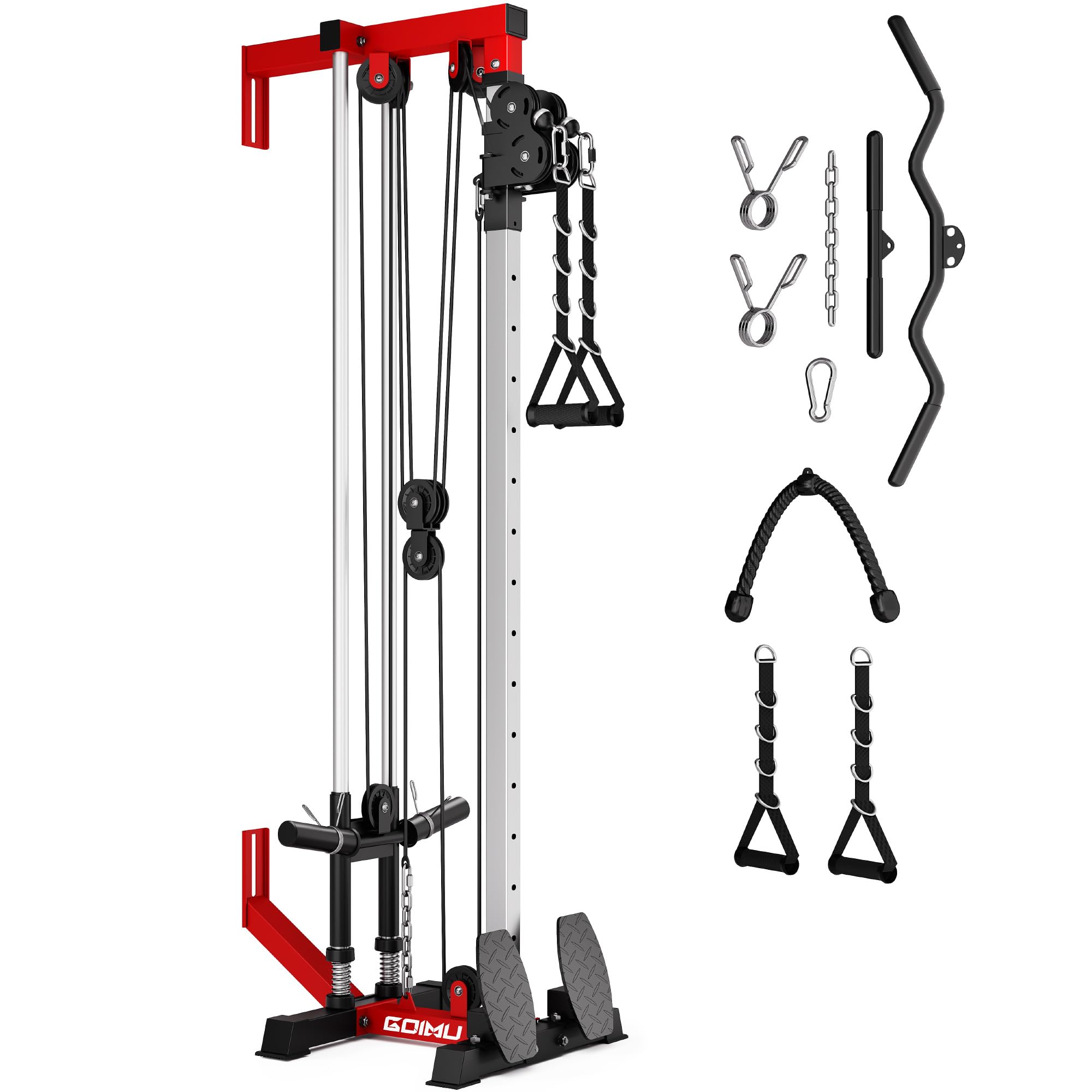
4. Goimu WM1 Cable Station
Switch between heavy and light resistance in seconds without touching a plate.
The WM1 is built around one clever idea: a cable adaptor that flips between a 1:1 ratio for heavy lifts and a 2:1 ratio for lighter endurance and drop sets. The ratio is just how much of the loaded plate weight reaches your hands: 1:1 gives you all of it, 2:1 cuts the felt load so you can rep lighter without swapping plates. That makes supersets fast, which is why the dual independent pulleys with 17 height settings matter.
The frame is industrial 14-gauge steel with an H-shaped base, rated to 300 pounds of maximum load. It weighs 81.4 lbs, so plan for two people at the wall. Compared with the Valor above, it adds dual independent pulleys and the ratio switch, and its 300-lb ceiling beats the Valor’s 200 lbs. Buyers report that the build quality is what they love most, closely followed by how straightforward it is to put together.
Assembly note: the clear instructions and straightforward build come up repeatedly — the manual and hardware make a two-person install manageable.
One thing to size up: 300 lbs of load is plenty for most home lifters but well below the 400-lb Mikolo and GarveeLife machines, so heavy-load pullers should read the ceiling first.
Pick it if: you want to switch resistance on the fly for supersets and drop sets.
Think twice if: your working sets live above 300 lbs.
5. GMWD Cable Machine G7 Pro

The adjustable-arm crossover that folds flat against the wall between workouts.
Adjustability is the whole story on the G7 Pro. You get 26 height adjustment holes across 13 arm angle settings, with arms that swing through 180 degrees — in plain terms, you can set the pulley to mimic a chest fly, a low row, or a high pulldown without moving the frame. The dual cable bracket lets you switch between 2:1 and 1:1 resistance (how much of the loaded weight reaches your hands), and the folding design lays the whole unit flat against the wall when the session ends.
It is the heavy one here at 165 pounds, backed by a 350-pound maximum load capacity and a 39-inch depth when open. Mounting hardware covers both wood and concrete surfaces, which saves you hunting for bolts. The kit is complete too: lat bar, cable bar, dual cable bracket, and leg holder are all in the box.
What owners value most is the quality of the build and how smoothly it goes together — the top-notch pulleys get particular notice, and the sturdy frame with its compact footprint earns steady praise. The trade-off is weight and depth: at 165 lbs and 39 inches deep it is not a quick one-person lift onto a stud wall, and you will want a helper and a solid mounting surface.
Why it stands out
- 26 height holes plus 13 arm angles give the widest adjustment range in this lineup.
- Folds flat against the wall — reclaim your floor between sessions.
- Switch 2:1 and 1:1 cable resistance without swapping plates.
The trade-offs
- 165 lbs is the heaviest to install here — two people and a solid wall are a must.
- 39-inch open depth needs more room than the slim ER Kang tower.
Built for: the lifter who wants the most angle options and a frame that disappears when folded.
Skip if: you need a one-person install or have a shallow wall nook.
6. Titan Fitness 80.5″ Short Wall Mounted Pulley Tower

A plate-loaded tower that bolts to your wall or clips onto your Titan power rack.
Titan builds this one for people who already own a rack. You can bolt it to the wall or mount it to a T-3, X-3, or Titan Series power rack — though the mounting hardware for the rack is not included, so factor that in. The plate-loaded design takes standard 1-inch plates on spring-clipped weight posts, and a pair of 12.5-inch nylon adapter sleeves lets you run Olympic plates too.
The cable math is the useful part. Each handle works at a 2:1 ratio on its own for high-rep work, so a light plate feels lighter and moves twice as far. Connect both handles with the chrome connector for a 1:1 ratio and the full loaded resistance — that is how you get a heavy pulldown without buying more plates. The 350-lb weight plate capacity and powder-coated 2″ x 2″ steel tubing put it in the middle of this group on load, between the 300-lb Goimu and the 400-lb Mikolo.
Smartest use case: a home gym that already has a Titan rack — you get cable work without another floor footprint.
Plan around this: assembly instructions have missing steps in spots, and a few owners say the range of motion feels limited, so test your key lifts early.
Fits best: Titan rack owners who want modular cable resistance.
Not for: someone starting from scratch with no rack and no wall space to spare.
7. Mikolo Folding Squat Rack with Cable Crossover

A squat rack, pull-up bar, and cable crossover folded into one wall-hung frame.
This is the one that replaces three machines. It runs a power rack, cable crossover, lat pulldown, and pull-up bar in one frame, with five adjustable modes — folded, semi-open, full power rack, functional trainer, and cable crossover. Fully open it expands to 9.5 square feet; folded it drops to just 3 square feet, and owners say it compacts against the wall in under a minute.
The load ceiling is in a different class: built from 2×2-inch 14-gauge steel with reinforced screw-in wall mounts and four adjustable ground feet, it handles up to 1000 lbs. That is more than twice the 400-lb ceiling on the Mikolo M-G3 and GarveeLife stations above. The cable side runs a 1:1 pulley ratio with 15 height options, so you pull the exact plate weight you load and skip the mental math on calculated resistance.
Strongest argument for it: value and assembly are what buyers highlight, with the foldability and space-saving design close behind.
The honest caveat: smoothness of the cable run is the recurring gripe — some find it less fluid than a dedicated cable tower — so if cable feel is your priority, a single-purpose station may suit you better.
Reach for this if: you do barbell work and cable work and only have room for one footprint.
Consider a dedicated tower if: cables are your main lift and you want the smoothest pull possible.
8. GarveeLife 19-Position Cable Machine

Carbon-steel frame with brackets that spin a full 360 degrees for any wall angle.
What separates the GarveeLife is the mounting flexibility. Both the top and bottom brackets rotate 360 degrees, so you can mount it at whatever angle your wall and training style call for — a rarity in this lineup. The high-density carbon-steel frame carries aviation-grade cables rated to 2200 lbs of tensile strength, and the dual cable system supports a maximum load of 400 lbs.
You get 19 adjustable height positions, an adjustable footplate that lowers flush to the ground when idle, and a weight bar that takes both 1-inch and 2-inch plates along with four barbell clips and three length-adjustable hooks. The attachment kit is complete: two single strap handles, a triceps rope, a T-bar, and a lat pulldown bar.
At 79.4 lbs it sits between the 62-lb Valor and the 81.4-lb Goimu in weight, and its 33.5-inch length is longer than the 25-inch Valor — so it needs a bit more wall real estate than the slimmest picks here, though the flip-up footplate keeps the floor clear.
The case for it
- 360-degree rotating brackets let you mount at any angle on an awkward wall.
- 400-lb load capacity with aviation-grade cables rated to 2200 lbs.
- Footplate drops flush when not in use to free up floor space.
What to weigh
- Longer 33.5-inch frame than the slim Valor — measure your wall first.
- Leaner owner feedback than the established picks, so read carefully before committing.
Suits you if: your wall runs at an odd angle and you need the brackets to pivot.
Better elsewhere if: you want a proven, deeply reviewed frame over mounting flexibility.
9. VIVITORY Lat Pull Down and Low Row Cable Machine

A vertical corner design built from 11-gauge steel with a 400-lb working ceiling.
VIVITORY goes vertical to save space, so the frame tucks into a corner rather than spreading across a wall. The build uses a commercial-grade 11-gauge black powder-coated steel frame with nylon-coated aircraft-quality cables, and it is rated to 400 pounds of maximum load. The A-shaped base is there to stop the shake that lighter wall units develop under resistance.
The updated double pulley system gives you 16 adjustable positions for unilateral or bilateral work — meaning you can pull one arm at a time or both together to hit different muscle groups. Detachable sleeves take 1-inch and 2-inch plates, so no adapter purchase is needed. Owners rate functionality and assembly as the two things that work, and it is the easiest to get running of the heavier frame picks.
One thing to plan around: at 46.9 inches deep and 37.4 inches wide, it is the chunkier corner footprint of the group — a genuine corner machine that wants a dedicated nook rather than a shared walkway. VIVITORY recommends two people for installation.
Best reason to buy: 400-lb capacity and Olympic-plate readiness in a corner-shaped frame that keeps your wall clear.
Watch this: the larger footprint needs a true corner, and a two-person install is called for.
Made for: a dedicated corner in a garage or basement where footprint is not the pinch point.
Not the one if: you need a slim, wall-hugging station in a narrow strip.
10. RC01 2-in-1 Rowing Cable Machine

The one that adds a full rowing stroke to your cable work in a folding frame.
The RC01 is the only 2-in-1 here that does cardio as well as strength. Lock the sliding seat for stable lat pulldowns, low rows, and curls, or release it for continuous rowing intervals that work your endurance as much as your muscle. The 1:1 pulley ratio means you pull the exact weight you load — no halving of the effective resistance — which makes tracking progressive gains straightforward.
Build strength is the headline: thick steel tubing rated for up to 730 lbs of dynamic load, the highest ceiling on this list and far above the 400-lb Mikolo and GarveeLife frames. You get 16 pulley heights and a 38-inch rail for full leg extension and a longer, more natural rowing stroke. It folds down to 4.26 square feet, saving nearly 70% of its floor space for apartments and tight garages.
Mount it to a solid masonry wall or a compatible power rack — it does not fit bare drywall studs like the Valor does. The kit is generous: masonry expansion bolts, a lat pulldown bar, straight bar, triceps rope, single D-handle, extension chain, carabiners, and 2-inch Olympic spring collars all ship in one box.
Why it earns a spot
- 730-lb dynamic load rating — the highest here by a wide margin.
- Rowing and cable strength in one frame, folding to 4.26 sq. ft.
- 1:1 ratio gives honest, easily tracked resistance.
What to know
- Needs masonry or a power rack — not a plain stud wall.
- Shorter track record than the established Valor and Mikolo units.
Good match for: a lifter who wants rowing intervals and cable strength from a single folding frame.
Not the fit if: your wall is standard wood studs with no rack to bolt onto.
Know the Specs
Maximum load capacity
This is the ceiling on resistance the frame and cables are rated to hold, in pounds. It is a safety limit, not a suggestion — a machine rated to 400 lbs is built to take 400 lbs of working pull, while a 200-lb unit is meant for lighter loads. Match the number to your heaviest working set, and leave headroom for dynamic pulls.
Cable ratio (1:1 vs 2:1)
The ratio is how much of the loaded plate weight you actually pull at the handle. At 1:1, a 50-lb plate feels like 50 lbs. At 2:1, that same plate feels lighter and the cable travels twice as far — handy for high-rep and drop-set work. Machines that switch between both give you the best of each.
Pulley height positions
Each position is a setting where the pulley locks, letting you pull from high for pulldowns, low for curls, or mid for flys. More positions mean more exercises fit your body. Taller lifters should check the rail length too, because a longer rail supports a fuller stretch and a longer rowing stroke.
Mounting surface and hardware
Wall-mounted stations need the right surface: wood studs, masonry, or a compatible power rack. Some models ship with masonry bolts, some with stud hardware, some with none. Check the included components before you buy, because the wrong wall means the machine cannot hang safely.
Common Questions
Will a wall-mounted cable machine fit standard wood studs?
What does the 1:1 vs 2:1 cable ratio actually mean for my lifts?
Can I use 2-inch Olympic plates on these machines?
How much weight can a wall-mounted cable machine hold?
Do I need two people to install a wall cable station?
How much floor space does a wall-mounted cable machine take up?
Is a squat rack with a cable crossover better than a dedicated cable tower?
Can a wall-mounted cable machine work in a rental apartment?
How many pulley height positions do I need for full-body training?
Do these machines include the attachments I need to start training?
The Bottom Line
For most people building a home gym, the workout wall machine that earns the first slot is the Valor Fitness BD-62, because its 16 height positions, 25-inch depth, and proven 200-lb frame cover the everyday cable moves without eating your floor. If you pull heavier and want 400 lbs of headroom with Olympic-plate compatibility, the Mikolo M-G3 is the stronger frame for the money. And if you need barbell work plus cable work in one footprint, the Mikolo Folding Squat Rack folds to 3 square feet and takes up to 1000 lbs. One honest nudge: the Valor’s depth of owner feedback is the reason it holds the top spot — that track record is worth more than an extra attachment on paper.
How we choose
We do not accept paid placement. Every pick is matched to a real buyer and a real use-case; we do not hands-on test units.
Sources
Specifications: manufacturer listings and product documentation. Review insights: verified customer reviews, as of November 2026. Pricing: not shown on this page (it changes often); check the current price via the retailer link.
As an Amazon Associate, Tactical Gear Guy earns from qualifying purchases. This does not affect which products we feature.