Specs are compiled from manufacturer listings and verified buyer reviews and can change over time — please confirm the key details on the product page before buying.
Your legs are wrecked after a heavy leg day and the gym’s foam roller is already taken. This list answers the question that matters: which recovery tool actually gets you moving again, and which one just looks like it will. The picks fall into two camps. A percussion gun (a handheld device that taps one sore spot fast) lets you aim at a single knot. Compression boots (inflatable sleeves that squeeze both legs at once) work a whole-limb heaviness. Your pick depends on which kind of pain you have.
This guide is built by comparing the manufacturers’ published specifications and the patterns across verified customer reviews, so you get each pick’s real strengths and trade-offs instead of marketing spin.
Below you will find the tools ranked by what they actually deliver on sore quads, tight calves, and stiff backs. Whether you are a runner chasing faster recovery or a desk worker with aching shoulders, these picks cover percussion guns, compression boots, rollers, and thermal tools across price tiers.
Top Picks


How To Choose The Best Workout Recovery Equipment
The biggest mistake buyers make in this category is assuming every recovery tool does the same job. A handheld percussion gun targets one knot at a time. Compression boots squeeze both legs through a timed cycle. A foam roller asks your own body weight to do the pressing. Picking wrong usually means buying twice.
Percussion guns: look at amplitude and stall force first
Amplitude is how far the massage head travels with each stroke, measured in millimeters. A gun with more travel reaches deeper muscle than one that only buzzes the surface. Stall force is how much pressure the motor can push through before it gives up and stops, measured in pounds. Higher stall force means the head keeps working when you lean into a tight quad. Speed settings tell you far less than either number.
Compression boots: chamber count, pressure range, and calf fit
Air compression boots wrap your legs and inflate in sections, called chambers, that fill in sequence. More chambers generally means a smoother squeeze from ankle to thigh, though a well-tuned four-chamber system can feel great too. Check the pressure range in mmHg (millimeters of mercury, the same unit a blood-pressure cuff uses) and, just as important, the maximum calf and thigh size the sleeve covers. A boot that does not fit your leg cannot help it.
Rollers and thermal tools: durability and heat range
A foam roller with a steel core resists bending under a hard roll, while a plain foam core can soften over time. For heat and cold tools, look at the actual temperature numbers stated by the maker and whether the battery runs the main unit separately from the thermal head. Cold helps after a sharp impact; heat loosens a stiff back before you train.
Side-by-Side Comparison
| Model | Best For | Amplitude / Pressure | Stall Force / Modes | Battery / Weight | Amazon |
|---|---|---|---|---|---|
| Opove M3 Pro 2★ Best Overall | Deep tissue on big muscle groups | 12 mm amplitude | 70 lbs stall force | 4-8 hours; 2.6 pounds | Amazon |
| BOB AND BRAD Q2 Pro MiniBest for Travel | Gym-bag travel and warmups | 7 mm amplitude | 35 lbs stall force; 5 speeds | About 0.95 lb | Amazon |
| RAD 2-in-1 Muscle Flushing KitBest for Self-Rolling | Full-body self-rolling at home | Steel-core EVA foam roller | Roller plus stick | 22 x 4 x 4 inches; 2.1 pounds | Amazon |
| BOB AND BRAD C2 Pro | Desk-day back and shoulder relief | 10 mm amplitude | 44 lbs stall force; 5 speeds | Up to 2 hours; 1.5 pounds | Amazon |
| FIT KING Leg Massager | Seated leg compression with heat | 4 air chambers | 27 massage options; 3 heat levels | 5.5 pounds | Amazon |
| Therabody RecoveryTherm Cube | Spot hot and cold therapy | 3 temperature presets | 24-minute heat session | 12.8 ounces | Amazon |
| QUINEAR Leg Recovery System | Athletes needing adjustable boot pressure | 60-140 mmHg pressure | 3 modes; 10 programs | 4.83 pounds | Amazon |
| Air Relax AR-2 | Clinic-level leg compression at home | 3 therapy modes | 4 chambers | 8 pounds | Amazon |
| Hyperice Normatec 3 Legs | Full-length leg recovery with app control | 7 levels of compression | 5 overlapping zones | 13.45 pounds | Amazon |
Detailed Reviews
1. Opove M3 Pro 2 Massage Gun Deep Tissue for Workout Recovery
Our pick — 4.5+★ from 20,000+ verified ratings; the strongest balance of quality and price.
The gun with the deepest stroke on this list, built for quads and glutes that need real pressure.
If your soreness lives in the big muscles — quads, hamstrings, glutes — this is the one to buy. Two numbers tell the story: a 12 mm amplitude (how far the head travels per stroke, in millimeters) and a 70 lbs stall force (how hard the motor can push before it quits). Compare that stroke to the BOB AND BRAD Q2 Pro Mini’s 7 mm — 12 mm versus 7 mm per stroke is exactly the difference between surface buzzing and reaching the muscle belly.
Battery life lands between 4 and 8 hours, and the motor tops out at 2500 RPM (revolutions per minute) across five speeds. That range means you can start slow on a sore calf and crank up for a stubborn knot. The outer shell is built to absorb sound and take a drop, so it runs quietly enough for a living room session without drowning out the TV. Hidden vents were redesigned from earlier feedback so heat escapes better, which is what keeps a tool like this working long after the new-toy phase.
It feels solid in the hand: at 2.6 pounds it carries noticeably more heft than the RAD kit’s 2.1 pounds. That 12 mm stroke (how far the head pushes in) means you will feel every one of those 70 lbs of stall force (the pressure it takes to stop the motor) if you press too hard on a bony spot. Sore muscles love it; thin areas around the shin and spine do not. Buyers back it too — 4.5+ stars across 20,000+ ratings — and owners describe it reaching depth and coming with a solid case and a set of head attachments for different muscle groups.
Why it earns the top spot
- 12 mm amplitude digs into big muscle groups better than shorter-stroke guns
- 70 lbs of stall force keeps the head moving when you lean in
- 4-8 hours of battery means fewer charging interruptions
- Quiet, drop-resistant shell and a carrying case for travel
Where it stings
- 2.6 pounds gets tiring on long sessions held one-handed
- Deep stroke is too much for bony or thin areas
Buy this if: you want the deepest percussion on the list and mostly work large muscle groups.
Think twice if: you need something palm-sized for travel — the heft and stroke are the trade-off.
2. BOB AND BRAD Q2 Pro Mini Massage Gun with Heat and Cold
A palm-sized gun that warms you up, cools you down, and slips into a gym bag without a struggle.
Heat before you train, cold after — that is the trick this mini gun brings. An included thermal head adds adjustable warmth at 104°F or 113°F and cooling at 50°F or 59°F (Fahrenheit), layered on top of the percussion. The head charges on its own battery, separate from the main gun, so you can top up the thermal piece while the gun still has juice. It is a small thing that saves you from juggling two separate devices on a gym night.
The motor runs a 7 mm amplitude (a shorter stroke than the Opove’s 12 mm) with five speeds from 1,800 to 3,000 percussions per minute. Its 35 lbs of stall force compares with the Opove’s 70 lbs — still enough to keep steady on quads and calves, but you will feel the difference if you press hard. Where it wins is size: the whole thing weighs about 0.95 lb, and it packs into a case with all five attachments.
What people fall for is the performance-to-size ratio. It punches harder than its dimensions suggest, the brushless motor stays quiet, and the silicone grip is easy to hold while you work a thigh. The honest caveat sits with the battery — most say it runs long, but a handful report the charge eventually fading. If you plan on hour-long daily sessions, budget for that.
The real draw: heat, cold, and percussion in one device you can carry on a plane.
The honest limit: shorter stroke and lower stall force than a full-size gun, so it is for maintenance, not deep knots.
Reach for this if: you train on the move and want warmup plus cooldown in your bag.
Look elsewhere if: you need to dig out deep knots and want maximum force.
3. RAD 2-in-1 Muscle Flushing Kit — Foam Roller & Massage Stick
No motor, no charging — just a firm roller and a stick that let your own body weight do the work.
Some soreness you cannot reach with a gun. For those spots — the IT band, the forearm, the calf — the RAD kit gives you two tools in one box. The foam roller is extra firm and high-density, built on a steel core (a metal tube running through the middle) so it will not bow when you put your weight over it. The massage roller stick handles the tighter, harder-to-reach areas your palms cannot press.
At 22 x 4 x 4 inches and 2.1 pounds, the roller is long enough to lie across for a back roll and light enough to haul to the gym. That 2.1 pounds makes it lighter than the Opove gun’s 2.6 pounds, though the comparison is unfair — one is a motorized tool, the other is a passive roller. The high-density EVA foam (a firm, dense foam that grips skin and wipes clean) is what gives it that extra-firm feel. Ten minutes a day is the intended routine, aimed at IT bands, quads, neck, glutes, hamstrings, and calves.
The trade-off is simple: a roller demands your own effort, and it will not vibrate or heat. If you have never rolled before, the extra-firm density takes adjustment on the first few uses. What owners note most is the build quality — it feels solid and holds up — and it earns its keep on tight back muscles where a foam roller often does not reach. It is a niche pick with a loyal following rather than a mass-market bestseller.
Good match for: anyone who wants a motor-free, charge-free tool that lives in the corner and never needs a battery.
Not for: buyers who want the tool to do the pressing for them.
4. BOB AND BRAD C2 Pro Massage Gun with Heat and Cold Therapy

Built for the stiff neck you get from eight hours at a desk, not just the soreness after a run.
Not every recovery tool is about the gym. This one is aimed at the shoulders and back that stiffen from a long workday. A thermal head switches between cold therapy for post-workout joint soreness and heat for a tight shoulder, and the 10 mm amplitude (how far the head strokes with each push) works through the muscle beneath. Its 44 lbs of stall force sits above the Q2 Pro Mini’s 35 lbs but below the Opove’s 70 lbs, so it holds steady under moderate pressure.
An LED screen shows real-time pressure so you can see when you are pushing too hard, and five speeds range from gentle to deep. The 40dB claim (decibels, a measure of loudness) is quiet enough to use during a lunch break without bothering coworkers, and a 10-minute auto shut-off stops you from over-working a muscle. Charging is 15W PD USB-C (Power Delivery, a faster charging standard) in 1.5 to 2 hours, and the battery runs up to 2 hours of massage per charge.
At 1.5 pounds it is light enough to hold one-handed while you work a calf or thigh. The catch worth knowing: while the quality and power are widely praised, some buyers report the battery eventually stops holding a charge, and a few mention durability issues over time. It is still the pick for desk workers with shoulder tension — just treat it as a daily-use tool that may need support down the road. Note too that 2 hours per charge compares with the Opove’s 4 to 8 hours.
What makes it click: the smart screen takes the guesswork out of pressure for beginners and older users alike.
What to watch: 2 hours per charge, and battery longevity is the recurring gripe.
Pick it if: your pain is desk-driven back and shoulder tension and you want guided pressure.
Pass if: you want a tool rated for the longest battery life on this list.
5. FIT KING Leg Massager with Heat & Compression

Air chambers that knead your legs like hands, with three heat levels for the stiff-calf crowd.
This is a different job entirely from a percussion gun. Four air chambers wrap your feet, calves, and thighs and fill in a 360° cycle, imitating the knead-and-squeeze of a real massage. Choose from 27 settings — three heat levels, modes, and intensities — and a heating feature that warms foot, calf, and thigh. If you sit all day and your legs feel heavy, this is the tool that addresses that feeling directly.
Two details matter for fit. First, the sleeves use a zipper rather than Velcro, which makes them easier to get on and off, especially for someone with limited grip or flexibility. Second, an LCD handheld controller clearly shows heat level, mode, and intensity so you are not guessing. The pressure sensor adapts to different leg sizes, and the stated maximums are a 20″ calf and 15″ foot with a calf height range of 17-18″, so measure before you buy.
Quality and relaxation are what buyers talk about most, and the heat function is a genuine draw. The catch is the compression itself — some find it gentle and pleasant, others find it too forceful on higher settings. Start low and move up. It is a 5.5-pound seated tool, not a travel pick, but for a living-room wind-down it does something no gun can do: work both legs at once.
Right tool for: people with heavy, tired legs from long sitting or standing who want hands-free air compression with warmth.
Wrong tool for: anyone with calves over 20″ or feet over 15″ — the sleeves will not fit comfortably.
6. Therabody RecoveryTherm Cube — Heat, Cold & Contrast Therapy

No melting ice bags, no fumbling with wraps — cold, heat, or contrast at the press of a button.
When you tweak an ankle or want heat on a stiff back, this replaces the dripping ice pack and the inconsistent heating pad with one wearable device. It runs three tune presets for cold, heat, and contrast, controlling both temperature and session duration through what Therabody calls Cryothermal Technology. You can strap it to a hard-to-reach knee, shoulder, or back with the included adjustable straps and go hands-free.
The heat therapy runs in 24-minute sessions, enough to loosen a stiff wrist, elbow, or neck. Cold therapy is aimed at acute injuries around the ankle, knee, back, or shoulder without the prep or melt of a reusable ice bag. At 12.8 ounces it is light enough to wear while you move around the house, and the cordless design means no cord to trip over while you sit.
The consensus is that the temperature switching is fast and the build feels solid — it works faster than the ice-pack-and-pad routine most people keep in a drawer. Two things to weigh: the straps need patience on awkward spots, and portability is fine but not a gym-bag afterthought. If you want a deep-tissue massage as your primary tool, this is not that; it is the targeted hot-and-cold specialist in the lineup.
Its strong suit: press-and-go temperature control that swaps between hot and cold in seconds.
Worth knowing: the straps can be fiddly on curved or bony areas like the ankle.
Choose it when: you want a wearable cold compress and heating pad in one cordless unit.
Move on when: your recovery is mostly deep-tissue muscle work, not hot-and-cold spot treatment.
7. QUINEAR Leg Recovery System for Athletes
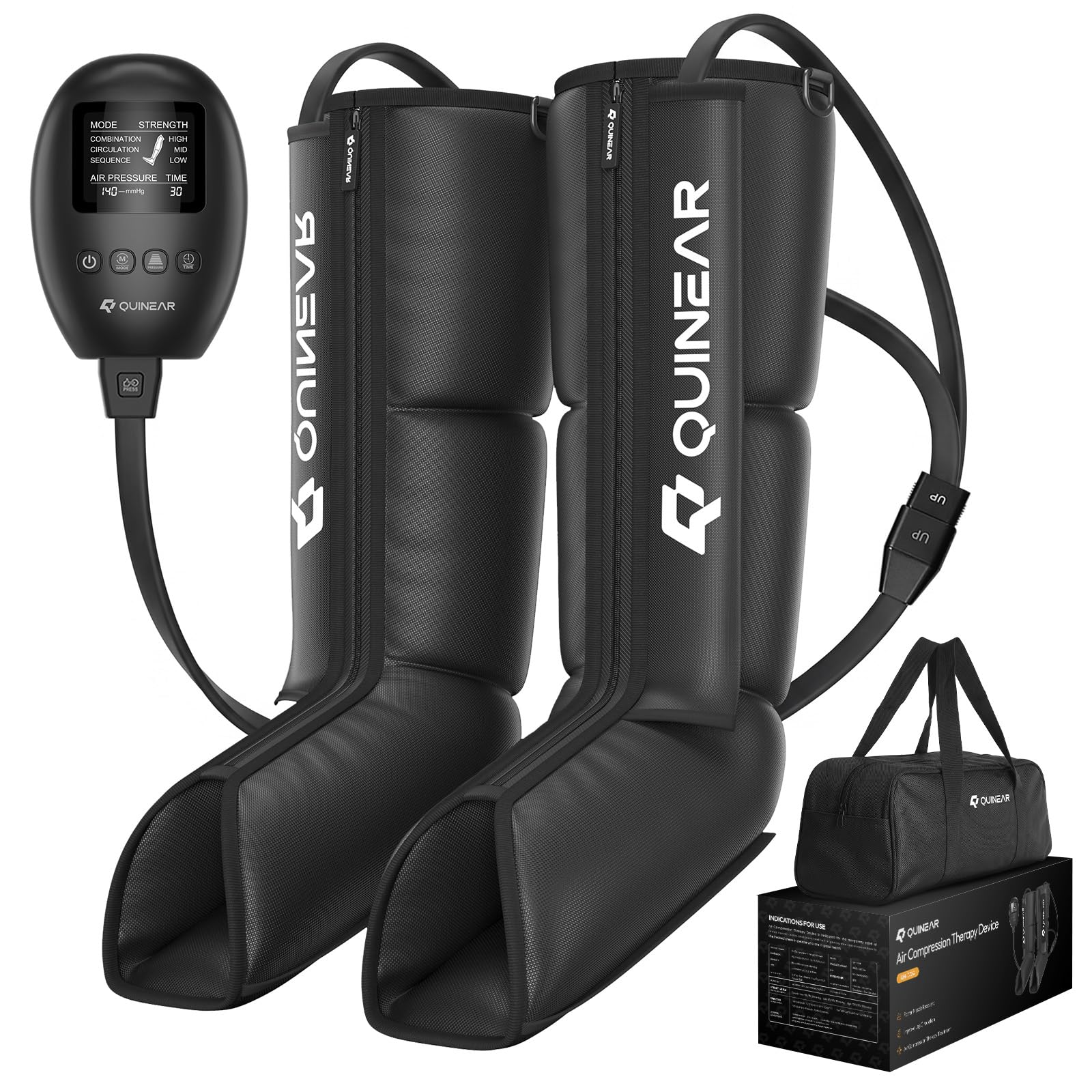
Three pressure levels you can dial in like a blood-pressure cuff, plus zipper sleeves that fit tall or skinny calves.
Compression boots live and die on pressure control, and QUINEAR gives you three clear steps: a minimum of 60 mmHg, a mid of 90 mmHg, and a maximum of 140 mmHg (millimeters of mercury, the cuff-pressure unit). Ten professional massage programs spread across three modes and three intensities give you a lot of ways to dial in a session. A three-channel air hose feeds the sleeves in sequence, circulation, or combination patterns, so it can feel like a pair of hands working up your legs.
The LED digital controller shows where the massage is and how much pressure is applied, so you always know what you are getting. The zipper-and-sleeve design is the practical win — put them on and off faster than Velcro, with one size fitting most calf shapes whether you are tall or skinny. At 4.83 pounds the whole system is light enough to move from room to room.
What comes through in the feedback is recovery. Buyers recovering from hard leg workouts find the uniform pressure across the feet and lower legs does the job, and the adjustable levels let you start gentle before going deep. It has a smaller review base than the big-name boots, but its 60-140 mmHg range is the most adjustable on the list.
Where it shines: a 60-140 mmHg range fills the gap between entry and clinical-pressure boots.
Worth noting: smaller review base than the top names, so you are trusting the spec as much as the crowd.
Worth a look if: you want fine-grained pressure steps without jumping to the highest price tier.
Maybe not if: you need a single-button-simple to use boot with no programming.
8. Air Relax AR-2 Professional Compression Boots

Clinic-style compression boots, now sized and priced for home use.
This one carries the clearest professional pedigree on the list. Air Relax states it uses FDA-cleared components and holds CE MDD clearance in Europe, and says physicians, chiropractors, and therapists use it in their own offices. The pump offers three therapy modes — peristaltic (a wave-like squeeze), cyclical uniform, and continuous — across four chambers, with an eight-pound build that feels substantial rather than flimsy.
The garment side matters too: the material is described as non-toxic and lead-free, and tested for biocompatibility for medical applications. What buyers notice is the squeeze in four segments — legs feel unwound after a session, and the multiple modes make it easy to find a rhythm. A one-year warranty with lifetime support rounds out the offer.
This is a higher-tier buy, and that brings a trade-off. It is heavier and bulkier than a portable boot, so it lives in one place rather than traveling easily. If you want a compact pick, look at the QUINEAR instead. But if you want the most clinical-feeling compression at home, with the pressure and modes to match, this is the one professionals already trust.
What makes it clinical-grade
- FDA-cleared components and CE MDD clearance stated by the maker
- Three therapy modes across four chambers
- Biocompatibility-tested, lead-free garment materials
- One-year warranty with lifetime support
The practical catch
- 8 pounds makes it a stay-at-home tool, not a travel one
- Higher-tier cost puts it out of the entry-level range
Best suited to: serious athletes and anyone who wants the most clinical compression system for a home setup.
Skip if: portability and a lower entry cost are your priorities.
9. Hyperice Normatec 3 Legs Compression Boots

Five overlapping air zones and seven pressure levels, controlled from your phone.
Normatec is the brand most pro athletes reach for, and the third generation adds seven compression levels and its patented Pulse technology across five overlapping zones. ZoneBoost (a setting that adds extra pressure to a chosen zone) lets you concentrate the squeeze where your legs need it. A Bluetooth-connected Hyperice App handles the controls, so you adjust pressure and cycle from your phone instead of a clunky remote.
Fit is the number to know: the Standard size covers a 31″ to 35″ inseam with a maximum thigh circumference of 30″. Measure both before you buy — this is a full-length boot, and an ill-fitting sleeve wastes the compression. At 13.45 pounds it is the heaviest pick here, which signals the size of the pump and garment, and it is a home tool rather than a gym-bag one.
Buyers stay loyal to its recovery quality, and the zone control lets you target a tight quad or calf. Two honest notes: the price puts it in the highest tier, with value being the split opinion, and battery reliability is the recurring gripe — a few report charging issues. If you want the most zone-controlled compression and phone-tuned sessions, it earns its top-tier price; if you want a simpler boot, the Air Relax covers that need more affordably.
Its edge: seven pressure levels and five zones under app control is a level of tuning no other boot on this list offers.
The caution: measure your inseam and thigh — the Standard size has hard limits, and battery reports are mixed.
For the serious athlete: you want pro-level zone control and app tuning and are happy with a home-only setup.
Not for you if: you want the simplest, lowest-cost boot or need to pack it for travel.
Know the Specs
Amplitude and Stall Force
Amplitude is how far the massage head travels in each stroke, measured in millimeters. More travel reaches deeper muscle. Stall force is how much pressure the motor can push through before it stalls, measured in pounds. Higher stall force means the head keeps working when you lean in. A gun with 12 mm of travel and 70 lbs of stall force reaches deeper than one with 7 mm and 35 lbs, which is why those two numbers matter more than a long list of speed settings.
Compression Pressure and Chambers
Compression boots inflate chambers (the padded sections wrapped around your legs) in sequence to squeeze blood and fluid upward. Pressure is measured in mmHg, the same unit a blood-pressure cuff uses, and a range like 60-140 mmHg gives you a gentle start and a deep finish. More chambers generally means a smoother squeeze from ankle to thigh, though a well-tuned four-chamber boot can feel great too. Always check the maximum calf and thigh size the sleeve covers.
Heat and Cold Temperature
Thermal tools state specific temperatures for warmth and cooling — for example 104°F and 113°F for heat, and 50°F and 59°F for cold. Cold therapy is aimed at acute injuries and post-workout joint soreness; heat is for loosening stiff muscles before you train. Check whether the thermal head has its own battery or draws from the main unit, since a separate battery means you can charge both at once.
Battery Life and Weight
Battery life on a percussion gun is stated in hours and ranges widely — from a couple of hours up to 4-8 hours on larger guns. Weight matters just as much: a 0.95 lb mini is easy to hold for long sessions, while a 2.6-pound gun can fatigue your arm. For boots, a heavier unit like 13.45 pounds usually means a bigger pump and sleeve, which is fine for a home tool but not for travel.
Common Questions
What is the difference between a massage gun and compression boots?
How much stall force do I need in a massage gun?
Will compression boots fit large calves?
Are recovery tools FSA or HSA eligible?
Is heat or cold better after a workout?
Can I use a massage gun on my neck or spine?
How long does a massage gun battery last?
Do compression boots really help sore legs?
What is the best recovery tool for a stiff desk-worker back?
How often should I use recovery tools?
The Bottom Line
For most people, the workout recovery equipment winner is the Opove M3 Pro 2 because its 12 mm amplitude and 70 lbs of stall force reach deeper into big muscle groups than anything else on this list. If you want a portable gun with heat and cold for warmups and cooldowns, grab the BOB AND BRAD Q2 Pro Mini. And for whole-leg compression after hard sessions, the Air Relax AR-2 is the one to reach for — and with 4.5+ stars across 20,000+ ratings, the Opove earns its spot at the top.
How we choose
We do not accept paid placement. Every pick is matched to a real buyer and a real use-case; we do not hands-on test units.
Sources
Specifications: manufacturer listings and product documentation. Review insights: verified customer reviews, as of November 2026. Pricing: not shown on this page (it changes often); check the current price via the retailer link.
As an Amazon Associate, Tactical Gear Guy earns from qualifying purchases. This does not affect which products we feature.