Specs are compiled from manufacturer listings and verified buyer reviews and can change over time — please confirm the key details on the product page before buying.
If your knees ache on a thin rolled mat and your closet is already full, a folding mat fixes both problems at once. You get a padded surface that opens flat in seconds and then collapses into a stackable block you can stand in a corner or slide under a bed. The picks below cover the whole spread: two-inch gymnastics padding, a seven-panel block that tucks away, and a mat that doubles as a yoga block when you fold it. Which one you want depends on one question: tumbling and floor work, or yoga and stretching?
This guide is built by comparing the manufacturers’ published specifications and the patterns across verified customer reviews, so you get each pick’s real strengths and trade-offs instead of marketing spin.
Folding mats are not roll-up mats with a crease — the hinge pattern decides how flat it lands and how small it stores. Below you’ll find padding thickness, folded footprint, and surface material laid out side by side so you can match one to your floor and your storage. These are the eight picks worth comparing as a workout folding mat for home training.
Top Picks


How To Choose The Best Workout Folding Mat
Start with the floor you will put it on. A mat that slides underfoot is worse than no mat at all, and grip comes from the surface finish and fold seams, not the padding. Then decide how much cushion your joints need, because the padding number is what you feel on every rep.
Panel count decides how small it stores
A three-panel mat folds twice and leaves you a long rectangle. A five- or seven-panel mat folds down further into something closer to a cube, which is what lets it stand upright in a closet or slide under furniture. More panels also means more seams, and seams are where a mat first shows wear, so buy based on where the mat will live most of the week.
Padding thickness versus stability
Two inches of foam is the number tumbling and gymnastics buyers chase, because it takes the sting out of landings and floor work. But thick foam can feel wobbly under a standing pose or a single-leg balance. If your routine is mostly yoga, Pilates, and stretching, a thinner mat around half an inch to one inch gives you a firmer base. If it is cartwheels, sit-ups, and mat work on a hard floor, go thick.
Surface material and cleanup
Vinyl and PU leather covers wipe clean with a damp cloth and handle daily gym use, which is why most gymnastics-style mats use them. TPE foam is a lighter, springier material often used on yoga-style folding mats. Check the care line carefully — some mats are hand wash only, and a mat you cannot spot-clean will not survive a sweaty week.
Handles, weight, and where it goes
Built-in carry handles only help if the mat is light enough to carry one-handed. Weights in this category run from a 3 lb mat up to a 14.3 lb mat, so a big unfolded size like a 10 ft x 4 ft mat is a floor fixture, not a grab-and-go item. Match the folded size and weight to your actual routine before you buy.
Side-by-Side Comparison
| Model | Best For | Unfolded Size | Thickness | Weight | Amazon |
|---|---|---|---|---|---|
| BalanceFrom All Purpose★ Best Overall | Tumbling and floor work | 72″ x 24″ | 2″ | 3 lb | Amazon |
| ProsourceFit Bi-FoldBest Bi-Fold | Basic floor exercises at home | 72″ x 24″ | 1.5″ | 4.7 lb | Amazon |
| Matladin 5-FoldWidest Kids Pick | Kids’ gymnastics and tumbling | 76″ x 30″ | 1.5″ | 5.8 lb | Amazon |
| Kangaroo Hoppers | Toddler play and cartwheels | 72″ x 36″ | 1″ | 4.5 lb | Amazon |
| PAIDU Foldable Yoga Mat | Yoga, Pilates, and travel | 74.8″ x 25.98″ | 0.39″ | 2.6 lb | Amazon |
| Wohao 7-Fold Yoga Mat | Small apartments and dorms | 70″ x 24″ | 0.5″ | 1.4 kg | Amazon |
| CAP Barbell Folding Mat | Large tumbling and gym floors | 118.11″ x 47.24″ | 1.89″ | 14.3 lb | Amazon |
| Stakt Original | Studio yoga and Pilates | 69″ x 24″ | 12 mm | 3 lb | Amazon |
Detailed Reviews
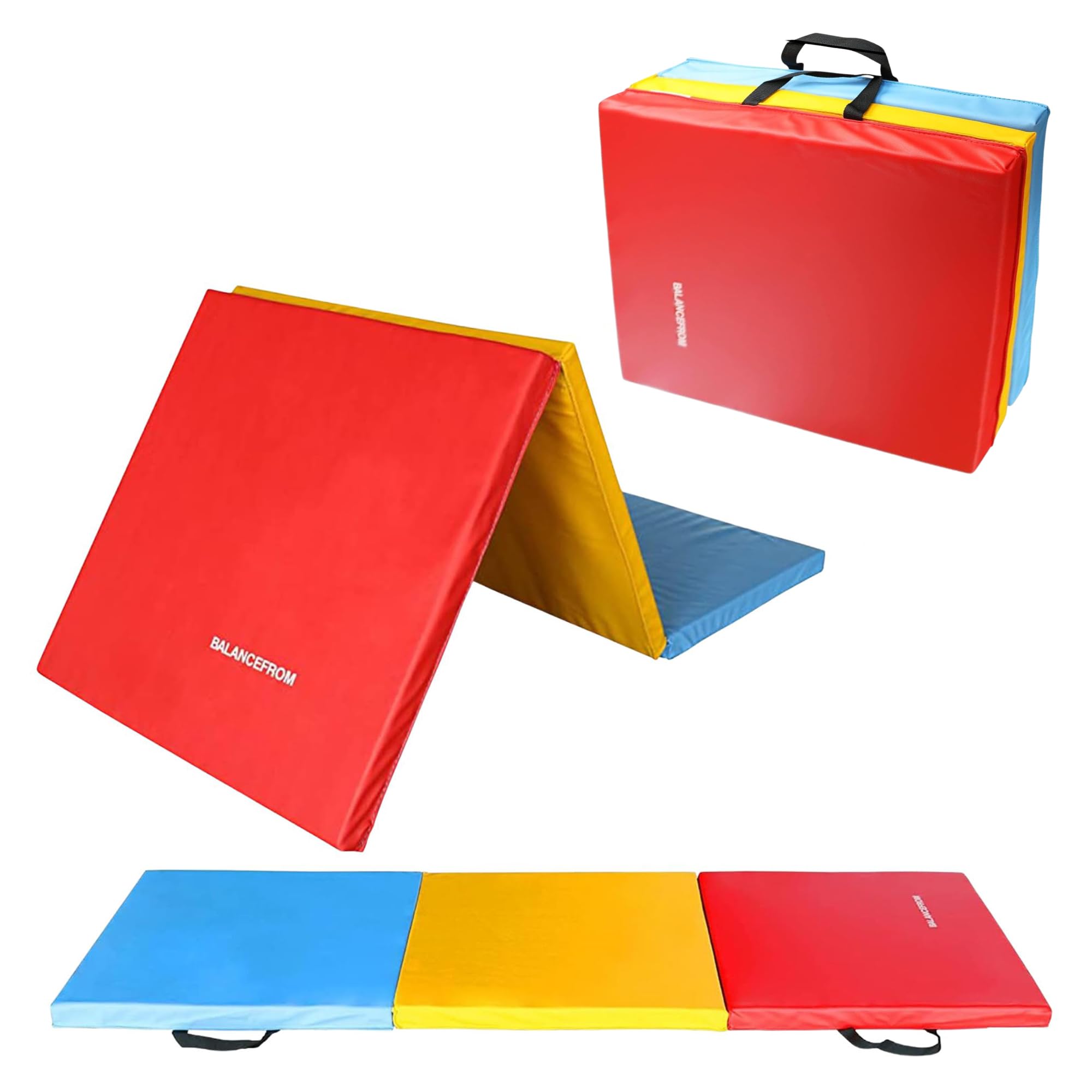
1. BalanceFrom All Purpose 2’x6’x2″ Folding Exercise Mat
Our pick — 4.5+★ from 32,000+ verified ratings; the strongest balance of quality and price.
Two inches of padding that folds into a stack you can carry one-handed.
This is the mat that solves the complaint behind almost every bad home workout: hard floor through a thin foam layer. BalanceFrom puts 2 inches of high-density foam under a 6 ft x 2 ft surface, which is enough to take the edge off sit-ups, planks, stretches, and tumbling without turning into a wobbly sponge. The top is a double-sided vinyl cover that wipes clean after a sweaty session, and the textured finish keeps the mat from skating across smooth indoor flooring.
You can clear your living-room floor in seconds, because the fold is a 3-panel design that collapses to roughly 2 ft x 2 ft x 6 in. The whole mat weighs 3 lbs and has built-in handles, so you carry it with one hand. That is why it suits someone who trains at home and has to pack up afterward. It is also the crowd favorite by a wide margin: 4.5+ stars across 32,000+ owners. The sharpest head-to-head here is with the CAP Barbell below. Both sit in the same 2-inch class of padding, but this one is 3 lbs against 14.3 lbs, so this is the one you actually carry.
The honest limit is width. At 24 inches it is a standard mat width, and a few buyers find it narrower than they pictured for wide-stance work. If you want room to sprawl, the 36-inch-wide Kangaroo Hoppers or the 30-inch Matladin give you more lateral space. Also note the care line: hand wash only, so plan on spot-cleaning with a damp cloth rather than machine washing.
What earns it the top spot
- 2 inches of high-density foam — the thickest padding class in this lineup alongside the CAP Barbell
- Folds to about 2 ft x 2 ft x 6 in and weighs 3 lbs, so it stores in a closet and carries with one hand
- Double-sided vinyl cover wipes down after use and resists moisture
- Hook-and-loop edges let you join two mats into a bigger tumbling area
Where it asks you to compromise
- 24-inch width is standard, so wide-stance moves feel tight
- Hand wash only — no machine cleaning
- Thick foam makes standing balance poses less stable than a thin yoga mat
Go with this if: you train on a hard floor at home and want serious padding you can fold away in seconds.
Size check first: 24 inches wide is plenty for mat work but tight for wide stances — measure your space before committing.
2. ProsourceFit Bi-Fold Folding Exercise Mat
One fold, two halves, and it is out of the way.
Most folding mats stack panels; this one just folds in half. That single hinge makes it the fastest mat here to put down and pick up, and the side handles mean you carry it like a briefcase. The surface is 71 inches long by 24 inches wide at 1.5 inches thick, filled with EPE foam — a closed-cell foam that holds its shape rather than bottoming out under your knees and wrists.
What buyers keep coming back to is the firmness. The padding is firm rather than plush, which is exactly what you want for floor exercises where a mushy mat makes your lower back sag. The vinyl surface wipes clean with a damp sponge, and the mat holds up over time without visible wear at the fold. Where it beats the BalanceFrom is in that firm, flat feel; where it falls short is padding depth, 1.5 inches against 2 inches, and it does not have the hook-and-loop edges for joining two mats.
Because it only folds once, the stored footprint is a long half-mat rather than a compact cube. If your storage is a narrow gap behind a door, that is fine. If you need something that disappears into a drawer or under a couch, the 7-fold Wohao below is the better shape. Weight is 4.7 lbs, so it is portable but not featherweight.
Firmness is the selling point: the EPE foam gives a supportive base that does not swallow your knees, and the vinyl wipes clean in a minute.
The trade-off to weigh: a single bi-fold leaves a long stored shape and skips the connectable edges, so it suits one person training solo, not a family building a floor.
Reach for this if: you want a firm, flat surface for floor exercises and a mat you can fold once and lean against a wall.
Look elsewhere if: you need the smallest possible stored footprint or plan to join multiple mats together.
3. Matladin 5-Fold Folding Gymnastics Exercise Mat
Thirty inches of width and a five-panel fold built for small tumblers.
A child learning a cartwheel lands on foam instead of the carpet, because the Matladin spreads out to 30 inches wide where most mats here sit at 24 inches. That extra six inches is real landing room. The five-panel fold collapses it small enough to stash, and the whole thing weighs 5.8 lbs — light enough for a parent to move, heavy enough to stay put. The 1.5-inch EPE foam (a dense, springy foam) is high-density and built to bounce back rather than flatten out.
The cover is a thickened PU leather — a synthetic leather that is waterproof, crack-resistant, and wipes clean. That matters for kids’ gear, where spills and sticky hands are the norm. Buyers report the material holding up with no rips or cuts, and it is a favorite for tumbling practice and floor work. The colors are a bold mix of pink and blue gradient, which is not subtle but does keep younger kids interested in using it.
Two things to know before you order. First, the size listings disagree: the Amazon title says 76″ x 30″, the feature bullets describe 1.5 inches, and the spec sheet lists 76″ x 30″ x 1.5″. Plan around the 1.5-inch thickness, not the 1.6-inch in the copy. Second, “lightweight for your little one” is the maker’s framing. At 5.8 lbs it is fine for an adult to carry but heavy for a small child, so this is a mat you set up for them.
Where it shines: 30-inch width, waterproof PU leather, and a 5-panel fold that packs down in a few seconds.
Set expectations: the 5.8 lb weight makes it an adult-carry item, and the bright gradient color is a commitment.
Best for: parents setting up a home tumbling spot for kids who need more width than a standard 24-inch mat.
Not ideal if: you want a neutral look for a shared living room or need a mat a small child carries alone.
4. Kangaroo Hoppers Gymnastics Tumbling Mat for Kids
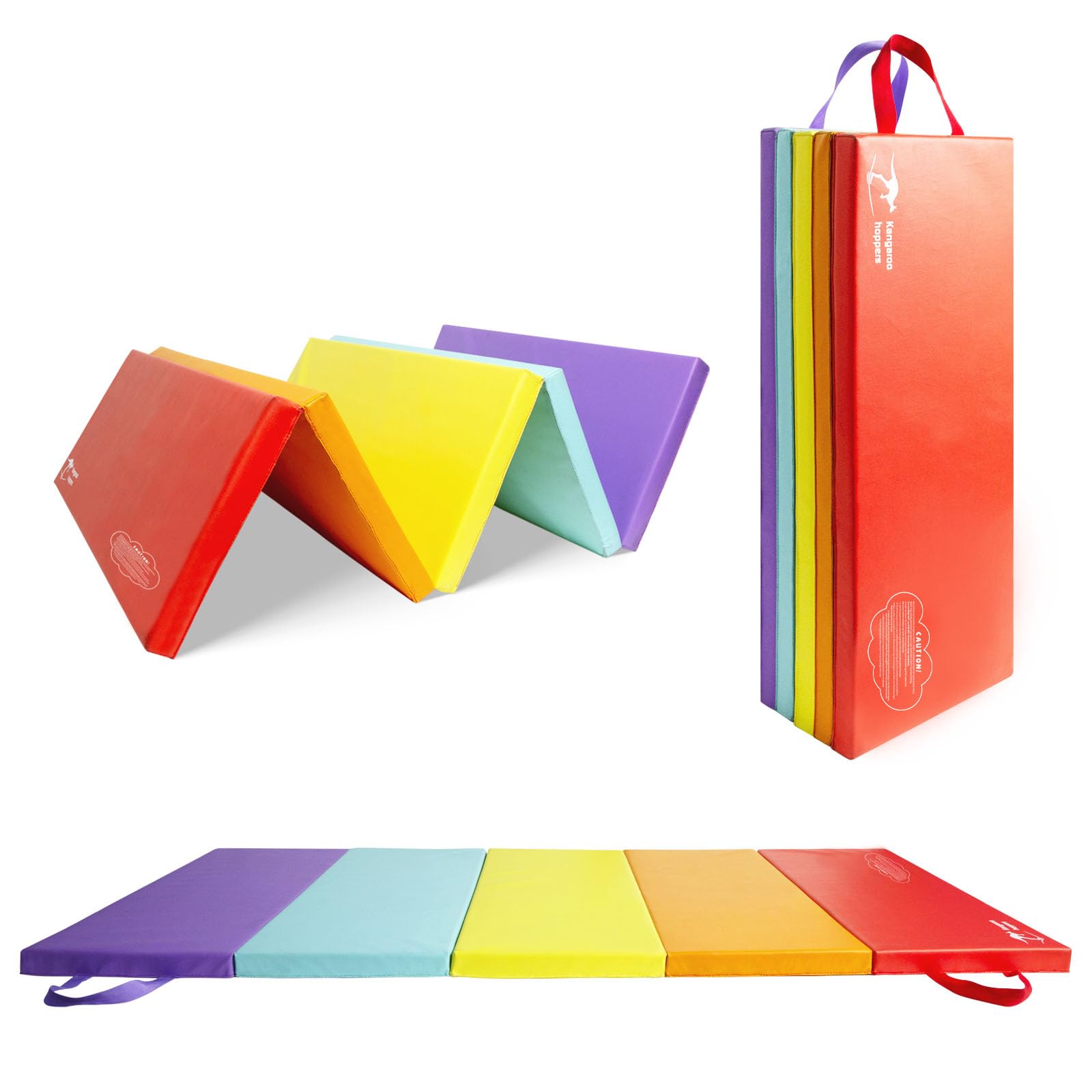
The 36-inch-wide play mat that turns a hard floor into a safe landing.
A toddler or young gymnast gets real room to roll, cartwheel, and stretch without drifting off the edge, because this mat measures three feet wide and six feet long. That makes it the widest mat in this lineup and puts it in a different lane from the rest. The foam runs 1 inch thick behind a PVC leather cover (a wipe-clean synthetic surface). The rainbow colorway is designed to pull kids onto it rather than away from it.
It folds into five panels with two carry handles and weighs 4.5 lbs, so it fits a closet or car trunk and sets up without any assembly. The PVC surface wipes down with a damp cloth, and the maker positions it for both indoor and outdoor use on flat surfaces — a patio or lawn works as well as a playroom. It comes ready to use from the start.
The point to watch is durability. This is a 1-inch mat designed for kids, and the review pages show a split: most owners find it tough enough for daily play, but there are reports of tearing within a week of use. That is a real risk worth knowing, and it fits the pattern of a thinner mat under energetic use. If your kids are rough on gear, the 1.5-inch Matladin gives more foam to absorb the abuse.
What you get: the widest surface here at 36 inches, a rainbow cover, and a 5-panel fold with two handles.
The honest caveat: at 1 inch thick it is the thinnest kids’ mat in this lineup, and some units have torn early under heavy play.
Pick this for: toddlers and young kids who need width to tumble safely and love a bright mat.
Think twice if: you need a mat that shrugs off hard daily abuse — step up to 1.5 inches for more padding margin.
5. PAIDU Foldable Yoga Mat 10MM Thick TPE
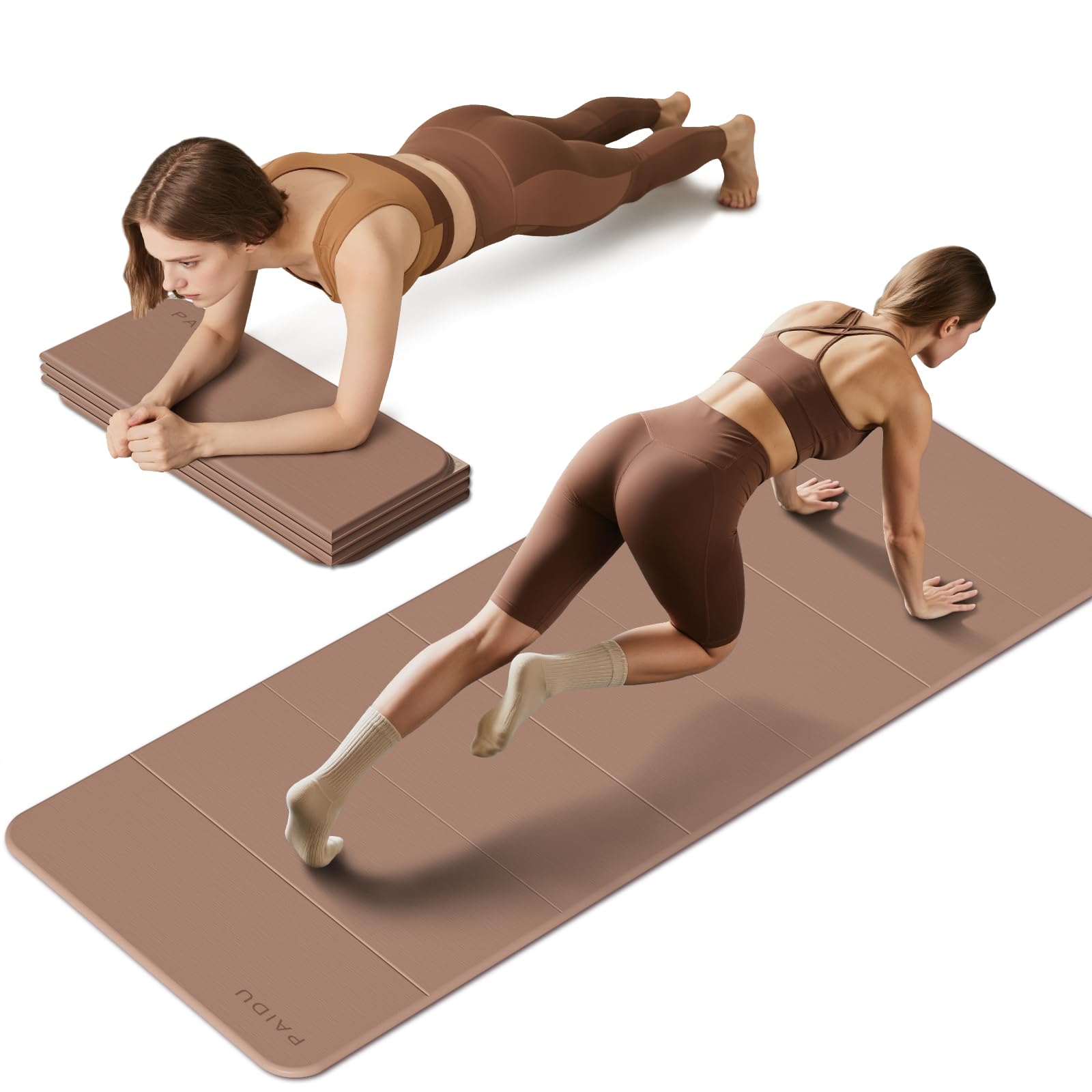
A yoga mat that folds in three seconds instead of rolling up badly.
You skip the chore of rolling a yoga mat into a tight cylinder, because this PAIDU mat folds instead. The folding design collapses in about three seconds, and the maker says the packed volume drops to a fraction of the open size. At 2.6 lbs it is the second lightest mat here. It opens to 74.8 inches long by 25.98 inches wide — longer than the standard 72-inch mat, so taller users get room to extend.
The 10 mm (0.39-inch) TPE foam is the springy, eco-friendly material yoga buyers look for, and it cushions joints for floor work and stretching. The grip is double-sided: a line pattern on the front, dots on the back, so it holds on both smooth floors and carpet. The two-tone brown and apricot finish is the kind of look that draws comments in a studio, which is exactly what buyers tend to mention.
The value question is the honest one. Some owners feel it is priced high for the material, and that is the one place where this mat divides opinion — the foldability and grip are loved, the price-to-quality read is not unanimous. If you mainly do yoga and Pilates and hate rolling mats, that trade is worth it. If you want floor padding for tumbling, go thicker.
Why yoga and Pilates people like it
- Folds in about three seconds and packs down small
- 10 mm (0.39-inch) TPE cushions joints for floor work
- Double-sided anti-slip texture — lines on front, dots on back
- 2.6 lbs and 74.8 inches long, so it is light and roomy
Where it splits opinion
- Some buyers feel the price runs high for the material
- 0.39-inch thickness is thin for tumbling or landing work
- Hand wash only — spot clean and air dry
Your mat if: you practice yoga or Pilates, want a light mat that folds instead of rolls, and value the double-sided grip.
The catch: it is priced toward the top of the yoga-mat range, and some buyers question the quality-to-cost ratio.
6. Wohao 7-Fold Yoga Mat 70″x24″
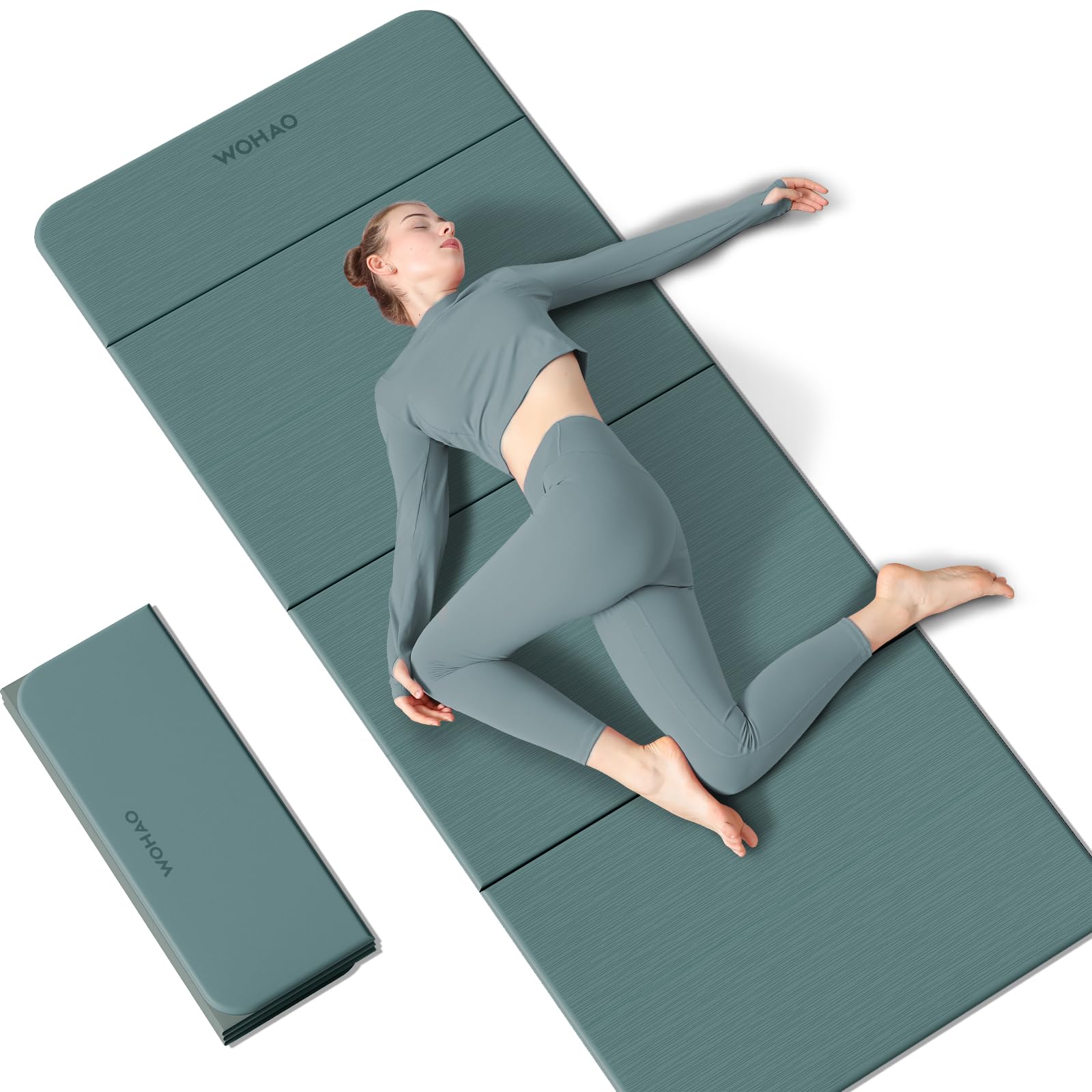
Seven folds turn a full yoga mat into a block that hides under furniture.
You can stand it upright in a closet or slide it under a couch, because seven panels fold this mat into a compact block the maker lists at 24″ x 10″ x 3″. No rolled mat can match that shape. Unfolded, it gives you 70 inches by 24 inches of surface at a half-inch (12 mm) thick. That is the plush end of the yoga range — thick enough that knees and wrists sink in without bottoming out.
The job of a mat this thick is comfort, and the 1/2-inch TPE foam delivers it while staying light. The maker’s own claim is that it’s “100% thicker than standard 1/4-inch mats” — 0.5 inches vs 0.25 inches is a real doubling, and it shows up as a plusher surface for Pilates and floor poses. The TPE is closed-cell, so it resists tears, moisture, and odors, and it wipes down with a damp cloth. The top has a non-slip texture and the bottom has raised dots to hold on carpet.
Two catches worth naming. It includes a full-color fitness guide sized to the folded mat, which is a nice extra but a paper item you will either use or lose. And while the foldability, quality, and grip are praised across the reviews, some owners find the 70-inch length a touch short if they are tall. That is a fit question, not a defect — for a compact apartment or dorm, this is the mat that actually gets put away.
The standout spec: a 7-panel fold down to 24″ x 10″ x 3″ and a 1/2-inch (12 mm) TPE surface — compact storage without giving up cushioning.
What to weigh: 70 inches is shorter than the 74.8-inch PAIDU, so very tall users may want the extra length.
This one’s for: small apartments, dorms, and anyone whose mat has to vanish into a closet after every session.
Check the length: at 70 inches it suits most users but runs short for the tallest — compare against the 74.8-inch PAIDU if you are tall.
7. CAP Barbell All Purpose Folding Exercise Mat 10′ x 4′

A 10-by-4-foot padded floor that you can fold up and roll to the wall.
This is not a mat you carry to the studio — it is a mat you lay down and leave down. At 118.11 inches long by 47.24 inches wide, it covers nearly ten feet of floor, which makes it the pick for a home gymnastics area, a martial arts practice space, or a garage workout corner. The foam runs 1.89 inches thick and is high-density for impact absorption, so it takes the thud out of landings and tumbling. Weight is 14.3 lbs — a floor fixture, not a grab-and-go item.
For safety-minded buyers, the foam is made 100% free of 10 phthalates (10P, a group of plasticizers some families want to avoid), lead, and mercury. That matters if it is going under kids. The foldable design uses built-in nylon handles for moving and storing, and hook-and-loop closures let you attach multiple mats to build a bigger padded floor — a feature the ProsourceFit bi-fold lacks.
The practical warning is size. A 10 ft x 4 ft mat needs real floor space and a real storage wall, so measure before you buy. And the foam is 1.89 inches, not a full 2 — close, but the BalanceFrom is the one with a true 2-inch pad if that number matters to you. What this mat gives in return is coverage you cannot get from any other mat here.
Built for a dedicated floor
- 118.11″ x 47.24″ of surface — nearly ten feet of padded floor
- 1.89-inch high-density foam for landing and tumbling
- 10P-free foam with no lead or mercury
- Hook-and-loop edges join multiple mats into a bigger area
What you accept
- 14.3 lbs — a fixed floor mat, not a portable one
- Needs a large storage wall and floor footprint
- 1.89 inches of foam falls just short of a full 2 inches
The right call if: you are building a home tumbling or martial arts floor and want wide, thick coverage you can join together.
Not for you if: you need something portable — at 14.3 lbs this one stays where you put it.
8. Stakt The Original Foldable Yoga Mat
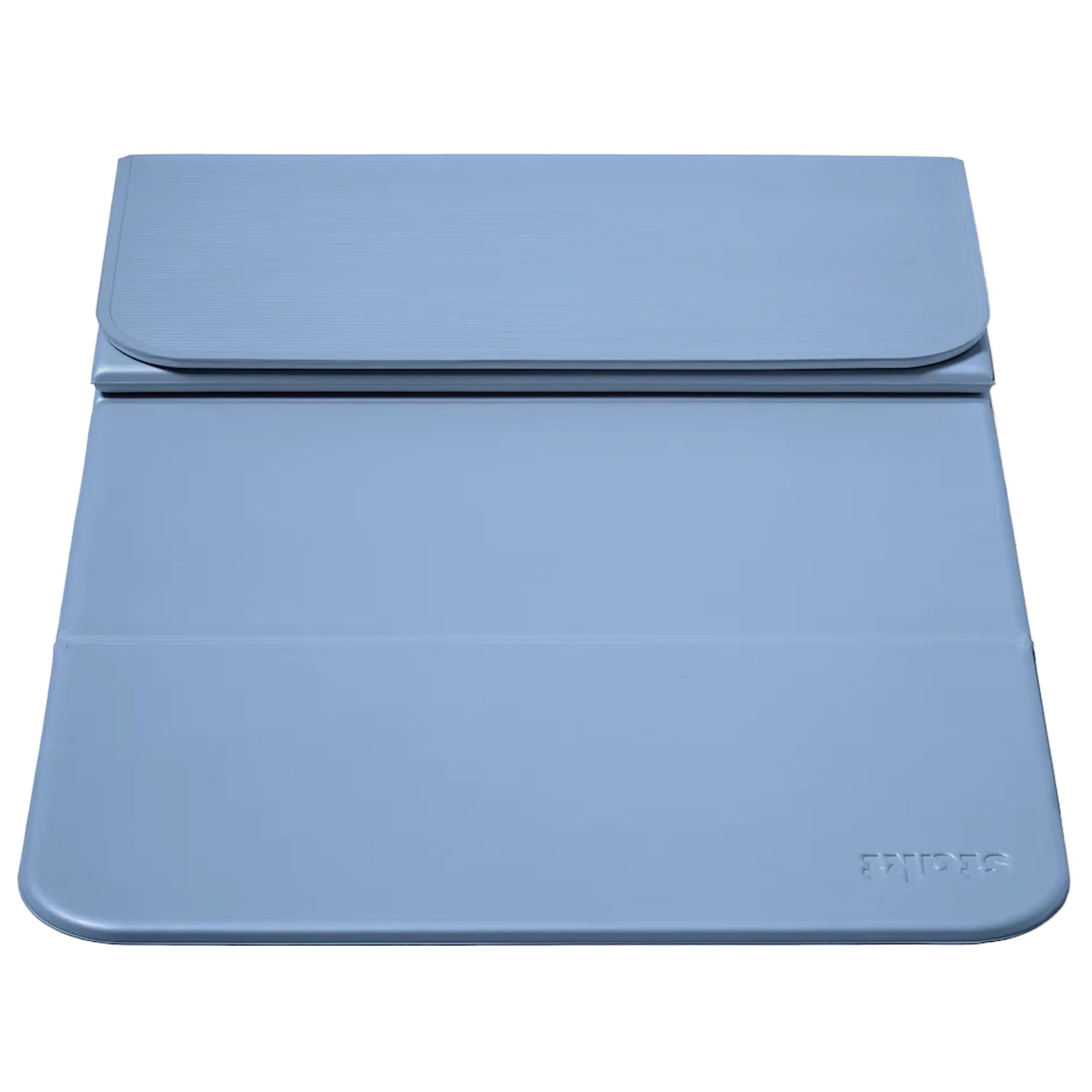
The mat that folds into its own yoga block, step, and meditation seat.
This is the one that does something no other mat here can: it works as a mat and as gear. Laid flat, it is 69 inches by 24 inches at 12 mm (about half an inch) thick — twice the padding of a standard yoga mat. Fold it, and it becomes an improve block for Pilates movements, a step, a meditation seat, or a support for core work and stretching. The structured design is covered by a patent (US D1,050,762 S), and at 3 lbs it folds down to a 24″ x 3″ x 12″ block for carrying to a studio.
The 12 mm depth is the spec that sells it. That is enough cushion to protect knees and wrists in plank and kneeling poses without the mushy, unstable feel of a thick foam mat, and the non-slip surface keeps you planted through flows and balance work. The EVA material wipes clean. Where it stands apart from the PAIDU and the Wohao is that it is not just a mat folded up — the fold creates a tool you would otherwise buy separately.
This is the premium-priced pick, and owners mention the split you would expect at the top of the market: quality, foldability, and versatility get praise, while durability and value are the two areas where opinion divides. Studio regulars who want one piece of gear to do several jobs are the right fit. If your routine is tumbling on a hard floor, the thick gymnastics mats above are better value.
what separates it: 12 mm of EVA (a firm, lightweight foam) folds into a block, step, and seat — one piece of gear that replaces three props.
The premium caveat: durability and value are the two things buyers question most, so it suits a committed studio practice more than rough daily tumbling.
Worth it for: yoga and Pilates regulars who want a mat that doubles as a block and seat, and who will carry it to a studio.
Skip the splurge if: you need impact padding for tumbling — the gymnastics mats here cushion landings better for less.
Know the Specs
Padding thickness (inches or mm)
This is the number you feel on every rep. Two inches of foam takes the sting out of tumbling and floor landings, and the same spec shows up across the BalanceFrom and CAP picks. Half an inch to 12 mm is the yoga zone — enough to cushion knees and wrists without making standing poses wobbly. Match thickness to your routine — 2 inches for tumbling, half an inch to 12 mm for yoga — not to the biggest number on the spec sheet.
Panel count and folded footprint
A 3-panel mat folds twice into a long rectangle; a 5- or 7-panel mat collapses into a compact stack. The 7-fold Wohao folds to 24″ x 10″ x 3″, which is what lets it hide in a closet. More panels means more hinges to look after, so pick the fold that fits your storage, not the highest panel count.
Surface material
Vinyl and PU leather wipe clean and take gym abuse, which is why most gymnastics mats use them. TPE is a lighter, springier foam used on yoga-style folding mats. EVA, as on the Stakt, is firmer and holds its shape. Whichever you choose, check the care line — several mats here are hand wash only.
Weight and carry handles
Handles only help if the mat is light enough to lift. The 3 lb BalanceFrom and 3 lb Stakt carry one-handed; the 14.3 lb CAP is a floor mat you move with two hands or not at all. Match the weight to how often the mat has to travel — 3 lbs for a one-handed carry, 14.3 lbs for a mat that stays put.
Common Questions
Is a folding mat better than a rolled yoga mat?
How thick should a workout folding mat be for tumbling?
Will a folding mat damage hardwood or tile floors?
Can I connect two folding mats to make a bigger area?
How do I clean a folding exercise mat?
Is a 24-inch-wide mat wide enough for adults?
Do folding mats have a weight limit?
How small does a folding mat get when packed?
Is a folding mat good for Pilates and core work?
The Bottom Line
For most home training, the workout folding mat winner is the BalanceFrom All Purpose — 2 inches of foam, a 3 lb build you carry one-handed, and a fold that clears the floor in seconds. If you need the smallest possible stored block, reach for the Wohao 7-Fold and its compact fold. And if you want one piece of gear that doubles as a block and seat for studio yoga, the Stakt Original is the premium pick worth the look.
How we choose
We do not accept paid placement. Every pick is matched to a real buyer and a real use-case; we do not hands-on test units.
Sources
Specifications: manufacturer listings and product documentation. Review insights: verified customer reviews, as of November 2026. Pricing: not shown on this page (it changes often); check the current price via the retailer link.
As an Amazon Associate, Tactical Gear Guy earns from qualifying purchases. This does not affect which products we feature.