Specs are compiled from manufacturer listings and verified buyer reviews and can change over time — please confirm the key details on the product page before buying.
Buy the deck length before the screen. Most home treadmills sold today advertise a big incline number or a touchscreen, then give you a running surface so short that your stride never opens up. The Pro Runner X takes the top spot here because it pairs a genuinely long 58-inch deck with a 3.0 HP motor and a 6.5-inch step-up height that keeps it easy to climb onto, and it does that without locking you into a monthly class subscription.
This guide is built by comparing the manufacturers’ published specifications and the patterns across verified customer reviews, so you get each pick’s real strengths and trade-offs instead of marketing spin.
Below you will find eleven machines sorted by who they actually suit, from apartment-friendly folders to commercial-grade runners. Every pick lists its real deck size, motor rating, and weight capacity so you can match the machine to your stride and your room. My full breakdown of the best workout equipment treadmill covers deck length, motor size, and incline honesty in plain terms.
Top Picks


How To Choose The Best Workout Equipment Treadmill
A treadmill is the one piece of gym equipment where a too-short deck shows up on your second run. You buy it, you jog on it once, and you realize your heel keeps landing near the rear roller because the belt is only 42 inches long. Choosing well depends on four measurements and one honest read of the specs page.
Measure the running deck, not the machine
The running deck is the flat belt surface your feet actually touch, and it is the number you should check first. A deck of 58 inches gives a tall runner room to open their stride. A deck of 42.5 inches is fine for walking and short jogging, but longer legs will feel boxed in. Measure your own stride once on the floor, then compare it against the deck length in the table.
Understand what horsepower is doing for you
Horsepower (HP) describes how strong the motor is, and a stronger motor holds its speed when a heavier person is mid-stride. A 2.5 HP motor suits walking and light jogging. A 3.0 HP or 4.0 HP motor keeps the belt moving smoothly through faster intervals. More HP also tends to mean a heavier frame, which matters if you need to move the machine alone.
Check the fold size against your room
Folding treadmills fold in two very different ways. Some tilt the deck up and keep a tall footprint, while others fold almost flat to a height of around 11 inches. Look at the folded size listed for each machine and picture it against your wall. If the folded footprint is close to the open footprint, the fold is not buying you much floor space.
Decide if you want a subscription
Several premium machines pair with a paid trainer membership to control speed and incline automatically. Those memberships add a recurring cost on top of the hardware. If you want to run without another monthly bill, look for a machine with built-in programs and no membership requirement. That single decision narrows the field faster than any spec.
Side-by-Side Comparison
| Model | Best For | Deck (L x W) | Motor | Max Capacity | Amazon |
|---|---|---|---|---|---|
| Pro Runner X by 3G Cardio★ Best Overall | Runners who want a long deck at home | 58″ x 20.5″ | 3.0 HP | 350 lbs | Amazon |
| WELLFIT Automatic InclineBest Heavy Capacity | Heavy users in a small apartment | 43″ x 18″ | 4.0 HP | 400 lbs | Amazon |
| Ateedge 15% Auto InclineBudget Incline | Budget incline walking | 42.5″ x 18″ | 3 hp | 350 lbs | Amazon |
| HUAGEED Incline Treadmill | Quiet daily jogging | 42.5″ x 18″ | 2.5 peak HP | 300 lbs | Amazon |
| renestar Auto Incline | Big screen, small room | 47.3″ x 17.7″ | 3.5 HP brushless | 300 lbs | Amazon |
| ProForm Carbon | iFIT-guided training | 55″ x 18″ | 1000 W | — | Amazon |
| Sunny Health & Fitness | Zero-assembly setup | 53.1″ x 20.1″ | 2.5 HP brushless | 300 lbs | Amazon |
| NordicTrack T Series T6.5s | Most trusted home machine | 55″ x 20″ | 400 W | — | Amazon |
| VitalWalk Apollo 11 | Upright storage in tight spaces | 49″ x 18″ | 3.5 HP brushless | 350 lbs | Amazon |
| Niceday TM3 Commercial | Serious running volume | 60″ x 20″ | 4.0 HP brushless | 330 lbs | Amazon |
| Peloton Tread | Class-led cross training | 59″ running space | — | 300 lbs | Amazon |
Detailed Reviews
1. Pro Runner X Treadmill by 3G Cardio
Our pick — 4.5+★ from 150+ verified ratings; the strongest balance of quality and price.
A folding treadmill built to actually be run on, not just walked on.
Most folding machines sacrifice the running surface to save space. This one keeps a 20.5-inch by 58-inch belt and still folds down to 40 inches long by 35 inches wide by 65 inches tall, so a runner can have both a real stride and a machine that tucks against a wall. The belt is built around an Ortho Flex suspension (a cushioning system under the belt) that softens the first contact of each footfall instead of passing the jolt up your leg.
What separates it from the pack is the 216-pound frame. That is heavy for a home unit, and it is the reason the frame feels planted when you push the speed up. Compare it with something like the Ateedge pick at the same capacity, and the difference in build is the whole story — this deck runs 58 inches against that machine’s 42.5 inches. The 3.0 HP motor ramps from 0 to 12 mph in 18 seconds, which is exactly the kind of quick response interval training needs.
Owners keep bringing up the running feel and the quiet belt under steady daily use. The recurring gripe is belt tracking; a belt that slips needs a re-tension and occasionally a service call. The 6.5-inch step-up height is the other quiet win, because you are not hoisting your knee over a tall deck to start walking. There is no membership attached, so your tablet and your own music are the whole entertainment system.
What Earns Its Keep
- 20.5″ x 58″ running belt gives tall runners room to open their stride
- 3.0 HP motor reaches 12 mph, with 0 to 12 mph in 18 seconds for intervals
- 0 to 15 incline levels and one-touch speed from.5 to 12 mph
- 216 lb frame holds steady under fast running, with a 350 lb user limit
- Lifetime frame warranty, 5-year parts, and 1-year in-home labor
Where It Asks Patience
- Belt tracking needs re-tensioning now and then before it holds true
- At 216 lb it is a two-person move, not a one-person shuffle
- No touchscreen and no built-in trainer programs beyond the preloaded courses
Buy it for: runners who want a long deck, a strong motor, and no monthly app bill in a machine that still folds.
Think twice if: you need to carry it up stairs or you want a trainer-controlled screen built in.
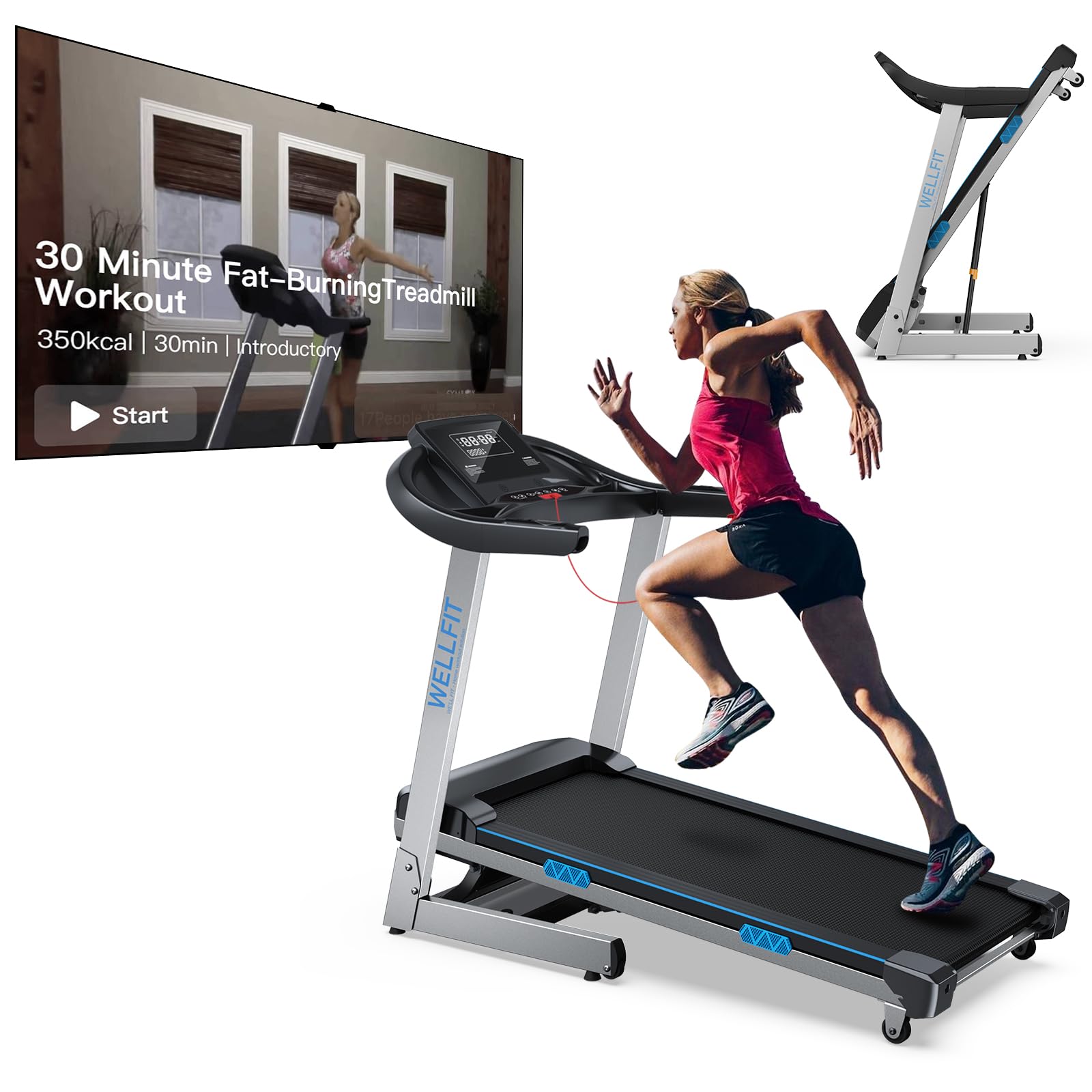
2. WELLFIT Automatic Incline Treadmill 400 lb
Four hundred pounds of rated support in a folder that slips behind a couch.
If the household has a big user and a small living room, this is the machine built for that exact squeeze. The reinforced alloy steel frame carries a rated capacity of 400 lbs — the highest of any pick here, and 100 lbs above what the HUAGEED model is rated for. A 4.0 HP brushless motor pushes the belt from 0.6 up to 8.8 mph with no sluggishness when the incline climbs.
What the apartment crowd talks about is the sound: the noise-reduction design keeps running under 45 dB, which is roughly the level of a quiet conversation. The soft-drop hydraulic fold brings the deck down to 31.89 by 28.74 by 44.1 inches, so it stores in a corner instead of taking over the room. Setup arrives 95% pre-installed and finishes inside 10 minutes with no special tools.
The catch worth knowing sits in the deck, not the frame. At 18 by 43 inches, the running belt is shorter than what the Pro Runner X offers, so very tall runners may find their stride clipped on all-out sprints. The incline makes up ground for hill work, with 15 automatic levels you can nudge from the console or by voice command. Joint-protection cushioning runs through the multi-layer diamond texture belt, which takes the edge off the landing compared with pavement.
Why the heavy users pick it: 400 lbs of rated capacity and a 4.0 HP motor in a folder is a combination almost nothing else at this size matches.
The honest limit: the 43-inch deck suits walkers and joggers, but a long-legged runner will want to size up the belt before committing.
Reach for this if: you need serious weight support and a quiet belt in a room with neighbors on the other side of the wall.
Look elsewhere if: you plan on long, fast outdoor-style running and need a deck closer to 58 inches.
3. Ateedge Treadmill with 15% Auto Incline
The entry-level folder that hands you 36 programs and a real incline.
For a first treadmill where the goal is walking, jogging, and hill intervals without overspending, the feature list here is generous. You get 15 incline options paired with a 0.5 to 10 mph speed range, and 36 preset programs loaded onto the console. A 3 hp motor runs the belt, and the frame carries up to 350 lbs.
The cushioning detail is what makes this one comfortable for daily use. The double-layer deck holds 8 built-in cushions and 6 external ones, which spread the landing impact across the belt rather than one hard spot. Bluetooth and built-in speakers let you run a show from your phone while you walk. The dual device holder keeps the screen at a usable angle instead of wobbling on the console shelf.
Here is the fit note you should weigh before buying: this machine’s running surface gets mixed reviews for length, and short-strided walkers love it while longer legs feel cramped. Buyers report it handles steady walking and light jogging without complaint. The fold brings it down to 35.43 by 27.5 by 48.43 inches, so storage is real but not flat.
Strong Points To Know
- 15 auto-incline options across a 0.5 to 10 mph speed range
- 36 preset programs built in, with no membership requirement
- 8 internal and 6 external cushions reduce impact on the landing
- 350 lb capacity with a 3 hp motor and Bluetooth speakers
Know Before You Buy
- The 18″ x 42.5″ belt runs short for tall runners who want a long stride
- The fold leaves a fairly tall footprint, so measure your wall gap
Good fit for: a first-time buyer who wants incline work and preset programs at the entry level.
Not the pick for: a runner chasing speed splits who needs a longer deck underfoot.
4. HUAGEED Incline Treadmill for Home
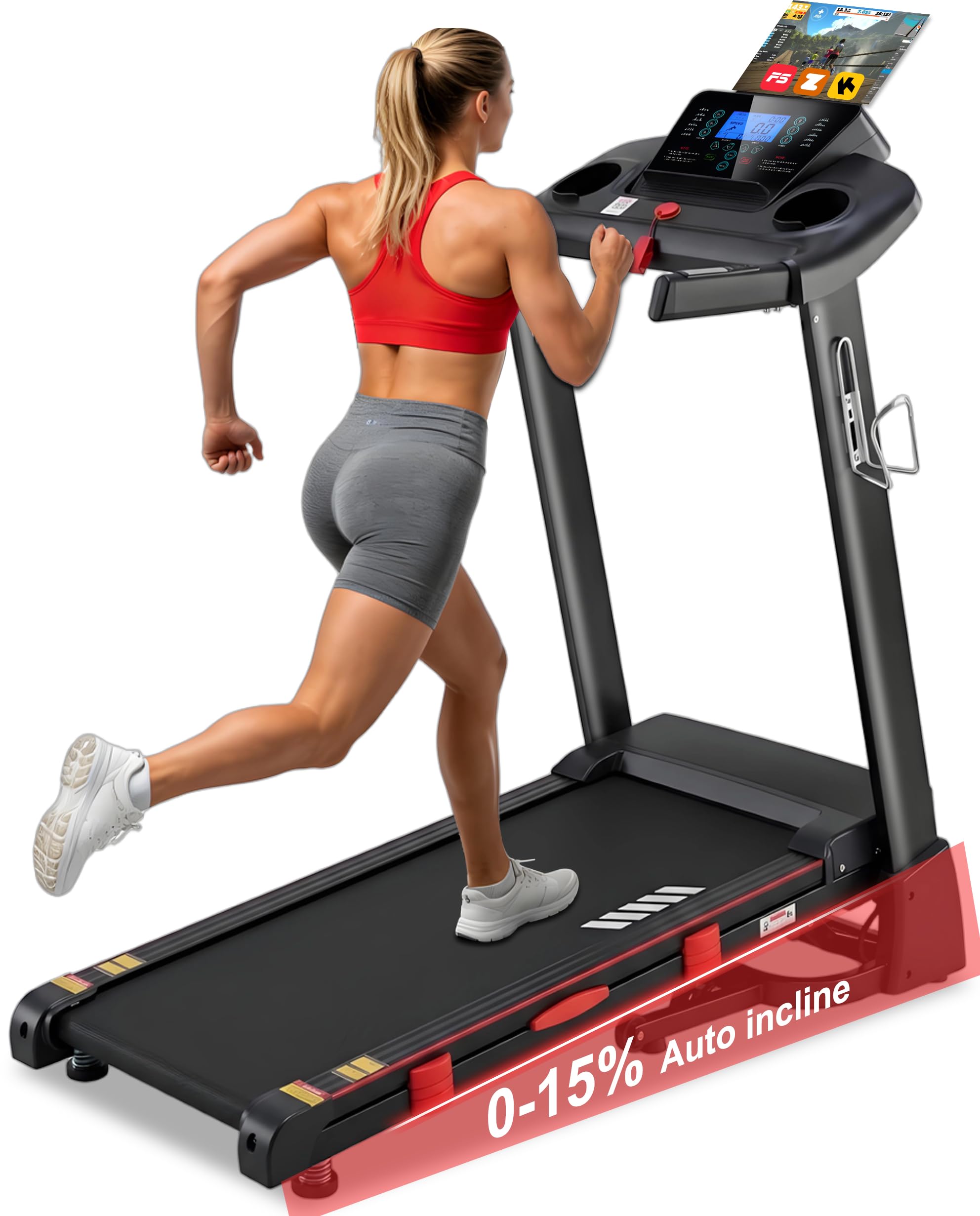
A double-deck build that keeps the noise down and the belt smooth.
The 18 by 42.5 inch diamond-patterned belt consolidates 5 layers into one surface, and the frame adds 8 built-in plus 6 external cushions to soak up the impact. A 2.5 peak HP motor handles a rated load of 300 lbs, which puts its capacity 100 lbs under the WELLFIT’s 400 lb rating.
Owners praise how the 5-layer belt feels underfoot at speed — acceleration arrives smoothly, and the incline moves through 15 levels without a jolt. The 5-inch LED display lays out speed, time, and distance at a glance. Bluetooth pairs with your phone for audio on the longer sessions.
The size note is the honest part. This is a compact machine at 42.5 inches of deck, and buyers split cleanly between those who think it is perfect for a spare room and those who find it very small. The fold trims it to 30.3 by 27.5 by 46.1 inches, so it occupies less floor than a standard sofa cushion. Durability reviews lean safe, with the belt and frame holding up under regular walking and jogging.
What it does best: the multi-layer belt and cushioned deck make daily jogging gentle on the knees and ears.
Where it runs out of room: a 300 lb capacity and a 42.5-inch deck mean bigger or taller users should look at a longer machine.
Go for this if: low noise matters in your house and walking or jogging is the main goal.
Pass if: you need a wider weight range or a longer belt for running at speed.
5. renestar Auto Incline Treadmill
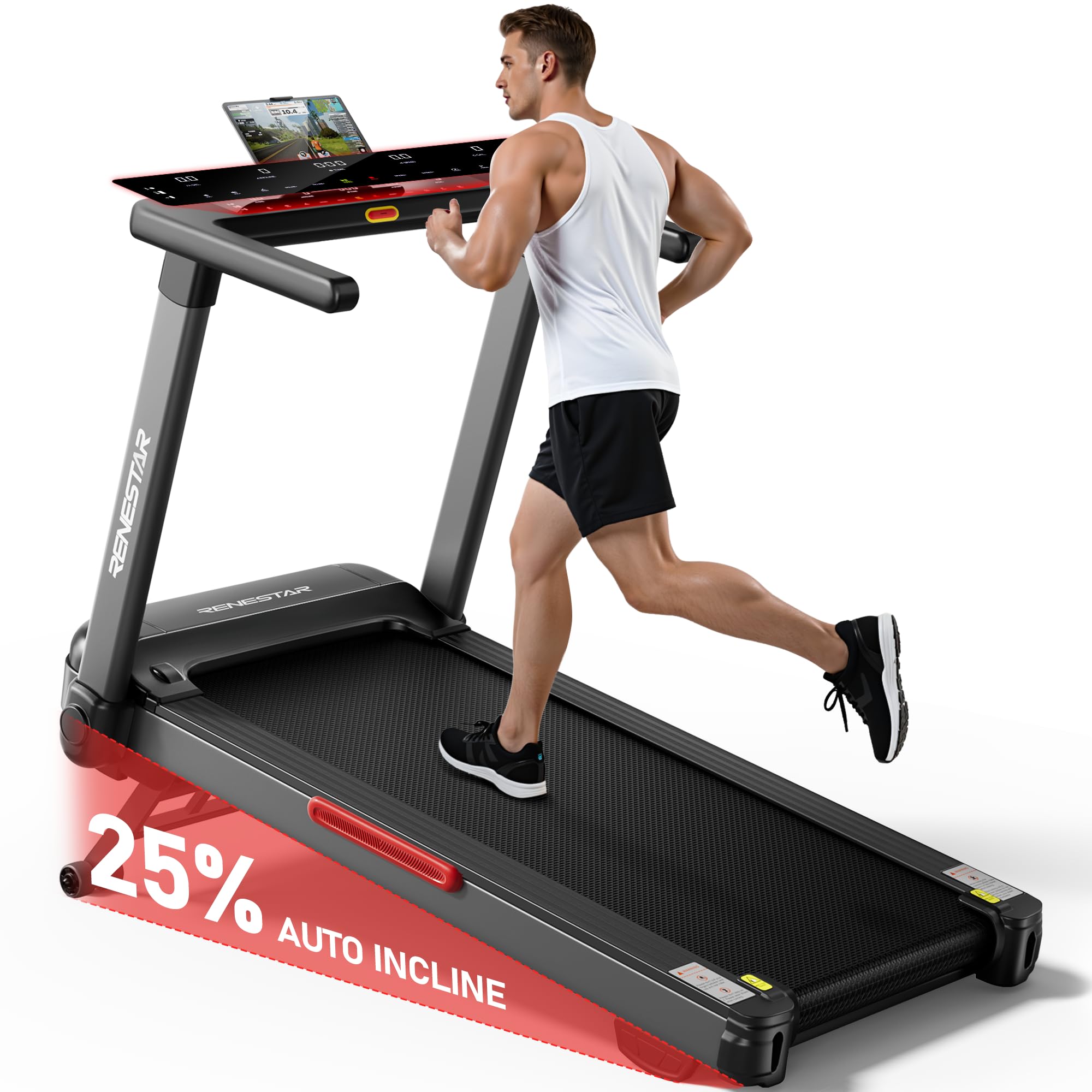
A nineteen-inch screen and a steep climb in one compact footprint.
The headline here is the incline range: a 25-level auto-incline system that rises to 25%, which is the steepest climb of any machine on this list and well above the 15-level systems on the Ateedge and HUAGEED. Combine that with a 19-inch LED touchscreen and a 12-inch device holder, and you have a console that is meant to carry your attention. The 8.5 mph top speed and 300 lb capacity set the working limits.
Under the deck sits a 3.5 HP brushless drive built to run below 45 dB for the microphone-quiet household. The running surface measures 47.3 inches long by 17.7 inches wide, with 4 extra inches of protective border. That deck sits between the short entry-level belts and the long 58-inch deck on the Pro Runner X, so it suits joggers who do not need a full sprint lane.
Buyers consistently feel they got a solid machine for the money, and the 47.3-inch deck lands in a middle size that does not dominate a room. The incline is the debate point: the automatic system gets love for convenience, but a share of buyers feel the number on the dial reads steeper than the belt actually climbs. Steepness aside, 24 preset programs carry you from endurance sessions to intervals, and setup finishes in 15 minutes from 90% pre-assembled parts.
The short verdict: a big-screen machine with a genuinely steep incline for joggers who want gym-style variety at home.
One thing to know: dial the incline up and judge the climb by feel, since the displayed grade runs steeper than the belt in some owners’ experiences.
6. ProForm Carbon Treadmill

The one for people who need a coach talking them through the mile.
A 55 by 18-inch deck anchors this one, with a 0 to 10 mph range and a 0 to 10% incline that suit walking, jogging, and steady running. The ProShox cushioning soaks up the impact on each step, softening the landing the way a padded mat would under your feet. A 5-inch LCD keeps speed and time in view while the deck does its work.
The real engine is iFIT. With a Train Membership, more than 10,000 workouts control your speed and incline automatically, so the treadmill follows the trainer’s terrain instead of you punching buttons. ActivePulse reads a Bluetooth heart rate monitor (sold separately) and adjusts speed and incline to hold your zone. SmartAdjust keeps learning from what you do, and the whole thing syncs to Strava, Garmin, and Apple Health.
The trade-off is the membership. Everything smart requires the Train Membership, so the hardware is one part of an ongoing commitment. Setup takes about 90 minutes to build, which is far longer than the pre-assembled contenders. In return, the folding frame rolls away with a hydraulic foot bar for a smooth, controlled landing, and the machine runs quietly enough that steady daily use does not turn into a noise problem at home.
The draw: a trainer that controls your speed and incline turns solitary cardio into something structured and guided.
The cost to weigh: the smart features lean on a paid membership, so factor that into the total picture before you commit.
Pick this if: you train better with guided classes and want the treadmill to follow along automatically.
skip it if: you want to run freely with no subscription and prefer a machine that sets up out of the wrapper.
7. Sunny Health & Fitness Auto Incline Treadmill
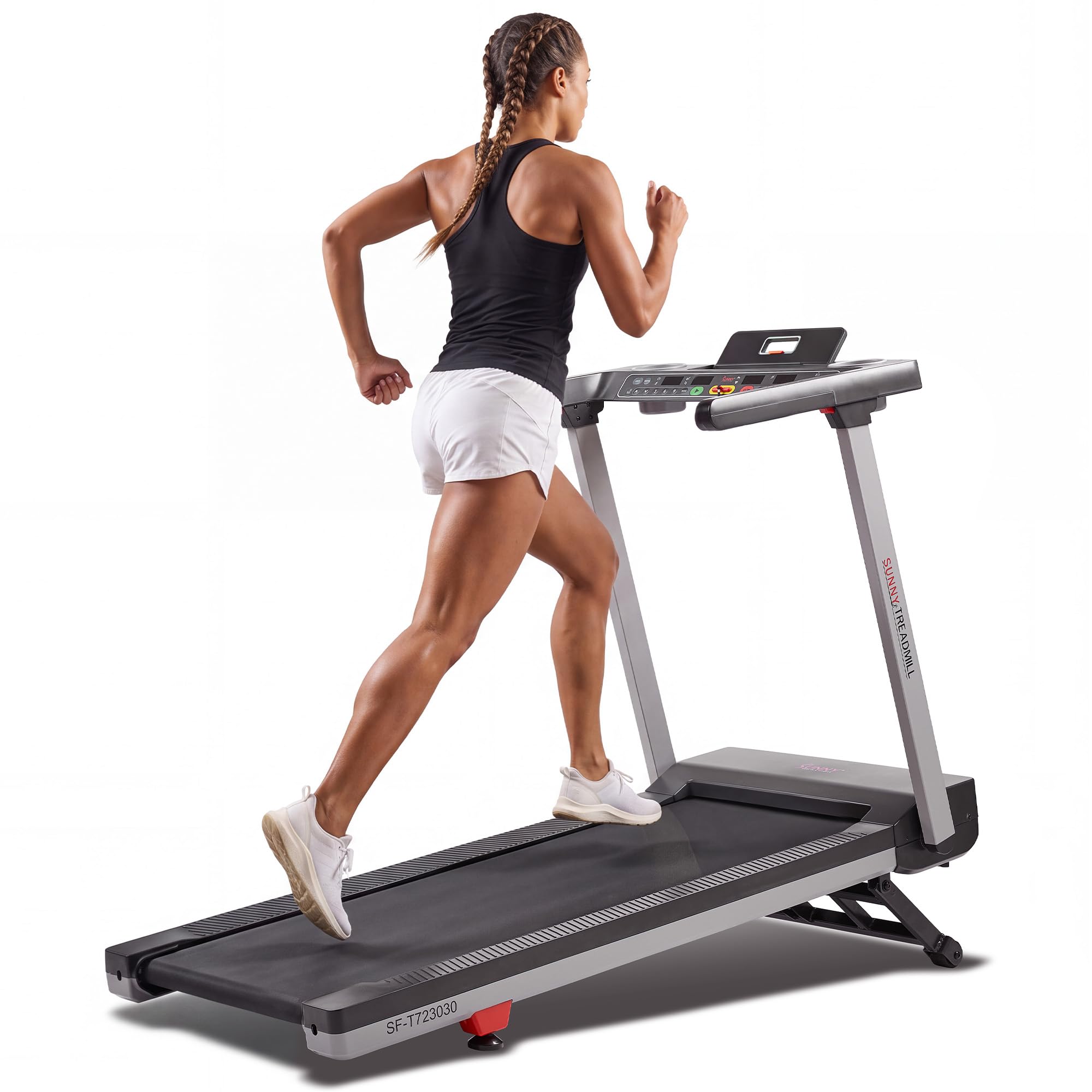
The one you unbox and start walking on the same afternoon, tools untouched.
Assembly is where treadmills lose their welcome, and this machine sidesteps it entirely. It arrives fully assembled and sets up in seconds with no tools, so the only step is raising and locking the handlebar. The 20.1 by 53.1 inch running surface gives you a real stride, backed by a 2.5 HP brushless motor that reaches 10 mph and carries up to 300 lbs.
Storage is the second win. Press the one-click fold and the deck drops to 63.8 by 30.9 by 11.4 inches, which is flat enough to slide under a bed or stand against a hallway wall. The 15 auto incline levels top out at 15% for hill days, and 24 preset programs plus 3 countdown modes and 3 user modes cover most training goals. Quick speed and incline buttons let you adjust without stopping mid-stride.
Owners praise the price and the small-room footprint, and the belt holds up to regular walking and jogging. The free SunnyFit app open up 2,000+ trainer-led videos and 10,000+ virtual tours, with no membership required. Pulse sensors track heart rate in real time, and a USB port charges your phone while you walk. Small extras like two cup holders and a device holder round out the convenience.
The setup story: no tools, no bolts, no instruction manual marathon — it stands up ready to run.
The flat-fold payoff: an 11.4-inch folded height means it stores where a normal treadmill simply cannot.
It suits you if: you want a no-hassle machine that folds nearly flat and works with a free app.
Look at the big commercial pick if: you need a much longer deck for high-volume running.
8. NordicTrack T Series T6.5s Treadmill

The home treadmill with the deepest track record behind it.
If you want the machine that the most home gyms already own, this is it — 4.0+ stars across a huge base of owners, and quality is the trait that gets brought up more than any other. The 20 by 55-inch deck runs longer than the shorter entry-level belts and pairs with a 0 to 10 mph range and a 0 to 10% incline. KeyFlex cushioning takes the sting out of each landing for daily walking and running.
Like the ProForm, the smart layer runs on iFIT. A Train Membership open up over 10,000 workouts that control your speed and incline automatically, and ActivePulse holds your heart rate zone using a Bluetooth monitor sold separately. SmartAdjust keeps adapting to your history, and Garmin, Strava, and Apple Health all sync up. The 5-inch LCD shows your live stats, or you can follow a trainer on your own phone or tablet.
The two things to plan around are assembly and noise, which split opinion. Some machines go together easily while others want a second set of hands, so budget an evening and a helper. Noise is the same story — quiet for plenty of owners, audible to others depending on the floor under it. Fold it, roll it away, and press the foot bar for a smooth assisted lower when the session ends.
Why it earns trust: the sheer volume of happy ownership behind the T Series says more than any single spec line.
Set aside time: two people and an evening make the build go smoothly, and a mat under the deck softens the noise.
It fits you if: you want a proven home treadmill and plan to use iFIT classes to stay motivated.
pass on it if: you would rather not build anything or pay for a training membership.
9. VitalWalk Apollo 11 Folding Treadmill

A folder that stands on its own two wheels and claims a sliver of floor.
Most folded treadmills still lie down and hog space. This one is designed to stand upright once you lock the support, holding a compact 2.67 square foot footprint that lets it tuck into a closet-sized gap. A patented one-touch quick-fold drops the deck for storage, and four bidirectional transport wheels let you roll it into place. A 20% motorized incline climbs steeper than the 15% systems on the Ateedge and HUAGEED machines.
The running surface measures 49 inches long by 18 inches wide, with a 53.9 by 29.5 inch footprint and speeds up to 10 mph. A 3.5 HP brushless motor carries a 350 lb capacity, and 8-point cushioning with external rubber dampening absorbs the impact of each step. The 7-layer belt helps the whole deck feel stable during regular home use.
It arrives roughly 99% pre-assembled, so the setup is quick. App support connects to Fitshow and Zwift with an AI smart coach, and a cooling fan, USB and Type-C charging ports, a device holder, and hand-grip pulse sensors are all on board. The three-color edge lighting shifts with your speed ranges, which is a small touch that helps you read your pace at a glance. Five years of frame coverage and two years on the motor back the build.
The case for it: upright storage plus a steep 20% climb makes it a strong fit for apartments and small home gyms.
Weigh this first: the 49-inch deck is generous for walking but still shorter than the 58-inch and 60-inch decks on the running-focused picks.
10. Niceday TM3 Commercial Series Treadmill
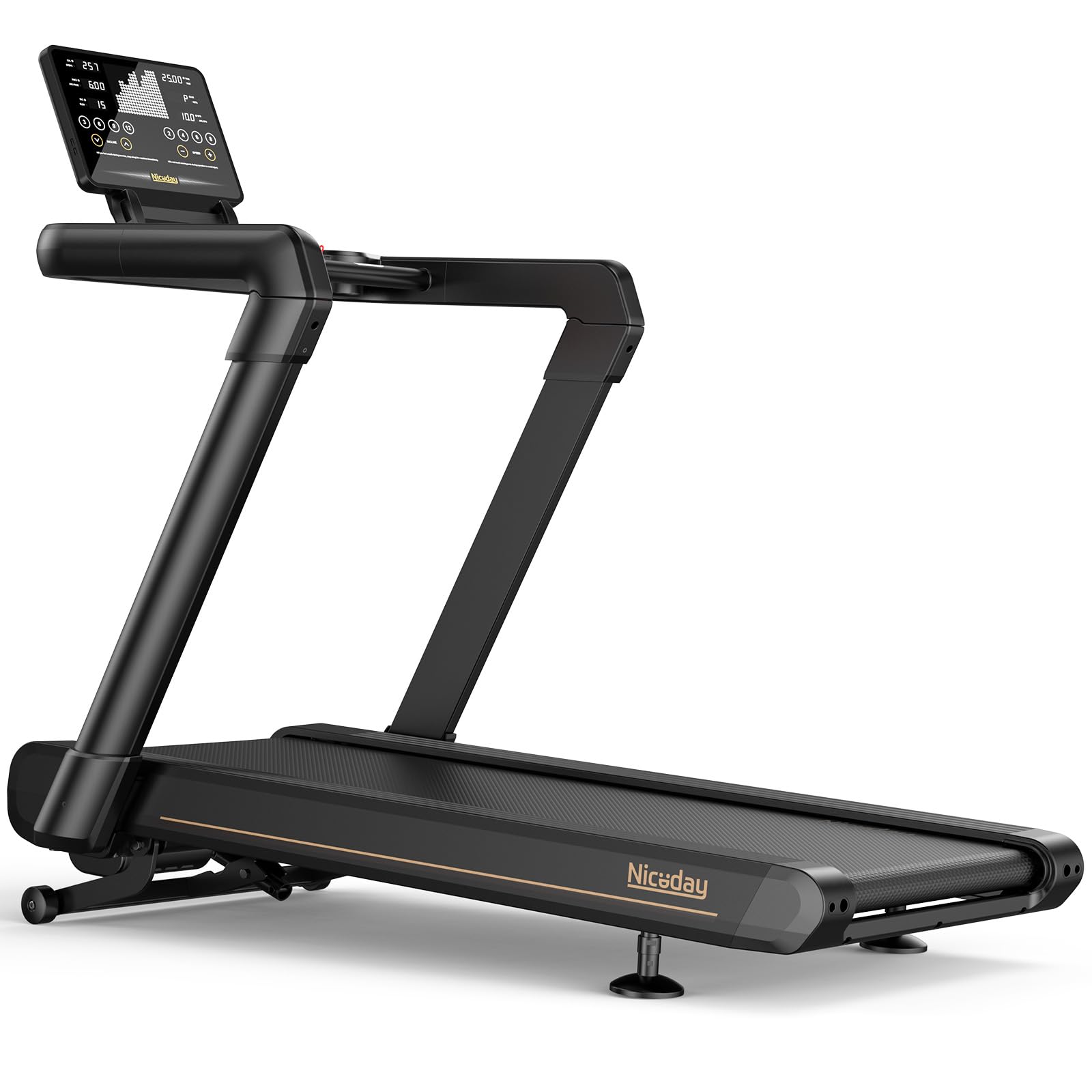
Sixty inches of running deck for the person who actually logs the miles.
The running surface here is the longest of any machine in this round-up: 20 inches wide by 60 inches long, with a 20mm cushioned deck and six impact zones to absorb footstrike. A 4.0 HP brushless motor drives 0.6 to 11.2 mph and 0% to 15% auto incline, carrying a 330 lb weight limit. That combo suits easy miles, tempo runs, and hill climbs without the deck feeling cramped under a longer stride.
Commercial-grade steel and a self-lubricating belt set the maintenance expectation low — no routine silicone oil application means fewer chores in the upkeep column. The 15-inch LED console shows 12 key metrics, including pace, distance, heart rate, calories, and incline. Bluetooth links to Kinomap and Zwift, and the device holder takes tablets and phones from 9 to 15 inches so virtual routes stay visible.
You will need room for this one. The footprint is large and the machine weighs 194 pounds, so it wants a dedicated gym corner rather than a folding spot. Setup is easier than the size suggests, with 95% pre-assembly and just six steps to finish. A marathon pace window keeps your splits on target, and the 2-year parts and 1-year labor warranty cover the frame’s working life.
The runner’s advantage: a 60-inch deck is the longest here, which is exactly what fast interval work needs.
Make room: this is a heavy, wide machine that stays put, so plan a dedicated space instead of a folding corner.
Choose it for: high-volume running where a long deck and a self-lubricating belt save you both space and upkeep.
Not for you if: your training space is small or you need to fold the machine away after each session.
11. Peloton Treadmill
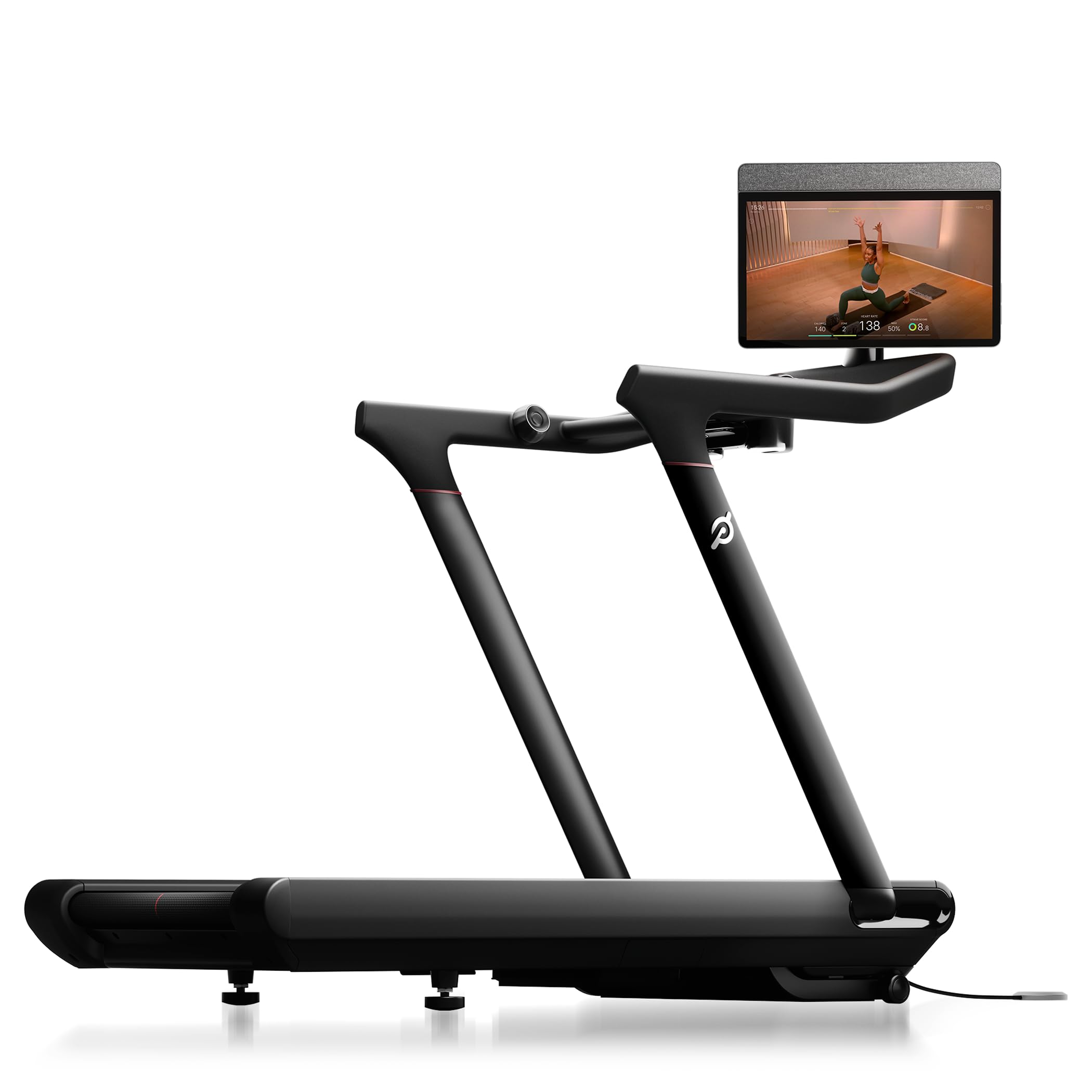
A treadmill that pivots its screen away from the belt and becomes a whole studio.
The 24-inch Full HD touchscreen swivels a full 360 degrees, so you can step off the deck and take a strength, yoga, Pilates, or barre class from the same machine. That swivel is the reason this appeals to people who want more than running from their equipment. The textured belt gives 59 inches of running space inside a compact 5½ by 2¾ foot footprint, supporting users from 4’11” to 6’4″ and up to 300 lbs.
Auto-incline follows instructor cues, and the rotating speed and incline knobs with jump buttons let you adjust without breaking stride. Bluetooth 5.2 handles connectivity, USB-C charging keeps your phone topped up, and front-facing speakers carry the class audio. Speed, mileage, pace splits, heart rate zones, and elevation all show on the screen while you move.
The membership is the part to plan around. A Peloton All-Access Membership open up all the content and intelligent features across the household, and it bills monthly, so the hardware is only part of the picture. Value is the split opinion here — plenty of owners love the classes and the quality, while some feel the monthly cost sits heavy for what the machine itself does. The unit is heavy and wants generous clearance behind the tread and a minimum ceiling height, so measure your room before it ships.
Worth it if: you want one machine for running, strength, and yoga with classes that follow you around the room.
Factor in first: the monthly membership and the room clearance, both of which come with owning this one.
Know the Specs
Deck Length and Belt Width
The deck is the flat running surface under your feet, measured in inches. A longer deck like 58 or 60 inches gives a tall runner room to open up the stride. A shorter belt around 42.5 inches keeps a walker comfortable but crowds a long-legged jogger. Width matters too — an 18-inch belt is common on compact machines, while 20 inches and up feel roomier at speed.
Motor Horsepower (HP)
Horsepower rates how much work the motor can do before the belt lags under a heavier user. A 2.5 HP motor handles walking and light jogging fine. A 3.0 HP or 4.0 HP motor holds speed better through fast intervals and climbs. Heavier machines usually carry bigger motors, which is why the strongest runners here also weigh the most.
Incline Percentage and Levels
Incline raises the front of the deck to mimic a hill, and it is usually listed as a percentage or as numbered levels. A 15% incline is a solid climbing challenge for most home training. Higher numbers like 20% or 25% open steeper hill work. Check whether the grade feels accurate underfoot, because the console number and the actual climb can differ in perceived effort.
Weight Capacity and Folded Size
The weight capacity is the maximum user weight the frame is rated to hold, and it usually rises with heavier construction. Folded size tells you how much floor the machine frees up when not in use. A fold that stands upright or drops near flat is far more useful in a small room than one that only tilts the deck. Measure both the open and folded footprints against your wall before buying.
Common Questions
How long should a treadmill deck be for running?
Does a folding treadmill have to sacrifice running quality?
What does the horsepower rating actually change?
Is a steeper incline actually harder?
Can I use a home treadmill in an apartment without complaints?
Do I need a paid membership to use these treadmills?
Which treadmill folds smallest for a small room?
How much weight will each treadmill actually hold?
Is assembly difficult on a home treadmill?
Which treadmill is best for serious running versus walking?
The Bottom Line
For most households, the strongest workout equipment treadmill here is the Pro Runner X by 3G Cardio — its 58-inch deck, 3.0 HP motor, and 6.5-inch step-up height give runners a real stride at home, all in a folder that still fits a wall. If heavy support and a quiet belt matter more than a long deck, reach for the WELLFIT with its 400 lb capacity. And when you want a machine that arrives built and folds nearly flat, the Sunny Health & Fitness is the one to take home.
Before you decide, measure your room and your stride once. A shorter deck suits walkers, while a longer one like the Niceday TM3’s 60 inches or the Pro Runner X’s 58 inches rewards anyone who runs. Buy for the deck length your stride actually needs, and the rest of the spec sheet matters less.
How we choose
We do not accept paid placement. Every pick is matched to a real buyer and a real use-case; we do not hands-on test units.
Sources
Specifications: manufacturer listings and product documentation. Review insights: verified customer reviews, as of November 2026. Pricing: not shown on this page (it changes often); check the current price via the retailer link.
As an Amazon Associate, Tactical Gear Guy earns from qualifying purchases. This does not affect which products we feature.