Specs are compiled from manufacturer listings and verified buyer reviews and can change over time — please confirm the key details on the product page before buying.
Your bench is the one piece of home gym gear that takes your full body weight plus a loaded bar, and a loose one turns every press into a balancing act. So the short answer: buy on weight capacity, frame steel thickness, and how quickly the backrest locks into a new angle. Everything below is sorted around those three things, with the honest trade-offs spelled out for each bench.
This guide is built by comparing the manufacturers’ published specifications and the patterns across verified customer reviews, so you get each pick’s real strengths and trade-offs instead of marketing spin.
The picks run from a 30-pound folding starter bench to a 112-pound commercial frame, and each entry names the lifter it fits. Read on for a straight breakdown of the best workout bench adjustable options for a home gym.
Top Picks
How To Choose The Best Workout Bench Adjustable
Most first-time buyers assume any adjustable bench will do because it looks like a pad on a frame. That pad carries your full body weight plus the bar, and the frame has to hold both without twisting. Three specs separate a bench that lasts from one that rattles by month three: capacity, steel thickness, and how firmly the backrest locks.
Start with the weight capacity, not the angle count
Your rated weight capacity is the total load the frame is engineered to hold — your body plus the weights. Budget frames often land around 600 to 660 pounds, which handles a lifter and moderate dumbbells fine. Frames rated at 1300 pounds are built for heavier dumbbell work and give you headroom so the steel never sits near its limit. Add your body weight to the heaviest load you press, then pick a rating with headroom above that total.
Count both backrest and seat positions
A backrest that tilts without a matching seat adjustment leaves you sliding on a flat ramp during incline presses. Benches here run from 3 seat positions up to 8, and more seat positions mean a flatter, more supported base under your hips at every angle. Serious decline work needs a leg hold-down that adjusts in both height and depth, which is a separate setting worth checking.
Check the bench height against your rack
Bench height sounds cosmetic until you press off it. The frames here cluster around 17 to 18.6 inches, and that range is what puts your feet flat and your shoulder blades in the right spot for leg drive. If you press inside a power rack, confirm the height sits comfortably above the safety arms so your setup is not cramped.
Decide how much folding you truly need
A foldable bench saves floor space but usually trades away some frame mass. If you have a dedicated corner, a heavier fixed frame like the 59-pound Major Fitness or 97-pound Keppi Bench6000 sits still under every rep. If your gym shares a room with a car or a guest bed, a 360-degree fold or upright vertical storage is worth prioritizing over a couple hundred extra pounds of rating.
Side-by-Side Comparison
| Model | Best For | Weight Capacity | Backrest Positions | Item Weight | Amazon |
|---|---|---|---|---|---|
| JOROTO FID MD80★ Best Overall | Heavy lifting in a garage gym | 1300 lbs | 7 | 42 lbs | Amazon |
| Major Fitness BenchTop Performer | High angle count without folding | 1300 lbs | 9 | 59 lbs | Amazon |
| FLYBIRD WB7Tall Lifter Pick | Tall lifters needing head support | 1300 lbs | 6 | 48.5 lbs | Amazon |
| YOLEO Commercial | Powerlifting-style stability | 2315 lbs test load | 10 | 60.6 lbs | Amazon |
| REP AB-3000 | Compact storage, pro build | 1000 lbs | FID platform | 112 lbs | Amazon |
| Keppi Bench3000 V2 | Leg extension and curl work | 1200 lbs | 12 | 93 lbs | Amazon |
| Keppi Bench6000 | Decline and bicep isolation | — | 11 | 97 lbs | Amazon |
| FLYBIRD WB6 | Small rooms and apartments | 880 lbs | 8 | 30 lbs | Amazon |
| BARWING 900LBS | Tall users and gap-free padding | 900 lbs | 9 | 32 lbs | Amazon |
| Marcy SB-7485 | Zero-assembly, everyday training | 600 lbs | 8 | 30 lbs | Amazon |
| Amazon Basics Foldable | First bench on a tight budget | 660 lbs | 7 | 13.8 kg | Amazon |
Detailed Reviews
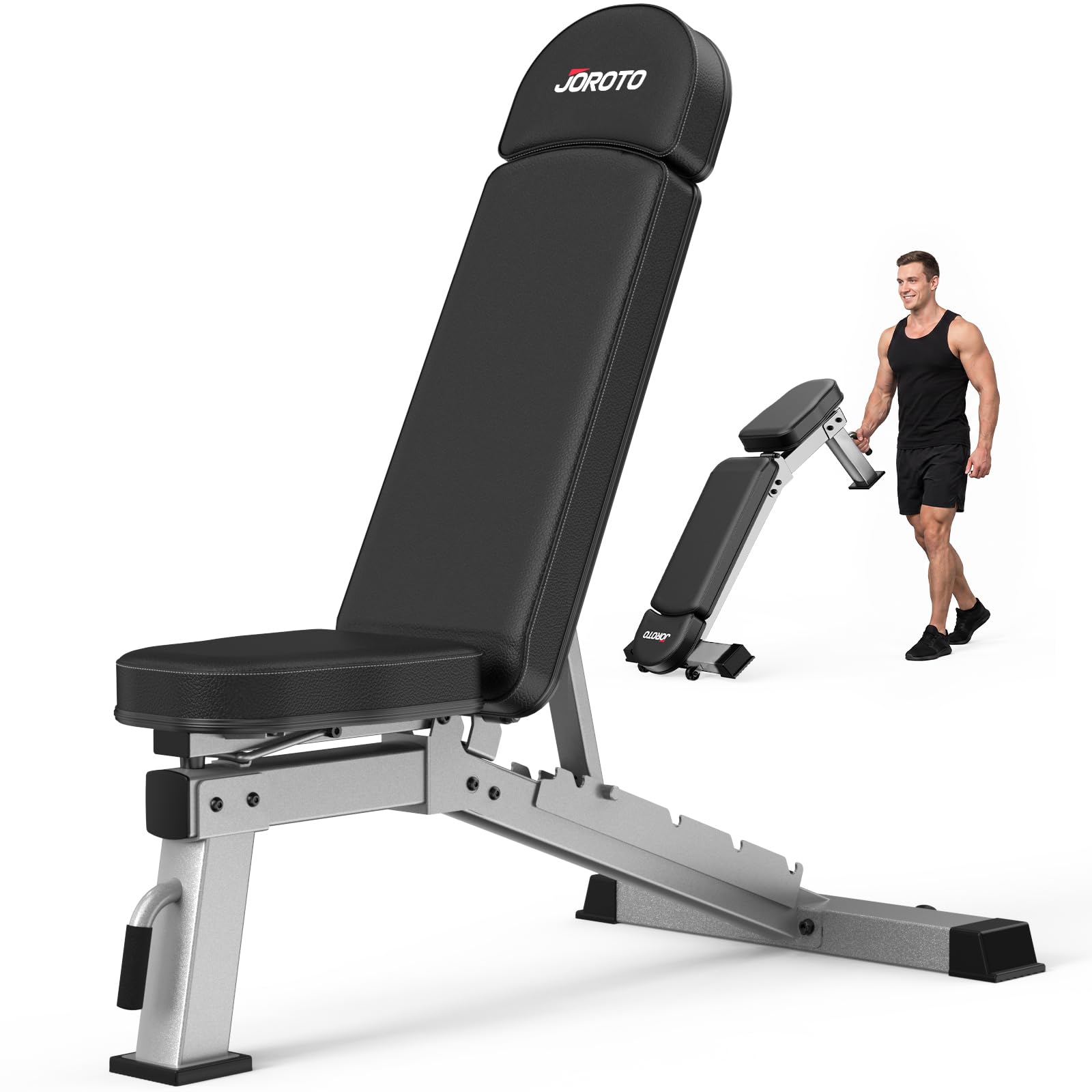
1. JOROTO FID Adjustable Weight Bench
Our pick — 4.5+★ from 900+ verified ratings; the strongest balance of quality and price.
A 1300-pound alloy steel frame that assembles with five bolts and still rolls out of the way.
If you press heavy dumbbells and want the frame to shrug it off, start here. The JOROTO MD80 is rated to hold 1300 pounds — the total of your body weight plus the load — and the maker states the frame was tested to 1500 pounds. That headroom is why the steel feels planted under a loaded bar instead of flexing. It is the crowd favorite too, sitting at 4.5+ stars across 900+ ratings.
The adjustment range is 7 backrest angles plus 2 seat adjustments, covering flat, incline, decline, and upright. That seat setting is what keeps your hips supported when the back pad climbs. Built-in transport wheels and handles solve the one problem with a 42-pound bench — moving it without dragging the feet across your floor. A 17-inch seat height puts most users in a strong position for leg drive.
The catch is weight, in both directions. At 42 pounds it out-masses the Marcy SB-7485 by a wide margin — 42 pounds to 30 — which is exactly why it feels steadier, but it also means you will use those wheels. Compare it with the Marcy and the JOROTO also gives you 1300 pounds of capacity versus 600. The padding is high-density foam under sweat-resistant leather, and the widened backrest cuts pressure points on long bench sessions.
What earns the top spot
- 1300-pound rated capacity, tested to 1500 pounds by the maker, so heavy dumbbell work stays well inside the limit.
- Five-bolt assembly gets you lifting the same afternoon instead of losing a weekend to tools.
- Wheels and handles make a 42-pound frame genuinely portable around a garage.
- 7 backrest angles plus 2 seat positions cover flat, incline, decline, and upright pressing.
Where it asks something of you
- Heavier than the budget frames here — plan on rolling it, not carrying it up stairs.
- It does not fold flat, so it needs a permanent corner of the room.
Buy it for: anyone loading real weight who wants commercial-grade bracing in a frame they can still wheel aside.
Think twice if: your gym doubles as a living space and has to disappear between sessions.
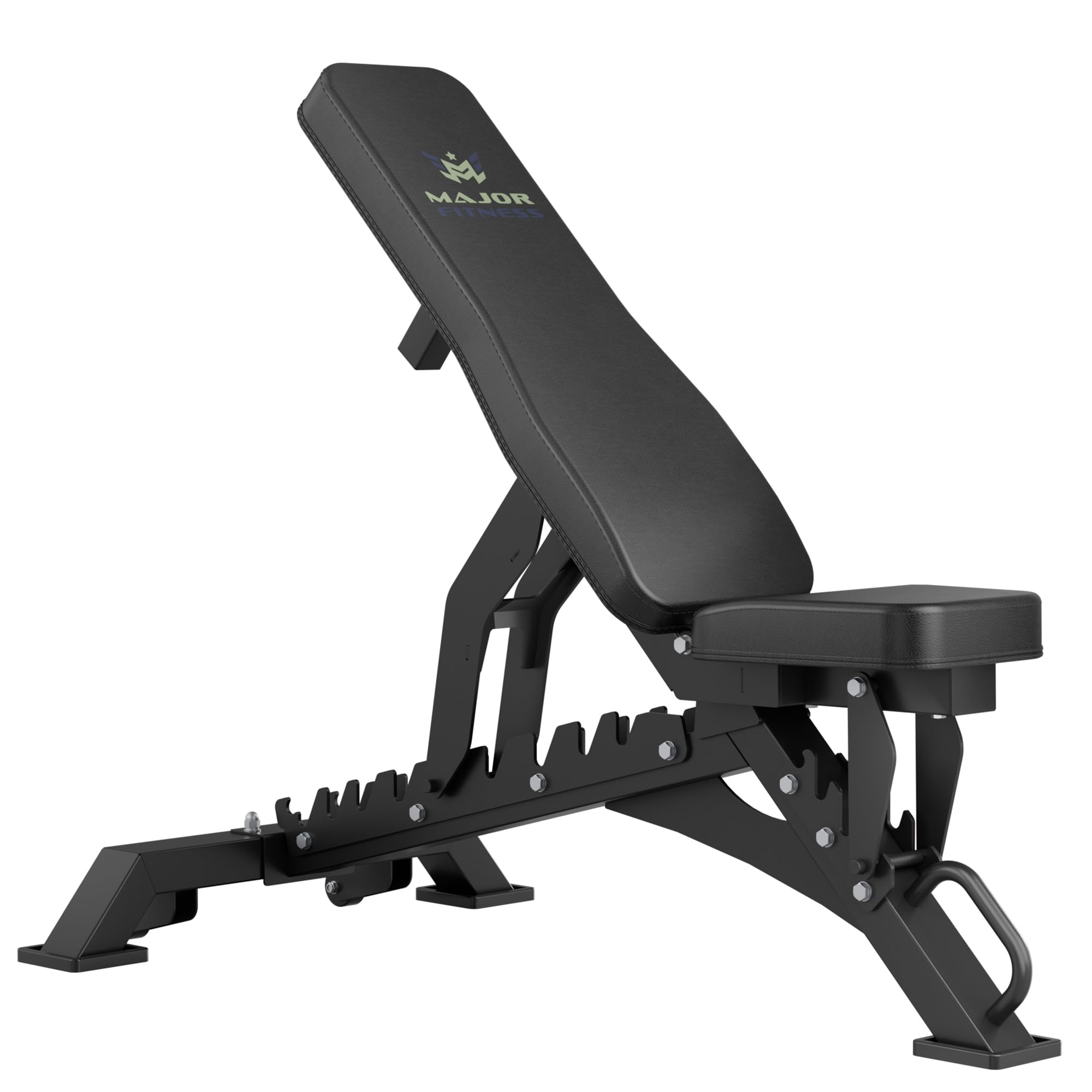
2. Major Fitness Weight Bench
Thirty-six positions on commercial square steel — the angle hoarder’s bench.
The Major Fitness bench hands you 9 backrest positions and 4 seat positions, which the maker totals as 36 adjustable configurations from flat through incline and a full 90-degree upright. Compare that with the JOROTO’s 2 seat adjustments and you can see where the extra flexibility lives: your hips move with the back pad instead of staying locked. The dual-track design on the backrest support bar is the second layer of bracing under heavy sets.
That 1300-pound capacity rides on a triangular structure and commercial-grade square steel, and the frame weighs 59 pounds — the mass is why it sits still. The 2.5-inch padding is covered in waterproof PU leather, and the 31.5-inch backrest is long enough to support your head when you lie back. Wheels and a handle mean it moves when you want it to, then stays put.
Here is the honest bit: the frame is wide at 29.2 inches across, and some owners find the pad narrower than they expected under the shoulders. The welds and matte finish hold up over time, and a one-year component replacement warranty backs the frame. For a lifter who changes angles four times a session, those 9 backrest stops are the real selling point.
The angle advantage: nine backrest stops and four seat stops give you finer resolution between flat and steep than almost anything else on this list, which matters if you chase very specific press angles.
Room required: it is a 59-pound, non-folding frame, so reserve a spot before it arrives.
Reach for this if: your training plan calls for many distinct angles and you want a heavy frame that never shifts.
Look elsewhere if: you need the bench to fold away between workouts.
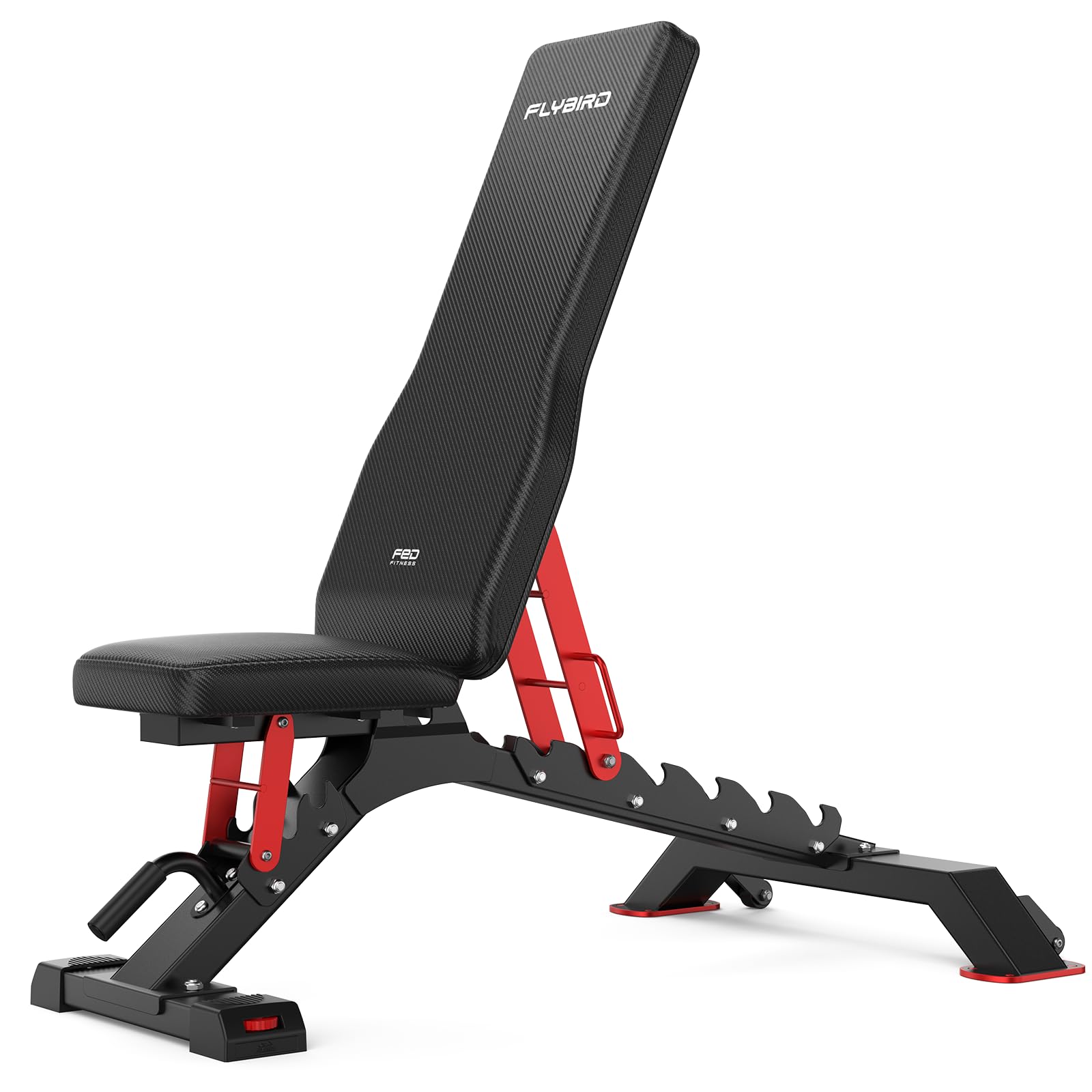
3. FLYBIRD WB7 Weight Bench
A 34-inch back pad built for lifters who hang their head off shorter benches.
The WB7’s defining number is that 34-inch backrest. If you stand over six feet, most bench pads end at your neck and leave your head dangling — this one supports your head and neck through the full range. The 17.7-inch press height follows the IPF standard, which keeps your arm and chest angles where they belong for pressing power. Capacity is 1300 pounds, tested on a triangle-reinforced frame of 3.2-inch by 1.6-inch tubular steel.
Adjustment runs on a C-shaped buckle the maker says moves in about a second, with 6 backrest angles from 0 to 90 degrees and 3 seat angles from 0 to 25 degrees. The one-piece steel frame cuts down on weld points so stress spreads across the structure. Woven leather over 2.5-inch high-density padding should hold up to daily abuse, and the 48.5-pound frame is heavy enough not to slide when you set your feet.
Worth knowing: the frame is narrow at 13 inches wide, which is why it stays out of your way but can feel slim if you are broad-shouldered. Assembly is partly done for you, with 75 percent of parts and tools pre-installed, and dual wheels plus a handle handle the moving. It carries a 1-year cover on frame and parts.
Head and neck support: the 34-inch backrest is the reason tall lifters gravitate here — no more craning off the end of the pad during flat presses.
Slim footprint caveat: a 13-inch-wide frame suits most lifters but gives broader shoulders less pad to land on.
Made for: taller lifters and anyone who wants proper head support plus a standard-height press surface.
Pass if: you want a wide, generous pad over a slim and space-friendly one.
4. YOLEO Commercial Weight Bench, 2315LB ASTM Certified
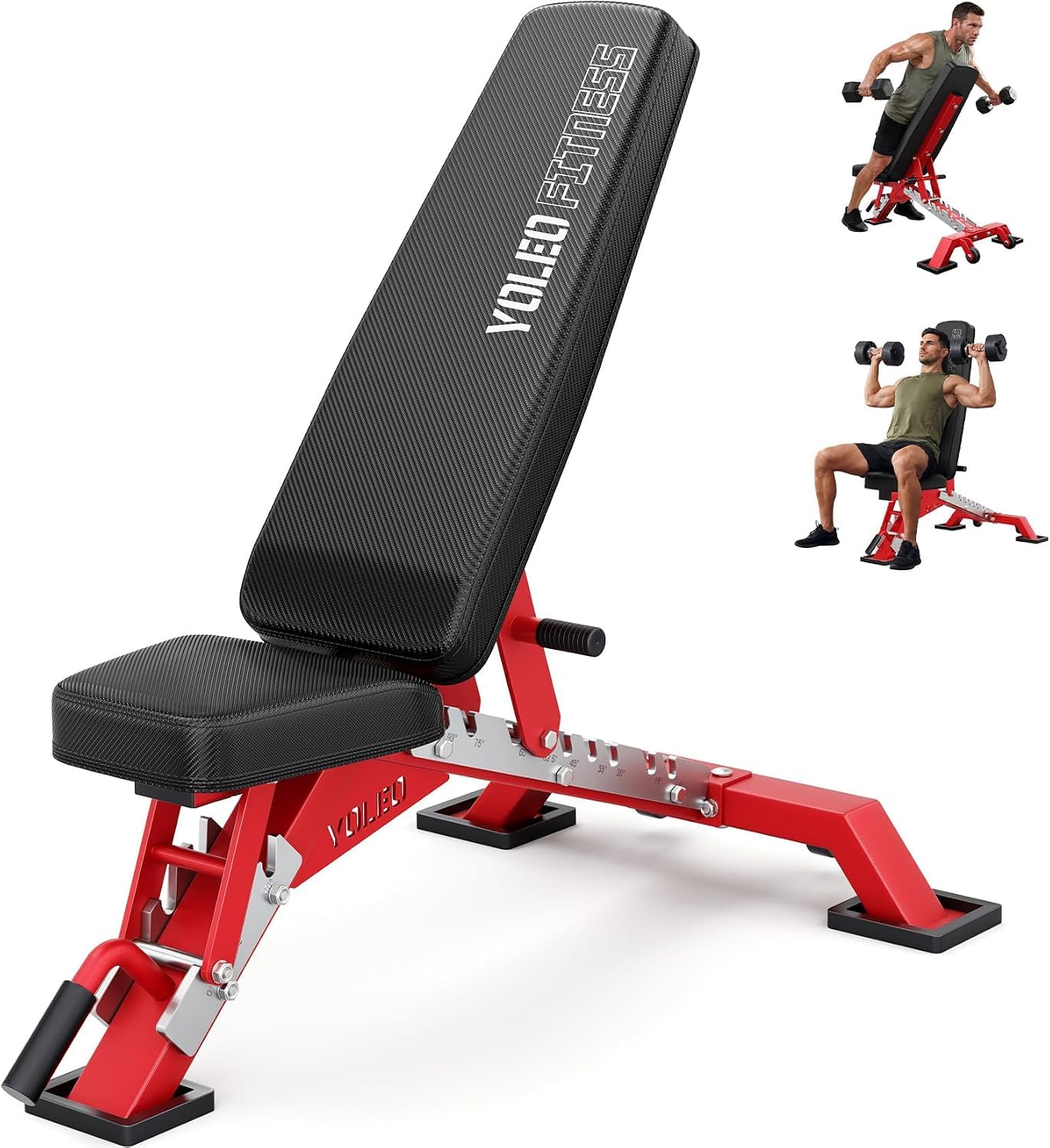
A three-post, 2315-pound test-load frame aimed at powerlifting demands.
YOLEO built this around a 3-post design for lateral stability, then added a 2.4-inch by 1.2-inch heavy-duty steel frame and 0.12-inch reinforced iron sheet. The headline figure is a 2315-pound test load capacity, supported by the H-shaped back support, triangular frame, and 4.5-by-4.5-inch rubber foot pads. That is the highest load figure on this list, and it is the bench for someone who never wants to think about the frame again.
Angles come from a C-shaped open-ladder locking mechanism the maker says adjusts inside 1 second, with 10 backrest positions spanning -15 to 90 degrees and 3 seat settings from 0 to 30 degrees. A full 90-degree backrest opens up shoulder and ab work you cannot do on a shallow incline. The 32-inch backrest supports your head, and the 2.4-inch 160D pearl sponge padding sits under PU twill leather. At 60.6 pounds it is one of the heavier benches here, and 8-gauge steel at up to 4.0mm is why.
Two things to know. It ships roughly pre-assembled with a maker-stated 6-step setup, and an extra handle plus 3-inch wheels let you lever 60.6 pounds around without lifting it. The genuine trade-off is floor space — this is a big, wide frame at 49 inches across, so measure your rack area first. A 10-year coverage on frame and components backs the build.
Built for the heavy end: 2315 pounds of test load, 8-gauge steel, and a 3-post structure put this frame in a different league for max-effort pressing.
Measure twice: at 49 inches wide and 60.6 pounds, it wants a real gym corner, not a hallway.
This one is for: heavy pressers and powerlifters who want the highest load rating and a decade-long frame warranty.
Not your bench if: your training area is tight or you need to fold it away.
5. REP FID Foldable Weight Bench AB-3000
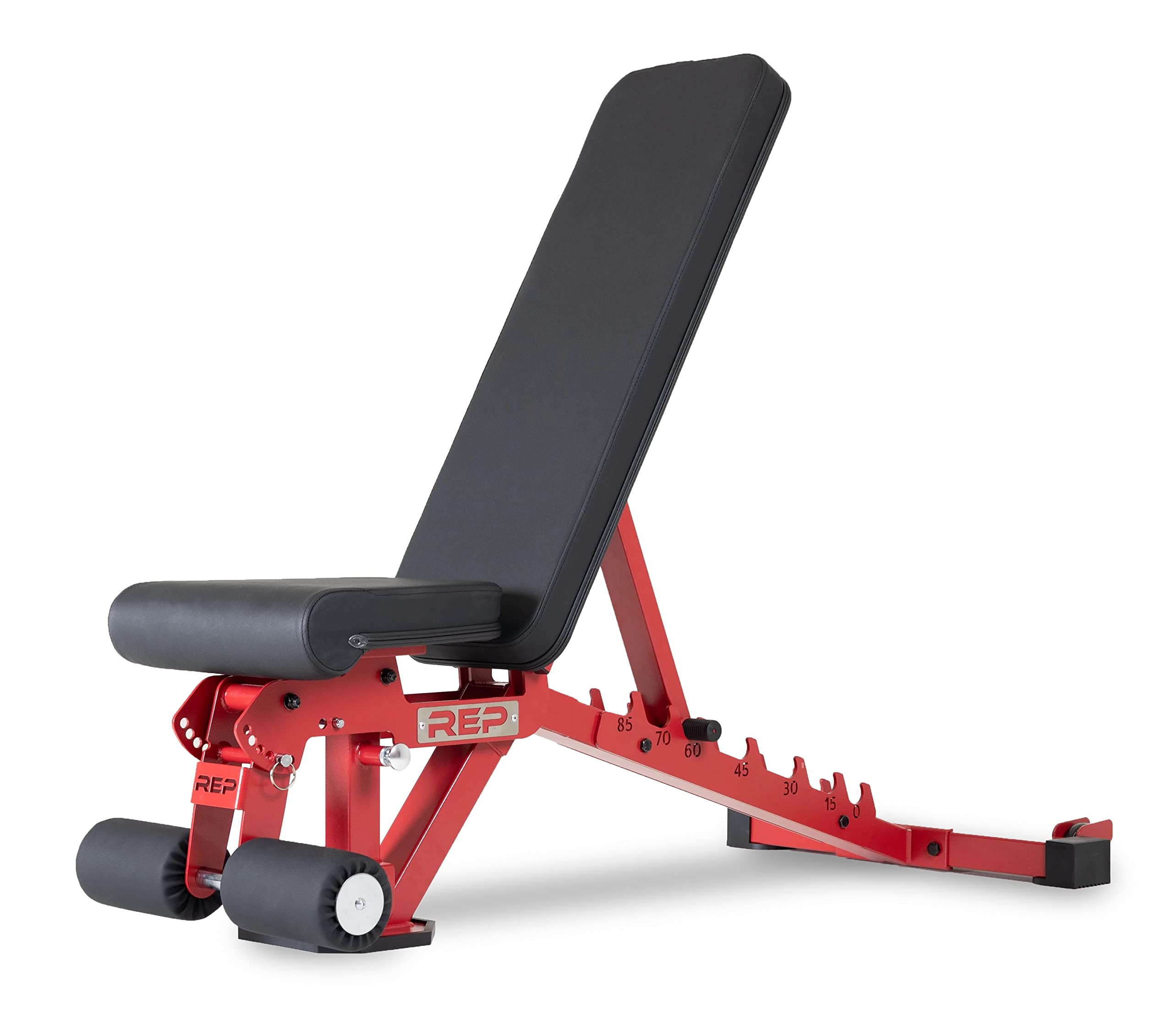
A folding bench that weighs 112 pounds — the storage answer for serious lifters.
Here is the bench that breaks the usual rule. Folding benches are normally light and flexy, but the REP AB-3000 folds for tight spaces while carrying 112 pounds of premium steel and rated for 1000 pounds of load. That mass is the whole point: a folding frame this heavy does not skate across the floor mid-press. It ships with a flat, incline, and decline platform so you can chase chest, core, shoulder, and arm angles from one frame.
Integrated wheels let you roll it between setups, then a secure base locks it down for work. High-density padding handles long sessions, and the reinforced frame is built for dumbbell and ab routines rather than one light exercise. Pair it against the FLYBIRD WB6 at 30 pounds and 880 pounds of capacity, and the REP gives you 112 pounds of frame and 1000 pounds rated — a different class of build if you have the floor plan for it.
The honest caveat is that 112 pounds is a genuine lift if your space has stairs, and folding it is a two-hand job rather than a one-second flip. Assembly follows clear instructions and is straightforward. It earns 4.5+ stars from a smaller base of 100+ ratings — the highest score on this list, though fewer owners have weighed in than on the frames below.
Storage without compromise: 1000 pounds of capacity in a bench that still folds — rare in this category, and the 112-pound frame is the reason it holds steady.
Weight tax: moving and folding that much steel is real physical work, so plan a spot where it can mostly stay put.
The pick for: a lifter with limited floor space who refuses to give up a rock-steady frame.
Downsides for: anyone who needs to carry their bench up and down stairs between sessions.
6. Keppi Fitness Functional Weight Bench Bench3000 V2
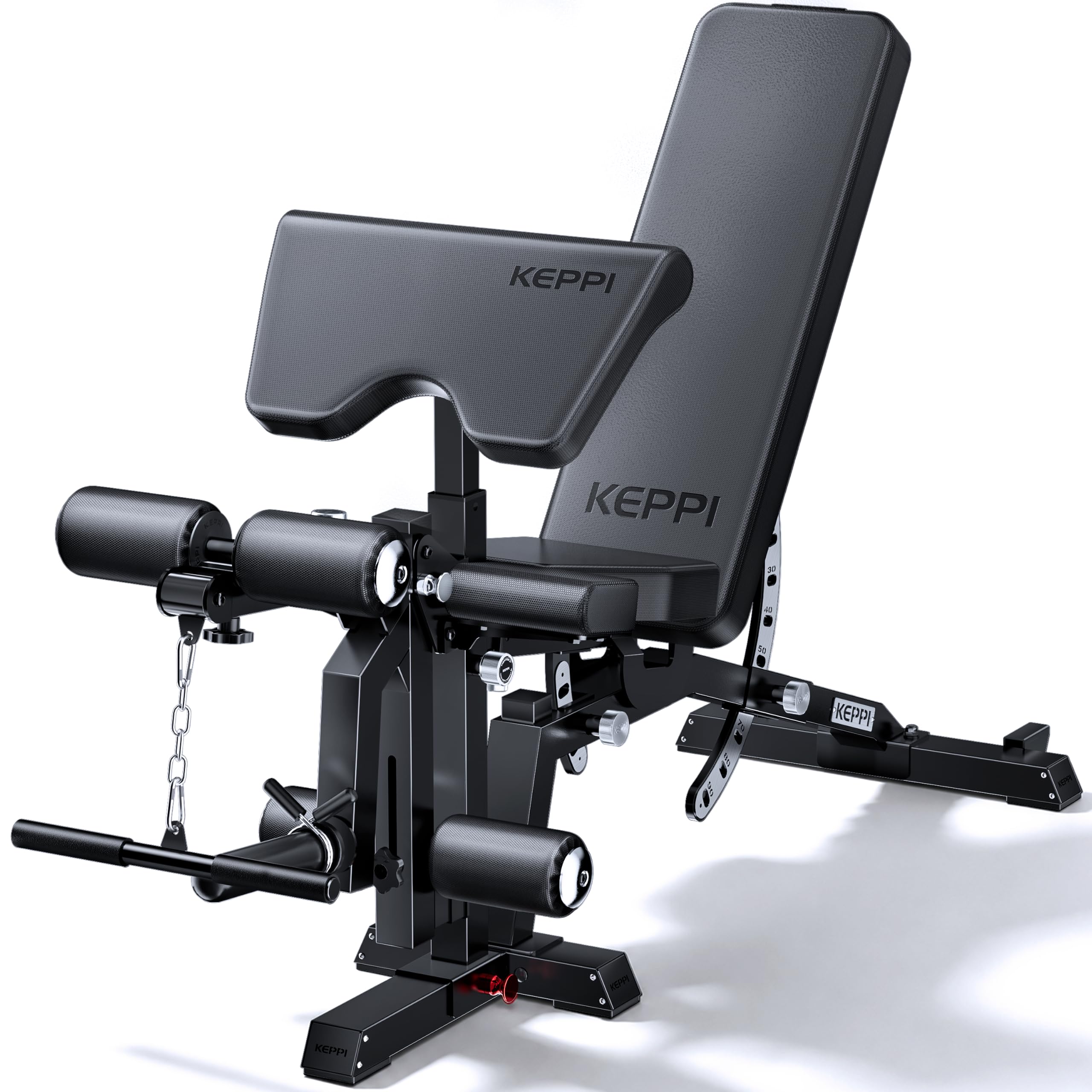
Twelve backrest angles and a leg-curl attachment that turns one bench into a leg station.
Most benches stop at your torso. The Keppi Bench3000 V2 adds a functional attachment for leg extensions, curls, and bicep work — with 5 range-of-motion angles, 5 arm length settings, and 5 preacher pad heights. That is the reason to pay for this frame: it replaces several single-purpose machines. The core bench gives you 12 backrest angles from -20 to 90 degrees and 3 seat positions at 0, 10, and 20 degrees.
Capacity is 1200 pounds in the flat position, carried on a 93-pound reinforced steel frame built from 8/16-gauge steel with aluminum alloy components and PVC upholstery. The 10-degree seat and oversized thigh pad are shaped for isolation work. When you want a plain bench, a magnetic pin and spring pin let you pull the attachment off in seconds — the maker says about 30 seconds back to a standard bench with no tools.
Where it gives ground is mobility and range. A few buyers report limited range of motion on some movements, and while the rear wheels help, 93 pounds is not something you toss around. Still, it earns 4.0+ stars across 700+ ratings, and the angle count alone — 12 backrest stops versus 6 on the FLYBIRD WB7 — is what keeps it in a lot of home gyms. It stands upright in 3.5 square feet when you are done.
Why it stays in the conversation
- 12 backrest angles plus 3 seats give the finest angle control on this list.
- Leg extension and curl attachment with 5 ROM angles handles lower-body isolation a plain bench cannot.
- Tool-free attachment removal converts it back to a standard bench in about 30 seconds.
- Upright storage in 3.5 square feet keeps a 93-pound frame out of the way.
The honest limitations
- Some owners hit a shorter range of motion on certain exercises than expected.
- At 93 pounds, it is a two-person move if you need to relocate it far.
Ideal if: you want one bench that covers chest, back, arms, and legs without buying separate leg equipment.
Weigh the trade-off if: you mainly press and would rather not pay for attachments you will not use.
7. Keppi Fitness Bench6000 Weight Bench, Commercial Grade FID
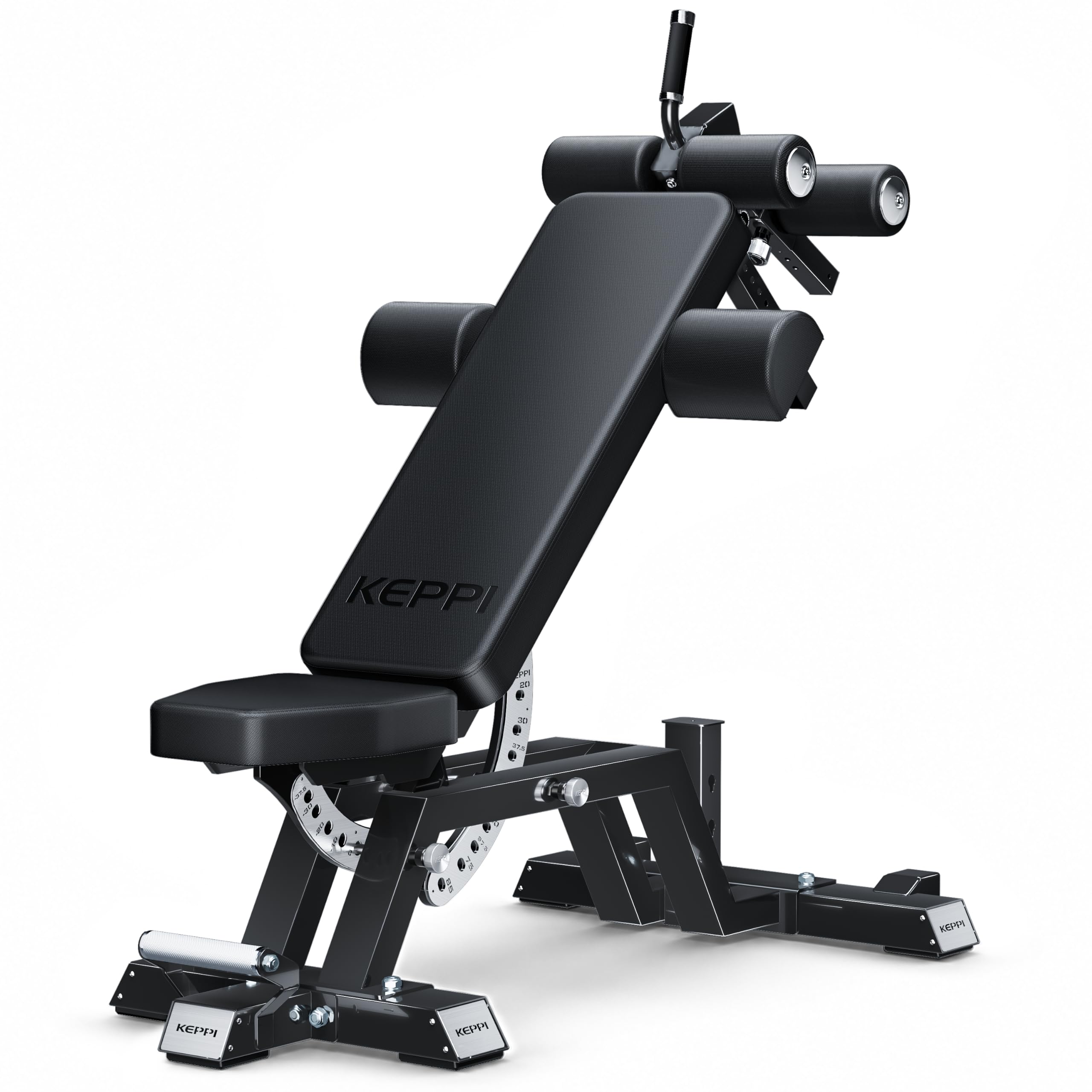
A 97-pound commercial frame with a leg hold-down that actually holds you in decline.
The Bench6000’s edge is its 8+5+4+4 adjustable leg hold-down. That means the leg support moves in height and depth, so it fits you no matter your shin length — a genuine advantage for decline pressing and Nordic curls. Pair that with 11 backrest positions and 8 seat adjustments and you can chase full-body angles on one platform. It sits on a 97-pound frame of high-strength Q235 steel, which is why it holds still under heavy loads.
The 17-inch height follows the IPF standard for proper foot placement and force transfer, and the 2.75-inch thick high-density pad uses Frict X PVC leather for grip that keeps your back from sliding. A bicep curl pad with 5 height settings adds arm isolation with quick-lock installation. When storage time comes, it stands upright in 3.5 square feet.
Two practical notes: it is one of the heaviest benches here at 97 pounds, so moving it is deliberate rather than casual, and it suits a dedicated garage spot far better than a guest room. The build is aimed at both home lifters and commercial environments. It scores 4.5+ stars from 100+ ratings, and the value is strong when you count the leg attachment and bicep pad as included.
Leg hold-down done right: 8+5+4+4 adjustments on the leg support let almost any body type lock in for decline work — the thing most benches get wrong.
Weight and placement: 97 pounds of steel is best parked where it can stay, so plan a fixed home for it.
Suits you if: decline pressing, sit-ups, and isolation work fill your training week.
Look past it if: you want a light bench you can shift session to session.
8. FLYBIRD WB6 Adjustable Weight Bench, 880LBS
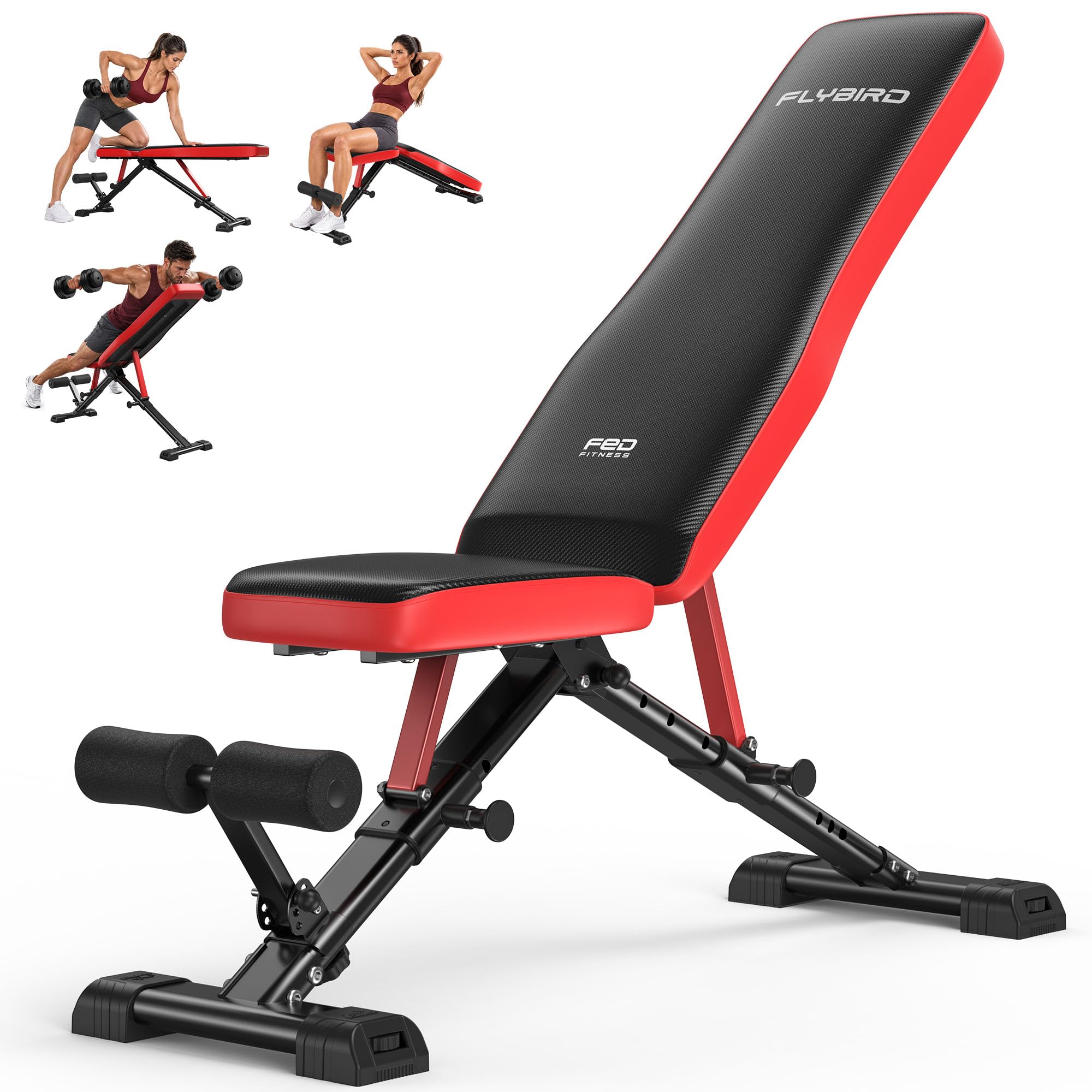
Folds in seconds, arrives almost built, and fits where a full rack cannot.
For a small apartment gym, the WB6 makes the most sense of anything here. It folds down in seconds when not in use, and the maker says it arrives 99 percent pre-assembled — you attach one foot support and start training. The 880-pound capacity rides on 1.4mm tubular steel with a triangular structure, enough for basic training through a heavy dumbbell press. Adjustable end caps and flat feet keep it level on uneven floors.
You get 8 backrest angles and 3 seat adjustments for strength, sculpting, and endurance work, switched via a spring pin design that balances speed and safety. Diamond-patterned leather on the pad stops your back from sliding mid-lift. At 30 pounds it is among the lightest benches here, which makes it easy to flip up and lean against a wall.
The trade-off is width. The frame is 20.87 inches across, and while some lifters call it extremely compact, broader users find it on the narrow side under the shoulders. That slim build is what lets it live in a corner without dominating a room. It earns 4.5+ stars across 800+ ratings, and the folding plus near-zero assembly is exactly what a first home gym needs.
Set up and stow in minutes: near-complete assembly plus a fast fold means this bench lives happily in a rental or small room.
Narrow pad: the 20.87-inch width feels slim to broad-shouldered lifters — check it suits your frame before you commit.
Best for: apartment lifters and first-timers who need a bench that stows fast and sets up faster.
Not ideal for: very broad lifters who want a wide, generous pad.
9. BARWING 900LBS Adjustable Workout Bench for Home Gym

Nine backrest stops, four leg-support heights, and a pad that closes the gap.
The BARWING solves a specific problem: comfort for tall lifters. It offers 9 backrest positions, 4 seat adjustments, 4 leg-support heights, and 3 leg-support depths — the maker totals that as 432 combinations, and the depth and height settings specifically fit taller users. The 18.6-inch seat height and 45.3-inch total seat-plus-backrest length are set for that same crowd. Capacity is 900 pounds on a thickened steel frame.
Stability comes from a fifth support bar and a fourth triangular structure the maker worked into the upgraded frame, for five support bars and four triangles where typical benches run two or three. A dual-locking spring adjustment releases in about a second and locks with a right turn, so the backrest will not slip mid-set. The padded gap between seat and backrest is reduced, and the four-layer padding includes a wooden inner board plus three layers of memory foam.
Where it asks for care: it is a foldable bench at 32 pounds, and some owners mention wobble under heavy load, so it shines for moderate dumbbell work rather than max-effort barbell pressing. The wear-resistant leather cover wipes clean, and the frame folds 360 degrees into a compact footprint. It holds 4.5+ stars across 400+ ratings, with value and adjustability doing most of the convincing.
Fit for big frames: leg support that adjusts in both height and depth is what lets tall users press properly — few benches bother.
Know its ceiling: some owners find it wobbles under heavy loads, so treat it as a dumbbell and moderate-weight bench.
Go for it if: you are tall, want leg support that fits you, and train with dumbbells.
Consider a heavier frame instead if: you press heavy barbell loads and demand zero play.
10. Marcy SB-7485 Adjustable Weight Bench

Comes built, unfolds once, and you are pressing — no bolts, no tools, no instructions.
The entire pitch is in the name: the Marcy SB-7485 arrives pre-built. Unfold it and you are done, which matters if you would rather train than read an assembly manual. Its adjustment range runs 8 backrest positions and 5 seat positions — more seat stops than the Amazon Basics bench’s 3 — and a secure locking knob holds each angle. Capacity is 600 pounds on an alloy steel frame, and it weighs 30 pounds.
Comfort sits at the front of the design. The wider backrest and seat carry 2-inch thick high-density foam, and the vinyl cover is double-stitched for durability and easy wiping. A powder-coated frame with non-slip rubber end caps protects both your stability and your floor. Fold it down and a carry handle lets you move it between rooms or stash it in a closet.
Be realistic about the ceiling: 600 pounds is the lowest capacity here, so it is built for everyday dumbbell work rather than a loaded barbell at your max. That lower spec is what keeps it light and easy to fold. It rates 4.5+ stars across 900+ ratings, and the maker’s own track record with companion programs — one buyer puts it to work with P90x and Body Beast — shows it holds up to structured home training.
Zero setup friction: arriving fully assembled makes this the fastest route from delivery to first set.
Capacity ceiling: 600 pounds means it suits bodyweight and dumbbell work, not max-effort barbell pressing.
Worth it for: anyone who dreads tools and wants a solid bench for dumbbells and home programs.
Skip the temptation if: you train heavy enough to push past 600 pounds of total load.
11. Amazon Basics Adjustable Weight Bench
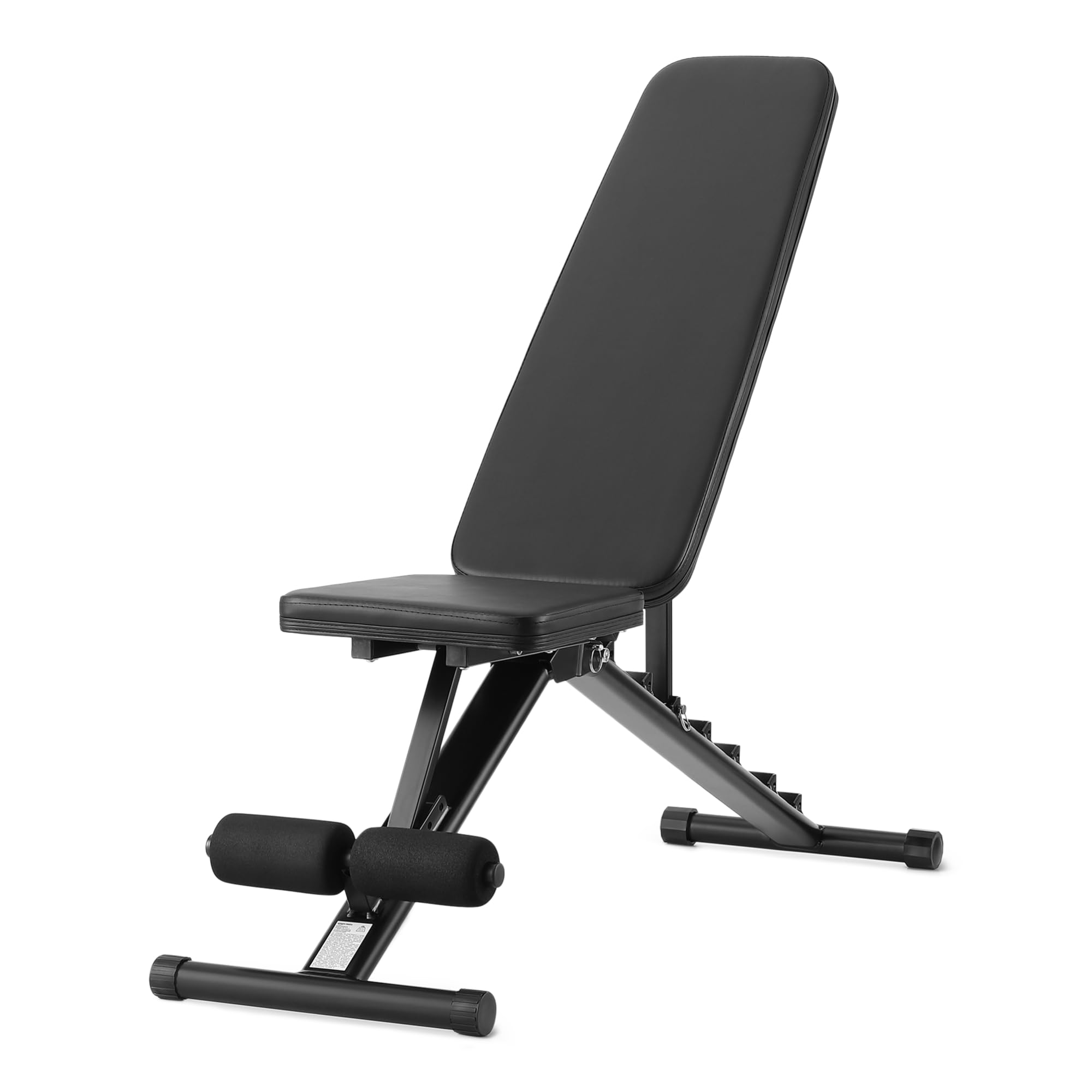
The entry ticket: seven backrest angles, a fold-flat frame, and no surprises.
For a first bench, the Amazon Basics model keeps things simple. It gives you 7 backrest positions and 3 seat positions for incline, decline, and flat work, supported by an alloy steel frame rated to 660 pounds. A fast folding mechanism lets it collapse for storage, and the compact size keeps it out of the way in a small home gym.
At 13.8 kg the frame is easy to shift, and setup is quick. Most of what owners value shows up around basic functionality and value, though adjustability and comfort draw mixed read. Customers note the padding is secured by nails hammered into particle board — so it is a bench to use with reasonable loads and to keep dry, rather than an heirloom frame for max-effort pressing.
That mixed material read is the reason to size your expectations, not to dismiss it. It still rates 4.5+ stars across 300+ ratings, and as an entry point for dumbbell work and bodyweight training it is sensible. If you plan to press heavy for years, spend up to the JOROTO or FLYBIRD WB7 instead — 660 pounds of capacity versus 1300 is a wide gap.
Cheap start, clear ceiling: 7 backrest positions and a fold-flat frame get you training on day one without overspending.
Material reality: the padded sections rely on a particle board base secured with nails, so treat it gently and keep it for moderate loads.
Pick it when: you want a first bench for dumbbells and bodyweight work with minimal spend and easy storage.
Move up the list if: heavy barbell pressing is in your future.
Know the Specs
Weight Capacity and Test Load
The rated figure is the total your frame is designed to hold — your body plus the weight. A test load is what the maker pushed the frame to in checking it, and it sits above the rated number. Bigger figures usually mean thicker steel and a heavier bench, which is why the rated capacity tracks so closely with how much the frame itself weighs. Match the capacity to your real training load and leave margin.
Backrest and Seat Positions
Backrest positions set how steeply you incline; seat positions set the angle under your hips. A bench with many backrest stops but only a couple of seat stops leaves you sliding during incline work. Leg support that adjusts in both height and depth is separate and matters for decline pressing. Count all three before you decide a bench is flexible.
Bench Height
Height runs roughly 17 to 18.6 inches across these frames, aligning with the height a competition press expects. A correct height puts your feet flat on the floor and your shoulder blades in the right place, which is what lets you push through your legs. Too low or too high and you lose that drive.
Padding and Upholstery
Pad thickness ranges from 2 to 2.75 inches across this list. Thicker high-density foam supports you on long sets, while textured leathers give grip so your back does not slide. Folding and lighter benches often thin the padding; heavier frames keep it plusher.
Common Questions
How much weight capacity do I actually need on an adjustable bench?
What is the difference between rated weight capacity and test load?
Will a foldable bench wobble under heavy lifting?
How many seat positions should an adjustable bench have?
What bench height should I look for if I press in a power rack?
Can a folding bench handle barbell bench pressing?
Does an adjustable bench work with both dumbbells and a barbell?
How much floor space does a bench take when it is folded?
Is a heavier bench better than a lighter one?
Do I need a leg hold-down for decline pressing?
What padding thickness is comfortable for long sessions?
The Bottom Line
For most lifters, the workout bench adjustable winner is the JOROTO FID MD80 — 1300 pounds of rated capacity, seven backrest angles, and wheels that make a 42-pound frame easy to move, which is the balance of strength and convenience most home gyms want. The 4.5+ star score across 900+ ratings tells you it holds up in real garages.
If you are tall and want proper head support at a standard press height, the FLYBIRD WB7 with its 34-inch backrest is the one to grab. And for leg extensions, curls, and the widest angle range here, the Keppi Bench3000 V2 is worth the step up.
One practical nudge: check the item weight and capacity together before you commit. The heavier frames like the YOLEO at 60.6 pounds and the REP at 112 pounds give you stability you feel on every rep, but they also ask for permanent floor space — measure your corner once and the right bench becomes obvious.
How we choose
We do not accept paid placement. Every pick is matched to a real buyer and a real use-case; we do not hands-on test units.
Sources
Specifications: manufacturer listings and product documentation. Review insights: verified customer reviews, as of November 2026. Pricing: not shown on this page (it changes often); check the current price via the retailer link.
As an Amazon Associate, Tactical Gear Guy earns from qualifying purchases. This does not affect which products we feature.