Specs are compiled from manufacturer listings and verified buyer reviews and can change over time — please confirm the key details on the product page before buying.
Your boots are the one piece of work gear you wear for every single hour of the shift, so the wrong pair shows up as sore heels by lunch and a lacing job you dread every morning. Start with the Wolverine I-90 EPX Boa — 4.5+ stars across 400+ owners — because its Boa twist dial lets you cinch the fit with gloves on. Everything below is weighed on toe protection, waterproofing, sole grip, and how your feet feel at hour ten, so you can tell a boot that survives the job from one that just looks the part.
This guide is built by comparing the manufacturers’ published specifications and the patterns across verified customer reviews, so you get each pick’s real strengths and trade-offs instead of marketing spin.
Below you’ll find nine pairs benchmarked on toe type, leather quality, and outsole grip, with honest fit notes so you can buy once. From lace-free dials to Goodyear-welted leather, here is how to sort the durable work zone boots that hold up past the first month of real shifts.
Top Picks


How To Choose The Best Work Zone Boots
A good work boot solves three problems at once: it protects your toes from dropped loads, it keeps your feet dry through wet ground, and it keeps you upright on oil-slick concrete. Buyers get caught out by assuming the most expensive pair is automatically the most comfortable. The truth is that the boot’s build — toe type, shank, outsole, and how it fits your own foot — decides how your shift feels far more than the price tier does.
Toe Type: Steel, Composite, or None
A steel toe is a metal cap that stops a dropped object from crushing your toes, and it meets ASTM impact and compression standards on the boots here that name it. A composite toe uses a non-metal cap that does the same protective job, typically weighing less and not transferring cold to your toes. If your site requires safety toe footwear, check the model’s safety marking before you buy. If you only walk around a shop floor, a plain leather toe box may be all you need.
Waterproofing and Water Resistance
Waterproofing on a work boot usually means a membrane inside the upper that blocks water while letting sweat vapor out. Water resistance is a softer claim — the leather is treated, so it shrugs off splashes but may soak through in a puddle. Read the exact wording on the listing. A boot labeled waterproof is the safer choice for concrete pour crews and outdoor site work.
Outsole Grip and Slip Resistance
The outsole is the bottom rubber layer that touches the ground, and its lug pattern matters more than the tread brand. A pronounced lug pattern grips loose dirt and climbs ladders well. A slip-resistant outsole is engineered to shed oil and water so you don’t slide on smooth concrete. Match the sole to your surface: mud and gravel want deep lugs, a shop floor wants a flat, oil-resistant compound.
Weight, Shank, and All-Day Fatigue
A shank is a stiff strip inside the sole — nylon, steel, or composite — that keeps the boot from folding and supports your arch. A steel shank in a heavy boot supports hard standing well, but the weight adds up over a long day. A nylon shank cuts the weight while keeping the arch supported. For ten-hour shifts on concrete, prioritize a light boot with a cushioned midsole over a heavier one.
Side-by-Side Comparison
| Model | Best For | Toe Type | Weight (per boot) | Waterproof | Amazon |
|---|---|---|---|---|---|
| Wolverine I-90 EPX Boa CarbonMax 6″★ Best Overall | Lace-free dial fit | CarbonMax composite | 1 lb 13 oz | Yes — full grain leather | Amazon |
| CAT Second Shift Steel ToeBest Value | Everyday value | Steel | 4 pounds | — | Amazon |
| Timberland PRO Pit Boss 6″ Steel ToeMost Trusted Steel Toe | Roomier steel toe | Steel | 1.83 pounds | Waterproof leather | Amazon |
| Georgia Boot Lace-to-Toe Steel Toe | Repairable welt build | Steel | 4.5 pounds | Yes — Georgia waterproof system | Amazon |
| Timberland PRO Titan EV Composite Toe | Sneaker-light comfort | Composite | 4.21 pounds | Yes — internal membrane | Amazon |
| KEEN Utility Reno Mid Composite Toe | Light-duty athletic feel | Composite | 25.0 oz / 708 g | Yes | Amazon |
| Ariat Rebar Lift 6″ Composite Toe | Cushioned stability | Composite | 5.5 pounds | Yes | Amazon |
| Ariat Rigtek Wide Square Toe | Oilfield & chemical work | Composite | 3.1 pounds | Yes | Amazon |
| Thorogood 1957 Series 8″ Steel Toe | Full-grain premium build | Steel | 4.6 pounds | Yes | Amazon |
Detailed Reviews
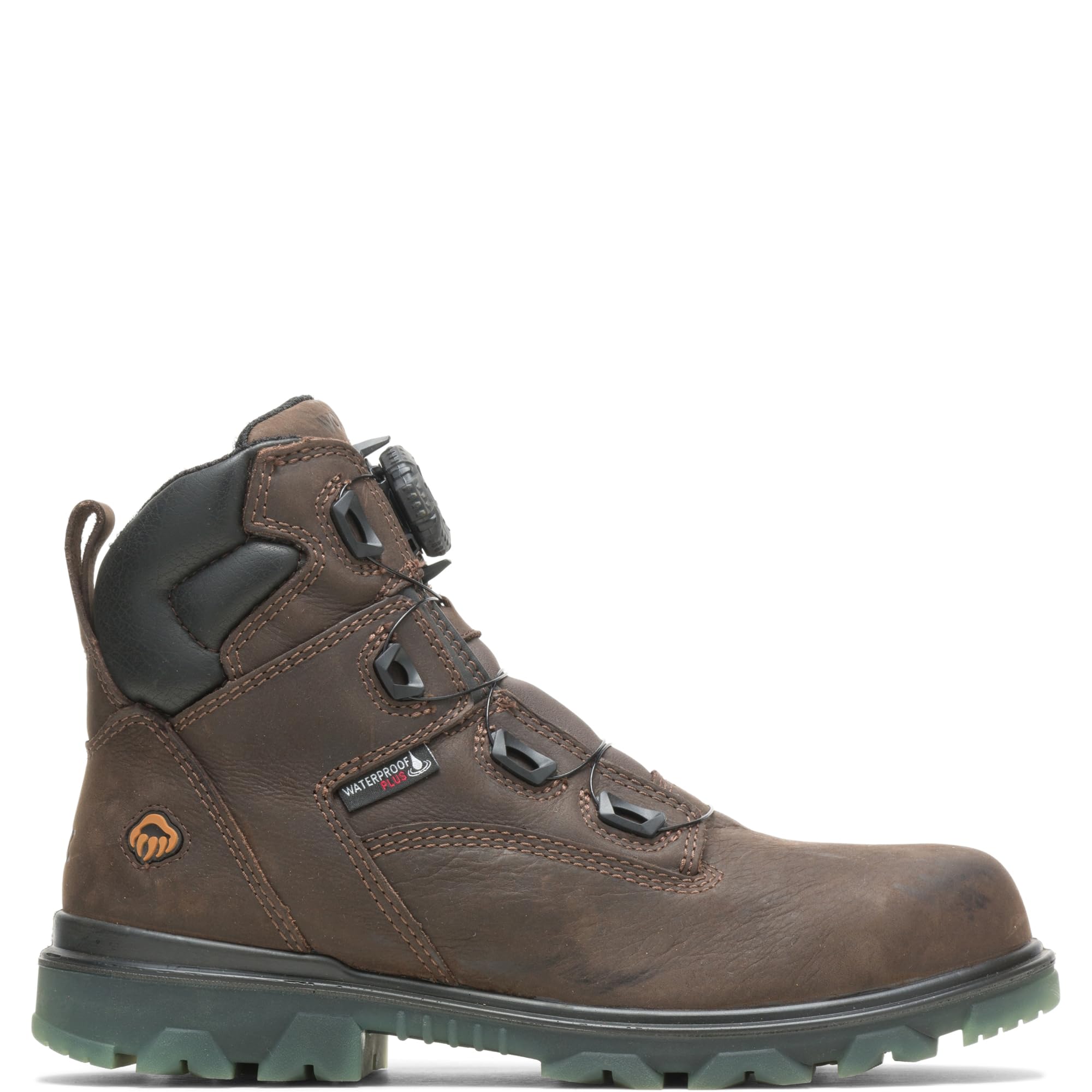
1. Wolverine Men’s I-90 EPX Boa CarbonMax 6″ Boot
Our pick — 4.5+★ from 450+ verified ratings; the strongest balance of quality and price.
A twist dial instead of laces, so your gloves never leave your hands at 5 a.m.
What you get is a 6-inch work boot that secures with a Boa Fit System — a dial and wire-lace setup you twist to tighten instead of tying bows. The maker says it sheds ice, dirt, and oil, and you adjust it with gloves on. That is the part that wins people over: no soaked laces to fight before the shift starts. It sits at 1 lb 13 oz per boot in a size 11 medium, light enough for ladder work and long walks across a site.
Comfort is the clear strength here, with durability close behind. The EPX footbed is built to cushion and flex with your foot through a full shift, and the Advanced Comfort PU midsole soaks up shock underfoot. A CarbonMAX composite safety toe meets ASTM F2413-18 F I/75 C/75 EH standards — that is a safety rating for impact and compression plus electrical hazard protection. The toe box is roomier than a metal cap and the material won’t conduct heat or cold, so your toes don’t freeze on a winter pour.
The catch is sizing. A recurring gripe is a narrow fit, and the boot tends to run a little smaller than expected, so some buyers end up a half size up. If you have wide feet, order with that in mind rather than assuming your usual size works. The upper is premium waterproof full-grain leather over a breathable, moisture-wicking mesh lining, and the abrasion-resistant TPU outsole carries a pronounced lug pattern that stands up to water, oil, chemicals, and heat.
What earns the top spot
- Boa dial tightens glove-free and evenly across the whole boot
- CarbonMAX composite toe is non-conductive to heat and cold
- EPX footbed and PU midsole for all-day shock absorption
- Waterproof full-grain leather with a breathable mesh lining
- TPU outsole rated against water, oil, chemicals, and heat
Where it asks for patience
- Runs narrow and slightly small — wide feet should size up
- Getting it on and off isn’t as quick as the dial suggests for some
- Premium tier pricing sits above the everyday-value options
Reach for this if: you want a waterproof, composite-toe boot you can cinch in seconds with work gloves on.
Look elsewhere if: you wear a true wide width and want to buy blind without sizing up.
2. CAT Men’s Second Shift Steel Toe
The budget-tier workhorse that thousands of site crews keep reaching for shift after shift.
If you want one boot that does the everyday job without stretching your budget, start here. The Second Shift puts a steel toe and rugged leathers on a 4-pound boot, which is heavy enough to feel planted on concrete but not so heavy that it drags your stride. Quality is what wins people over here — the leather is the part buyers talk about most, and it holds its look over time. The 12 x 8 x 4.5 inch footprint matches a standard boot, and the steel toe box protects against dropped loads.
Per boot, the Second Shift sits at 4 pounds — heavier than the Timberland Pit Boss at 1.83 pounds, though far heavier boots exist in this lineup. That extra mass is the trade-off for a tank-like feel and a tough leather upper. The fit is the honest wrinkle: it runs narrow for some people, though plenty step into it right from the start. Order your true size and read the width notes if your feet run wide.
The durability story is mixed, and it’s worth knowing before you buy. Some buyers put years on theirs and some report the sole beginning to separate. That’s the typical fit of a budget-to-mid steel toe rather than a red flag on the whole line. For value on a working boot that looks good on the jobsite and off it, this one still earns its place as the everyday pick for a lot of people who’d rather not spend premium tier.
The leather factor: quality and comfort take the top spots, and the leather keeps its look through daily wear instead of aging into a scuffed mess.
The one thing to plan around: a narrow last and mixed sole-durability notes mean you order your size with care and keep an eye on the welt.
The plain-truth verdict: a sturdy steel-toe boot for trades and shop work where you want honest leather at an entry-level sticker.
Consider skipping it if: your feet run wide or you need the lightest boot out there for ten-hour standing shifts.
3. Timberland PRO Men’s Pit Boss 6 Inch Steel Safety Toe
A roomier steel toe box than most, built for long hours without bruised feet.
The Pit Boss is the steel-toe boot that turns up on job sites of every stripe. It meets ANSI safety standards for the steel toe and offers a roomier toe box than other steel boots, so your toes have room to spread even after a long shift. The 1.83-pound weight makes it one of the lighter steel-toe options here, and the 10 x 15 x 6 inch dimensions are a standard 6-inch profile. Waterproof leather and electrical hazard protection keep you covered on wet ground and around live circuits.
Two things define the ride. The nylon shock-diffusion plates add support and torsional rigidity — a stiffness under the arch that stops the boot from twisting on uneven ground. A removable sock liner is there so you can swap in your own insole without tearing the liner out. The outsole is described as offering strong traction on wet or slippery surfaces, which is what most site crews need on a slick concrete floor.
Durability is the honest caveat: some units hold up for years and some come apart within months, so it’s not the most predictable lifer on the shelf. The Pit Boss is not the featherweight pick — the CAT Second Shift above carries more than double the poundage per boot, so if low weight is your priority the Pit Boss is comfortably on the lighter side of steel toes. For a proven steel toe with room to spare, this is the safe, well-understood choice.
Who it beats: heavier steel toes that squeeze your toes and slow your step all day.
Who should look on: buyers chasing maximum sole longevity need to know durability is the noted weak spot.
4. Georgia Boot Men’s Lace-to-Toe Steel Toe Waterproof
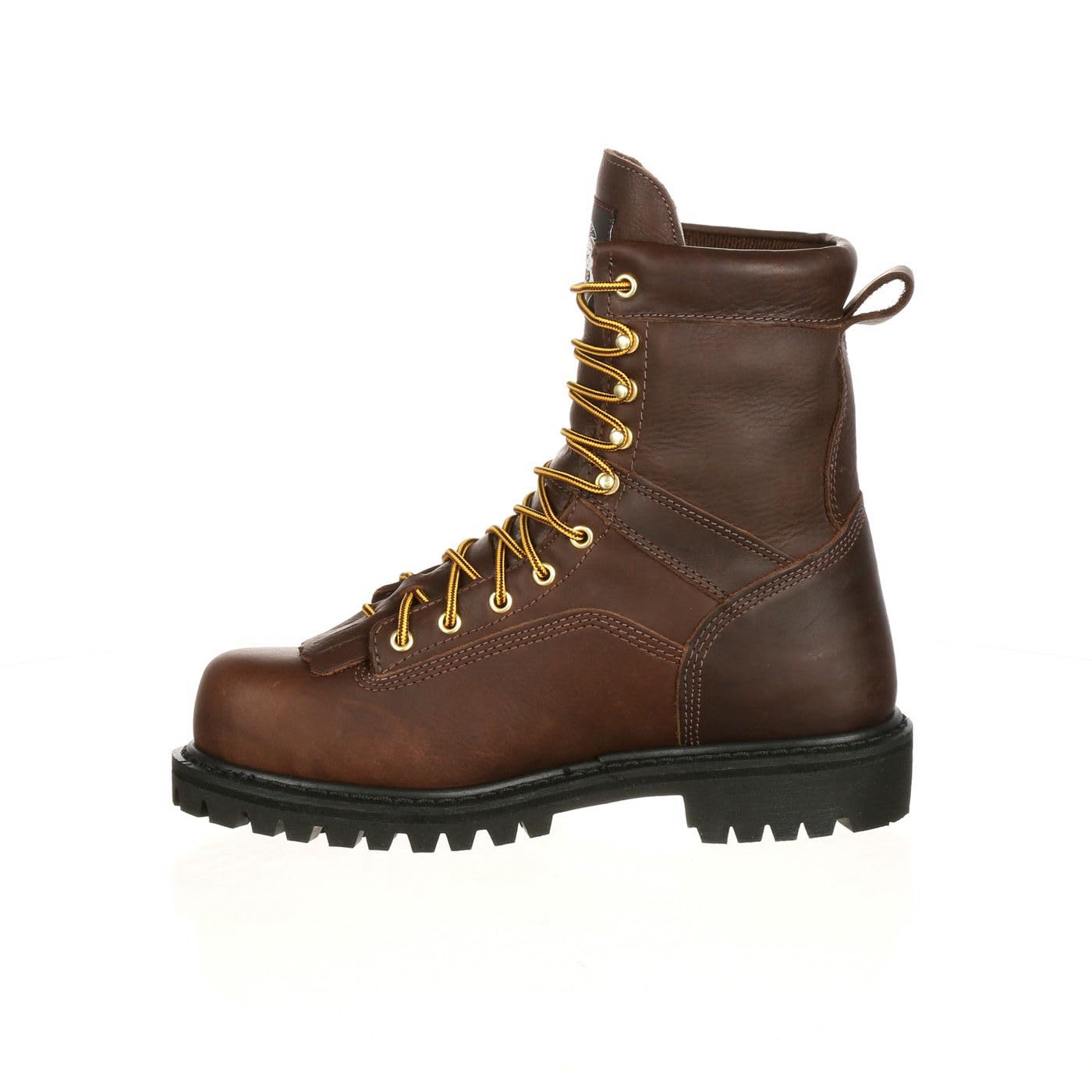
The lace-to-toe build you can resole instead of replace when the tread wears thin.
Lace-to-toe means the lacing runs all the way down toward the toe, which lets you snug the whole foot for a supportive custom fit — great for uneven ground and mud. The part that matters for long-term ownership is the repairable Goodyear welt construction, a stitched sole attachment a cobbler can re-sole without scrapping the upper. The steel toe meets ASTM standards for impact and compression plus electrical hazard resistance, and the Georgia waterproof system is built to keep feet dry through wet terrain. At 4.5 pounds per boot it’s the heaviest of the lighter options, so it feels substantial on the foot — notably heftier than the Pit Boss at 1.83 pounds.
Quality is the standout — the leather and stitching are the first thing people notice, and the boot breaks in quickly for a rugged leather lace-to-toe. The Vibram lug outsole is oil-resistant and digs in on loose dirt, and a steel shank supports the arch and settles the whole boot. That’s why it lands here: a full-grain boot you can wear hard and repair rather than retire.
The sizing runs the other way from most of this list — the recurring note is that it fits about half a size too big, so many go down half a size. A few say the leather isn’t quite as thick as they pictured. Neither is a reason to skip it. For mud, sand, and rough outdoor terrain, this is the boot that appreciates maintenance instead of demanding a replacement.
Why it’s here: the Goodyear welt lets you resole a boot whose build is already the top strength, which is a long-term ownership win.
Fit warning: it runs about a half size large, so order down if you’re between sizes.
Buy it for: the outdoor worker who wants a waterproof lace-to-toe steel boot built to be repaired, not thrown away.
Think twice if: you need the lightest possible boot — this one carries real heft.
5. Timberland PRO Men’s Titan EV 6″ Composite Safety Toe Waterproof
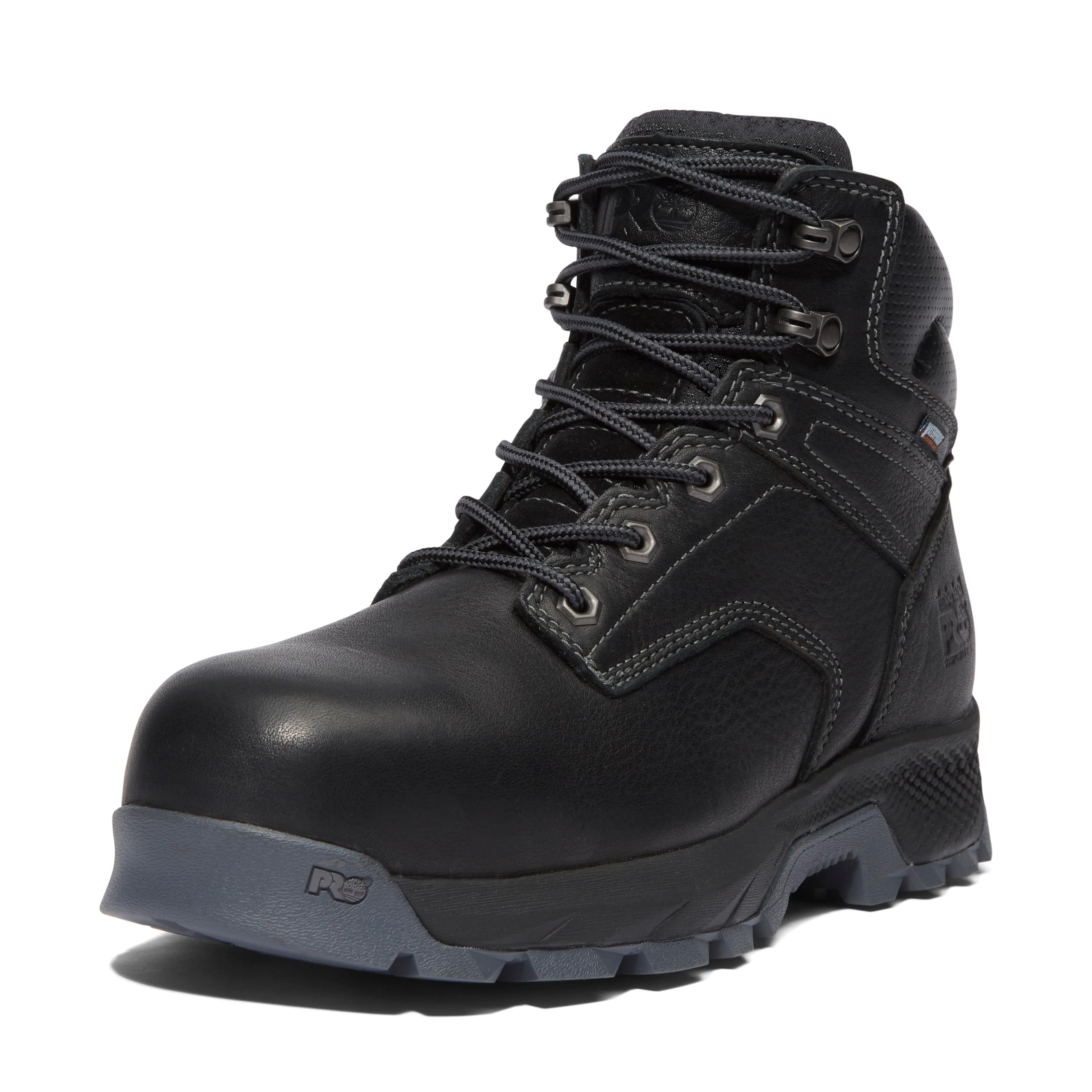
Hover Spring foam and a full-grain leather upper that feels more sneaker than safety boot.
The defining spec here is the Hover Spring foam midsole, a cushioning layer the maker describes as offering high comfort and flexibility while holding up to harsh work environments. Pair that with the Anti-Fatigue Technology footbed that absorbs shock and returns energy, and your feet get a springy ride through a long shift. The composite safety toe and electrical hazard protection cover the safety side, and the whole package weighs 4.21 pounds as listed.
The waterproofing is a full system: premium Timberland full-grain waterproof leather over an internal waterproof membrane for maximum protection. The outsole is a non-marking Timberland PRO rubber convex design that resists heat, oil, slip, and abrasion for traction indoors and out. The breathable, moisture-wicking lining is made of ReBOTL fabric containing at least 50% recycled plastic — good news if you care about the footprint of your kit. Comfort is the headline, and buyers call it sneaker-light underfoot.
Fit runs true to size with a roomy toe box, and the ankle support is the second thing people praise. The caution is on durability — it draws mixed notes, and slip resistance earns some mixed words too, so if you’re after the most predictable sole lifespan this isn’t the surest bet. As a comfortable, waterproof composite boot for long days on your feet, it does exactly what it sets out to do.
Comfort first, always: the Hover Spring midsole plus the Anti-Fatigue footbed is what sells this pair — the cushioned feel is the whole point.
Read the fine print: durability and slip resistance post mixed notes, so those needing the toughest sole should weigh that in.
The standout-spec pick: for buyers whose shifts are long and their feet are the pain point, the cushioning earns the price.
Not your pick if: the sole wearing out fast would be a deal-breaker for your line of work.
6. KEEN Utility Men’s Reno Mid Composite Toe Waterproof
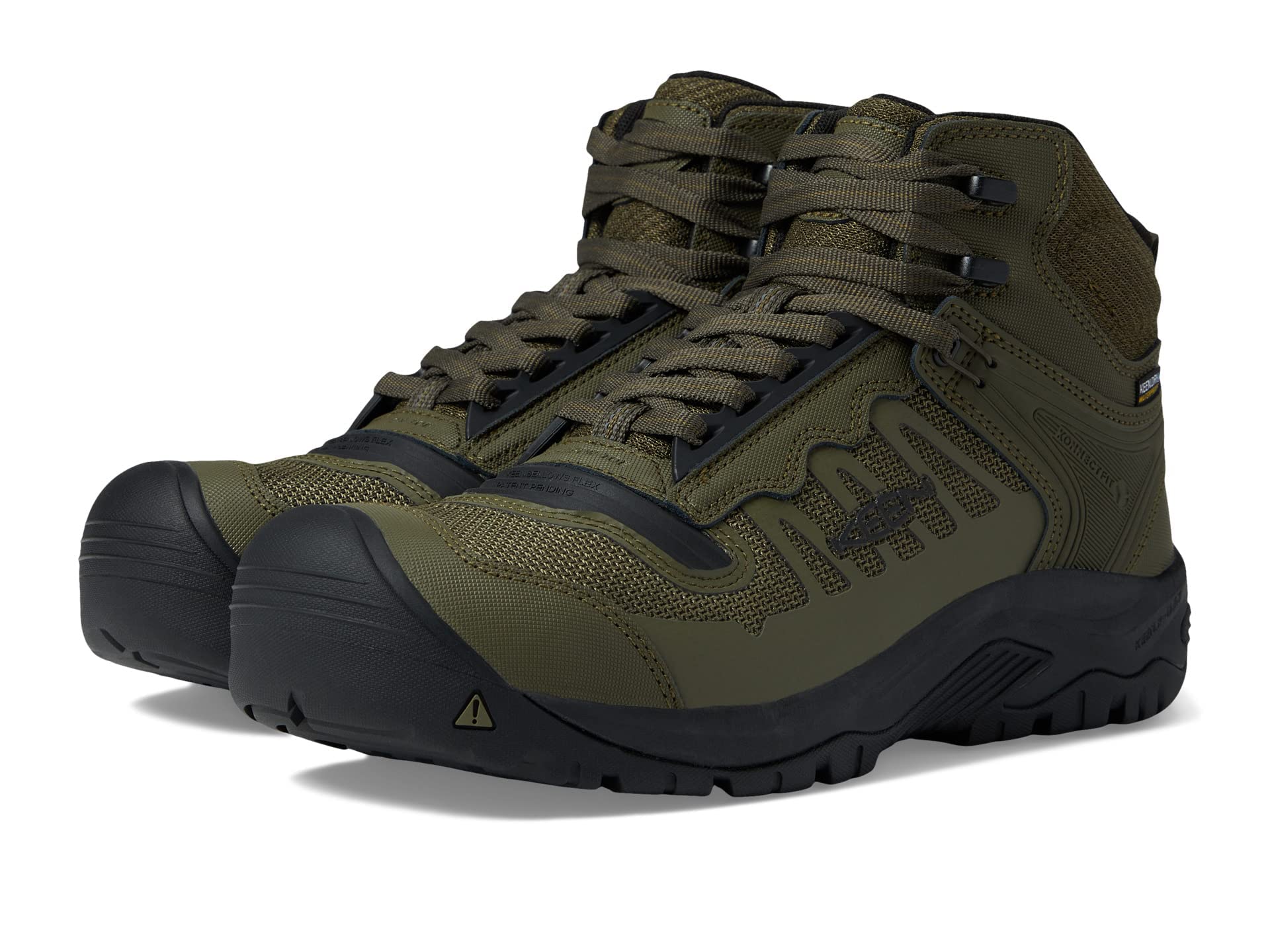
A work sneaker that bends at the toe and weighs 25.0 oz per boot.
The Reno is built off a work sneaker shape, and at 25.0 oz / 708 g per boot it’s among the lightest composite-toe options here. Two pieces of tech drive it: KEEN.Bellows Flex technology that makes the toe bend easier for crouching and climbing, and a KEEN.ReGEN midsole for all-day cushioning. The composite toe and waterproof build keep it safety-rated, and the slip-resistant, non-marking outsoles add resilient grip. It’s built on KEEN’s traditional wider footwear form, so buyers with wide feet have a boot that fits the way they need.
This one suits light-duty work best — warehousing, trucking, delivery, carpentry, roofing, and landscaping are the jobs it names. Quality and the lightweight feel are what line up as strengths, with water resistance and traction rounding out the positives. The composite toe means no cold metal against your toes in winter. Removable insoles let you swap the factory footbed for your own orthotic.
The catch is durability. Some pairs come apart after a few months of use, and the fit draws mixed notes — some can’t get the laces tight enough for their liking. Lace quality and overall design also gather mixed feedback. If your work is light-duty and your knees and arches want a softer, lighter ride, the Reno is a smart fit. If you’re on a heavy site with constant twisting, plan for the boot to earn periodic replacement.
Your best fit if: you’re in warehousing, delivery, or light duty and want a composite toe that bends with your foot.
Pass it by if: you need a heavy-duty sole for rough, high-torque jobs.
7. Ariat Men’s Rebar Lift 6″ Waterproof Composite Toe
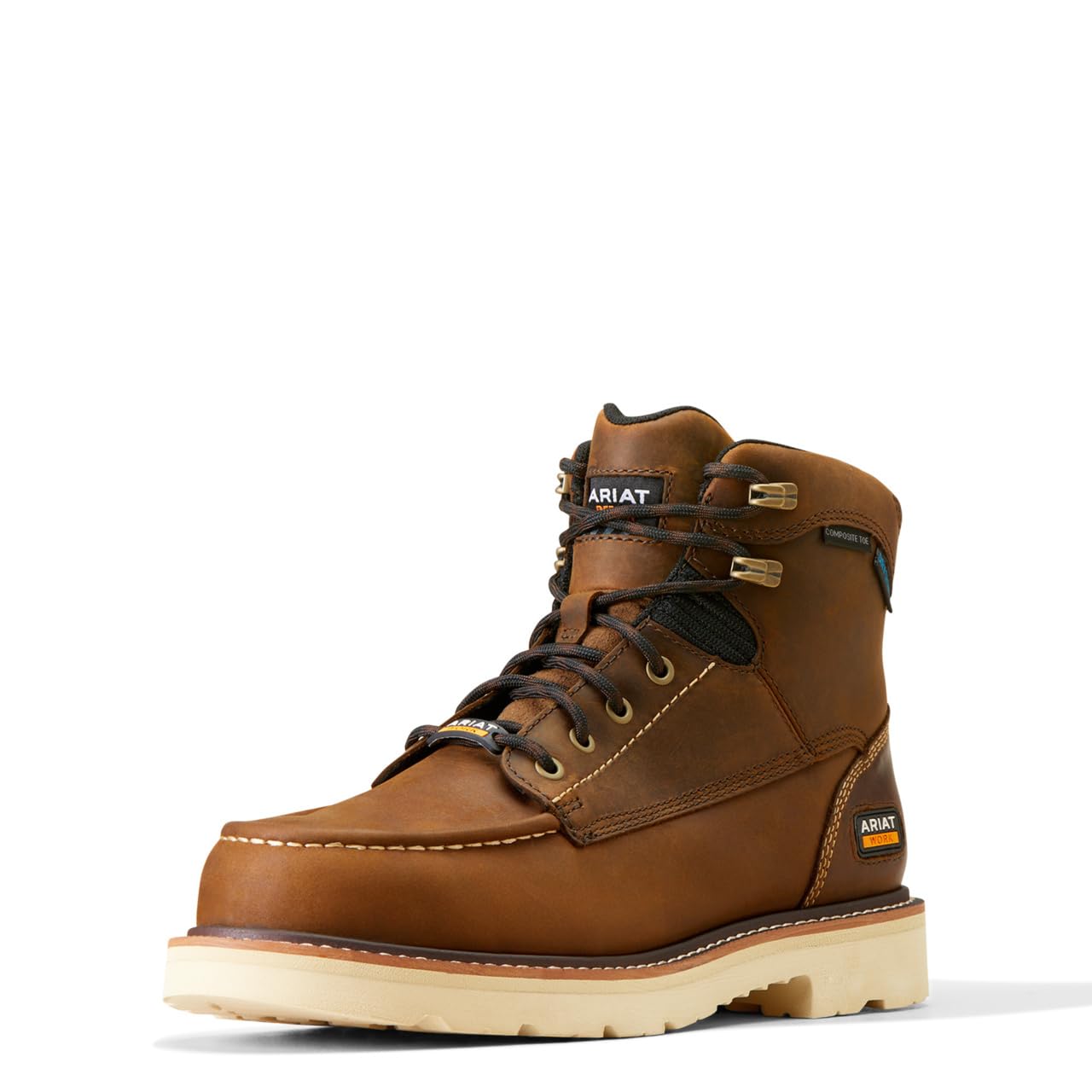
Cushioning and stability for long shifts, in a 6-inch waterproof composite boot.
The Rebar Lift pairs a lighter build with the cushioning and stability to power through long days. It’s waterproof, composite toe, and it stands at 5.5 pounds per boot. Quality and comfort are the two strengths that stand out — the leather upper and foot support are what keep people coming back, and the look holds its own when you’re off the clock. The extra elastic at the ankle allows you to squat and crouch without the boot biting.
Where it earns its place is on outdoor conditions: a waterproof, versatile build you can wear on and off the job. The support underfoot suits long shifts on varied ground, and the composite toe gives the protection without the metal cap’s cold transfer. That combo — cushioning plus a real safety toe — is the reason it stays in the conversation at the premium tier.
Where it asks for patience is durability. Soles peeling apart and boots breaking down after a couple of months are the recurring complaint, and that’s the honest caution to carry in. Fit also draws mixed reports — some are great straight on, some need tweaking. If comfort and support are your top priorities and you’re good about watching the sole for wear, the Rebar Lift gives you a boot that loves long outdoor days.
The strongest case: cushioning plus stability, with an ankle that flexes enough for squatting on the job.
The honest risk: sole separation after a couple of months is noted often enough to be worth watching, so treat the welt as the thing to inspect.
Worth the pick if: you want premium cushioning and support for long outdoor days and can forgive a sole that may need attention.
Point it elsewhere if: you demand the most predictable long-term sole life.
8. ARIAT Men’s Rigtek Wide Square Toe Waterproof Composite Toe

A wide square toe built for oilfield days, chemical contact, and constant standing.
The Rigtek is aimed at oilfield work, and the wide square toe gives your toes room to splay — a big deal when you’re on your feet for twelve hours on a rig. Its durable traction and cushioning hold up to long, hard days, and the build handles jobs involving chemicals. A waterproof composite toe keeps the safety side covered while the leather keeps your feet dry. At 3.1 pounds per boot it’s lighter than the 4.5-pound Georgia Boot and 4.6-pound Thorogood.
The square toe is the defining shape: more room across the forefoot, which suits wide-footed workers who get pinched in a standard rounded steel toe. The waterproofing earns good marks — feet stay dry through wet ground, and the boot looks the part too. It’s a solid mid-premium choice for trades where oil and chemical exposure are part of the day.
The friction is fit and arch support. The fit can be tight for some and the arch support draws mixed notes, with high arches needing extra support underneath. Durability is the other split — some put a lot of miles on theirs and some report ripping after a couple of days of wear. If you run wide-footed and need a chemical-resistant boot for tough outdoor work, the Rigtek is built exactly for that job.
Made for: oilfield and chemical-exposure work where a wide square toe and dry feet matter most.
Skip the bet if: you have high arches without added support, or you demand the strongest sole-durability record.
9. Thorogood 1957 Series 8″ Waterproof Steel Toe
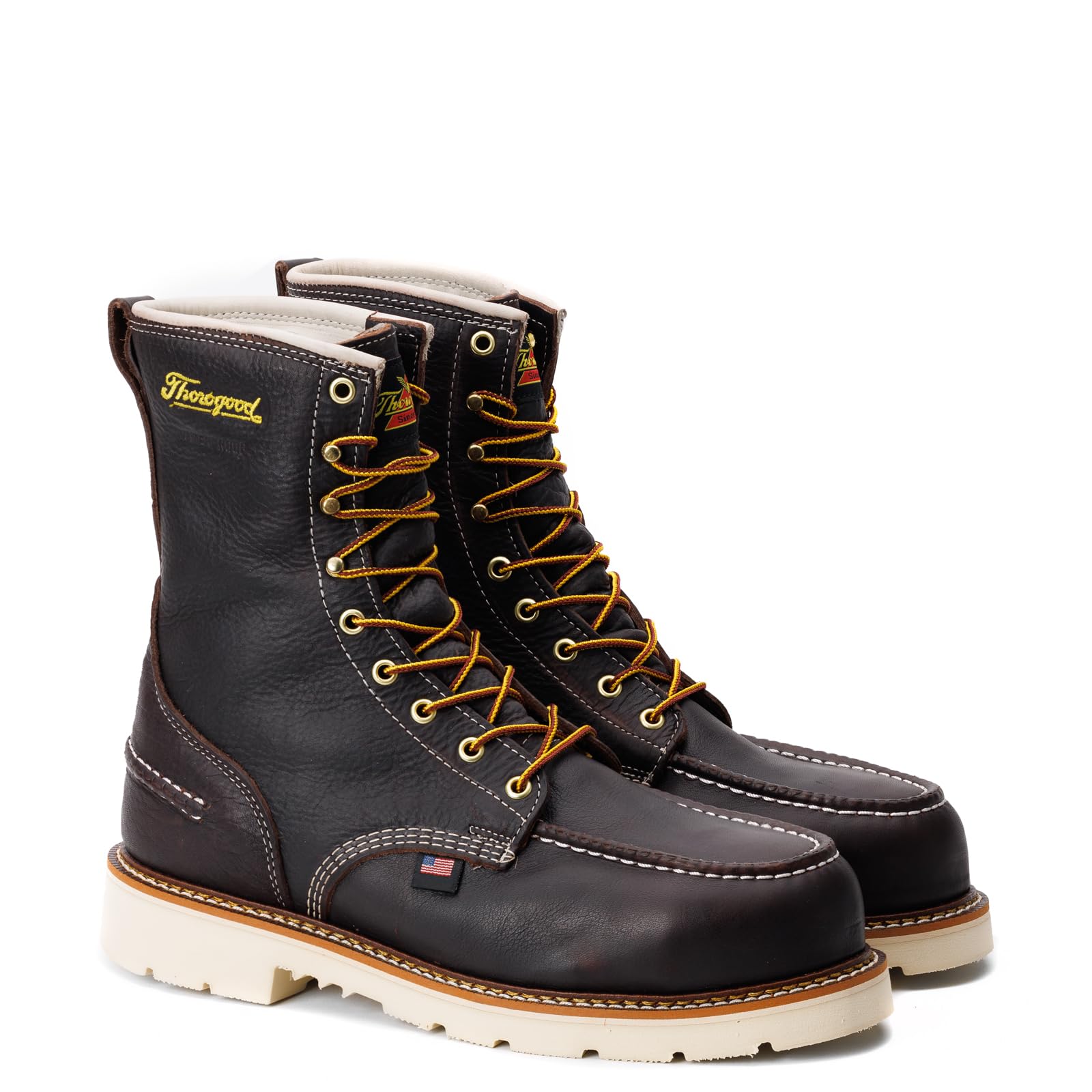
American full-grain leather and an 8-inch shaft, built for the long haul.
The top of the spend here buys you an 8-inch boot cut from Briar Pitstop full-grain American leather. The full-grain hide is the thickest cut of the leather, which is why it takes longer to break in but holds up over time. The steel toe and composite shank give protection plus arch stability, and the MaxWear 90° slip-resistant outsole bites on smooth, wet surfaces. A removable Ultimate Shock Absorption footbed sits over memory foam, and the Goodyear storm welt construction is built to last and be re-soled.
Build quality is what separates it — the leather and the welt (the stitched seam joining the upper to the sole) are the first thing that wins people over, and water resistance backs it up. At 4.6 pounds per boot, it’s the heaviest of the lace-up leather boots here, heavier than the 4.5-pound Georgia and 4.21-pound Timberland Titan. The trade for that heft is a boot that feels like real armor. Full-grain leather over a Goodyear storm welt is a pair you resole instead of replace.
Expect a break-in. Comfort is a strength once you’re through the initial wear-in, but this isn’t a come-out-of-the-box-soft boot. Fit draws mixed reports, and a few have had sole issues. Neither is unusual for a heavy welt boot. The premium tier here is for the buyer who wants a traditional leather work boot that can be rebuilt rather than replaced every season.
The premium justification: full-grain leather plus Goodyear storm welt means a boot you can resole and wear for years, not a disposable pair.
What to expect: a break-in period and real weight — this is a dial-in-your-pace boot, not a slip-on-and-go.
Pick it for: the traditionalist who wants American full-grain leather, an 8-inch shaft, and a welted sole that can be repaired.
Leave it for the next guy if: you want a featherweight boot or a zero-break-in ride from day one.
Know the Specs
Safety Toe Type
A steel toe is a metal cap that meets ASTM impact and compression standards — a federal safety marking that says it will shield your toes from a dropped object. A composite toe is a non-metal cap that does the same job with less weight and no cold transfer to your toes. Both are found across this lineup, so pick by if you want the lighter feel of composite or the traditional weight of steel.
Waterproofing Membrane
A waterproof boot carries a membrane inside the leather that stops water coming in while letting sweat vapor escape. “Water resistant” is a lesser claim — treated leather that handles splashes but can soak through during a long wet shift. When the listing says waterproof, expect a membrane or a full system. Read the exact wording if you’ll be standing in puddles all day.
Outsole and Slip Resistance
The outsole is the bottom rubber layer you stand on, and its lug pattern is what keeps you upright on loose dirt or slick concrete. A slip-resistant compound sheds oil and water so you don’t slide, while deep lugs bite into mud and gravel. Match it to your surface: mud and ladders want pronounced lugs, while a shop floor wants a flat, oil-resistant sole.
Shank and Welt Construction
A shank is a stiff strip inside the sole — steel, nylon, or composite — that keeps the boot from folding and supports your arch. A Goodyear welt is a stitched sole attachment a cobbler can replace without scrapping the upper, so a welted boot can outlive a glued one. For long-term ownership, check for a Goodyear welt you can resole and a steel or composite shank for arch support.
Common Questions
Will a steel toe boot pass my site’s safety requirements?
Is composite toe lighter than steel toe?
Do these work boots run true to size?
How long does it take to break in leather work boots?
Can a waterproof work boot be re-soled?
What does EH rated mean on a work boot?
Are steel toe boots heavier than composite toe boots?
Can I wear these boots for concrete floors all day?
Do I need wide width or square toe work boots?
What is the difference between waterproof and water resistant?
The Bottom Line
For most people working in these boots, the work zone boots winner is the Wolverine I-90 EPX Boa because the twist-dial lets you cinch the fit with gloves on and the composite toe stays warm in cold weather. If everyday value is your priority, grab the CAT Second Shift for its tough leather at an entry-level tier. And for the heaviest-duty build with a resoleable sole, the Thorogood 1957 Series is the one to reach for — a premium boot that earns its keep over years, not seasons.
How we choose
We do not accept paid placement. Every pick is matched to a real buyer and a real use-case; we do not hands-on test units.
Sources
Specifications: manufacturer listings and product documentation. Review insights: verified customer reviews, as of November 2026. Pricing: not shown on this page (it changes often); check the current price via the retailer link.
As an Amazon Associate, Tactical Gear Guy earns from qualifying purchases. This does not affect which products we feature.