Specs are compiled from manufacturer listings and verified buyer reviews and can change over time — please confirm the key details on the product page before buying.
You do not need the heaviest coat on the shelf — you need the one that stays warm when you are standing still in wind at 6 a.m., and that can take a scrape against a truck bed without shredding. That is the whole job of a winter work jacket, and it is where most cheap coats quietly fail. Below are nine men’s work jackets that survive real cold, sorted by what each one actually does best: shell-only rain protection, fleece-lined softshells, and full duck canvas coats built to outlast several winters of abuse.
This guide is built by comparing the manufacturers’ published specifications and the patterns across verified customer reviews, so you get each pick’s real strengths and trade-offs instead of marketing spin.
Workwear buyers get burned by two things: a jacket sold as “winter” that is really a rain shell, and one sized so tight you cannot layer a hoodie under it. This breakdown covers insulation type, shell fabric weight, pocket layout, and how each coat runs at the shoulders, so you can pick the work winter jacket for men that fits your job the first time.
Top Picks


How To Choose The Best Work Winter Jacket for Men
A work jacket has to do three jobs at once: hold heat when you are not moving, block wind and light rain, and survive contact with tools, truck beds, and scaffolding. Most buyers pick on looks and get burned on one of those three. Start with the shell fabric, because that decides everything else.
Shell fabric: duck canvas versus nylon
Duck canvas is a tightly woven cotton — Carhartt’s classic is a 12-ounce, 100% cotton washed duck, and the heavier weave shrugs off abrasion and sparks. It is heavy and it takes a while to break in, but it lasts for years. Super Dux nylon is the newer alternative: Carhartt’s own description calls it lighter and stronger than classic duck, and a 7.75-ounce 100% Super Dux nylon shell is far less bulky on your shoulders. If you are climbing ladders all day, nylon wins on mobility. If you are dragging logs and brush, canvas wins on punishment.
Insulation: counted in grams, felt in degrees
Insulation is measured by weight, written in grams. A 100g 3M Thinsulate fill is a lightweight layer meant to trap warmth without puffing you out like a sleeping bag — good for active work where you heat up fast. Sherpa fleece and synthetic down, like the combination in the Montana, give a warmer static feel for standing around in real cold. Match the fill to your activity level: 100g Thinsulate for active work, sherpa or synthetic down for stationary cold.
Fit and layering room
A work jacket is worn over a base layer and often a hoodie, so it must be bought with that in mind. A loose or relaxed cut gives you that room; a straight or tailored cut does not. Read the sizing notes carefully — several coats here run large by design, and one model recommends ordering a size up for a looser fit. Buy for the layers you will actually wear underneath, since a straight cut will bind at the shoulders.
Hi-vis requirements
If your site requires Level 3 personal protective equipment, a standard duck coat will not satisfy the safety officer. You need an ANSI Class 3 rated jacket with reflective striping, like the TCCFCCT below. ANSI Class 3 is a compliance requirement, so check the label and stripe placement before warmth.
Side-by-Side Comparison
| Model | Best For | Shell Fabric | Insulation / Lining | Hood | Amazon |
|---|---|---|---|---|---|
| Carhartt Montana Loose Fit Insulated Jacket | Coldest days, standing work | — | Sherpa fleece + synthetic down | — | Amazon |
| TCCFCCT Hi Vis Class 3 Bomber | Site compliance and rain | 300D coated PU Oxford | Lightweight lining | Detachable | Amazon |
| Pudolla Softshell Hooded Jacket | Active outdoor work | Softshell | Fleece lined | Detachable, drawcord | Amazon |
| TBMPOY Hooded Work Cotton Coat | Budget canvas warmth | Cotton with flannel | Fleece lined | Hooded | Amazon |
| Wrangler RIGGS Quilted Sherpa Hood | Everyday ranch and farm | Cotton duck | Quilted, Sherpa hood | Sherpa lined | Amazon |
| HISEA Sherpa Work Jacket | Wet cold and rain | Canvas, water resistant | Sherpa lined | Hooded | Amazon |
| Carhartt Super Dux Insulated Traditional Coat | Cold plus mobility | 7.75-ounce 100% Super Dux nylon | 100g 3M Thinsulate | Adjustable with chin guard | Amazon |
Detailed Reviews
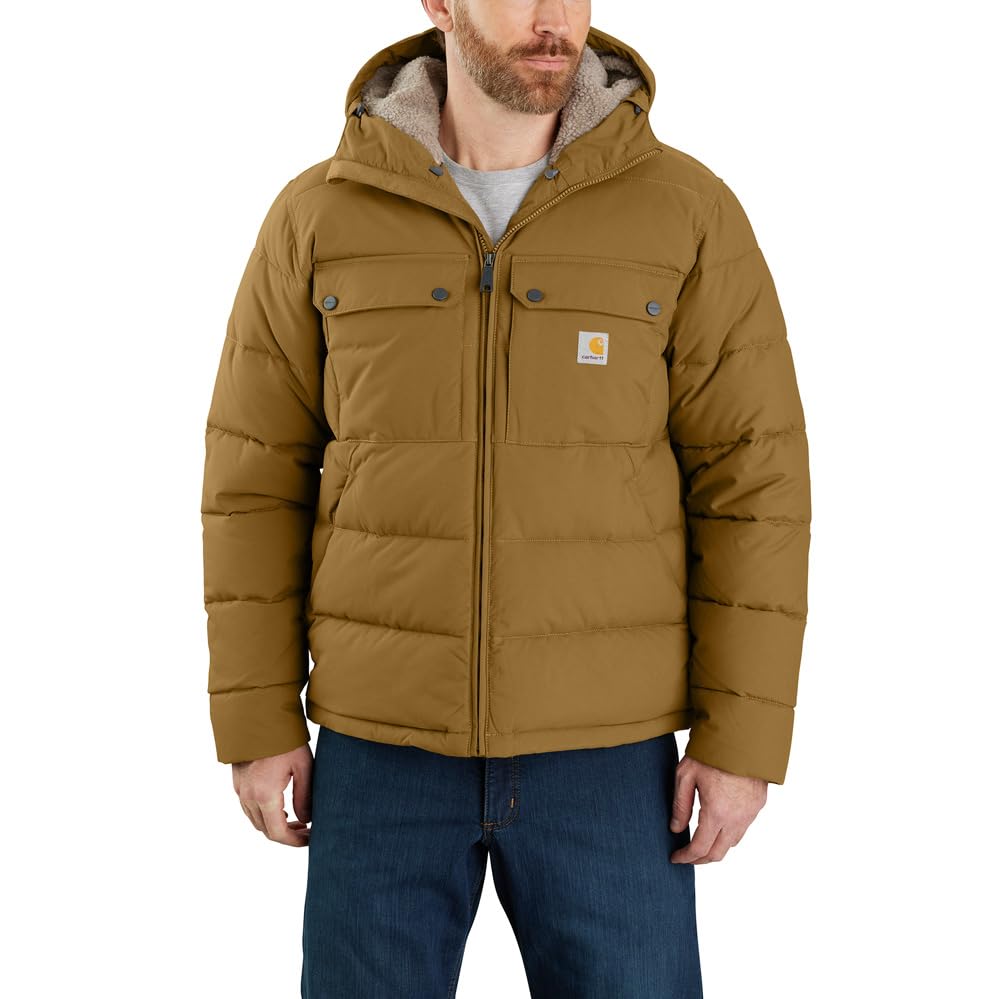
1. Carhartt Men’s Montana Loose Fit Insulated Jacket
Double insulation — sherpa fleece plus synthetic down — for the guy who spends half his shift standing still in wind.
The Montana is the coat you reach for on the mornings when the work is mostly waiting. It warms your core with a two-part system: sherpa fleece against the body for instant soft heat, synthetic down layered behind it to hold that heat in. It also blocks wind and sheds damp conditions, so a wet snow that soaks a cotton shell slides off this one. And a loose fit means you can put a hoodie under it without feeling like your arms are strapped down.
Storage is genuinely generous here — pockets inside and out, which matters when you are carrying a phone, gloves, a pen, and a knife and refuse to set any of it on the ground. Owners talk about snow shoveling as its natural habitat, and that tracks: it is built for cold, stationary labor, not for sprinting up scaffolding.
Now the honest part. This jacket runs big, and the front is cut noticeably short while the sleeves run long. If you are long in the torso or expect a coat to sit over your belt line, size down or look at the Ridge instead. The crowd verdict is strong — 4.5+ stars across 700+ owners — and quality and warmth are the two things buyers bring up most, well ahead of anything else. That is a coat people trust, with a length quirk to work around.
What earns its keep
- Sherpa fleece plus synthetic down warms your core without a bulky feel
- Wind blocking and damp shedding handle wet snow, not just dry cold
- Pockets inside and out hold a full day’s small gear
- Loose fit leaves room for a hoodie underneath
Where it asks you to compromise
- Sizing runs huge — most buyers should drop a size
- Short in the front with long sleeves, an awkward combo for tall frames
Reach for this if: your winter work involves standing, shoveling, or slow outdoor labor in real cold.
Try something else if: you are long-waisted — the short front cut will ride above your belt.
2. TCCFCCT High Visibility Jacket Class 3 Hi Vis Bomber
The only coat here that keeps you legal on a Level 3 site — and keeps you dry doing it.
Two-inch reflective striping wraps the shoulders, waist, sleeves, and cuffs, and the neon yellow body meets Level 3 ANSI personal protective equipment standards. If your safety officer walks the site, that stripe layout is the difference between working and going home. The black bottom and cuffs are a smart touch: they hide the grime that builds up where you actually touch things, so the jacket still looks professional after a month of handling materials.
The shell is 300D coated PU Oxford — a coated synthetic fabric that holds rain out rather than soaking through like cotton duck. The lining is lightweight, and owners describe the warmth as suited to mild cold on the jobsite rather than deep winter. Think of it as a three-season work shell that keeps the wind and wet off, not a replacement for a heavy insulated coat in January.
The hood detaches, there is a transparent ID holder on the left chest, dual microphone buckles on the shoulders for a walkie-talkie, and a vertical zip pocket on the right chest. Sizing runs a little big, so the fit is forgiving over layers. Durability is the split opinion — reviews mention a rip appearing after two weeks on one unit — so treat it as a working jacket, not an heirloom. Quality and warmth are what buyers praise most, and 4.5+ stars across 400+ owners backs that up.
Built for the clip-on crowd: ID holder, walkie mic buckles, and ribbed cuffs with hook-and-loop straps that seal out wind — this jacket was designed by someone who has actually carried a radio on a site.
The right call when: your site mandates Class 3 hi-vis and you need rain protection over warmth.
Keep looking if: you work in genuine deep-winter cold — the lightweight lining will not carry you there.
3. Pudolla Men’s Softshell Jacket Hooded Fleece Lined
A softshell that bends with you — fleece inside, wind and water outside, no canvas stiffness.
Softshell is the fabric that splits the difference between a hoodie and a hard canvas coat. It stretches, it moves, and it still blocks wind and sheds rain. This one lines the inside with fleece for warmth against the body, so a cold fall morning or a wet winter shift does not bite through. Buyers describe staying dry and warm through rain in it, which is exactly the job of a water-resistant softshell.
Storage is unusual for the price: there are zippered sleeve pockets on top of the hand pockets and three deep inner pockets big enough for a wallet and phone. The hood zips off entirely and adjusts with drawcords, and the cuffs close with snap closures for a fit you can dial in. Add it all up and it beats the TCCFCCT on everyday pocket utility for a working day that does not require hi-vis.
Where it separates from the Carhartt Firm Duck above is sheer toughness — a softshell will not shrug off barbed wire the way firm canvas does. And sizing runs a little large on some frames, so check the chart rather than assuming. Quality takes the top spot in owner feedback by a wide margin, and 4.5+ stars across 350+ buyers suggests the cut and the fleece land well for most.
The pocket story: zippered sleeve pockets plus three inner compartments means your phone, wallet, and gloves each have a home that does not swing loose while you work.
Made for: movers, drivers, and outdoor workers who want warmth without canvas stiffness.
Not the pick for: heavy abrasion work where the shell will meet wire, rock, or sharp edges.
4. TBMPOY Men’s Winter Hooded Work Cotton Fleece Lined Coat
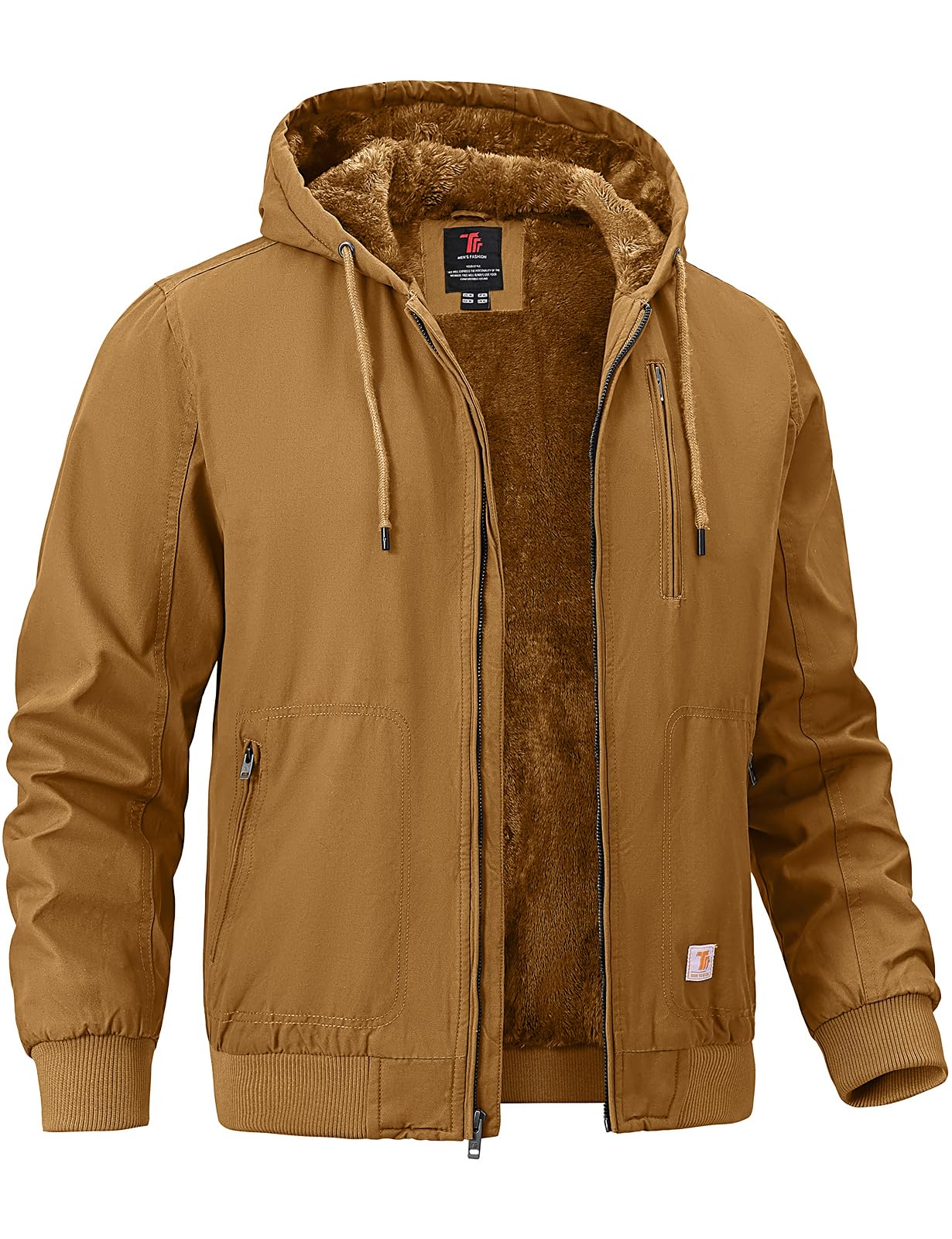
A duck-style work coat that keeps the cold out without demanding premium money for it.
This is a cotton work coat with a fleece lining and a flannel layer underneath — the classic three-layer approach that traps warm air against your body. Owners say it does its job in cold weather, and the quality reads better than the price tier suggests. If you need a coat for the truck, the yard, and the occasional weekend job, this covers the basics without asking much.
The one thing you must get right is sizing. The listing itself recommends ordering one size up for a looser fit, and owners split on whether it runs small in the sleeves. Order one size up if you plan to layer. The fleece lining keeps it light enough to move in, though buyers are divided on whether it is genuinely worth the money versus the step-up coats on this list.
Compared with the Carhartt Montana above, this one gives you a similar cotton-and-fleece warmth formula with less insulation depth and a slimmer track record. It is a solid entry into duck-style workwear, not a lifetime investment. Quality and warmth are the most-praised traits, and 4.5+ stars across 200+ owners is a fair reflection of a budget coat that delivers what it promises.
The layering math: the maker’s own advice is to size up — take it seriously, because the sleeve fit is where most of the gripes land.
Buy it if: you want canvas-style winter warmth on a tight budget and will size up to layer.
Pass if: you need the coat to last several hard winters — that is a step up from here.
5. Wrangler Men’s Quilted Lined Jacket With Sherpa Hood
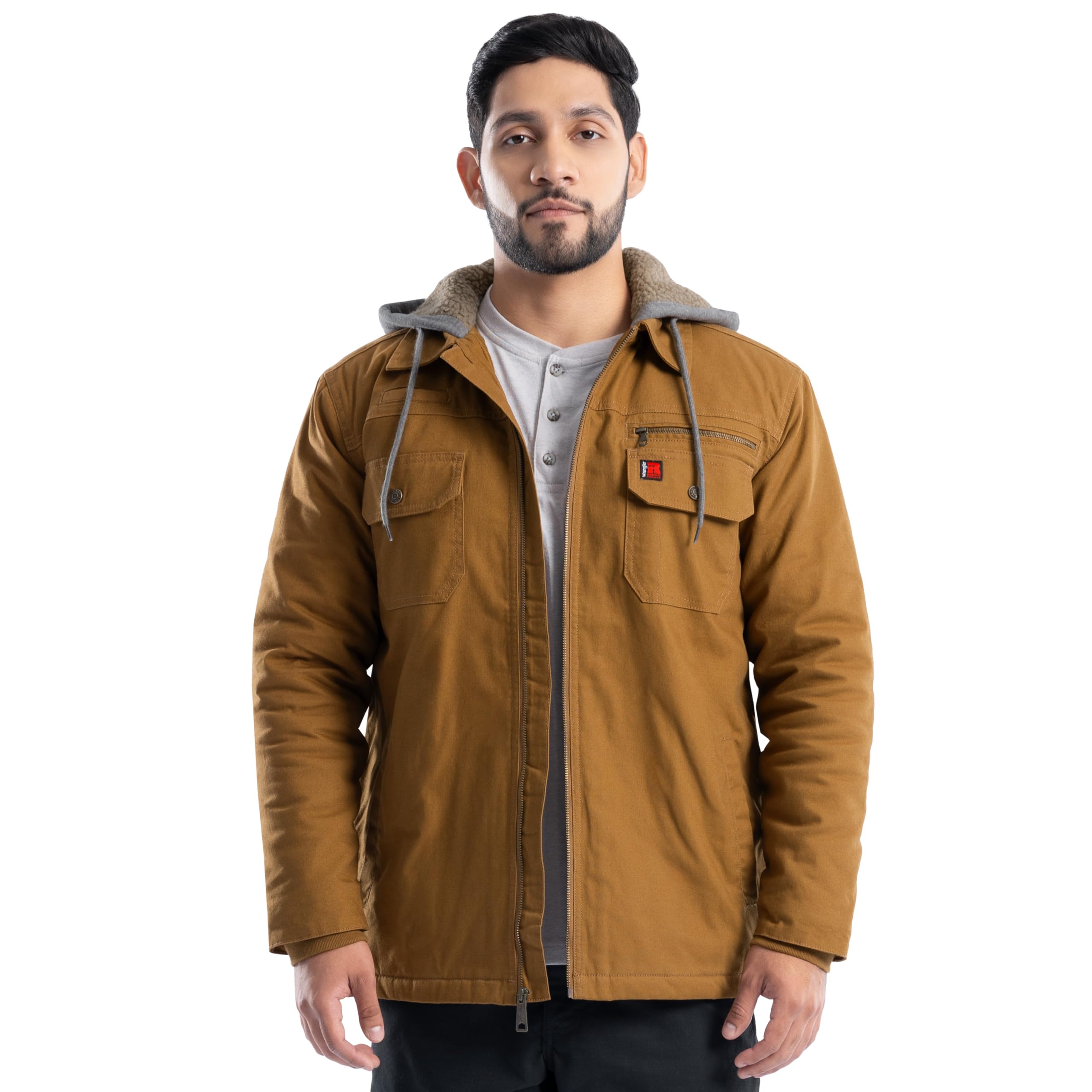
Reinforced elbows and a sherpa hood — ranch wear built for the low-winter middle ground.
Wrangler’s RIGGS line builds on tough cotton duck, and this jacket pairs that shell with a quilted lining and a plush sherpa-lined hood. The hood is the standout: sherpa against your head and neck adds a layer of warmth most work coats skip. Utility zip pockets keep valuables secure, and hidden inside pockets hold essentials out of the weather.
Reinforced elbows are the detail that matters on a work coat — elbows are where a jacket wears through first when you are leaning over a truck engine or a fence line. Owners describe it as warm for fall and low winter temperatures, which is the honest range. It is not built for the deep-freeze mornings the Montana and Super Dux are. Durability and softness both come up positively, and comfort is a recurring theme.
Watch the chest and shoulders. Sizing is mixed — some buyers find the length right while others say the chest and shoulders feel tight. If you have broad shoulders, size accordingly or plan to wear it without a bulky layer. At 4.5+ stars across 280+ owners, this is a well-liked ranch and farm jacket for its warmth range.
Best detail on the coat: the sherpa-lined hood. Your head and neck lose heat fast outdoors, and this is the one feature here that covers that gap directly.
Fits the bill for: fall and low-winter work where comfort and a warm hood matter most.
Think twice if: you have broad shoulders — the chest runs snug on bigger frames.
6. HISEA Men’s Sherpa Work Jacket
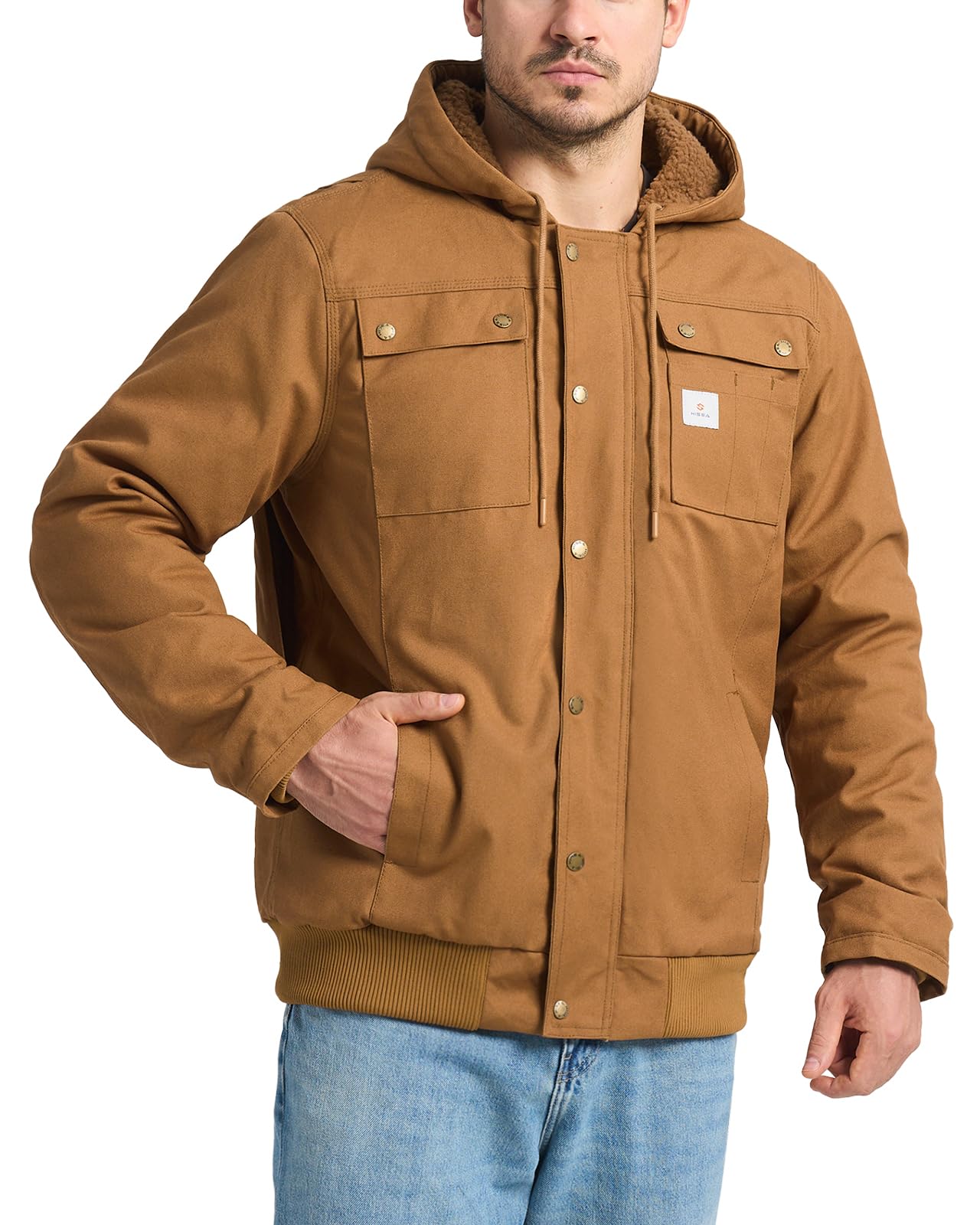
A canvas work coat that treats rain as part of the job, not a reason to stop.
Sherpa lining inside a water-resistant canvas shell is a proven combination for wet cold. The sherpa traps warmth close to the body, and the treated canvas keeps light rain from soaking through and chilling you — which matters more than raw temperature when you are working in sleet or drizzle. Owners describe using it through a harsh winter, and winter suitability is one of the traits they bring up with approval.
The pocket layout is practical: one chest pocket, hand pockets, and inner pockets, so your gloves and phone stay dry and reachable. Fit is a strength rather than a caveat — one size fits owners exactly as expected, and fit is the second thing buyers praise after quality. Weight is genuinely a split: some find it light to wear, others find it a bit heavy. On a canvas coat, that heaviness is the warmth.
The zipper is the weak spot. It works, but treat it as the part to handle carefully rather than yank. Everything else — construction, comfort, durability, value — is well-reviewed, and 4.5+ stars across 200+ buyers suggests the coat holds up in real cold.
What buyers keep coming back to
- Water-resistant canvas shell handles rain and wet cold
- Sherpa lining warms close to the body
- Chest, hand, and inner pockets keep essentials dry
- Fit runs true for most buyers
What you should know going in
- The zipper is the most common weak point noted — handle it gently
- Owners disagree on weight; it feels substantial, not feather-light
Pick this one for: wet winter work where rain and sleet are part of the day.
Look past it if: you want a featherweight coat — the canvas and sherpa carry real mass.
7. Carhartt Men’s Firm Duck Traditional Coat
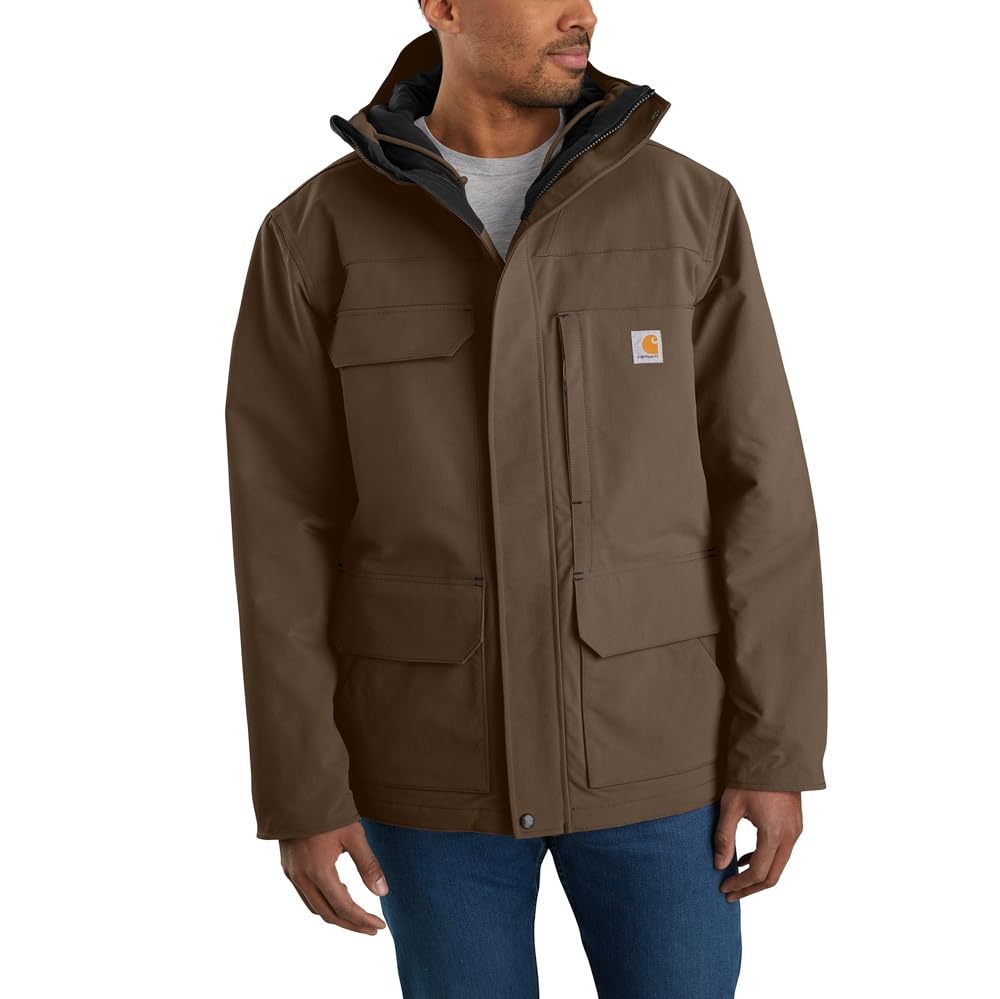
Nylon instead of duck: lighter on the shoulders, warm down past freezing, and built for movement.
Carhartt’s own description calls Super Dux nylon lighter and stronger than its classic duck material, and that is the whole pitch of this coat. The shell is 7.75-ounce 100% Super Dux nylon, lined with 100g 3M Thinsulate insulation for warmth without bulk. Rain Defender durable water repellent keeps light rain off, and Wind Fighter technology cuts the wind. In practice, that combination means you can work with full arm movement without feeling like you are wearing a canvas barrel.
The cold-weather proof is in the details: an adjustable hood with a chin guard and hidden drawstrings, internal rib-knit storm cuffs, and a droptail hem for added coverage over your lower back. Owners say it keeps them dry and warm in harsh cold, with the coat holding up in genuinely brutal temperatures. Fit earns steady praise too — it contours from shoulders to waist rather than hanging boxy.
Pockets are laid out for work: a hook-and-loop right-chest pocket with pen stalls, a left-chest zip pocket, two snap-button lower pockets with side-entry handwarmers, and an inner pocket. Sizing is the one mixed note — a few find it runs large — so check the relaxed-fit measurement before you commit. Quality and warmth dominate the feedback, and 4.5+ stars across 650+ owners puts this at the top of the ratings here.
Where it beats the Ridge: the Super Dux shell and 100g Thinsulate give you real cold protection in a lighter, more mobile package — the Ridge asks you to carry more fabric for its warmth.
Choose it when: you work in harsh cold and want insulation without losing arm mobility.
Consider the Ridge instead if: you prefer traditional duck feel and a standard fit over nylon.
Know the Specs
Duck canvas weight in ounces
Canvas is graded by weight per square yard, written in ounces. A 12-ounce washed duck is the classic workwear weight — thick enough to shrug off abrasion but softened with a washing process. Firm duck is the same cotton in an unwashed, stiffer form that takes months to break in but resists scrapes better from day one. Heavier duck equals more durability and more stiffness; that is the trade you are making.
Insulation grams and fill type
Insulation is sold by weight in grams — 100g of 3M Thinsulate is a lightweight fill that traps warmth without puffing you out. Sherpa fleece and synthetic down work differently: they warm more immediately and feel softer against the body, but they add bulk. Choose light gram weights like 100g Thinsulate for active work and heavier sherpa or synthetic down for standing still.
ANSI Class 3 hi-vis rating
ANSI Class 3 is the highest visibility class for workwear, requiring a specific amount of fluorescent background material plus reflective striping. If you work construction, surveying, or warehousing where Level 3 personal protective equipment is required, a standard duck coat will not satisfy the requirement no matter how warm it is. Look for the Class 3 label and check the stripe placement — high-vis jackets put the reflective tape at shoulders, waist, and cuffs.
Water repellent versus waterproof
Water-repellent coatings (often called DWR) make light rain bead up and roll off a fabric, but they do not seal out sustained rain. Waterproof shells, like coated PU Oxford, are built to hold rain out entirely. For winter work, water-repellent duck is usually enough for snow and sleet, while a waterproof shell is the better call if you are outdoors in steady rain.
Common Questions
Is duck canvas or nylon better for winter work?
How much insulation do I need for working outside in winter?
Will a work jacket fit over a hoodie?
Do I need an ANSI Class 3 jacket or a regular winter coat?
How long should a winter work jacket last?
What is the difference between water-repellent and waterproof on a work jacket?
Why do work jackets run big?
Can a hi-vis work jacket keep me warm in deep winter?
What are storm cuffs on a winter work coat?
Do Carhartt work jackets run true to size?
The Bottom Line
The best work winter jacket for most men is the Carhartt Montana, because it combines sherpa fleece and synthetic down into a warm core layer that blocks wind, sheds damp, and leaves room for a hoodie — and 4.5+ stars across 700+ owners says it holds up. If you work in harsh cold and want mobility, the Carhartt Super Dux uses lighter, stronger nylon with 100g Thinsulate so your arms still move freely. And when your site demands Class 3 hi-vis, the TCCFCCT bomber is the one to reach for. If you are buying on a tighter budget, start with the Pudolla softshell — a fleece-lined coat with more pockets than its tier usually gets. Pick by shell fabric: duck canvas for abrasion and brush, Super Dux nylon for mobility and lighter weight.
How we choose
We do not accept paid placement. Every pick is matched to a real buyer and a real use-case; we do not hands-on test units.
Sources
Specifications: manufacturer listings and product documentation. Review insights: verified customer reviews, as of November 2026. Pricing: not shown on this page (it changes often); check the current price via the retailer link.
As an Amazon Associate, Tactical Gear Guy earns from qualifying purchases. This does not affect which products we feature.