Specs are compiled from manufacturer listings and verified buyer reviews and can change over time — please confirm the key details on the product page before buying.
Rubber or leather? That question decides almost everything about a waterproof work boot. Rubber shells shrug off standing water in flooded trenches, mud, and creek crossings — they simply cannot soak through. Leather boots with an internal waterproof liner breathe better on hot days and give you a stiffer, more supportive platform under heavy loads. Pick the wrong shell for your job and you will either sweat through your socks by noon or feel water seeping in at the seams by week three. This guide separates the two families, matches each pick to a real workday, and flags the trade-offs worth knowing before you buy.
This guide is built by comparing the manufacturers’ published specifications and the patterns across verified customer reviews, so you get each pick’s real strengths and trade-offs instead of marketing spin.
Six of these nine boots are rubber or lined leather with a certified safety toe or shank, so the list covers farm mud, construction sites, and wet-weather hauling alike. Here are the work waterproof boots worth your money, ranked by what each one actually does for your feet.
Top Picks


How To Choose The Best Work Waterproof Boots
Start by naming the water you actually stand in. A flooded trench, a muddy feedlot, and a wet construction deck each call for a different boot shell, and the boot that wins in one will fight you in another.
Rubber shell or leather with a waterproof liner
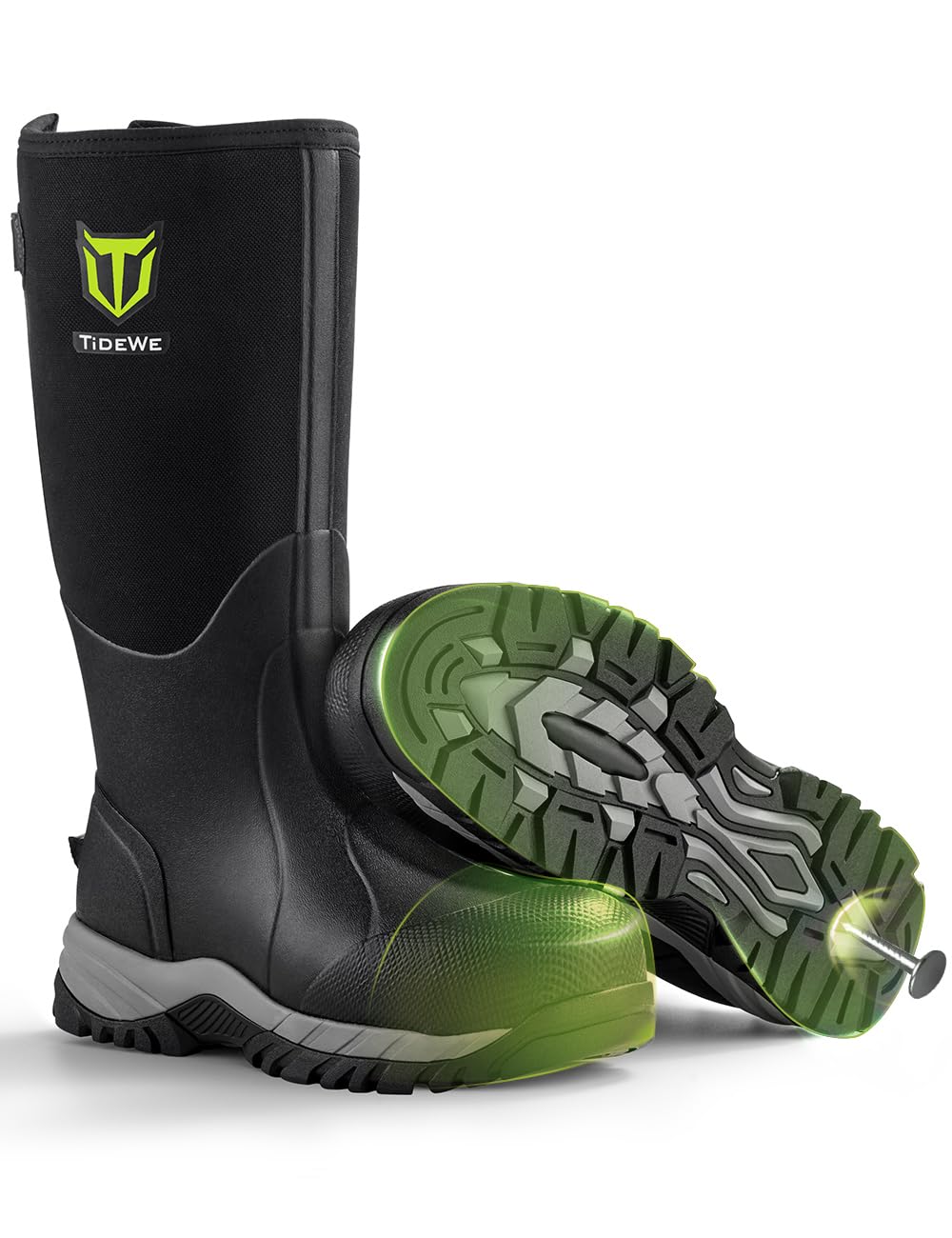
A rubber boot like the Trudave or the TIDEWE is a solid molded shell — water has no seam to sneak through, so it wins in standing water, deep mud, and snow. The catch is breathability. A leather boot such as the Wolverine Floorhand or the Timberland PRO Gridworks uses a waterproof membrane inside the leather, which breathes better but depends on that liner staying intact. If you work in splash and rain, leather with a liner is often the more comfortable pick. If you wade, rubber is the honest answer.
Safety toe, shank, and puncture protection
A steel toe is a metal cap over your toes that takes the hit from a dropped beam or a rolling drum. An alloy toe does the same job in lighter metal, which is why the Timberland PRO Gridworks uses one. Underfoot, a steel shank is a stiff metal strip between the insole and outsole — it stops nails and rebar from pushing up through the sole and adds support across a long shift. The TIDEWE pairs a steel shank with puncture-resistant construction, while the Thorogood 1957 spells out its safety toe and slip-resistance standards on the listing.
Warmth, neoprene, and all-season use
Neoprene is the synthetic rubber foam used in wetsuits, and its thickness sets how warm a rubber boot runs. The Trudave uses a 5mm neoprene layer, and the TIDEWE uses 6mm — thicker foam means more warmth when the temperature drops, but also a heavier, warmer boot on a July jobsite. If you work through fall and winter in wet conditions, that foam is your friend. If you mostly work hot months, a leather boot with a breathable lining will feel cooler.
Side-by-Side Comparison
| Model | Best For | Upper / Shell | Safety Feature | Key Detail | Amazon |
|---|---|---|---|---|---|
| Trudave Rubber Boots★ Best Overall | Wet mud and flooded ground | Rubber with neoprene | Reinforced protective toe | 5mm neoprene, anti-slip outsole | Amazon |
| TIDEWE Rubber Work BootsBuilt For Safety | Daily farm and site work | 100% waterproof rubber and neoprene | Steel toe, steel shank, puncture resistant | 6mm neoprene, pull-on tab | Amazon |
| Wolverine Floorhand 6”All-Day Comfort | All-day leather comfort | Waterproof leather | Steel toe | Moisture-wicking mesh lining | Amazon |
| Wolverine Trade Wedge Romeo | Easy on, easy off | Waterproof leather | — | Wedge outsole, flexible cushioning | Amazon |
| Timberland PRO Gridworks | Construction and rough terrain | Full-grain leather with waterproof membrane | Alloy safety toe, electrical hazard | Anti-fatigue footbed, ReBOTL lining | Amazon |
| Irish Setter Mesabi 8” | Logger-style all-weather work | Full-grain waterproof leather | Soft toe, EH rating | Goodyear welt, UltraDry waterproofing | Amazon |
| Carolina CA8821 8” | Long-shift comfort | Waterproof leather | Logger build | 3 lbs per boot | Amazon |
| Ariat Rebar Lift 6” | Cushion underfoot | Waterproof leather | Composite toe | Ankle elastic, supportive fit | Amazon |
| Thorogood 1957 Series 8” | Serious safety-toe jobs | Full-grain saddle leather | Steel toe, EH rated | Gusseted tongue, MaxWear 90 outsole | Amazon |
Detailed Reviews
1. Trudave Rubber Boots for Men with Steel Shank
Our pick — 4.5+★ from 700+ verified ratings; the strongest balance of quality and price.
The rubber shell that keeps your socks dry through mud, snow, and flooded ground.
If your workday ends with your boots caked in mud or standing in a flooded ditch, a solid rubber shell is the honest answer. The Trudave is a full rubber boot with 5mm neoprene built in — a wetsuit-style foam layer that traps warmth and keeps your feet from feeling like ice in cold, wet conditions. Because the shell is molded rubber, there are no leather seams to soak through, so water simply cannot find a way in. The reinforced protective toe adds a hard plastic cap over the front of the foot for those moments when something heavy lands where it should not.
What wins people over is the overall build quality — it is the thing buyers talk about most by a wide margin, and it shows in how the boots hold up through muddy seasons. Value for money follows close behind, because a boot this well put together lands in the mid-range tier rather than the premium one. Fit and warmth come up often too, with the neoprene reading like the inside of a wetsuit — warm, snug, and dry. Traction holds up on wet surfaces, which matters when the ground under you is slick.
The honest catch is durability and sizing. Some owners find the boots rip within a month of hard use, so this is not the pick for someone who kicks off boots by the heel or scrapes against sharp edges daily. Others find they run bigger than average, so check the size chart rather than assuming your usual number. The rubber shell also does not breathe like leather, so on a hot day your feet will run warmer than they would in a lined leather boot.
What earns its place on top
- Solid rubber shell with 5mm neoprene keeps feet warm and dry in wet, cold conditions
- Reinforced protective toe shields the front of the foot from impact
- Anti-slip outsole holds on wet and muddy ground
- Quality and value are what buyers call out most
Where it asks for care
- Some buyers report rips within a month of rough use
- Sizing can run bigger than average, so check the chart
- Rubber shell does not breathe like leather
Buy it if: you work in mud, snow, or flooded ground and want a boot that stays dry without a liner to worry about.
Think twice if: you need breathability on hot days or you tend to drag your boots off by the heel.
2. TIDEWE Rubber Work Boots
Rubber boots that put a steel toe and steel shank between your feet and the jobsite.
You get real underfoot protection here, because the TIDEWE takes the rubber-shell idea and adds a steel toe and steel shank. A steel toe is a metal cap that takes the hit from a falling or rolling object. A steel shank is a stiff metal strip between the insole and outsole that blocks nails and debris and supports your arch over a long shift. Puncture-resistant construction gives you a second layer of protection if you walk where nails or debris lie. The shell itself is 100% waterproof rubber and neoprene, so water stays out on wet, muddy, or hazardous ground. This one suits anyone working that kind of site who does not want to think about water getting in.
For warmth, TIDEWE uses 6mm neoprene — slightly thicker foam than the Trudave above, which means more insulation when the temperature drops. The breathable inner lining works the other way, moving air through so your feet do not cook when the weather warms up. A pull-on and kick tab speeds up getting in and out the door, and a 10-inch shaft circumference gives you a snug fit around the calf. The ergonomic arch at the top of the boot helps the whole thing sit comfortably once it is on.
Owners use these daily on everything from farms and gardens to fisheries and construction sites, and the boots hold up without complaints about water getting in or warmth running out. The main thing to plan for is sizing: TIDEWE asks you to measure your feet and pick a size roughly 0.16 inches longer than your actual measurement for the best fit. Skip that step and you may find yourself guessing. Like any rubber shell, it will feel warmer and heavier than a leather boot on a midsummer shift.
Steel under the rubber: A steel toe, steel shank, and puncture-resistant build make this the more protective of the two rubber picks — ideal if the ground itself is the hazard, not just the water.
The sizing step matters: Measure first and add the recommended 0.16 inches for the on-size fit, because rubber boots rarely play nice with guesswork.
Right for: wet, hazardous ground where falling objects or nails are part of the job.
Look elsewhere for: a cool summer boot — the 6mm neoprene runs warm when the sun is out.
3. Wolverine Men’s Floorhand Waterproof 6” Steel-Toe Work Boot
A leather workhorse light enough to forget about across a ten-hour shift.
Leather boots breathe in a way rubber shells cannot, and the Floorhand shows why that matters on a long shift. The waterproof leather upper sheds rain and splash while letting air move through, and a moisture-wicking mesh lining pulls sweat away from your foot so it does not sit there all day. At 4 pounds per boot, this is a leather-workboot weight that does not drag you down after lunch. The steel toe sits at the front to take the impact from dropped tools and rolling loads, and Wolverine has been building work boots since 1883, so this is a mature, well-known platform rather than a new experiment.
Owners mention they can wear these for ten-plus hour days — that is a leather boot that does not leave you thinking about your feet at hour eight. Quality leads the conversation by a wide margin, with value for money and comfort close behind. The fit earns steady praise too, and one wide-footed buyer found the 9 extra wide size worked perfectly, which is a useful signal if you usually struggle to find a leather boot that does not pinch. It is a lighter boot than the heavier logger picks further down this list.
What you should know going in: some owners find the boots started coming apart over time, so treat the leather and stitching with care if you work in harsh abrasion areas. Water resistance holds for most, though a few find it not fully sealed in extended wet conditions — so this is a wet-weather boot rather than a wading boot. If you spend hours standing in deep water, a rubber shell is the better tool.
The case for the Floorhand
- Waterproof leather with a moisture-wicking mesh lining keeps feet drier and cooler than rubber
- Light enough that ten-plus hour days stay comfortable
- Steel toe takes impacts from dropped and rolling loads
- Wide sizes available for broader feet
The honest caveat
- Some owners found the boots coming apart over time
- Water resistance is not the same as standing-water proofing
Pick this if: you want leather breathability and a full shift of comfort with splash protection built in.
Pass if: your day involves deep standing water rather than rain and splash.
4. WOLVERINE Men’s Trade Wedge Waterproof Romeo Boot

A pull-on wedge boot for the worker who is in and out of the truck all day.
Not every workday involves lacing up. The Trade Wedge Romeo is a slip-on waterproof boot with a wedge outsole — a one-piece, flat-bottom sole that spreads pressure evenly across hard surfaces instead of concentrating it under the heel. That even spread is what keeps you on your feet through a long day on concrete. The wedge also adds flexibility, so the sole bends with your foot rather than fighting it. For anyone hopping between a truck cab, a shop floor, and a muddy yard, the slip-on design saves real time.
Quality is the thing buyers praise most here, and the appearance earns a mention too — this is a boot that looks as good as it works. Owners find it light on the foot and easy to slide in and out of, and the smooth lining helps your foot slip in without a fight. Value for money rounds out the positives, since it lands in the mid-range tier for a leather slip-on.
The big thing to sort out before you buy is sizing. This boot runs very big, and sizing is the most-discussed point in the feedback — so go down rather than up, and check the size chart against your actual foot length. Durability is mixed as well; the boots hold up well for some, while others find the bottoms wear quickly on abrasive ground. If you work on gravel or rough concrete every day, plan for the soles to be the wear item.
Where it shines: Hours on concrete feel less punishing than in a heeled boot, because the wedge outsole spreads your weight evenly across hard floors. And the slip-on cut means you are not crouching to tie laces every time you step inside.
Size down, not up: The sizing runs very big here, and that is the point buyers raise most, so measure your foot and pick accordingly.
Made for: drivers, shop workers, and anyone who wants a waterproof leather boot they can kick on and off a dozen times a day.
Not the pick for: heavy gravel work where sole wear comes fast, or anyone who wants a locked-in lace fit.
5. Timberland PRO Gridworks Wedge 6 Inch Alloy Safety Toe
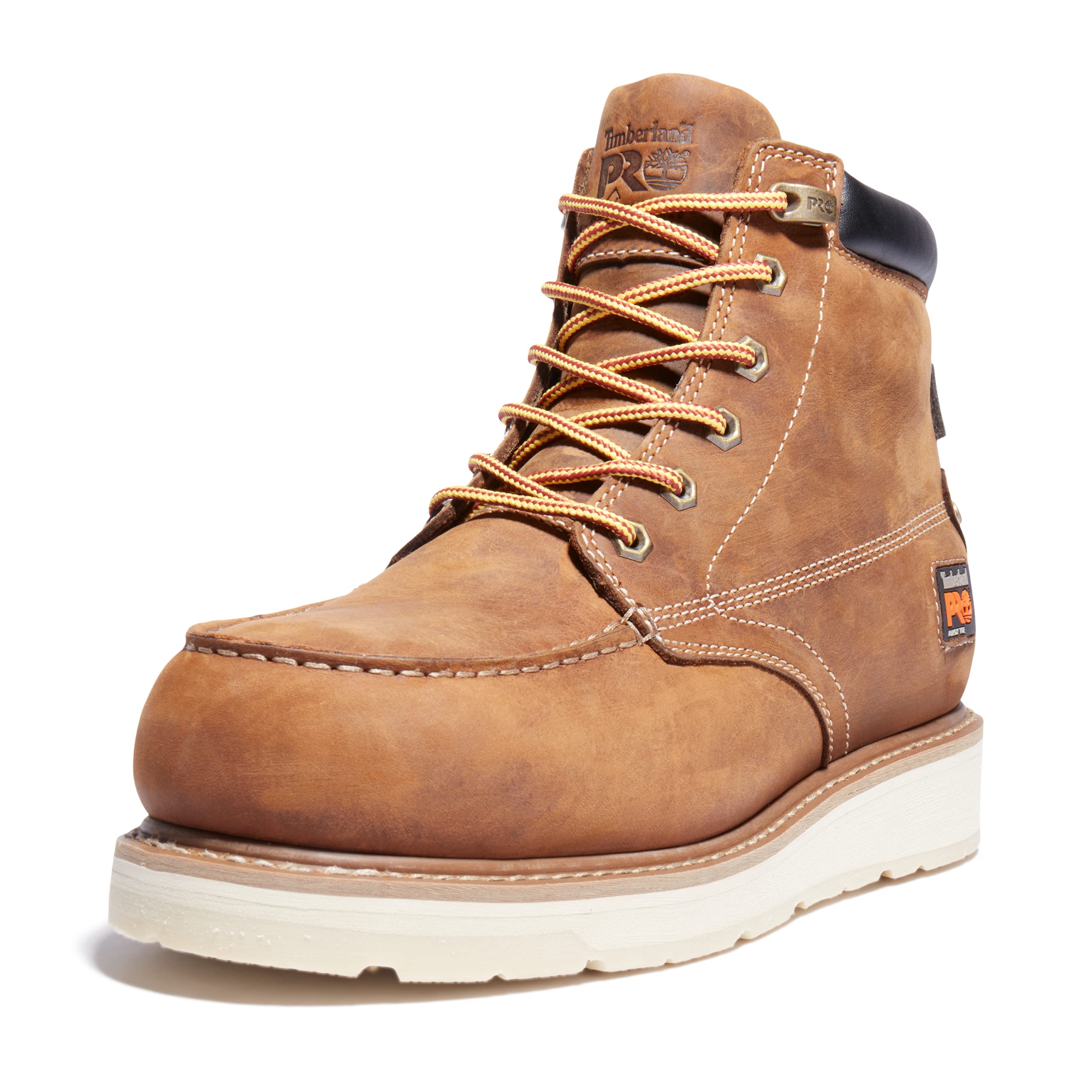
Full-grain leather, an alloy toe, and a footbed built to give energy back with every step.
This is the boot for construction sites that throw everything at your feet — freezing ground, oily patches, and rough terrain in the same shift. The upper is premium full-grain leather with an internal waterproof membrane, which is the layer that keeps water out while still letting the leather breathe. An alloy safety toe does the same job as steel in lighter metal, and electrical hazard protection adds a safety buffer for workers around live circuits. The outsole uses a cold-formula rubber built to hold traction when the ground freezes or turns oily.
The Anti-Fatigue Technology footbed absorbs shock and returns energy with every step, which matters on hard ground over a long shift. The lining is ReBOTL material containing at least 50% recycled plastic, treated with an antimicrobial finish to help keep the boots from getting funky. Quality and comfort are what buyers praise most, and construction workers in particular find them well-suited to the job. Fit and appearance round out the positives.
Two things to weigh honestly. Durability is genuinely mixed — the boots last almost two years for one camp of buyers, while another camp reports them falling apart within a month. So your mileage depends heavily on how hard you are on the toe and sole. Weight and break-in time are also split: some find them not too heavy, others call them chunky and heavy. If you are used to a light leather boot, expect an adjustment period.
Why it earns Top Performer
- Full-grain leather with an internal waterproof membrane and blood-borne pathogen resistance
- Alloy safety toe plus electrical hazard protection for site work
- Anti-Fatigue footbed absorbs shock and returns energy with each step
- ReBOTL lining uses at least 50% recycled plastic with an antimicrobial treatment
Where it splits opinion
- Durability ranges from almost two years to falling apart within a month
- Some find them chunky and heavy with a real break-in period
Built for: construction and industrial work where a safety toe, waterproof leather, and shock-absorbing comfort all matter at once.
Consider the lighter leather pick if: you want something that feels broken-in from day one and does not feel chunky on your foot.
6. Irish Setter Mesabi 8″ Men’s Soft Toe Logger Work Boot

An eight-inch logger built on waterproof full-grain leather and a Goodyear welt.
The Mesabi is a full-grain, waterproof leather logger with an 8-inch shaft — a taller cut that gives you more coverage up the leg when you are working in brush, wetlands, or deep snow. The Goodyear welt construction is a stitched method of attaching the sole to the upper, and it is the kind of build that holds together under hard use. UltraDry waterproofing handles the wet, and the outsole is heat resistant, slip resistant, and rated for electrical hazard use, so it covers the bases a logger-style boot needs. There is also a Swen-Flex puncture-resistant variant and a 600g insulated variant in the same family, so check which one you are actually adding to the cart.
Customers note quality first and comfort right behind it. Owners describe the fit as glove-like, and one says the arch support relieved back and calf pain over a shift. The boots perform well in wetlands and hold up across weather conditions, so this is a genuine all-weather option rather than a fair-weather boot. The removable EVA footbed (a cushioned insole you can lift out) lets you swap in your own insole if needed.
The trade-offs to know: waterproofing is mixed in the feedback, so treat this as a boot for wet ground rather than hours of standing water. The warning built into the listing is that this is a soft toe model, so it is not the right pick if you need impact protection from falling objects. And the logger cut is a taller, heavier style than a 6-inch boot, so if you want something light and low, look to the Floorhand.
The eight-inch advantage: A taller shaft gives you more coverage up the leg in brush, wetlands, and weather, which is where a logger cut proves its worth over a shorter boot.
Soft toe, so plan around it: This one is built for comfort and coverage rather than impact protection, so match it to jobs where dropped loads are not the hazard.
Best for: wetland, brush, and wet-weather work where a taller logger cut and a stitched sole are worth having.
skip it if: your site hands out impact hazards — you need a safety toe for that.
7. Carolina CA8821 & CA8823 8″ Waterproof Logger Boots for Men

Comfort is the headline here — a waterproof logger that feels right from the start.
Comfort is the thing buyers bring up most with the Carolina, and that is the reason it sits this high. The fit follows close behind, which matters in a heavy logger boot where a wrong fit becomes a blister by the end of the week. Water resistance holds up too — the boots keep water out during creek crossings, which is a real test for any waterproof leather. At 3 pounds per boot, this is a lighter logger than it looks, and the eight-inch cut gives you the same taller coverage as the Mesabi above. The leather keeps its new look, so it earns its keep both on the jobsite and off it.
What separates this from a lot of heavy leather boots is how little you have to fight it. The comfort is there from the first week rather than after a long break-in, and durability earns its own quiet praise — reviewers point out using them three years in a row without the build letting go. Value for money stands out for a premium-tier boot, since you are paying for a logger that is genuinely comfortable rather than one that just looks the part.
The realistic note is weight and pace. This is still a heavy leather logger, so if you are used to a light rubber pull-on or a 6-inch work boot, it will feel heavier on your feet at first. And like any leather boot, it will not stand in deep water the way a molded rubber shell can — it is built for wet ground and creek crossings, not for standing in a flooded ditch.
What stands out
- Comfort leads the feedback by a clear margin, with a fit that follows close behind
- Water resistance holds through creek crossings
- Durable enough to see three years of steady use
- Lighter than a typical heavy logger at 3 pounds per boot
The fair warning
- Heavier than a 6-inch or rubber boot on the foot
- Leather construction is not a substitute for a rubber shell in deep standing water
Reach for this if: a comfortable, durable, waterproof logger is the priority and you work wet ground rather than standing water.
Look elsewhere if: you want minimal weight or a rubber boot for flooded conditions.
8. Ariat Men’s Rebar Lift 6″ Waterproof Composite Toe Work Boot
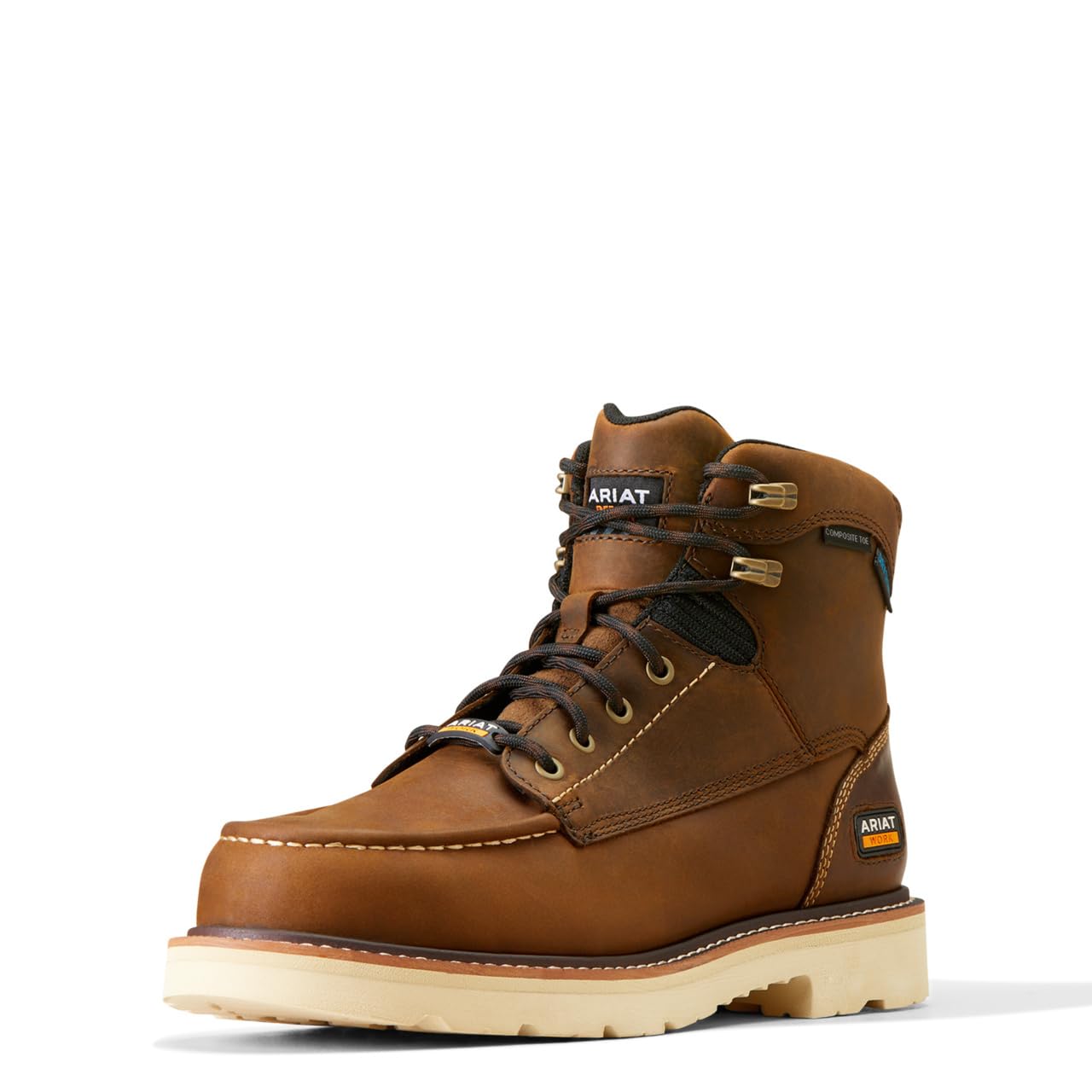
Cushioning and ankle flex for a long day that keeps you crouching and moving.
You get front-of-foot protection without the weight of steel, because the composite toe is a non-metal safety cap. Buyers call out quality most, with comfort right behind it. One detail that earns genuine praise is the elastic at the ankle, which makes the boot flexible enough to squat without fighting the shell. Foot support and appearance round out the positives.
For a waterproof boot, the leather upper handles wet outdoor conditions while still breathing like leather should, and the boot wears well enough to pass as everyday footwear away from the site. It is a 6-inch cut, so it is lighter and lower than the 8-inch logger picks on this list, and that lower cut makes it easier to move in tight spaces.
Here is the honest part. Durability is the concern on this one — the soles can peel apart, and some find the boots falling apart after a couple of months. That puts this in the same category as other premium leather boots that want care and clean-up, not the abusive treatment of a rubber shell. Fit and water resistance split opinion too, so try them on with your work socks and keep them clean and dry between shifts. If you need a boot that takes serious abuse, a rubber shell or a welted logger will outlast it.
Where the cushioning pays off: The composite toe and ankle elastic make this the most flexible boot on the list for crouching, kneeling, and quick changes of position — the support is real underfoot.
Plan for sole wear: The sole is the wear item here, so keep the boot clean and dry and you get more life out of it.
The one for: workers who crouch and move all day and want composite-toe protection with cushioned support.
Better options exist if: you need a boot that survives serious abuse over years rather than months.
9. Thorogood 1957 Series 8” Waterproof Steel Toe Work Boots

American-made full-grain leather with a steel toe and a slip-resistant heel outsole.
The 1957 Series is the pick for the worker who wants a serious safety-toe boot built from premium materials. The upper is full-grain saddle leather with a moc toe design, finished in Trail Crazyhorse brown with a special wax that gives it an Old West look. It is American made with USA and globally sourced components, built by Thorogood at its US plants. A gusseted tongue keeps water and liquids at bay, while the moisture-wicking lining pulls sweat away so you are not stewing in your boots all shift. The steel toe meets ASTM F2413-18 safety toe standards, and the MaxWear 90 traction outsole meets ASTM F3445-21 slip-resistance standards on loose gravel, wet, and oily surfaces.
Quality leads the feedback by a wide margin, and comfort follows once the leather breaks in. Buyers find the boots top quality, well-constructed, and built to last, and they like the look as much as the function. The 8-inch shaft and memory foam insole give you the tall logger coverage and a soft landing underfoot, and the boot weighs 4.9 pounds — a substantial leather boot, as expected for a steel-toe logger.
The two-sided part: some find the soles coming apart over time, and value for money splits down the middle — many find it worth the premium-tier cost while some feel it does not earn that price. Break-in takes real time on full-grain leather like this, so plan to give it a week or two before it feels like yours. If you want a boot that is comfortable from minute one, a rubber or softer leather pick suits you better.
Why the heritage build holds up
- Full-grain waterproof saddle leather with a gusseted tongue
- Steel toe meets ASTM F2413-18 standards
- MaxWear 90 outsole meets ASTM F3445-21 slip-resistance standards
- Memory foam insole and moisture-wicking lining add comfort over the shift
The realistic trade-offs
- Some find the soles coming apart over time
- Value for money splits — some do not feel the premium-tier cost is earned
- Full-grain leather takes time to break in
Worth it for: anyone who wants an American-made steel-toe logger with full-grain leather and standards-tested slip resistance.
Think twice if: you want instant comfort from the start or you are hard on soles and want a rubber shell instead.
Know the Specs
Waterproof shell vs waterproof liner
A rubber boot is a molded shell, so there are no seams for water to push through — which is why the Trudave and TIDEWE handle flooded ground, mud, and snow. A leather boot like the Wolverine Floorhand or Timberland PRO Gridworks uses an internal waterproof membrane: water is blocked by the liner while the leather still breathes. The practical split is standing water versus wet conditions. If you wade, go rubber. If you work in rain, splash, and mud, the lined leather boot gives you more breathability and a lighter feel on the foot.
Steel toe vs alloy vs composite toe
A steel toe is a metal cap that absorbs impact from falling or rolling loads, and it is the standard choice on boots like the Wolverine Floorhand and Thorogood 1957. An alloy toe does the same protective job in lighter metal, which is what the Timberland PRO Gridworks uses. A composite toe, like on the Ariat Rebar Lift, is a non-metal cap that keeps the safety protection without the steel weight. If impact hazards are part of your day, you want one of these. If they are not — like the Irish Setter Mesabi soft toe — match the boot to the job and do not pay for protection you will not use.
Shank and puncture resistance underfoot
A steel shank is a stiff metal strip between the insole and outsole, and it does two jobs: it stops sharp objects from pushing up through the sole and it supports your arch over a long shift. The TIDEWE pairs its shank with puncture-resistant construction, and the Trudave also uses a steel shank in its rubber shell. If you walk ground with nails, rebar, or debris, the shank is the feature that matters more than the upper — a waterproof boot that lets a nail through is not protecting you.
Neoprene thickness and warmth
Your feet stay warm in cold, wet weather because of the neoprene — the synthetic rubber foam used in wetsuits — and its thickness sets how warm a rubber boot runs. The Trudave uses 5mm and the TIDEWE uses 6mm. Thicker foam means more warmth when temperatures drop, but a warmer boot on a hot day. If you work through fall and winter in wet conditions, this foam is what keeps your feet from going numb. If you work mostly hot months, a breathable leather boot like the Floorhand will feel cooler on your feet.
Common Questions
Are rubber work boots better than leather for waterproofing?
Do I need a steel toe or a composite toe for work?
What does a steel shank actually do in a work boot?
How warm are neoprene rubber boots in cold weather?
Should I size up in rubber work boots?
How long should waterproof work boots last?
Are waterproof leather boots safe in heavy rain all day?
What does the EH rating on a work boot mean?
Can I wear a rubber boot like thefive or six-millimeter neoprene boot in summer heat?
Is a puncture-resistant sole worth it if I work on a farm?
The Bottom Line
For most people shopping for work waterproof boots, the Trudave is the pick that makes the most sense. A solid rubber shell with 5mm neoprene, a reinforced toe, and an anti-slip outsole keep your feet warm and dry in mud, snow, and flooded ground. If your site hands you falling objects and nails, the TIDEWE steps up with a steel toe, steel shank, and puncture-resistant build for a small step up in cost. Want leather breathability for a full shift? The Wolverine Floorhand is the more comfortable choice for rain and splash. And if you need an American-made steel-toe logger, the Thorogood 1957 is built for exactly that job.
The one honest nudge: match the shell to the water you actually stand in, not the water you hope to avoid. A rubber shell wins in standing water, and a lined leather boot wins in rain and splash.
How we choose
We do not accept paid placement. Every pick is matched to a real buyer and a real use-case; we do not hands-on test units.
Sources
Specifications: manufacturer listings and product documentation. Review insights: verified customer reviews, as of November 2026. Pricing: not shown on this page (it changes often); check the current price via the retailer link.
As an Amazon Associate, Tactical Gear Guy earns from qualifying purchases. This does not affect which products we feature.