Specs are compiled from manufacturer listings and verified buyer reviews and can change over time — please confirm the key details on the product page before buying.
You need a radio that still works after it hits concrete, gets rained on, or rides in a truck bed all day. That is the whole job. So the list below focuses on what actually breaks on a work walkie talkie — battery life through a full shift, a sealed body that survives weather, and channels that stay clear on a noisy site — rather than the fantasy “36-mile range” printed on the box.
This guide is built by comparing the manufacturers’ published specifications and the patterns across verified customer reviews, so you get each pick’s real strengths and trade-offs instead of marketing spin.
You will see how each set behaves in real working conditions, from clip-on palm-sized units for a warehouse crew to rugged pairs built for a job site. Here is a straight, spec-checked rundown of the best work walkie talkies for job sites, crews, and field teams.
Top Picks

How To Choose The Best Work Walkie Talkies
A work radio fails you in three ways: it dies mid-shift, it lets water in, or nobody can hear you over the equipment. Pick a set that solves those three and the rest is preference. Here is what to weigh before you buy.
Range is a city block, not a highway number
Manufacturers advertise the flat, open-air maximum, often phrased as a huge square-footage figure or a number of floors. Real work happens between steel walls, concrete floors, and racks of inventory, and that cuts the distance sharply. A radio rated for 300,000 sq ft or 25 floors is a rough promise of coverage, not a guarantee. Size your coverage plan around the shorter urban figure, not the open-air maximum.
Water and dust sealing means the difference between a shift and a repair
An IP67 rating (a two-digit scale for dust and water protection — the 6 means dust-tight and the 7 means it survives being dunked) is the work-grade mark. A radio with only “water resistant” branding may shrug off rain but not a dropped-in-a-puddle moment. If your crews work outdoors or near water, insist on a real IP number.
Battery: capacity plus a charging dock
Look at the milliamp-hour (mAh) figure on the battery — it’s the fuel tank size. Higher mAh generally means more hours of talk time. Pair that with a charging dock or USB-C port so the whole crew can refill overnight in one place. A radio with 2000mAh or more, plus a dock, is set for a full working day.
Channels, privacy codes, and glove-friendly controls
Multiple channels let each team or floor stay on its own frequency, and privacy codes (also called CTCSS or DCS) cut down on crosstalk from other radios nearby. On top of that, look for physical key layout that works with gloves on. Oversized push-to-talk buttons and knobs beat tiny touchscreens on a wet, dirty job site.
Side-by-Side Comparison
| Model | Best For | Battery Life | Water Rating | Channels | Amazon |
|---|---|---|---|---|---|
| Retevis RB48★ Best Overall | Rugged field work | 18 hours | IP67 / Floating | FRS | Amazon |
| Midland GXT1000VP4Most Channels | Campgrounds & crews | 10 hours | JIS4 | 50 | Amazon |
| TIDRADIO TD-628Best Crew 4-Pack | Job site 4-pack | 72-hour standby | IP67 | 16 | Amazon |
| Motorola T605_H2O | Wet & emergency use | 9 hours | IP67 / Floats | 22 | Amazon |
| DEWALT DXFRS300 | Multi-level commercial sites | 12 hours | IP67 | 22 | Amazon |
| Radioddity X1 | Construction & logistics | 2-day (2500mAh) | IP67 | 22 | Amazon |
| Retevis RT68 | Team & staff comms | 14 hours | — | 16 | Amazon |
| SAMCOM FPCN30A | Programmable UHF crews | 10 hours | — | 20 UHF | Amazon |
| Mountain Radio | Multi-day backcountry | 4 days | IP56 | FRS | Amazon |
Detailed Reviews
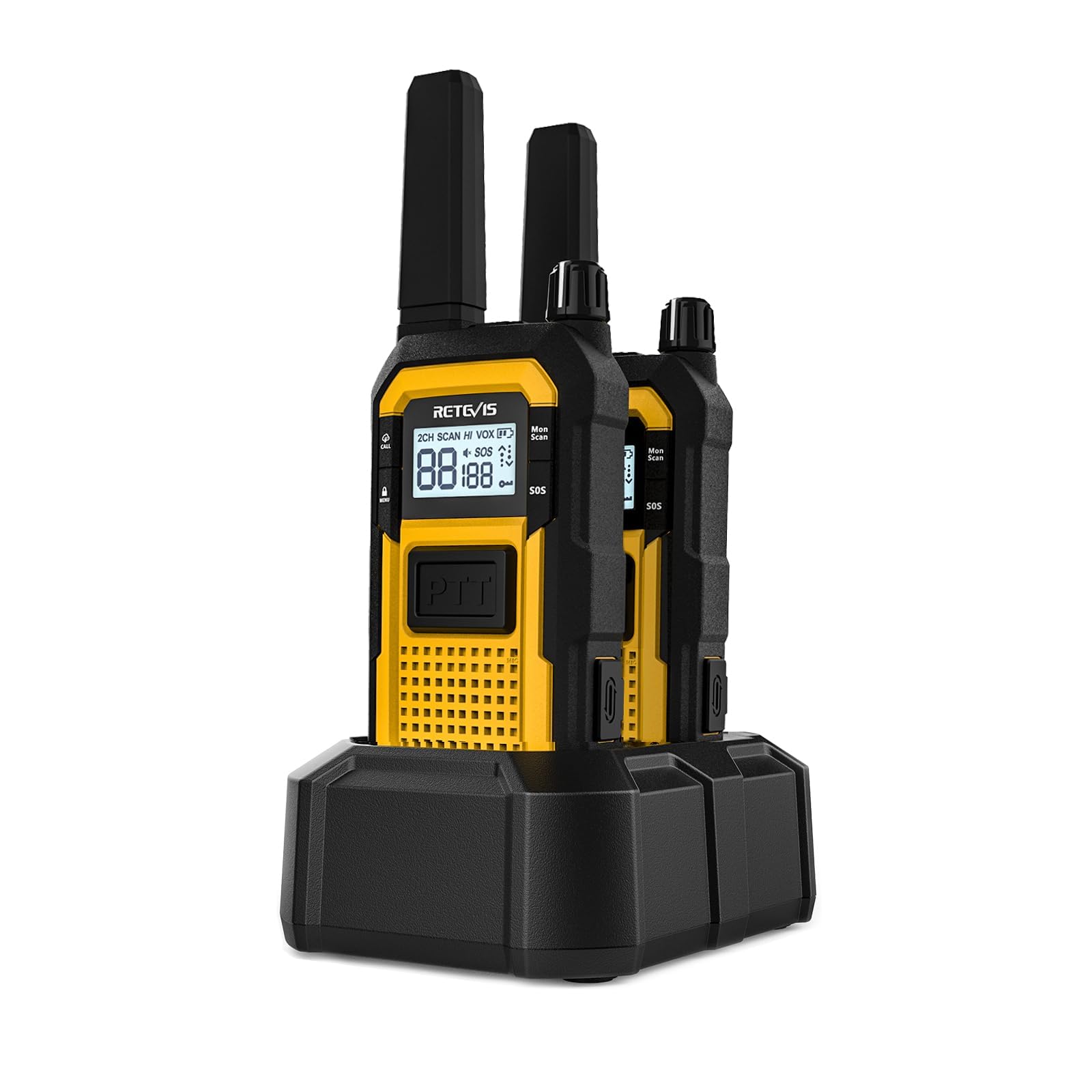
1. Retevis RB48 FRS Walkie Talkies
Our pick — 4.5+★ from 900+ verified ratings; the strongest balance of quality and price.
The yellow brick that survives a drop, a downpour, and a full shift without complaint.
The RB48 earns the top spot because it solves all three work-radio fears at once. It is built to MIL-STD-810H — a military test standard that covers drops, dust, vibration, heat, and cold — so it takes daily abuse instead of babying it. And it is rated IP67, meaning the body is sealed against dust and survives a dunking, with a floating design so a dropped unit does not vanish in a pond.
Battery sits at 2000mAh, with the maker listing up to 20 hours of run time and the average-life figure at 18 hours. Either way, that is a long shift covered, and it recharges through USB-C or the included two-in-one dock. The sealed silicone button covers and bright yellow shell are small touches that matter when your hands are wet and the floor is busy.
What wins people over is plain functionality: it works in rain or on a ladder, over a maker-rated 300,000 sq ft or 25 floors. The honest catch: the controls lean simple rather than programmable, so if you need custom frequencies this is not the set — the SAMCOM FPCN30A lower down handles that better.
What earns the top slot
- MIL-STD-810H build means it handles drops and rough handling
- IP67 rated and floats, so water is a non-issue
- 2000mAh battery with USB-C and a two-in-one dock for easy refills
- Glove-friendly buttons and a high-visibility yellow body
Where it asks patience
- Simpler control set with no deep programming from the start
- Only two units per pack, so a large crew needs several sets
The clear call: Buy this if your radios live outdoors, get dropped, or work near water — it is the most work-ready set on the list.
Trade-off to weigh: Need to program custom frequencies into the radios yourself? This one keeps things simple instead.
2. Midland GXT1000VP4 GMRS Two-Way Radios with Headsets
Fifty channels and hands-free voice activation for crews who keep their hands on the wheel.
The GXT1000VP4 runs on GMRS (General Mobile Radio Service, a licence-free band for the whole family in the US) and gives you 50 channels plus 142 privacy codes. That channel count is more than triple the TIDRADIO TD-628’s 16 channels — 50 versus 16 — so if you have a busy site with plenty of other radios around, there are far more places to find a clean line.
Where it shines is hands-free work: an EVOX voice-activation feature lets it transmit while you keep both hands on gear, and dual-power mode swaps to AA cells when the rechargeable pack runs low. A built-in NOAA weather scan sounds an alert when rough conditions roll in. Battery life is listed at 10 hours, which covers a standard outing with a recharge to spare.
The trade-off is the water rating: this radio is JIS4 water resistant, not the full IP67 dunking-grade sealing the Retevis RB48 above carries. It handles rain and splashes fine, but a drop into standing water is not its job. For campgrounds, road trips, and dry-site work, that is a perfectly fair trade for the extra channels.
What it does best: It packs two radios, rechargeable packs, and a desktop charger in the box ready to go, plus an SOS siren, keypad lock, and vibrate mode for silent sites.
The fit question: Best for outdoors-in-fair-weather crews that want channel variety; if you work in wet, gloves-on conditions, look at the IP67 sets instead.
Pick it when: You want the widest channel choice and hands-free talk without paperwork.
Not this one if: Your radios get submerged — JIS4 is splash-grade, not submersible.
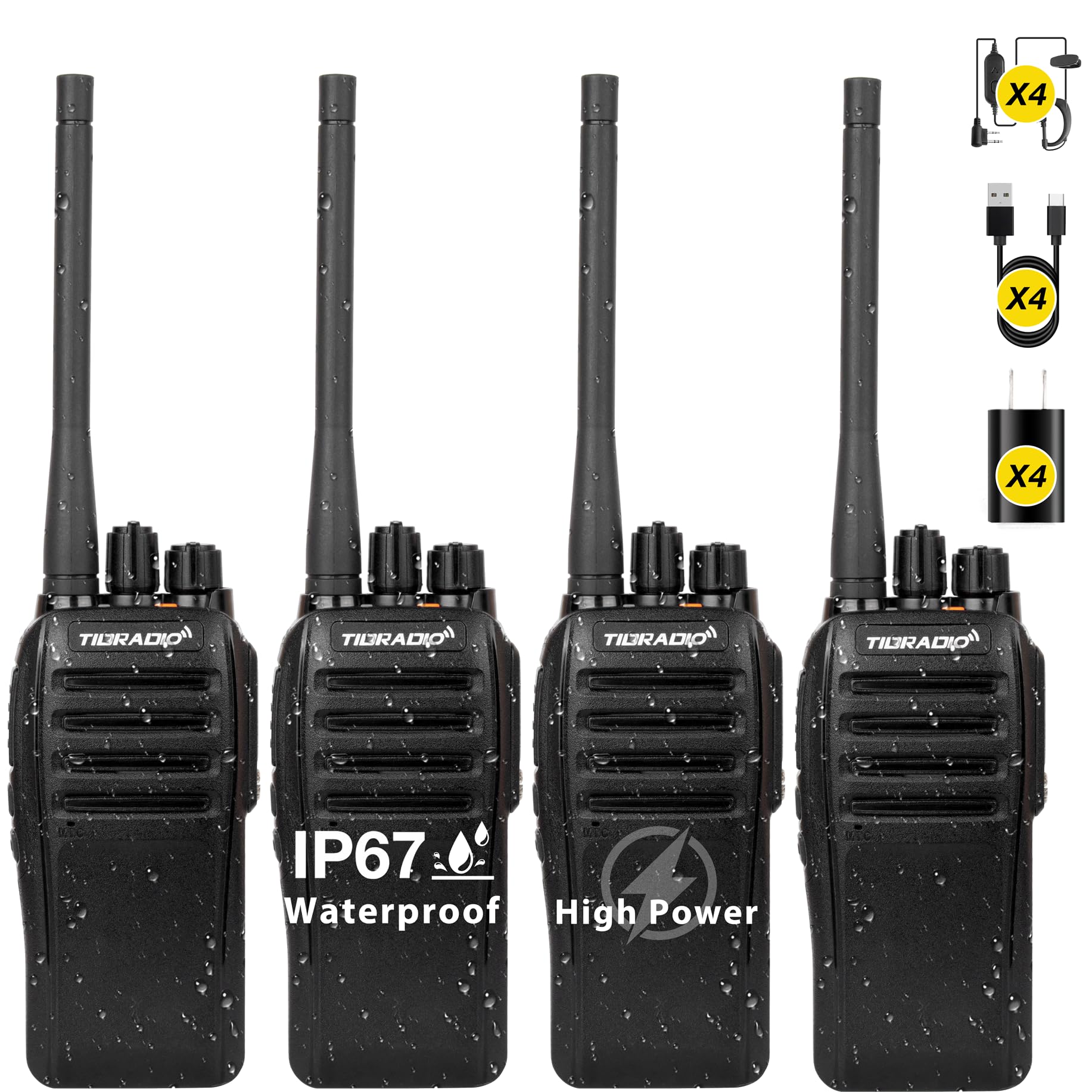
3. TIDRADIO TD-628 Heavy Duty Walkie Talkies
Four radios, four batteries, four earpieces — a full crew ready in one box.
If you are equipping a five-person team, this four-pack is the practical buy. Each unit carries a 2500mAh battery — more capacity than the Retevis RB48’s 2000mAh — and the maker lists over 72 hours of standby with a full charge in 4 hours via Type-C. The bigger number that sells it for site work is the “advanced triple-proof” build, engineered to survive a 2-meter drop or being run over, backed by an IP67 waterproof and dust-proof seal.
The ease of use is genuine: a simple design, no complex screens, and 9 sensitivity levels on the VOX (voice-activated transmit) function so people talk hands-free. There is also a frequency-copy feature that clones another radio’s channel without a computer, plus a two-mode SOS alarm for local and team alerts.
Here is the honest limit: the channel count is 16, so mid-size rather than sprawling channel needs. And the programming path uses CSP, not CHIRP, so anyone planning deep custom setups should confirm that fits their toolchain. For a straightforward crew needing four tough radios fast, none of that is a real obstacle.
Why a foreman would grab it
- Four radios per pack, each with its own 2500mAh battery
- IP67 rated and rated to nudge off a 2-meter drop or a car crush
- Frequency-copy clones a channel without a laptop
- Type-C charging and a 4-hour full-charge cycle
The fine print
- 16 channels is fine for small crews but not sprawling operations
- Programming uses CSP, not CHIRP — check your software first
Go this way if: You are kitting out a small-to-mid crew and want everything in one box with no programming homework.
Hold off if: Your workflow depends on CHIRP-based programming or a long channel list.
4. Motorola Solutions T605_H2O Walkie Talkies
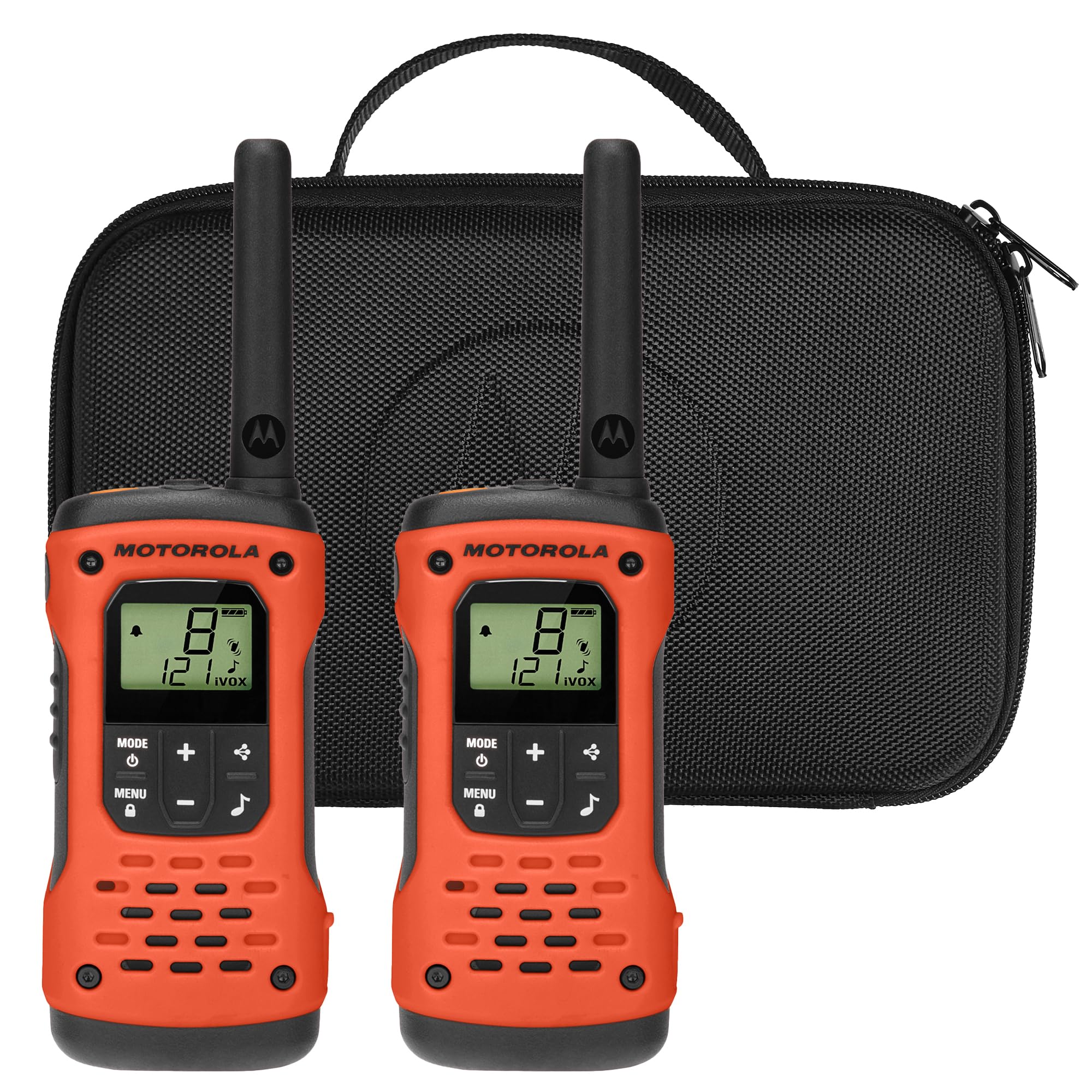
The set that floats face-up and lights its own flashlight the moment it hits water.
For dock work, marinas, or anywhere a radio can end up in the drink, the T605_H2O is built around water in a way most sets are not. It is IP67 rated, floats face up so it stays retrievable, and a water-activated flashlight clicks on to help you find it. That is a focused design choice, not a feature list — and it explains why the body is taller than the others: at 7.8″H it stands well above the 3.9″H RB48, and it weighs 7.84 ounces.
Pairing is easy, and 22 channels with 121 privacy codes — 2,662 combinations in all — means you can usually find an open line. A backlit display helps in low light, and USB-C charging is standard. Battery life is listed at 9 hours, which is the shortest full-day figure on this list, so plan a midday top-up or a spare set for long shifts.
The durability feedback is genuinely mixed — some crews report solid long-term service, others say theirs did not last — so treat this as a water-first radio you care for rather than a drop-everything beater. If water is your main threat, that focus is worth it.
Where it wins: Floats face up, fires off a water-activated flashlight, and offers 22 channels plus 121 privacy codes for a clean line.
The catch to size up: At 9 hours of listed battery life it wants a mid-shift charge, and it is a water specialist rather than an all-round bruiser.
Made for you if: Your radios work near water and you want one that comes back up instead of sinking.
Think twice if: You need a full double-shift on one charge — 9 hours is the limit here.
5. DEWALT DXFRS300 FRS Walkie Talkies

One watt of output built to keep a crew connected across multi-level job sites.
The DXFRS300 packs 1W of transmit output, rated to reach up to 250,000 sq ft or 20 floors — enough to hold a multi-level commercial site together. It carries 22 FRS channels and 121 privacy codes with auto-squelch to keep audio clean when the airwaves are crowded, plus vibration alert and roger beep so gloved workers get heads-up feedback.
Build is the other selling point: IP67 rated for water and dust, with an anti-slip housing built to take drops up to 2 meters. The 10.6-ounce body is heavier than the 7.84-ounce Motorola T605_H2O, which most crews read as sturdier in hand. A 12-hour rechargeable Li-polymer battery covers a standard shift, and the box includes holsters and a dual-port dock charger.
Buyers report strong results at workable distances — loud, clear sound and reliable range up to roughly half a mile in practice. Durability and battery feedback split both ways, so treat this as a solid daily driver that rewards proper care over a unit you throw around without thought. The 1W reach is real; the printed max is not what you get between walls.
What crews get
- 1W output rated for 250,000 sq ft or 20 floors
- IP67 with anti-slip housing and 2-meter drop protection
- 22 channels, 121 privacy codes, and auto-squelch for clean audio
- 12-hour battery plus a dual-port dock charger
What to keep in mind
- At 10.6 ounces it is one of the heavier units here
- Durability and battery reports vary, so don’t treat it as indestructible
Reach for this if: You run a multi-floor or large-footprint site and want real transmit power with glove-friendly feedback.
Look elsewhere if: You want the lightest possible radio for all-day carry — this one leans toward heft.
6. Radioddity X1 Waterproof Walkie Talkies
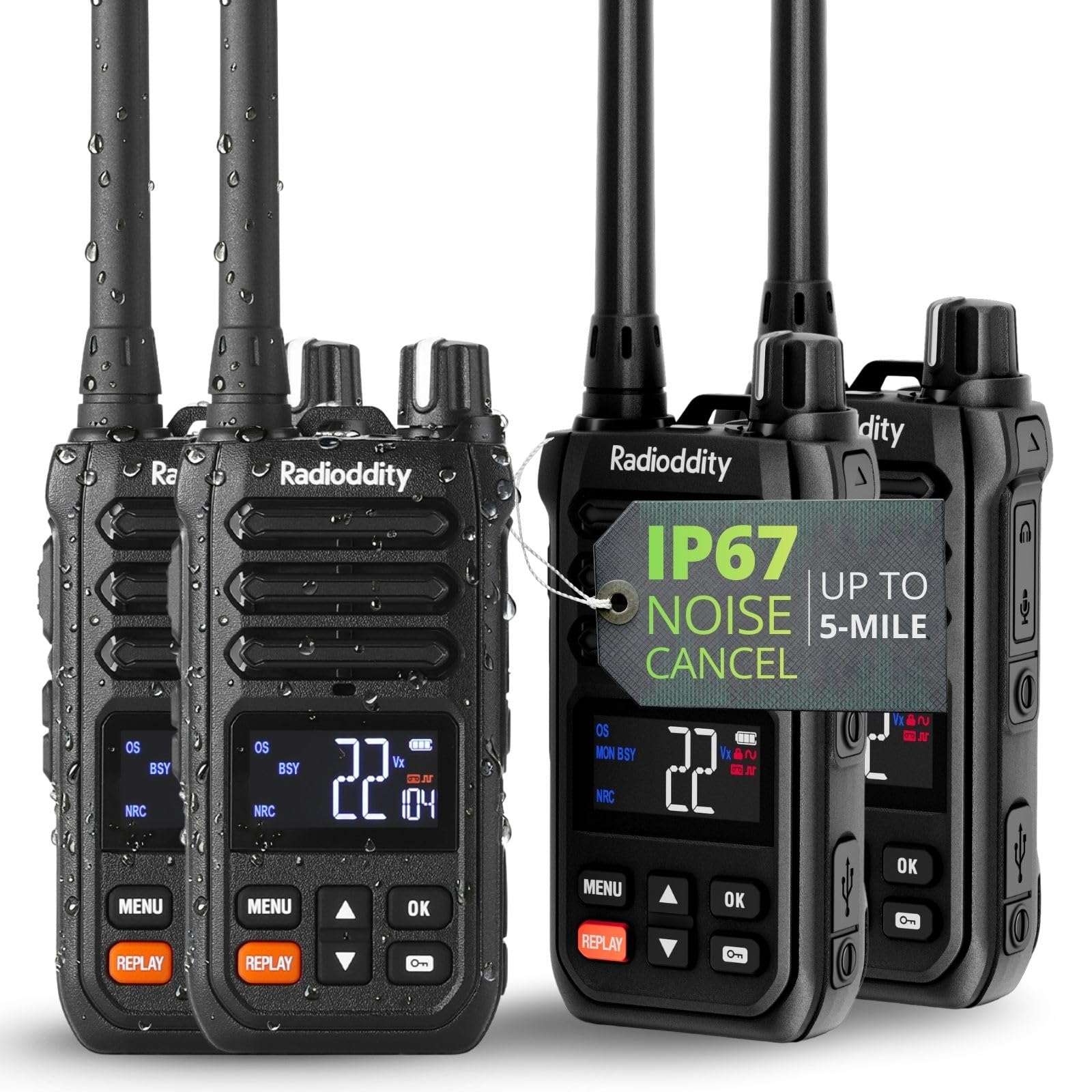
Drop-tested past a thousand falls and sealed against water for 30 minutes.
The X1 is a four-pack built for abuse. Radioddity tests the rugged ABS housing to handle over 1,000 drops, and the IP67 seal survives immersion up to 30 minutes while blocking particles as small as 0.1μm. That is a real spec, not a slogan — ideal for construction sites, logistics floors, and field work where the radio gets treated like a tool.
Power is strong too: a 2500mAh Li-ion battery rated for up to 2 days of use and recharges over USB-C from a wall adapter, car charger, or power bank. You get 22 FRS channels with 50 CTCSS and 105 DCS codes for clean lines, plus a noise-reduction feature on both transmit and receive. Extras include NOAA weather alerts, SOS, VOX hands-free, record-and-replay, and an adjustable backlight.
The honest note on reach: the maker lists up to 5 miles in open areas or 2 miles in urban settings, which is the usual story — the city number is the one your crew will actually see. At 7.4 ounces per unit it stays light for all-day carry.
Standout spec: Over 1,000-drop testing and 30-minute immersion protection make it the most abuse-tolerant pick here.
Real-world reach: Expect the listed 2 miles in urban settings, not the open-air 5-mile figure, once walls get involved.
Suits you if: You need a four-pack of genuinely tough radios for a construction or logistics crew.
Consider waiting if: You want a long proven track record — this set has fewer owner reports behind it.
7. Retevis RT68 Business FRS Walkie Talkies
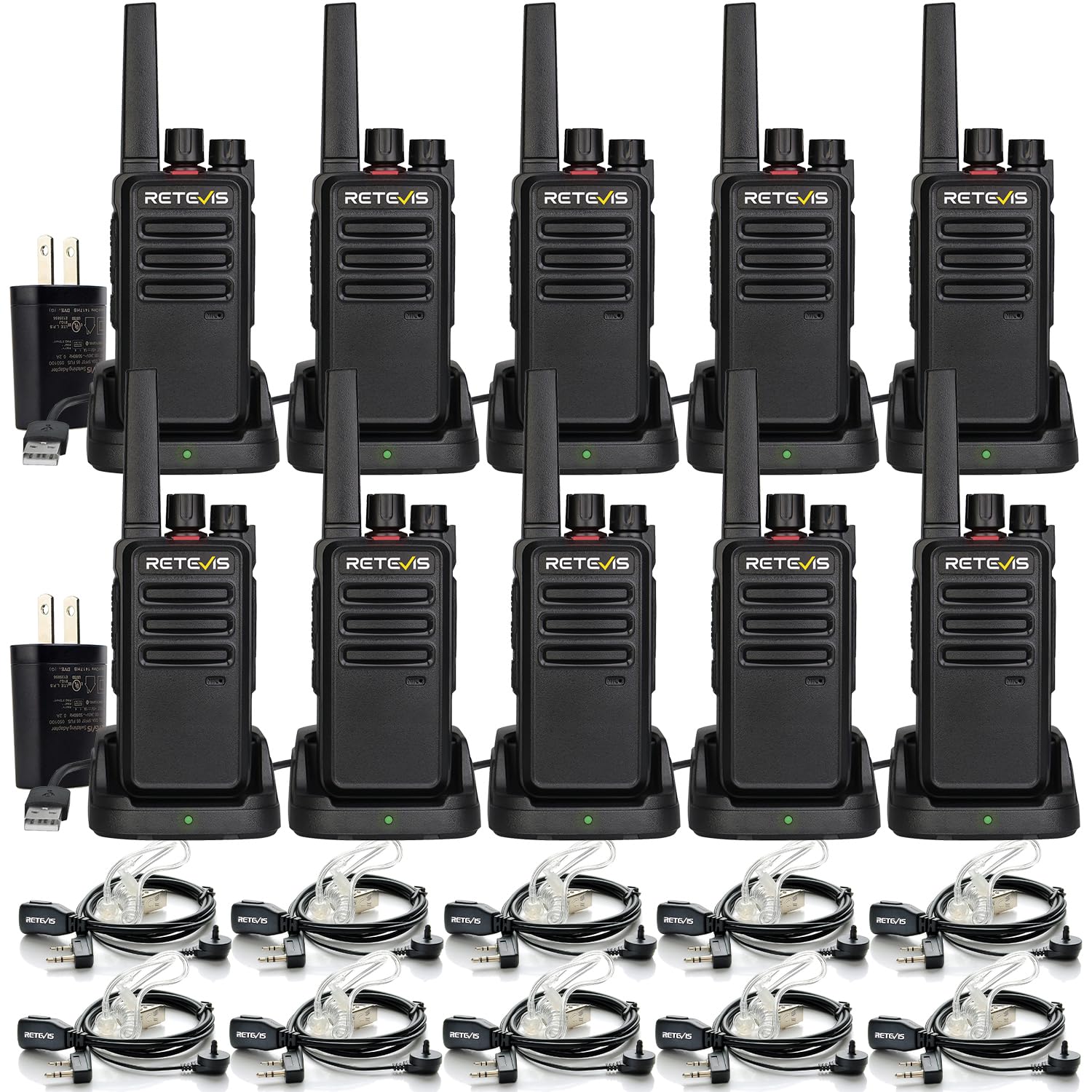
Ten palm-sized radios to put a whole staff on one clean channel.
When the job is outfitting a full roster — a retail floor, a school, a warehouse — the RT68 ten-pack is the efficient answer. Each palm-sized radio runs 16 channels that the maker says can penetrate concrete or steel, with a hardened shell built to shrug off normal drops. The 14-hour battery life tops the Motorola T605_H2O’s 9 hours by a clear margin, so a shift-plus gets covered.
Usability is the draw here: a knob and buttons for volume and channel, 0-9 squelch levels to filter noise, and VOX so people talk without pressing the button. The 500mW speaker aims for loud, clear output even in busy spaces, and earpieces ship with every unit. Quality and value are what the brand’s reputation rests on, and it fits crews that need many radios without training anyone.
The caveat is range: feedback splits, with some crews finding it impressive and others reporting it falls short of expectation. Battery-life and durability notes also vary. So this is a quantity-and-value play for indoor teams — not the set to pick if your coverage stretches across a large outdoor site.
The case for ten radios
- Ten units per pack with earpieces included
- 14-hour battery and 16 channels for team separation
- Palm-sized with a knob and button layout that needs no training
- 500mW speaker and 0-9 squelch for clear audio in noise
What to weigh
- Range reports vary — some crews find it falls short of expectation
- Durability and battery notes are mixed over the long term
Right pick for: Indoor teams and staff rosters that need many radios fast with no training.
Reconsider if: Your crews cover a large outdoor site where range is the deciding factor.
8. SAMCOM FPCN30A Commercial 5W UHF Walkie Talkies

Five watts of UHF and one-button group calls for crews that already have a channel plan.
The FPCN30A is the set for teams that run on their own frequencies. It offers 5W UHF output — the maker lists about 1 to 2 miles through buildings and 3 miles line of sight — plus 20 UHF channels and a one-button group call that reaches every radio on the net at once. Crucially, it is programmable: you can write your own frequencies and match the radios your crew already carries, with no factory-locked list.
Work-readiness is built in: glove-friendly keys and rugged bodies, a 1500mAh battery listed at 10 hours for a full shift, and a charging base that refills all three radios overnight. An earpiece ships with every unit, and the radios cover UHF 406.1-470MHz. Quality and range are where owners speak most warmly, and the sense is durable commercial gear.
The honest caveat is that this is commercial UHF rather than plug-and-play family FRS — it rewards a crew that knows its channel plan and wants the flexibility. If you want a channel set and forget, the simpler IP67 sets higher up suit better. If you want programmable reach and group calls, this delivers.
Best at: Programmable 5W UHF with a one-button group call and a three-radio charging base.
Where it demands expertise: It expects an existing channel plan rather than a fixed factory list, so plan to program it.
Choose it if: Your crew already runs its own UHF channels and wants 5W reach with group calls.
Stay clear if: You want a plug-and-talk FRS set with zero programming.
9. Mountain Radio FRS Handheld Radio
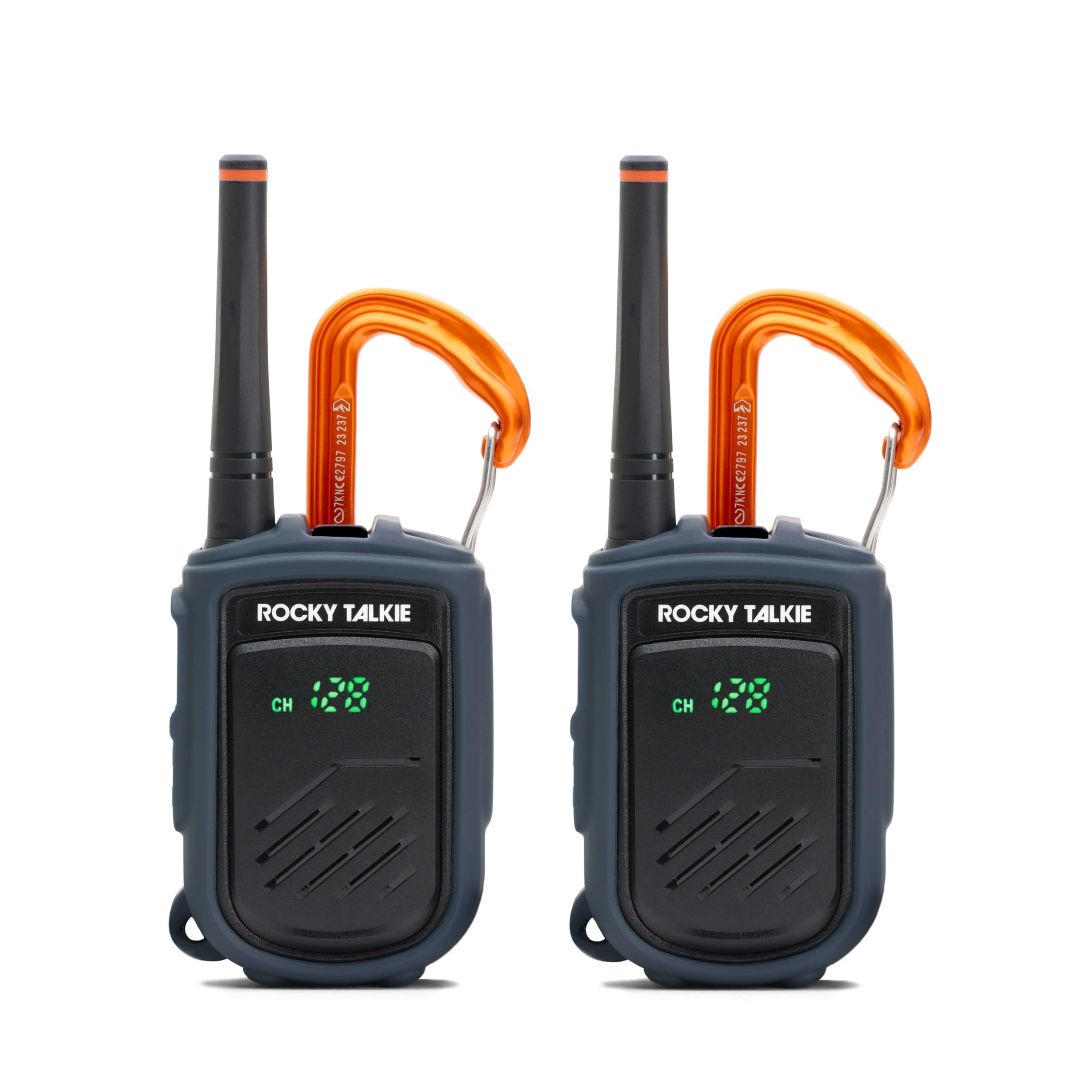
Four days of battery and a climbing carabiner clip for the backcountry crew.
For multi-day field work, the Mountain Radio’s headline is a specialized lithium-ion battery rated for over 4 days of use, even in very cold conditions. That far outstrips the 9 hours on the Motorola T605_H2O — days versus a single shift. It runs FRS at the maximum licence-free 2-watts, with a max range listed over 35 miles but a more honest 1 to 5 miles typical in backcountry terrain.
The mounting is the clever part: no fragile plastic clips, just an ultra-light climbing-rated carabiner and a metal-reinforced back-up leash that secures to packs and harnesses. A shatterproof LED screen and thermoplastic protective covering take knocks, and the IP56 rating handles splashes and snow. Five easy buttons and zero configuration mean it works straight from the start.
Battery life is exactly where this earns its spot, with owners noting the level flashes on power-up so you know where you stand. The trade-off is water rating — IP56 covers splashes and snow but not the full dunking-grade IP67 you get higher up the list. For cold, rugged, multi-day carrying, that is the right balance.
Why backcountry crews love it
- Over 4 days of battery life, even in cold conditions
- Climbing-rated carabiner and metal-reinforced leash for pack mounting
- Max 2-watt FRS transmit, licence-free
- Shatterproof LED screen and thermoplastic shell
What it does not do
- IP56 handles splashes and snow but not full immersion
- Tops out the highest on reach-honesty — the 35-mile figure is not a working distance
Built for you if: You carry a radio for days in cold, rugged terrain and need battery above all else.
Not your set if: You need IP67 submersion protection — this one stops at splash-grade.
Know the Specs
IP ratings, ranked in plain words
An IP number is a two-part score: the first digit rates dust protection (6 means dust-tight) and the second rates water (7 survives a dunk, 6 heavy spray, 4 splashes). IP67 is the usual work-grade mark for a radio that can get dropped in a puddle. JIS4 and IP56 handle rain and snow but not a full dunking, so match the number to how wet your work gets.
Battery in mAh versus hours
The mAh figure is the battery’s tank size; the hour figure is how long the maker says that tank lasts. Higher mAh generally means more run time, but the two figures don’t always line up — a 2500mAh unit can list a standby measure while a 2000mAh unit lists talk hours. Check the hour figure for your shift length, and confirm there is a dock or USB-C port so the crew can recharge in one place.
FRS versus GMRS licensing
FRS (Family Radio Service) and GMRS (General Mobile Radio Service) are the two licence-free channels in the US for most buyers. Many work radios run FRS at no paperwork; the Midland GXT1000VP4 runs GMRS. Both keep you legal from the start, so pick the band your other gear already uses.
What “long range” really means
The printed maximum — a mileage figure or a square-footage/floor count — assumes wide-open, clear air. Buildings, steel, and heavy foliage cut that down hard. Expect the shorter urban number, not the open-air one, and size your site plan around the realistic figure. A radio rated for 25 floors still needs clear sight lines between floors to work well.
Common Questions
Do I need a licence to use these work walkie talkies?
Will an IP67 walkie talkie survive being dropped in water?
How many walkie talkies do I need for my crew?
Will these radios talk to the walkie talkies I already own?
How long does the battery last on a full work shift?
What is the realistic range on a job site with walls and steel?
Can I use these radios with gloves on?
Do these walkie talkies come with chargers and earpieces?
Which is better for a noisy site: more channels or more power?
Can these radios send an emergency alert?
The Bottom Line
For most work crews, the work walkie talkies winner is the Retevis RB48 because it solves the three things that kill a work radio — drops, water, and a shift-length battery — all at once, with a float and MIL-STD-810H build that most sets skip. If you need to outfit a whole team quickly, the TIDRADIO TD-628 four-pack or the Retevis RT68 ten-pack fills a roster in one order. And for multi-day backcountry carrying where battery is everything, the Mountain Radio is the one to reach for. Match the set to your water exposure, shift length, and crew size — those three decide the buy, not the printed range figure.
How we choose
We do not accept paid placement. Every pick is matched to a real buyer and a real use-case; we do not hands-on test units.
Sources
Specifications: manufacturer listings and product documentation. Review insights: verified customer reviews, as of November 2026. Pricing: not shown on this page (it changes often); check the current price via the retailer link.
As an Amazon Associate, Tactical Gear Guy earns from qualifying purchases. This does not affect which products we feature.