Specs are compiled from manufacturer listings and verified buyer reviews and can change over time — please confirm the key details on the product page before buying.
If you want one answer: buy a guided stone setup, not a gadget that drags your blade through two carbide slots. The pull-through style takes metal off fast and leaves a ragged edge that dulls again in a week. A proper work shop knife sharpener — a bench stone with an angle guide, a clamped rod system, or a water-cooled machine — puts a clean, repeatable bevel on the blade that lasts. This guide sorts nine of them by how much control they actually give you.
This guide is built by comparing the manufacturers’ published specifications and the patterns across verified customer reviews, so you get each pick’s real strengths and trade-offs instead of marketing spin.
You will see which stones stay flat, which clamps actually hold a blade, and which machines are built for a workshop rather than a drawer. The picks below cover every budget and skill level, so you can choose the right work shop knife sharpener the first time instead of buying twice.
Top Picks


How To Choose The Best Work Shop Knife Sharpener
The biggest mistake buyers make is treating all sharpeners as the same job. They are not. A pull-through tool refreshes a kitchen knife in ten seconds; a bench stone rebuilds a damaged bevel over twenty minutes. Decide which job you actually have before you spend anything.
Match the sharpener to the blades you own
A thin Japanese-style kitchen knife wants a water stone and a shallow angle. A thick hunting or bushcraft blade with a scandi grind wants a coarser stone and a steeper angle so the edge holds up to chopping and batoning. If your drawer holds a bit of everything, a system with adjustable angle settings covers more ground than a single fixed stone.
Steel type matters too. Hard, high-carbon and powder-metallurgy steels reward a diamond plate, which cuts them without hollowing out. Soft stainless from a discount bin responds to almost anything, but it will not hold a fine polished edge for long, so a coarser finish is often the smarter call.
Understand grit before you buy
Grit is a measure of abrasive particle size, and the numbering runs backwards from what most people expect. A low number like 100 or 220 grit is coarse — it removes metal fast and repairs chips and rolled edges. A high number like 3000 or 6000 grit is fine — it polishes and refines but removes almost nothing. A sharpener that only offers one grit is a compromise; you want coarse to repair and fine to finish.
Decide how much angle control you need
Freehand sharpening on a bare stone is a skill. Holding a steady 20° by eye takes practice, and most beginners round over the edge before they learn. A guided system — a set of rods and a clamp, a stone with a preset angle, or spring arms that self-adjust — takes that variable out. If you sharpen twice a year, guidance is nice. If you sharpen weekly, it is the difference between a working edge and a wrecked one.
Think about where the machine lives
A bench stone and a rod kit tuck into a drawer and come out when needed. A water-cooled machine is a permanent fixture with a water reservoir and a spinning wheel, and it wants bench space and a power outlet nearby. Be honest about whether you have room for that before you commit.
Side-by-Side Comparison
| Model | Best For | Grit Type | Angle Control | Weight | Amazon |
|---|---|---|---|---|---|
| Norton Combination Grit Oil Stone★ Best Overall | Repairing and maintaining edges with a single bench stone | Fine / Coarse (100 and 280 grit) | None — freehand | 1.5 pounds | Amazon |
| Work Sharp Benchtop WhetstoneBest For Beginners | Beginners who want guided stone sharpening | Fine and Coarse (1000 / 6000 water stone) | 15° and 17° guides | 2.3 pounds | Amazon |
| VN3 Professional SharpenerClever Value | Fast pull-through sharpening with no technique | Fine, Coarse, Medium | Self-adjusting 15°–20° spring arms | 1.9 pounds | Amazon |
| Lansky Deluxe 5-Stone System | Controlled-angle work on folding and hunting knives | Coarse, Medium, Fine, Ultrafine | Clamped rod system | 650 g | Amazon |
| Work Sharp MK2 Electric | Sharpening every blade and tool in the shop | Medium (belt system) | Edge guide | — | Amazon |
| Warthog V-Sharp A4 | Multi-angle work on kitchen, hunting and filet knives | Coarse, Fine (325 grit diamond) | 15°, 20°, 25°, 30° settings | 0.62 kg | Amazon |
| WEN BG4270T Wet/Dry System | Chisels, planer blades and high-volume knife work | 220 grit stone plus leather stropping wheel | Angle guide and universal jig | 35.5 pounds | Amazon |
| SHARPAL 202H Precision System | Full grit progression from repair to mirror polish | Extra Coarse to Ultra Fine (220–6000 plus strop) | Adjustable 10°–35° | 4.4 kg | Amazon |
| Tormek T-8 Original | Workshop-grade water-cooled sharpening | Fine (10-inch stone) | Jig-based system | 18.13 kg | Amazon |
Detailed Reviews
1. Norton Knife Sharpener Combination Grit Oil Stone
Our pick — 4.5+★ from 950+ verified ratings; the strongest balance of quality and price.
Two grits on one flat block of corundum, and a price that undercuts everything else here.
This is the stone to buy if you already have the patience to hold an angle. One side runs 100 grit for repairing a rolled or chipped edge, the other runs 280 grit for bringing it back to a working sharp. That covers the whole job — a blade that will not bite gets reset on the coarse face, then refined on the fine face until it slices paper cleanly.
The stone arrives prefilled with oil, which is the detail that keeps it working. The oil sits on the surface and floats the steel swarf away instead of letting it clog the abrasive, so each pass cuts the same as the last. It is a bench stone through and through — 8 inches long by 2 inches wide by 1 inch thick, sized for kitchen knives up to 8 inches and short enough to keep stored in a drawer. At 1.5 pounds it stays put on the bench once you set it down.
What wins people over is the material. The corundum body is harder and more durable than a whetstone, and owners routinely describe it as a lifetime bench stone rather than a consumable. Sharpening performance comes up right behind it: kitchen knives, hunting knives, and shop tools all come off it with a clean, quick-cutting edge. The one thing to know is that a bare stone gives you nothing in the way of angle guidance. You are the jig, so if your hand is unsteady, one of the guided systems further down this list will serve you better.
What earns it the top slot
- 100 and 280 grit faces cover both edge repair and everyday sharpening
- Prefilled oil keeps the surface lubricated so the stone does not clog
- Corundum body is harder than a whetstone and holds its shape
- 8 by 2 inch face suits kitchen knives up to 8 inches
Where it asks more of you
- No angle guide, so consistency depends entirely on your hand
- Durability opinions are split — some owners see a lifetime stone, others less
- Needs Norton sharpening oil on hand to work at its best
Buy it if: you want one flat, hard stone that repairs and sharpens, and you are willing to learn the angle.
Think twice if: you have never sharpened freehand — pick up the Work Sharp Benchtop below instead, because it hands you the angle.
2. Work Sharp Benchtop Whetstone Knife Sharpener
A water stone with the angle built in — the fix for anyone who has ever rounded an edge.
Here is the honest problem with the Norton above: a bare stone gives you nothing to lean on. Work Sharp solves that by pairing a 1000 / 6000 combination water stone with 15° and 17° guides. You rest the blade against the guide and the angle is decided for you, which is why this is the tool to hand someone who has never sharpened a knife before.
The stone stands upright in a water control base that holds it steady and keeps the water where it belongs. There is an anti-skid mat underneath so the whole rig stays planted while you draw the blade across. The 1000 side handles routine sharpening; the 6000 side polishes the edge to a refined finish. It is a tall unit — 9.5 inches high against the Norton’s 1 inch — so it wants counter space rather than a narrow drawer slot. That height is what makes the guided stroke work.
The coverage is broad for the price. Kitchen cutlery, EDC pocket knives, fillet blades, and edged tools all belong on this stone, which suits anglers, hunters, and DIYers who keep a mix of blades. Owners consistently describe it as one of the better whetstones they have used, with a great edge on every knife they put to it, and it draws praise as a novice-friendly tool — the exact buyer this design targets. If you own large kitchen knives, the wide face handles them comfortably. The catch is maintenance: a water stone needs soaking and flattening over time, and the 6000 side is slow to remove material if you let an edge go badly dull.
The novice case: fixed 15° and 17° guides remove the single hardest part of stone sharpening, and the anti-skid base means you are not chasing the stone across the counter.
What to expect: a water stone that needs soaking, a tall 9.5-inch footprint, and a fine 6000 side that polishes rather than repairs.
Reach for this if: you want real stone sharpening without a year of practice before the edges come good.
Pass if: you need fast metal removal on badly neglected blades — the coarse side here refines rather than resets.
3. VN3 Professional Knife Sharpener
The pull-through that earns its place — spring arms find the angle so you do not have to.
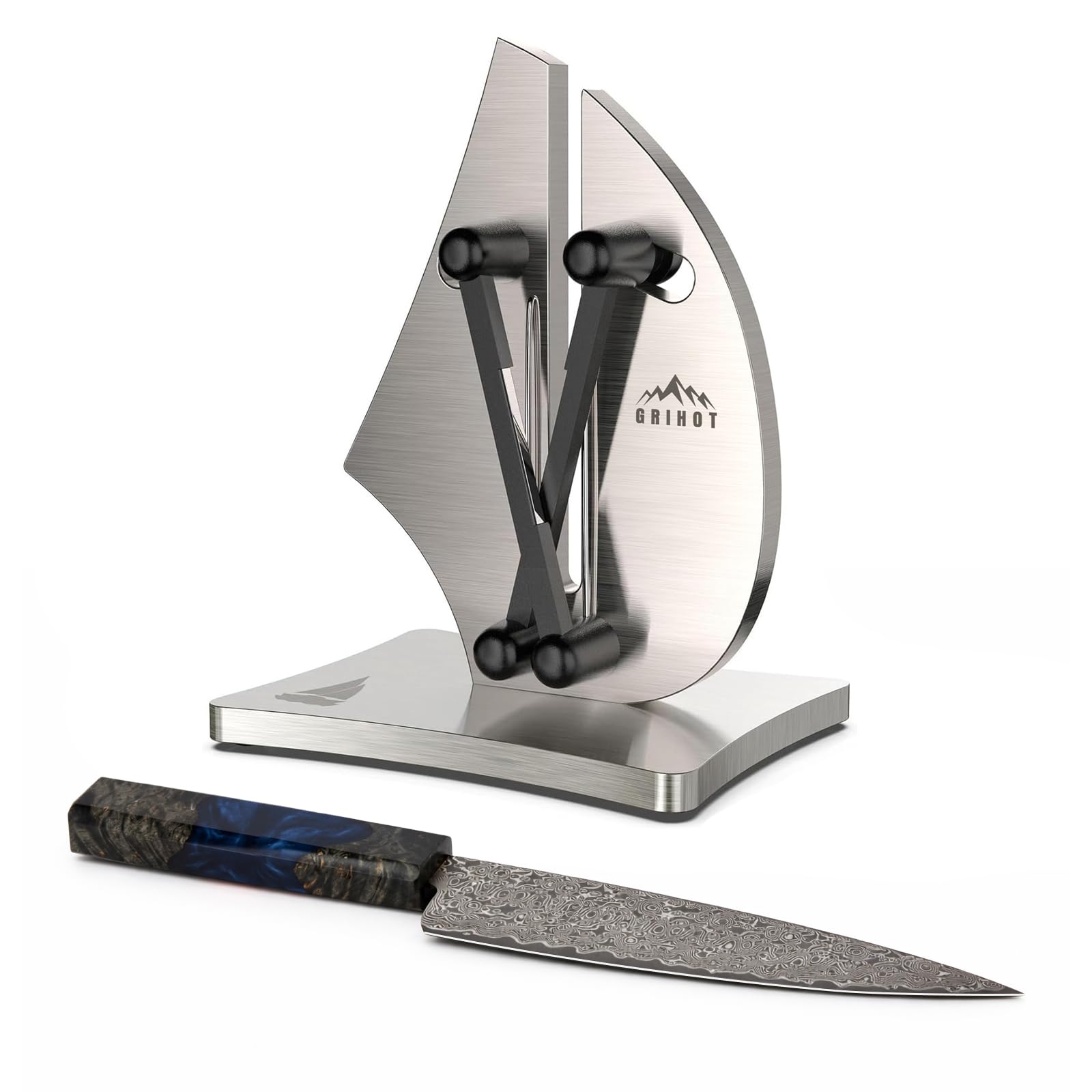
Sailboat-shaped body, 304 stainless steel frame, Himalayan tungsten carbide sharpening arms. The shape is what most buyers notice first, but the mechanism is the interesting part. Those spring-loaded arms auto-adjust between 15° and 20° to sit against whatever blade you feed in, so there is no technique to learn and no angle to eyeball.
It runs three actions. Tip down sharpens a dull knife, tip up hones an edge you want to keep sharp day to day, and an angled pull handles serrated blades. Kitchen knives, chef’s knives, field knives, and multi-purpose blades all fit the brief. The maker cites 196+ hours of grinding and polishing per unit, and the 45-month warranty is the longest on this list.
Effectiveness is the thing that sells it; pulling a knife through and getting an extremely sharp edge back is the whole point, and it delivers that in seconds rather than minutes. Ease of use is close behind — the manufacturer notes it suits seniors, which tells you how little hand strength or finesse it asks for. Buyers rate it against electric sharpeners and come away happy. Be clear on what it is not: a carbide pull-through removes metal faster than a stone, so a blade used this way will wear down over years of use. The durability picture is mixed for the same reason. Use it as a maintenance tool between proper stone sessions, not as your only sharpener.
What it costs you: carbide removes steel quickly, so a knife sharpened this way every week wears faster than one maintained on a stone.
The honest read: if you want a sharp knife in ten seconds with zero learning curve, this is the one.
Made for: cooks and outdoors folks who want a fast touch-up between proper sharpening sessions.
Not for: the buyer who wants to preserve a blade’s steel for decades — that calls for a stone.
4. Work Sharp MK2 Electric Knife Sharpener & Replacement Belts
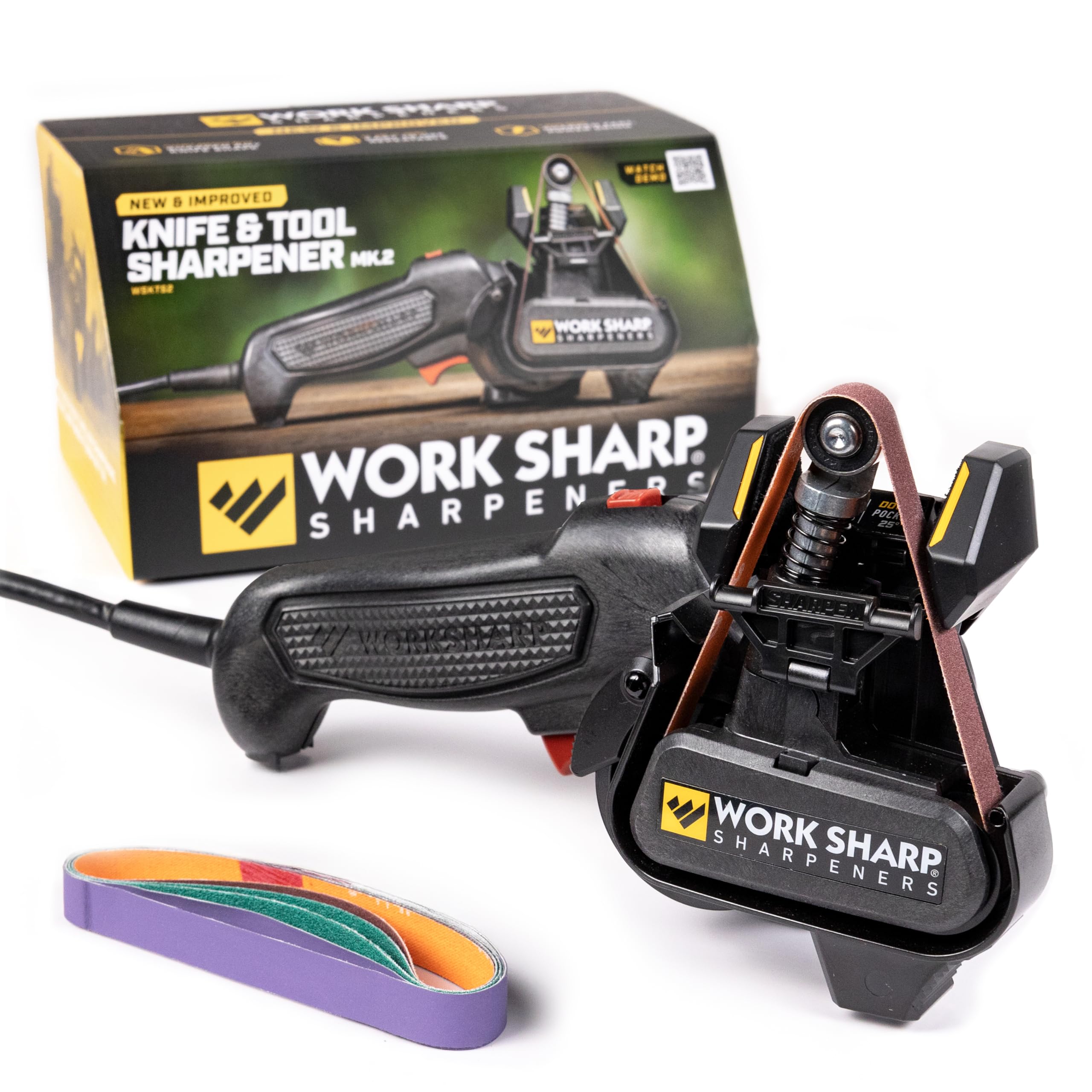
A belt grinder in a small box — kitchen knives, scissors, axes, mower blades.
The belt is the whole idea. Abrasive belts conform to the edge of any blade you put against them, so the same machine handles a chef’s knife, a serrated bread knife, a pair of scissors, and an axe. That breadth is why this machine sits at the top of the shop-tool end of the list rather than the kitchen-drawer end.
Two motor speeds give you a slow setting for a delicate kitchen edge and a faster one for grinding work on lawnmower blades and garden tools. The edge guide supports the blade right through to the tip so the grind stays even as you pull through. Belt changes are simple enough that buyers report no fuss swapping grits or replacing a worn belt. Extra belts come included, so you are not buying consumables on day one.
Performance is what carries it — bringing kitchen and outdoor knives to razor sharp in a fraction of the time a bench stone takes, and staying easy for beginners because the machine does the angle work. Work Sharp builds and calibrates these in Oregon and backs the sharpener with a 3-year warranty. The trade-off is real, though: this is a powered machine with moving abrasive belts, so you can take too much steel off a fine kitchen knife if you rush and let it sit in one spot. Feed it deliberately and it is superb; feed it carelessly and it will grind a blade thin.
Why it covers the whole shop
- Belts conform to any edge, from serrated knives to scissors to axes
- Two speeds separate delicate kitchen work from heavy grinding
- Extra replacement belts included in the box
- 3-year warranty with design and calibration done in Oregon
The ownership reality
- Powered belts remove steel fast, so a rushed pass can thin a fine kitchen edge
- Consumable belts are an ongoing cost a stone never has
- Needs a power outlet and bench space, unlike a hand stone
Right answer when: your sharpening pile includes tools and garden gear as well as knives.
Look elsewhere when: every blade you own is a thin Japanese kitchen knife — you want the slower control of a stone.
5. Lansky Deluxe 5-Stone Knife Sharpening System

Clamp the blade, set the rods, and let five stones walk the edge to a razor finish.
Five stones in a rod-guided jig is the classic answer to controlled-angle sharpening, and it works on both cheap kitchen knives and expensive ones. The clamp holds the blade, the guide rods keep each stone at a fixed angle, and you progress through coarse, medium, fine, and ultrafine until the edge is where you want it. Honing oil and a storage case come with it, and the whole system is made in the United States.
The footprint tells you what kind of tool it is. At 9.65 inches long and 9.5 inches wide it is essentially a small workbench station — wider than the Norton stone is long, and wider than the 2-inch Norton stone by a stretch. Set it up on a stable surface and leave it there through a full progression rather than expecting to pack it into a pocket. In return, 650 g of body keeps it planted while you work.
Quality is what buyers of this system talk about most, and second to that is ease of use — the guided stroke covers for someone who has not built freehand muscle memory yet, though there is a genuine learning curve as you get the clamp tension and rod sweep right. The recurring note to take seriously is the clamp: some users find it does not grip every blade profile as tightly as they would like, and a few report the unit losing effectiveness over time. That is a fit issue more than anything — thick-spined knives and full flat grinds grip better than thin flexible blades. Line the knife up squarely and it works; rush the setup and the edge comes out uneven.
The real draw: a full coarse-to-ultrafine progression and honing oil in one kit, made in the USA, that will sharpen a paring knife and a folder alike.
The honest caveat: the clamp is the weak point for some blades — thin flexible stock can shift, so check your knife’s spine thickness against the jaws before you commit.
Reach for this if: you want repeatable angles across a collection of folding and hunting knives.
Keep looking if: your knives are thin, flexible Japanese blades that want a stone rather than a clamp.
6. Warthog V-Sharp A4 Knife Sharpener

Four angle settings, spring-loaded diamond rods that sharpen both sides at once.
The V-Sharp mechanism is the reason to own this over any other guided sharpener here. Four settings — 15°, 20°, 25°, and 30° — let you pick a shallow edge for delicate filet and sushi knives, a mid angle for kitchen work, and a steep one for a hunting or bushcraft blade that has to survive chopping. Nothing on this list covers that spread as cleanly.
The rods are 325 grit natural diamond, and they are spring loaded so they sharpen both sides of the blade simultaneously as you draw through. Diamond cuts hard high-carbon and powder steel without the stone hollowing out over time. The frame is metal with a solid rubber base, and the finish is powder coat, so it stays put on the bench and looks good doing it. At 0.62 kg it is light enough to move around but heavy enough not to skate.
The quality and speed are what get noticed — knives coming off it very sharp, very quickly, and the multiple grit options giving you room to work from repair up to a finished edge. One owner reports an almost razor edge with minimal effort, which fits the simultaneous-both-sides rod design. Where it asks something of you is blade style: the V shape suits flat and sabre grinds well but can struggle with a deeply convex edge, and a very flexible filet knife needs a light hand so the rod does not dig in. Match the angle setting to the blade’s grind and it behaves.
Where it leads: with 15°, 20°, 25°, and 30° settings it covers thin kitchen knives and heavy hunting blades in one unit — nothing else here spans that range.
What to watch: the V-shape wants a matching grind, so a deeply convex edge or a very flexible filet blade calls for a lighter touch.
Best matched to: anyone sharpening a mix of filet knives, kitchen knives, and thick hunting blades and needing the angle to match each.
Worth a pass if: you only ever sharpen one style of knife and never need to change the angle.
7. WEN BG4270T 10-Inch Wet/Dry Sharpening System

A water-cooled wheel that turns in both directions, built for chisels and planer blades.
Water cooling is the reason this machine exists. The 10-inch 220 grit stone spins through an adjustable water reservoir so the blade never overheats — a real concern on hardened chisel and planer irons where a dry grind can draw the temper out of the steel. Flip the switch and the rotation reverses so you can sharpen bevel-up or bevel-down without turning the machine around.
Speed is fixed at 115 RPM, deliberately slow for precision rather than fast stock removal. An 8-inch leather-stropping wheel finishes the edge after the stone, and honing compound comes included. A universal jig support takes a range of accessories including the WEN 42704B sharpening kit, and the onboard jig handles chisels and planer blades directly. An angle guide and a carrying handle round out the box.
This is a bench machine, and the 35.5 pounds and 16.9 by 10.8 by 16.5 inch body make that plain. Wet sharpening saves time on a full shop’s worth of chisels and knives, and the sharpness it delivers is what buyers notice — a mirror edge on kitchen knives that a hand stone struggles to match. Ease of use splits opinions, though. The water system, jig alignment, and the care needed to present a blade to a spinning wheel leave some users frustrated at first. Expect a learning session before the results feel natural, and keep the reservoir topped up — running dry is the fastest way to ruin both the edge and the stone.
Why it earns bench space
- Water cooling keeps hardened chisel and planer irons from overheating
- Two-direction rotation lets you sharpen either way without repositioning
- 115 RPM slow speed favors precision over aggressive stock removal
- Universal jig support and included honing compound add flexibility
The setup cost
- 35.5 pounds, so it wants a permanent spot on a bench
- Water reservoir, jig alignment, and wheel presentation take practice
- The reservoir has to be kept filled to work safely
Built for: woodworkers and shop owners with a pile of chisels and planer blades that need a cool, controlled grind.
Not the pick for: a kitchen drawer — the size and water reservoir make it a bench fixture, not a quick grab.
8. SHARPAL 202H Precision Knife Sharpening System
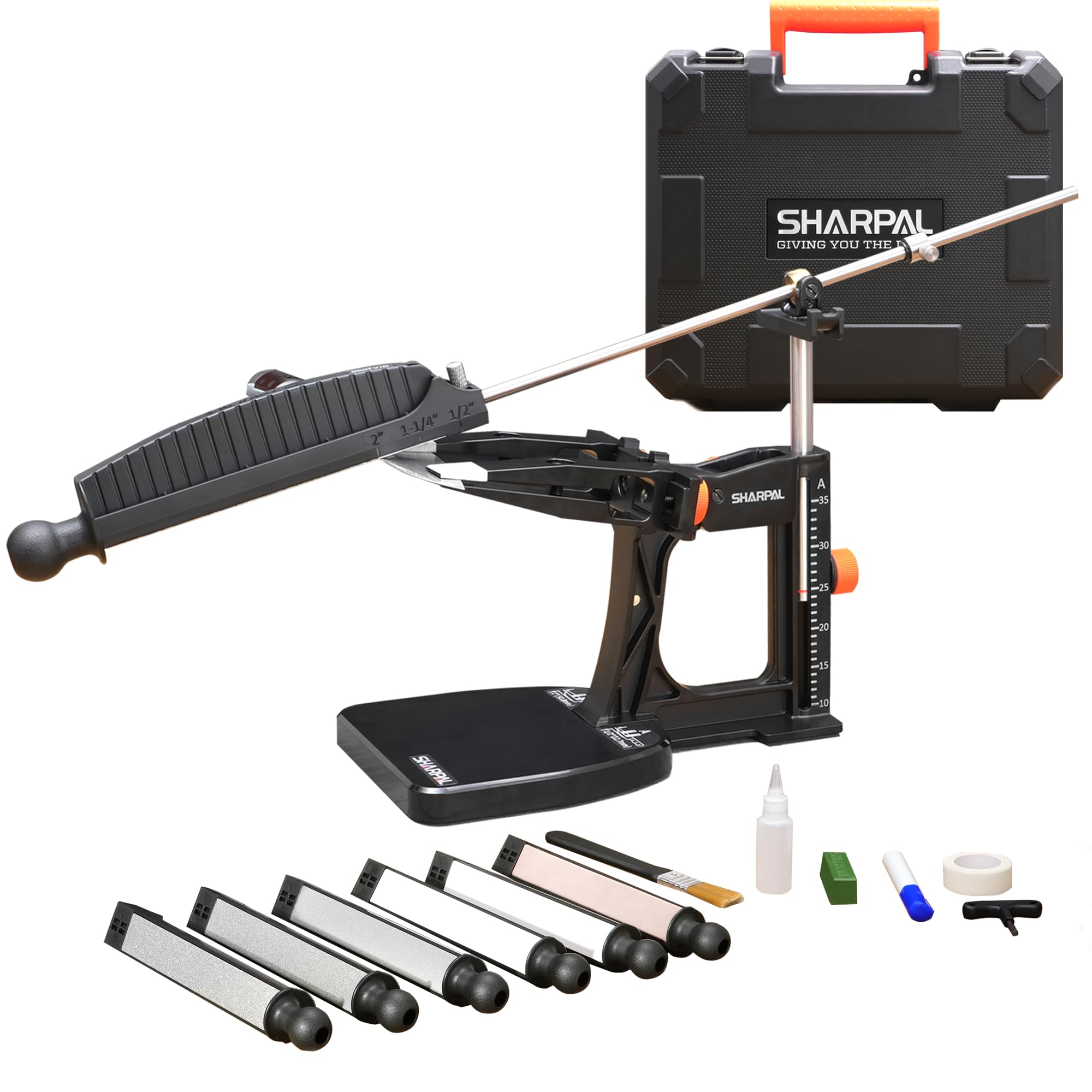
Seven abrasives from 220 grit diamond up to a 6000 whetstone and leather strop.
This is the most complete kit on the list by a wide margin. Four monocrystalline diamond plates run 220, 325, 600, and 1000 grit for edge repair and sharpening; a ceramic plate adds 3000 grit; a whetstone plate adds 6000; and a leather strop with 2 oz of green polishing compound finishes the edge to a mirror. You get a full progression from a chipped bevel to a polished apex without buying a single extra stone.
The angle system is the clever part. It adjusts smoothly from 10° to 35°, and the distance-based setting keeps the edge-to-clamp distance fixed so the angle stays accurate regardless of how wide the blade is — which addresses the width-variation problem that trips up traditional clamp systems. Dual sliding clamps hold blades of any length, and the flip mechanism keeps the same angle on both sides so the bevel comes out symmetrical. Narrow pocket knives through extra-wide cleavers all fit.
Build is heavy metal with an anti-slip base, and the whole kit rides in a rigid carry case that makes it giftable. Sharp results, sturdy construction, and consistency that beats freehand sharpening by a wide margin are what owners come back to. The weight is the honest cost of all that kit — 4.4 kg means you are not carrying this in a pocket, and setting the clamp distance correctly takes a careful first session before the workflow clicks. Three years of after-sale service from a California company with branches in Germany and Australia backs the purchase.
What you gain: the widest grit spread here — 220 through 6000 plus a strop and compound — in one case, with an angle range from 10° to 35°.
What it costs: 4.4 kg of kit and a first session spent learning the clamp distance before the results smooth out.
For the buyer who: wants one kit that handles repair, sharpening, and mirror polish without adding stones later.
Skip if: you only sharpen one knife occasionally and a single bench stone would do the job.
9. Tormek T-8 Original Water Cooled Sharpening System

The machine a professional sharpening bench is built around — 10-inch water-cooled stone.
Some tools are bought once and kept for decades. This is one of them. The T-8 runs a 10-inch water-cooled stone on a zinc alloy body, and the water keeps the edge cool through the whole grind so hardened steel never loses its temper. It sharpens knives, chisels, planer blades, and any other edge tool you bring to it.
The scale is what separates it from everything above. At 18.13 kg with a 15 by 11.5 by 15 inch body, it is a fixed piece of workshop equipment rather than something you pull out for a quick touch-up. In return it handles volume — it is built for volume — over 200 knives in a couple of hours, with a minute or two per dull edge.
Quality is the headline, with sharpness and ease of use right behind it. The water cooling makes the whole process forgiving; you are not racing the heat the way you are on a dry belt. The honest considerations are cost and scope: this is the most expensive tool here by a wide margin, and opinions on its versatility are genuinely mixed — it is built for edge tools and that is where it shines, so a household that only owns kitchen knives will not use a fraction of its capability. Tormek stocks spare parts for 8 years after purchase.
The volume case: a minute or two per knife, and 200-plus knives in a couple of hours for someone sharpening professionally.
The scope caveat: it is a dedicated edge-tool machine, so kitchen-only households will leave much of its capability unused.
Choose this if: sharpening is a serious part of your work or hobby and you want one machine for the next decade.
Not for you if: you sharpen a handful of kitchen knives twice a year — the Norton stone does that job for a fraction of the footprint.
Know the Specs
Grit Ratings Explained
Grit measures how coarse or fine an abrasive is, and the number runs backwards from intuition. A 100 grit stone is coarse — it cuts fast and repairs a chipped or rolled edge. A 6000 grit stone is fine — it polishes the apex and removes almost nothing. Serious sharpening uses both ends: coarse to reset a damaged bevel, fine to finish the edge that actually slices. A sharpener with only one grit is always a compromise, which is why combination stones and multi-stone kits appear throughout this list.
Angle Control and Why It Matters
Edge angle is the angle between the two faces of the bevel. A shallow angle cuts better but is weaker; a steeper angle holds up to hard use but does not slice as cleanly. The number itself matters less than keeping it consistent — a burred, wobbling stroke rounds over the apex and undoes the work. Systems here range from a bare stone with no guidance, through fixed 15° and 17° guides, to fully adjustable 10°–35° and four-setting mechanisms. Pick the level of guidance that matches how steady your hand is.
Stone Flatness and Maintenance
A stone does its best work when its face is flat. Over time a stone hollows in the middle, and a dished face cannot produce a straight bevel. Combination oil stones and premium water stones arrive flat from the factory and stay truer longer when you keep them lubricated. Water stones need soaking before use and periodic flattening; oil stones need a film of oil to float away the steel swarf. Budget a little maintenance time alongside the sharpening itself.
Water Cooling Versus Dry Grinding
Heat is the enemy of a sharp edge. Grinding on a dry abrasive generates heat, and on hardened steel that heat can draw the temper out of the very edge you are trying to improve. Water-cooled systems — a spinning stone or belt running through a reservoir, or a manually soaked water stone — keep the temperature down so the steel keeps its hardness. This is why chisel and planer-blade sharpening almost always calls for a water-cooled machine.
Common Questions
Will a work shop knife sharpener work on serrated blades?
What grit should I start with on a dull kitchen knife?
Is a carbide pull-through sharpener bad for my knives?
Do I need an electric sharpener or is a manual one enough?
What angle should I sharpen a hunting knife at?
Why do water stones need soaking before use?
Can a sharpener handle both cheap and expensive knives?
Is a water-cooled sharpener worth it for chisels and planer blades?
How much bench space does a serious sharpening setup take?
The Bottom Line
The best work shop knife sharpener for most buyers is the Norton Combination Grit Oil Stone. Two grits on one hard corundum block handle both edge repair andeveryday sharpening, it arrives flat and prefilled with oil, and its hard corundum face wears far slower than a whetstone and stays flat through years of bench use. The catch is that it hands you no angle guidance, so if your hand is unsteady, step up to the Work Sharp Benchtop Whetstone and let its 15° and 17° guides do the thinking for you.
If your sharpening pile runs beyond knives to scissors, axes, and mower blades, the Work Sharp MK2 covers that ground with conforming belts and two speeds. For a knife collection that needs repeatable clamped angles across a full grit progression, the SHARPAL 202H brings seven abrasives from 220 grit diamond to a 6000 whetstone and strop in one case. And if you sharpen for a living, the Tormek T-8 is the machine a professional bench is built around — a 10-inch water-cooled stone with spare parts stocked for 8 years. Start with the Norton, learn the angle, and add the guided systems as your blades and your ambitions grow.
How we choose
We do not accept paid placement. Every pick is matched to a real buyer and a real use-case; we do not hands-on test units.
Sources
Specifications: manufacturer listings and product documentation. Review insights: verified customer reviews, as of November 2026. Pricing: not shown on this page (it changes often); check the current price via the retailer link.
As an Amazon Associate, Tactical Gear Guy earns from qualifying purchases. This does not affect which products we feature.