Specs are compiled from manufacturer listings and verified buyer reviews and can change over time — please confirm the key details on the product page before buying.
You need rain gear that survives a full shift, not a jacket that soaks through by lunch. The short answer: the Carhartt Monterey Jacket is the safest buy for most working men — fully seam-sealed, waterproof zippers, and packable enough to live in a truck cab. Below are eight suits and jackets that actually hold water out, sorted so you can match one to your job in a couple of minutes.
This guide is built by comparing the manufacturers’ published specifications and the patterns across verified customer reviews, so you get each pick’s real strengths and trade-offs instead of marketing spin.
Waterproof fabric is only half the story — seams, zippers, and cuff design decide whether you finish the day dry or damp. This breakdown of the work rain gear for men covers what actually fails first and which suits handle it.
Top Picks


How To Choose The Best Work Rain Gear for Men
Most buyers walk into this purchase thinking the fabric is the whole story. In practice, the parts that let water in are the seams, the zipper, and the gap between your glove and your cuff. Judge a suit on those three first, then look at fabric weight.
Seams And Zippers Decide Whether You Stay Dry
A waterproof shell is only as good as its stitching holes. Look for taped or seam-sealed construction, which means the needle holes are covered from behind so water cannot creep through. The same logic applies to the front closure — a storm flap over the zipper keeps rain from driving straight into the teeth.
Visibility Ratings And Reflective Tape
If you work near traffic, a visibility class is not decoration. ANSI Class 3 is the highest daytime visibility classification for high-visibility apparel, and suits that meet it wrap reflective tape around the garment rather than sticking a stripe on the chest. Reflective strips do double duty in rain, when spray and grey light cut how far a driver can see you.
Denier And Fabric Weight
Denier is a measure of fabric yarn thickness — higher numbers generally mean a heavier, more tear-resistant cloth. A 150D Oxford or ripstop shell is the common working weight, because it resists snags on scaffolding and truck beds. Lighter shells pack smaller but scuff faster against rough surfaces.
Fit For Layering
You will almost never wear rain gear over a bare shirt in cold weather. A suit needs room for a hoodie or thermal underneath without pulling tight across the shoulders. Relaxed cuts and adjustable hems, waistbands, and cuffs let you close the gaps once the layers are on.
Side-by-Side Comparison
| Model | Best For | Shell Fabric | Waterproof Build | Visibility Rating | Amazon |
|---|---|---|---|---|---|
| Carhartt Monterey Jacket★ Best Overall | Everyday wet-weather work | — | Waterproof zippers, seam-sealed, adjustable hood | — | Amazon |
| TICONN Hi Vis Safety Rain SuitBest Visibility | Roadside and site visibility | 100% polyester 150D Oxford with PU coating | PU-coated, 2-inch reflective tape | ANSI Class 3 | Amazon |
| HANMENGXUAN Rain SuitBest On A Budget | Highway and utility crews | — | Taped sealed seams, storm flap with snaps | Reflective strips | Amazon |
| PU-Coated Reflective Rain Suit | Long outdoor shifts in heavy rain | PU-coated multi-layer | Sealed seams, tear-resistant PU | Reflective jacket | Amazon |
| JORESTECH JK-03 / PANTS-03 | Logger and industrial crews | 150D heavy duty | Dual zipper with storm flaps | ANSI/ISEA 107 Type R Class 3 | Amazon |
| SKSAFETY Hi Vis Rain Jacket | Extended sizes for site work | — | Zipper waterproof construction | Class 3 high visibility | Amazon |
| Viking Open Road 150D Suit | Heavy industrial rainwear | 150D trilobal poly ripstop over PVC backing | Ventilated, removable hood, weatherproof cuffs | — | Amazon |
| Carhartt Shoreline Jacket | All-day storm work with layering | Storm Defender waterproof/breathable | Waterproof and breathable, loose fit | — | Amazon |
Detailed Reviews
1. Carhartt Men’s Monterey Jacket
Our pick — 4.5+★ from 750+ verified ratings; the strongest balance of quality and price.
The packable shell that lives in your truck and earns its keep every grey morning.
What makes the Monterey the default pick is that nothing on it is left open. Waterproof zippers close the pockets and front, the hood adjusts, and the whole shell is fully seam-sealed — so the stitching holes that usually leak on cheap jackets are covered. It also blocks wind, which is the part that makes a wet day feel twice as cold.
It also blocks wind, which keeps a wet day from feeling twice as cold. The lightweight build packs down into its own pocket when the sun comes back out, so it rides in a cab or a backpack without taking up real room. Adjustable cuffs and hem let you cinch the openings once you have a sweatshirt on under it. This is a jacket the crowd trusts — 4.5+ stars across 700+ ratings — and the strongest theme in owner feedback is plain build quality, with water resistance a close second.
Here is the honest catch: a jacket covers your torso, not your legs. If your job means kneeling in a wet trench or standing in roadside spray for hours, you want a full suit instead — the TICONN below adds pants for less bulk in the cab. And the sizing feedback splits both ways, so check the size chart against your chest measurement rather than guessing.
Where It Delivers
- Fully seam-sealed shell with waterproof zippers and an adjustable hood
- Packs into its own pocket when the weather clears
- Blocks wind as well as rain
- Adjustable cuffs and hem dial in the fit over layers
What To Weigh
- Jacket only — no pants for wet-leg work
- Fit feedback runs both directions, so measure before ordering
Reach for this if: you want one jacket that handles rain, wind, and layering on a normal working day.
Look elsewhere if: your shift puts your legs in the splash zone — you need the pants that come with a suit.
2. TICONN Hi Vis Safety Rain Suit
Full suit, full tape wrap — built for the man standing where traffic passes.
The reflective tape is 2 inches wide and wraps 360 degrees around the garment, hand-stitched on. That is the difference between being spotted at distance in grey rain and being invisible. It meets ANSI Class 3 safety standards, with extra orange reflective strips adding a second hit of visibility in low light.
The shell is 100% polyester 150D Oxford fabric with a PU coating — a tear-resistant weave that stays lightweight while keeping water out. Both jacket and pants carry two large pockets, and both have adjustable cuffs, hems, waistbands, and trouser legs so you can shut out drafts and spray. There is a transparent ID pocket and a D-ring for hanging a tool. Owners rate the quality highest of everything about it, with water resistance second.
Two fit notes worth knowing before you order. Pants run long, and the suit can run larger than expected, so a lot of buyers would do well sizing down. Durability is where feedback splits — the shell handles heavy rain well, but some report the material ripping easily, so treat snag-prone corners with care.
The tape advantage: a 360-degree, 2-inch reflective wrap plus an ANSI Class 3 rating puts this ahead of suits that use a decorative stripe.
The honest trade: length and sizing both skew large, so measure and consider a size down — pants that drag are a hazard on a ladder.
Suits you best if: traffic, cranes, or forklifts are part of your day and you need to be seen first.
Size down if: you sit between sizes — the pants and jacket both tend to run generous.
3. Rain Suits for Men Waterproof Work
The entry-level suit that still tapes its seams and cuffs you twice.
Budget suits usually skip the details that keep water out. This one does not — the seams are taped and sealed, the front zipper is covered by a storm flap with snap buttons, and the sleeves use a double-cuff design. Each of those is a place rain normally sneaks in on cheap gear.
Reflective strips run across the garment so you stay visible in daylight and dark alike, which matters most when haze and rain flatten the light. Multiple easy-access pockets are cut to hold a radio, phone, instrument, or hand tools, and the suit is pitched at road work, utilities, construction, surveying, transportation, and manufacturing crews. For the price, it handles road work, utilities, and construction crews alike.
Where it slips is the zipper. Zipper quality draws the most criticism of any single part of this suit, so expect to treat the front closure with some care — ease it up and down rather than yanking. Fit runs small for some buyers and durability opinions split, so check the size chart carefully.
Working Details You Get
- Taped and sealed seams at the budget level
- Storm flap with snap buttons over the zipper
- Double-cuff sleeves and reflective strips
- Multiple pockets for a radio, phone, or tools
Where It Gives Ground
- Zipper is the weakest link in owner feedback
- Runs small for some, so order with room
Great match for: a crew buying suits for a season of road and utility work without a premium bill.
Handle with care: the front zipper — it earns more complaints than any other part, and a little patience at the closure buys you a lot of shifts.
4. Rain Suit For Men & Women Reflective Jacket
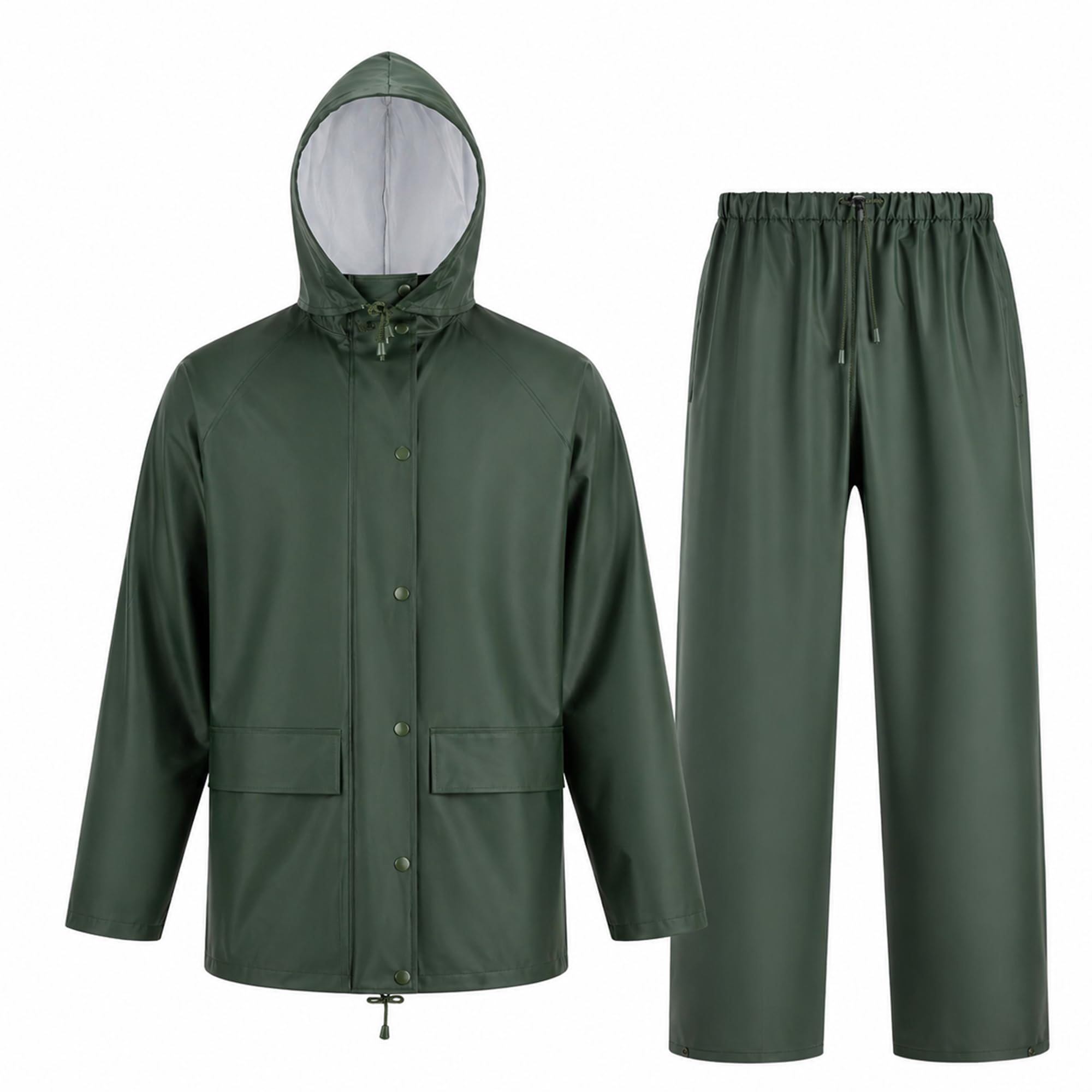
Built for the man who wears a hoodie and thermals and still wants elbow room.
The relaxed cut is built to layer over a hoodie and thermals without binding. The relaxed fit is cut to slip over workwear or daily clothing without restricting your movement, and a multi-layer construction is designed to let heat and vapor escape while still blocking rain. That balance is the hard part of rain gear — full waterproofing is easy, waterproofing that does not steam you up is not.
On the wet side, a PU-coated outer layer plus sealed seams does the work in heavy rain, and the heavy-duty PU fabric is built to resist tearing under tough conditions. Reflective detailing keeps you visible on the jacket. Owners most often cite quality first and water resistance second, and it holds up in snow as well as rain.
The trade-off sits in longevity. Some buyers report the material ripping after a week of use, which in a heavy-duty suit usually points to catching a seam on scaffolding or a truck edge rather than a manufacturing miss. If your work drags the suit across rough surfaces daily, consider the 150D JORESTECH for tougher cloth.
What owners notice: room for a hoodie and thermal underneath while still keeping you dry through a long wet day.
The honest limit: tear resistance is the weak spot in feedback, so keep the shell clear of sharp corners and hooks.
Pick this one if: you layer up hard in cold weather and want a suit that does not fight your shoulders.
Think twice if: your day involves scraping against rough steel all shift — you want heavier fabric.
5. JORESTECH Safety Rain Set JK-03 with PANTS-03

A dual-zipper, storm-flapped suit that stays quiet when a logger is sweating.
Two details set it apart: a dual zipper behind storm flaps and 150D heavy-duty fabric. First, the closure — a dual zipper behind storm flaps on the jacket and pants, so water has to get past two layers before it reaches you. Second, the fabric — 150D heavy-duty cloth that still lets you move, plus ankle zippers that let you pull the pants on over boots without wrestling.
It carries an ANSI/ISEA 107 Type R Class 3 rating on the jacket and Class E Level 2 on the pants, which is the real industrial standard rather than a claim. Owners praise the quality above everything else, with fit close behind — the sizing runs true and the legs are cut wide enough for logger-style boots. The suit keeps you dry without turning into a sauna, and it packs light enough to stash in a crew truck.
The point of disagreement is water resistance — some find it waterproof for a full shift, others find it struggles in a downpour. That split is worth knowing if you work in sustained heavy rain rather than intermittent showers.
Standout Strengths
- Dual zipper with storm flaps on both pieces
- ANSI/ISEA 107 Type R Class 3 jacket, Class E Level 2 pants
- Ankle zippers for getting over work boots
- Lightweight with true-to-size fit
Fair Caveats
- Water resistance feedback splits in sustained heavy rain
- Less breathable in hot weather than breathable shells
Built for: loggers, industrial crews, and anyone who needs ANSI-rated visibility plus a rugged dual-closure suit.
Worth weighing: if you work in steady downpour rather than passing showers, compare it against the Viking before deciding.
6. SKSAFETY Hi Vis Safety Rain Jacket, Class 3 Waterproof

If standard sizes leave you gaping at the shoulders, this one goes to 5XL.
Extended sizing is the headline. This lime hi-vis rain coat runs from standard sizing all the way up to 4XL/5XL, which is a rarity in safety rainwear and the whole reason to consider it. It carries a Class 3 high-visibility rating and a waterproof zipper, so you are covered on both the visibility and water fronts.
The jacket does what you need on a site: it keeps you dry, and it earns solid marks for reliability in use. Owners rate the quality highest and value for money second, which lines up with a reasonably-priced suited rain coat at this size. It is also handy for scooter riders working the city streets, where rain plus traffic plus spray is the daily reality.
Check two things before ordering: the pants waist can run small, and durability feedback is mixed. The waist on the pants can run small, so if you are between sizes you may want to go up. And durability is mixed — the middle can sag and some report ripping while working, which points again to keeping the shell clear of catching surfaces.
Why it earns a spot: true Class 3 hi-vis in sizes up to 4XL/5XL, which resolves the gap most brands leave open.
The catch: waist sizing and middle sag are the recurring gripes, so check the size chart and keep the pants clear of snagging tools.
Best for you if: you need a safety-class rain coat in an extended size without giving up visibility or waterproofing.
Watch the waist: it can run small, so size up if you sit between two options.
7. Viking Men’s Open Road 150D Suit

Three pieces of industrial fabric — rips don’t travel and water has no seam to crawl through.
The 150D ripstop over PVC backing is what keeps the suit intact. The Open Road is built from 150 Denier trilobal poly ripstop over a PVC backing — ripstop meaning the weave resists a tear spreading once it starts. That combination is what keeps a working suit intact after months of being dragged against trucks, scaffolding, and brush.
It is a full suit with bib overalls, and it does not skimp on weather. Ventilation keeps air moving while you work up a sweat. The hood adjusts and comes fully off when you do not need it, and both jacket and bib overalls have adjustable weatherproof cuffs that seal the wrist and ankle. Owners rate quality highest and value second, with durability and fit trailing close behind — the bibs come up to the chest and leave you room for a hoodie and thermal underneath.
The question mark is water resistance, which draws mixed feedback. In practice that means shell-vented construction that holds off rain and spray well but may reach its limit in a long soaking — the outer shell is the working surface, not an impermeable second skin. The loose fit and bib cut compensate for most of the downside.
Why It Stands Out
- 150D trilobal poly ripstop over PVC backing
- Full bib overalls that reach the chest
- Ventilated to keep you cool working hard
- Adjustable weatherproof cuffs and a removable hood
Where To Hesitate
- Water resistance feedback is mixed in prolonged soaking
- Heavier fabric means a slower pack-down than a shell
Choose this for: industrial, forestry, or mining work where the suit meets rough surfaces every day.
Not the pick for: packing small — the three-piece ripstop build takes up far more room than a shell jacket.
8. Carhartt Men’s Shoreline Jacket

Storm Defender keeps the rain off and lets your sweat escape — the premium end of the jacket game.
What sets the Shoreline apart is Storm Defender, Carhartt’s waterproof and breathable fabric. It works in both directions: rain cannot get in, and sweat vapor can get out. That is the big step up over a plain waterproof shell, where a long shift can leave you as wet inside as the weather outside. It is cut in a loose fit so you can layer a sweatshirt underneath without binding.
Anyone who works outside in real storms will recognise the appeal. Owners describe it as heavy-duty and built to keep you dry through storms, and it fits a range of working builds — one buyer notes it accommodates a moderate beer belly without pulling. Value for money and versatility also sit high in what people say about it.
Cold is the honest caveat. The inner layer can transfer outside cold through to your skin, and it is not a puffy insulated coat — it is a shell to layer under. Warmth feedback splits because of this, so wear the layers you plan to work in underneath, not rely on the jacket to hold heat.
The breathable edge: Storm Defender keeps rain out and lets sweat vapor escape, which is the difference between a jacket you can wear all day and one you take off every hour.
The caveat to weigh: the shell itself does not hold heat, and the inner layer can transfer cold through — treat it as the outer layer of a layered system.
Right for: storm-day work where you want one jacket with breathable, fully waterproof construction and room for layers.
Pair it with: an insulating layer — the shell is built for breathability and rain, not for trapping warmth.
Know the Specs
Waterproof vs. Water-Resistant
A waterproof shell is built to stop water entirely, usually through a coated or laminated fabric with sealed seams. Water-resistant gear sheds light rain but gives up under sustained wet. When you see “PU-coated” or “PVC backing” on a product, that coating is the waterproof barrier — it has to be paired with taped or sealed seams to actually work.
Denier And Ripstop Weave
Denier measures yarn thickness — 150D is a common working weight in rainwear because it resists snags without turning the suit into a heavy blanket. Ripstop is a weave with reinforcement threads that stop a tear from spreading. A 150D ripstop shell over a PVC backing is the toughest combination you will commonly see on a working suit.
ANSI Visibility Classes
ANSI Class 3 is the highest daytime visibility classification for high-visibility apparel, and it typically involves reflective tape wrapping the garment rather than a decorative chest stripe. Type R Class 3 applies to road and traffic exposure. If your job involves moving vehicles near you, the visibility class is the first spec you should check, before fabric or fit.
Seam Sealing And Storm Flaps
Stitching punches thousands of tiny holes through a waterproof fabric. Seam sealing covers them from behind so water cannot wick through. A storm flap is a fabric layer over the zipper so rain does not drive directly into the teeth. A suit with both sealed seams and a storm flap is doing the two things that actually matter in a downpour.
Common Questions
Is rain gear marked waterproof really dry in a downpour?
What does ANSI Class 3 mean on a rain suit?
Should I buy a jacket or a full suit?
What is denier and does it matter in rain gear?
Will a rain suit fit over a hoodie and thermals?
How long can I expect a working rain suit to hold up?
Do reflective strips help in daylight rain?
Can I use a work rain jacket as my only wet-weather layer?
What should I do if a rain suit’s pants run long or small?
Is a breathable rain jacket worth stepping up for?
The Bottom Line
The strongest all-around pick among the work rain gear for men is the Carhartt Monterey Jacket — fully seam-sealed, waterproof zippers, and it packs into its own pocket. Sealed seams, waterproof zippers, and packability cover most wet working days. When you need to be seen as much as kept dry, the TICONN Hi Vis Rain Suit adds ANSI Class 3 tape wrapped 360 degrees around the garment. And for the toughest environment, the Viking Open Road 150D Suit brings ripstop fabric over a PVC backing plus bib overalls. Whichever you choose, the right pick is the one whose seams, zipper, and fit match your daily conditions — that is where your money should go.
How we choose
We do not accept paid placement. Every pick is matched to a real buyer and a real use-case; we do not hands-on test units.
Sources
Specifications: manufacturer listings and product documentation. Review insights: verified customer reviews, as of November 2026. Pricing: not shown on this page (it changes often); check the current price via the retailer link.
As an Amazon Associate, Tactical Gear Guy earns from qualifying purchases. This does not affect which products we feature.