Specs are compiled from manufacturer listings and verified buyer reviews and can change over time — please confirm the key details on the product page before buying.
You want a raised heel under your foot and a steel toe over your toes, and you do not want to find out on a concrete floor at hour nine that the two cannot coexist. That is the whole job here. Every pick below is a genuine work boot with an improve heel, a protective toe, and a sole built for oil and slip resistance (so you stay upright on greasy floors), so you can look the way you want on the job and still walk out at the end of the shift.
This guide is built by comparing the manufacturers’ published specifications and the patterns across verified customer reviews, so you get each pick’s real strengths and trade-offs instead of marketing spin.
Heel height gets all the attention, but three other things decide whether a heeled work boot survives a real shift: the toe cap standard (the safety rating that says how much impact the toe takes), the outsole’s heat and slip ratings (how well the sole resists hot surfaces and slick floors), and whether the shaft height (the part that rises above your ankle) clears your work pants. This breakdown of the work boots with high heels covers all three so you pick the right pair once.
Top Picks

How To Choose The Best Work Boots with High Heels
A heeled work boot is a compromise you have to manage on purpose. The heel gives you the look and the stirrup-friendly stance, but it moves your weight forward, so the toe box and the insole have to do more work than they would on a flat boot. Get those two right and the heel stops being a problem.
Start with the heel type, not the heel height
A 90-degree heel sits under the back of your foot at a right angle to the ground, which is the classic Western and riding shape. A 1 ¼-inch rocker heel like the one on the Durango is lower and rolls you forward slightly as you step. The rocker shape is the easier one to stand in for a full shift on concrete. The 90-degree shape gives you a more planted, traditional stance and works better around a stirrup.
Check the toe standard before anything else
A steel toe and a composite toe both protect your toes, but they are rated differently and they fail differently. Look for a stated ASTM F2413 classification with impact and compression figures, or a stated F2413 electrical hazard rating. A composite toe is lighter and does not conduct cold the way steel does. Steel is the more traditional choice and it is what the Ariat picks here use.
Match shaft height to your pants and your job
Shaft height is the measurement from the top of the heel to the top of the boot. On these three it runs 8-inch, 9-inch, and 10-inch. A shorter shaft tucks under jeans and work pants more easily. A taller shaft gives you more coverage against mud, brush, and debris, but it can bunch up your pant leg. If you wear your pants over the boot, the shorter shaft wins. If you tuck in, the taller one is fine.
Read the outsole ratings for heat and slip
Work soles are graded on two things you will actually hit: oil and slip resistance, and hot-contact resistance. Ariat’s Duratread sole on the two Ariat picks is rated for hot contact at 300°C/572°F. That figure tells you the rubber will not melt or degrade when you kneel on hot pavement or work near a heat source. If your job keeps you on wet concrete or greasy shop floors, the slip resistance matters more than the heat number.
Side-by-Side Comparison
| Model | Best For | Heel | Toe Protection | Weight | Amazon |
|---|---|---|---|---|---|
| Ariat Women’s Krista Waterproof Steel Toe Work Boot★ Best Overall | Wet jobs and long shifts | 90-degree heel | Steel toe, F2413 electrical hazard | 3.1 pounds | Amazon |
| Durango Lady Rebel Work Women’s Waterproof Composite Toe Western Work Boot | Standing all day on concrete | 1 ¼-inch rocker heel | Composite toe, ASTM F2413 I/75 C/75 | 4.5 pounds | Amazon |
| Ariat Women’s Fatbaby Work Pull-On Steel Toe Work Boot | Style-first barn and ranch work | 90-degree heel | Steel toe, F2413 electrical hazard | 4.6 pounds | Amazon |
Detailed Reviews
1. ARIAT Women’s Krista Waterproof Steel Toe Work Boot
Our pick — 4.0+★ from 200+ verified ratings; the strongest balance of quality and price.
The heeled work boot that keeps your feet dry and still tucks under your jeans.
This is the safest bet in the group because it is the only one here that pairs a raised heel with real waterproofing. Ariat builds the Krista with a DRYShield membrane, a breathable layer sealed inside the boot that stops water getting in while letting sweat vapour escape. On a wet morning around a barnyard or a wash-down job site, that is the difference between dry socks at lunch and a squelching boot by ten.
The heel is a 90-degree shape, the traditional right-angle block that sits under the back of your foot and keeps you planted. Beneath it sits an oil- and slip-resisting Duratread sole rated for hot contact at 300°C/572°F, so kneeling on hot pavement will not chew the rubber down. At 3.1 pounds it is noticeably lighter than the Fatbaby, which comes in at 4.6 pounds. If you are on your feet moving all day rather than standing in one spot, that gap is the one you feel in your calves by the end of the shift.
The 9-inch shaft is the middle of the three, short enough to go under work pants but tall enough to keep debris out. There is a six-row stitch pattern across it, so the Western styling is deliberate rather than an afterthought. Ariat also fits a U-Turn Entry System, a pull-on cut shaped to let a high-arched foot slide in without a wrestling match. The removable All Day Cushioning insole sits on top of the 90-degree heel, and you can swap it for a different footbed if your arch needs it.
What earns the most praise from owners is build quality — the general sense of solid construction. The honest caveat is fit: a share of buyers find the Krista runs small, and durability opinions split between boots that hold up and boots that come apart. Order with room at the toe and treat the first few weeks as break-in rather than proof.
Where the Krista Earns Its Keep
- DRYShield waterproof construction keeps feet dry through wet work
- At 3.1 pounds it is 1.5 pounds lighter than the Fatbaby’s 4.6 pounds
- Duratread sole passes hot contact tests at 300°C/572°F
- U-Turn Entry System makes pull-on easy for high arches
- Removable All Day Cushioning insole on a 90-degree heel
Where It Gives You Pause
- Fit runs small for a portion of wearers — try with room at the toe
- Durability feedback is genuinely mixed, not unanimous
- Steel toe is heavier and colder to the touch than a composite cap
Reach for this if: you work wet ground, move constantly, and want a heeled boot that will not soak through by midday.
Look elsewhere if: you need a guaranteed true-to-size fit on the first order — this one is best tried with a little toe room.
2. Durango Lady Rebel Work Women’s Waterproof Composite Toe Western Work Boot
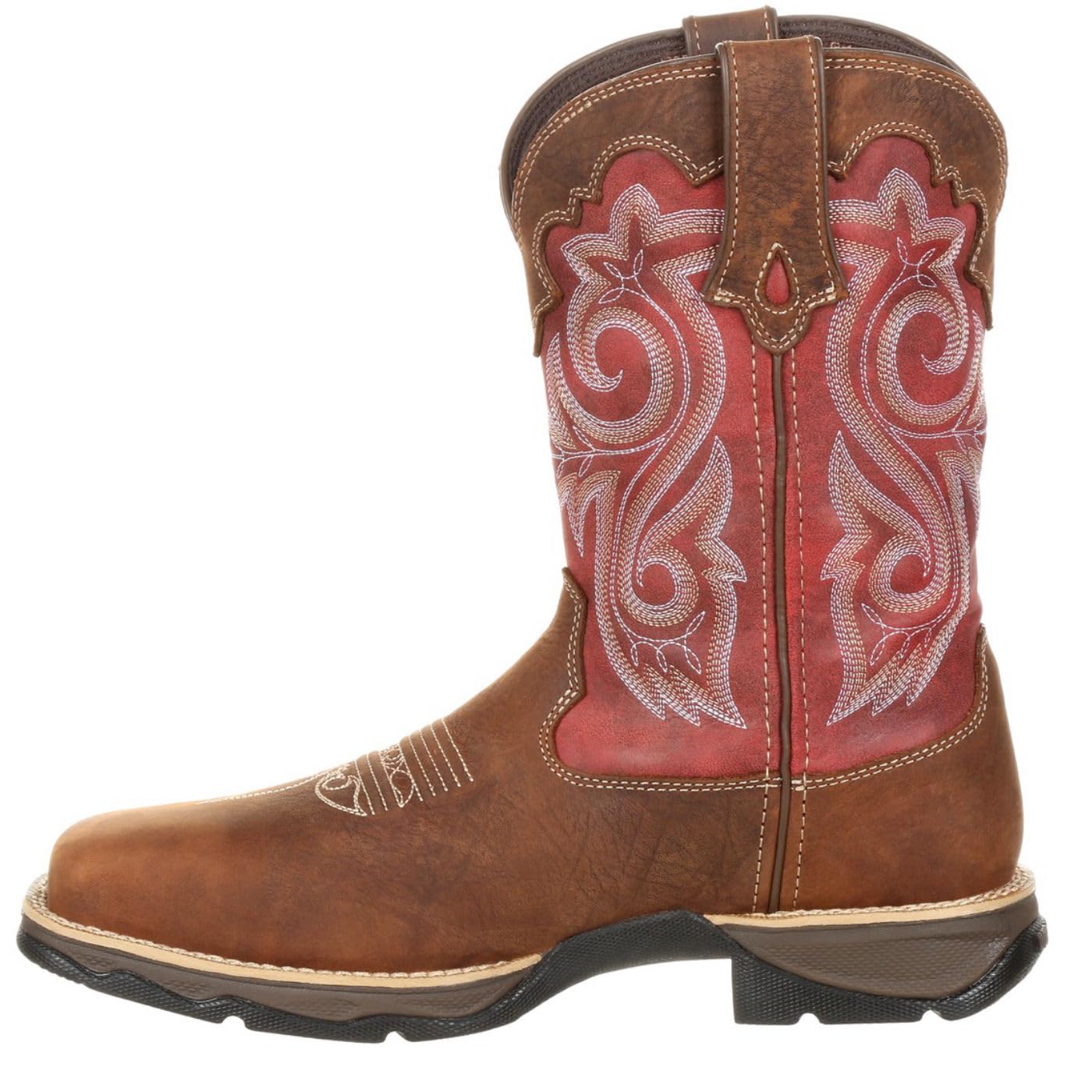
A low rocker heel that rolls you forward instead of planting you square.
The Durango solves the heel problem a different way. Instead of a right-angle 90-degree block, it uses a 1 ¼-inch rocker heel — the back of the sole is curved so your foot rolls through each step rather than stopping dead on a flat heel face. On a concrete slab that matters. The taller, squarer heel of a traditional boot puts a jolt up your leg with every stride; the rocker spreads that out. It is the reason this one is the easiest of the three to stand in for a long shift.
The toe is composite rather than steel, rated to ASTM F2413 I/75 C/75. That is an impact rating of 75 and a compression rating of 75, so the cap is rated for 75 lbs of impact and 75 lbs of compression load. Composite does not conduct cold the way steel does, so it stays warmer on a frosty morning. It also meets the Electrical Hazard Standard. The upper is dark brown full-grain leather with a dipped topline, pull tabs, fancy stitching on the shaft, and a square toe, so it looks like a Western boot first and a work boot second.
Inside, a soft mesh lining keeps air moving around your leg, and a cushioned footbed takes some of the sting out of hard steps. A tempered steel shank runs under the arch for support, and the outsole is described as lightweight, abrasion-resistant, and flexible. The 10-inch shaft is the tallest here — more coverage against mud and brush, but you will want your pants cut to go over it.
Comfort is the second-strongest thing owners talk about, right behind overall quality. Plenty report no blisters or bruises even on the first long wear, and the color and light feel get their own steady stream of approval. The recurring honest note is the composite toe: some units have been reported coming apart there, and fit is a split — some find it perfect, others say it runs small.
The rocker-heel argument: if your job is hours of standing on hard concrete, a curved 1 ¼-inch rocker heel is gentler on your stride than a square 90-degree block, and no other pick here offers that shape.
One thing to plan around: the 10-inch shaft is the tallest of the three, so it wants pants that drape over it rather than tuck into it.
Best for: all-shift standing on hard floors where a curved heel beats a square one, plus anyone who prefers a lighter composite cap over steel.
Think twice if: you want the surest long-term toe cap — this is the one place the composite design has drawn complaints.
3. Ariat Women’s Fatbaby Work Pull-On Steel Toe Work Boot

The one that looks like the boot you wanted and still meets the safety standard.
This is the pair you buy when the look matters as much as the safety line. Full-grain leather wraps an 8-inch shaft, the shortest of the three, so it slides under jeans and work pants without a fight. The 90-degree heel gives you the classic planted Western stance, and the stirrup-friendly outsole is shaped to sit cleanly in a stirrup if your work happens on horseback.
The practical side is all there. The Duratread sole is oil- and slip-resisting and rated for hot contact at 300°C/572°F, so hot surfaces will not eat into the rubber. The boot meets F2413 standards for electrical hazard resistance and carries a steel toe. A removable All Day Cushioning insole sits on the 90-degree heel, and the 4LR technology is a support layer built into the midsole to hold your foot steady on uneven ground. What it does not have is waterproofing — the Krista above does, and that is the clearest line between the two Ariat picks.
Here is the trade-off, and it is a real one. The Fatbaby weighs 4.6 pounds against the Krista’s 3.1 pounds, so you are carrying a heavier boot for the sake of the leather look. Its 8-inch shaft is also shorter than the Krista’s 9-inch, which helps with pants but leaves a bit less leg covered. The comfort insole and the removable footbed are what buyers praise most, with appearance running a close second — the boot looks the way it does in the listing photos.
The fit is the decision: this is the most-discussed topic on the Fatbaby, and it is a split — some wearers find it perfect and others find it not true to size. Treat sizing as the first thing to get right.
Second honest point: a share of owners find the boot hard to pull on, which is where the pull-on design and a high instep can clash.
Pick it when: you want a heeled steel-toe boot that reads as a real Western boot and you are willing to size carefully to get there.
Skip it when: you work wet ground — there is no waterproof membrane here, so the Krista is the pair for that.
Know the Specs
Heel shape: 90-degree vs rocker
A 90-degree heel is a square block that meets the ground at a right angle. It plants you firmly and suits a stirrup, but it puts a sharper jolt through your leg on concrete. A rocker heel, like the 1 ¼-inch one on the Durango, is curved at the back so your foot rolls through each step. If you stand for hours, the curve is easier on you. If you ride, the square heel is the better shape.
Toe ratings: ASTM F2413 explained
ASTM F2413 is the safety footwear standard, and the figures after it tell you what the toe cap has been rated to withstand. On the Durango that is I/75 C/75 — 75 lbs of impact and 75 lbs of compression. The two Ariat picks state F2413 electrical hazard resistance instead. Electrical hazard resistance means the boot is built to reduce the risk of a circuit forming through your body, not that it is insulated for every electrical job. Steel and composite caps both meet the standard; steel is heavier, composite is lighter and warmer.
Waterproofing and DRYShield
DRYShield is Ariat’s name for a breathable waterproof membrane built into the boot. It blocks liquid water from outside while letting vapour from sweat pass out. A boot without a membrane, like the Fatbaby, will wet through in sustained rain or standing water. If your work involves wash-down, mud, or wet weather, the membrane is worth prioritizing over style.
Shaft height and weight
Shaft height is measured from the top of the heel to the top of the boot, and it decides how the boot sits under your pants. Shorter shafts tuck under more easily; taller shafts give more coverage. Weight matters more than people expect in a heeled boot, because the heel already moves your weight forward and every extra pound works against your calves. The Krista is 3.1 pounds, the Fatbaby 4.6 pounds, and the Durango 4.5 pounds.
Common Questions
Can you actually work all day in a heeled work boot?
Is a steel toe or a composite toe better in a heeled work boot?
Do these work boots with high heels run true to size?
What does the 300°C/572°F hot contact test on the Duratread sole mean for me?
Will a 10-inch shaft work with my regular work pants?
Do I need waterproofing on a heeled work boot?
What is the U-Turn Entry System on the Krista?
Does electrical hazard resistance mean the boot is safe for any electrical work?
How much does boot weight matter in a heeled work boot?
The Bottom Line
For most people, the work boots with high heels pick that makes the most sense is the Ariat Krista, because it is the only one here that combines a 90-degree heel with DRYShield waterproofing (a built-in barrier that keeps water out) and the lightest build at 3.1 pounds. If standing on hard concrete all shift is your reality, reach for the Durango Lady Rebel and its 1 ¼-inch rocker heel (a curved sole that helps you roll through each step). And if you want the Western look up front, the Ariat Fatbaby gives you full-grain leather on an 8-inch shaft with a steel toe under it. Buy the heel shape your job asks for, not the one the photo sells you.
How we choose
We do not accept paid placement. Every pick is matched to a real buyer and a real use-case; we do not hands-on test units.
Sources
Specifications: manufacturer listings and product documentation. Review insights: verified customer reviews, as of November 2026. Pricing: not shown on this page (it changes often); check the current price via the retailer link.
As an Amazon Associate, Tactical Gear Guy earns from qualifying purchases. This does not affect which products we feature.