Specs are compiled from manufacturer listings and verified buyer reviews and can change over time — please confirm the key details on the product page before buying.
Your feet are the one tool you cannot swap out at lunch. If you are buying men’s work boots, the thing that actually decides whether you last the day is whether the fit and the cushioning hold up past hour eight — not the badge on the side. The nine picks below cover steel toe, soft toe, alloy toe and composite toe, from wedge-sole boots you can wear all day to heavy-leather tanks built for wet ground. Pick the wrong weight or the wrong toe box and you will feel it by lunchtime, every shift.
This guide is built by comparing the manufacturers’ published specifications and the patterns across verified customer reviews, so you get each pick’s real strengths and trade-offs instead of marketing spin.
Each boot below is matched to a specific job site, foot shape and shift length. You will see steel toe versus alloy versus composite explained in plain words, why a wedge sole behaves differently on concrete than a lug sole does on gravel, and where these boots honestly fall short. The work boots mens list below leads with the strongest all-round pick, then the value options.
Top Picks


How To Choose The Best Work Boots Mens
Most work boot buyers start with the brand and fight the fit for months. They pick a brand name they trust first, then fight the fit for six months. Shop in this order instead: toe type, then weight, then fit — those three decide whether the boot survives a full shift.
Toe type is a weight and temperature decision
Steel toe caps are the traditional safety option and meet ASTM F2413 impact standards, which is the safety rating most job sites ask for. They are dense, so they soak up cold on winter mornings and add noticeable bulk to the front of the boot. Alloy toes and composite toes do the same protective job with less mass at the toe — composite is non-metallic, so it does not conduct cold the way steel does. That is the whole trade in plain terms: heavier and colder versus lighter and pricier.
Weight per boot tells you how the shift will end
A heavy boot fatigues your legs, and a very light boot may wear out faster at the sole. Two pounds per boot is genuinely light for a safety boot; four and a half pounds per boot is a leather tank. If you climb ladders or cover a lot of ground, go light. If you stand in one spot on a wet slab, the heavier, stiffer boot usually holds its shape longer.
Wedge sole versus lug outsole
A wedge sole is one flat, continuous slab of rubber with no separate heel. It spreads your weight evenly, which is why it feels so good on concrete, shop floors and ladder rungs. A lug outsole has deep tread blocks, so it digs into loose dirt and gravel better. Neither sole is better — each is built for different ground.
Waterproof means a membrane, not magic
A waterproof boot keeps water out through an internal liner, often paired with full-grain leather on the outside. The leather still gets wet on the surface, and the boot still needs to breathe through the lining, so you have to let it dry properly between shifts. Waterproof boots are also warmer in summer, because that same membrane holds moisture in as well as out.
Side-by-Side Comparison
| Model | Best For | Toe Type | Waterproof | Weight | Amazon |
|---|---|---|---|---|---|
| Ariat WorkHog Patriot★ Best Overall | Steady footing on uneven ground | Steel toe | — | — | Amazon |
| Cat Footwear StriverBest Value | All-round build quality | Steel toe | — | — | Amazon |
| Georgia Boot Eagle LightLightest Leather | Light day-to-day wear | — | — | 4.5 lb (packaged) | Amazon |
| Wolverine Floorhand 6″ | Long shifts on a budget | Steel toe | Yes | 4 lb | Amazon |
| Carhartt Rugged Flex 6″ Steel Toe | Wet weather protection | Steel toe | Yes (Storm Defender) | 4.5 lb | Amazon |
| Timberland PRO Barstow Wedge | All-day standing comfort | Alloy safety toe | — | 2 lb | Amazon |
| Carhartt Rugged Flex Soft Toe | Moving all shift, no toe cap needed | Soft toe | Yes | 1.6 lb | Amazon |
| KEEN Utility Evanston 6″ | Wide feet and medium-duty work | Composite toe | Yes | 25.3 oz per boot | Amazon |
| Wolverine I-90 | Fighting fatigue on hard floors | Composite toe | Yes | 1.81 lb | Amazon |
Detailed Reviews
1. Ariat Men’s WorkHog Patriot Steel Toe Work Boot
Our pick — 4.5+★ from 600+ verified ratings; the strongest balance of quality and price.
The boot that stops your ankle rolling when the ground shifts under you.
Side-to-side stability is the whole point of the WorkHog. Ariat builds this boot around a sole that cushions impact and resists the sideways twist that catches your ankle on gravel, mud or a sloped roof. If your job puts you on uneven ground all day, that lateral support is worth more than any single comfort feature. You get it in a steel toe, so the front of the boot is built for impact protection to ASTM standards.
What wins people over is the fit. The Ariat WorkHog line has a reputation for locking your heel down without crushing your toes, and that combination keeps a shift bearable. Buyers report almost no break-in — you lace them up and go to work. One buyer’s summary puts it plainly: “They are durable, with one customer noting they can handle 15-hour days, and another mentioning they never needed to break them in.” That is a full shift plus overtime on the same pair of feet.
The honest catch is weight and breathability. A steel toe boot built for stability, with heavy leather and a shock-absorbing sole, is not light, and the same structure that supports you also traps heat. In summer heat, or on a job that keeps you moving fast between tasks, a lighter boot will feel better by the end of the day. Popularity is not a concern here — this is among the most established picks in the category, holding 4.5+ stars across 600+ ratings.
What the WorkHog Gets Right
- Side-to-side stability and shock absorption are the design center, not an afterthought
- Steel toe gives you impact protection your site will recognize
- Minimal break-in — the leather and sole arrive ready for a full shift
- Holds up to 15-hour days according to buyer feedback
Where It Gives Ground
- Heavy leather plus a shock-absorbing sole adds up to a weighty boot
- Not a breathable summer boot — the support structure traps heat
- Stability focus means less flex than a lightweight work shoe
Made for uneven ground: This is your boot if your day is spent on gravel, mud, scaffolding or any surface that shifts underfoot.
Think twice on heat: If you work in summer humidity or cover serious mileage, the heavier build will feel like a cost by mid-afternoon.
2. Cat Footwear Mens Striver Steel Toe
A steel toe that runs true to size and slips less than you expect.
The Striver’s defining quality is build. Caterpillar’s work line has a long history in heavy equipment, and this boot carries that industrial feel in the leather, the stitching and the molded sole. Build quality is the thing the reviews keep circling back to — it is the aspect buyers praise most, by a wide margin over everything else. For a mid-range steel toe, that matters: you are not buying a boot that will feel thin in six weeks.
Sizing and comfort are the second pillar. The Striver runs true to size, which sounds like a low bar until you have bought a work boot that arrives a half size small. The slip-resistant outsole gives you real grip on smooth shop floors and oil-slicked concrete, and that reliability on slick ground is the reason a lot of buyers keep coming back. Appearance gets its share of attention too — these look like a work boot, not a hiking shoe pretending.
The trade-off is weight, and it is not a small one. Buyers split on it: some call it lightweight, others find it very heavy. If you are coming from a soft-toe hiking style, the Striver will feel like a brick. If you are stepping up from a worn-out lug-sole tank, it will feel trim. Steel toe safety boots carry real mass at the front, so go in expecting a substantial boot.
The value read: For a steel toe from a company that makes earthmoving equipment, the Striver overdelivers on construction. The leather is substantial, the toe is protected, and the tread grips well on indoor floors.
The weight split: This is the boot that divides reviewers most on the question of mass. Try to know your own tolerance before you commit — heavy-boot wearers love it, light-boot wearers do not.
Reach for it if: You want a genuinely well-made steel toe that fits true to size and grips slick floors without the premium price tag.
Look elsewhere if: Your last pair was a featherweight soft toe — the Striver’s mass will take adjustment.
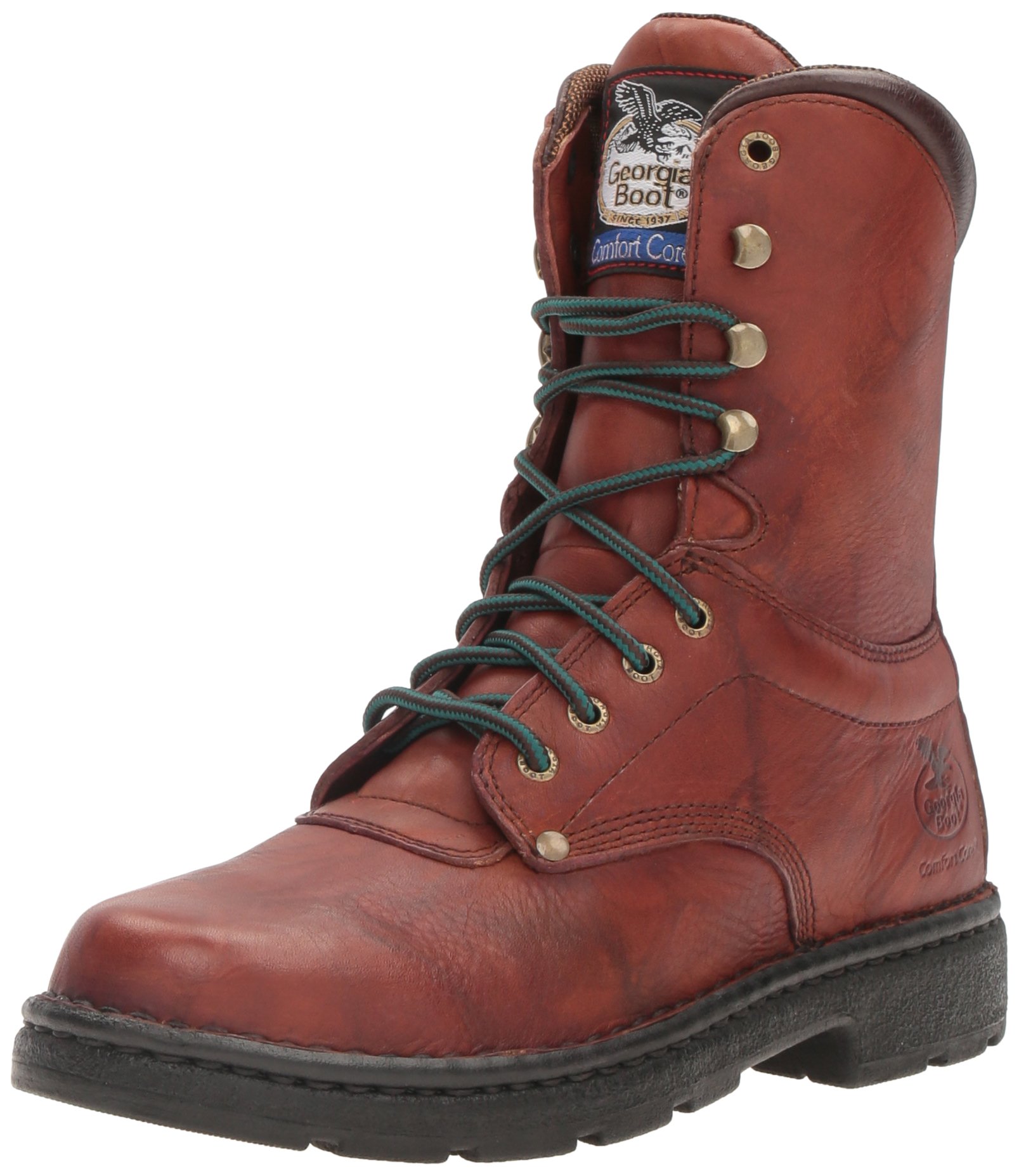
3. Georgia Boot Eagle Light Work Boot
Soft leather and a light sole that feel broken in from the first lace-up.
Comfort here comes from the leather itself. The Eagle Light uses a soft upper that flexes with your foot rather than standing stiff against it, and the light build keeps the boot from dragging through a long shift. Quality is what buyers praise most about this one, and the fit lands right behind it. On the shelf, that combination reads as a comfortable boot you do not have to fight.
Here is where the honest part starts. Durability on the Eagle Light draws split reactions: some owners wear theirs for years, while others see them coming apart inside eight months. Water resistance is the weaker spot — the softer leather lets moisture through in sustained wet conditions, so this is not the boot for a rainy job site or a shift spent in puddles. Value also divides people, because a boot that lasts years is a bargain and a boot that lasts months is not.
The Georgia is worth considering if you need one thing above all: a comfortable leather work boot that does not feel like a cast on your foot. It is best matched to dry indoor work, light-duty outdoor tasks and shorter shifts. It is a lighter-leather boot in a category of heavier-leather boots — that is the whole sentence. Treat it as a comfort pick and you will be happy; treat it as a wet-weather tank and you will not.
Why It Feels Good On
- Soft leather upper flexes instead of binding
- Light build cuts fatigue on shorter shifts
- Fit lands well for most wearers straight away
Where It Falls Off Pace
- Durability draws mixed reports, with some pairs failing inside eight months
- Water resistance is the most consistent weak point
- A comfort boot, not a wet-ground boot
Best matched to: Dry indoor work, light outdoor tasks and anyone who prioritises a soft, flexible upper over a heavy tank.
Wrong tool for: Standing water, constant rain or a site that punishes boots — the leather will let moisture in and the sole will wear faster.
4. Wolverine Men’s Floorhand Waterproof 6” Steel-Toe Work Boot

Waterproof, steel-toed and four pounds — the value boot that does not feel cheap.
At 4 pounds, the Floorhand lands in the middle of the weight spectrum for a steel toe work boot — heavy enough to feel substantial, light enough that “not too heavy” is how buyers describe it. The waterproof build handles wet ground, and the moisture-wicking mesh lining inside is what keeps the inside of the boot from turning into a swamp. A steel toe caps the front for impact protection.
Comfort and fit are the quieter wins. Wearers report wearing them through 10+ hour days, and the wide sizing runs wide enough to matter — the 9 extra wide in particular fits properly. If your feet have been squeezed by boots that call themselves “wide” without being wide, this is a genuine option. Value for money is the second-strongest theme in feedback here, and it makes sense: you get steel toe, waterproofing and a decent leather upper without paying for premium branding.
What you should know before buying is that the long-term picture is honest but not perfect. Some pairs hold up beautifully; others start coming apart at the seams sooner than you would like. Water resistance is also inconsistent between pairs. This is the pattern of a boot built to a price — good construction on day one, with more variance in how long it lasts. Buy the Floorhand for wet work while you build up to a heavier boot, and keep an eye on the seams.
The case for the Floorhand: Waterproofing plus steel toe plus real wide sizing is a rare combination in the budget tier. The mesh lining and the 10+ hour comfort reports are the reason it earns its spot.
What you are accepting: Durability is the variable here, not a guarantee. Some boots wear for years and others give up sooner, and there is no way to tell which one you got until it happens.
Pick this for: Wet or damp work on a tighter budget, and especially if you need a genuinely wide fit with a steel toe.
Not for you if: You want one pair to last several seasons — the long-term reports here are genuinely mixed.
5. Carhartt FF6213-M Steel Toe Work Boot
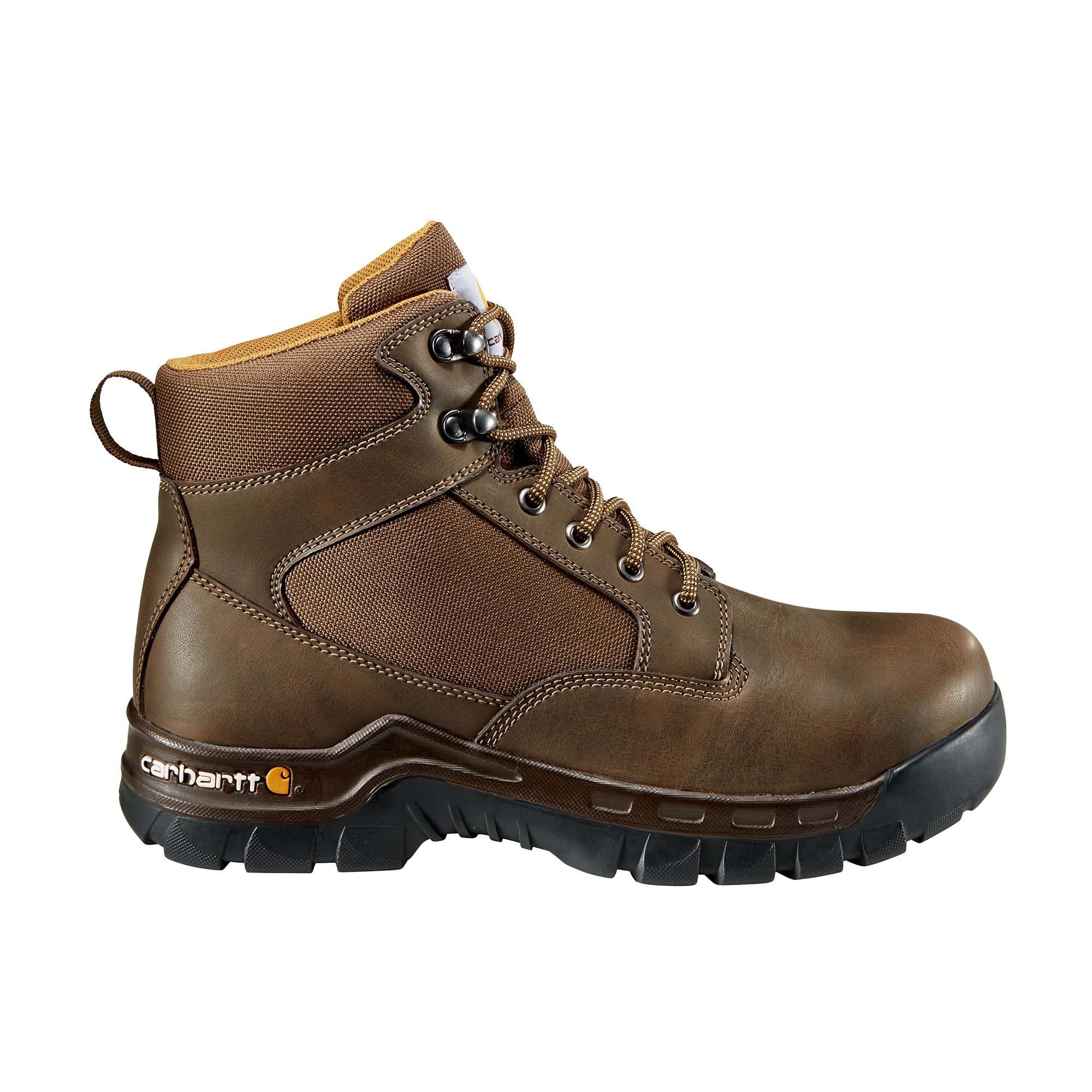
Rain, puddles and a steel toe — this is the boot for wet ground.
Carhartt’s Storm Defender membrane is the headline here. It is a waterproof liner that lets moisture vapour escape while blocking liquid water, so you get dryness without a steamy foot. The upper pairs brown leather with Carstrong fabric, which is a tougher fabric weave built to resist scuffs and abrasion. The steel toe meets ASTM 2413-21, the standard most sites check against for impact protection. Buyers confirm it performs in wet and rainy weather.
Underfoot, the sole is a slip-resistant Rugged Flex rubber lug outsole — deep tread blocks that bite on loose ground and uneven job sites. The layered cushioning system, a polyurethane insole, a PU Strobel pad and EVA filler, is designed to cut fatigue across a long shift. At 4.5 pounds, it is a substantial boot. That weight comes from the leather, the steel toe and the added waterproofing layers, and it is the same mass that lets this boot feel like real protection rather than a shoe dressed up as one.
Comfort and fit are where this boot earns mixed responses. It is a stiff, structure-first boot, and stiffness reads as support to one wearer and as discomfort to another. Some also find it runs large. The honest advice is simple: order your usual size with the expectation that it may feel roomy, and break it in properly before a big job. If you fight the fit from the start, you will fight it all season.
The Wet-Weather Argument
- Storm Defender waterproof membrane keeps water out while letting vapour escape
- ASTM 2413-21 steel toe gives you site-ready impact protection
- Slip-resistant Rugged Flex rubber lug outsole grips loose and uneven ground
- Layered insole, Strobel pad and EVA filler are built to reduce fatigue
The Stiffness You Accept
- Stiff structure divides wearers on comfort
- Some find it runs large — do not size up
- Heavy at 4.5 pounds with the toe and waterproofing layers
Suits the wet job: Pick this if rain, puddles or wet concrete are part of your normal day and you need a real steel toe.
skip it if: You want a supple, pre-broken-in feel from day one — this is a stiff boot that needs time.
6. Timberland PRO Men’s Barstow Wedge Alloy ST Work Boot

Two pounds per boot, a wedge sole and an alloy toe that skips the steel cold.
Two pounds. That number changes how the Barstow feels next to the heavier boots above. The wedge sole is the second half of the story: one flat, continuous slab of cushioning rubber with no separate heel, so your weight spreads evenly and your heel does not punch down into the floor with each step. For standing on concrete all day, that is the exact geometry you want. It is also why the Barstow weighs less than the 4.5-pound Carhartt steel toe: 2 pounds versus 4.5 pounds.
Comfort is the aspect that carries this boot — it is what buyers praise most, by a large margin. The leather upper has a vintage, broken-in look rather than a tactical one, and the alloy safety toe protects without the bulk or the cold-draw of steel. Slip resistance is built into the outsole, so ladders and shop floors are handled. For a boot with a safety toe, this is a genuinely wearable everyday work shoe.
The honest caveat on the Barstow is fit and long-term durability. The fit divides people: some find it great for wide feet, others find it runs large and can slip at the heel. Durability also splits — some pairs go five-plus years, others come apart early. The practical answer is to get the fit right before you commit to heavy wear, because a heel that slips in a wedge sole is more noticeable than in a boot with a distinct heel block.
The standout: At 2 pounds with an alloy toe and a wedge sole, the Barstow is built for the person who stands in one place for hours and feels every step in their heels.
Get the size right: The wedge sole is firm, the toe is safety-rated, and the fit is where the boot either works or does not. Try before you trust the size chart.
Ideal for: Long shifts standing on concrete, shop floors and ladder work where a lighter boot spares your legs.
Not for: Deep mud or heavy gravel — a wedge sole spreads load, but a lug outsole digs in better on soft ground.
7. Carhartt Men’s Rugged Flex Waterproof 6″ Soft Toe Work Boot
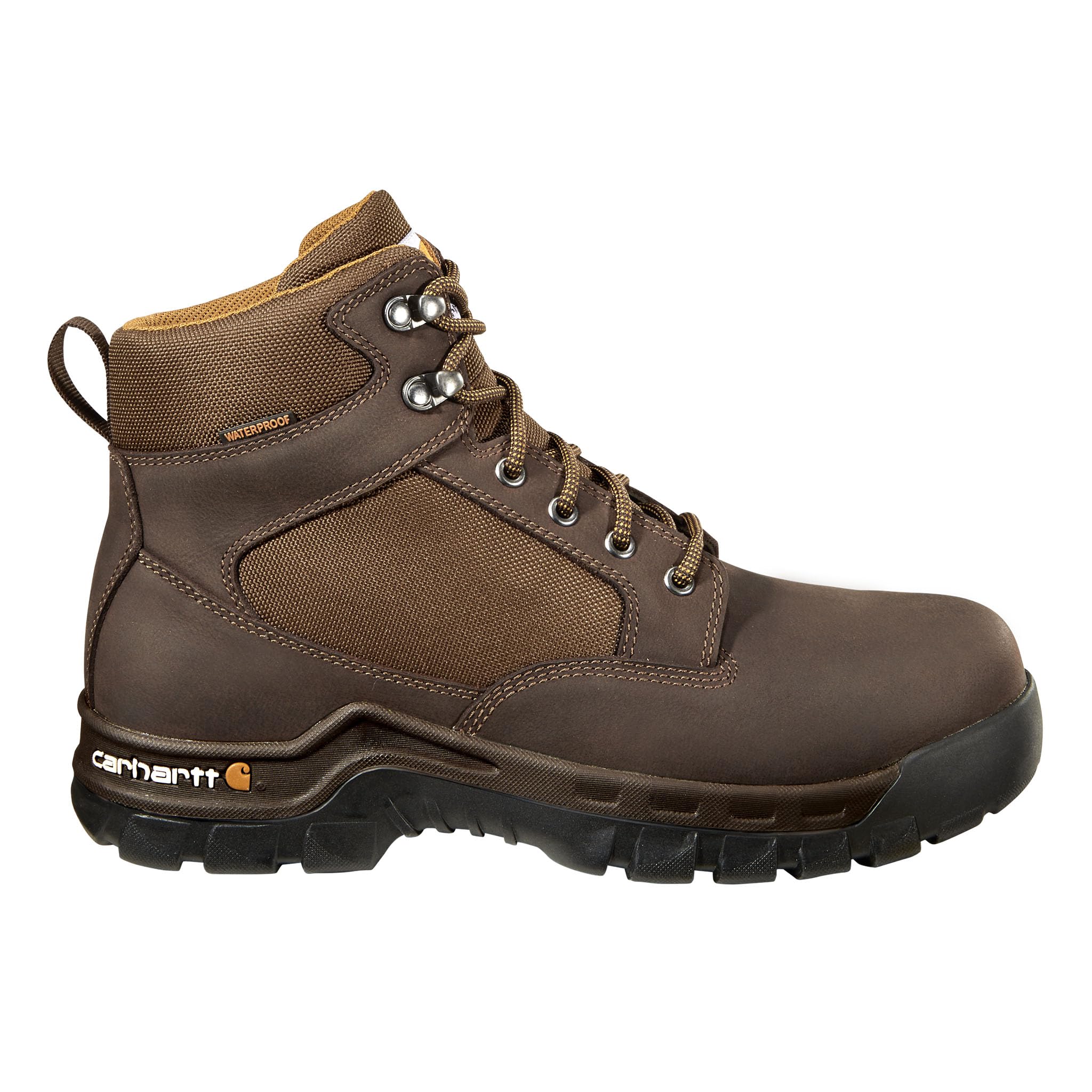
At 1.6 pounds, this is the boot for people who never stop moving.
If your job is up and down ladders all day, the Rugged Flex soft toe is the boot that stays out of your way. At 1.6 pounds it is among the lightest boots on this list — lighter than the 2-pound Timberland wedge and the 4.5-pound Carhartt steel toe in the same family. The flexible rubber outsole is built with ladder rungs, cement floors and uneven terrain in mind. It bends where your foot bends instead of fighting you.
The soft toe is the design choice that makes the weight possible. There is no steel cap in the front, so the front of the boot stays flexible and cool. That means this boot is for jobs that do not require impact-rated toe protection — a distinction worth checking against your site’s requirements before you buy. What you gain is a waterproof boot with resilient cushioning that carries the ASTM F2413-24 EH rating, which is the electrical hazard standard, and lets your foot flex naturally all day.
Comfort and fit are the strengths. Buyers describe it as extremely comfortable, suitable across weather conditions, with a fit that leaves the right amount of room in the toe box. The lightweight build and the reliability both get attention too. The caveat is value and, in some cases, water resistance, both of which split opinion. If you need a waterproof soft toe boot for a dry-ish job and mobility is the priority, this is a strong fit. If you need a toe that takes impact, this is not that boot.
The Agility Case
- 1.6 pounds per boot — one of the lightest picks in this guide
- Flexible outsole grips ladder rungs and cement floors
- Waterproof build with ASTM F2413-24 EH rating
- Roomy toe box reported by buyers
The Soft Toe Trade
- No steel or composite cap, so no impact-rated toe protection
- Value and water resistance draw mixed reactions
- Best suited to moving jobs, not heavy static work
Made to move: The right boot for ladder work, delivery routes, landscaping and any job where you are on your feet and in motion for the whole shift.
Not the one for: Sites that demand a safety toe, or work where a heavy object might land on your foot.
8. KEEN Evanston Composite Toe Work Boot
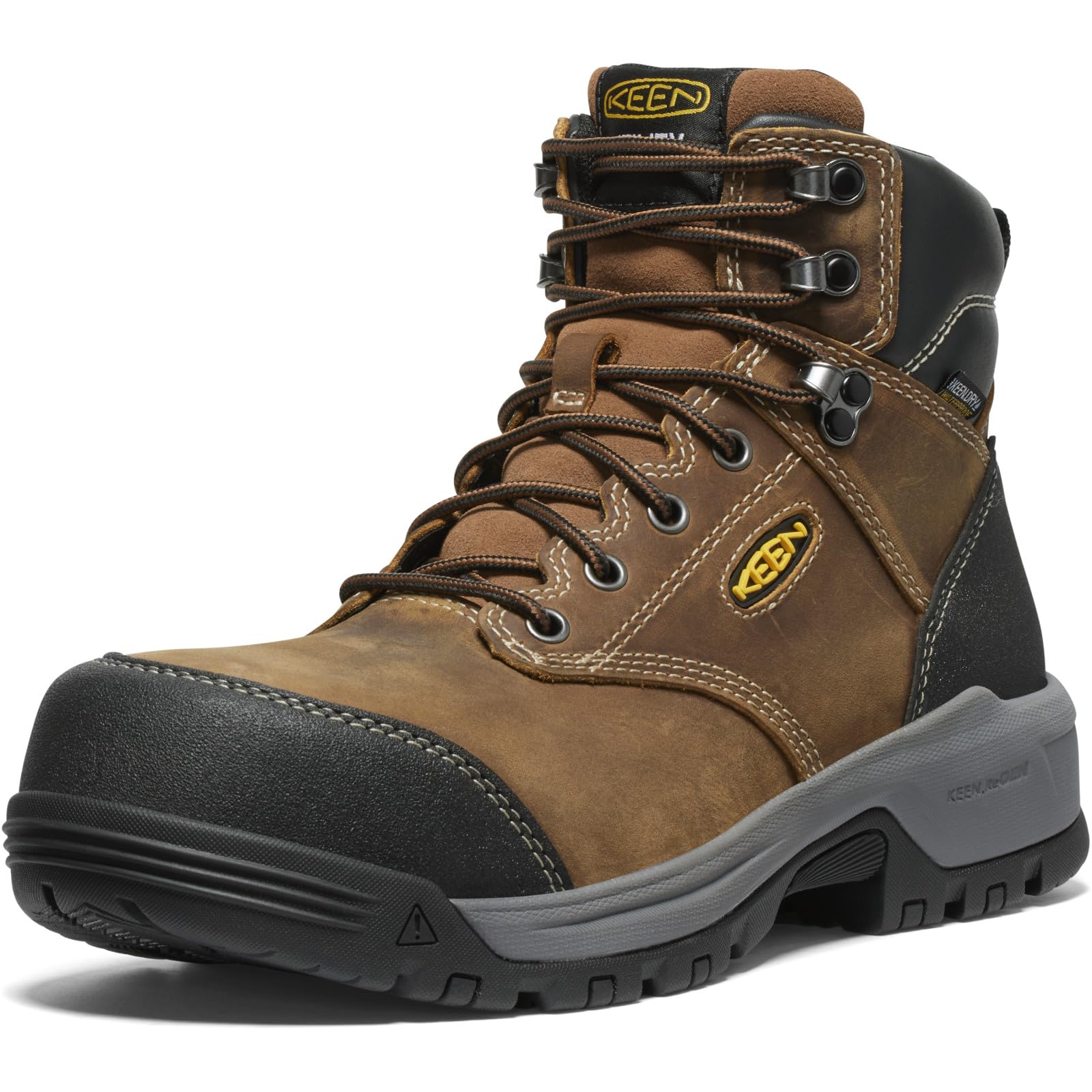
A wide, roomy toe box with a composite cap that skips the steel chill.
KEEN builds on a traditional wider footwear form, and that shape is the reason to put the Evanston on your list if your feet have never truly fit a standard width boot. The composite toe lightens the front of the boot and does not conduct cold the way steel does, which changes winter mornings. The waterproof leather upper is barnyard-resistant, a treatment that helps it stand up to mud, muck and animal waste on top of plain water. A 90-degree heel and an internal shank add stability when you are standing on a slope or working from a ladder.
The midsole is the comfort story. KEEN.ReGEN is an energy-returning midsole — a foam designed to give back some of the energy your step puts into it, rather than just absorbing it. Each boot weighs 25.3 oz, which is a real number for a composite toe waterproof boot but not featherweight. The removable insoles let you swap in your own footbed if the stock one does not suit your arch. Traction and water resistance are the two things buyers praise alongside comfort.
The honest limitation is longevity. Durability draws split reports: some pairs hold up for up to a year, others do not. That is not unusual for a medium-duty boot, and KEEN positions the Evanston exactly that way — construction, utilities, landscaping, transportation, maintenance and manufacturing. If your job involves heavy debris, constant abrasion or wet concrete every day, expect to replace sooner than a hardened heavy-duty boot.
Why it earns a spot: The wide form and composite toe solve two problems at once — cramped toes and cold toes. The energy-returning midsole keeps the day feel lighter.
Know the duty rating: This is a medium-duty boot by the maker’s own wording, so match it to your actual work. If your site is heavy and punishing, plan for a shorter life.
Choose this if: You have wide feet, want a non-metallic toe, and your work is medium-duty rather than demolition-level.
Pass if: You need a boot that shrugs off constant heavy debris — the durability here is not built for that.
9. WOLVERINE I-90 Composite-Toe Construction Boot

The honeycomb heel that fights fatigue step after step on hard floors.
Wolverine’s EPX anti-fatigue technology is the reason to buy the I-90. It is a layered system: a footbed with a honeycomb heel that expands and absorbs impact, a cushioned midsole underneath it, and a rubber lug outsole below that. The three work together to conserve and return energy, which is the technical way of saying the boot is engineered to make long shifts on concrete less punishing. At 1.81 pounds, it is light enough that the anti-fatigue build is not fighting its own mass. The waterproof full-grain leather upper and a waterproof-plus-breathable membrane keep feet dry all day.
Fit is the aspect buyers praise most by a wide margin — it is the standout strength of the I-90. Comfort and lightweight design come next, and all three together explain why this boot gets so much repeat attention. The 6-inch construction-boot cut gives you ankle coverage without a tall-shaft feel, and the composite toe keeps the front light. For a waterproof composite toe boot, that combination is a solid all-rounder.
The size caveat is worth knowing up front. The “extra wide” option runs narrower than expected according to buyer feedback, so if you are buying this specifically for a wide foot, the fit may surprise you. Durability also splits — some I-90s hold up beautifully, others break down inside six months. Water resistance holds up well as a rule, so the weak point is long-term wear, not wet ground. For an anti-fatigue boot with a waterproof membrane and a composite toe, this is a fair trade as long as you go in with realistic expectations.
Why the I-90 Stands Out
- EPX anti-fatigue system layers honeycomb heel, cushioned midsole and rubber lug outsole
- 1.81 pounds per boot — light for a waterproof composite toe
- Full-grain waterproof leather with a breathable membrane
- Fit is the strength buyers return to most often
Where It Needs Care
- “Extra wide” runs narrower than expected
- Durability splits — some pairs give up inside six months
- Best for anti-fatigue work, not heavy-abrasion demolition
Suits the long shift: Buy this if you stand on hard floors all day and want a lightweight composite toe boot with an anti-fatigue sole.
Try wide sizes in person: If you need an extra wide fit, verify the sizing before you commit — the “extra wide” is the most common complaint.
Know the Specs
Steel Toe, Alloy Toe and Composite Toe — What They Actually Mean
A steel toe is a metal cap in the front of the boot that absorbs impact, and it is the traditional choice most sites recognize. An alloy toe does the same job in a lighter metal, so the front of the boot feels less bulky. A composite toe uses non-metallic material, so it stays lighter and does not conduct cold the way steel does on a winter morning. All three protect the front of your foot. The difference is in weight, temperature and how the boot feels across a full shift.
Why a Wedge Sole Feels Better on Concrete
A wedge sole is one continuous, flat slab of rubber with no separate heel block. That means your weight spreads across the whole foot every time you step, so you are not concentrating force in one spot. On concrete, shop floors and ladders, that even pressure is why wedge-sole boots feel so good over long hours. The trade is grip on loose ground: a lug outsole’s deep tread blocks dig into loose dirt, but a wedge sole does not. Match the sole to the ground you actually walk on.
Common Questions
Do I need steel toe or composite toe for my job?
How much should work boots weigh per boot?
Are waterproof work boots worth it if I sometimes stand in water?
What is a wedge sole good for compared to a lug outsole?
How long do work boots usually last?
Do wide sizes actually fit wide feet?
Can I wear soft toe work boots on a construction site?
What does the ASTM rating on a work boot mean?
Is a composite toe as protective as a steel toe?
Should I size up or order my normal size in work boots?
The Bottom Line
For most people buying work boots mens, the best overall pick is the Ariat WorkHog Patriot because it pairs a steel toe with real side-to-side stability and shock absorption, and it breaks in fast enough to wear on day one. If you want a lighter path to a safety toe, reach for the Timberland PRO Barstow Wedge — at 2 pounds with an alloy toe and a wedge sole, it is the pick for standing on concrete all shift. And for wet, muddy work on a tighter budget, the Wolverine Floorhand delivers waterproofing and a steel toe in a genuinely wide fit.
The crowd favorite of the whole group is the Wolverine I-90, a 4.0+ star boot with 900+ ratings behind it and an EPX anti-fatigue sole built for hard floors — if standing still is your work, start there. Match the boot to your ground, your toe requirement and your shift length, and the rest of the spec sheet stops mattering.
How we choose
We do not accept paid placement. Every pick is matched to a real buyer and a real use-case; we do not hands-on test units.
Sources
Specifications: manufacturer listings and product documentation. Review insights: verified customer reviews. Pricing: not shown on this page (it changes often); check the current price via the retailer link.
As an Amazon Associate, Tactical Gear Guy earns from qualifying purchases. This does not affect which products we feature.