Specs are compiled from manufacturer listings and verified buyer reviews and can change over time — please confirm the key details on the product page before buying.
You stand on concrete for nine hours, you climb ladders in the rain, and you need a boot that keeps your feet dry and under control. That is what the picks below are built for — real leather, steel or composite toe caps, and soles that grip wet floors. Each one on this list is a genuine heavy-duty work boot, not a lifestyle boot dressed up in laces, and each entry tells you who it fits and where it stops.
This guide is built by comparing the manufacturers’ published specifications and the patterns across verified customer reviews, so you get each pick’s real strengths and trade-offs instead of marketing spin.
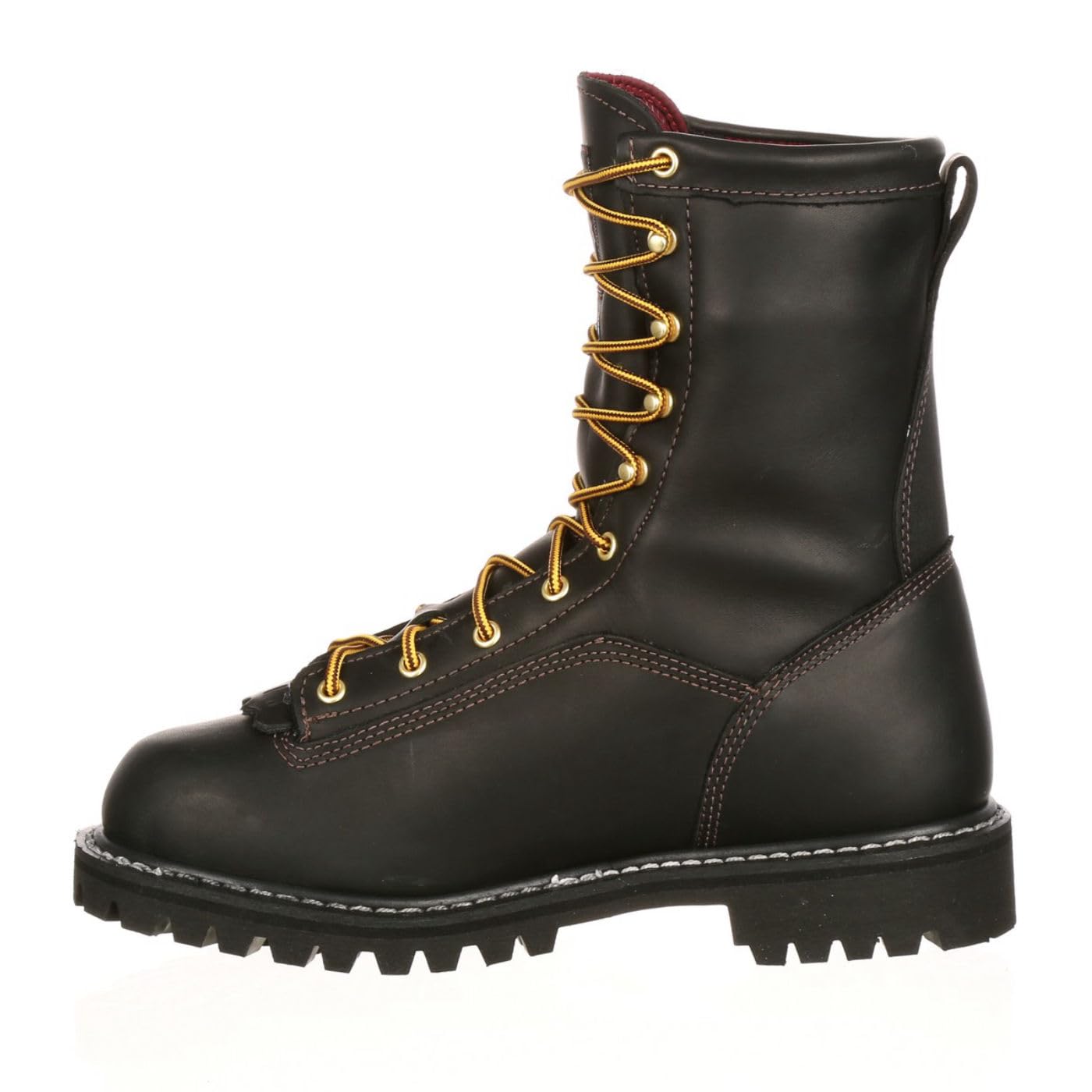
Start with the buying logic, then move through the picks. The Georgia Boot Low Heel Logger makes the shortlist because it pairs a GORE-TEX waterproof liner with 3M Thinsulate, and the best work boots heavy duty crews can wear need that mix of dry feet and warm toes.
Top Picks

How To Choose The Best Work Boots Heavy Duty
A work boot is a tool, not a fashion pick. The three things you feel by hour six are the sole, the shank, and whether your feet are damp. Buy for your daily surface and your safety rule, and most of the decision makes itself.
Start with the sole and the shank
A steel shank is a metal strip buried between the insole and the outsole. It stops the sole from folding under your arch when you stand on a ladder rung or a pipe. Vibram lug, PU, and Duratread outsole compounds all resist oil and chemicals, so the boot does not turn slippery when a machine leaks on the floor. If your shift is standing work, look for a cushioned insole or a polyurethane midsole — those spread the pressure instead of letting your heel take the load.
Match the toe cap to your safety rule
A safety toe cap guards the front of your foot against impact and compression — dropping a box on your foot or getting it caught under rolling gear. Steel is the classic choice. Composite (carbon fiber) toes are non-metallic alternatives that also do not pass cold as fast. A soft-toe logger skips the cap entirely and is built for workers who do not need one but want the ankle height and heel. Check the ASTM label of any boot that carries one, and match it to what your site requires.
Waterproof is not one technology
A waterproof membrane is a thin liner that lets vapor out while blocking water from coming in. GORE-TEX is one of those liners, and it sits inside the leather rather than on top. A plain rubber shell is a second route — it blocks water outright and skips the liner. Both keep water out, but they feel different: a membrane boot breathes, and a rubber shell is a solid barrier that can get warm.
Weight, welt, and how to size
A Goodyear welt is a stitched sole attachment that can be repaired instead of thrown away, so it extends the boot’s working life. Weight is a trade-off nobody escapes: a leather logger tips the scale, and a lighter industrial boot eases up a ladder. Measure your foot before you order, and if the brand supplies an insole length chart, use it — a half-size miss wastes weeks of break-in.
Side-by-Side Comparison
| Model | Best For | Toe Protection | Waterproofing | Stated Weight | Amazon |
|---|---|---|---|---|---|
| Georgia Boot Low Heel Logger★ Best Overall | Cold, wet outdoor work | Soft toe | GORE-TEX | 4.5 lb | Amazon |
| TIDEWE Rubber Work BootBest Value | Wet, muddy ground | Steel toe + shank | 100% rubber and neoprene | — | Amazon |
| Timberland PRO Pit Boss 6″Top Seller | Everyday site work | Steel toe | Waterproof leather | 1.83 lb | Amazon |
| Carhartt Rugged Flex 6″ | Long shifts on your feet | Steel toe (ASTM 2413 21) | Storm Defender membrane | 4.5 lb | Amazon |
| DEWALT Richardson BOA | Fast on/off between sites | Steel toe | Water resistant | — | Amazon |
| Georgia Boot Farm and Ranch Lacer | Barnyard and chemical exposure | Soft toe | — | 4.5 lb | Amazon |
| ARIAT Treadfast 8″ | Construction and warehouse | Soft toe | DRYShield | — | Amazon |
| KEEN Utility Cincinnati 6″ | Climbing and 90-degree heel work | Composite toe | KEEN.DRY | — | Amazon |
| Irish Setter Mesabi 8″ | Logger-style all-weather work | Soft toe | UltraDry | — | Amazon |
| Ariat WorkHog Wide Square | Ladder work with wide feet | Steel toe (ASTM rated) | — | 2 lb | Amazon |
| Kenetrek Lineman Extreme | Line and tree work | Steel toe (ASTM rated) | smooth one-piece vamp | — | Amazon |
Detailed Reviews
1. Georgia Boot Low Heel Logger GORE-TEX
Our pick — 4.5+★ from 750+ verified ratings; the strongest balance of quality and price.
The logger that turns a cold, wet morning into an ordinary one
Your shift runs outdoors through slush, mud, and cold, and the Georgia Boot Low Heel Logger is built for exactly that. It carries a GORE-TEX waterproof liner — a breathable membrane that lets sweat vapor escape but stops water from getting in — plus 200 grams of 3M Thinsulate insulation, a synthetic thermal layer that traps warmth around your foot. That combination makes it the top pick here for working outside in wet cold.
What wins people over is the construction. The full-grain leather is stitched to the sole with Goodyear welt construction, which is a stitched attachment you can have repaired instead of replacing the whole boot. All the eyelets and stud hooks are seated on steel washers, so the hardware survives the yank of a tight lace-up. A steel shank runs under the arch for steadier footing when you are up high, and a removable cushioned orthotic insole gives you something to swap out if your arch needs different support. The Vibram lug rubber outsole resists abrasion, heat, chemicals, and oil, so a spill on the shop floor does not turn the boot into a skate.
The honest catch is fit. The lace-to-toe build runs narrow for some feet, and getting it snug takes a little patience at the start. Buyers report these hold up well and stay dry in wet weather, with the rugged soles drawing a lot of the praise. It is also the heaviest boot in this guide’s head-to-head against the Timberland PRO Pit Boss — 4.5 pounds versus 1.83 pounds — so if you spend your day on ladders instead of ground, that weight is real and worth thinking about before you commit. Its package is also noticeably bigger than the Carhartt’s 12.99 x 11.81 x 4.92 inches at 16 x 13 x 5 inches, though that only matters if you are short on storage.
For cold, wet, chemical-splashed outdoor work, the GORE-TEX liner and 200g Thinsulate are what earn it the top spot. If your job is logger duty, start here: the welted sole can be resoled and the Vibram lug grips oil and chemicals.
What You Get
- GORE-TEX waterproof liner under full-grain leather
- 200 grams of 3M Thinsulate insulation for cold mornings
- Goodyear welt construction that can be repaired
- Steel washers hold every eyelet and stud hook in place
- Vibram lug outsole resists oil, heat, chemicals, and abrasion
Where It Bites
- At 4.5 pounds it is the heaviest boot here next to the Timberland PRO at 1.83 pounds
- The lace-to-toe profile runs narrow and takes patience to lace snug
- The removable orthotic insole is a nice touch but you will likely swap it for your own
Reach for this one if: your work is outdoors in cold and wet, and you want dry feet that still breathe through a long shift.
Look elsewhere if: you need light boots for climbing all day — the leather logger weight will slow you down on the rungs.
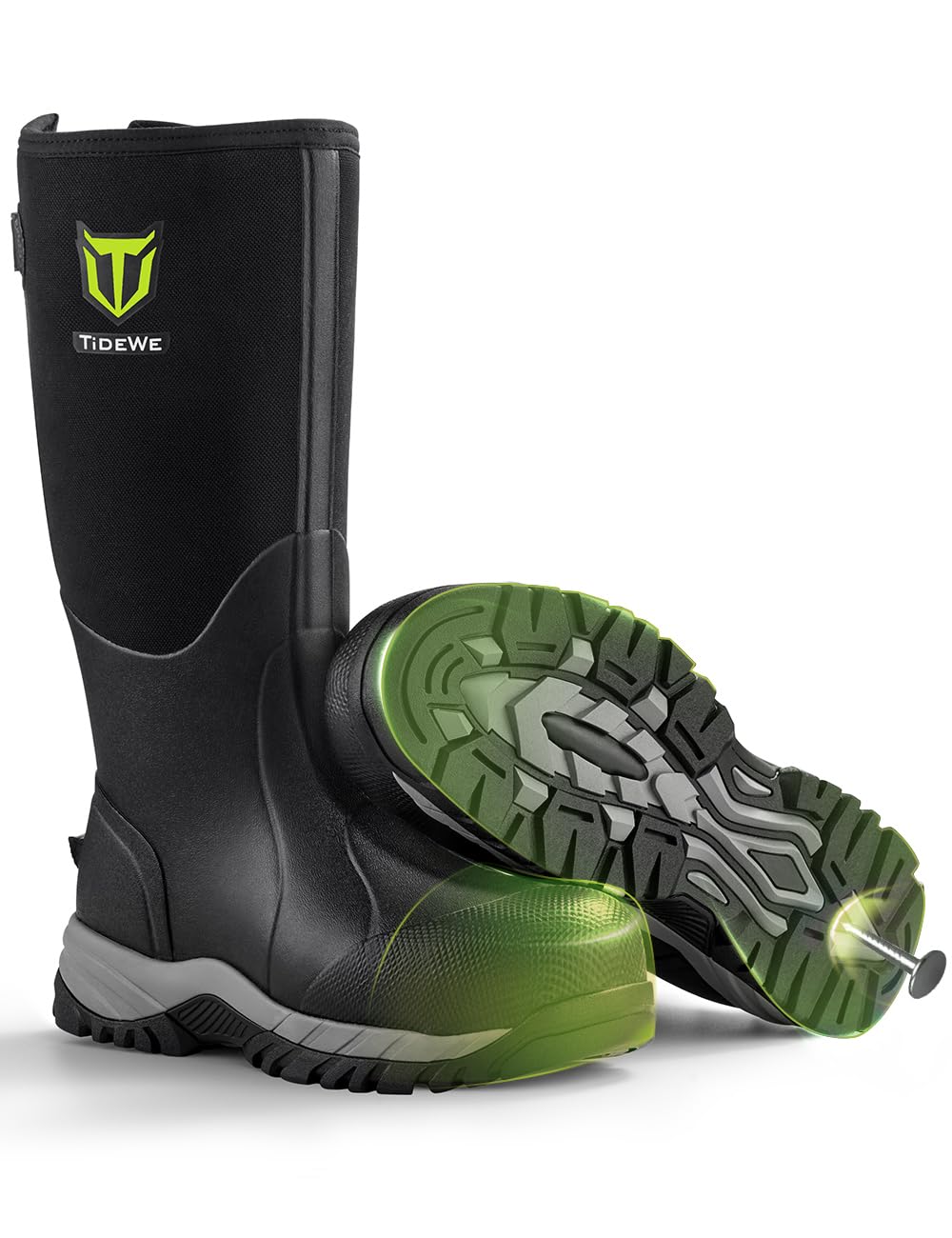
2. TIDEWE Rubber Work Boots Steel Toe
The rubber tank that walks into a flooded trench and doesn’t care
Wet ground is where this boot makes its case. The TIDEWE is built from 100% waterproof rubber and neoprene, which is a synthetic rubber that stays flexible in the cold. It has no membrane to trust and no leather to soak — water meets the shell and stops there. A steel shank sits between the insole and outsole to protect your foot from below, and the steel toe takes impact from falling or rolling objects. For mud, standing water, and a wash-down at the end of the shift, this is a different animal from a leather logger.
Owners mention these keep feet dry and warm and give plenty of room, and the functionality earns daily use with no fuss. The 6mm neoprene layer adds warmth when the temperature drops, and the breathable inner lining keeps air moving when it rises. A 10-inch shaft circumference comes up the leg enough to keep splash out. The pull-on and kick tab means you are out the door fast — no laces to feed at 5 a.m.
The limitation is the water story itself: a rubber shell is a solid barrier, so it holds heat in a way a breathable membrane does not. Some wearers have found theirs gets wet fast, and TIDEWE warns that your fit depends on measuring against the size chart — the company advises picking a size roughly 0.16 inches longer than your actual foot. Miss that and you will be fighting the boot all day. Get the sizing right and the rubber shell plus steel toe and shank make it the cheapest reliable wet-weather option here.
The rubber argument: no leather to soak, no membrane to puncture, a steel shank under the arch, and a steel toe on top — the protection package is the reason this sits so low on the page.
The rubber shell and steel shank shrug off mud, water, and wash-downs shift after shift.
Fire it up when: your daily surface is mud, water, or a wash-down bay, and you want a steel toe and shank without the leather upkeep.
Leave it on the shelf when: you need a breathable boot for a hot indoor floor — the rubber will hold warmth.
3. Timberland PRO Pit Boss 6 Inch Steel Toe
The light industrial boot that trades ounces for all-day mobility
The number that stands out here is weight. At 1.83 pounds, the Timberland PRO Pit Boss is the lightest boot on this list by a wide margin — the Carhartt comes in at 4.5 pounds and the Georgia logger at 4.5 pounds too. That matters if your day is climbing, walking between job sites, or moving up and down stairs all shift. Your legs feel it in the afternoon.
The construction is built for hard work. The steel toe is rated to ANSI safety standards and the toe box is roomier than other safety boots — enough that customers note no pain after long hours. A nylon shock-diffusion plate adds torsional support so the sole does not twist under a harder push. The sole holds traction on wet and slippery surfaces, and there is electronic hazard protection built in for work near open circuits. The removable sock liner is a small thing that means you can swap in your own insole for the long shifts.
The honest follow-up is durability. Some of the owners who wear these daily say they hold up well, and others report them falling apart in a few months. That split is worth hearing before you assume the boot is either immortal or doomed — the way you wear it, the surface, and the fit all play a part. The roomier toe box is what makes the Pit Boss the comfortable pick for the widest range of feet, which is why it is the safest first choice if you do not know your exact needs yet.
Your first-move pick: the roomier steel toe and the 1.83-pound weight together make this the easiest entry into dedicated work boots if you are coming from cheap shoes.
Where it can catch you: the light build is not the longest-lived on the page, and some owners have seen the front end wear faster than expected. Keep it to the kind of work it was built for and it holds its own.
Make the switch if: you are tired of heavy boots slowing you down on a site and want a steel toe that slips into your routine without a break-in slog.
Think twice if: your job is hard on the front end of a boot and you want a logger that can be resoled — this is a light industrial build, not a ranch boot.
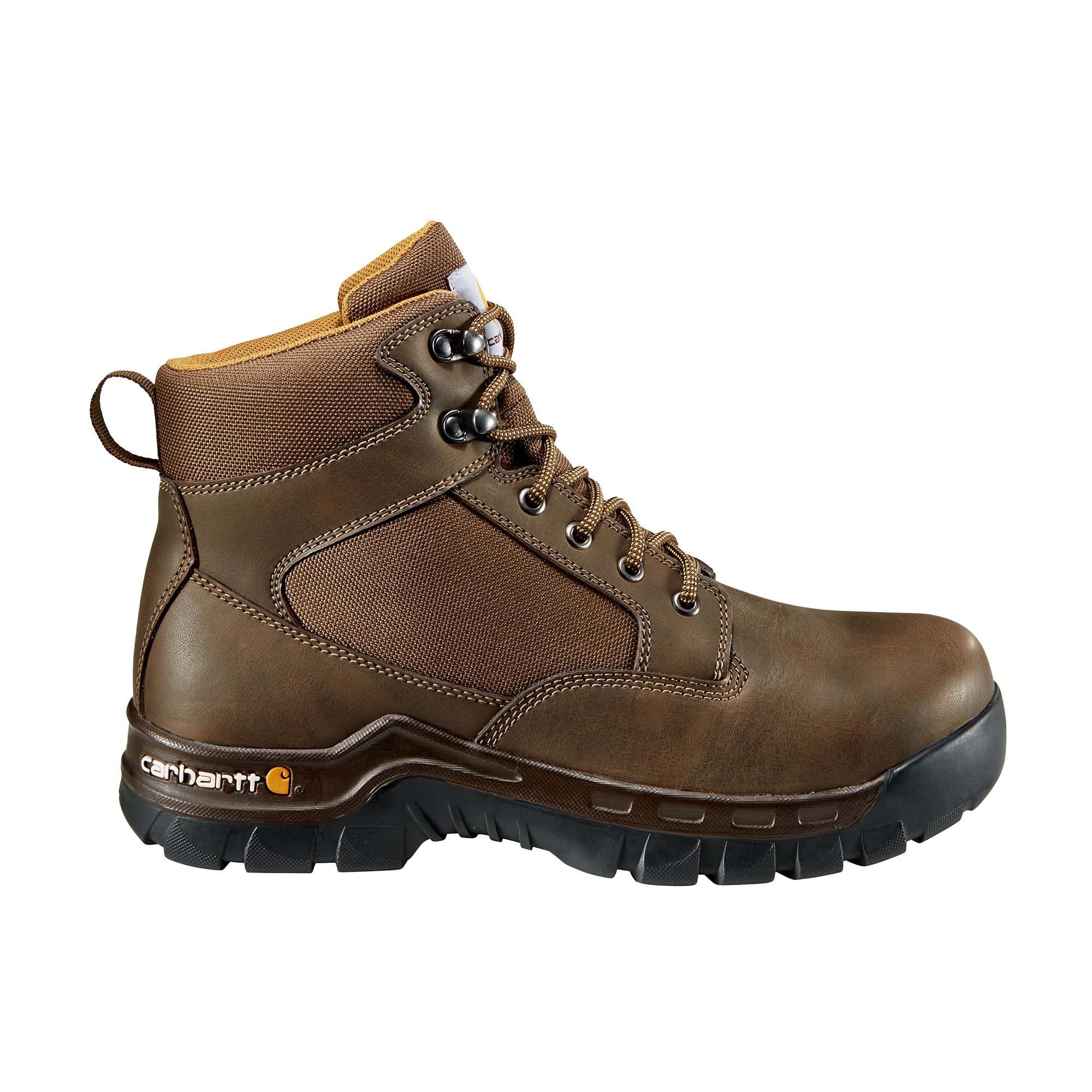
4. Carhartt FF6213-M Flex WP 6″ Steel Toe
Built to keep a standing shift from grinding down your soles
The Carhartt Rugged Flex makes its pitch on the inside of the boot. A cushioned polyurethane insole, a PU Strobel pad, and an EVA filler work together to take pressure off your feet across a whole shift. That is a lot of padding underfoot, and it is the part of a work boot that decides whether hour eight feels like hour three.
On the outside you get premium brown leather with Carstrong fabric panels, which are the reinforced sections where a boot wears through fastest. The Storm Defender membrane is a waterproof liner that still lets feet breathe, so a rainy day does not turn into a damp day. The steel toe is built to ASTM 2413 21 standards — the safety rating for toe impact and compression — and the slip-resistant Rugged Flex rubber lug outsole gives grip on wet concrete and gravel.
What buyers cheer most is the protection and durability when the boot is right for the person — the pairs that fit have kept feet dry in wet weather and held up through daily use. The fit is the pivot point. Carhartt’s sizing has been described as either perfect or too big by different wearers, and the 4.5-pound weight is the same as the Georgia logger, so neither is a featherweight. Measure your foot against the brand’s chart before ordering, because the right fit is what open up the comfort.
Why It Fits a Standing Shift
- Cushioned polyurethane insole, PU Strobel pad, and EVA filler for underfoot comfort
- Storm Defender membrane keeps feet dry while letting the boot breathe
- Steel toe meets ASTM 2413 21 safety standards
- Slip-resistant Rugged Flex rubber lug outsole grips wet ground
Why You Should Measure First
- Sizing has proven inconsistent — some feet get a snug fit, others find it too big
- The 4.5-pound build is no lighter than the Georgia logger, so it is a work boot, not a sneaker
- You need the right fit for the cushioning to do its job
Go with this if: your day is long shifts on concrete or gravel, and you want the cushioning baked in from the first wear.
Skip the trial-and-error if: you are between half sizes and cannot wait on a return — get the chart out first and size carefully.
5. DEWALT Richardson BOA Steel Toe

The dial-lace boot for wide feet and grab-and-go mornings
Instead of shoelaces, the DEWALT Richardson uses the BOA Fit System — a steel-lace dial that you turn to tighten and pop to release. That means a micro-adjusted fit in seconds and no laces to tie, retie, or catch on a ladder rung. The boot is cut on a wider fitting last, which is the version of this boot for higher-volume or wider feet. It is also the fastest boot here to take on and off between site changes.
Around the dial, the boot is built to hold up. A nubuck leather upper — leather that has been buffed to a soft, velvety surface — gives water and oil resistance while staying breathable. The steel toe cap, per DEWALT, is rated to handle impact forces up to 200J, and a toe scuff guard protects the outside of the toe. The PU/rubber outsole carries a built-in ladder grip and slip resistance, and the brand states it withstands temperatures of up to 300ºC. Reviewers point out the BOA mechanism keeps working and holds up over time, with comfort and fit drawing steady praise.
The honest read on the water resistance: the boot is water resistant, not fully waterproof, so standing in a deep puddle is not what it was built for. It is the dial, the wide fit, and the on/off speed you buy it for. If your daily routine is hopping in and out of a truck and walking varied terrain, the trade is worth it. If you work all day in standing water, choose the TIDEWE rubber boot instead.
Why the dial changes your morning: a steel-lace dial replaces tying, and the wide last gives higher-volume feet a fighting chance at a real fit. That combination is the whole pitch here.
The water caveat: water resistant is not the same as waterproof — puddles and standing water ask a question this boot answers only in passing.
Slot it into your rotation if: your feet run wide, your days are split between sites, and you want the dial lock instead of laces.
Step away if: you work in standing water all day — you need a fully waterproof shell, not a water-resistant leather.
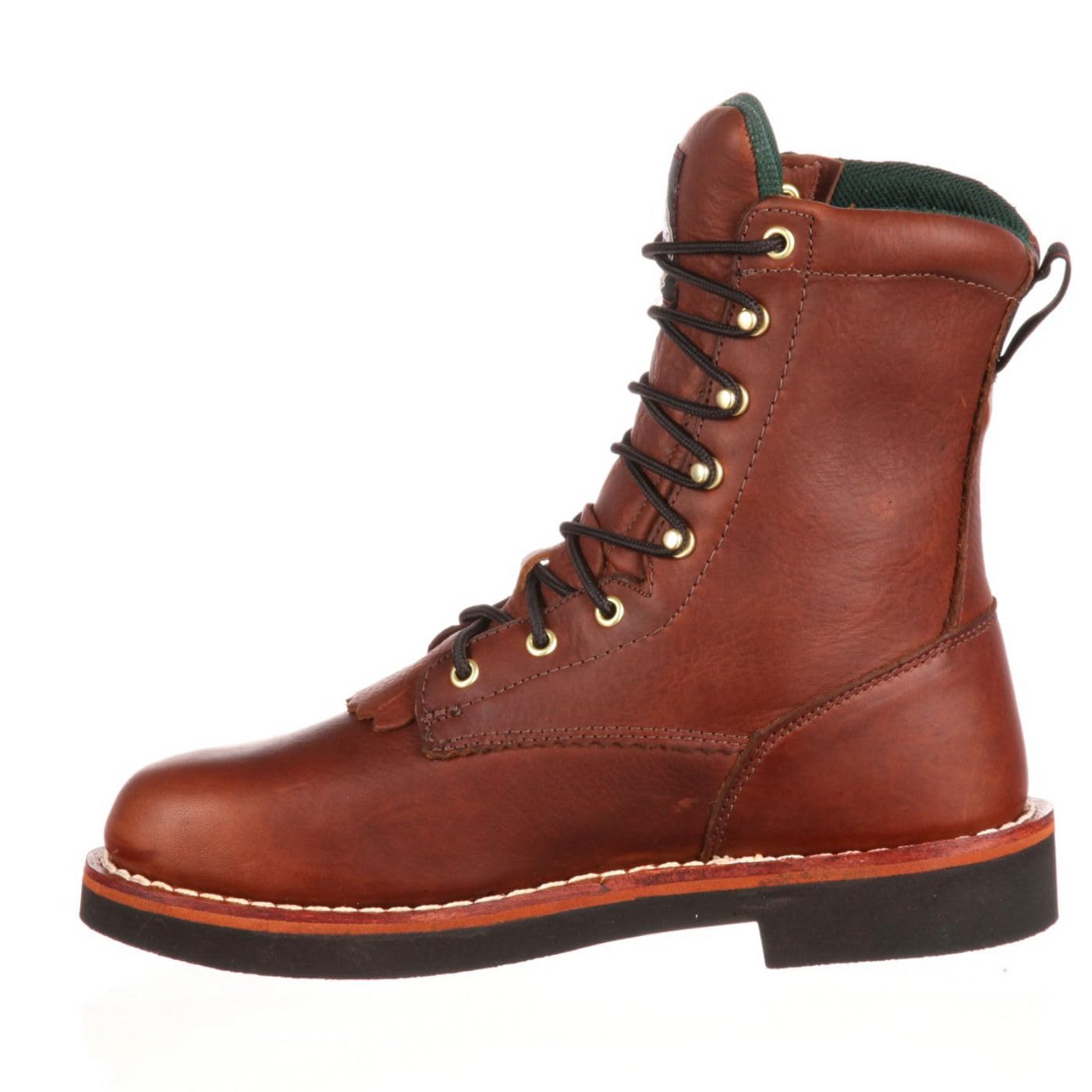
6. Georgia Boot Men’s Farm and Ranch Lacer Work Boots
The barn boot built to shrug off acids and caustic chemicals
If you work around livestock or chemicals, this is the boot that comes at the problem from the material side. The Georgia Boot Farm and Ranch Lacer uses SPR leather, and the brand states that leather resists abrasions 2 ½ times better and carries 3 times the strength of traditional leathers. It is also built to resist barnyard acids and caustic chemicals, which is the part most leather boots skip. That is the differentiator here — not a membrane or a safety toe, but a hide that holds up to what your work sticks in it.
The details are tuned for a long day outdoors. A brush guard kiltie keeps debris from working its way down into the boot, and the internal padded collar and flex-notched quarters let you crouch and bend without the boot fighting you. A steel shank gives steady footing and arch support. The polyurethane X-10 outsole is non-marking, highly resistant to chemicals and oils, and cushioned enough to stand on for long stretches. A nylon pull loop on the back makes getting them off at the end of the day easier than getting them on was.
The fit is the one thing to check carefully. The sizing gets mixed reports, with some wearers describing it as strange, so try the chart before you commit. Otherwise the comfort feedback is strong — the soft leather and extra cushioning draw steady praise, and buyers find them comfortable enough to wear all day. It is a soft-toe build, so this is not the boot for a site that mandates a steel cap.
The Material Story
- SPR leather resists abrasion 2 ½ times better than traditional leather
- SPR leather resists barnyard acids and caustic chemicals
- Brush guard kiltie keeps debris out of the boot
- Non-marking X-10 outsole resists chemicals and oils
Check Before You Buy
- Some feet find the sizing strange, so measure from the chart
- Soft toe only — no steel cap for a site that requires one
- Not aimed at standing water, which is where the rubber TIDEWE wins
Take it to the barn if: you work around animals or chemicals and want leather that resists both.
Choose something else if: your site rule demands a steel toe cap — this one is built soft.
7. ARIAT Work Men’s Treadfast 8″ Waterproof Work Boots
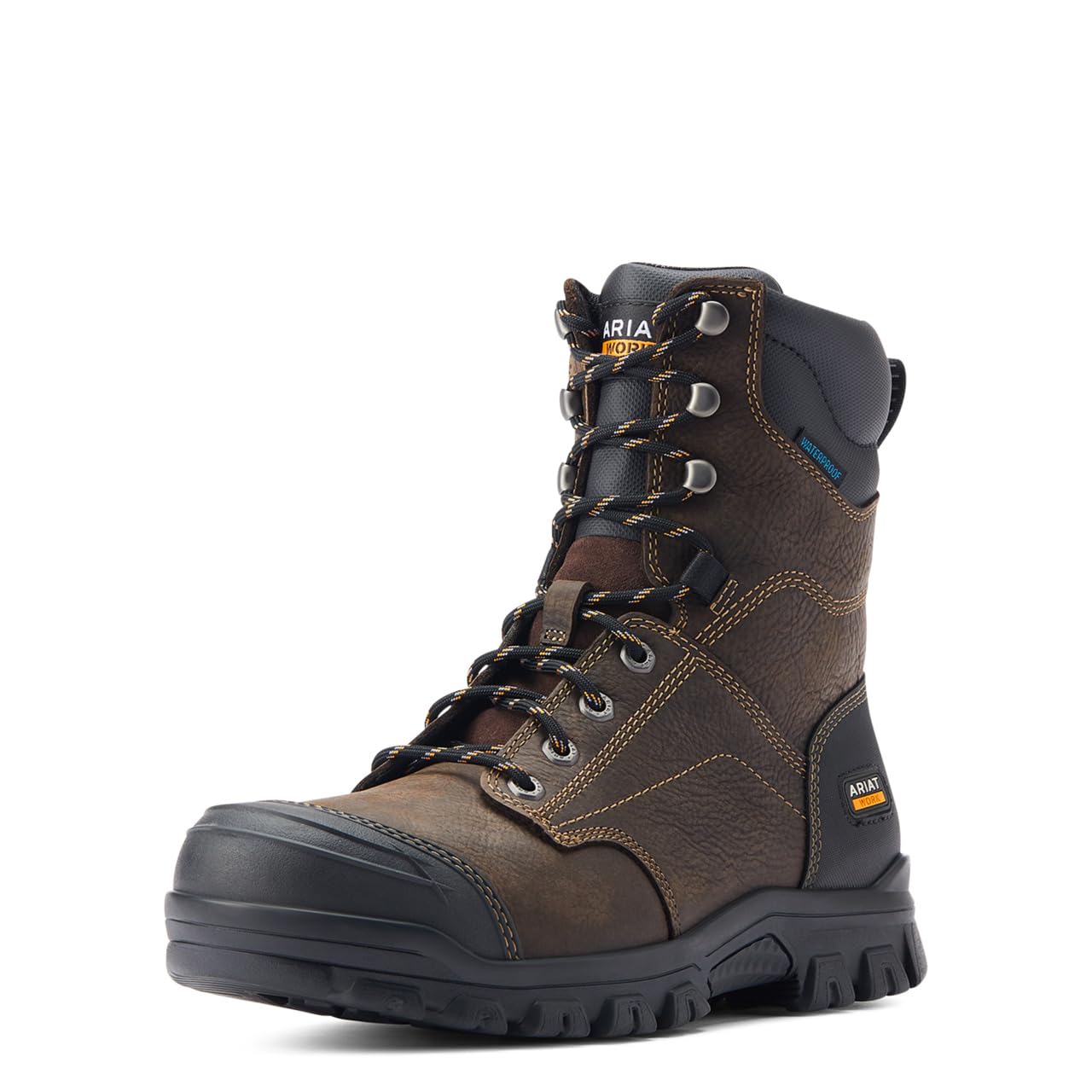
The 8-inch shaft boot that covers ankle height and wet concrete
An 8-inch shaft comes up the leg far enough to cover the ankle, which is a different feel from a 6-inch boot when you are stepping off a truck or crossing uneven ground. The Treadfast wraps its full-grain leathers around DRYShield — a waterproof, breathable membrane that keeps water out and lets vapor escape. It meets ASTM standards for electrical hazard and slip resistance, which matters if your floor is wet or your work brings you near live circuits.
Comfort is the headline in the owner feedback — these are called extremely comfortable and easy on the feet, with a true-to-size fit most people can trust. The 4LR technology gives lightweight support, and the all-day cushioning insole backs it up. Reinforced ExGuards on the toe and heel take the scuffs that would otherwise wear through the boot. The oil- and slip-resistant Duratread outsole gives you grip on a wet factory floor or a farmyard.
Durability is the split vote. Some owners find them sturdy and others have reported the boot coming apart after about four months. That is the honest picture on a boot built for the mid price range — it covers comfort, waterproofing, and electrical hazard protection well, and time on the job is where the variable sits. If comfort on your feet is the priority and you do not need a capped toe, this is a strong daily driver.
The daily-driver case: DRYShield waterproofing, electrical hazard rating, and reinforced toe and heel guards in one mid-range build — that is a full working package without a steel cap.
That split tells you the Treadfast is built for comfort first, with longevity as the variable.
Wear it daily if: you want an 8-inch waterproof boot that is comfortable out of the gate and slip and electrical-hazard rated for site work.
Go elsewhere if: your site requires a steel toe or your role demands a hard-wearing logger — this one trades some longevity for comfort.
8. KEEN Utility Cincinnati 6″ Composite Toe
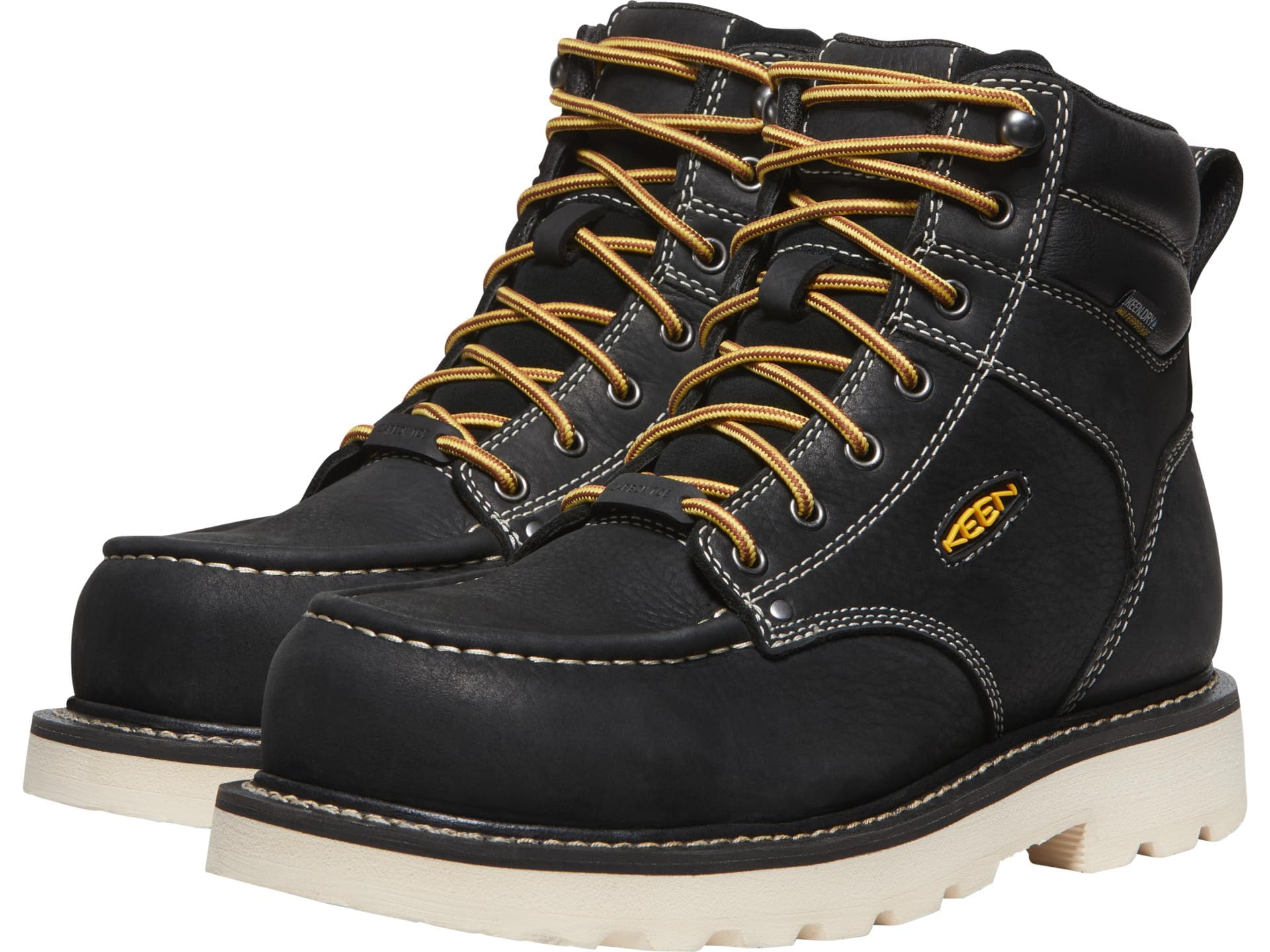
The climbing boot that catches on the rung and holds
The 90-degree heel is the standout feature here. That is a 5/8-inch block that juts out at the back of the boot, and KEEN builds it to catch or lock the foot in place — the kind of grip you want when your weight is on a ladder rung or a scaffold bar. If your job takes you up rather than across, that block does work no flat-heeled boot can do.
The toe is composite, which is a non-metallic carbon cap that is 15% lighter than steel. That is the reason a composite boot feels easier to lift than a steel-cap equivalent, and it also does not pass cold as fast in winter. The KEEN.DRY liner is a waterproof, breathable membrane that keeps water out and lets vapor escape. Shoppers say comfort that lasts all day and a fit they can trust, with the appearance getting favourable mention too.
The trade-offs are honest and worth knowing. Composite toes do not carry the same protection rating as steel for every site policy, so check your rules. Some owners have found the sole coming apart, which is the durability question you should weigh against the climbing grip. The boot is also described as heavy by some wearers, so if you were hoping for a featherweight, look to the 1.83-pound Timberland PRO instead. For ladder and scaffold work, the 90-degree heel is worth the weight.
The rung catch: a 5/8-inch 90-degree heel is a real safety feature for climbing work, and the composite toe shaves weight against steel.
The honest cost: the sole is the wear point to watch, and the boot carries heft for a 6-inch. Check your site’s composite-toe rules before you commit.
Pick it for climbing: ladder, scaffold, and pole work where a 90-degree heel and a lighter composite toe matter more than a steel cap.
Pass if: your site requires a steel toe or you want a boot that will not show sole wear at the front — both are real considerations here.
9. Irish Setter Mesabi 8″ Mens Soft Toe Logger Work Boot

The 8-inch logger that earns its keep in wetlands and all weather
An 8-inch logger boot is a specific tool, and the Mesabi is built to be one. It starts with full-grain waterproof leather and an UltraDry waterproof liner inside, so the outside takes the scuffs and the inside stays dry. The sole is attached with Goodyear welt construction, meaning the boot can be repaired rather than replaced when the sole wears. A removable EVA footbed lets you swap in your own support. The outsole is built for heat resistance and slip resistance, with an electrical hazard rating.
What owners talk about most is the comfort — the boot is described as feeling like a glove, with arch support that some wearers say made a real difference on their feet and legs. The weather coverage is another strong point: these are reported to perform in wetlands and in all-weather conditions, which is the logger brief done right. The leather softens in, and the fit settles instead of needing constant adjustment.
The soft toe is the line in the sand. If your site mandates a protective cap, this boot cannot fill that role — the Mesabi is built for workers who want the ankle height and heel without the cap. The waterproofing has drawn mixed feedback from some wearers, so treat it as a strong liner rather than a guarantee of a dry foot in a submerged puddle. For an all-weather logger that prioritises comfort and repair-ability, it does the job.
The logger formula: full-grain waterproof leather, an UltraDry liner, a Goodyear welt, and a heat- and slip-resistant outsole — a classic combination that holds up to the elements.
The one line: soft toe only. And while the waterproof liner is strong, a boot submerged in water is not what this is for. Wear it as a logger and it rewards you.
Wear it in the wet field if: you want an 8-inch logger that is comfortable from the first walk and can be resoled rather than replaced.
Leave it if: your site requires a steel toe or you need a boot to stand in water — this logger is aimed elsewhere.
10. Ariat Men’s WorkHog Wide Square Toe Steel Toe Work Boot

The pull-on that finally fits wide feet and high arches
If you have wide feet or high arches and pull-on boots have never fit, this is the one to try. Ariat’s U-Turn Entry System uses a patented construction to let you get into the boot smoothly with a true fit regardless of foot shape, and the brand says it accommodates high arches. The wide square toe gives your toes room to spread instead of pinching. A 6-row Western stitch detail and a deep scalloped top make it a boot you will not mind being seen in, and the reinforced finger holes on both sides give you something to grip when pulling them on.
Under the foot, the ATS Max platform is a stability system built to cut side-to-side fatigue and support body alignment. A lightweight EVA midsole adds cushioning, and the highly abrasion-resistant Duratread outsole gives you wear resistance and flexibility. The steel toe is ASTM rated for compression and impact, and the boot carries an ASTM F2892-11 EH rating — the electrical hazard mark for work near live current. Buyers report a minimal break-in and an easy on/off, with the grip drawing favourable mention.
The fit is where the split shows up. Some owners get a great fit and others find the sizing off — so order carefully. Durability has also produced mixed reports, with some boots wearing well and others not lasting as long as expected. Neither is enough to write off a boot that fits the wide-footed wearer better than most, but factor it into how hard you plan to work it. For wide feet and ladder work, the support and entry system are the argument.
The Wide-Foot Case
- U-Turn Entry System fits wide feet and high arches
- ATS Max platform provides side-to-side stability
- Steel toe rated to ASTM standards for impact and compression
- ASTM F2892-11 EH rating for electrical hazard work
The Fit and Wear Split
- Sizing has produced mixed reports — measure against the chart
- Durability has been uneven for some owners
- Pull-on fit can be hard to predict without trying the brand
Pull it on if: you have wide feet or high arches and want a steel-toe pull-on that actually gets over your foot.
Try before you trust if: you are between sizes — the fit reports are genuinely mixed, so the chart is your friend.
11. Kenetrek Lineman Extreme Non-insulated Steel Toe Boot

The 10-inch line boot built for climbing with a tool belt on
The Kenetrek Lineman Extreme is built for exactly that: a 10-inch shaft, 2.8mm-thick premium full-grain leather, and a smooth one-piece vamp construction with no seams down the tongue — which means one fewer place for water to get in and one fewer place for a tool belt to chafe. Reinforced double and triple stitching sits in the high-wear areas, and the hardware swivels instead of breaking under the pull of a lace-up.
The build is tuned for climbing. The 7mm nylon midsole adds support in difficult terrain, which is the part you feel when you are leaning back in a belt. The reinforced rubber toe cap takes the scuffs and scrapes that would otherwise wear through leather. The steel safety toe meets ASTM F2412-11 and ASTM F2413-11 standards for impact, compression, and electrical hazard protection — the electrical hazard rating is arguably the most important line on the spec sheet for line work. The fit and the comfort are the parts owners talk about most, with water resistance praised for keeping feet dry.
The honest limit is the cost. This is a boot from the premium price range, and durability has drawn mixed reports — some owners find them durable, others have seen the soles break open. It is also a purpose-built boot for one trade, so if you do not climb for a living, the weight and the price will not be repaid. If you climb for a living, the electrical hazard rating and smooth one-piece vamp justify the premium price.
The climbing spec set: 10-inchshaft, 2.8mm full-grain leather, one-piece vamp, 7mm nylon midsole, and an electrical-hazard-rated steel toe.
The price of the trade: this is a premium-priced purpose-built boot, and the sole has been the wear point on some pairs — you are buying it for the trade, not for a weekend.
Gear up for line work if: you climb for a living and need a 10-inch steel-toe boot with electrical hazard protection and a smooth vamp.
Look past it if: you work on flat ground — the premium price and the purpose-built build are wasted on a floor job.
Know the Specs
Toe protection: steel, composite, and soft
A toe cap is a reinforced shield built into the front of the boot. Steel is the classic — heavy, cold in winter, and rated for impact and compression on most sites. A composite toe is a non-metallic carbon cap, and KEEN states its composite toes are 15% lighter than steel and do not pass cold as fast. A soft toe skips the cap entirely and is meant for workers who want the ankle height and heel without a safety rating. Match the cap to your site rule, and check the ASTM label of any boot that carries one.
Waterproofing: membrane versus rubber shell
A waterproof membrane is a thin liner built into the boot that lets vapor out while blocking water in. GORE-TEX, KEEN.DRY, DRYShield, UltraDry, and Storm Defender are all liners of this type. A rubber shell is a different route: it blocks water outright with no liner, so it cannot wet out, but it also breathes less. If your day is slush and rain, a membrane boot is comfortable. If your day is standing in a puddle, a rubber boot like the TIDEWE is the safer call.
Sole compounds and the shank
The outsole compound decides wet and oily-floor grip: Vibram lug, Duratread, and X-10 all resist oil and chemicals. Beneath the foot, a steel shank is a metal strip between the insole and outsole that stops the sole folding under your arch on a ladder rung. A thicker midsole, like the 7mm nylon midsoles on the Kenetrek Lineman Extreme, adds support on uneven ground. These are the parts you cannot see, and they are the parts that decide whether hour eight feels like hour three.
Welt construction and repair life
Goodyear welt is a stitched sole attachment that lets a cobbler replace the sole instead of the whole boot. It adds a little weight but buys you a second and third life out of the leather, which is why loggers and ranch boots lean on it. A cemented sole is glued and is not usually repairable. If you want a boot to last through resolings rather than one season, welt construction is the spec to hunt for.
Insulation and temperature
Insulation ratings, like the 200 grams of 3M Thinsulate in the Georgia Logger, tell you how much thermal barrier sits inside the boot. Higher numbers mean warmer feet, and a non-insulated boot runs cooler. For summer indoor work a non-insulated boot makes more sense. For winter outdoor work the insulation is the difference between a boot you can wear all shift and one you have to leave in the truck.
Safety ratings and electrical hazard
An ASTM rating on a work boot tells you what it was tested to withstand — impact and compression for the toe, and in some cases electrical hazard for work near live circuits. The Ariat Treadfast, the Ariat WorkHog, and the Kenetrek Lineman Extreme all carry an electrical hazard rating, and the Carhartt carries the ASTM 2413 21 toe rating. If your job site requires a specific rating, the label inside the boot is the only line that matters.
Common Questions
How do I break in a heavy leather work boot without blistering?
Will a steel toe boot fit the same as a soft toe boot?
Is a composite toe as protective as a steel toe?
How long should a heavy duty work boot last before I replace it?
Can I wear rubber work boots all day indoors?
What does an electrical hazard rating on a work boot actually mean?
Is a logger boot better than an industrial boot for construction work?
How should I fit a pull-on work boot if I have wide feet?
Do work boots with a BOA dial hold up to real site work?
The Bottom Line
For most workers, the work boots heavy duty pick is the Georgia Boot Low Heel Logger: its GORE-TEX liner, 200 grams of 3M Thinsulate, and Goodyear welt cover cold, wet, chemical-splashed outdoor work in one 4.5-pound boot. If you want a lighter industrial boot for everyday site work, grab the Timberland PRO Pit Boss — it weighs less than any other pick here, and the roomier steel toe suits most feet. And for line work and climbing, the Kenetrek Lineman Extreme is the one to reach for, with its 10-inch shaft, one-piece vamp, and electrical hazard rating. For wet ground, the TIDEWE costs a fraction of the rest and blocks water outright.
One honest note on ordering: the Georgia Logger is far from the highest-rated boot on this page — the Farm and Ranch Lacer sits higher — but the Logger’s GORE-TEX and insulation combo is the better fit for cold and wet work. Match the boot to your daily surface and measure your foot against the brand’s chart before ordering.
How we choose
We do not accept paid placement. Every pick is matched to a real buyer and a real use-case; we do not hands-on test units.
Sources
Specifications: manufacturer listings and product documentation. Review insights: verified customer reviews, as of November 2026. Pricing: not shown on this page (it changes often); check the current price via the retailer link.
As an Amazon Associate, Tactical Gear Guy earns from qualifying purchases. This does not affect which products we feature.