Specs are compiled from manufacturer listings and verified buyer reviews and can change over time — please confirm the key details on the product page before buying.
Logging wrecks boots fast. Wet ground, saw chips, heavy logs dropped near your feet, and long shifts standing on cut timber all punish a soft leather boot within weeks. What you actually need is a pair with a protective toe that survives impact, a sole that grips in mud, and a waterproof build so your feet are not soaked by lunchtime. This guide breaks down ten real options so you can pick the one that matches how you actually work.
This guide is built by comparing the manufacturers’ published specifications and the patterns across verified customer reviews, so you get each pick’s real strengths and trade-offs instead of marketing spin.
You will see which boot fits wide feet, which one holds its grip on wet bark, and where each model falls short before you spend a dime. Here are the ten strongest choices for the toughest days on the landing with the best work boots for logging.
Top Picks


How To Choose The Best Work Boots for Logging
Buying a logging boot is a safety decision first and a comfort decision second. You are standing on uneven ground, near saw teeth and falling timber, and often in wet weather. Get the toe protection, the waterproof seal, and the sole grip right before you worry about anything else. Then match the boot to your feet and your climate.
Toe protection first
A protective toe is a metal or composite cap built into the front of the boot that shields your toes from impact and compression. Look for a boot marked with an ASTM F2413 protective toe classification, which is the safety standard that tells you the cap has been tested. On a logging site, dropped logs and rolling timber make this the single most important feature. Steel toe caps are tough and proven; composite caps are lighter on your feet.
Waterproofing and insulation
Wet feet ruin a shift. A GORE-TEX lining is a breathable waterproof membrane that blocks water from getting in while letting sweat vapor escape. Insulation, measured in grams like 600 grams of Thinsulate, adds a warm layer for cold, damp weather. If you work in a cold climate, insulation keeps your feet warm through a long day. If you work in heat, a waterproof lining without heavy insulation is more comfortable.
Sole grip and construction
The outsole is the bottom rubber layer that touches the ground. An oil-resistant Vibram or lug outsole grips better on wet wood, mud, and oily surfaces than a basic tread. Welt construction is a stitched method that joins the upper to the sole so the boot can be resoled by a cobbler. That means a good boot can be repaired instead of replaced. A steel shank adds a stiff support plate under your arch for stability on uneven ground.
Side-by-Side Comparison
| Model | Best For | Height | Toe Type | Weight | Amazon |
|---|---|---|---|---|---|
| Rocky Ranger Steel Toe GORE-TEX Insulated★ Best Overall | Cold, wet sites | 9 inches | Steel | 5.0 lb per pair (size 10) | Amazon |
| AdTec Super Logger Crazy Horse LeatherBest Value | Value logger fit | 9 inches | Steel | — | Amazon |
| SUREWAY 8″ Waterproof Steel-Toe LoggerCrowd Favorite | Everyday value | 8 inches | Steel | — | Amazon |
| Timberland PRO Pit Boss 6 Inch Steel | Long-shift comfort | 6 inches | Steel | 1.83 lb | Amazon |
| Viking Class 2 Chainsaw Boots | Chainsaw work | — | Grade 1 steel | 3 lb | Amazon |
| Carolina 8″ Waterproof Steel Toe Logger | All-day support | 8 inches | Steel | — | Amazon |
| Georgia Boot Lace-to-Toe Steel Toe | Lace-to-toe support | 8 inches | Steel | 4.5 lb | Amazon |
| Ariat Workhog Waterproof Composite Toe | Side-to-side stability | 11 inches | Composite | 5.5 lb | Amazon |
| Carolina Linesman 10″ Composite Toe | Tall-line climbing | 10 inches | Composite | 3 lb | Amazon |
| Chippewa Super DNA 9″ Insulated Logger | Heavy timber | 9 inches | Steel | 3.3 lb | Amazon |
Detailed Reviews
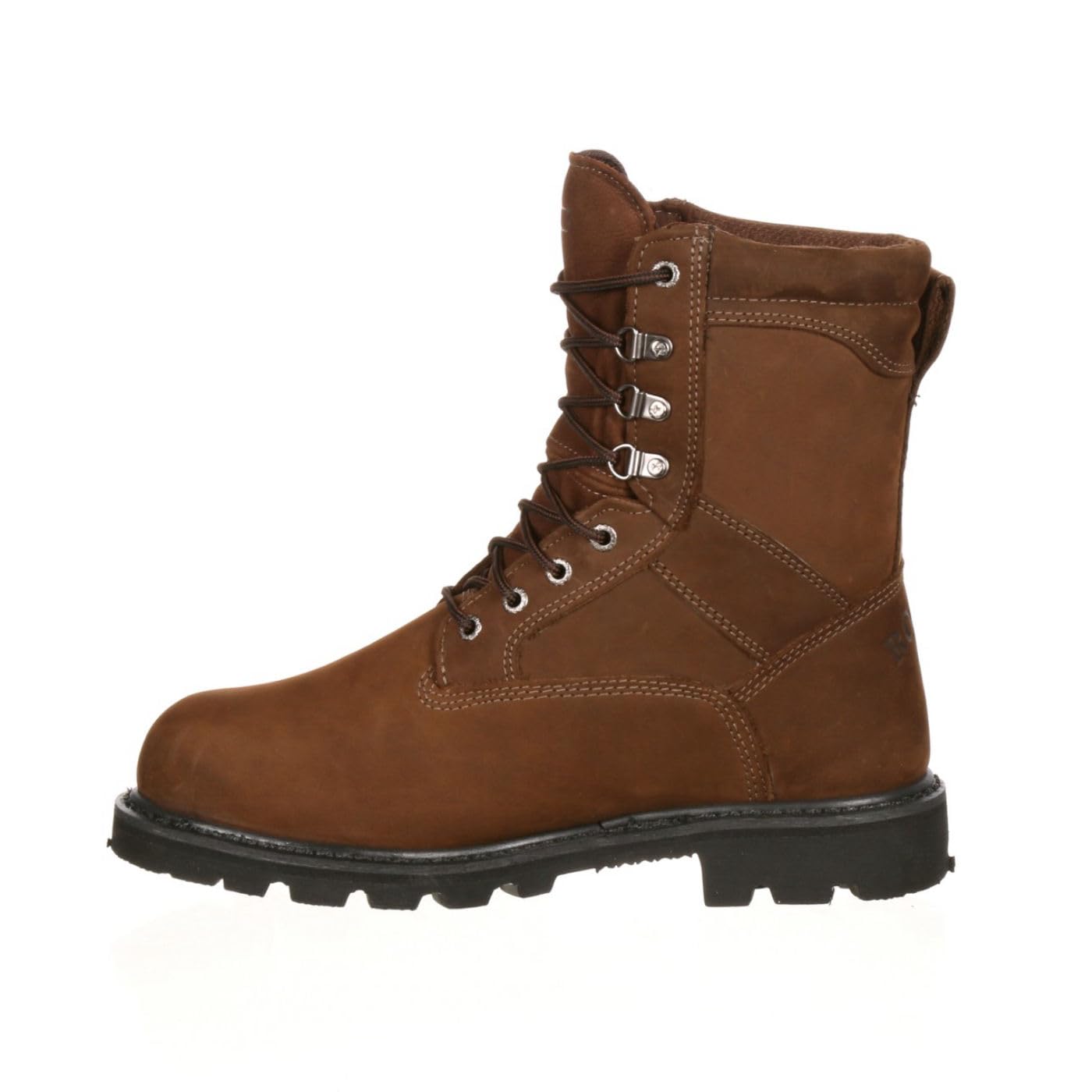
1. ROCKY Ranger Steel Toe Work Boots
Our pick — 4.5+★ from 200+ verified ratings; the strongest balance of quality and price.
A 9-inch GORE-TEX logger with 600g Thinsulate and a steel toe for cold, wet sites.
The Rocky Ranger earns the top spot for one reason: it stacks waterproofing, warmth, and toe protection into a single boot that handles cold, wet logging days. That waterproofing is GORE-TEX, a breathable membrane that blocks outside water while letting sweat vapor out. The 600 grams of Thinsulate Ultra insulation is a thermal layer that keeps your feet warm in cold or damp weather without adding a lot of bulk. A steel toe built to an ASTM F2413 protective toe classification shields your toes from impact and compression, the standard safety rating for work boots.
The sole is a rubber Vibram outsole engineered to resist oil, so it grips better on wet wood and greasy equipment than a basic tread. Goodyear welt construction stitches the upper to the sole so a cobbler can resole it — that turns a worn heel into a repair instead of a replacement. At 9 inches tall, it stands 3 inches higher on your leg than the 6-inch Timberland PRO Pit Boss, giving you more ankle coverage and a bit more splash protection. A size 10 pair weighs 5.0 pounds, so expect a substantial boot on your foot.
Where it wins people over is fit. The comfortable cut across the forefoot keeps a lot of feet happy from the start, and the warmth and dry feel hold up through a wet shift. The honest catch is the break-in: several buyers report the boot demands some time to soften before it feels lived-in, so plan a short wear-in before a full day on the hill. It is also a bigger, heavier boot than a low-cut work shoe.
What earns it the top slot
- GORE-TEX lining keeps water out while sweat vapor escapes
- 600 grams of Thinsulate warmth for cold, damp shifts
- Steel toe meets ASTM F2413 protective standards
- Goodyear welt construction means it can be resoled
- Oil-resistant Vibram outsole grips wet surfaces
The honest trade-offs
- 5.0 pounds per pair is a heavy boot to haul up hills
- Takes a break-in period before it softens up
The rainy-season pick: Best for cold, wet sites where warm dry feet and steel toe protection matter most.
Skip if it’s a hot climate: The 600-gram insulation is overkill in warm weather.
2. AdTec Super Logger Work Boots
A tall leather logger that brings Crazy Horse leather and a grippy lug sole at the entry end of the logger market.
If you want the classic tall-logger look without spending a lot, the AdTec Super Logger is your starting point. It stands 9 inches tall — 50% more leg coverage than the 6-inch Timberland PRO Pit Boss, per the spec comparison — so it wraps higher over the ankle on the landing. The Crazy Horse leather upper is a pull-up style with a rich, worn character, and the oil-resistant lug sole is a treaded bottom designed to hold grip on wet or greasy ground.
The build taps a steel toe for the front of the foot, and the overall cut is the familiar logger profile that fits over work pants. One thing to sort out early: sizing runs narrow for some wearers. Buyers describe the fit as great for some feet and narrow for others, so treat the width as the main risk and check the size chart against your own foot width before you commit.
Here is the honest read. The AdTec is not going to match a premium welted boot for long-term durability, but it lands at the value tier and gives you a tall leather logger with a lug sole for lighter-duty landing work. Budget buyers who keep an eye on fit tend to get a lot of boot for the money. Those with wide feet should look closely at the sizing notes first.
Where it shines: A genuine 9-inch leather logger at the value end, with an oil-resistant lug sole for mud and wet ground.
Watch the width: The fit runs narrow for some wearers — sort out your size and width before you buy.
Reach for it if: You want a full-height leather logger on a budget and your feet run toward the narrow side.
Look closer if: You need a wide toe box for a broad foot.
3. SUREWAY Men’s 8″ Waterproof Steel-Toe Logger Work Boot
An 8-inch waterproof steel-toe logger with soft leather that wins on out-of-box comfort.
SUREWAY has built a big following, and the thing that wins people over is the feel of the leather. The soft upper and comfortable support land well for a broad group of wearers, and the appearance and solid construction get plenty of praise. It runs as an 8-inch waterproof steel-toe logger with a high-strength steel toe to guard the front of the foot, and the leather lace-up build keeps it in everyday-work territory rather than specialty climbing.
Buyer feedback on this boot splits, and you should hear that straight. Some wearers find the toe box runs small, so try your usual size with care. Durability divides the same way — as owners mention, “while some say they fit great and last 6 months of abuse, others report the toebox being too small and the boots coming apart after 4 weeks.” Water resistance also draws mixed feedback. That does not make it a bad boot. It means fit and how hard you push the boot are the two things to watch.
For a broad swath of buyers the Sureway hits the mark: soft leather, good support, and a steel toe at the value end. Try them on early and size carefully, and give the toe box room if your feet run wide. If you expect a hard abuse cycle and need a welted boot you can resoled, look at the welt-built options here.
What people feel first: Soft leather and comfortable support that make it easy to wear all shift.
The sizing move: Check the toe box against your width — that is the most common concern to watch.
Best for: Buyers who want soft leather, good support, and a steel toe without paying premium-tier money.
Think twice if: Your feet run wide or you plan the heaviest abuse cycle.
4. Timberland PRO Pit Boss Work Boot

A 6-inch steel-toe boot with a roomier toe box and nylon shock-diffusion plates underfoot.
This is the pick for the guy who wants a shorter, more comfortable boot than a full 9-inch logger. The Pit Boss stands 6 inches tall, which is 3 inches shorter than the 9-inch AdTec Super Logger — less leg coverage but a lighter, freer feel on the ankle. It carries nylon shock-diffusion plates, which are stiffening plates under the foot that add support and torsional rigidity for twisting on uneven ground.
The steel safety toe is built to meet ANSI safety standards, and the toe box is designed to be roomier than other boots — so long hours do not turn into toe pain. The removable sock liner adds a layer of padding you can pull out and clean. An electronic hazard protection construction is built in to keep you safer around open circuits, and the traction gets strong marks for wet or slippery surfaces.
At 1.83 pounds it is far lighter on the scale than a size-10 Rocky Ranger at 5.0 pounds — a real difference when you are on your feet all day. Buyers call it an excellent everyday work boot, though a few report pairs coming apart within months, so keep an eye on the seams. That 6-inch height means less ankle splash protection than a tall logger. Overall it is the comfort-first choice for flat or mixed ground rather than deep mud.
Comfort-first build: Roomier toe box, removable sock liner, and 1.83 pounds of boot make long shifts easier on the feet.
Height trade-off: At 6 inches it runs 3 inches shorter than a full logger, so you give up some ankle coverage.
Pick it for: Comfort-first days where you want a roomy toe box and a light boot.
Not for: Deep mud and tall brush where a 9-inch logger gives more protection.
5. Viking Chainsaw Boots
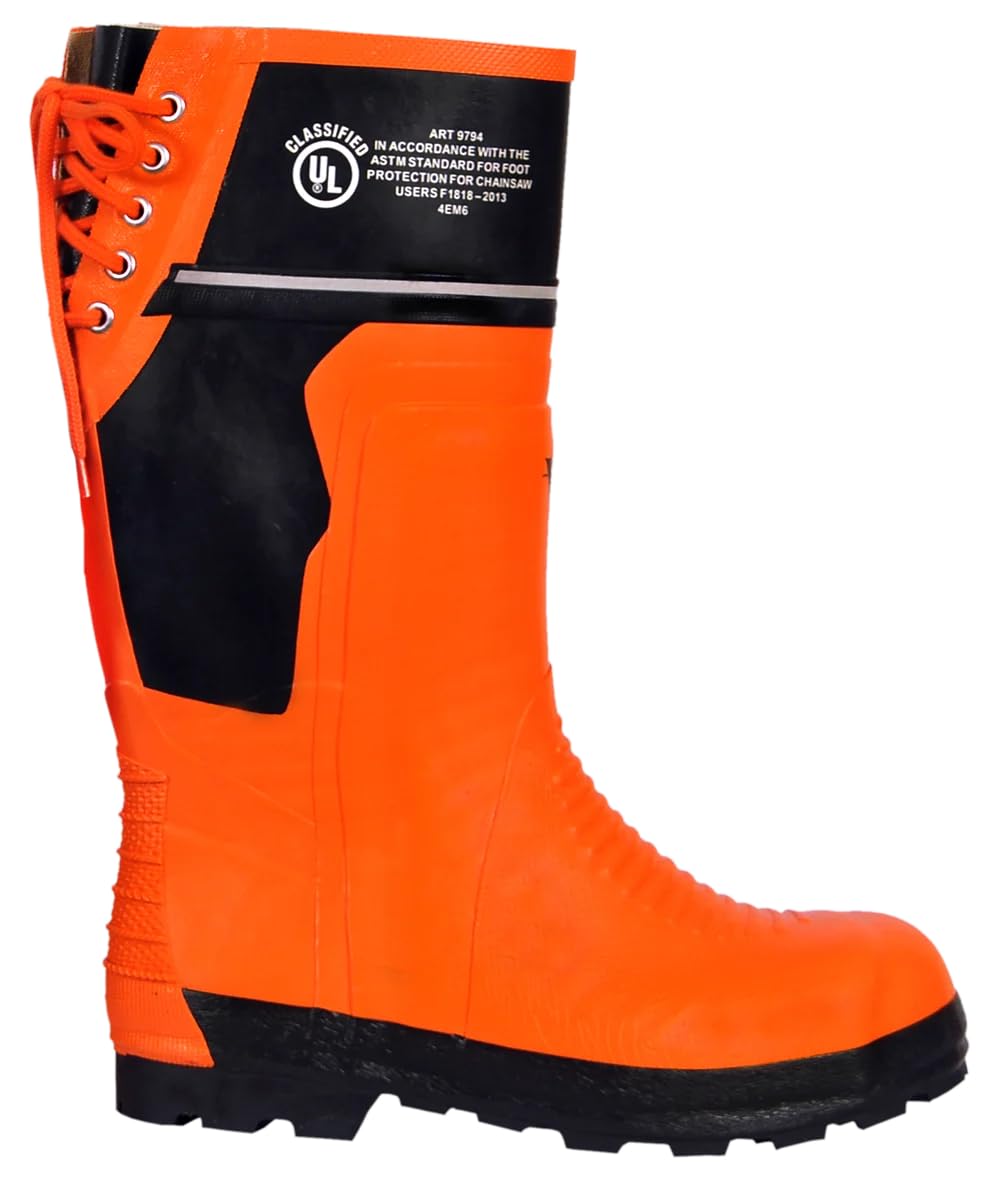
The only Class 2 chainsaw boot here, with a Grade 1 steel toe and SBR rubber upper.
Most of the boots on this list protect you from impact, water, and rough ground. The Viking goes one step further: it is a Class 2 chainsaw boot, cut to protect against chainsaw accidents. It is wrapped in heavy-duty SBR blended natural rubber — a tough, flexible rubber compound that keeps water and hazardous liquids out while flexing with your stride. The Class 2 rating and the Grade 1 steel toe together give you saw protection plus impact and compression backup.
The upper is bright safety orange with a high-visibility reflective safety stripe looped at the collar, so you are easier to spot on a busy landing. Tough rubber laces cinch the fit down tight. The natural rubber build is designed to be flexible, so it bends more with your foot than a stiff leather logger. Customers note it is well-constructed and protects well — wood chips stay out of the boot when you are cutting.
The fit runs tight for some wearers, and it takes a period of wearing before it loosens up, so treat the fit as the main question and get the right size up front. The rubber upper does not breathe like leather, so expect a sweatier foot on hot days. If your job puts you anywhere near a running saw, no leather boot replaces this level of chainsaw-specific protection.
Why it earns a slot
- Class 2 chainsaw protection plus a Grade 1 steel toe
- Heavy-duty SBR blended natural rubber resists water and hazardous liquids
- High-visibility reflective stripe on the safety orange upper
- Flexible rubber build bends with your foot
Fit and breathability notes
- Runs tight until broken in for some wearers
- Rubber upper does not breathe like leather
The saw job pick: Best for anyone who works near a running chainsaw and wants protection designed for the saw itself.
Choose leather instead if: You need breathability for hot long shifts and no saw exposure.
6. Carolina Men’s 8″ Waterproof Steel Toe Work Boots

A rugged 8-inch logger with a memory foam footbed and a steel shank for uneven ground.
The Carolina 8-inch is designed for tradespeople who need reliable protection and comfort across a long shift. It carries a steel toe that guards against impacts and compression, and an EH-rated construction, which means it is built to resist electrical hazards. The waterproof construction keeps feet dry in wet environments — a real advantage over logger boots that skip reliable moisture protection. A slip-resistant, oil-resisting rubber lug outsole holds stability on slick or oily surfaces.
Comfort gets serious attention here. The Pillow Cushion Memory Foam footbed molds to your foot to ease foot fatigue over a long day. A triple-rib steel shank runs under the arch to add stability on rugged ground or when you climb. The durable leather upper and welt construction give it a longer service life than mass-market boots, and a cobbler can resole a welted boot when the tread wears down.
Buyers wear these all day and note the comfortable, supportive feel — the leather and stitching fit right from the start. It is a work boot that suits multiple jobs rather than a single specialty. The honest limit is breathability on the hottest days; a fully built waterproof leather boot traps more heat than a mesh work shoe. For an 8-inch logger with a steel shank and a memory foam footbed, it is a grounded premium-tier choice.
The supportive build: Memory foam footbed plus a triple-rib steel shank keep feet stable and cushioned on uneven ground.
Heat trade-off: Fully waterproof leather traps warmth on the hottest shifts.
The all-day crew: Best for tradespeople who want cushioned comfort, a steel shank, and dependable waterproof leather.
Think twice if: You work in heavy heat and need a breathable upper.
7. Georgia Boot Lace-to-Toe Work Boots
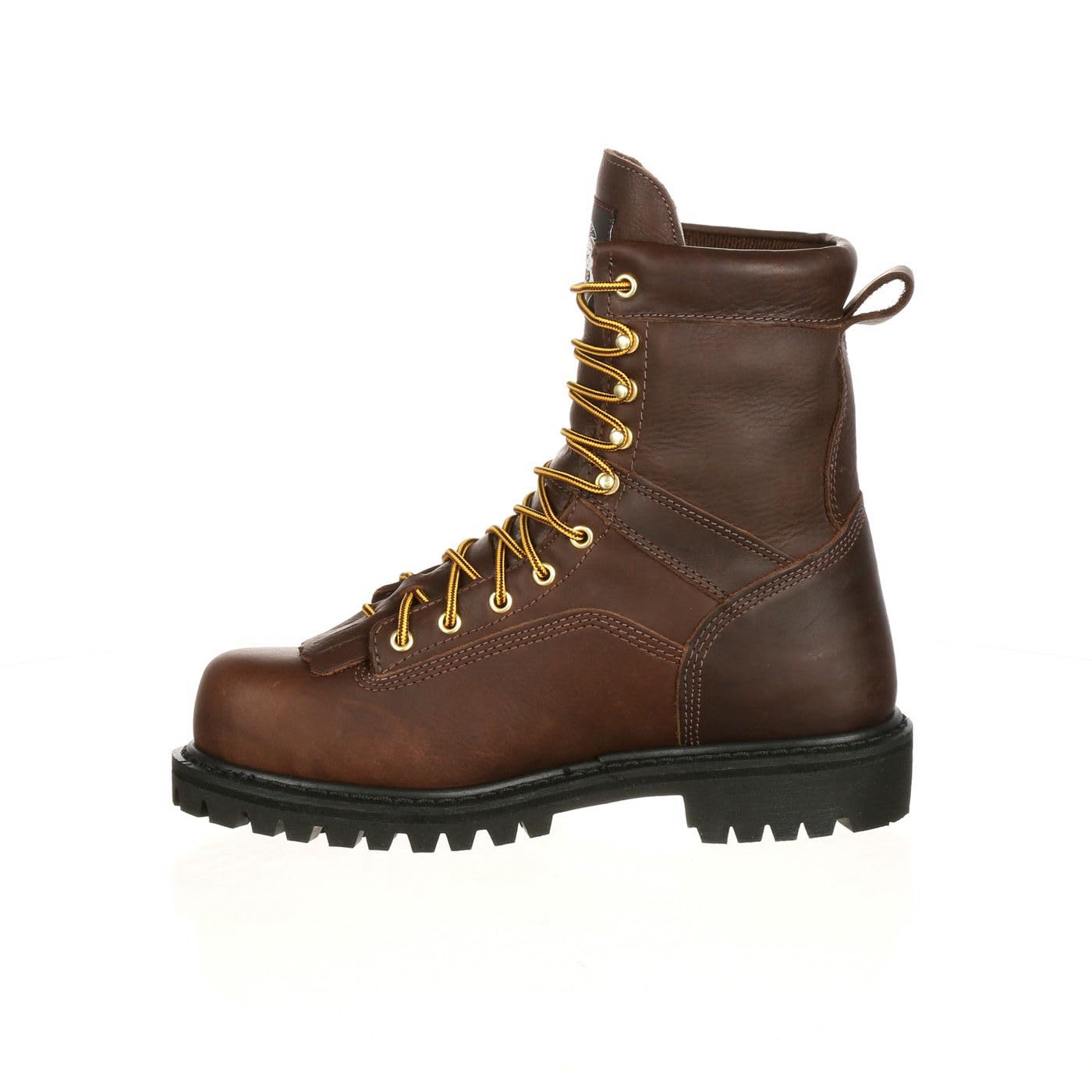
Lace-to-toe eyelets run toward the toe so you can cinch the whole foot down.
Lace-to-toe lacing is the standout here. Instead of stopping the laces partway up, the eyelets run all the way toward the toe, which lets you cinch the whole foot down for a snug, supported feel. The boot stands 8 inches tall and builds on premium leathers that break in quickly, so you are not fighting a stiff boot for weeks. A steel toe meets ASTM standards for impact and compression, and the boot also meets standards for electrical hazard resistance.
Waterproofing comes from the Georgia waterproof system, so feet stay dry in wet, muddy conditions. The Vibram lug outsole is oil-resistant and bites into soft ground, and a steel shank runs under the arch for stability. Goodyear welt construction means the boot can be repaired by a cobbler rather than replaced. The build quality and water resistance both get strong marks, and the quick break-in period is a real bonus on a welted leather boot.
Two fit notes to know. Several wearers find the boots run about half a size big, so consider sizing down. And the leather is not the thickest some buyers expected, so if you want a heavy armored hide, look at the Chippewa. For most, the quick break-in, the lace-to-toe lockdown, and the repairable welt construction make this a solid mid-list pick.
what separates it: You get a locked-in fit from lace-to-toe lacing, grip on oily ground from a Vibram oil-resistant lug outsole (a sole with deep rubber lugs that bite into slick surfaces), and a longer service life from repairable welt construction (the sole is stitched on so a cobbler can replace it).
Sizing heads-up: Runs about half a size big for several wearers — size down if you are between sizes.
Go for it if: You want a quick-breaking-in lace-to-toe boot with the lockdown feel of full-foot lacing.
Pass if: You need a very thick, heavy leather hide.
8. Ariat Men’s Workhog Waterproof Composite Toe Work Boot

An 11-inch composite-toe boot with a DRYShield membrane and a Duratread outsole for side-to-side stability.
Ariat builds the Workhog for harsh outdoor work and oil and gas exploration, and the thing it emphasizes is side-to-side stability with cushioning and shock absorption. It stands 11 inches tall — the tallest boot on this list — so it wraps the most leg coverage of the group for brush and deep ground. The toe is composite rather than steel, which is a lighter cap material that still carries an ASTM F2413 M/I/C EH rating, meaning it is rated for impact, compression, and electrical hazard. A DRYShield waterproof membrane keeps the foot dry.
Underfoot, a performance cushion insole sits inside an oil- and slip-resistant Duratread outsole, a rubber build designed to grip on slick surfaces. The square toe and block heel are paired with a single welt stitch for the stitched construction. This is a boot cut for a bigger platform underfoot and stability when you are braced on uneven ground.
The fit is the thing to sort out. Reviewers point out the area across the top of the foot can run tight for some wearers, so try before a long day. Durability and value also split both ways, so expectation matters. For a wide, tall, composite-toe boot with strong side stability, the Workhog is a comfort-led option for heavy outdoor work.
Where it holds up
- Composite toe with an ASTM F2413 M/I/C EH rating
- 11-inch height gives the most leg coverage here
- DRYShield waterproof membrane
- Duratread oil- and slip-resistant outsole
- Built for side-to-side stability
Fit and value notes
- The top of the foot can run tight for some feet
- Durability and value expectations split both ways
Best for: Heavy outdoor work on uneven ground where tall coverage and side stability matter.
Look elsewhere if: Your foot runs high across the top, where this cut can pinch.
9. Carolina Linesman 10″ Work Boots
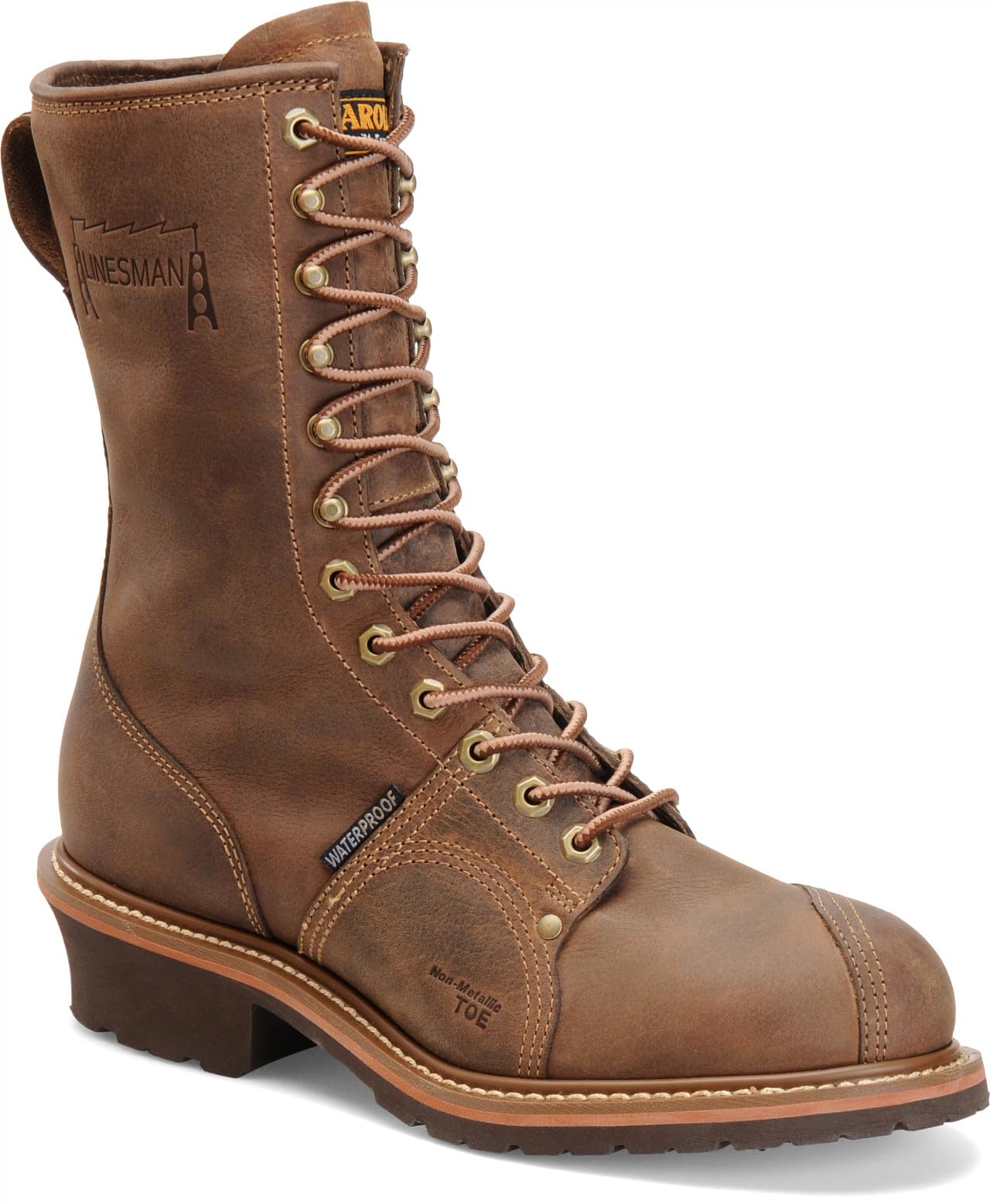
A 10-inch composite-toe linesman boot cut for climbing and bracing on poles.
The Carolina Linesman is aimed at a specific worker: the person who climbs and braces on poles and tall structures. It stands 10 inches tall for serious leg coverage, and it uses a composite toe rather than steel, so the front of the boot is lighter while still protecting the toes. The 10-inch height and the linesman cut are the features that separate it from the shorter everyday loggers on this list.
The fit is where linesman boots get judged, and here the boot earns its keep. The fit gets strong marks, and the sizing is usually true to size. Buyers who climb regularly tend to praise the feel underfoot, which matters when you are up on a structure and need the boot to move with you.
The honest question is value. Some buyers feel the price is worth it and rate it among the best they have worn, while others say the sizing does not land properly, so take the time to confirm your size. If you are not a climber, the tall linesman cut is more boot than you need — the Carolina 8-inch logger does the flat-ground work for less height. For the climber, the fit and coverage are the reason to buy.
Built for the climb: A 10-inch linesman cut with a composite toe for pole work and high structures.
Value question: Some owners find the price worth it, others feel the sizing misses — confirm your size.
The climber pick: Best for linesmen and pole climbers who want a tall composite-toe boot built for bracing and climbing.
Overkill if: You work flat ground — the 8-inch logger gives similar protection with less height.
10. Chippewa Super DNA Work Boot

A 9-inch insulated steel-toe logger with waterproof leather and a deeply lugged rubber outsole.
Chippewa builds the Super DNA for heavy timber, and the boot is set up for it. The leather is waterproof to keep feet dry and protected, and the thickly treaded rubber outsole — a deeply lugged rubber bottom — gives strong traction and durability on rough ground. A steel toe guards the front of the foot, and the boot is insulated to keep feet warm through cold, damp shifts. At 9 inches tall it has the full logger height for ankle and splash coverage.
The comfort stands out. Buyers find them comfortable all day, with the steel toe lining sitting well against the foot. Keep in mind the fit runs narrow for some wearers, so if your foot runs toward the wide side, treat the width as the thing to confirm before you commit. The insulation that keeps feet warm in cold weather can feel heavy in the heat.
The Chippewa is one of the strongest boot-makers on this list, and its American construction and warmth are what buyers talk about most. Price tiers run high, so compare your needs against the Carolina 8-inch if budget is a factor. For cold-weather, heavy-timber work, the warm waterproof build and deep rubber tread hold up.
The heavy-timber build: Waterproof leather, insulated warmth, and a thickly treaded rubber outsole for deep grip.
Width caution: Runs narrow for some wearers — check the width if your foot is broad.
Pick it if: You work heavy timber in cold, wet conditions and want warm waterproof leather with deep tread.
Skip if: Your foot runs wide or you work in the heat.
Know the Specs
Protective Toe Classification
An ASTM F2413 protective toe classification is a standard safety rating that tells you the toe cap has been tested for impact and compression — the hazard of a dropped log or rolling timber. A steel toe is a metal cap; a composite toe is a lighter cap material. Both protect the front of the foot. On a logging site, treat this as the minimum requirement, and look for the label so you know the cap is rated. Electrical hazard (EH) construction is a separate build that adds a nail-free sole to resist electrical conduction.
Waterproof Linings and Insulation
A GORE-TEX lining and a DRYShield membrane are both breathable waterproof barriers that block outside water while letting sweat vapor escape. That keeps you dry in wet ground and weather. Insulation, measured in grams like 600 grams of Thinsulate, adds warmth for cold climates without adding much bulk. The trade-off is heat: the more waterproof and insulated a boot is, the warmer it feels on hot days. Match the level of insulation to your climate, and pick a lighter build if you work in heat.
Common Questions
Do I need a steel toe or a composite toe for logging?
What is a Class 2 chainsaw boot and who needs one?
Will the AdTec Super Logger fit a wide foot?
Do logging boots stay warm enough in cold weather?
What does welt construction do for a work boot?
Is a Vibram outsole better for wet wood and mud?
How tall should a logging boot be?
What is the difference between the Carolina 8-inch and the Carolina Linesman?
Do these boots run true to size?
Are insulated logging boots too warm for summer work?
The Bottom Line
For cold, wet sites, the work boots for logging pick that covers the most ground is the Rocky Ranger Steel Toe GORE-TEX. It keeps your feet dry with a GORE-TEX waterproof barrier (a membrane that blocks water but lets sweat vapor out), holds warmth with 600 grams of Thinsulate insulation, protects your toes with a rated steel toe, and lasts longer with a resoleable welt build (the sole is stitched on so it can be replaced). Want a roomier toe box and a lighter boot for long flat-ground shifts? Reach for the Timberland PRO Pit Boss. Work near a running saw? The Viking Class 2 Chainsaw Boot is the only boot here with chainsaw-specific protection. Whatever you choose, get the protective toe rating and the waterproof build right first — those two features keep a logger working.
How we choose
We do not accept paid placement. Every pick is matched to a real buyer and a real use-case; we do not hands-on test units.
Sources
Specifications: manufacturer listings and product documentation. Review insights: verified customer reviews, as of November 2026. Pricing: not shown on this page (it changes often); check the current price via the retailer link.
As an Amazon Associate, Tactical Gear Guy earns from qualifying purchases. This does not affect which products we feature.