Specs are compiled from manufacturer listings and verified buyer reviews and can change over time — please confirm the key details on the product page before buying.
If your feet ache by lunchtime, the boot is usually the problem, not the job. This guide sorts nine work boot styles by what actually matters on a shift — how the toe box fits, how fast the leather softens, and whether the sole survives wet concrete and oily shop floors. You will see which pairs suit a 12-hour standing shift, which ones favor climbing and kneeling, and which ones need a week of break-in before they feel right.
This guide is built by comparing the manufacturers’ published specifications and the patterns across verified customer reviews, so you get each pick’s real strengths and trade-offs instead of marketing spin.
Every pair below is a real, currently sold style with published safety ratings and leather specs. The short version: the Irish Setter Marshall 11″ takes the top spot on build and finish, and it is the pair most likely to still look sharp after a season of hard use — which is exactly what most people want from the work boot styles they wear every day.
Top Picks


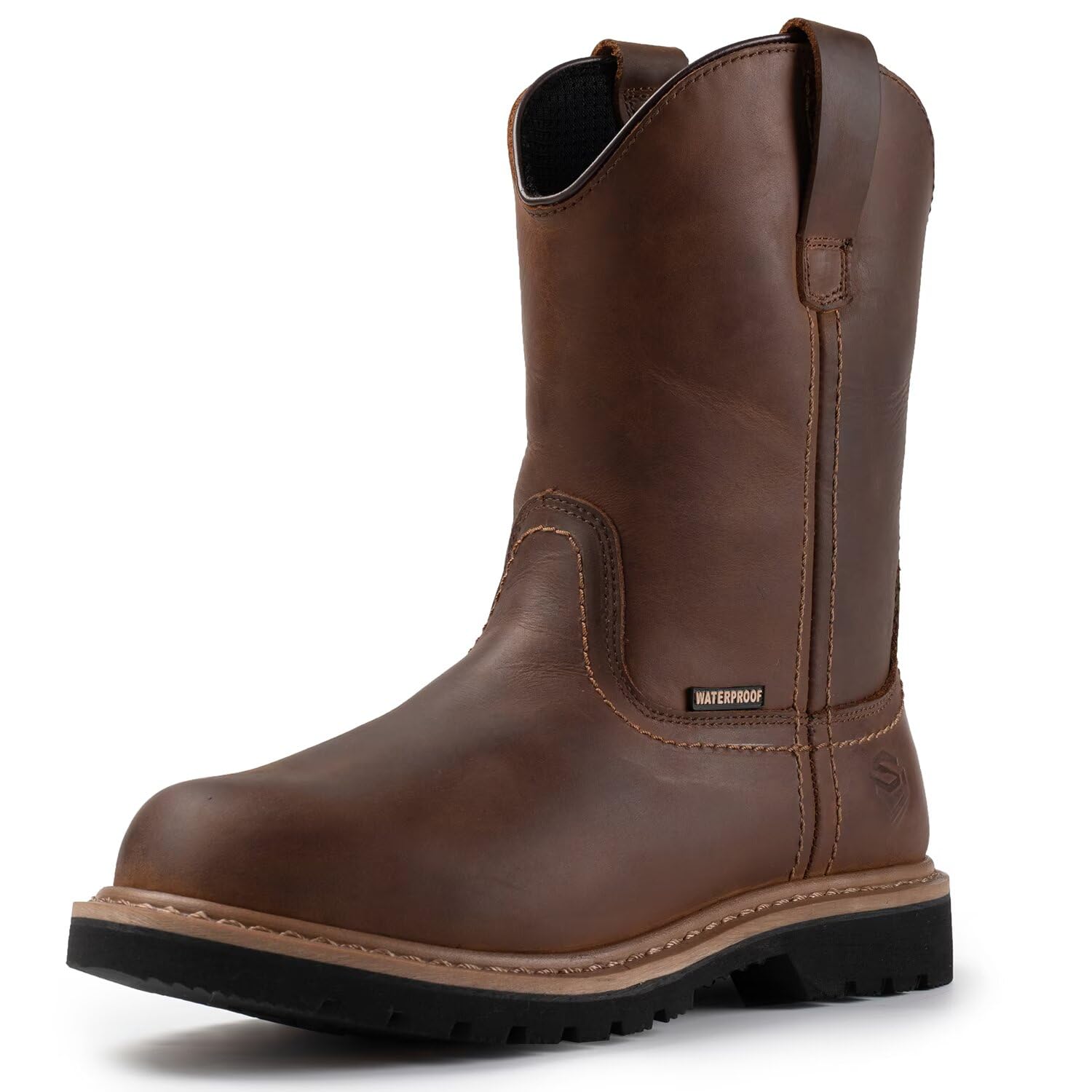
How To Choose The Best Work Boot Styles
The wrong boot shows up in your knees and lower back long before the leather wears out. Start with the toe type, the shaft height, and the sole construction, and most of the rest follows.
Toe type decides how much room your toes get
A steel toe is a metal cap over the toe box that protects against impact and compression — the crush risk when something heavy rolls over your foot. A soft toe has no cap, so the boot flexes more and feels roomier. A composite toe uses a non-metal cap, which is lighter and does not conduct heat or cold the way steel does. If your site requires a rated toe, check the ASTM F2413-18 rating printed on the boot itself — that is the standard that covers impact and compression protection.
Shaft height changes support, weight and how fast you get them on
A 6-inch shaft (the height of leather above your ankle) gives ankle support without much bulk. An 8-inch or 11-inch shaft adds more protection and stability on uneven ground but takes longer to lace up. A pull-on Wellington trades laces for two side handles, so you get them on in seconds — handy for a boot you swap at the door, less handy if you want a snug, adjustable fit around the ankle.
Sole construction tells you whether the boot can be repaired
A Goodyear welt stitches the upper to a midsole so a cobbler can replace the sole later — a repairable boot that can outlast several soles. A direct-attach sole is bonded straight to the upper with no stitching, which is lighter and cheaper to make but usually not resoleable. If you plan to keep a pair for years, the welted construction is the one that earns its keep.
Side-by-Side Comparison
| Model | Best For | Safety Toe | Shaft Height | Weight | Amazon |
|---|---|---|---|---|---|
| Irish Setter Marshall 11″★ Best Overall | Long shifts that need a repairable boot | Soft toe | 11 in | 4.67 lb | Amazon |
| Moc Soft Toe 6 InchBest Value | Budget moc-toe look on a construction site | Soft toe | 6 in | — | Amazon |
| SUREWAY 10in WellingtonQuickest On | Pull-on speed in wet conditions | Steel toe | 10 in | — | Amazon |
| Timberland PRO Pit Boss 6″ | Light steel toe for long standing shifts | Steel toe | 6 in | 1.83 lb | Amazon |
| KEEN Utility Evanston 6″ | Wide feet that need room up front | Composite toe | 6 in | 25.3 oz per boot | Amazon |
| Wolverine I-90 EPX Boa | Glove-on lacing in cold and wet | CarbonMAX composite | 6 in | 1 lb 13 oz | Amazon |
| Georgia Boot Lace-to-Toe | Mud, sand and outdoor terrain | Steel toe | 8 in | 4.5 lb | Amazon |
| Ariat Rebar Lift 6″ | Cushioning for kneeling and squatting work | Composite toe | 6 in | 5.5 lb | Amazon |
| Thorogood 1957 Series 8″ | Buying once and resoling for years | Steel toe | 8 in | 4.9 lb | Amazon |
Detailed Reviews
1. Irish Setter Marshall 11″ Mens Soft Toe Work Boot
Our pick — 4.5+★ from 400+ verified ratings; the strongest balance of quality and price.
The tall leather boot that gets a resole instead of a replacement.
An 11-inch shaft sounds like a lot of leather, and it is — that is the whole point. The extra height wraps your ankle and lower calf in full-grain waterproof leather, so wet grass, mud and splashing concrete stay outside the boot. It is the highest-rated boot here at 4.5+ stars across 400+ ratings, and that score rests on the Goodyear welt and full-grain leather rather than any one feature.
What holds up over time is the Goodyear welt (a stitched sole that a cobbler can replace). That construction is why the quality of the build is what wins people over here — owners keep coming back to how solid it feels underfoot. The removable polyurethane footbed means you can swap in your own insert without fighting the boot. And the outsole carries a heat-resistant rating plus a slip-resistant and electrical-hazard certification, which is the difference between a boot that handles a hot shop floor and one that does not.
The honest trade-off is weight. At 4.67 pounds this is a substantial boot, and the data lists it at 4.67 pounds against the Timberland PRO Pit Boss at 1.83 pounds — a real gap if you spend the day on ladders. The other recurring point is fit: buyers split on whether these run true to size or slightly big, so measure your foot before you commit. Give the leather about an hour of wear and it softens noticeably.
Where it pulls ahead
- Goodyear welt sole means it can be repaired rather than thrown away.
- Full-grain waterproof leather with an 11-inch shaft for serious ankle coverage.
- Rated for heat, slip and electrical hazard, so it suits mixed shop and site work.
- Removable polyurethane footbed lets you fit your own insole.
What to weigh first
- At 4.67 pounds it is the heaviest pick here by a wide margin.
- Sizing is split — some find it true to size, others find it runs big.
- An 11-inch shaft takes longer to lace than a 6-inch boot.
- The stiff new sole needs a short break-in before it flexes.
Reach for this if: you want one pair of leather boots you can resole and keep wearing for seasons, and you do not mind the heft.
Think twice if: you are on ladders or scaffolding all day, where 4.67 pounds per boot starts to tell.
2. Moc Soft Toe Work Boots 6 Inch
The entry-level moc toe that punches well above its price tag on looks.
This is the boot you buy when you want the classic moc-toe silhouette — the stitched U-shape across the toe — without spending premium money. The leather is thick and genuinely full-grain, and the wedge outsole — a flat, one-piece rubber sole with no separate heel — spreads your weight evenly from heel to toe. That flat, heel-less base is why it feels planted during long stretches of standing.
With no steel cap, the soft toe box stays flexible and roomy across the forefoot. The 6-inch shaft covers the ankle without the bulk and lacing time of an 8- or 11-inch boot. On the fit side, the leather wraps snug around a narrow ankle, which suits slimmer legs better than thick ones.
Where it gets more complicated is longevity. Expectations split right down the middle — some buyers report the construction holding up past the two-month mark, while others doubt it will survive a full year. That is the honest picture for a boot at this price point, and it is why you treat these as a workhorse you replace rather than a lifer you resole. The leather quality is the standout, and it is what the majority of the commentary focuses on.
What shoppers notice: the leather reads far more expensive than the boot does — buyers routinely compare the look and feel to a boot costing twice as much.
The realistic catch: weight gets flagged as a downside, so if you are already carrying a tool belt all day, this adds to the load.
Fits best: a first work boot, a backup pair, or anyone who wants the moc-toe look on a tight budget.
Look elsewhere if: you need a rated safety toe or a boot you plan to keep for several years.
3. SUREWAY 10in Mens Soft/Steel Toe Waterproof Wellington
No laces, a steel cap, and 10 inches of leather — the wet-day workhorse.
A Wellington is a pull-on boot with no laces, and that changes your whole morning. Two side handles, a tug, and you are out the door — no kneeling to tie anything. The 10-inch shaft covers your ankle and lower calf, which keeps splash and mud out on a wet site. The steel toe adds a protective cap over the front of the foot for impact and compression protection.
The comfort side is where this one really delivers. Owners consistently describe it as comfortable and properly fitting, with good quality leather and a look that holds up on the job. If you are on your feet all shift and want a pull-on that feels broken in on day one, this is the pick.
The catches are worth knowing up front. Getting them off can be a struggle for some — a tight pull-on fit is great at staying on and less fun at the end of a shift. And the inside liner has been reported tearing within the first week on some pairs, which is the durability question mark here. Neither issue hits every pair, but both are real enough to size your expectations.
Why it earns the slot: the pull-on design plus a steel toe plus waterproof leather is a rare combination, and it makes a wet commute or a muddy site far less annoying.
The liner caveat: some pairs show liner wear early, so check the inside of the boot when it arrives and keep your receipt.
Best match: anyone who swaps boots at a job trailer door and wants a steel toe without lacing up.
Not for you if: you want a fully adjustable fit around the ankle — laces do that better than handles.
4. Timberland PRO Pit Boss 6 Inch Steel Safety Toe

Steel protection at under two pounds per boot — the lightest pick on this list.
Here is the number that defines this boot: 1.83 pounds. Compared with the Irish Setter Marshall at 4.67 pounds, it is dramatically lighter on your foot, and a full day of climbing or walking barely registers the difference. For a steel-toe boot, that is a genuine win.
The steel toe meets ANSI safety standards and comes with a roomier toe box than a lot of steel-toe boots, so your toes are not pinned. There is electronic hazard protection built in for working around open circuits, plus nylon shock-diffusion plates underfoot for support and torsional rigidity (resistance to twisting). The removable sock liner helps cut down on blisters during long shifts.
The one caution is durability. Reports vary — some pairs hold up well over months of use, others start coming apart sooner. That spread is not unusual for a synthetic-and-leather work boot, but it means you should treat it as a boot you keep an eye on rather than one that lasts forever. What you are really paying for here is the low weight and the comfort of a roomy steel toe.
The weight advantage: if your knees or feet are worn down by heavy boots, 1.83 pounds per boot versus the Marshall’s 4.67 pounds is the single biggest reason to pick this one.
The durability question: longevity is genuinely inconsistent from pair to pair, so a careful inspection when they arrive is smart.
The pick for you if: you need a rated steel toe and your feet are asking for something light.
Consider another boot if: you want a resoleable leather boot built to be repaired and kept long-term.
5. KEEN Utility Evanston 6″ Composite Toe Waterproof
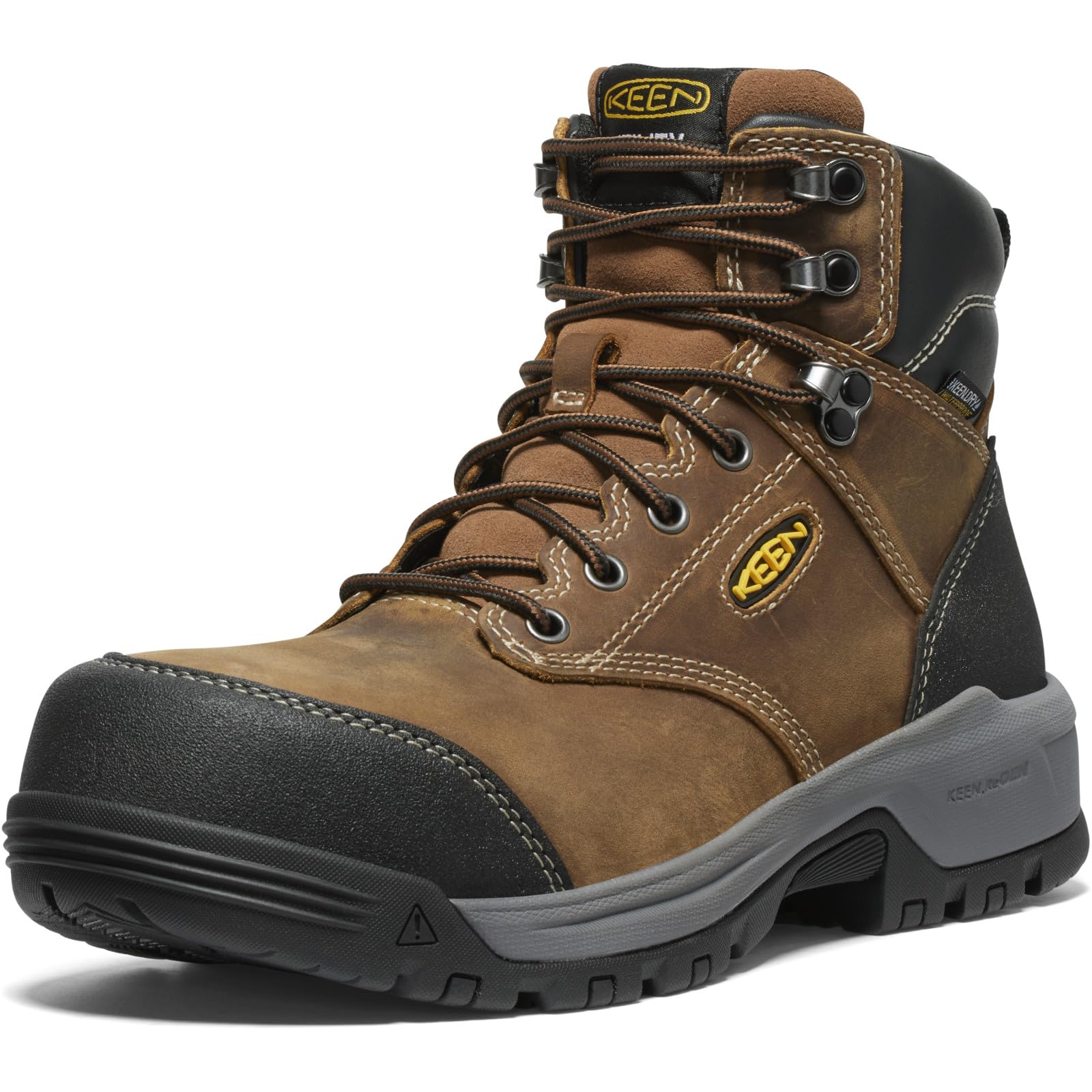
Built wide on purpose, with a carbon toe that keeps the boot light.
If most boots squeeze your forefoot, the Evanston is worth a serious look. It is built off KEEN’s traditional wider footwear form, so the toe box accommodates a broad foot without pinching. The carbon toe is a composite cap — non-metal, so it is lighter on your foot than a steel cap and does not conduct heat or cold the way metal can. Combined with the barnyard-resistant waterproof leather, that makes it a solid fit for landscaping and outdoor utility work.
Underfoot, the KEEN.ReGEN midsole is described as energy-returning — it flexes and springs back as you walk. A 90-degree heel and internal shank add stability. At 25.3 oz (720 g) per boot, it sits in a comfortable middle range for weight. Owners describe the boots as comfortable and light, with good water resistance and traction. Wide-footed buyers appreciate the room in particular.
The catch is durability, where reports genuinely split. Some pairs last up to a year, others wear out faster. That means the Evanston is best bought as a comfortable daily boot with a realistic lifespan, not a boot you expect to resole for years.
Comfort is the draw: the wide form and energy-returning midsole make long shifts kinder on your feet — especially if you have been fighting narrow boots.
What to plan for: at 25.3 oz per boot it is no featherweight, so pair it with a good sock on the longest days.
Choose this if: your foot is wide and every boot you try feels tight across the toes.
skip it if: you want one boot that outlasts multiple pairs — check the Thorogood or the Marshall below.
6. Wolverine Men’s I-90 EPX Boa CarbonMax 6″ Boot
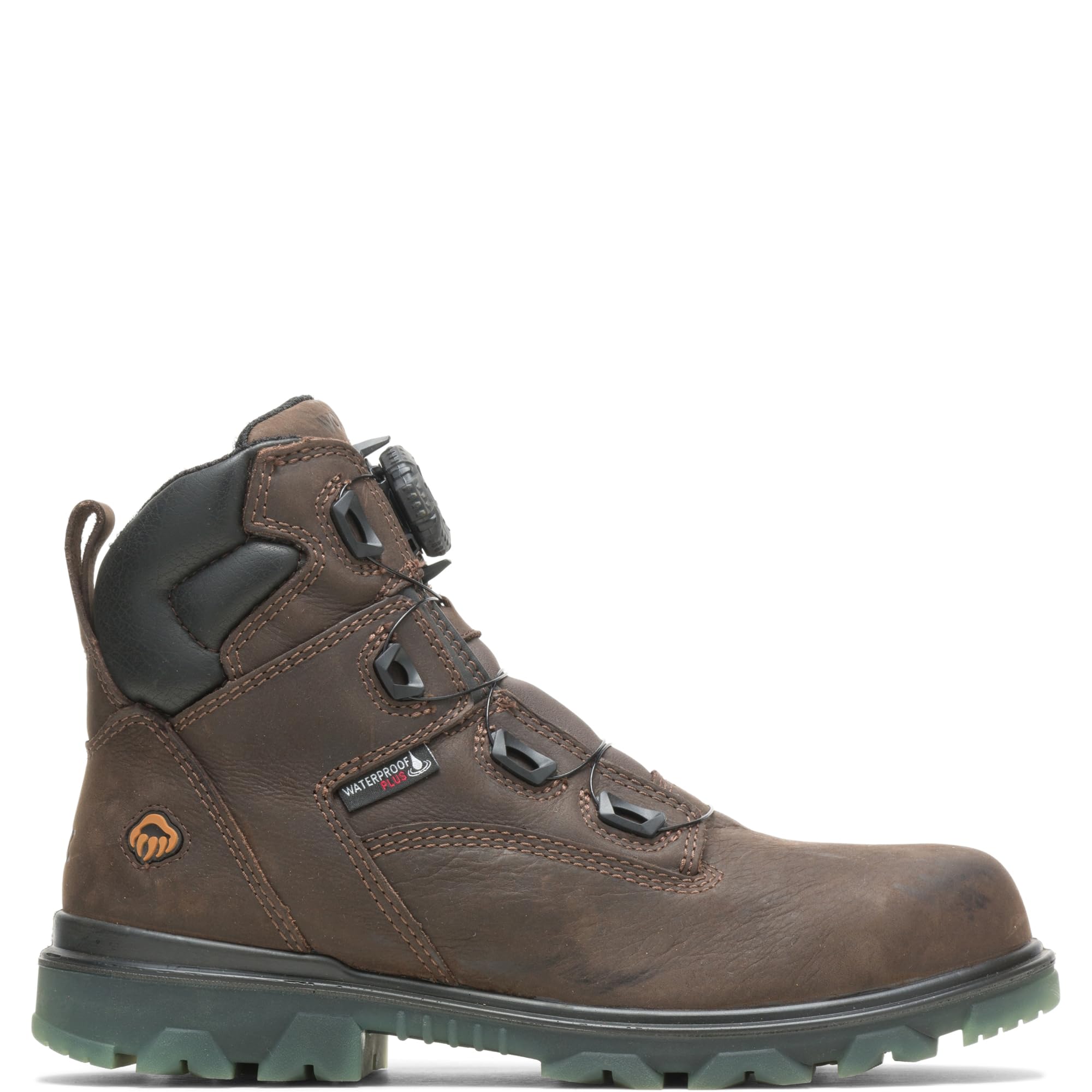
Twist the dial, skip the laces, keep your gloves on in the cold.
The Boa Fit System is the reason to look here. Instead of laces, a dial on the boot tightens a steel wire evenly across the whole boot — and it sheds ice, dirt and oil, so it still works in bad conditions. In cold weather with gloves on, that is a real advantage. The CarbonMAX toe meets ASTM F2413-18 F I/75 C/75 EH safety standards, so it is rated for impact and compression protection while staying non-conductive to heat and cold.
Comfort is the standout. Owners highlight the cushioning, and the EPX footbed is designed to flex with your foot for support through a long day. The waterproof full-grain leather upper plus a breathable, moisture-wicking mesh lining keeps sweat moving out and water outside. The TPU outsole uses a pronounced lug pattern for grip on wet, oily and chemical-covered surfaces, and Wolverine rates the TPU outsole at 3x the wear life of traditional rubber.
The fit is the thing to watch. Some find it snug and easy to put on, others find it runs narrow and is harder to get on and off. Sizing also tends toward the smaller side, so if you are between sizes, lean up rather than down.
Why the dial wins: micro-adjustable tightening across the whole boot means you can tune the fit to your ankle instead of living with one lace tension.
The sizing reality: buy half a size up if you are unsure — narrow-footed buyers are happy, wide-footed ones often are not.
Made for: cold-weather crews and anyone who has ever fumbled a lace with thick gloves on.
Not ideal for: very wide feet — the narrow reputation here is real.
7. Georgia Boot Lace-to-Toe Steel Toe Waterproof
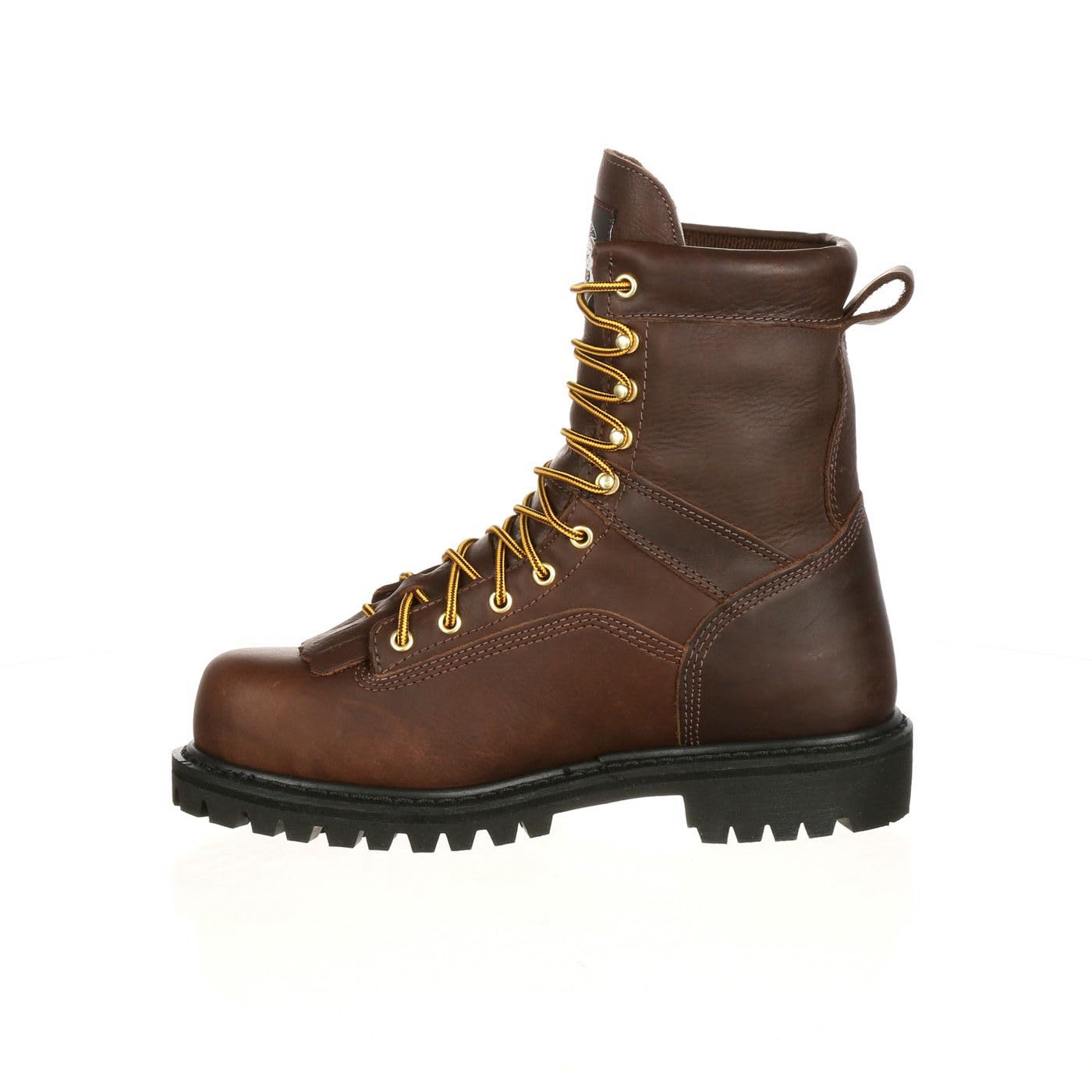
An oil-resistant Vibram sole stitched on so it can be repaired, not trashed.
Lace-to-toe is the defining feature here: the laces run all the way down to the toe, so you can tighten the whole front of the boot like a glove around your foot. That is the fit advantage for anyone who has felt a standard boot slosh around up front. The steel toe meets ASTM standards for impact and compression, and the boots also meet electrical hazard resistance standards.
The waterproofing matters for anyone working outdoors. Georgia’s waterproof system keeps water out, and the Vibram lug outsole is oil-resistant, so it holds grippy on shop floors. Underneath, a steel shank gives arch support and stability, and the boot is fully lined. The Goodyear welt construction means a cobbler can repair and resole them rather than you replacing the whole boot.
The break-in period is short and the fit is generally good — that is where the bulk of the praise lands. Watch the sizing, though: several note these run about half a size big, so size down if you are between. And the leather is thinner than some expect, which is worth knowing if you want a very rigid, heavy upper.
Built to be fixed: the stitched Goodyear welt plus an oil-resistant Vibram outsole means this is a boot you repair, not replace.
Fit note: sizing runs roughly half a size big, so avoid sizing up for thick socks.
Built for: outdoor crews who want a repairable boot with grip on oily and wet ground.
Look elsewhere if: you want a heavy, thick-leather upper — this one is lighter than it looks.
8. Ariat Men’s Rebar Lift 6″ Waterproof Composite Toe Work Boot
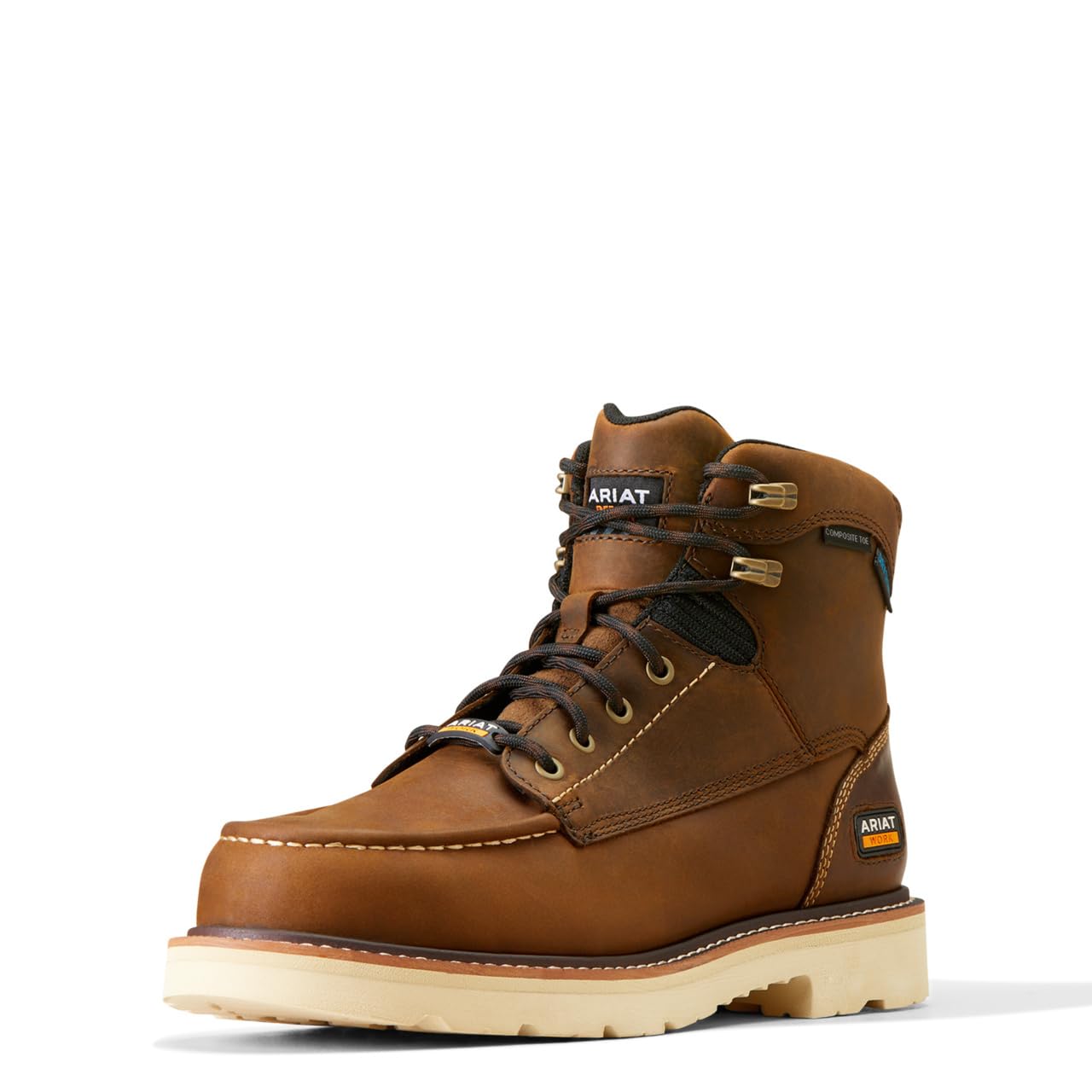
Cushioning built for a day that never lets you stand all the way up.
Some jobs mean squatting, kneeling and climbing all day — and this boot is tuned for that. The elastic at the ankle flexes with you, which is what makes squatting and kneeling comfortable instead of restrictive. The composite toe keeps the front of the boot light and non-metallic. And the cushioning and stability that Ariat built in are exactly what long shifts in a crouch position demand.
Owners describe the boot as supportive and comfortable, with solid quality leather and looks that hold up. The waterproofing keeps feet dry through outdoor conditions. That combination — padding plus support plus a flexible ankle — is why it lands as a good choice for kneeling and squatting work rather than flat-out standing.
Now the part you should not overlook: durability is the loudest concern with this boot. Soles peeling apart and boots coming apart after a few months is the recurring report, and the durability feedback is the one clear negative category. That does not make it a bad boot — it makes it a boot you buy for comfort and replace sooner than you might like. Buyers also split on value, which makes sense when lifespan is the question.
Comfort you notice: the ankle elastic plus cushioning make crouching work far easier than a rigid lace-up allows.
The real risk: sole separation after a few months is a pattern worth accepting before you buy — this is not the longest-lived boot on the list.
Right for: anyone who spends more of the day kneeling, squatting or climbing than standing still.
Not right for: hard-wearing site work where you need a boot to last years — weight the durability reports first.
9. Thorogood 1957 Series 8″ Waterproof Steel Toe

American-made leather boots with a moc toe and a sole built for oily ground.
Thorogood makes the 1957 Series in the USA with globally sourced components, and it shows in the leather. The full-grain saddle leather upper comes in Trail Crazyhorse brown with a wax treatment that gives it a vintage, broken-in look right away. The moc toe design is stitched, and the 8-inch shaft gives good ankle coverage without the weight of an 11-inch boot.
The sole is the standout. The MaxWear 90 traction outsole has a heel and is designed to flex better than other work boot outsoles while absorbing impacts. It meets ASTM F3445-21 slip-resistance standards, so loose gravel, wet ground and oily surfaces all get real grip. The steel toe meets ASTM F2413-18 standards. Inside, the gusseted tongue keeps water and liquids out, and the moisture-wicking lining pulls sweat away. Weight comes in at 4.9 pounds.
Quality and comfort are what consistently win people over once the leather breaks in — but the break-in is real and worth planning for. The other honest point is durability, which splits both ways: the leather holds up well, while the soles have been reported ripping off on some pairs. For the money, that is the one thing to keep in mind before committing.
The upgrade worth paying for: a slip-rated MaxWear 90 outsole with a heel is a harder-working sole than a flat one, and the moc-toe leather looks the part for years.
The break-in reality: give them time to soften — and keep an eye on the sole stitching given the mixed reports.
Worth it if: you want an American-made leather boot with a serious slip-rated outsole that you break in and wear for a long stretch.
Maybe not if: you need a boot that feels comfortable the first day — this one wants a break-in period.
Know the Specs
ASTM Safety Toe Ratings
ASTM F2413-18 is the standard that covers impact and compression protection for a protective toe cap. The letters after it describe what else the boot is rated for — for example, EH means electrical hazard protection and SR means slip resistance. A rating is only meaningful if it is printed on the boot you buy; a boot without a rating has no cap, even if it looks like it does.
Goodyear Welt vs Direct-Attach
A Goodyear welt stitches the leather upper to a midsole, which lets a cobbler replace the sole when it wears through. A direct-attach sole is bonded straight onto the upper with no stitching; it can be lighter and cheaper but is usually not repairable. If you plan to resole a boot rather than replace it, the welted construction is the one you want.
Shaft Height in Inches
Shaft height measures the leather above the ankle. A 6-inch shaft gives ankle support without bulk and laces up fast. An 8-inch or 11-inch shaft covers more of the lower leg for extra protection and stability on uneven ground, at the cost of weight and a longer lacing routine.
Outsole Materials
Rubber, TPU and Vibram outsoles each behave differently. Rubber offers good general grip; TPU is often abrasion-resistant and stands up to oil, chemicals and heat. A lug pattern — the raised ridges under the boot — gives grip on loose ground. An oil-resistant outsole matters if you work around machinery or spills.
Common Questions
Does a soft toe boot protect my toes at all?
What does the EH rating on a work boot mean?
How long does a work boot usually take to break in?
Do I need a steel toe or a composite toe for construction work?
Can I resole a work boot when the tread wears out?
Is a pull-on Wellington as supportive as a lace-up boot?
What is the Boa Fit System on the Wolverine I-90?
Why do some work boots feel heavier than others?
Do waterproof work boots make my feet sweat?
Should I size up or down in a work boot?
The Bottom Line
For most people, the work boot styles winner is the Irish Setter Marshall 11″ because the full-grain waterproof leather, the Goodyear welt sole and the heat, slip and electrical ratings together make a boot you can repair and keep wearing season after season. If you want a rated steel toe with far less weight on your foot, grab the Timberland PRO Pit Boss 6″. And for cold-weather crews who lace up with gloves on, the Wolverine I-90 EPX Boa is the one to reach for.
One last nudge: the Marshall is the highest-scoring boot on this list, so if you want a single pair to commit to and the weight does not bother you, that is the one that will earn its place in the rotation.
How we choose
We do not accept paid placement. Every pick is matched to a real buyer and a real use-case; we do not hands-on test units.
Sources
Specifications: manufacturer listings and product documentation. Review insights: verified customer reviews, as of November 2026. Pricing: not shown on this page (it changes often); check the current price via the retailer link.
As an Amazon Associate, Tactical Gear Guy earns from qualifying purchases. This does not affect which products we feature.