Specs are compiled from manufacturer listings and verified buyer reviews and can change over time — please confirm the key details on the product page before buying.
If your work boots feel like two planks of wood by hour eight, the fix is usually not a new pair of boots. It is a better footbed. A good work boot sole insert adds a cushioning layer between your foot and the hard factory insole, and it can change how your whole shift feels. The picks below range from budget-friendly to premium, and each one suits a different kind of worker. Start with the PowerStep Pinnacle if you want the safest all-round bet.
This guide is built by comparing the manufacturers’ published specifications and the patterns across verified customer reviews, so you get each pick’s real strengths and trade-offs instead of marketing spin.
Your feet ache by hour eight because a thin factory footbed gives your arch no support on hard floors. Three things decide whether an insert fixes that: your arch height, how much room your boot has inside, and the surface you stand on all day. Below are plain-English notes on the Best Work Boot Sole Inserts for long shifts on hard floors.
Top Picks


How To Choose The Best Work Boot Sole Inserts
Most people buy insoles by squeezing the foam in the store and guessing. That test tells you almost nothing about how the insert will feel after six hours on a concrete floor. The three things that actually decide whether a work boot insert helps you are arch support, shoe volume, and how the heel is cradled.
Start with your arch, not the cushion
Your arch is the curve on the inside of your foot that acts like a spring. An insert with a structured arch shelf spreads your weight across the whole foot instead of dumping it on the heel. If you have flat feet or high arches, the shape of that shelf matters more than how soft the top layer feels. A soft insert with a flat base will bottom out by lunchtime.
Check how much room your boot actually has
Adding an insert steals volume from inside the boot. If your work boots already fit snug, a thick full-length footbed can press the top of your foot against the laces. Look at the thickness of the insert and, where a maker offers one, the trim-to-fit option so you can shave it down to your boot’s outline. Factory insoles that pull out are the easiest to replace.
Look at the heel cup and the top cover
A deep heel cup is the raised wall around the back of the insert. It keeps your heel from sliding sideways and helps your foot land in the same spot every step. The top cover matters too on long shifts — a moisture-wicking fabric pulls sweat away from your sock so your feet do not stew inside a sealed boot.
Side-by-Side Comparison
| Model | Best For | Weight | Length | Width | Amazon |
|---|---|---|---|---|---|
| PowerStep Pinnacle★ Best Overall | All-round daily work boot support | 5.61 ounces | 14.2 inches | 4.4 inches | Amazon |
| Superfeet Work CushionLongest Support Window | Long shifts on concrete | 7.83 ounces | 13.73 inches | 4.35 inches | Amazon |
| BRUNT Super CUSH NCushion-First Pick | Cushion-first comfort in boots | 8 ounces | 14.2 inches | 4.3 inches | Amazon |
| Dr. Scholl’s Heavy Duty Support | Big and tall workers over 200 lbs | 14.4 ounces | 14.17 inches | 4.37 inches | Amazon |
| ARIAT Energy Max | ARIAT round-toe work boots | 6.38 ounces | 11 inches | 3.7 inches | Amazon |
| ROCKROOSTER Anti-Fatigue | Wide feet and heavy-duty boots | 8.15 ounces | 12.4 inches | 4.25 inches | Amazon |
| VALSOLE 220+ lbs | Budget arch support for heavy workers | 9.52 ounces | 12.44 inches | 4.17 inches | Amazon |
| Sof Sole WORK | Budget anti-fatigue for hard floors | 5.93 ounces | 14.02 inches | 4.92 inches | Amazon |
| Heavy Duty Plantar Fasciitis (BestHalo) | High arches on a tight budget | 9.91 ounces | 12.36 inches | 4.17 inches | Amazon |
Detailed Reviews
1. PowerStep Pinnacle Insoles
Our pick — 4.5+★ from 31,500+ verified ratings; the strongest balance of quality and price.
The safe all-rounder: dual-layer cushioning and a structured arch that fits most work boots.
Here is the surprise for anyone who thinks a serious footbed has to weigh a ton. The PowerStep Pinnacle is a full-length orthotic built for plantar fasciitis relief, and it weighs just 5.61 ounces. The dual-layer cushioning sits under a premium arch shell, so the insert holds its shape instead of pancaking by mid-shift.
What wins people over is the arch and heel cradle first, then the cushioning on top. The shape is built to add stability to the foot and ankle, and it is ordered by shoe size with no trimming needed — a genuine time-saver if you hate scissors and guesswork. It fits athletic shoes, work boots and some casual shoes, and it pulls out and drops straight into another pair when you rotate boots.
The trade-off is firmness. The arch is deliberately structured, and the base is not a soft pillow — if you want a plush, sink-in footbed, this is not that. It is also sized to specific shoe sizes, so the fit is precise rather than universal. One honest note on the numbers: the Dr. Scholl’s Heavy Duty pick has far more ratings behind it, but this PowerStep holds the higher 4.5+ star score — so the crowd size is not the whole story here.
What owners praise most
- Comfort is the most-mentioned win — owners describe immediate relief the first week in.
- Structured arch and heel cradle support the foot and ankle through a full shift.
- No trimming required — order by shoe size and drop it in.
- Light at 5.61 ounces, so it does not change how your boot feels to lift.
The honest catches
- Firmness is the recurring gripe — some feet want more give under the ball.
- Fits shoes where the factory insole can be removed; snug boots may feel tight.
Reach for this if: you want a proven orthotic-shaped footbed for work boots and you are fine with a firm, supportive arch.
Look elsewhere if: your boots do not have a removable factory insole, or you want plush rather than structured support.
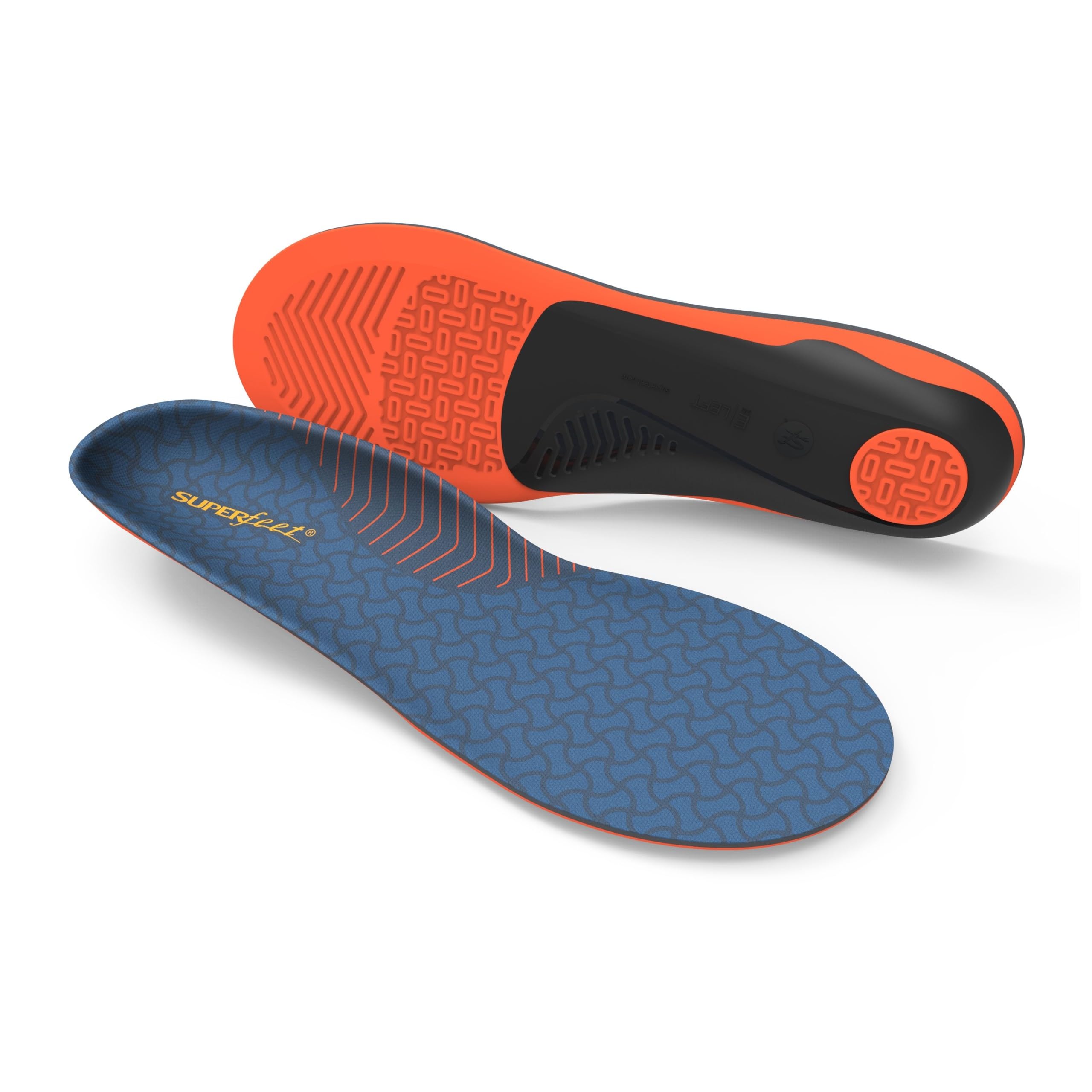
2. Superfeet Work Cushion Insoles
Built for the concrete-floor shift, with a stated support window of up to 12 months.
Superfeet is the pick for anyone who clocks in on a hard floor and stays there. The soft underfoot cushioning is aimed squarely at anti-fatigue support for work and duty, and the maker states the insoles keep their shape and deliver support for up to 12 months. That clock starts the day you drop them in, so plan to rotate a fresh pair in about once a year on a daily-wear schedule.
Unlike the PowerStep above, this one ships as a trim-to-fit blank. You cut it down to your boot’s outline following the printed guides, and if you land between sizes, you size up and trim down. That gives you a precise fit even in boots the size charts get wrong. A moisturewick top cover helps cut odor and keep feet fresh through long hours. At 13.73 inches long it is closer to a full boot length than the Heavy Duty BestHalo at 12.36 inches, so it suits taller boots better.
The honest caveat is fit volume. A trim-to-fit insert adds thickness, so a boot that already ran snug can feel tight once it goes in. That is a sizing issue, not a quality one — measure before you trim. what separates it is the stated lifespan and the moisturewick cover, which point at real durability rather than just a soft first week.
The durability angle: Up to 12 months of stated support makes this the pick to plan a yearly replacement around, which suits workers who want a reliable schedule rather than guessing.
Who it fits: Concrete-floor and duty workers who want a firm-but-cushioned anti-fatigue footbed and are comfortable trimming it themselves.
Worth knowing: Some boots run snug once the insert is in, so check your boot volume before you commit to trimming.
Best for: the worker who stands on concrete all day and wants a stated 12-month support lifespan.
Think twice if: you refuse to trim your insoles or your boots already fit tight with the factory footbed in.
3. BRUNT Super CUSH N Insoles
The plush option for workers who want softness first and support second.
If your feet feel bruised rather than achy, the BRUNT Super CUSH N is aimed right at you. It leads with next-level foam cushioning and impact-absorbing technology placed at the heel and forefoot — the two spots that take the hammering when you walk hard floors. A bonus memory foam layer sits on top to spread pressure, and a contoured heel bed cradles the back of your foot so it stays anchored in the boot.
The practical details are where this one earns its keep. A grippy top coating holds your foot in place to cut the friction that leads to blisters, and a moisture-wicking, anti-odor design keeps boots fresher through the day. The non-stick top cloth wipes clean, which extends how long the insert stays comfortable. At 8 ounces it is heavier than the PowerStep Pick, but it is a cushion-first build, not a weight-weenie footbed.
The catch is durability expectation. Polyurethane foam this soft is built for comfort more than rock-hard structure, and the anti-odor treatment needs occasional wiping to hold up. It is the right pick when soft comfort beats a rigid arch shell.
Where it shines: Heel and forefoot impact-absorbing foam plus a memory foam layer make this the softest-feeling pick in the lineup, good for workers who want plush over firm.
The maintenance habit: The non-stick top cloth is easy to wipe down, so a quick clean each week keeps the anti-odor treatment working.
Choose this for: a cushiony, grippy footbed when your feet feel bruised by the end of the week.
Look past it if: you need a hard, structured arch shell rather than foam.
4. Dr. Scholl’s Heavy Duty Support Insole Orthotics, Big & Tall
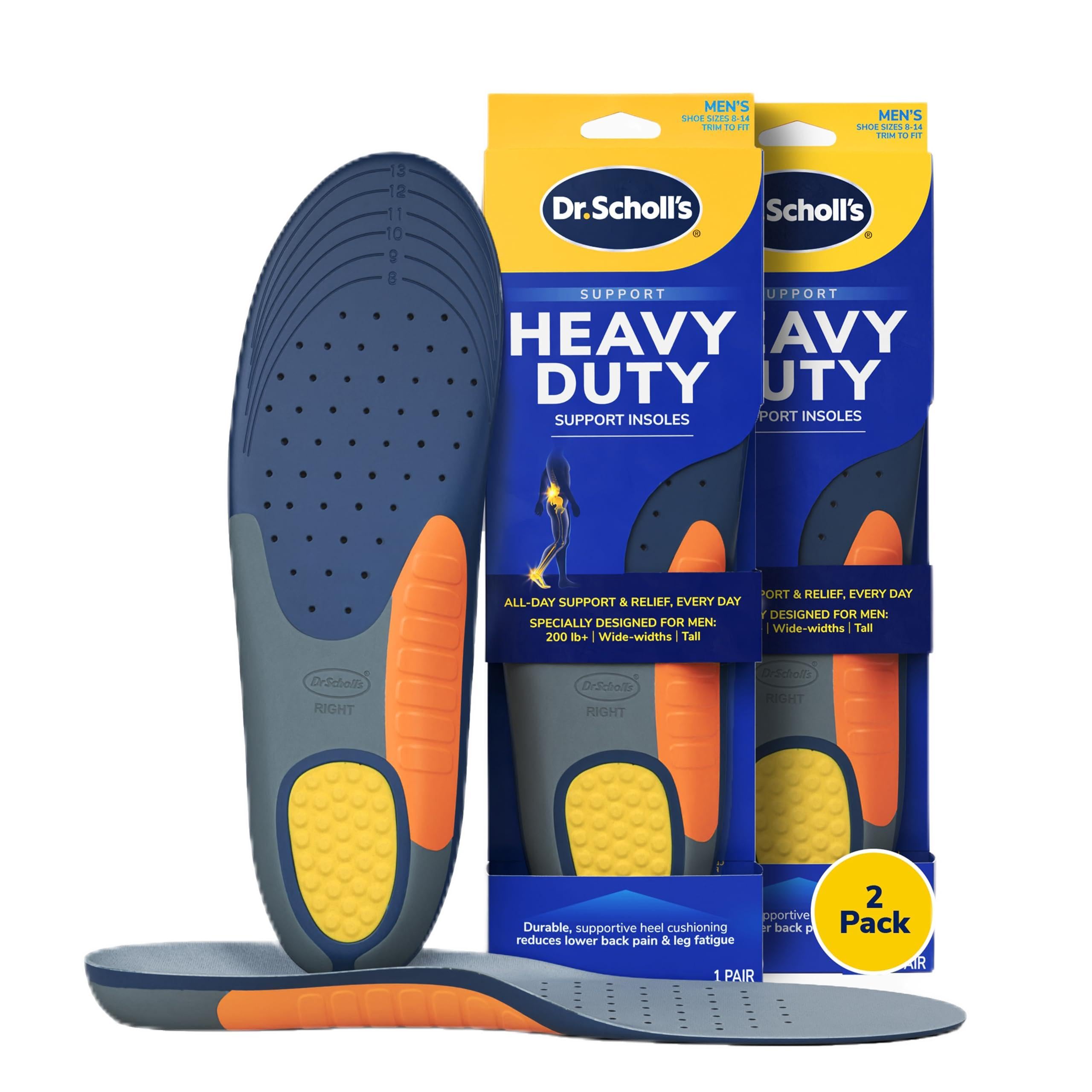
Engineered for workers over 200 lbs, tall frames, or wide feet that crush lighter footbeds.
Most insoles are built for an average foot. This one is built for the bigger frame. Dr. Scholl’s Heavy Duty Support Insole is designed for people over 200lbs, tall stature, or wide feet, and it fits any arch type, including high and fallen arches. Extra supportive heel cushioning is aimed at the feet, legs and lower back together, not just the heel.
It is also the heaviest, most substantial footbed in the group at 14.4 ounces, with shock-absorbing foam built to take steady pressure rather than flex like a light insert. You can trim it to fit athletic shoes, work boots, casual shoes and slippers, so it can follow you from the site to the house. The maker says the even pressure distribution is aimed at lower back pain and leg fatigue.
Two honest fit notes: the arch support is a personal fit, and the added thickness can make a snug shoe feel tighter, so trim carefully and start with roomier boots. And while this pick has the most ratings of the lineup — the biggest single pool of owners — the PowerStep above still holds the higher score. This one wins on raw body-weight support, not on top marks.
What earns its keep
- Built specifically for over-200-lb, tall, or wide-footed workers, not average feet.
- Extra heel cushioning spreads load to the lower back and legs, not just the foot.
- Trims to fit work boots, athletic shoes, and slippers, so it travels with you.
What to plan around
- The thickness added by this heavy-duty build can crowd a shoe that already fits snug.
- Arch support is a personal fit — heavier, taller users with a strong arch should size by that.
Great for: the big, tall, or wide-footed worker whose weight flattens lighter inserts fast.
Skip the hype if: your boots are already full inside — this thick footbed needs a little breathing room.
5. ARIAT Men’s Energy Max Work Insole Round Toe, Orange, 10.5 M
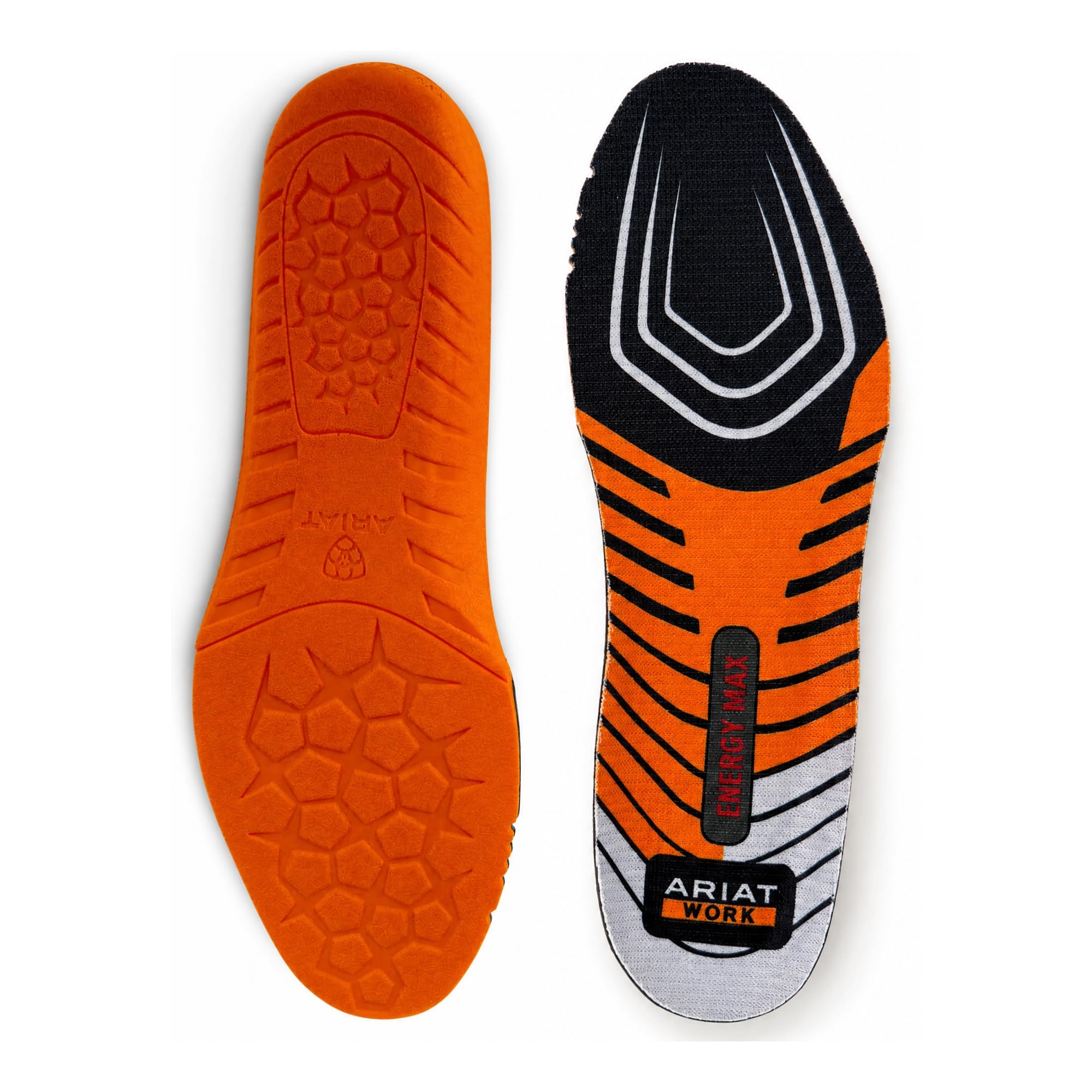
A footbed made to slip straight into an ARIAT round-toe work boot.
Buy an ARIAT boot and you inherit a specific footbed shape. This insole is pre-shaped to a round-toe last for ARIAT work boots, and it is ordered in your usual US men’s size in D width, whole sizes 7 to 15 and half sizes 7.5 to 11.6. That means it drops in with no trimming and no guessing whether the arch lines up. The Energy Max layer compresses under each step and springs back to feed energy into your stride — a rebound effect aimed at the drain of long shifts on hard floors.
What wins people over is comfort straight from the start. Anatomical cushioning is shaped to the foot’s natural contours so weight spreads evenly instead of landing on one hot spot. A moisture-wicking liner pulls sweat away from the sock, so your feet stay drier on a long shift. A temperature-regulating open-cell core (a foam with open pockets that let heat escape) vents heat so the footbed stays cooler through warm floors and long hours. At 11 inches long and 6.38 ounces, it is a compact footbed that sits neatly inside a round-toe boot without crowding it.
The trade-off is fit scope. This insert is specifically shaped for ARIAT round-toe boots, so it is a poor match for other boot brands or square-toe shapes. Cushioning and durability also draw mixed notes — great underfoot softness, but a few find the padding thinner than expected and the lifespan short of a heavy-duty orthotic.
Made-to-measure feel: Pre-shaped to ARIAT’s round-toe last and sized by your US men’s size, this is the least fiddly install of the bunch.
Breathability built in: A moisture-wicking liner and open-cell core are aimed at warm floors and long shifts, keeping the footbed cooler than a sealed foam block.
Best fit for: ARIAT round-toe work boot owners who want a matched footbed that drops straight in.
Not the one for: anyone in a different boot brand or square-toe shape, where the pre-shaped last will not line up.
6. ROCKROOSTER Work Boot Insoles
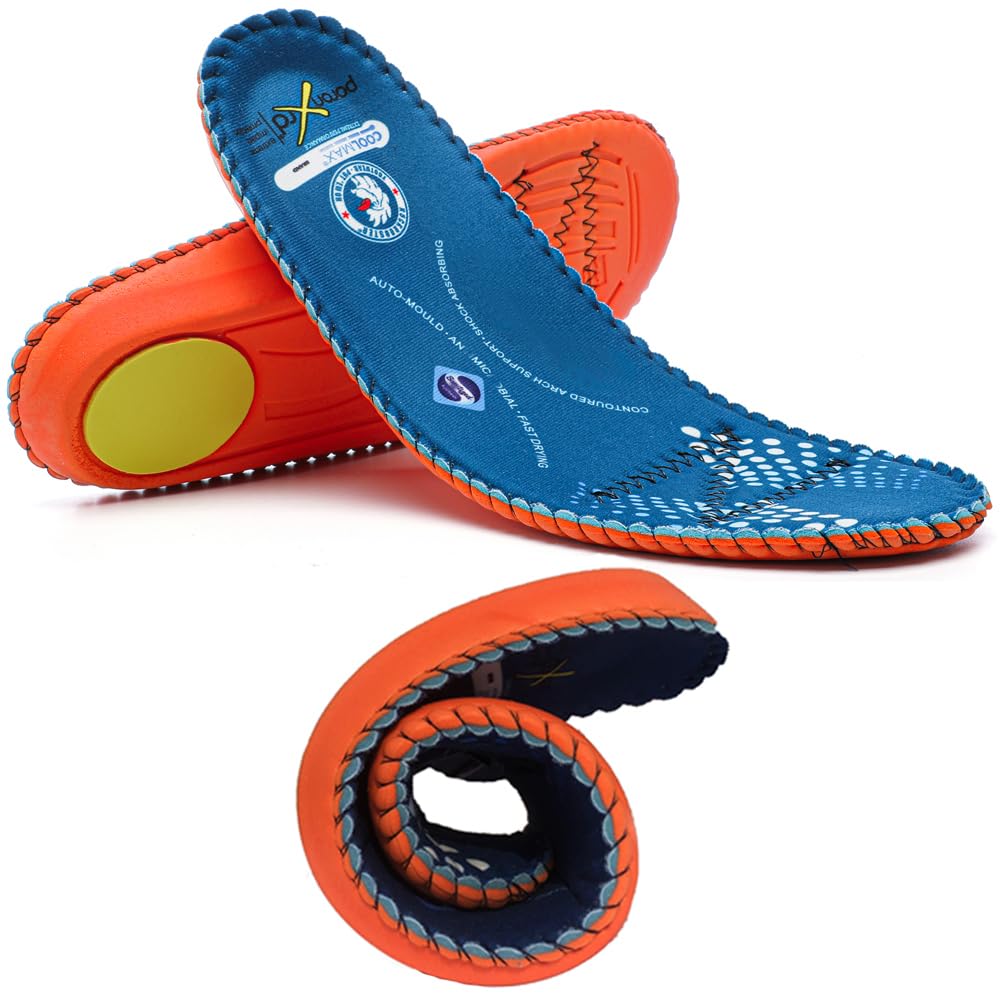
For wide boots and wide feet, with a memory-foam layer that cradles from day one.
Wide feet usually win the shoe hunt and lose the insole one. This ROCKROOSTER footbed is built with a flexible shape that comfortably fits wide-width boots or work shoes, and it is true-to-size with no trimming required. Layer on PU foam and memory foam, and you get immediate cushioning the moment you step in. A reinforced heel cushion soaks up impact on the joints and arches, which is the difference between a steady shift and a wobbly one on concrete.
Two details make it better than a plain soft slab. The engineered contour aims at improving balance and posture, and the COOLMAX top fabric actively wicks sweat and heat so feet stay dry on long outdoor shifts. A thick perimeter stitching keeps the edges from flattening or fraying, which is where cheap insoles usually start to fall apart. It is a bit heavier at 8.15 ounces, but the construction justifies the bulk.
The honest limit is arch. This is more of a comfort-and-cushion footbed than a rigid orthotic, so a flat-footed worker wanting a hard structural shelf may find it a touch soft. For wide boots and heavy steel toes, that trade — cushion and breadth over rigid arch — is often the right one.
Why wide-foot workers like it
- Fits wide-width boots and work shoes without cutting or guessing.
- PU and memory foam layers deliver soft cushioning from the first step.
- COOLMAX fabric wicks sweat and heat on outdoor, long-hour shifts.
- Reinforced heel cushion and thick perimeter stitching add durability.
Where it stops short
- Softer than a rigid orthotic — a structured arch is not its focus.
- Heavier at 8.15 ounces than the lightest picks here.
Pick this for: wide boots and wide feet that need cushion and breathability more than a hard arch shelf.
Pass on it if: you specifically want a firm, structured arch support and nothing softer.
7. VALSOLE 220+ lbs Plantar Fasciitis High Arch Support Insoles

Budget-friendly arch support rated to handle 220 lbs and over.
If you want a structured arch without paying premium prices, the VALSOLE is the entry-level pick worth a look. It is rated to withstand 220 lbs and over for heavy-duty support, with a rigid arch built to realign the foot and a highly elastic rear heel pad that absorbs shock under the heel. Forefoot padding adds cushioning under the ball of the foot, so the load spreads front to back rather than hammering one spot.
It suits all arch types — low, neutral and high — and drops into casual shoes, sneakers and work boots. The footbed is cut-to-fit so you can trim it to the factory insert, and the maker states returns are still supported after cutting. If you are working on your feet and want a budget arch shelf, this is the value read.
The catch is fit. Width and arch height draw mixed feedback, and some feet find the footbed too narrow or the arch not quite enough. Start with 2-3 hours a day and build up slowly while your feet adjust; those early days can feel like pressure, not comfort. It is a budget footbed, so treat the cushioning as functional rather than plush.
The budget case: A rigid arch support rated to 220 lbs and over is a genuine value at this tier, especially for casual shoe and boot use.
The fit reality: Width and arch height draw mixed feedback, so if you have an unusual foot shape, expect a few days of breaking in before you judge it.
Worth it for: a budget-conscious worker who wants an arch shelf that holds up under heavier weight.
Look past it if: you have a wide foot or a sensitive arch and need a shape you can trust from the start.
8. Sof Sole WORK Insoles

An anti-fatigue core aimed at the hardest shop floors, at entry-level pricing.
Sof Sole’s WORK insole is built around one job: keeping your feet feeling good through the longest shifts. An anti-fatigue core is designed to reduce impact forces on the hardest surfaces, and a moisture-management treatment keeps feet cool and dry. At 5.93 ounces it stays light, so it does not turn a comfortable boot into a clunky one.
Where it earns its place is the everyday work value read. It is slightly wider than most at 4.92 inches — 18% more width than the Heavy Duty BestHalo at 4.17 inches — which helps it fill out a wider boot and cover more of the footbed. The single top-layer design keeps installation simple, and it fits a range of work shoes and boots without fuss.
The fit is the honest catch. The arch height draws mixed notes and the cushion is not especially thick, so this is not the pick for an aggressive high arch or a foot that wants deep padding. Owners describe it working all day for basic support; treat it as a solid starter footbed, not a structural orthotic.
Best for the shop floor: The anti-fatigue core is designed to cut impact on hard surfaces, which suits light-to-medium duty shifts.
A sizing note: The 4.92-inch width fills out roomier boots well, but a high or low arch may need more structure than this provides.
Good entry point for: workers who want light anti-fatigue support and a wider footbed at a budget tier.
Not ideal for: high arches or feet that need real depth of cushioning underfoot.
9. BestHalo Plantar Fasciitis Insoles
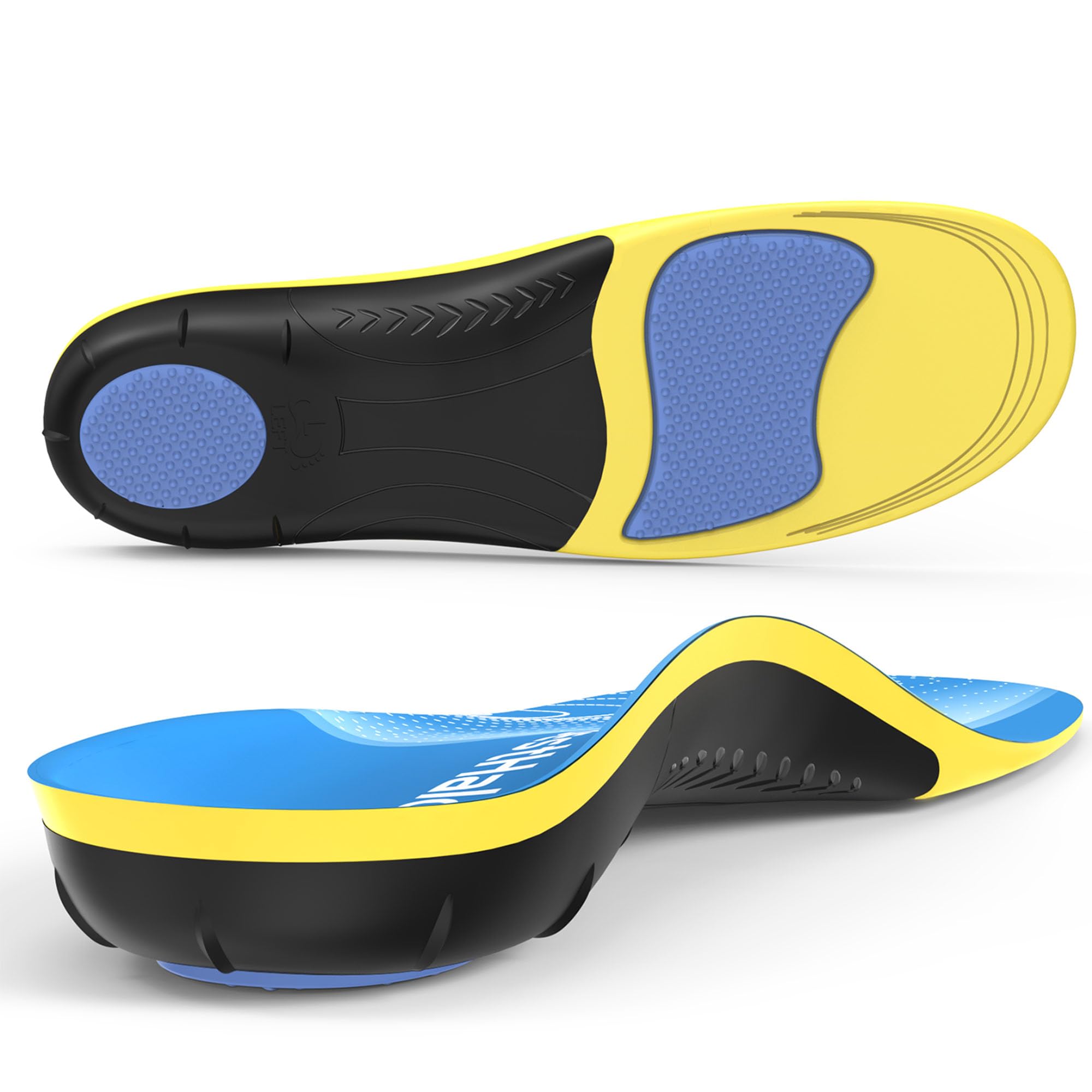
A high-arch orthotic with a deep heel cup, at the cheapest tier in the list.
Here is the value answer for high arches. The BestHalo insert is built specifically for plantar fasciitis comfort and structured high arch support, aimed at improving foot and leg alignment and easing stress through the arch and heel. The ergonomic deep heel cup stabilizes the heel and helps control overpronation and supination — the inward and outward roll that throws off your stride.
Premium EVA foam and gel cushioning give it real shock absorption for walking, running or standing all day. It trims to fit athletic shoes, sneakers, casual shoes and work boots, so you shave it down to your boot’s shape. At 9.91 ounces it is the densest footbed in the value tier, and that means substantial cushioning underfoot rather than a thin flap. It measures 12.36 inches long and 4.17 inches wide — shorter than the Sof Sole at 14.02 inches, so check your boot’s internal length first.
The adjustment period is the honest part. The maker notes mild pressure for the first 3-7 days as your feet adapt, so start with 2-3 hours a day. Trim-to-fit also means the fit depends on how carefully you cut, so measure the outline before you start snipping.
Arch-first design: A deep heel cup and structured high arch make this the pick for high-arched feet that need alignment, not just cushioning.
Ease-in required: The suggested 3-7 day adjustment window means you should not judge it on day one — ramp up slowly.
Ideal for: high arches and plantar fasciitis relief at the most budget-friendly tier.
skip it if: your boots run short inside, or you want to skip the break-in period entirely.
Know the Specs
Arch Support — The Real Decider
Arch support is the structured curve built into the insert to hold up the arch of your foot. It spreads your weight across the whole foot rather than loading the heel. For flat feet or plantar fasciitis, a rigid arch shelf usually does more than a soft top layer. Check whether the insert is described as structured or cushioned, because soft inserts often flatten out on hard floors.
Trim-to-Fit vs Pre-Sized
Trim-to-fit means you cut the insert down to your boot’s outline for a precise fit. It is flexible, and it lets you match an odd boot size. Pre-sized inserts are ordered by your shoe size and drop in without cutting, which saves time but leaves less room for error. If your boots run narrow or snug, trim-to-fit gives you more control over how much volume the insert adds.
Weight and Thickness
An insert’s weight and thickness tell you how much cushioning and structure it carries. A dense footbed rated for heavy weight tends to be heavier and thicker, which suits big-framed workers but can crowd a tight boot. A light insert is easier on the foot lift but gives less shock absorption. Match the build to your body weight and to how much room your boot leaves inside.
Top Cover and Moisture Control
The top cover is the fabric or coating your sock rests against. A moisture-wicking or COOLMAX top fabric pulls sweat away from the sock so feet stay dry through a hot shift. An anti-odor treatment helps keep boots fresher. A grippy or non-stick top layer also reduces the friction that leads to blisters and makes the insert easier to wipe clean, which extends how long it stays comfortable.
Common Questions
Will these work boot sole inserts fit in my boots?
Do work boot insoles help with plantar fasciitis?
How long does a work boot insert last?
Are heavier insoles better for heavy-duty work?
Can I trim a work boot insert to fit a smaller shoe?
What is the difference between anti-fatigue and orthotic insoles?
Can insoles cause discomfort in the first week?
Will a work boot insert make my boots too tight?
Do work boot inserts help with lower back pain?
The Bottom Line
For most workers, the work boot sole inserts winner is the PowerStep Pinnacle because it pairs a structured arch and heel cradle with dual-layer cushioning that holds up in real work boots. If you stand on concrete all shift and want a stated 12-month support window, grab the Superfeet Work Cushion. And for big, tall, or wide-footed workers who flatten lighter inserts, the Dr. Scholl’s Heavy Duty Support is the one to reach for. The PowerStep also carries the highest score of the lineup alongside its support shape, which is a quiet nudge that this is the safest pick if you want one solid footbed and nothing more to think about.
How we choose
We do not accept paid placement. Every pick is matched to a real buyer and a real use-case; we do not hands-on test units.
Sources
Specifications: manufacturer listings and product documentation. Review insights: verified customer reviews, as of November 2026. Pricing: not shown on this page (it changes often); check the current price via the retailer link.
As an Amazon Associate, Tactical Gear Guy earns from qualifying purchases. This does not affect which products we feature.