Specs are compiled from manufacturer listings and verified buyer reviews and can change over time — please confirm the key details on the product page before buying.
Buying work boots is not like buying sneakers. You need a toe cap that shrugs off a dropped toolbox, an outsole that grips wet concrete, and a pair you can stand in for ten hours without your heels screaming. This guide covers nine real pairs and tells you which one fits which job, so you can stop guessing and get back to work.
This guide is built by comparing the manufacturers’ published specifications and the patterns across verified customer reviews, so you get each pick’s real strengths and trade-offs instead of marketing spin.
You will see where the steel and composite toe caps land on safety ratings, how much each pair weighs, and which outsoles actually grip when the floor turns slick. The features that matter most on work boot shoes are toe protection, outsole grip, and all-shift comfort.
Top Picks


How To Choose The Best Work Boot Shoes
Start with the floor you stand on. A warehouse worker on sealed concrete needs grip and cushioning more than a rubber shell. A framer on a wet site needs a waterproof upper and a sole that bites. Match the boot to the surface and the shift length, and most of the decision makes itself.
Toe cap construction and weight
A steel toe puts a metal cap over your toes, which is why it stops a falling object but adds a little heft. A composite toe uses carbon fiber or a similar non-metal material, so it protects the same way while weighing less — and it will not trip a metal detector. Every safety toe here is built to meet an ASTM standard, which is the test that proves the cap survives a set impact and compression load.
Outsole grip on the surfaces you actually walk
Slip resistance is a read-the-label spec, not a guess. Look for an outsole described as slip resistant or SR, and check whether the maker names a test standard. A deep lug tread bites on gravel and mud. TPU and rubber outsoles each handle oil and abrasion differently, so pick based on what spills on your floor most.
Upper material, waterproofing, and how long a shift lasts
Full-grain leather resists abrasion and takes a beating, while a rubber and neoprene shell sheds water and cleans off fast. Mesh uppers breathe but need a waterproof liner to keep your socks dry. Whatever the upper, check for a removable insole — swapping it out is the cheapest way to fix a boot that fits everywhere except under your arch.
Side-by-Side Comparison
| Model | Best For | Toe Cap | Waterproofing | Upper Material | Amazon |
|---|---|---|---|---|---|
| CAT Men’s Threshold★ Best Overall | All-day site work | Steel toe | Waterproof construction | Leather | Amazon |
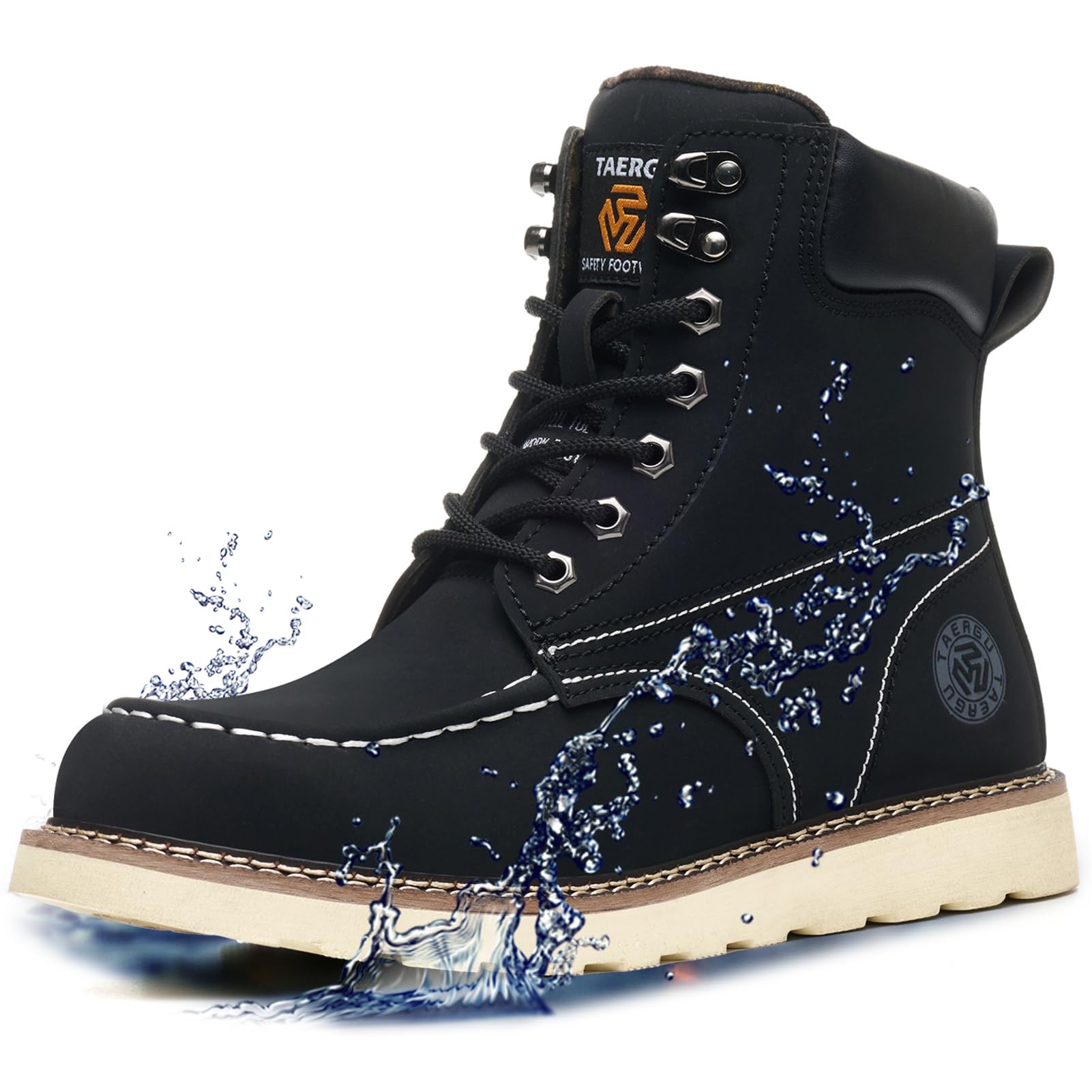
| Steel Toe Boots for Men Moc ToeBest Value | Construction and western wear | Steel toe | Waterproof | — | Amazon |
| LARNMERN Non Slip Ankle BootsBest for Kitchen Floors | Chefs and restaurant floors | — | Built-in waterproof isolation layer | Mesh | Amazon |
| NINGO Waterproof Steel Toe | Oil and gas, warehouse shifts | Steel toe, ASTM F2413-24 | Waterproof direct-attach | Full-grain leather | Amazon |
| TIDEWE Rubber Work Boots | Farms, fisheries, wet sites | Steel toe | 100% waterproof rubber and neoprene | Neoprene | Amazon |
| BOIWANMA Steel Toe Work Boots | Hiking and trades mix | Rubber toe reinforcement | — | Crazy horse leather and Cordura | Amazon |
| Timberland PRO Pit Boss | Wet or slippery surfaces | Steel toe, ANSI standard | Waterproof leather | Leather with nylon shock plates | Amazon |
| KEEN Utility Gibson | Electrical and hazard sites | Carbon fiber, ASTM F2413-18 | Water-resistant leather | Full-grain leather | Amazon |
| Ariat Rebar Lift 6″ | Long shifts and outdoor conditions | Composite toe | Waterproof | — | Amazon |
Detailed Reviews
1. CAT Men’s Threshold Waterproof Steel Toe Work Boot
Our pick — 4.0+★ from 13,500+ verified ratings; the strongest balance of quality and price.
The boots that earned their reputation one muddy job site at a time.
The CAT Threshold is the pick that keeps meeting the test. Its leather upper takes knocks without peeling, and the slip-resistant outsole is built to keep you upright when the floor turns shiny and slick. On your feet all day, that grip is the whole point — it is the difference between a confident stride and a shuffling, hesitant walk across a wet plant floor.
Comfort is the other big reason people talk about this boot. The soft removable insole lifts out, so you can swap in your own arch support without buying new boots. A removable footbed also means you can air it out and keep the inside from getting sour over a long season. At 2.06 pounds, it feels planted underfoot without dragging.
The catch is durability, and it is the honest sort of caveat. A number of buyers report the boot eventually falls apart, and some find water works its way in during sustained wet wear. The CAT Threshold is still the strongest overall package here, but treat it as a site boot for genuinely rough ground rather than a dunking boot for standing in water all day.
Where this boot delivers
- Leather upper takes hard knocks and keeps its shape
- Slip-resistant outsole keeps you upright on slick plant floors
- Soft removable insole swaps out for custom arch support
- 2.06 pounds feels planted without dragging
What to weigh before you buy
- Water resistance is mixed — sustained wet wear can let damp in
- Some pairs come apart faster than the price suggests
- Not a standing-in-water boot; pair it with a rubber shell for that
Made for: anyone working rough, dry-to-damp ground who wants grip and instant comfort without paying top tier.
Think twice if: you stand in standing water or deep puddles all shift — a rubber-shelled pair handles that better.
2. Steel Toe Boots for Men 6 Inch Moc Toe Safety Work Boots
The boot that checks every protection box without charging for the logo.
For the tradesman on a tight budget who still needs a serious safety package, this moc-toe pair does the job. It carries an ASTM 2413-2024 rating, which is the current test standard for toe impact and compression protection. It is also listed as puncture resistant, waterproof, non-slip, and heat resistant — that is a lot of protection folded into one very affordable boot.
The moc-toe stitching gives it a cleaner profile than a lot of safety boots, and the buyers who wear it for a full shift say the fit holds up across long days. The same pattern reads perfectly well off the clock, so you are not stuck changing shoes if you grab a beer straight from work.
The honest read: the safety specs are the real story here. Heat resistance is the one that matters if your job puts your feet near hot asphalt, welding spatter, or machinery exhaust.
The trade-off: at this end of the market, a moc-toe steel boot runs heavier and breaks in slower than a composite-toe pair higher up this list. First-week soreness is normal, so size to a thick sock.
Reach for this if: the budget is the hard stop and you still need heat and puncture protection on the job.
Look elsewhere if: you want a broken-in feel from day one — a mid-range leather boot gets you there faster.
3. LARNMERN Men Non Slip Ankle Boots
A kitchen-floor specialist that trades leather armor for a breathable mesh shell.
This is the pick for the person who lives behind a stove rather than on a build site. The mesh upper uses dense weave so air keeps moving and your feet do not cook, which matters when you are on your feet across a full dinner service. Inside, a built-in waterproof isolation layer is there to stop liquid from soaking in from above.
A porous cushion sole spreads pressure across the footbed, so the longest shifts do not leave you flat-footed by closing time. The one-piece tongue is the underrated bit — it blocks sand and strong wind from slipping in through the laces, so debris stays out of the shoe. The quality is what owners talk about most here, and the sizing runs true to the chart according to the feedback.
Water is the honest weak point. Some wearers report water creeping through the bottom of the sole, so if you tread through standing water all shift, this mesh pair is riskier than a rubber shell. Comfort leans mixed too — cushioning suits many, but a few find the sole stiff from the start. For grease-slick kitchen tiles, though, the non-slip grip earns its keep.
Fit profile: correct sizing and a snug tongue seal are the strengths here, so order your normal size rather than sizing down.
Real-world story: the non-slip and breathability make it the obvious pick for chefs, dishwashers, and floor managers on wet tiles.
Suits: chefs, restaurant staff, and anyone pacing wet, greasy kitchen floors in a hot kitchen.
Give it a miss if: your shift involves standing in deep puddles — go for the rubber-shelled pair instead.
4. NINGO Waterproof Steel Toe Work Boots
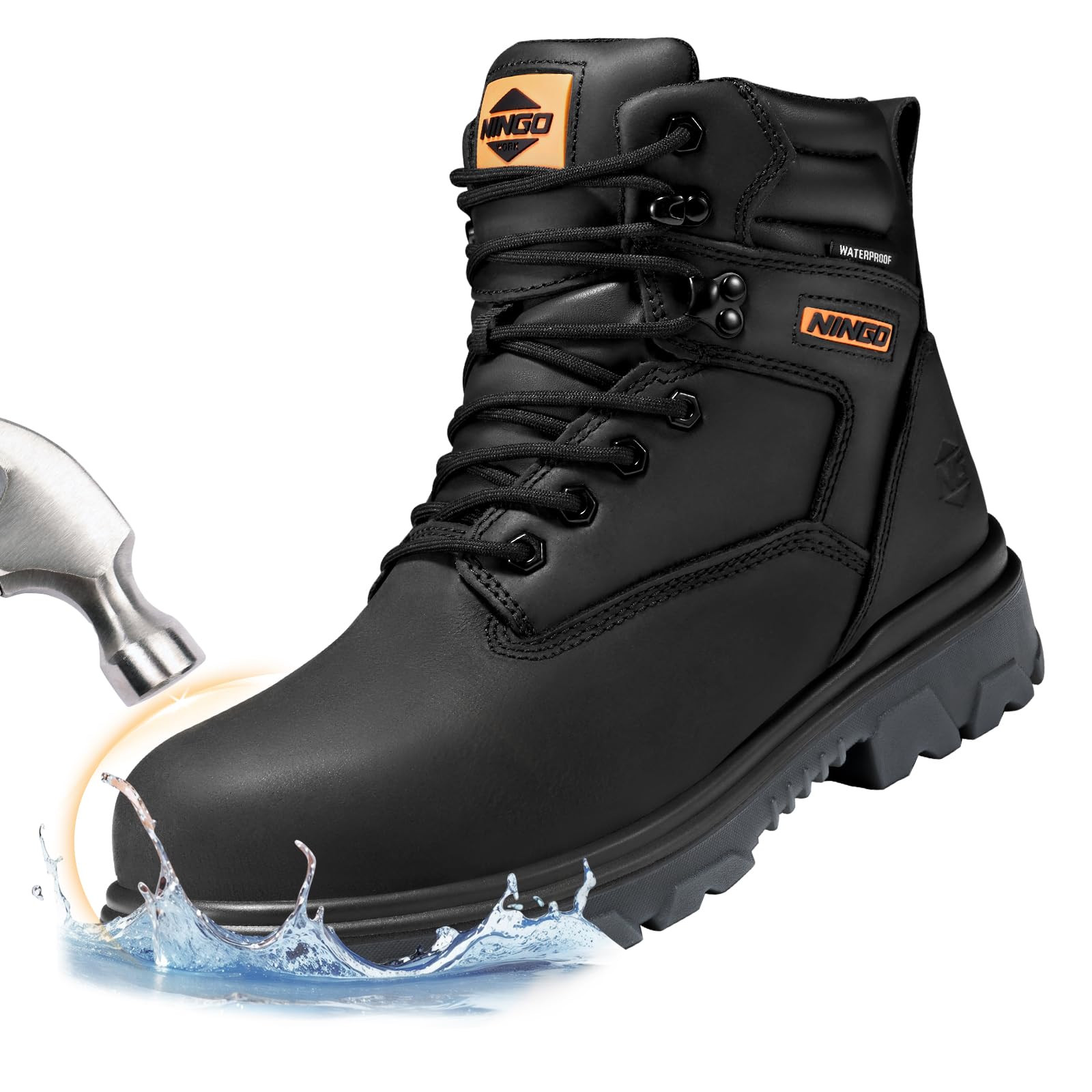
A full-grain leather workhorse that stacks certified protection into one boot.
Here is the spec sheet a site foreman wants to see. The steel safety toe meets ASTM F2413-24 for impact at I-75 and compression at C-75, plus Electrical Hazard protection. In plain terms, that toe cap is tested to survive a set falling weight and a crushing load, and the EH rating helps guard you if you touch a live circuit through the sole.
The full-grain leather upper is the other serious piece. It resists abrasion, holds its shape in rough conditions, and stays breathable for extended wear in a way thin synthetic uppers do not. Direct Attach Construction bonds the outsole to the upper, which the maker says improves stability and reduces separation over time — so the sole stays put instead of peeling at the toe.
Traction comes from a TPU SR lug outsole built to bite on wet, oily, and uneven ground. The maker claims the TPU outsole is built to resist abrasion and hold its tread over time. Weight is where opinions split, but the comfort verdict is clear — a removable high-rebound insole with gel heel padding softens the shock of a long shift.
Standout strengths
- Steel toe meets ASTM F2413-24 impact (I-75) and compression (C-75)
- EH rated against accidental live-circuit contact through the sole
- Full-grain leather resists abrasion and keeps breathing
- Removable gel-heel insole softens long-shift shock
Points to consider
- Buyers split on how heavy it feels once broken in
- Full-grain leather needs a care routine to stay supple
The specialist pick: an oil-and-gas or warehouse worker who needs certified EH and puncture protection in one leather boot.
The caveat: weight splits opinions, so if you have knee or back concerns, try a dedicated lightweight pair before committing.
5. TIDEWE Rubber Work Boots
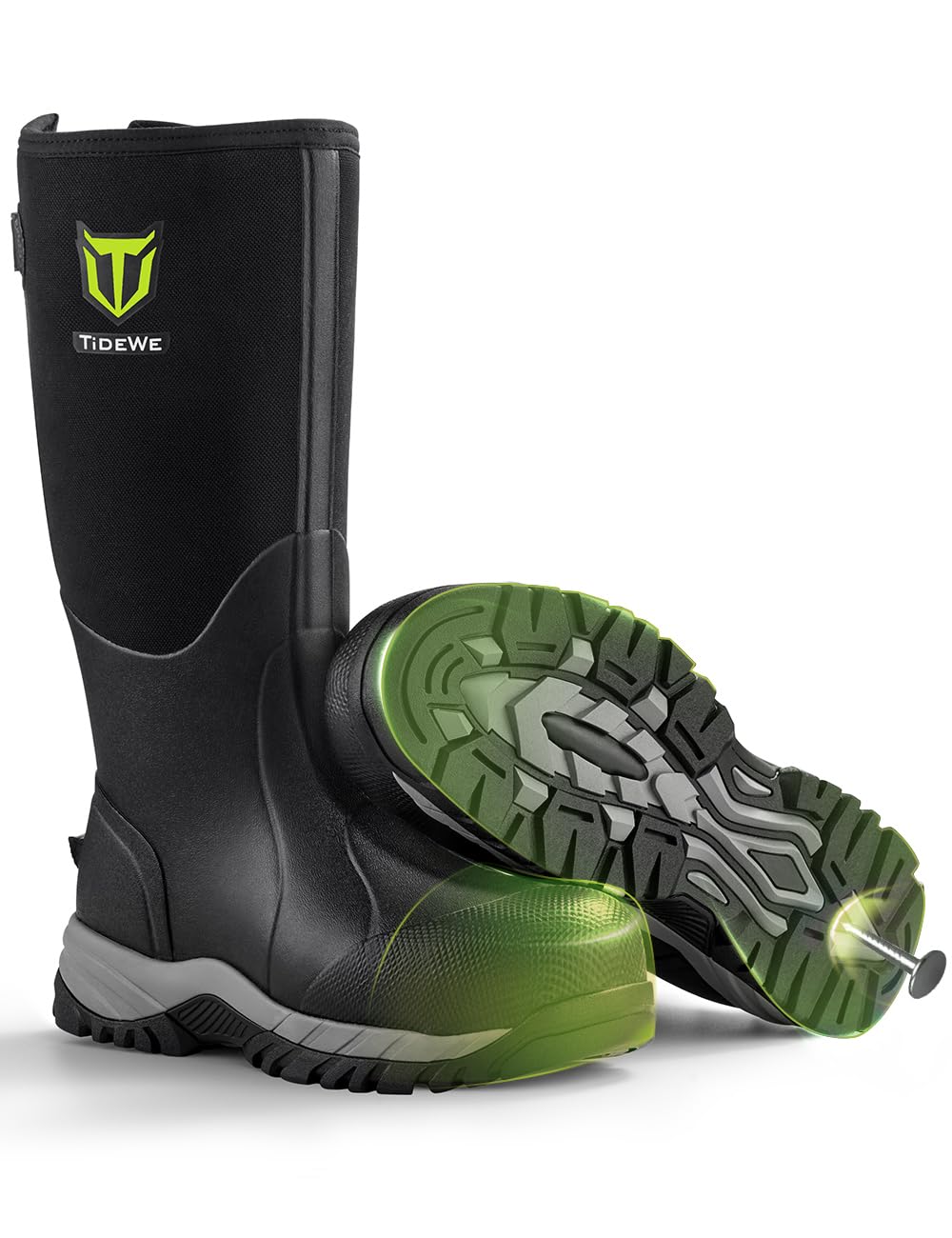
The pull-on rubber shell that keeps feet dry when the site is ankle-deep.
When water is the whole problem, you want a shell, not a stitched boot. The TIDEWE is made from 100% waterproof rubber and neoprene, so there are no seams for water to seep through. Pull it on, kick it off — the kick tab gets you out the door in a hurry, and 6mm neoprene adds warmth when the temperature drops.
Underfoot, a steel shank runs between the insole and outsole to support your arch and stiffen the boot, which is why these stay comfortable across a full workday of standing. The steel toe is built to take the impact of falling or rolling objects, and a puncture-resistant layer adds secondary protection under the sole. A breathable inner lining keeps air moving so your feet do not overheat on warmer days.
The size chart deserves your attention. The maker advises ordering a size about 0.16 inches longer than your measured foot, so measure in inches before you order. Water resistance is a mixed note in the feedback — most owners find it reliably dry, but some report it gets wet quickly, usually at the point where the shaft meets the top of the foot. The 10-inch shaft height covers the ankle for muddy, flooded ground.
Why it works: a rubber-and-neoprene shell with a steel shank gives you a boot you can hose off, and there are no leather panels to keep conditioned.
What to expect: this is a slip-on, so it lacks the lace-up ankle lock of a leather boot — fine for flat ground, less supportive on steep, rocky terrain.
Reach for it: farmers, fishery workers, and anyone wading through mud, manure, or standing water.
Not for: a clean indoor floor — the heavy lug tread and rubber shell are overkill, and the breathability is tuned for outdoor shifts.
6. BOIWANMA Steel Toe Leather Work Boots

One boot for the job site, the trail, and everything between.
BOIWANMA built this as an ankle-high hiking boot with a work boot soul. The upper is high-quality crazy horse leather backed by nylon Cordura, which is the abrasion-resistant fabric used in heavy packs. The outsole mixes EVA for cushioning with rubber for grip, and a rubber toe reinforcement guards the front against scuffs when you kneel or crawl.
The sizing advice from the maker is worth pinning. If your foot falls between two sizes, move up to the next one, and pick the width you are closer to. That is the same guidance you would want from any boot sold in a wide and medium range, and it is the difference between a snug fit and a binding one. Whether you are walking the dog, hiking, camping, or working a shift, this boot is designed to cover the ground.
Owners are loudest about quality, and the look earns real praise — the crazy horse leather takes a patina that looks better worn than new. Fit and traction are the honest risks. Some find the toe box too cramped, and some report the rubber outsole is not slip-resistant at all, so treat it as a dry-ground boot. Some buyers also report pairs coming apart within about 60 days, a real risk under hard daily abuse. On mixed-use duty, though, the versatility is hard to argue with.
Wins you over
- Crazy horse leather picks up a rich patina with age
- Rubber toe reinforcement takes scuffs when you kneel
- Available across a wide size range with width options
Where it may disappoint
- Traction is mixed — some find it not slip-resistant
- Toe box runs narrow for a few buyers
- Durability is a risk for hard daily site abuse
Made for: the person who wants one boot for the trailhead and the yard, and likes leather that gets better-looking with wear.
Think twice if: your job means oily or wet floors all day — this one is best on dry ground.
7. Timberland PRO Pit Boss 6 Inch Steel Safety Toe

A six-inch classic with a roomier toe box and a tread that claws at wet concrete.
The Pit Boss is the boot that has been on site crews for years. Its steel toe meets ANSI safety standards, and the toe box is cut roomier than most, so you get the protection without feeling like your toes are in a vise. Add electrical hazard protection and it is built for wet concrete, slick concrete ramps, and open circuits alike.
The waterproof leather upper is the foundation. Nylon shock-diffusion plates run through the boot for support and torsional rigidity, which is the stiffness that keeps the boot from twisting underfoot on uneven ground. A removable sock liner lets you pull it out and swap in your own, and the cushioning underfoot is there to keep blisters from being the price of a hard day.
Where does it fall short? Waterproof leather needs a regular condition to keep it supple — skip that and the surface will crack over a season. Durability is mixed in the long run, with a share of owners seeing pairs give out eventually. On traction and comfort, though, this is a boot that has earned its reputation, and it is second to none on wet or slippery surfaces.
The traction case: unsurmountable grip on wet and slippery surfaces is the headline, backed by the electrical hazard protection for job-site safety.
The comfort note: a roomier toe box than most steel-cap boots means less pinching after long hours, which is where steel-toe soreness usually starts.
For the crew: a site worker who wants a proven, roomy steel toe and refuses to slip on wet ramps.
Leaves out: nothing for dry sites — just plan to condition the leather and buy a new pair when soles wear through.
8. KEEN Utility Gibson Mid Height Composite Toe Work Boots

Composite safety toe, non-metal construction, and a footbed that feels like part of you.
If you walk through a metal detector for your job, this is the pick that keeps you moving. The carbon fiber safety toe is a non-metal cap, so you get the impact protection without the alarm. It is certified to ASTM F2413-18 M I/75 C/75 ESD/SD 35, which is the standard for impact and compression protection plus static dissipative performance — helpful if you work around sensitive electronics or static-risk areas.
Grip is engineered rather than guessed. The rubber outsole is built to meet or exceed ASTM F2913-19 SATRA non-slip testing and ASTM F1677-96 Mark II, two standards used to prove a sole bites on wet and oily surfaces. The midsole uses a compression-resisting material that holds its cushioning, so the boot still feels like a boot at the end of a shift, not a flat plank.
The upper is full-grain water-resistant leather from an LWG-certified tannery, with a PFAS-free durable water repellent — meaning the coating repels water without the long-lasting chemicals. Durability is the recurring doubt, with some pairs failing within a couple of months. Still, the comfort and quality are what the majority talk about, and the round-toe profile looks sharp off the clock too.
The safety case: a non-metal carbon fiber toe keeps you through metal detectors, and the static-dissipative rating suits electronics and clean-room work.
The caveat: comfort is high but the fit runs mixed, and a few people say the sole separates early — so buy from a retailer with a solid return policy.
Ideal for: electronics workers, clean-room crews, and anyone who needs to pass a metal detector in a safety boot.
Rethink it if: you want the toughest long-haul sole — this is a comfort-first boot with a mixed durability record.
9. Ariat Men’s Rebar Lift 6″ Waterproof Composite Toe Work Boot
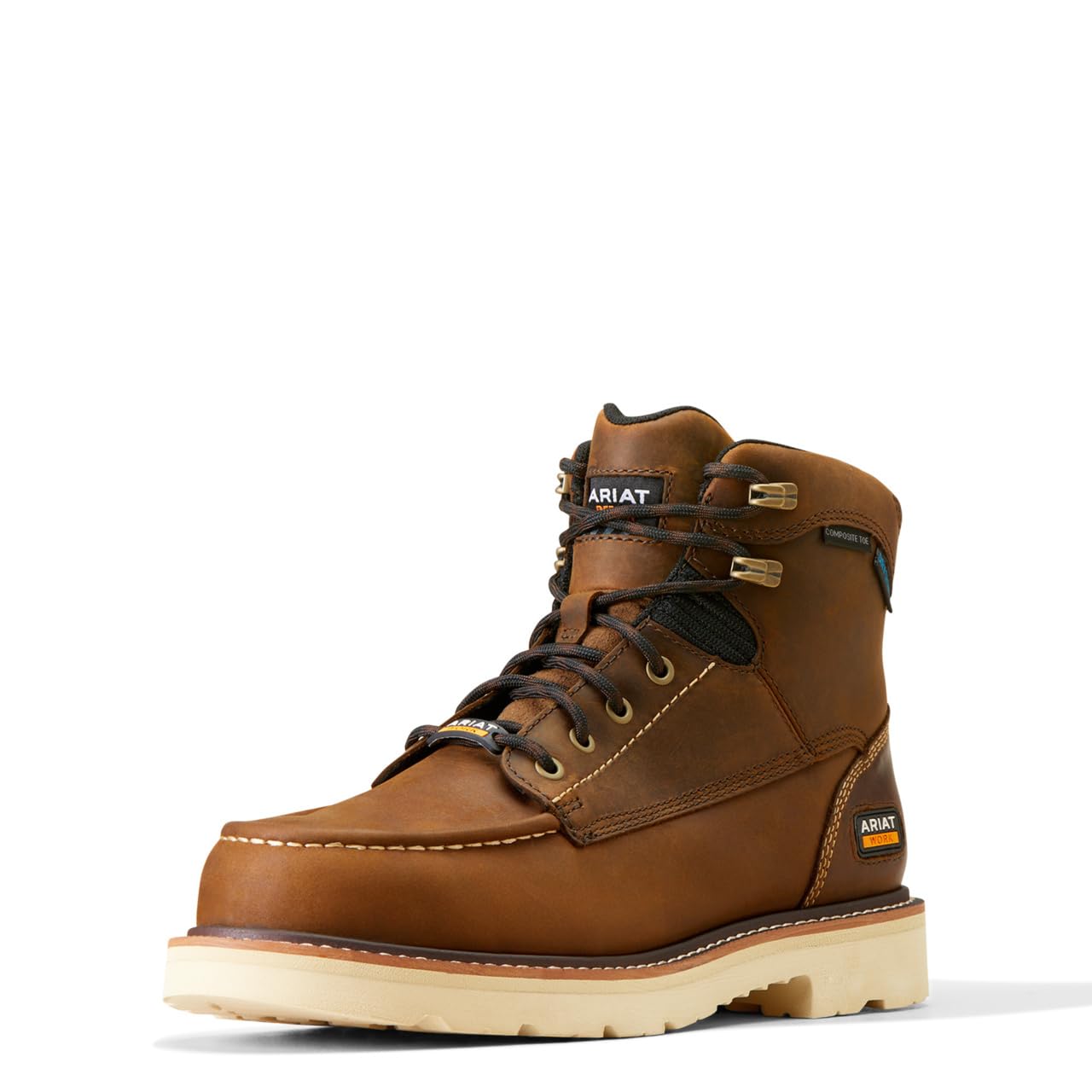
The long-shift boot for the worker who plans to stand all day and stay dry.
This is the top-tier pick for long days on tough ground. It is a composite-toe waterproof boot with cushioning built for stability, and at 5.5 pounds per pair, the heaviest here — noticeable on the first step, then forgotten once the support takes over. The elastic at the ankle is the detail the squat test is about — it gives where a stiffer collar would pinch, so you can bend and kneel without the boot fighting you.
Support is where this boot earns its tier. The footbed is cushioned and stable, which is the part that keeps your arches alive through a ten-hour day. Waterproofing is built in, so a wet morning does not turn into a wet afternoon.
The durability record is the caveat, and it is a real one. The most-discussed concern among owners is the sole peeling apart, and a share of the feedback describes the boot failing after a couple of months. For a premium boot, that is a caution. If you want the cushioned, supportive feel for less-abusive work, it is a strong pick. If your shift is pounding the sole against constant abuse, set expectations accordingly.
Where it shines
- Composite toe and built-in waterproofing in one boot
- Cushioned, stable footbed built for ten-hour shifts
- Elastic ankle section flexes for squatting and kneeling
- Foot support and appearance both land strong
Where it needs watching
- Sole separation is the recurring complaint
- Heaviest pair here at 5.5 pounds
- Premium tier pricing demands a longer lasting sole than some buyers get
The buy for: a worker who wants a cushioned, supportive waterproof boot and mostly walks and stands rather than pounding a sole into constant abuse.
The caution: if your job is the harshest sort of daily abuse, check the return policy and watch the sole seam.
Know the Specs
ASTM toe standards
ASTM toe testing is the standardized test that proves a safety toe cap survives a set impact and compression load. On a work boot label it appears as a code like I/75 C/75, which means the toe cap passed the impact and compression thresholds. If your site specifies a standard, buy a boot that names it on the label — a pair without the mark has not passed the same test, no matter how thick the cap looks.
EH and static-dissipative ratings
An EH (electrical hazard) rating means the boot is built to act as a secondary barrier from the ground to your feet when you contact a live circuit through the sole. A static-dissipative boot moves static charge to the ground rather than letting it build up. These two are not the same job — EH protects against electric shock through the shoe, while static-dissipative protects delicate electronics. Pick the one your workplace requires.
Outsole traction standards
Slip resistance is tested, not assumed. A boot described as meeting SATRA non-slip testing or ASTM F2913-19 has been put on a machine that measures how it grips a wet or lubricated surface. If your job involves oil-coated concrete or wet ramps, look for a named outsole test standard. A deep lug pattern alone tells you it bites on gravel, but it does not promise grip on oil.
Upper materials and weight
Leather and rubber and mesh each solve a different problem. Leather resists abrasion and takes a beating. A rubber shell is 100% waterproof and easy to hose off. Mesh breathes but needs a waterproof liner to keep water out from below. Weight is the trade-off you feel — a heavier boot often carries more support and a stiffer shank, while a lighter one is easier on the knees. Neither is better; the right one depends on how many hours you stand.
Common Questions
What does ASTM F2413-24 mean on a work boot?
Is a composite toe as protective as a steel toe?
What is the difference between EH rated and static dissipative boots?
Are rubber work boots like TIDEWE better than leather for wet job sites?
Will a non-slip work boot slip on oily concrete?
How long should a pair of steel toe work boots last?
Should I buy a work boot the same size as my sneakers?
Can I replace the insole in a work boot?
Do waterproof work boots need special care?
Is a heavier boot more protective than a lighter one?
The Bottom Line
For most working people, the work boot shoes winner is the CAT Men’s Threshold — leather that takes knocks, a slip-resistant sole that keeps you upright, and a removable insole for all-day comfort. If certified EH and puncture protection are your priorities, grab the NINGO Waterproof Steel Toe. And for soldiers of the wet ground — farms, fisheries, flooded sites — the TIDEWE Rubber Work Boots is the one to reach for.
The category favorite over the years is still the Timberland PRO Pit Boss, and there is a reason its name comes up on site crews — a roomy steel toe with traction that holds on wet concrete. But if your priority is protection on a budget, the BOIWANMA gives you a leather-and-Cordura upper for less than the premium names, and the CAT Threshold outstrips it on all-day grip.
How we choose
We do not accept paid placement. Every pick is matched to a real buyer and a real use-case; we do not hands-on test units.
Sources
Specifications: manufacturer listings and product documentation. Review insights: verified customer reviews, as of November 2026. Pricing: not shown on this page (it changes often); check the current price via the retailer link.
As an Amazon Associate, Tactical Gear Guy earns from qualifying purchases. This does not affect which products we feature.