Specs are compiled from manufacturer listings and verified buyer reviews and can change over time — please confirm the key details on the product page before buying.
If your saddle is sliding, pinching at the withers, or leaving a sore back after a long ride, the pad underneath is usually the culprit — not the saddle. A genuine wool pad conforms to your horse’s back, wicks sweat, and spreads pressure instead of concentrating it. Below are nine wool western saddle pads that actually earn their place under a saddle, sorted by what each one does best.
This guide is built by comparing the manufacturers’ published specifications and the patterns across verified customer reviews, so you get each pick’s real strengths and trade-offs instead of marketing spin.
You will see how thickness, contour, and wear leather placement change the ride for your horse. Every pick here is real wool at the contact layer, and each one suits a different back shape and riding discipline, which is exactly what separates a good wool western saddle pad from a pad that fights your saddle.
Top Picks


How To Choose The Best Wool Western Saddle Pad
Start with your horse’s back, not the pattern on the pad. A wool pad that matches your horse’s topline and your saddle’s skirt will sit still all day. One that fights either one will slide, rub, or bunch at the withers no matter how much you paid for it.
Match the thickness to your saddle fit
A 3/4-inch wool pad adds light cushioning without lifting your saddle off the back — good when your saddle already fits well. A 1-inch pad adds more protection for a saddle that sits slightly wide or a horse with a sensitive back. Go too thick and the saddle trees can pinch at the shoulders, so choose the thinnest pad that solves your fit issue.
Check the wither cutout and contour
A contoured pad has a shaped spine that follows the dip and rise of a horse’s back. The wither cutout is the notch at the front that keeps pressure off the gullet. If your horse has high, prominent withers or is young with undeveloped shoulder muscle, this shaping matters more than the colour.
Look at where the wear leathers sit
Wear leathers are the leather panels on the sides where your saddle’s fenders and stirrups rub hardest. Top grain leather there takes the abrasion so the wool doesn’t wear through. On a pad you plan to keep for seasons, that trim is the difference between a pad that ages well and one that frays at the edges.
Confirm it is real wool, not fleece
Genuine wool felt is dense, springs back when you press it, and wicks moisture away from the skin. Synthetic fleece feels soft but mats down with sweat and heat. Every pad on this list uses real wool at the contact layer, so you can compare on fit and thickness instead of material guesswork.
Side-by-Side Comparison
| Model | Best For | Thickness | Material | Size | Amazon |
|---|---|---|---|---|---|
| The Montana by Southwestern★ Best Overall | All-around western riding | 3/4″ or 1″ | 100% extra fine wool | — | Amazon |
| Reya Show Saddle BlanketShow Ring Pick | Show ring layering | Heavyweight | 100% New Zealand wool | 34″ x 38″ | Amazon |
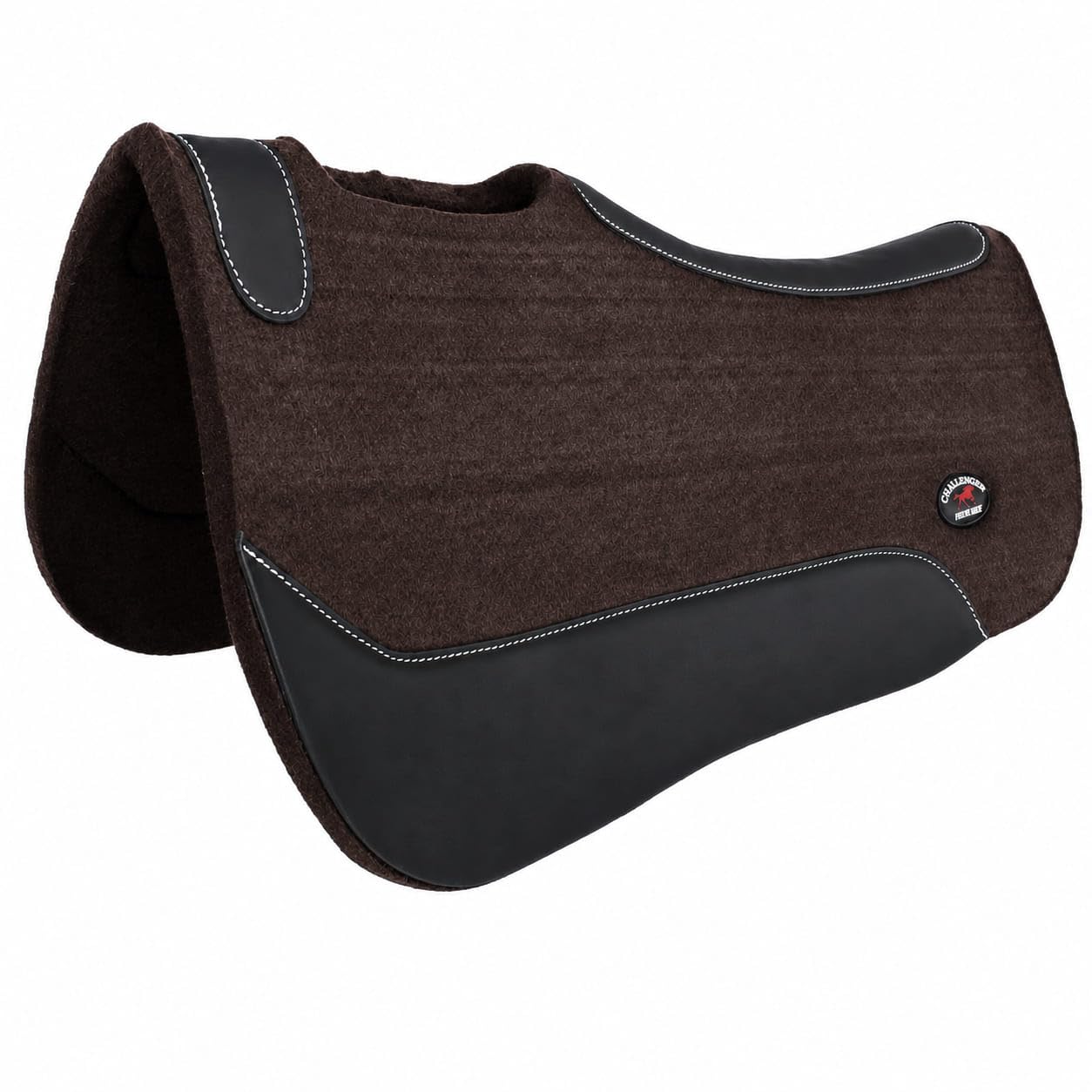
| Challenger Wool Felt ContouredBarrel Racing Fit | Barrel racing fit | — | 100% wool felt | 30″ spine x 15″ drop | Amazon |
| Tough 1 Pachanga Contour | Quarter horses | Firm | Wool fill | 36″L x 34″W | Amazon |
| Professional’s Choice Wool Felt | Shoulder freedom | 1″ | Steam-pressed wool felt | 31″ x 32″ | Amazon |
| OrthoRide All Wool Build Up | High-withered and young horses | Build up | All wool | 31″ x 32″ | Amazon |
| Silverado 1″ Contoured | Dipped backs | 1″ | 100% grey wool | 32″ x 32″ | Amazon |
| Jeffers WoolLuxe | Colour matching tack | 3/4″ or 1″ | 100% pressed wool | 30″ x 30″ | Amazon |
| 5 Star Performer Full Skirt | Roping and barrel racing | 1″ | 100% virgin wool | 32″ x 32″ | Amazon |
Detailed Reviews
1. The Montana 100% Extra Fine Wool Saddle Pad by Southwestern
Our pick — 4.5+★ from 200+ verified ratings; the strongest balance of quality and price.
Extra fine wool that moulds to a horse’s back instead of sitting stiff on top of it.
The Montana is the pad to buy if you want one that works across disciplines — working cattle, trail miles, shows, or a casual Sunday ride. It is built from 100 percent extra fine wool and made in the USA, at 6.28 pounds in the package. Fit is what wins people over: it settles onto the back and stays put, which keeps a saddle quiet on a moving horse.
You get a real choice on thickness with the 3/4-inch or 1-inch build. Pick the thinner version when your saddle already fits and you just want wool against the skin. Step up to the 1-inch version for more cushioning, and it comes with premium leather wear leathers that develop a patina the more you ride. It weighs 6.28 pounds in the package versus the Tough 1 Pachanga at 6 pounds, and that extra wool goes into the thicker option and the leather trim rather than dead weight.
The honest catch is stability and material, which both draw a split verdict from owners. Most horses keep this pad centred, but a few riders watch it shift side to side under a heavy roper. Wool is a natural fibre, so the density can vary between pads. If your horse has a dramatic back shape, try it before you commit to a full show season.
Where it proves itself
- Conforms to the horse’s back for a close, stable fit
- Holds up past a year of steady work
- 3/4-inch or 1-inch thickness covers both fit types
- Extra fine wool and USA construction
What to weigh first
- Can shift side to side on a hard-riding horse
- Natural wool density varies pad to pad
Reach for it when: you want one pad that covers trail, show, and ranch duty without a second purchase.
Think twice if: your horse has an extreme topline or you rope hard and need a pad that grips no matter what.
2. Reya Western Show Saddle Blanket
The blanket that gets you noticed in the ring and layers over the pad you already trust.
This is a show blanket, not a work pad, and it makes no apology for that. It is hand-woven and hand-dyed from 100 percent New Zealand wool in a geometric diamond stripe pattern, sized 34 by 38 inches and listed as heavyweight. You lay it over your regular saddle pad as a colourful top layer at shows, parades, and rodeos. Bulky enough to read from across the arena, but it does not add the kind of bulk that throws off your saddle fit.
The draw here is the colour. Owners rave about the vibrant finish, and it comes in four colour sets so you can match it to your horse’s coat, your tack, and your show attire. The tight weave is built to last years with proper care, and the New Zealand wool breathes and wicks moisture instead of trapping it. Since this is a single-layered blanket, treat it as the visible layer and let a proper felt pad do the pressure work underneath.
The follow-up question most buyers have is whether it can stand alone. It is meant to layer, so under a heavy saddle on a hard-riding day it will not give the cushioning a 1-inch felt pad does. Buy it for the look and the layering, add a wool pad underneath, and the combination works beautifully.
The colour story: hand-woven and hand-dyed in a diamond stripe pattern, in four colour sets, with the vibrant finish winning over show riders.
Read the fine print: this is a single-layered show blanket designed for layering, so it needs a felt pad beneath it for daily riding.
Best for: the rider who wants a show-stopping top layer in genuine New Zealand wool.
Not the one if: you need a standalone work pad for long trail days.
3. CHALLENGER Barrel Saddle Pad
A close-contact cut that puts you nearer the horse for quick barrel turns.
Barrel racers want to feel the horse under them, and this pad is shaped for exactly that. The contoured close contact design follows the natural curve of the back with a raised wither cutout, sized 30 inches along the spine with a 15-inch drop. The heavy wool felt stays soft from the first ride and conforms with little break-in, so you are not waiting weeks for it to settle.
The wool felt reduces heat build-up under the saddle and wicks moisture away. Top grain leather wear leathers run along the spine and the bottom edge, protecting the spots that wear fastest. It carries a 1 year manufacturer warranty on manufacturing defects, which is a real vote of confidence on a felt pad.
Here is the catch, and it matters. The contour is shaped to a specific back curve, and a number of owners find it does not match their horse’s topline. That is not a defect; it is a fit mismatch. If your horse has high withers and a pronounced curve, this cut is made for you. If the back is flatter or the shoulders are unusually shaped, measure before you buy.
What the shaping buys you: a raised wither cutout and close contact fit that relieves pressure at the withers and keeps the saddle secure underneath you.
The fit gamble: the contour suits a specific back shape, so a horse with a flatter topline may find it does not sit right.
Pick this one if: you race barrels and want felt that breaks in fast with a wither-relief cut.
Look elsewhere if: your horse has an unusually flat or wide back that this contour was not shaped for.
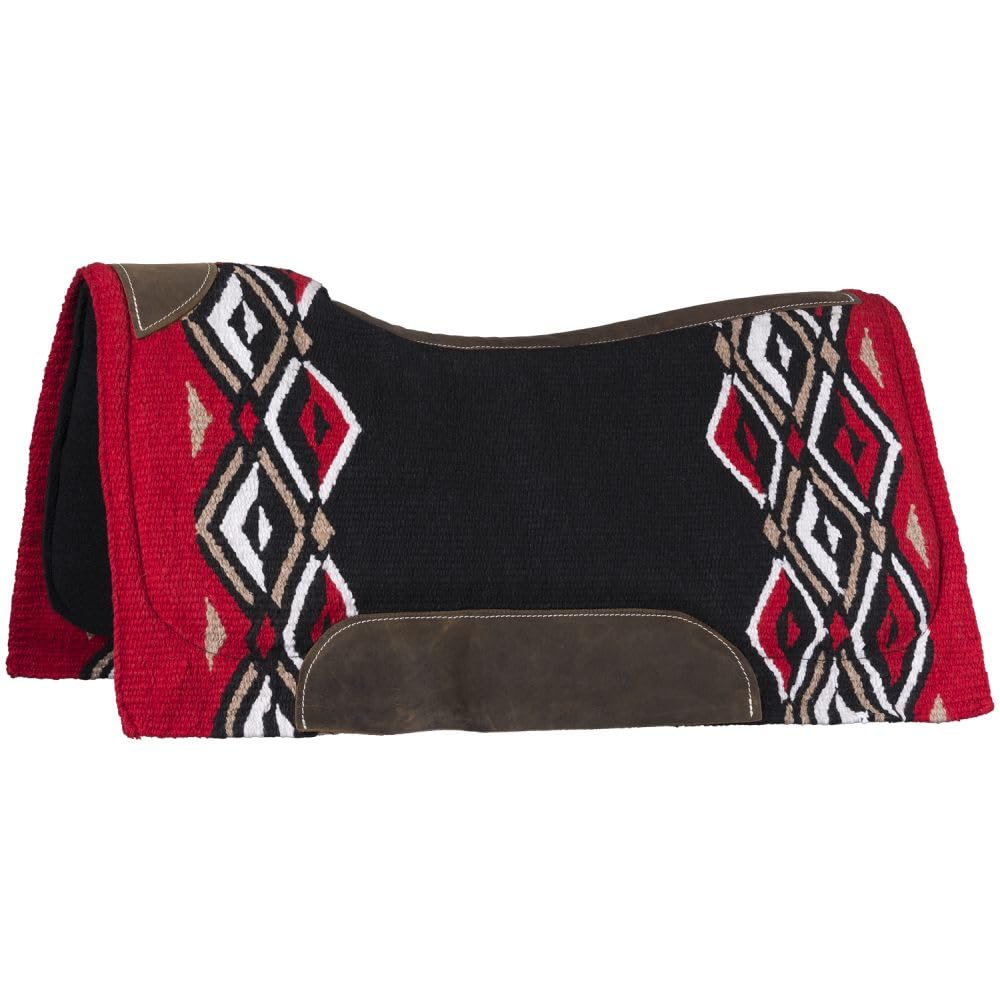
4. Tough 1 Pachanga Contour Wool Saddle Pad
A firm contoured pad that Quarter horse owners keep coming back to.
Firmer than most pads on this list, and that is the point. The Pachanga uses a wool fill with a felt cover, measures 36 inches long by 34 inches wide, and tips the scale at 6 pounds. The contour is shaped for a horse that has a natural curve to the back, and Quarter horse owners in particular find it fits their horses’ build well. What earns it the value label is quality for the money — owners call it out as genuinely well made.
The cushioning is a genuine strength. It lifts pressure off the withers enough that the pinching some horses live with disappears. Colours are bright and hold up, and the red and black option looks sharp without being loud. Compare it to a thinner, lighter pad and you feel the difference in support.
Where it falls short of the heavier Montana: this one’s firm build can feel too stiff on a horse that is used to a soft pad, and it takes a ride or two to relax into the back. It is not the pad for a horse that needs a thick layer of cushioning. Buy it for a Quarter horse with a curved back and a saddle that already fits reasonably well.
Why Quarter horse owners rate it
- Contour is a natural fit for a curved Quarter horse back
- Cushioning lifts pressure off the withers
- Bright colours that hold up over time
- Firm support that stays put without bunching
The trade-offs worth knowing
- Firm build feels stiff at first
- Wool fill with a felt cover rather than 100% wool top
The best buy for: a Quarter horse with a curved back and a rider who wants firm, honest support.
Maybe not for you: a horse that needs a thicker, softer pad under a marginally fitting saddle.
5. Professional’s Choice Western Saddle Pad

A cutback front that gives the shoulders room to swing through a full stride.
Built from 100 percent steam-pressed wool felt, this pad is shaped 31 by 32 inches and a full 1 inch thick. The steam pressing compresses the wool into a dense, springy felt that absorbs shock and holds its shape. The contoured spine has a built-in channel that opens the airflow and lifts the withers clear. What really distinguishes it is the cutback front — the front is scooped away so the shoulder can move freely, which matters for a horse in serious work.
The felt bottom wicks sweat and moisture away from the skin, so the back stays cooler on a long training session. Oversized wear leathers sit where the saddle rubs hardest, and they resist the friction that eats through cheaper trim. Quality is the strongest theme in the owner feedback, with fit and appearance right behind it.
Durability is where opinions split. Most pads hold up fine, but the stitching along the leather trim has come apart on a few. Check those seams when it arrives and keep an eye on them over the season. The payoff is a pad with real shoulder freedom and a well-built felt body — that is the combination you are buying.
What owners gush about: the dense, springy steam-pressed felt and the cutback shoulder cut that lets a horse stretch out.
The watch-out: check the stitching on the leather trim, as that is the spot where a few pads have started to separate.
Right for: the performance horse whose shoulders need freedom and whose rider wants dense, shock-absorbing felt.
Skip the leap if: you want to avoid leather trim stitching entirely and prefer a plain wool edge.
6. OrthoRide Made in USA Premium All Wool Build Up Saddle Pad

Shaped to fix a saddle fit problem before you buy another saddle.
If your saddle rubs at the withers and you have been blaming the saddle, this pad is designed to be the cheaper fix. The OrthoRide is an all wool build up, made in the USA, in a 31 by 32 inch classic contour. It is shaped specifically for high-withered horses where the saddle rubs, and for young horses whose shoulder muscles have not filled out yet. The added build up fills the gap so the saddle sits level.
What owners notice is how it behaves over the back. It bends to follow the horse’s shape rather than sitting like a plank, and it settles in place instead of shifting under a riding horse. One OTTB working in a western saddle gets on with it well. Quality is what comes through most in owner feedback, with fit close behind — that is the pairing you want from a pad doing correction work.
Under the horn, a PORON-RXD layer is claimed by the maker to absorb up to 90 percent of shock. That is the company’s claim, and it matters most if you rope, run barrels, or do other hard-stop work where the shoulders take a jolt. The trade-off is weight: at 2.86 kg in the package it is a heftier pad than a slim felt one, so a very weight-conscious rider will feel it. For a horse that needs a fit problem solved, that weight is spent on purpose.
Where it shines
- Build up fills the gap on a high-withered horse
- Designed for young horses with undeveloped shoulders
- Bends over the back and stays in place
- PORON-RXD under-horn shock layer
What it does not hide
- Heavier build than a slim felt pad
- The shock-absorbing figure is the maker’s
Buy it for: a high-withered or young horse whose saddle rubs, and for ropers chasing shock protection.
Hold off if: your horse already fits its saddle and you want the lightest pad possible.
7. Silverado 1″ Contoured Saddle Pad

A full inch of grey wool shaped for a horse with a dip in its back.
The Silverado is built for a specific horse: one with a slight dip in the back or more prominent withers. The contour is shaped so the front relieves pressure from the withers, and a wither cutout helps lift the saddle gullet clear. It measures 32 by 32 inches and a full 1 inch thick in 100 percent grey wool, at 7.2 pounds. That is a substantial pad, and the 1-inch body is why.
Top grain wear leathers protect the sides where the saddle and stirrup leathers wear hardest. The maker claims this trim outlasts an unprotected edge, and owner reports on the leather guards back that up. Owners who ride several times a week find the wool body holds up and stays comfortable under a saddle. The 1-inch thickness is the real comfort lever for a horse with a dipped back.
One practical note: this pad is hand wash only. Wool that dense does not belong in a machine on a spin cycle, and hand washing keeps the felt from collapsing. A softer, more forgiving thickness might suit a well-muscled horse better, but for the dipped-back and high-wither horse this is a strong, honest option.
The defining spec: a full 1 inch of 100 percent grey wool at 7.2 pounds, shaped for dipped backs and high withers.
Upkeep reality: hand wash only, so plan for a gentle wash rather than a machine cycle.
Made for: a horse with a dipped back or prominent withers that needs a full inch of cushioning.
Probably not your pad: if you want a light, thin pad for a well-muscled horse or you prefer machine washing.
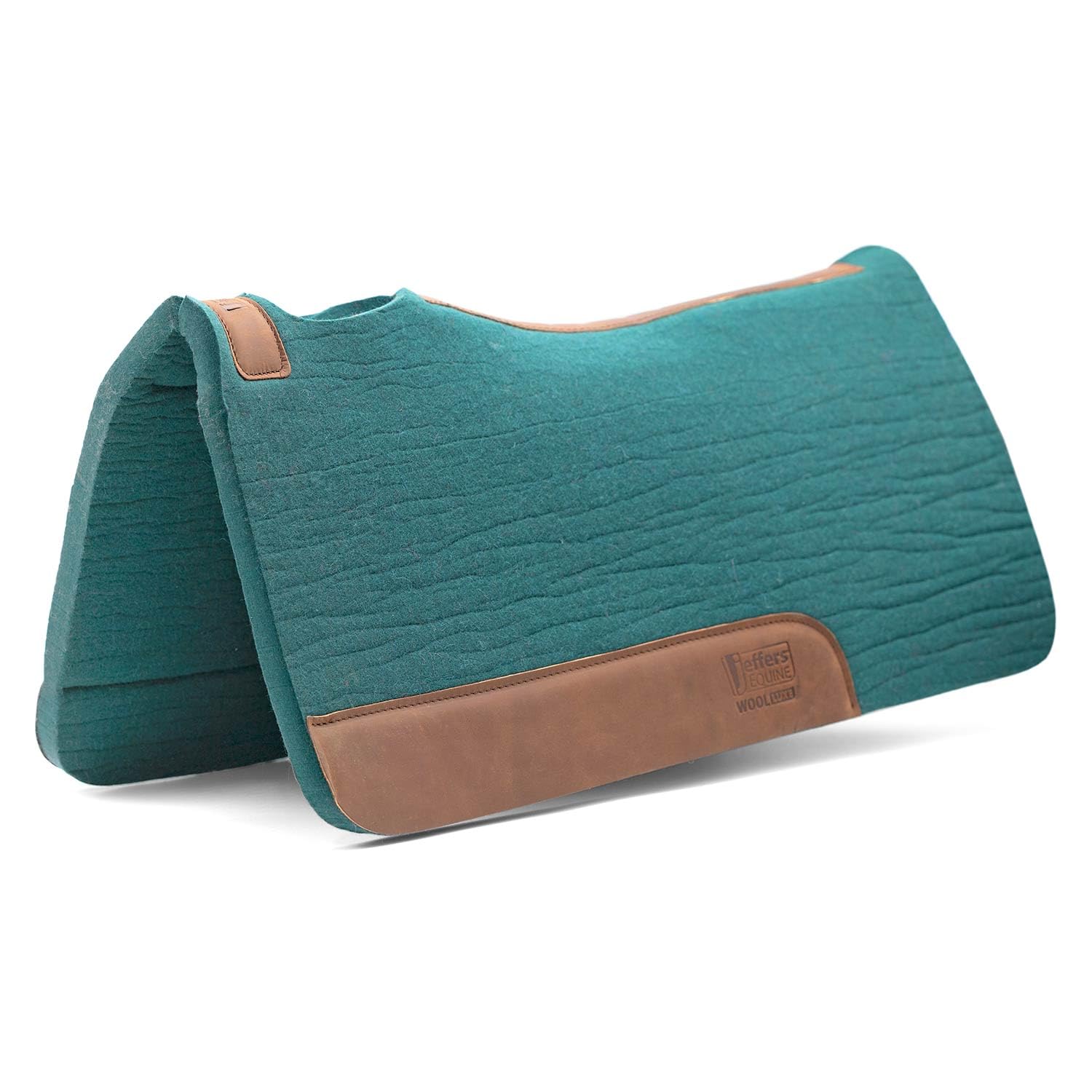
8. Jeffers WoolLuxe 100% Wool Felt Saddle Pad
The eight-colour build for riders who want their pad to match their whole tack set.
This pad makes coordinating your tack easy. The WoolLuxe comes in pink, turquoise, blue, cream, red, purple, emerald green, and black, so you can pull the pad into your bridle, breast collar, horse blanket, and leg wraps. It is 100 percent pressed wool, compression resistant, and naturally breathable, sized 30 by 30 inches with a 3/4-inch or 1-inch thickness choice.
The pressed wool is built to hold its shape ride after ride rather than matting down, and it wicks moisture to keep the back cool on extended sessions. It suits trail riding, arena work, daily training, barrel racing, and roping, so it is a practical all-rounder rather than a single-discipline pad. At 8 pounds it sits at the firm end — weight you notice but do not fight.
The one thing to look at closely is the sizing. The 30 by 30 inch footprint is on the smaller side compared with the 32 by 32 inch Silverado, so a full-skirt western saddle may push past its edges. Measure your saddle’s skirt before you buy. For a compact saddle and a rider who wants colour in a wool pad, this one delivers.
Where it wins: eight colourways in 100 percent pressed wool, so your pad can match the rest of your tack.
Size it first: the 30 x 30 inch footprint is smaller than the 32 x 32 inch Silverado, so a full-skirt saddle may overhang.
Ideal for: the rider who wants a wool pad in a colour that matches the whole tack set.
Check the fit if: you ride a full-skirt western saddle and need the pad to reach the edges.
9. 5 Star Horse Saddle Pad – The Performer Full Skirt 32″ X 32″

A full-skirt wool pad built for hard barrel runs and long roping days.
For riders who work a horse hard, the Performer is the top-tier option. It is 100 percent virgin wool, 1 inch thick, and shaped 32 by 32 inches in a full skirt to cover plenty of back. The contoured shape is built to fit horse and rider, and the wool body has more compression resistance than a synthetic pad, which spells less cinching. That matters on a hard run — a pad that stays put and holds its cushion means you can cinch down less and ask more of the horse.
The 1-inch thick wool body keeps pressure spread across the back, so a hot barrel run or a roping turn does not concentrate force into one spot. The full-skirt coverage protects more of the back under a heavy western saddle. For hard riding, virgin wool is the material that holds its shape season after season.
The honest caveat is weight and length. This is a substantial full-skirt pad, so a weight-conscious rider will feel it, and the full skirt is more pad than a minimal close-contact setup needs. For a rider who wants a compact pad, look at the Challenger’s close-contact cut instead. For a rider who wants the maximum wool down the back, this is the one.
What hard riders want
- 100% virgin wool holds its shape and compression
- 1 inch thick spreads pressure across the back
- Full skirt protects more of the back under a heavy saddle
- Contoured for less cinching and reduced slippage
The cost of all that wool
- Substantial weight a weight-conscious rider will feel
- Full skirt is more pad than a close-contact setup needs
Go with this if: you want the most wool down the back for roping, barrel racing, and trail miles.
Pass if: you want a light, compact pad for a close-contact work horse.
Know the Specs
Thickness and Saddle Fit
Thickness is measured in inches and it decides how much lift your saddle gets. A 3/4-inch wool pad adds light cushioning and sits close to the back — use it when your saddle already fits well. A 1-inch pad raises the saddle higher for extra protection, which suits a saddle that sits wide or a horse with a sensitive back. Go too thick and the saddle tree can pinch at the shoulder, so pick the thinnest pad that solves your issue.
Wool Felt vs Woven Wool
Both are real wool, but they behave differently. Wool felt is pressed into a dense, springy sheet that springs back when you press it and cushions consistently. Woven wool is hand-woven, so you get a visible pattern and a softer, more structured drape. Felt is the workhorse for daily riding and correction; woven wool is often the choice for a show blanket that layers over a pad for colour.
Contour and Wither Cutout
A contoured pad has a curved spine that follows the dip and rise of the back. The wither cutout is a notch at the front that keeps pressure off the gullet and the withers. For a high-withered horse or a young horse whose shoulder has not filled out, the contour and cutout do more for comfort than extra thickness alone.
Wear Leathers and Pad Life
Wear leathers are the leather panels on the sides where the fenders and stirrup leathers rub hardest. Top grain leather there takes the abrasion so the wool does not wear through. On a pad you plan to keep for seasons, the quality of that trim decides whether the edges stay intact.
Common Questions
Should I choose a 3/4-inch or 1-inch wool saddle pad?
Will a wool western saddle pad stop my saddle from slipping?
Does a contoured pad help a high-withered horse?
Can I use a show blanket on its own for riding?
How do I clean a wool felt saddle pad?
What size saddle pad do I need for a full-skirt western saddle?
Is wool better than synthetic fleece for a saddle pad?
Do leather wear leathers make a saddle pad last longer?
Can a build-up pad fix a saddle that rubs at the withers?
Is a heavier wool pad a problem for my horse?
The Bottom Line
The wool western saddle pad that suits most riders is the The Montana by Southwestern, because its extra fine wool conforms to the back and stays put across trail, show, and ranch work. If your horse is high-withered or young and the saddle rubs, grab the OrthoRide All Wool Build Up to fill that gap. For a Quarter horse with a curved back on a sensible budget, reach for the Tough 1 Pachanga — its firm, honest support has earned a loyal following among owners who want a pad that just works.
How we choose
We do not accept paid placement. Every pick is matched to a real buyer and a real use-case; we do not hands-on test units.
Sources
Specifications: manufacturer listings and product documentation. Review insights: verified customer reviews, as of November 2026. Pricing: not shown on this page (it changes often); check the current price via the retailer link.
As an Amazon Associate, Tactical Gear Guy earns from qualifying purchases. This does not affect which products we feature.