Specs are compiled from manufacturer listings and verified buyer reviews and can change over time — please confirm the key details on the product page before buying.
You want a wool top that keeps you warm on a cold hill without scratching your skin raw. The best women’s wool base layer disappears under your shell on the climb and still feels dry and warm when you stop.
This guide is built by comparing the manufacturers’ published specifications and the patterns across verified customer reviews, so you get each pick’s real strengths and trade-offs instead of marketing spin.
Below you will find nine wool layers sorted by what they actually do well, from everyday crews to a heavyweight expedition bottom. My aim is simple: help you land on the right wool base layer for women’s cold-weather days without guessing.
Top Picks


How To Choose The Best Wool Base Layer Women’s
Most people buy a wool layer in a hurry before a trip, then discover the fit or the weight is wrong for how they actually move. A few minutes of reading the label saves that. The label tells you the weight, the wool content, and the fiber size — and those three numbers decide your comfort.
Start with fabric weight, not the logo
Weight is measured in grams per square meter, written as g/m2 or gsm. A 175 g/m2 layer is thin enough to wear under a work shirt in fall. A 400 g/m2 layer is a deep-winter piece built for standing around in serious cold. If you run hot on a climb, the 175 g/m2 layer vents better. If you sit still at a ski lift, the 400 g/m2 layer holds heat.
Check the merino fiber size in microns
A micron is one thousandth of a millimeter, and it is how wool is graded for softness. Merino in the 17.5 to 18.5 micron range is fine enough that most people do not feel itch against bare skin. Wool above roughly 30 microns is the scratchy fiber that made you hate sweaters as a kid.
Decide between 100% merino and a blend
You get the best odor control and temperature regulation from pure merino (a soft, fine wool from merino sheep). A blend with polypropylene (a synthetic fiber that dries fast) adds durability and a faster dry time. That blend does soften the natural-wicking story slightly. Choose pure merino for odor control and natural feel, or the blend for durability and faster drying on high-output days.
Match the garment shape to the layer above it
A crewneck sits quietly under a flannel or a fleece. A half zip gives you a vent when you overheat on the climb and a collar when the wind picks up. Bottoms are a separate decision: a 400 g/m2 expedition bottom under jeans serves a different job than a thin legging under ski pants.
Side-by-Side Comparison
| Model | Best For | Wool Content | Weight | Style | Amazon |
|---|---|---|---|---|---|
| Icebreaker 175 Everyday Crew★ Best Overall | Everyday wear and travel | 100% merino wool | 175 g/m2 | Long sleeve crewneck | Amazon |
| Merino.tech Thermal Shirt UnderscrubBest Under Workwear | Under scrubs and workwear | 100% merino wool | — | Long sleeve crew | Amazon |
| MERIWOOL 250g Half ZipBest Half Zip | Venting on the move | 100% merino wool | 250 g/m2 | Half zip | Amazon |
| LAPASA Merino Set | Full top-and-bottom kit | 100% merino wool | — | Set | Amazon |
| Minus33 Expedition Bottoms | Frigid-weather leg layer | 100% merino wool | 400 g/m2 | Bottoms | Amazon |
| MERIWOOL 400g Thermal Shirt | Deep cold and standing still | 100% merino wool | 400 g/m2 | Thermal crew | Amazon |
| Helly Hansen LIFA Merino Crew | Hard output and moisture | 57% merino, 43% polypropylene | — | Midweight crew | Amazon |
| Merino.tech 250 GSM Set | Complete cold-weather kit | 100% merino wool | 250 GSM | Top and bottom set | Amazon |
| Smartwool Classic Thermal Crew | All-day comfort and washing | 100% wool | Medium weight | Long sleeve crew | Amazon |
Detailed Reviews
1. Icebreaker Merino Womens 175 Crewneck
Our pick — 4.5+★ from 750+ verified ratings; the strongest balance of quality and price.
The thin merino layer you can wear alone on a hike and again under a ski jacket.
Icebreaker pitches the 175 Everyday as a year-round top, and the weight backs that up: 175 g/m2 is thin enough that it does not bulk under a shirt. That same thinness is why it works as a next-to-skin layer on frigid resort days. You are not layering a sweater’s worth of fabric under your shell.
What wins people over is the construction quality — the rib-knit fabric earns the most praise of anything on this top, with fit right behind it. Owner experience backs both up. The shirt runs slender and stays long enough to tuck into jeans or leggings, which is the fit detail that decides whether a base layer rides up all day. It does not itch, and the wool handles odor on its own, so you can wear it more than once on a trip.
The catch: this is a thin layer by design. If you are standing still in deep cold, it will not be enough alone — you need a midlayer over it. And a 100% wool knit this light deserves gentle washing and lay flat drying to keep its shape over many seasons.
What makes it the pick
- 175 g/m2 rib-knit merino packs tiny and layers without bulk.
- Slim cut with enough length to stay tucked under jeans or leggings.
- Wear-it-alone looks plus odor resistance make it a travel one-bag favorite.
- 100% merino, so temperature regulation and breathability stay natural.
Where it asks for care
- Thin at 175 g/m2 — it needs a midlayer for genuine deep-cold standing around.
- 100% wool knit wants careful washing and air drying to hold shape.
Land this pick if: you want one light merino top that pulls travel, hiking, and resort duty all year.
Move on if: you need serious standalone warmth in frigid conditions — this is a first layer, not a winter coat.
2. 100% Merino Wool Base Layer Women Thermal Shirt
A merino crew cut slim enough to disappear under scrubs and office shirts.
If your day starts in scrubs or a uniform, the base layer has to sit flat and stay quiet — no bunching at the cuff, no bulk at the neckline. This Merino.tech top is built for exactly that. The cut keeps close to the body so it slips under scrubs, workwear, or a regular blouse without a visible seam of wool showing through.
The shirt carries a UPF 50+ rating, which is a measure of how much of the sun’s UV rays the fabric blocks. That matters if you commute, work near windows, or hike on sunny days. The 100% merino knit is soft enough to skip the itch, and the four-season warmth claim holds up in practice — it adapts to warm rooms and cool outdoor stretches without a hard switch. The maker also rates it washer and dryer safe, with hand wash and air dry recommended for a longer life.
The honest note: merino this thin will not carry you through a bitter day alone. It is a comfort layer, not a cold-weather hero. If you want standing-still warmth in real cold, look at a heavyweight.
Why it earns a slot: it solves a specific problem — a wool layer that does not announce itself under a uniform — and adds sun protection on top.
The trade-off to know: a light knit, so it lives in the comfort-and-layering tier rather than the deep-winter one.
This one is for: nurses, office workers, and anyone who wants merino under a uniform all day.
Look elsewhere if: you need the warmest single layer for standing around in freezing air.
3. MERIWOOL Womens Base Layer 250g Half Zip
A midweight merino zip you can vent on the climb and zip up at the summit.
Half zips fix a problem the crewnecks cannot: you can dump heat without stopping to strip. MERIWOOL builds this one at 250 g/m2 — a middle weight that sits above the thin 175 g/m2 Icebreaker and well below the heavy 400 g/m2 layers. That gap between 175 and 250 is the difference between a shirt you wear under a flannel and one that almost doubles as an outer layer on a cool hike.
The wool is 18.5 micron merino, a fine fiber size that keeps it soft against bare skin. The raglan sleeves set the shoulder seam away from the top of your arm, which frees your range of motion and keeps a pack strap from grinding into a join. The cut ends just beneath the sternum, so it reads as a light sweater — you can wear it on its own around town or on the slopes. Quality and fit carry the most weight with buyers, and the fabric gets called out as beautiful and soft.
Sizing is the one mixed signal. Some women find the fit true, others want more room — reading the size guide before you order is more useful here than trusting your usual letter size. The 100% merino also wants a gentle wash cycle and flat drying, not a hot tumble.
What the zip buys you: temperature control on the move, plus a collar that seals a cold wind when you need it.
The honest fit note: sizing runs inconsistent enough that the chart, not your default size, is the better guide.
Pick it for: active cold-weather days where you heat up climbing and cool down at the top.
Think twice if: you want a guaranteed true-to-size pull-on without checking the chart.
4. LAPASA Womens 100% Merino Wool Base Layer Set L58/L91/L127

One box gives you the top and the legs — a complete merino kit for a cold trip.
Buying layers one piece at a time means two decisions and two chances to get the fit wrong. This set removes one of them. You get a merino top and matching bottom in a single order, which matters most when you are packing for a ski week or a cold-weather trip and do not want to hunt for the matching half.
Warmth is the aspect buyers praise most, with quality close behind, and the temperature-regulating wool is what carries it — it handles deep cold without feeling clammy up close. The fabric is soft enough for a full day against the skin and light enough that the set adds little to a pack. Most owners consider it money well spent, which is the phrase that keeps coming up.
Fit and sizing are the mixed notes. Some women find the cut snug, others find it roomy — the same body size can land on both sides. That is worth planning for: if you want a loose fit, lean toward sizing up, and read the size guide before you commit.
Worth knowing upfront
- Top and bottom in one purchase — no mismatch, no extra shopping trip.
- Warm without the scratch many people expect from wool.
- Temperature-regulating merino holds up in extreme cold.
- Soft, light knit that does not weigh down a bag.
What to plan around
- Sizing is inconsistent — check the guide rather than trusting your usual letter.
- The cut can feel snug on some body shapes and loose on others.
Best fit for: a trip where you want both halves sorted in one move.
Skip the guesswork: order against the size chart, not your habitual size, and the fit complaint mostly goes away.
5. 100% Merino Wool Women’s Base Layer Bottoms

The bottom half of a serious winter system — thick, warm, and built to wear under work pants.
These are bottoms, not a top, so judge them against the other leg layers on this list. Minus33 knits them at 400 g/m2 — the heaviest fabric weight here. The 175 g/m2 Icebreaker crew above is built for layering under a shirt; these are built for carrying you through a hard cold snap under your regular pants. That gulf is the whole point of the product.
The fabric is 18.5 micron 100% merino in an interlock knit — a denser construction that traps warmth better than a thin rib. Minus33 rates it UPF 50+ and lists it for high-activity temperatures from 0°F to 30°F and low-activity from 30°F to 0°F, which tells you who these are for: people who will be outside for hours, not five minutes. Owners use them in Arctic conditions and under work clothes on cold commutes, and they call the fabric smooth and silk-like. A covered waistband and flat lock seams keep the fit clean under jeans.
Be honest about the weight: 400 g/m2 is overkill for a mild winter or a day indoors. It is a specialist piece for genuinely frigid use, and it needs the matching heavyweight top to be a full system.
The spec that sells it: 400 g/m2 is the thickest weight in this lineup, so it works where thin leggings stop.
Who should pass: anyone in a mild climate — this much wool is a burden indoors, not a comfort.
Reach for these: if your winter involves long stretches outside in single digits or below.
Hold off if: you want an everyday legging — this is a deep-cold tool.
6. MERIWOOL Womens Base Layer 400g Thermal Shirt

A 400 g/m2 merino shirt for the days the thin layers cannot answer.
Compare this to the same brand’s 250 g/m2 half zip and you see the trade clearly: 400 g/m2 traps far more heat, at the cost of bulk and breathability. This top is built for the cold that does not let up. The 18.5 micron merino keeps it soft against skin even at that thickness, so you get warmth without the scratch that heavy wool used to mean.
Warmth leads on this shirt by a wide margin in how buyers talk about it — it is the reason people buy it. Some wear it comfortably in temperatures down to 42 degrees, and it earns its place for skiing, camping, and cold mornings. It also handles odor naturally, so it can go several wears without a wash. The cut is generous without being baggy, and a matching 250 g/m2 crew exists in the same line if you want a lighter companion piece.
The line on sizing is mixed: some women find it true to size, others say it runs small. If you plan to layer a thin shirt underneath, order up. And at 400 g/m2, do not expect to wear it indoors without overheating.
Why it is the heavyweight pick
- 400 g/m2 gives the most insulation of any top on this list.
- 18.5 micron merino stays soft at a thickness that usually turns rough.
- Natural odor resistance lets it go several days between washes.
- Works as a standalone on a cold fall night or as a midlayer under a shell.
The fine print
- Sizing is inconsistent — some find it runs small, so check the chart.
- That much insulation is wrong for mild days or indoor wear.
If the cold is the problem: this is the warmest single top here, and it solves it.
The only reason to look past it: you live somewhere the thermostat rarely drops, where 400 g/m2 is more heat than you need.
7. Helly Hansen LIFA Merino Midweight Crew
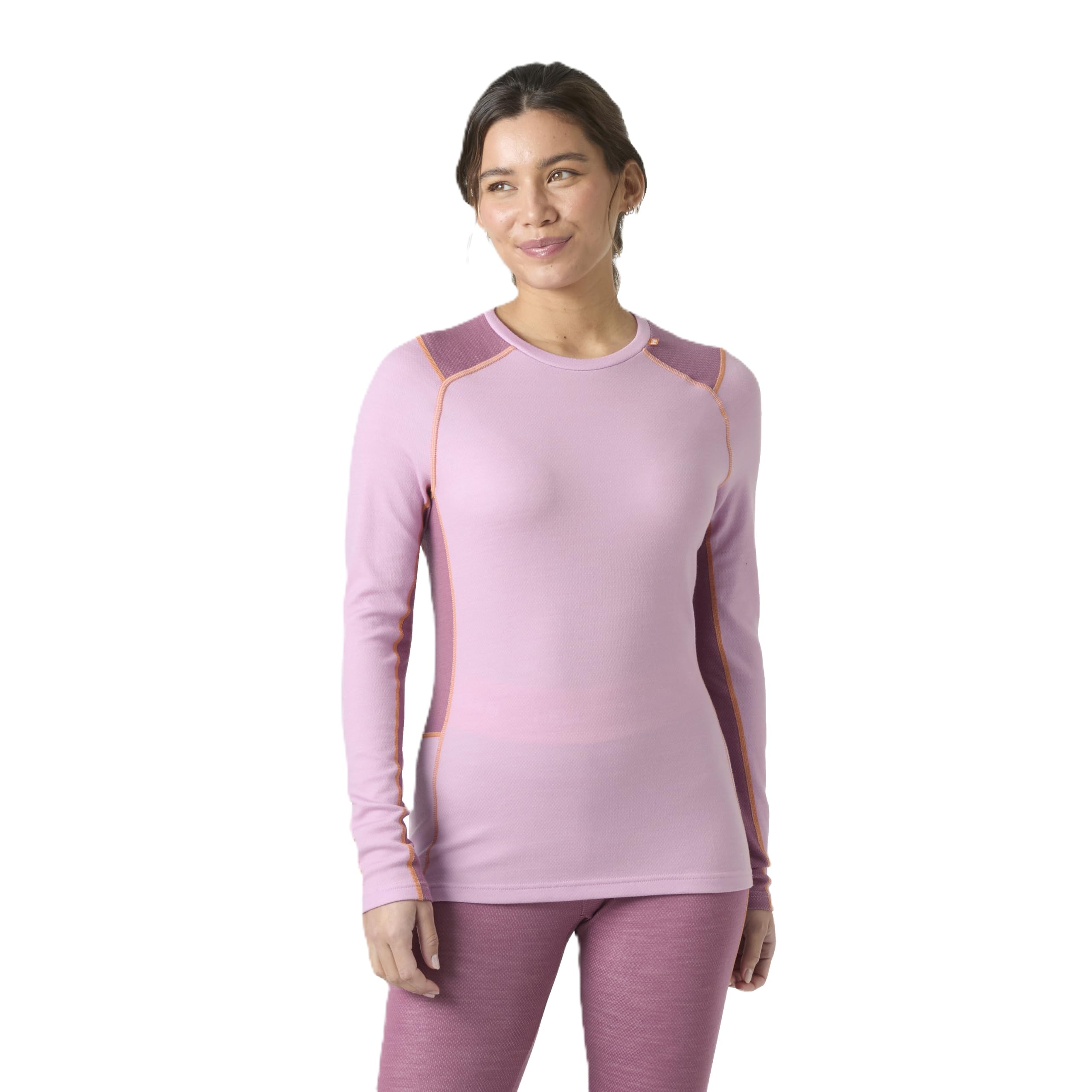
A wool-and-polypropylene crew for days when you sweat more than you sit still.
Most layers on this list are pure merino. This one is a two-layer system: 57% merino wool on the outside, 43% polypropylene against your skin. That is the LIFA construction, and it does a specific job — the polypropylene moves moisture away fast while the wool keeps the warmth. If you ski hard, hike uphill, or climb where you are dripping by the top, this combo earns its place.
The fit details are where it shines for active days. Flat lock seams are stitched so the seam sits flush instead of raised, which cuts down friction under a pack strap or a harness. The fabric is described as non-itch, and the pullover cut is standard length. It is a midweight, so it sits between the thin crews and the heavy 400 g/m2 tops.
The trade-off is the blend itself. Pure merino beats a blend on natural odor control and on the all-natural story some buyers want; 43% polypropylene shifts the balance toward durability and moisture handling. If your reason for buying wool is the material itself, this is not the purest pick. If your reason is staying dry when you work hard, it is.
The case for the blend: 43% polypropylene pushes sweat off the skin faster than pure wool on hard-output days.
The case against it: a wool purist will miss the all-merino feel and odor control here.
Go here for: high-output cold-weather activity where staying dry is the whole game.
Keep looking if: you want the purest merino against your skin with no synthetic in the mix.
8. Merino.tech 100% Merino Wool Base Layer Women Thermal Set

A 250 GSM top and bottom set that also throws in socks and a beanie.
This is a full cold-weather kit in one order: a merino top, matching bottom, plus a pair of hiking socks and a beanie. That last part is worth naming because it is unusual — most sets stop at two pieces. For a first-time merino buyer or a gift, that completeness means you are not piecing together a system from three listings.
The knit is 250 GSM, a midweight that sits between the thin 175 g/m2 tops and the heavy 400 g/m2 ones. The fiber is 17.5 micron superfine merino — finer than human hair, which is why it does not itch even on sensitive skin. The maker also notes OEKO-TEX certification and that the wool is RWS certified Australian merino, tested against 100+ harmful substances. Quality and comfort lead on this set in how buyers describe it; owners call it soft, warm, and their go-to layer, and it wears well under jeans or a sweater.
Two practical rules from the maker: size down one for a snug fit under ski gear, and never tumble dry — the heat permanently damages the fine fibers. Lay it flat to dry and it will hold its shape.
What those numbers buy: 17.5 micron fiber explains the no-itch feel, and 250 GSM gives you real warmth without the bulk of 400.
What to watch: the snug-fit advice means you may want a size down, and the no-tumble-dry rule is not optional.
Reach for this: as a complete starter kit or a gift where socks and hat come along too.
Know the routine: cold wash and flat dry, or the fine merino fibers lose their shape.
9. Smartwool Women’s Classic Thermal Merino Base Layer Crew

A medium-weight wool crew built for wash-and-wear convenience and all-day softness.
Smartwool is the name most people reach for when they want wool that handles washing without drama. This crew is 100% wool, made in the USA, and cut with a slim fit and medium stretch. That stretch is the spec that matters — it lets the shirt move with you instead of pulling across the shoulders when you reach.
Quality is the strongest thing buyers report about it, with warmth close behind. It fits well under pants and shirts without adding bulk, which is why so many people reach for it as a spring or fall layer rather than only a deep-winter piece. It washes and dries well — dye and shape hold up — and the temperature regulation plus odor resistance mean it can stretch several wears between laundry days. The design also helps minimize chafing, which is the difference between a shirt you forget and one you keep tugging.
The one note on value is the honest one: this is a premium-priced wool crew, and some buyers feel the price is high for a single top. It earns the spend on washability and fit, not on being the cheapest way to get merino. If you want the warmest layer, the 400 g/m2 tops above beat it on pure heat.
Where it leads: washability and fit — 100% wool with medium stretch that holds up through repeated washes.
Where it costs you: premium pricing for one top, so the value is in longevity, not the initial buy.
For the everyday wearer: someone who wants a wool crew that can go in the wash and come out the same.
Not for the heat seeker: if you need the warmest single layer, a 400 g/m2 top beats this one.
Know the Specs
Fabric Weight (g/m2 or GSM)
This is the grams of wool per square meter of fabric, and it is the single best predictor of how warm a layer feels. A 175 g/m2 top is a light first layer for fall or resort wear under a shell. A 250 g/m2 top is a midweight for active cold days. A 400 g/m2 top is a deep-winter piece for standing around in serious cold. Higher weight means more warmth and more bulk.
Micron Rating
A micron is one thousandth of a millimeter and it measures how fine each wool fiber is. Fine merino in the 17.5 to 18.5 micron range is soft enough that most wearers do not feel itch on bare skin. Coarser wool above that range is the scratchy stuff. If you have sensitive skin, the micron number is more useful than the word “merino” on the label.
Wool Content and Blends
100% merino gives maximum odor control and natural temperature regulation. A blend with polypropylene adds durability and faster moisture movement at the cost of some of the all-natural feel. Neither is better in every case — pure wool suits everyday comfort, while a blend suits high-output activities where staying dry matters most.
Style and Fit
A crewneck layers quietly under shirts and jackets. A half zip lets you vent heat on a climb. Bottoms are their own category and should be matched to the temperature and the pants you wear over them. Slim fits stay tucked; relaxed fits feel looser. Check the size guide either way, because sizing varies between brands and sometimes within a brand.
Common Questions
Will a merino wool base layer make me itchy?
What does the g/m2 number mean on a wool base layer?
Can I wear wool base layers more than once between washes?
Is a half zip better than a crewneck for skiing?
How should I wash a merino wool base layer so it does not shrink?
What is the difference between a 250 g/m2 and a 400 g/m2 wool layer?
Do I need the matching bottom, or is a top enough?
Should I size down on a wool base layer for a snug fit under ski gear?
Does a wool and polypropylene blend work as well as pure merino?
Can I wear a wool base layer in spring and fall, or only in winter?
The Bottom Line
One top covers the most situations: the Icebreaker 175 Everyday Crew wins our wool base layer women’s pick. Its 175 g/m2 knit (grams per square meter — a measure of fabric weight) works as a thin travel layer, a resort first layer, and a shirt you can wear on its own. Want a venting zip for active cold days? Grab the MERIWOOL 250g Half Zip. And for the deep-cold bargain hunter, the MERIWOOL 400g Thermal Shirt delivers the most insulation of any top here.
How we choose
We do not accept paid placement. Every pick is matched to a real buyer and a real use-case; we do not hands-on test units.
Sources
Specifications: manufacturer listings and product documentation. Review insights: verified customer reviews, as of November 2026. Pricing: not shown on this page (it changes often); check the current price via the retailer link.
As an Amazon Associate, Tactical Gear Guy earns from qualifying purchases. This does not affect which products we feature.