Specs are compiled from manufacturer listings and verified buyer reviews and can change over time — please confirm the key details on the product page before buying.
Buying a woofer for home theater is mostly about one decision: matching a powered subwoofer’s driver size and amplifier power to the room you actually sit in. Match them correctly and explosions hit with weight while dialogue stays clean. Mismatch them and the sub either rattles the room or vanishes under the soundtrack. This guide walks you through nine real powered subwoofers, each with its own strengths mapped to a specific room and budget, so you can pick the one that suits your space instead of guessing.
This guide is built by comparing the manufacturers’ published specifications and the patterns across verified customer reviews, so you get each pick’s real strengths and trade-offs instead of marketing spin.
A subwoofer handles the low-frequency effects channel that most speakers can’t reproduce. To pick the right one, match the driver size (the width of the cone that moves air) and the amplifier power to your room. Here is the plain-English breakdown of the best woofer for home theater.
Top Picks

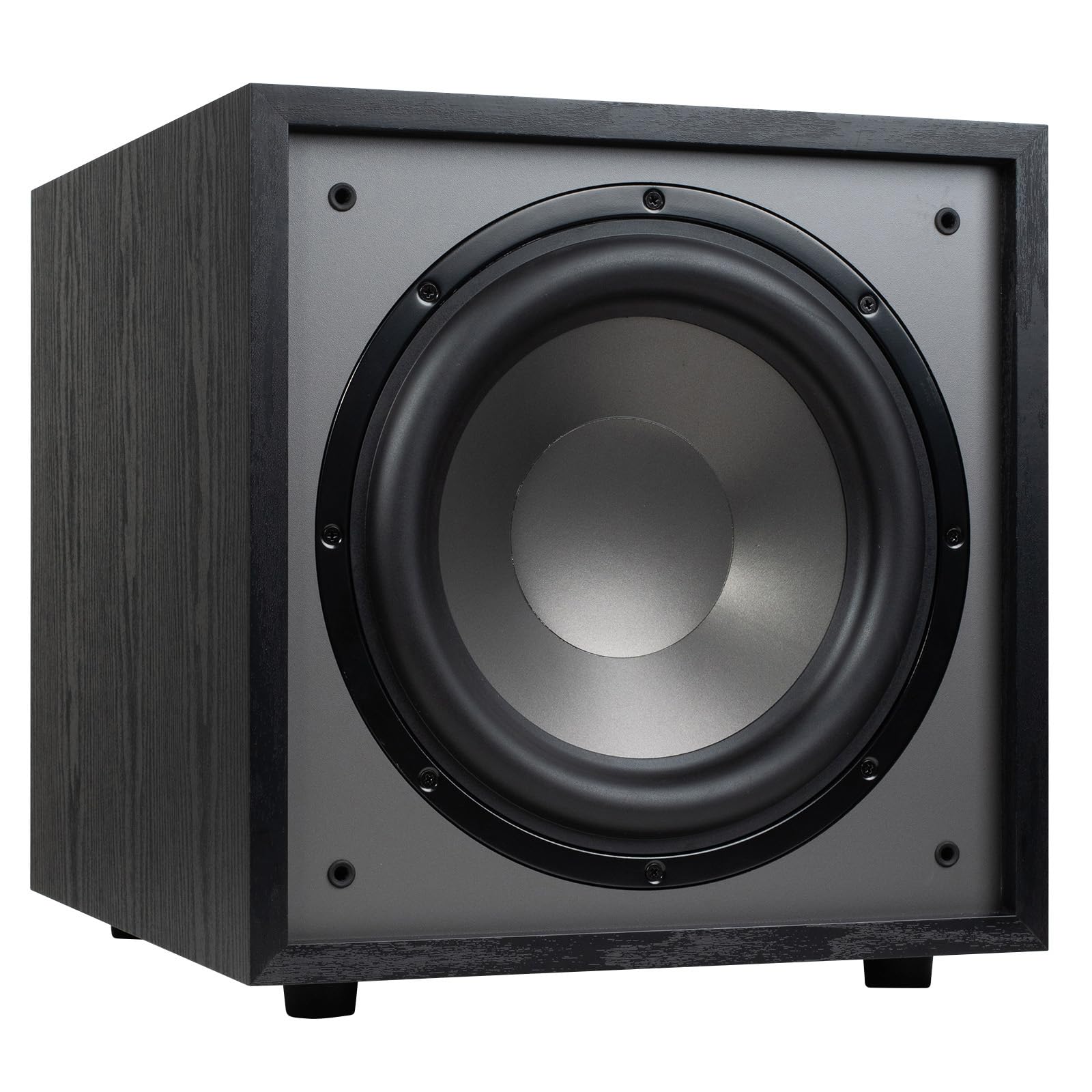

How To Choose The Best Woofer for Home Theater
The right subwoofer pressurizes your room without muddying dialogue, and that comes from matching three specs to your space: driver size, amplifier power, and low-frequency extension. Here is what each one actually does for you.
Driver size and amplifier power: the pair that decides output
A bigger driver moves more air, and more amplifier power pushes it harder — together they decide how loud and how deep the bass can go before it distorts. An 8-inch driver suits a small room or a desk setup, while a 12-inch driver can fill a larger living room. Wattage tells you the reserve on tap, not a guarantee of volume on its own.
Frequency response: how low can it really reach
You feel the deepest notes first. The lowest number in the frequency response (the range of notes a speaker can play) is the deepest note the sub can play with control. A sub that reaches down toward 20 hertz (Hz — the unit for how fast sound vibrates, with lower numbers meaning deeper bass) gives you movie rumble you feel in your chest. One that stops higher sounds punchy but not subterranean.
Sealed versus ported cabinets
Your cabinet choice shapes the sound. A sealed cabinet (a fully closed box) trades some raw output for tight, accurate bass that suits music and fast action. A ported cabinet uses a vent to reinforce low notes, so you get more rumble at a given power level. Neither is better outright — it depends on if you want rumble or precision.
Placement and connection options
Where the port fires matters: a rear-firing port needs breathing room from the wall, while a front-firing one is easier to tuck into a corner. Look for LFE and RCA inputs (the standard cables that carry bass from a receiver to the sub) so the sub drops into your existing AV receiver without adapters.
Side-by-Side Comparison
| Model | Best For | Driver Size | Amplifier Power | Lowest Frequency | Amazon |
|---|---|---|---|---|---|
| Klipsch R-120SW★ Best Overall | Overall movie bass | 12 inches | 200W continuous / 400W peak | 29 Hz | Amazon |
| Dayton Audio Classic CS1200Clean Value | Clean bass on a value budget | 12 inches | 200W Class-D | 26 Hz | Amazon |
| Klipsch Synergy Sub-120Front-Firing Pick | Front-firing corner placement | 12 inches | 200W continuous / 400W dynamic | — | Amazon |
| Audioengine S8 | Compact wireless-ready sub | 8 inches | 250W | — | Amazon |
| Polk Audio Monitor XT12 | Dolby Atmos systems | 12 inches | 100W Class A/B | 24 Hz | Amazon |
| SVS SB-1000 Pro | App-tuned room control | 12 inches | 325W RMS / 820W+ peak | — | Amazon |
| SVS SB-2000 Pro | High-power sealed rumble | 12 inches | 550W RMS / 1,500W peak | 20 Hz | Amazon |
| Sonos Sub 4 | Sonos ecosystem setups | Dual drivers | — | — | Amazon |
| Polk Audio Signature Elite ES12 | Large rooms, deep extension | 12 inches | 300W Class D | 18 Hz | Amazon |
Detailed Reviews
1. Klipsch R-120SW Subwoofer, Black
Our pick — 4.5+★ from 2,500+ verified ratings; the strongest balance of quality and price.
A 12-inch, 200W sub that delivers floor-shaking movie rumble for most living rooms.
The Klipsch R-120SW is the one to beat for everyday movie nights, because it pairs a 12-inch spun-copper woofer (the driver that moves air to make bass) with 200 watts continuous and 400 watts peak of amplification. It reaches down to 29 Hz (the low, rumbly end of the sound), and its maximum acoustic output of 116 dB gives you real volume headroom before anything strains. What wins people over most is the sound itself — the movie-bass rumble lands with weight and stays clean across a whole soundtrack.
Where it slips past a typical sealed sub is punch and authority: that 200W continuous vs a 100W Class A/B in the cheaper Polk Monitor XT12 gives it double the amplifier reserve. The bass-reflex design uses a rear-firing port, so it needs a little breathing room from the wall behind it to avoid muddiness — a floor corner works well. Setup is genuinely simple: it connects over RCA (the standard single-cable bass connection from a receiver) and adds a full low-end foundation to almost any speaker system.
The catch is placement and size. The rear port and the cabinet’s footprint mean you should plan a little clearance behind it rather than pushing it flush into a shelf. Volume is also a matter of taste — it can be dialed up hard — so you may end up backing the gain down in a smaller room. For most living rooms, though, it’s the pick that delivers the cinema rumble without fuss.
Why It Earns The Top Spot
- 12-inch driver with 200W continuous / 400W peak for real movie rumble.
- Reaches 29 Hz for deep, room-shaking bass you can feel.
- 116 dB max output gives generous headroom before distortion.
- RCA hookup makes it simple to add to a receiver.
The Trade-Offs To Weigh
- Rear-firing port needs clearance from the wall behind it.
- Cabinet footprint is on the larger side for a living room corner.
Grab this one: if you want proven, powerful movie bass that drops into most living rooms without tuning gymnastics.
Reconsider: if you need a compact sub that tucks flush against a wall — the rear port needs breathing room.
2. Dayton Audio Classic CS1200 Subwoofer
Tight, accurate bass from a 12-inch driver — the sub that trades boom for clean control.
If your room already has plenty of corner gain and you want bass that stays tidy instead of overpowering, the Dayton Audio Classic CS1200 makes a strong case. It runs a 12-inch driver off a 200W Class-D amplifier (a compact, efficient amp type that stays cool), housed in a rigid, braced cabinet built to keep the low end from turning to mush. Its response reaches down to 26 Hz, so movie rumble still arrives with authority.
What it does well is control. The bass is described as clean and tight, and the cabinet’s bracing quietens resonance so notes stay defined rather than boomy. Connectivity is unusually flexible here: you get stereo RCA, LFE (the dedicated subwoofer channel from a receiver), and speaker-level inputs, so it fits almost any setup including a bare stereo amp. A 5-year warranty is a genuine vote of confidence on the amp and cabinet.
It’s also a full-size cabinet, so it wants real floor space. But for the buyer who wants accurate bass without paying for a status badge, it’s a smartly built choice.
Where it wins: clean, accurate bass with a rigid braced cabinet, plus stereo RCA, LFE, and speaker-level inputs so it fits nearly any system.
What to plan for: a full-size cabinet footprint and a brand with less mainstream recognition — the 5-year warranty is your reassurance.
Worth it for: listeners who value tight, defined bass and want flexible inputs over brand name.
Look elsewhere if: you want a compact sub that disappears into a corner.
3. Klipsch Synergy Black Label Sub-120 Subwoofer
A front-firing 12-incher built to go nose-to-nose with a corner and win.
Corner placement is where this sub is happiest, and that’s exactly why its front-firing 12-inch Cerametallic driver matters. With 200 watts continuous and 400 watts dynamic power, it throws bass forward into the room instead of needing clearance behind it. The maker even suggests a corner for optimal performance — an easy fit for most living rooms where floor space beside the TV is tight.
The house-shaking output is the headline. As owners put it, the subwoofer makes the house shake with zero distortion, and it reportedly only uses 33% power for normal use. That leaves a huge reserve for the loud action scenes, so it never sounds like it’s working hard. A strong, flexible, removable grille and a contemporary finish help it blend with your decor, and it’s compatible with almost any AV receiver.
The one thing to get right is placement: a corner helps it sing, but the cabinet is a substantial size, so measure your spot before it arrives. It’s a wired-only design, so plan a cable run to the receiver. For a front-firing sub that can be tucked near a wall without muddying, this is a confident pick.
The headline: 200W continuous and 400W dynamic power through a front-firing 12-inch driver, with output that keeps control at high volume.
Measure first: it’s a big cabinet and it’s wired-only, so check your corner space and cable path.
Best matched to: rooms that can use a corner and want front-firing bass that doesn’t need rear clearance.
Skip if: your only spot is against a low shelf with no floor space to spare.
4. Audioengine S8 Subwoofer

An 8-inch, 250W sub sized for bedrooms, dens, and desk systems.
Not everyone has a wall to spare for a 12-inch cabinet. The Audioengine S8 fits where full-size subs can’t, with an 8-inch down-firing driver (it points at the floor to spread bass around the room) fed by 250 watts of power. That’s more amplifier wattage than the Klipsch R-120SW’s 200 watts, packed into a much smaller box, so it punches above its size.
The setup flexibility is the real story. It’s wireless-ready via the optional W3 adapter kit, so you can place it away from the receiver without a long cable run. A sleep mode powers it down when idle, and the down-firing design lets you tuck it into a tight spot. Owners say it works well with Audioengine HD3 and A2+ speakers, so it’s a natural match if you’re building a small system.
The honest limit is scale: an 8-inch driver moves less air than a 12-inch, so a large, open living room is a stretch. It’s at its best in a bedroom, den, or desk setup where a big box simply won’t fit. If floor space decides the purchase, this is the sub that makes the smaller driver an easy trade.
What It Brings
- 250 watts of power in a compact 8-inch cabinet.
- Wireless-ready via the optional W3 adapter for easy placement.
- Sleep mode saves power when idle.
- Down-firing design suits tight spaces.
Who It Won’t Suit
- An 8-inch driver moves less air, so a big open room is a stretch.
- Needs the separate adapter for the wireless option.
Ideal for: bedrooms, dens, and desk systems where a full-size sub won’t fit.
Not the one for: large, open living rooms that need 12-inch air movement.
5. Polk Audio Monitor XT12 Subwoofer

A long-throw 12-inch woofer tuned to dig down to 24 Hz for modern Atmos rigs.
If your receiver runs Dolby Atmos or DTS:X (the object-based surround formats that put sound all around and above you), the Polk Monitor XT12 is built to match. It uses a long-throw, high-excursion 12-inch Dynamically Balanced woofer driven by a 100W Class A/B amplifier, reaching down to 24 Hz. That’s deep enough for the low rumble these formats lean on hard.
The cabinet does quiet work behind the scenes. A rigid, critically braced MDF (a dense engineered wood) enclosure with a removable precision-fit grille cuts resonance and keeps the bass clean. You also get real tuning control — a variable crossover (80-160Hz, the dial that sets where the sub takes over from your main speakers) and phase polarity (0/180, a switch that keeps the sub in step with your speakers) — so you blend it with your speakers rather than fight them. Buyers report the punch keeps them coming back, especially the satisfying low-end thwack in action scenes.
The trade-off to know: with 100W of Class A/B power, this is the lowest amplifier figure on the list, so it leans on its driver size rather than raw wattage. It rewards careful crossover tuning more than most. Set it up right and it delivers deep, musical bass that belies its wattage.
Built for modern formats: Dolby Atmos and DTS:X compatibility, a 12-inch woofer reaching 24 Hz, and full crossover plus phase controls for a clean blend.
Worth knowing: at 100W it’s the least powerful amp here, so take the time to dial in the crossover.
Suits you: if you run an Atmos or DTS:X receiver and want a braced, controllable 12-inch sub that blends cleanly.
Rethink it: if you want maximum amp wattage for the rawest output.
6. SVS SB-1000 Pro Subwoofer
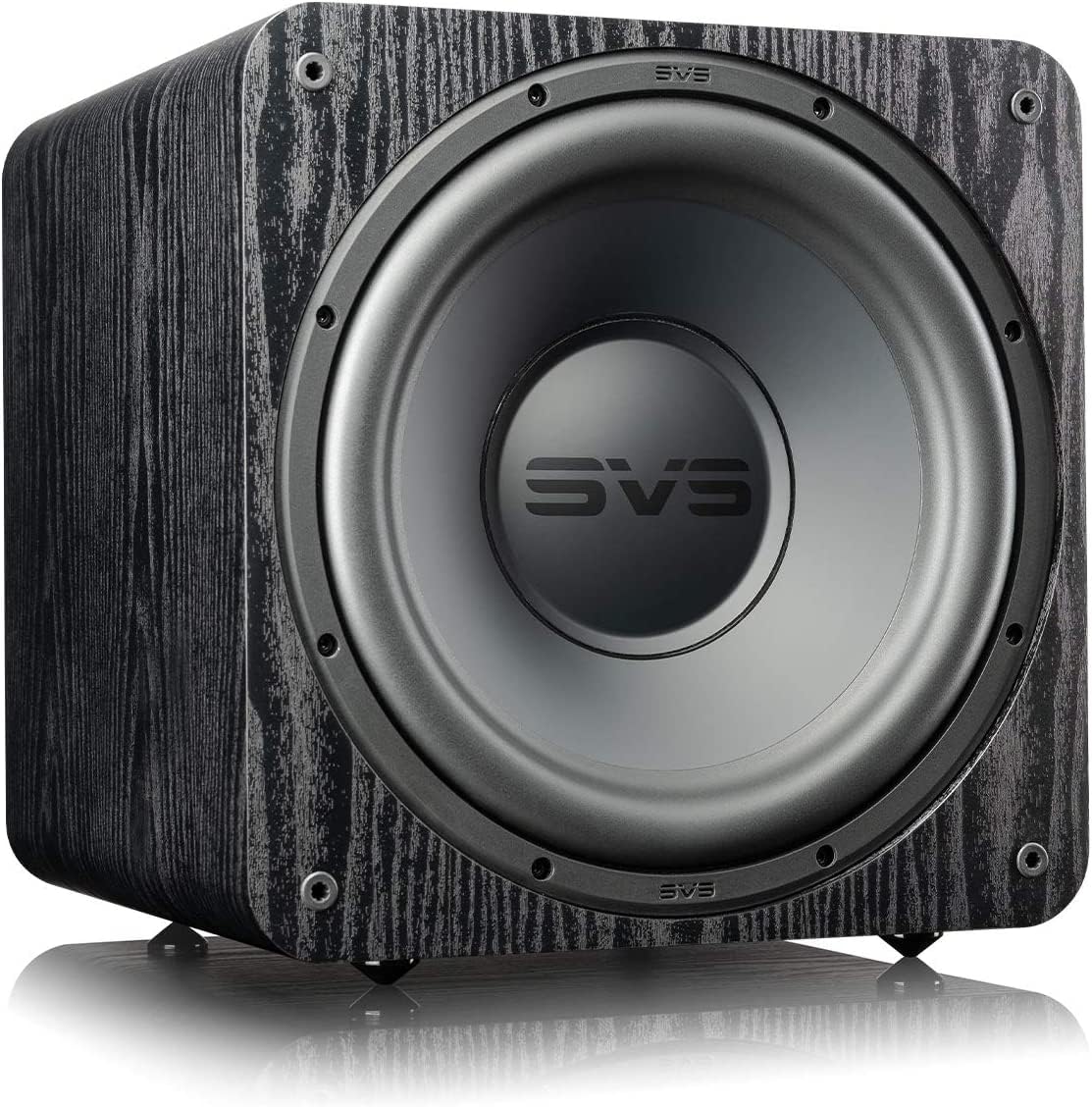
A sealed 12-incher you tune from your phone — precision bass with an app in charge.
The SVS SB-1000 Pro is the pick for anyone who wants to tune their bass from the couch instead of crawling behind the cabinet. Its sealed cabinet (no port — the box is closed for tighter, more accurate bass) houses a 12-inch high-excursion driver and a Sledge STA-325D amplifier rated 325 watts RMS and 820+ watts peak. A 50MHz Analog Devices Audio DSP (a processor that shapes the signal) handles the tuning.
Then there’s the app. The SVS smartphone app lets you control volume, manage custom presets, and fine-tune performance from your listening position — a genuinely useful feature when your sub sits deep in a corner. Owners mention it fills large rooms with booming bass while staying compact; one called it a “medium-format subwoofer.” The sealed design keeps it tight and controlled rather than boomy.
The honest note: sealed subs trade some raw output for accuracy, so it’s about clean, punchy bass rather than a ported wall of rumble. It’s also the pick where you’ll get the most value from taking time with the app presets. For a compact, controllable sub that fills a big room cleanly, this is a strong step up.
The standout: app-based control of volume and custom presets from your seat, backed by 325W RMS / 820W+ peak and a sealed cabinet for accurate bass.
Fair caveat: sealed designs favor control over raw rumble, so pair it with your expectations for punchy, precise bass.
Made for: buyers who want precise, app-tunable bass and a compact footprint in a larger room.
Look past it if: you want the ported, wall-shaking rumble of a bigger cabinet.
7. SVS SB-2000 Pro Subwoofer
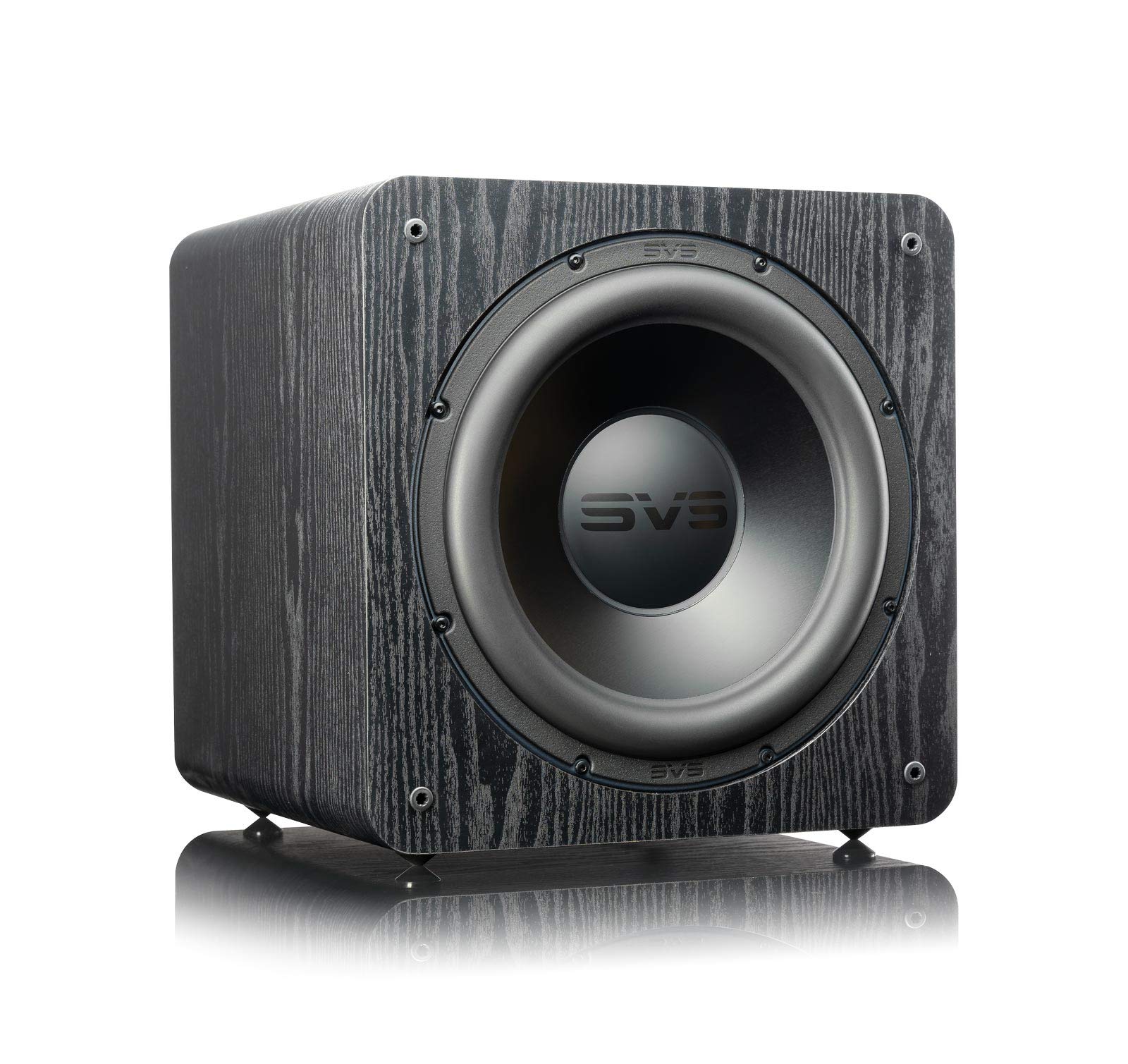
The sealed sub that hits 20 Hz with 1,500 watts of peak power on tap.
When you want sealed-cabinet accuracy without giving up output, the SVS SB-2000 Pro is the answer. It carries 550 watts RMS and 1,500 watts peak of fully discrete MOSFET output (the power transistors that drive the driver hard and clean), pushing a 12-inch high-excursion driver down to a 20 Hz response. That’s the deepest low end in this group, and it arrives with real control.
Owners describe punch without excessive rumble — controlled and powerful rather than loose. One noted it keeps its composure even at 15ft, so it holds together across a big room. The SVS app adds app-controlled tuning, and the compact cabinet can fit under a small table, which is handy if floor space is tight. This is the enthusiast’s choice for high-output sealed bass.
The catch is that all that power is most at home in a larger room where it has room to flex — in a tiny space you’ll simply back it down. It’s a serious investment in bass, so it’s aimed at the movie fan who wants the deepest, most controlled low end the Pro lineup offers.
What Powers The Case
- 550W RMS / 1,500W peak into a 12-inch driver for huge headroom.
- Reaches a 20 Hz response — the deepest extension in this group.
- App-controlled DSP tuning plus a compact cabinet that fits under furniture.
- Holds output at distance, so it stays composed in big rooms.
Before You Commit
- That much output is overkill for a small, tight room.
- A premium choice aimed at buyers chasing the deepest sealed bass.
The fit: big rooms and movie fans who want 20 Hz extension and app-tuned control.
Overkill for: small rooms, where the power simply gets dialed back.
8. Sonos Sub 4 – Wireless Subwoofer – Black

A WiFi sub with dual force-canceling drivers that pairs with Sonos soundbars.
If your home theater already runs on Sonos, the Sub 4 is the missing piece. It uses dual Sonos-engineered drivers in a force-canceling acoustic architecture (two drivers that move opposite each other to cancel out buzz and rattle) to deliver deep, dynamic bass without the cabinet buzzing. It connects to your Sonos soundbar or speaker over WiFi, so you place it where it sounds best, not where a cable reaches.
The setup is genuinely plug-and-play: one power cable and the Sonos app, and you’re done. It pairs naturally with an Arc Ultra, Arc, or Beam, and it works just as well laid on its side hidden under the sofa or standing upright. Owners single out how cleanly it improves bass in larger rooms and how neatly it slots into an existing Sonos ecosystem. It’s designed to look like part of the family, with a matte finish that matches the rest of the system.
The obvious limit: this sub is Sonos-first. Its wireless connection only fully pays off with a Sonos soundbar or speaker. Buyers also say the value is a matter of taste, since it’s a premium-priced piece. For a Sonos household, though, it’s the smooth way to add real rumble.
Why Sonos owners like it: dual force-canceling drivers kill buzz and rattle, WiFi frees placement, and one power cable plus the app gets it running fast.
The caveat: its best features depend on pairing with a Sonos soundbar or speaker, so it’s a poor fit outside that ecosystem.
Worth it for: Sonos households that want cable-free bass that blends with an Arc Ultra, Arc, or Beam.
Not the one if: you run a non-Sonos receiver and want a traditional wired sub.
9. Polk Audio Signature Elite ES12 Subwoofer

A 300W forward-firing 12-incher tuned to reach 18 Hz for the biggest rooms.
For a large home theater where you want to feel the deepest notes, the Polk Signature Elite ES12 is the extension specialist here. A 300W Class D amplifier drives a 12-inch long-throw woofer with a mineral-filled polymer cone, and Polk quotes deep bass down to 18 Hz. That’s the lowest figure on the list — the kind of extension that puts real weight under a movie score.
This sub is built to keep the bass clean. Dual Power Ports (the vents that reinforce low notes) are shaped to cut air turbulence and distortion. Time-Smart Phase Control offers 360-degree phase adjustment (a dial that aligns the sub with your main speakers), so the bass blends rather than overlaps. The cabinet is ported and reinforced with FEA-tune internal bracing (a computer-modeled frame that resists vibration) to keep resonance low. A forward-firing, removable grille rounds it out.
It’s also a large cabinet made for a room with floor space. If maximum low-frequency extension is the goal, it’s a compelling choice for a big cinema room.
The headline spec: 300W Class D through a 12-inch long-throw driver, reaching 18 Hz — the deepest extension in this group.
Check your room and timing: it’s a large forward-firing cabinet, and it’s a newer model with a lighter review trail.
Pick it for: a big cinema room where you want the lowest, most extended bass available here.
Hold off if: you want a well-worn track record or a compact footprint.
Know the Specs
Amplifier power (watts RMS vs peak)
Wattage tells you how much power the built-in amp can supply to the driver. RMS (or continuous) is the sustained figure you’ll actually use most of the time, while peak is a short-term burst for big action moments. Higher wattage generally means more headroom for loud scenes before the bass distorts — but driver size still sets the ceiling.
Frequency response in hertz
The lowest number in a subwoofer’s frequency response is the deepest note it can play with control. Down toward 20 Hz is where movie rumble and the lowest bass guitar notes live, so a lower figure means you’ll feel more of the soundtrack. A sub that stops higher can still sound punchy, but it won’t reach the subterranean notes.
Sealed vs ported cabinet
Your box type sets the character of the bass. A sealed box is fully closed and tends to deliver tighter, more accurate bass that suits music and quick action. A ported box uses a vent to reinforce low notes, so you get more rumble at a given power level. Your choice depends on whether you prioritize precision or raw low-end output.
Port placement and connectivity
A rear-firing port needs clearance from the wall behind it, while a front-firing port is easier to place near a wall or corner. Look for LFE and RCA inputs so the sub plugs straight into your AV receiver. Wireless options and app controls add setup flexibility if you’d rather not run cables.
Common Questions
Do I need a powered subwoofer or a passive one for home theater?
Will a 12-inch subwoofer be too much for a small room?
What frequency response do I want for movie bass?
What is the difference between a sealed and a ported subwoofer?
Can I place a rear-firing subwoofer against the wall?
Will a Polk subwoofer blend with my Klipsch speakers?
How do I connect a subwoofer to my AV receiver?
Does a Sonos Sub work with a non-Sonos soundbar?
What does the crossover dial on a subwoofer do?
The Bottom Line
For most living rooms, the woofer for home theater that gets the balance right is the Klipsch R-120SW. Its 12-inch driver, 200W continuous / 400W peak (watts — the power it can deliver, with peak being short bursts), and 29 Hz extension make movie rumble land with real weight. If you want tight, accurate bass and flexible inputs on a smarter budget, the Dayton Audio Classic CS1200 is the value call. For the deepest extension in a big cinema room, the Polk Signature Elite ES12 reaches down to 18 Hz. If you already run a Sonos system, the Sonos Sub 4 is the cable-free way to complete it.
How we choose
We do not accept paid placement. Every pick is matched to a real buyer and a real use-case; we do not hands-on test units.
Sources
Specifications: manufacturer listings and product documentation. Review insights: verified customer reviews, as of November 2026. Pricing: not shown on this page (it changes often); check the current price via the retailer link.
As an Amazon Associate, Tactical Gear Guy earns from qualifying purchases. This does not affect which products we feature.