Specs are compiled from manufacturer listings and verified buyer reviews and can change over time — please confirm the key details on the product page before buying.
Buy the widest jaw opening your bench can mount, because a board that will not fit the jaws will not get clamped. A woodworking workbench vise is the one tool that decides whether a board sits still while you plane it or skates across the bench and ruins the edge. The picks below separate on three things that actually matter at the bench: how wide the jaws open, how deep the throat reaches, and whether a quick-release lever lets you reposition without cranking the screw a dozen turns.
This guide is built by comparing the manufacturers’ published specifications and the patterns across verified customer reviews, so you get each pick’s real strengths and trade-offs instead of marketing spin.
Every pick here is judged on jaw opening, throat depth, and how well the guide rods resist racking. Below you will find the full breakdown of each woodworking workbench vise, with the exact jaw and throat numbers side by side.
Top Picks


How To Choose The Best Woodworking Workbench Vise
Start with the widest board you actually clamp, not the one you dream about. A vise’s jaw opening is the gap between the jaws when fully open. That single number decides whether a cabinet door, a thick blank, or a glued-up panel will fit. Everything else — throat depth, guide rods, quick release — is built around clearing that opening and holding square.
Match Jaw Opening To Your Widest Panel
Jaw opening (the widest gap between the jaws) runs from 8 inches on the smaller vises up to 10.25 inches on the biggest here. If you regularly clamp wide doors or panels, that extra opening is what lets the piece sit flat instead of hanging off the edge. A wider opening also means fewer jaw resets during a long glue-up.
Check Throat Depth Before You Mount
Throat depth is how far the jaws reach down from the top of the vise body toward the bench. A deeper throat lets you clamp a board on its edge and still have room to work above it. A shallow throat can force you to clamp higher or flip the board to get clearance for a plane or saw. Measure the thickest stock you plane on edge, then match the throat depth to it.
Single Screw Or Dual Guide Rods
Racking is when the sliding jaw twists out of square under pressure, clamping harder on one side than the other. Dual guide rods (two steel bars that keep the jaw tracking straight) resist racking better than a single screw. If you only clamp narrow stock, a single-screw vise is fine. If you clamp wide boards and need the jaw square across the full width, dual guide rods are the safer choice.
Why Quick Release Saves Real Time
A quick-release lever lets you slide the jaw open or closed without turning the main screw. You pull the lever or trigger, slide the jaw to the piece, then let go and crank to tighten. On repeated clamping — drilling, cutting joinery, gluing up — that saves dozens of turns over a session. The trade-off is one more mechanism to keep clean and functioning; a plain screw vise has fewer moving parts.
Side-by-Side Comparison
| Model | Best For | Jaw Width | Jaw Opening | Throat Depth | Amazon |
|---|---|---|---|---|---|
| Yost Vises M9WW★ Best Overall | Wide panels and long benches | 9 in | 10.25 in | 4 in | Amazon |
| Yost Vises M7WWBest Value | Everyday bench work, best balance | 7 in | 8 in | 3 in | Amazon |
| Groz 39020Bench Build Pick | Building your own bench vise | 7-1/8 in | 8-1/4 in | — | Amazon |
| VEVOR MGJ-9 | Batch drilling and frequent changes | 9 in | 10.2 in | — | Amazon |
| Eclipse EWWQR7 | Vise and tail vise in one | 7 in | — | — | Amazon |
| Jorgensen 40709AE | Firm grip on thin and angled stock | 7 in | 9 in | — | Amazon |
| Shop Fox D4327 | Thinner benchtops and tighter budgets | 7 in | 8 in | — | Amazon |
| Rockler Front Vise | Racking-free wide clamping | 9 in | — | — | Amazon |
| Wilton 78A | Irregular and angled parts | 4 in x 7 in | 10 in | — | Amazon |
Detailed Reviews
1. Yost Vises M9WW Rapid Action Woodworking Vise
Our pick — 4.5+★ from 550+ verified ratings; the strongest balance of quality and price.
The widest reach and deepest throat here, built for boards that refuse to sit still.
This is the vise you buy when nothing in your shop is small. The jaws open to 10.25 inches, so a wide cabinet door or a thick glued-up panel drops in flat instead of hanging off the edge. The throat reaches 4 inches, which is the deepest here — it lets you clamp a board on edge and still have clear room to run a plane above it. The Yost Vises M9WW has the biggest reach here: a 10.25 inch jaw opening and 4 inch throat on a 9 inch jaw width.
Compared with the Yost Vises M7WW below, this one opens 10.25 inches against 8 inches, and its throat matches at 4 inches against 3. That extra reach is the difference between a board fitting flat and a board needing repositioning mid-cut. It is also compared with the VEVOR MGJ-9 in jaw width — both come in at 9 inches. The cast iron body is rated 30,000 PSI (a measure of compressive strength), with a chrome-plated steel sliding T-bar handle and steel guide rails keeping the jaw tracking straight.
The rapid action lever lets you slide the jaw to the piece without cranking the screw, then tighten. What wins people over most is the build — the cast iron feels substantial and the quick release works every time you pull it. The recurring gripe is the weight: at 14.55 kg it is heavy, so plan on two people and a steady bench for mounting. Jaw orientation also draws mixed notes, so check that the mounting face lines up with your bench before you drill.
What earns the top spot
- Widest jaw opening here at 10.25 inches — wide panels fit flat
- Deepest throat at 4 inches — clamp boards on edge and still reach above
- 30,000 PSI cast iron body with chrome-plated steel handle and guide rails
- Rapid action lever speeds up repeated clamping
Before you drill the bench
- At 14.55 kg it is heavy — plan for two people to mount it
- Jaw orientation draws mixed notes; verify alignment first
- 1-year limited warranty and 90-day return
Best fit: a shop that regularly clamps wide doors, panels, and thick stock on edge.
Worth reconsidering if: you work mostly narrow stock and want to save bench space.
2. Yost Vises M7WW Rapid Action Woodworking Vise
The 7-inch benchmark that most bench builds should start with.
For most home shops this is the vise that does everything without overhanging the bench. The 8 inch jaw opening clamps most board work, the 3 inch throat clears stock clamped on edge, and the 7 inch jaw width keeps the body compact enough to fit a standard bench front. It is built from 30,000 PSI cast iron with a chrome-plated steel sliding T-bar handle and steel guide rails, and the rapid action lever slides the jaw to the piece before you crank.
Owners single out durability: the cast iron body feels like it will outlast the bench, and the quick release works without fuss. Installation is the split point: some find it a quick two-drill job, others note it takes two people to lift and seat. At 21 pounds it is heavy enough to want a helper. That heft keeps the vise from shifting when you lean into a plane stroke.
Set against the M9WW above, this one gives up 2.25 inches of jaw opening and 1 inch of throat depth, in exchange for a smaller footprint and less bench overhang. If your widest board fits inside 8 inches, this is the smarter fit. The 1-year limited warranty and 90-day return apply here too, and Yost backs both vises with lifetime tech support.
The 7-inch reasoning: an 8 inch opening and 3 inch throat cover the majority of bench work, and the heavier build earns the steady handle feel.
The honest catch: at 21 pounds it wants a second pair of hands at install — do not plan a solo bolt-up.
Reach for this if: your widest clamp is a board under 8 inches and you want the steady feel of cast iron.
Go bigger if: wide doors or panels are in your regular rotation.
3. Groz Woodworking Front Vise, 7-1/8″ Jaw Width
Hardware for the woodworker who is building the bench, not buying it.
This is not a bolt-and-go vise. It is a hardware kit for building a custom front vise into a bench you are constructing, complete with a cast iron body, a cast iron handle socket, and a turned wooden handle ready for the spindle. You supply the wooden jaw faces. That makes it the pick for anyone outfitting a new bench from scratch and wanting the vise to match the build.
The precision rolled threads and twin guide rods are the mechanical story. Those twin rods keep the jaw square under pressure, so stock stays aligned during planing, sawing, hand-cut joinery, and glue-ups. With a 7-1/8 inch jaw width and an 8-1/4 inch opening, it covers the same mid-size range as the Yost M7WW, but at 9.4 pounds it is far lighter to handle during the build — that lighter body is the honest trade-off for a shop-built installation.
The construction feedback splits. Some buyers find it well-made and functional, working well with custom worktables. Others note sloppy machining and casting holes that are not properly aligned — check your mounting holes against your bench before you commit to a drill pattern. If you have the bench-planning skills, this is a proven foundation.
Who builds a bench around it: woodworkers assembling a custom front vise who want a cast iron body, twin guide rods, and a wooden handle in one kit.
The alignment caveat: casting holes are not always properly aligned, so dry-fit against your bench before drilling.
The right buyer: someone mid-way through a bench build who wants hardware that matches the wooden jaw faces they plan to add.
Not for you if: you want a ready-to-mount vise with factory holes that line straight up.
4. VEVOR Woodworking Vise, 9 Inch Jaw Width

A wide 9-inch jaw with a labor-saving handle for shops that clamp all day.
The VEVOR MGJ-9 matches the Yost M9WW on jaw width at 9 inches and nearly matches its opening at 10.2 inches. Where it differs is the adjustable front stop — a feature that lets the vise adapt to standard woodworking or tail vise setups, so it handles more than one job on the bench. The cast iron body is built for high-strength use over time.
The labor-saving handle is the pitch. It slides the jaws to the piece without repeatedly turning the screw, which is exactly what batch processing wants — you drill, release, reposition, and drill again without a dozen crank turns each cycle. The thickened lever is meant for long sessions and steady clamping without jamming. Build quality is the bright spot in the feedback, with the cast iron feeling solid.
The quick release itself draws mixed notes — some say it works well, others report issues. That is the honest picture on a wide-jaw vise with an adjustable stop; the more mechanism you add, the more you want to keep it clean and check the release before each session. Pairing that against the Yost M9WW, the VEVOR gives you the same 9 inch jaw but adds the adjustable front stop in exchange for a smaller track record.
Where it shines
- 9 inch jaw width with 10.2 inch max opening — wide range
- Adjustable front stop adapts to standard and tail vise setups
- Labor-saving handle saves crank turns on repeated cycles
The mechanism to watch
- Quick release draws mixed feedback — check it each session
- Smaller track record than the Yost vises
- More moving parts means more to keep clean
Best for: a shop doing batch drilling and frequent repositioning, where the labor-saving handle pays off across the session.
Consider the M9WW instead if: you want the wider opening and a simpler release mechanism.
5. Eclipse EWWQR7 7″ Woodworking Vise

One vise that doubles as a tail vise, thanks to the adjustable front stop.
The EWWQR7 gives you something none of the single-purpose vises do: a front stop (often called a dog) that pairs with a bench stop to add a second clamping station. That turns one tool into a normal vise and a tail vise at once. For a small shop where two vises will not fit, that flexibility is the reason to pick it.
The body and sliding jaw are high-quality grey cast iron chosen for its shock-absorbing quality, and the slide rods and main screw are steel with a single start thread. There is one safety detail worth knowing: the tommy bar is designed to bend before the vise becomes over-stressed, so a bent bar is your signal to back off, not a defect. The 7 inch jaw width matches the Yost M7WW and the Eclipse comes with two predrilled holes for mounting.
The quick release trigger is the single most-appreciated feature here — it opens and closes the vise quickly without touching the main screw, and it is what owners reach for first. Size and weight draw mixed notes, so measure your bench front before you buy. At 20.7 pounds it is solid without being unmountably heavy.
The standout build detail: the tommy bar is designed to bend before the vise over-stresses — a built-in tell that you are pushing too hard.
The measurement to take first: size and weight draw mixed notes, so confirm the 7 inch width fits your bench front.
Pick this one if: space is tight and you want a front vise that also acts as a tail vise.
Step back if: you need a wider opening for big panels — the other picks reach further.
6. Jorgensen 7″ Woodworking Vise, Quick Release, 9″ Jaw Opening
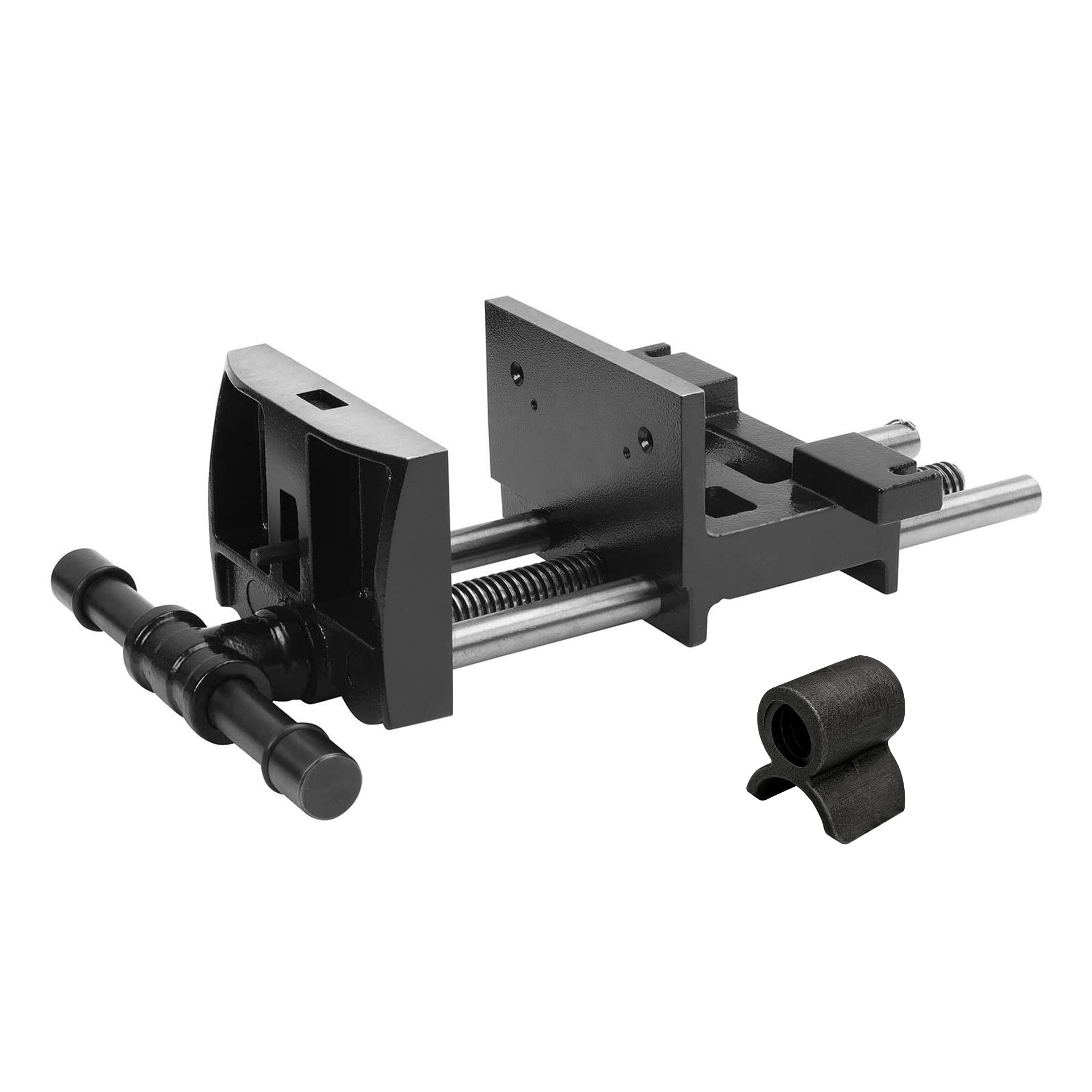
Machined toed-in jaws bite harder at the top, where thin stock slips.
The detail that sets this one apart is the toed-in jaws. Machined so the top of the jaw closes first, they grip thin stock and angled work at the point that matters instead of letting the piece ride up. Add a 7 inch jaw with a 9 inch opening and the Jorgensen gives you more clamping room than the Yost M7WW (8 inch opening) while keeping the compact 7 inch jaw footprint.
The main body is heavy-duty ductile iron with all-steel hardware. Ductile iron is stronger against cracking than standard cast iron, which matters on a bench where someone eventually leans a little too hard. Countersunk holes in the front and back jaws let you add optional wood facings, so you can protect finished pieces and replace the faces when they wear.
It is designed for workbenches up to 3 inches thick, so measure your top before you commit — a thicker bench means you are looking at a different mounting solution. The quick-action rapid release slides the jaw for fast repositioning. If your work centers on thin, tapered, or angled pieces, the toed-in bite is the reason to choose this over a flat-jaw vise.
The grip that earns it a spot: toed-in jaws close at the top first, holding thin and angled stock where a flat jaw lets it slip.
Mount limit to check: built for benchtops up to 3 inches thick — a thicker top needs a different plan.
Designed for: the woodworker who clamps thin, tapered, or angled pieces and needs the jaw to bite at the top.
Look elsewhere if: your bench top runs thicker than 3 inches.
7. Shop Fox D4327 7-Inch Quick Release Wood Vise

Built for the thinner benchtop where a heavier vise would not seat.
Most vises here assume a thick bench. The Shop Fox D4327 is specified for a workbench thickness of 2-1/4 inches, which makes it the pick when your top is on the slim side. It still delivers a 7 inch jaw width and an 8 inch max jaw opening, matching the Yost M7WW on opening while fitting a thinner mounting depth. At 21 pounds it has real mass without demanding a monster bench.
The cast iron body earns solid quality marks, and installation is straightforward — buyers find it easy to put on. The quick-release mechanism is the mixed part: some love how it works, others find it does not always operate properly. Durability and ease of use split the same way, with some finding it heavy-duty and others raising longevity concerns.
The honest read is that this is a solid mid-tier vise with a release lever you want to keep clean and check. If you want a cast iron body on a thinner bench, it fits a gap the others do not — measure your top thickness first, because that 2-1/4 inch mounting height is the specific reason to pick it.
Why it fits a slim bench
- 2-1/4 inch mounting height suits thinner benchtops
- 7 inch jaw width with 8 inch max opening
- Cast iron body with easy installation
The release to check
- Quick release draws mixed feedback — check it before each session
- Longevity gets split notes; keep it clean and covered
- Confirm your bench thickness matches the 2-1/4 inch mounting height
The bench it suits: a thinner top that needs a cast iron vise without a deep mounting depth.
Check before buying: your benchtop thickness against the 2-1/4 inch mounting height.
8. Rockler Quick Release Front Vise 9″

Dual guide rods and an extra-wide handle plate, made to hold wide stock square.
Racking is the enemy on a wide-jaw vise: the sliding jaw twists and one side clamps harder. The Rockler attacks that with sturdy dual guide rods that eliminate racking, plus an extra-wide 9 inch handle-plate that spreads leverage across the front. The structure is iron and steel with a solid hardwood handle, and the 9 inch guide bar grips firm on wide stock.
Operation is a simple rhythm: pull up on the handle and hold to disengage the nut, slide the wooden jaws to the opening you need, let go, then turn the main handle to tighten. The 1/4 turn quick-release slides the vise fully open or closed in seconds. Mounting uses 1/4 inch lag bolts, which are not included, so pick those up before install day.
The feedback splits on two points: the vise is sturdy and works well, but the quick release is loved by some and called poor by others. That is honest for a multi-part release on a wide body. If racking is what has been ruining your wide clamping, the dual guide rods are the reason to choose this over a single-screw vise.
The anti-racking case: dual guide rods and a 9 inch handle-plate keep the jaw square across a wide grip.
Order these too: the 1/4 inch lag bolts are not included, and the quick release draws split notes.
For you if: wide stock keeps racking in your current vise and you want dual guide rods holding it square.
Plan ahead on: buying the 1/4 inch lag bolts separately and checking the release before each session.
9. Wilton 78A Woodworking Vise

The front jaw pivots 10 degrees, so tapered and crooked parts finally sit flush.
Irregular stock is where the Wilton 78A makes its case. The front jaw pivots 10 degrees to seat irregularly shaped parts flat against the jaw, and you can remove the pivot jaw entirely when you need a wider clamping face. With a 4 by 7 inch jaw and a 10 inch max jaw opening, it matches the widest opening here while offering something the fixed jaws cannot: give.
The vise ships with a set of magnetic maple jaw inserts, which protect finished faces and swap in when the inserts wear. It is backed by Wilton’s lifetime warranty against manufacturing defects — the longest coverage in the group. At 30 pounds it is the heaviest here, so plan the mounting with a helper and a bench rated for that mass.
Owners describe it as a high-quality tool with solid construction that lasts, and the quick-release function and smooth operation are the parts people call out. Jaw adjustment draws mixed notes — the pivot is the feature, so expect to spend a moment setting it. If your work includes tapered legs, live-edge pieces, or any part with a wonky shape, that 10 degree pivot is the reason to pay for this one over a flat-jaw vise.
The reason it earns its place: a 10 degree pivoting front jaw grips tapered and irregular stock that a fixed jaw simply cannot.
The mass to plan for: at 30 pounds it is the heaviest here and wants a helper and a solid bench.
Made for: the woodworker clamping tapered legs, live-edge pieces, and irregular parts.
Skip if: your work is all square stock and you do not want to budget the time setting a pivot.
Know the Specs
Jaw Opening vs. Jaw Width
Jaw width is how wide the jaw faces are; jaw opening is how far apart they get. A vise can have a 7 inch wide jaw and still open to 9 inches or more, as the Jorgensen does. Match the opening to your widest board, and match width to how much of the jaw the stock should sit against.
Throat Depth and Edge Work
Throat depth is the vertical reach from the top of the vise down to the bench. A deeper throat, like the 4 inch on the Yost M9WW, lets you clamp a board on edge and still have room to plane above it. A shallower throat can force a clamp higher or a flip of the board.
Racking and Guide Rods
Racking is the sliding jaw twisting out of square under pressure. Dual guide rods on the Rockler are there specifically to prevent it. If you clamp wide stock and notice one side biting harder, you are seeing racking — dual guide rods fix it, a single screw does not.
Mounting Height and Benchtop Thickness
Mounting height is the bench thickness a vise is built to fit. The Shop Fox D4327 is specified for 2-1/4 inch tops; the Jorgensen fits tops up to 3 inches. Measure your top thickness before buying — a mismatch means the vise will not seat flush and you will be re-planning the bench.
Common Questions
How do I measure the jaw opening I actually need?
What is throat depth and why does it matter?
What does racking mean and will my vise rack?
Is a quick-release vise worth it over a plain screw vise?
Will the vise fit my benchtop thickness?
How heavy are these vises to mount?
Do guide rods really stop racking?
What are toed-in jaws and who needs them?
Can I add wooden jaw faces to protect finished work?
The Bottom Line
For most shops the winner is the Yost Vises M9WW, because its 10.25 inch jaw opening and 4 inch throat clear the widest panels and still leave room to plane a board on edge. If your bench is thinner or your budget tighter, the Shop Fox D4327 fits a 2-1/4 inch top. And for shops clamping tapered or irregular parts, the Wilton 78A and its 10 degree pivoting front jaw is the one to reach for.
The clear takeaway: match jaw opening to your widest board, throat depth to stock clamped on edge, then confirm the mounting height fits your benchtop.
How we choose
We do not accept paid placement. Every pick is matched to a real buyer and a real use-case; we do not hands-on test units.
Sources
Specifications: manufacturer listings and product documentation. Review insights: verified customer reviews, as of November 2026. Pricing: not shown on this page (it changes often); check the current price via the retailer link.
As an Amazon Associate, Tactical Gear Guy earns from qualifying purchases. This does not affect which products we feature.