Specs are compiled from manufacturer listings and verified buyer reviews and can change over time — please confirm the key details on the product page before buying.
If your saw keeps wandering off the line, the problem is usually the line, not your hand. A good scribe leaves a crisp, shallow groove that a saw tooth or chisel edge can actually drop into. That groove is what separates a tight joint from one you have to fill. Below you will find nine real tools, sorted by what each one is genuinely built to do, so you can stop guessing and start cutting.
This guide is built by comparing the manufacturers’ published specifications and the patterns across verified customer reviews, so you get each pick’s real strengths and trade-offs instead of marketing spin.
Some of these tools cut the line, some transfer a line, and one traces a wall profile. Knowing if you need to cut a line or transfer one is half the decision. The other half is blade steel, beam length, and head locking. This breakdown covers all of it so you can pick the right woodworking scribe tool for your bench.
Top Picks


How To Choose The Best Woodworking Scribe Tool
The first thing to settle is what you actually need the tool to do. Cutting a fine line and transferring a line are different jobs, and the wrong tool makes both feel harder than they are. Settle that first and the list narrows fast.
Knife Versus Wheel Gauge
A marking knife cuts a groove across the fibers, which gives a saw a place to sit. A wheel gauge rolls a fine line parallel to an edge, which is what you want for repeated offset marks. Most benches end up with one of each, because neither does the other’s job.
Blade Steel And Geometry
High carbon steel holds a keen edge and sharpens back up easily. A double-edged blade lets you work left or right handed without turning the tool around. A long thin neck reaches into dovetail sockets that a standard blade simply cannot enter.
Locking And Beam Length
For gauge work, the head has to lock hard or your measurement drifts mid-project. A grooved beam stops the head from rotating while you adjust it. Longer beams reach across wider stock, while shorter ones stay nimble for small parts.
Side-by-Side Comparison
| Model | Best For | Tool Type | Blade / Cutter | Build Material | Amazon |
|---|---|---|---|---|---|
| Clarke Brothers Marking Knife★ Best Overall | Cutting crisp joint lines | Marking knife | Carbon steel, 5.5 cm | Padauk wood handle | Amazon |
| KAKURI Wood Marking GaugeBest for Wide Stock | Parallel lines on wide stock | Japanese kebiki gauge | Japanese carbon steel | Laminated bamboo | Amazon |
| RUITOOL Marking KnifeBest for Dovetails | Dovetail sockets | Long-neck knife | One-piece high carbon steel | Wood handle | Amazon |
| YOSELIN Dovetail Jig Set | Dovetail layout | Dovetail marker and wheel gauge | 2 wheel cutters | CNC aluminum | Amazon |
| Tracer Scribe Block Set | Repeat offsets and centres | Scribe block and centre finder | 0.3 to 0.9 mm lines | ABS plastic | Amazon |
| Saker Multi-function Scriber | Tiling and panel work | Adjustable scriber | Deep hole pencil | Aluminum alloy | Amazon |
| VISLONE Wheel Marking Gauge | Mixed materials | Linear and arc scriber | Stainless steel roller | Aluminum alloy | Amazon |
| Taytools Brass Cutting Gauge | Precision joinery | Cutting gauge | Hardened 3/8 in cutter | Solid brass and steel | Amazon |
| Trend Multi-Scribe Pro | Tracing wall profiles | Profile scriber | 15 functions | Composite body | Amazon |
Detailed Reviews
1. Clarke Brothers Marking Knife and Real Leather Sheath
Our pick — 4.5+★ from 900+ verified ratings; the strongest balance of quality and price.
A carbon steel knife that cuts a groove instead of a smudge.
Here is the tool you reach for when a pencil line just is not cutting it. The Clarke Brothers knife pairs a 5.5 centimeter blade of high carbon steel with a handle carved from padauk, a dense exotic wood that gives your fingers something solid to push against. Total length runs 16 centimeters, so it sits comfortably in a fist without feeling like a paring knife. That shape matters, because control is everything when you are scribing a dovetail shoulder.
The double-edged blade is the real design decision here. You can pull it toward you or push it away, and it works the same in a left or right hand without flipping the tool over. The maker notes it will cut hardwood like cherry and ash, not just soft pine. That range is why it sits at the top: it handles cherry and ash joinery, not just soft pine.
Where it wins people over is plain old build quality, with the edge arriving sharp enough to cut straight from the sheath. It makes a clean recessed cut, and that recess is what guides a saw tooth on its first stroke. The friendly catch is the edge itself: carbon steel this keen wants a light touch and a wipe down, and the included sheath earns mixed notes, so treat it as a cover rather than a safe.
What earns its keep
- Double-edged blade works pulling or pushing
- Carbon steel takes an edge quickly
- Reaches into cherry and ash without balking
What to plan around
- The sheath is functional, not a hard case
- Carbon steel needs a dry wipe after use
Go for it if: you cut dovetails and tenons by hand and want one knife that works in either hand.
Think twice if: you want a tool that marks parallel to an edge — that is a gauge job, not a knife job.
2. KAKURI Wood Marking Gauge 4.7″ Japanese KEBIKI Scribe
A Japanese gauge that scribes a parallel line up to 120 mm from the edge.
When you need a line running parallel to a board edge, this is the classic Japanese answer. The KAKURI is a suji kebiki, which is simply the Japanese name for a marking gauge that draws a line at a set distance from the edge. You loosen the hand screws, slide the blade to the width you want, tighten, and drag the tool along the face. Maximum width is 120 mm, which is 4.7 inches — enough to cover most panel and rail work in one pass.
Two practical details stand out. The blade retracts into the bamboo body when you are done, so it travels in a bag without snagging on anything. And the body is laminated bamboo, weighing in at 4.2 ounces, which keeps the tool light in hand for long marking sessions. Japanese carbon steel does the cutting, and the maker states it is handcrafted in Japan.
The honest caveat is accuracy consistency. Some users get a dead-straight line every time, while others find the setup fiddly and the results uneven — precision here depends on how carefully you lock the blade. Quality of the build itself gets consistent praise, so this is a fit question, not a defect. One more note: the item dimensions of 2.32 x 5.31 x 7.28 inches make it slightly longer in the package than the compact Tracer set further down this list, which measures 4.53 x 2.28 x 1.18 inches.
Line length that matters: 120 mm of reach covers cabinet rails and face frames where a short gauge runs out of beam.
Set it carefully: the blade lock is where accuracy is won or lost, so snug the screws and test on scrap before you commit to a cut.
Made for: panel and frame work where you set one offset and repeat it across many boards.
Not the one for: dovetail shoulders — the retractable blade is built for parallel lines, not joint cuts.
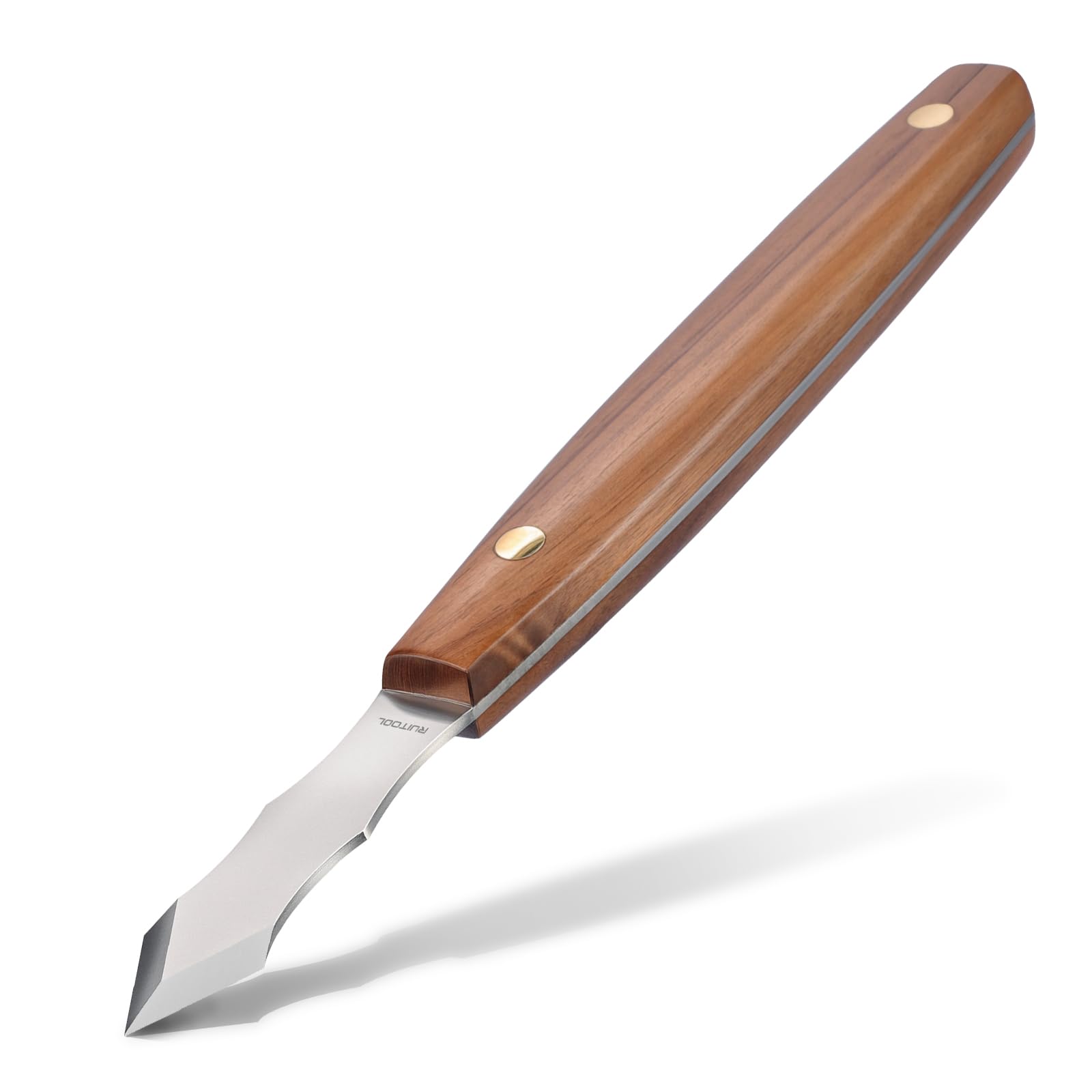
3. RUITOOL Marking Knife, 2.6 Inch Long-Neck Thin Blade
The thin neck that slips into a dovetail socket where a fat blade cannot go.
Most marking knives are too chunky to get into the corner of a tight pin socket. The RUITOOL solves that with an extended slender neck, and that single shape change is the whole reason to buy it. The blade assembly measures 2.6 inches, long and narrow enough to reach the base of a dovetail joint for a mark that actually lands where the saw needs it.
Underneath the shape is a one-piece high carbon steel blade, forged as a single unit rather than pressed from parts. That construction is meant to lower the risk of breakage at the joint between blade and handle. Springy, sharp, and forged in one piece is a sensible combination for a tool you will lean on repeatedly. The double bevel means it cuts in either direction, so left and right handed woodworkers both get a working angle.
The handle carries two grooves, letting you shift your grip up or down the handle to find the position that keeps your hand freshest during a long run of joints. The contoured shape also stops the tool rolling off the bench, a small thing that saves you a lot of bending. If you want one knife dedicated to dovetail sockets, this is the sharpest fit on the list.
The case for it: the long neck reaches where the Clarke Brothers blade cannot, and the one-piece forging keeps the blade whole under pressure.
The honest limit: it is a specialist. If you also need to scribe parallel offsets, this will not do it.
Reach for this if: dovetails are your main joinery and the sockets keep fighting your standard knife.
Look elsewhere if: you want a single tool for both knife cuts and edge-parallel lines.
4. YOSELIN Dovetail Jig Wheel Marking Gauge Tool Set

A complete dovetail starter kit that hands you the gauge, the marker, and the cutters.
Buying a marking gauge usually means buying one gauge. This set gives you the whole layout station in one box: a dovetail marker, a wheel marking gauge, a screwdriver, a pencil, a pencil holder, an M6 thumbscrew, and a protective case. If you are learning dovetails, having all of it in one kit removes the guesswork about what else you need to buy before your first joint.
The wheel gauge runs on an 8-inch precision ground steel rod, and the scale reads 1 mm and 1/64 inch, so you can work in metric or imperial without swapping tools. A knurled knob adjusts the head, and the head slides along the workpiece edge for repeat marks. Two wheel cutters are included: one bearing cutter for softwood and one locked cutter for hardwood. The body is CNC machined from solid aluminum billet with an anodized finish, which keeps it light while holding its shape.
What buyers respond to most is the build quality and the value in the box — this reads as more tool than the entry-level layout crowd usually expects. If there is a limit, it is the learning curve on dovetail angles; the marker helps, but it is still your eye and your saw doing the work. Treat it as a strong starting point rather than a finished skill.
Why it stands out
- Two cutters for softwood and hardwood
- Scale in both millimetres and 1/64 inch
- Protective case keeps the kit together
Where it has limits
- A dovetail marker does not replace saw practice
- The pencil accessories are extras, not the main event
Worth grabbing if: you are starting out on dovetails and want the whole layout kit without sourcing pieces separately.
Better skip if: you already own a good wheel gauge and only need a marker.
5. Tracer Scribe Block and Center Finder Marking Guide Set
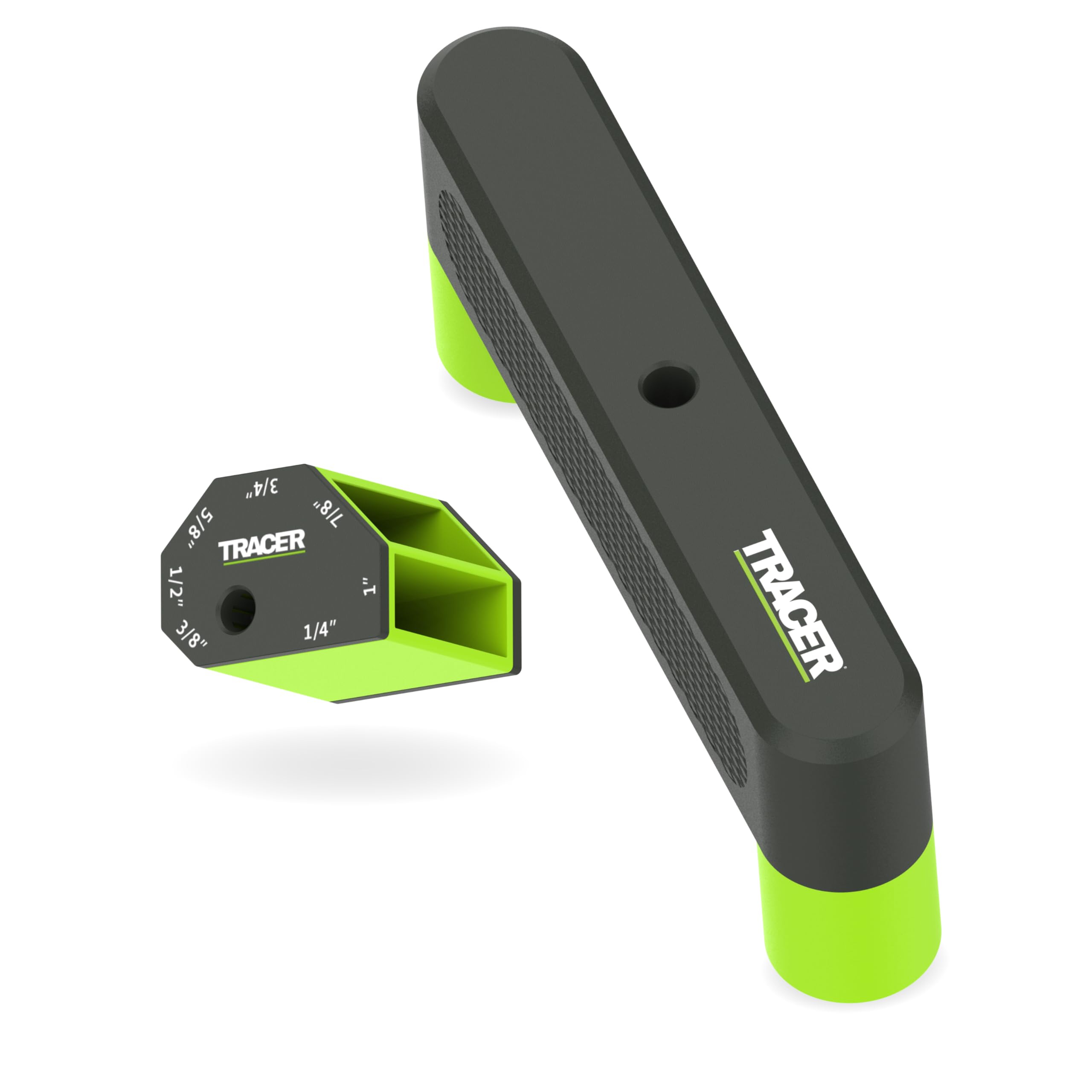
Two blocks that find a board’s centre and repeat an offset, no guesswork required.
Finding the centre of a board by eye is how you end up with dowel holes that do not line up. This set solves that with a dedicated centre finder that works on boards up to 2-3/4 inch thick, which covers a wide range of stock for dowel joints and mortise and tenon layouts. The scribe block alongside it does the other job: consistent edge marking at multiple offsets so you can carry one measurement across every piece in a project.
Markings are cut in both imperial and metric, and the line sizes run 0.3 mm, 0.5 mm, 0.7 mm, and 0.9 mm, so you can pick a width to match the mark you want. The body is ABS plastic, chosen for a durable, lightweight shell that shrugs off worksite handling. At 4.53 x 2.28 x 1.18 inches it is compact enough to pocket, and notably more compact than the 2.32 x 5.31 x 7.28 inch footprint of the KAKURI gauge covered above. There are also holes sized to hold a Tracer pencil if you use one.
One thing to size up front: this is a layout guide, not a cutter. ABS plastic will not slice wood fibers the way carbon steel does, so this is about repeatable accurate placement, not about cutting a deep groove. If your goal is to lay out symmetrical drilling and matching offsets, that is exactly what it is built for.
Layout, not cutting: four line widths and dual scale markings make this a repeat-measurement tool, so pair it with a knife or gauge when you need an actual scribed groove.
Pocket-sized precision: the compact ABS body slips into an apron pocket, which is where a layout guide earns its keep.
Fits you if: you are drilling dowels, laying out mortise and tenon joints, or repeating an offset across many parts.
Not for you if: you need a blade that cuts into grain.
6. Saker Multi-function Scribing Tool, Aluminum Alloy, 5.5 Inch

An adjustable scriber that draws arcs, parallel lines, and 15 other marks.
The Saker lives on the jobsite rather than the bench. Adjust the tightness on the pencil holder and nut, reshape the tool to what you need, then lock it so the setting holds through the job. That adjust-and-lock design is what lets one small tool draw parallel lines, curves, and arcs. The maker lists over 15 marking applications, including tiling and paving, stud walls, gables, panelling, infill panels, shop fitting, and built-in furniture.
The body is aluminum alloy with an anodic oxidation treatment on the surface, which is the finish that resists wear over time. At 0.14 kg it is genuinely light, and the trouser belt clip means you can wear it and forget it until you need it. A deep hole pencil and spare leads come included, so you have a marking point from day one.
The fair warning here is the grip. A lot of users find it hard to hold steady and hard to keep locked at a setting, so the tool can shift when you lean on it. It works well enough for rough layout and tiling, but if you need a dead-reliable setting for fine joinery, you will want a tool with a screw-locked head instead. Functionality gets the credit; the grip is where it asks for patience.
What it does well
- 15+ marking applications from one pocket tool
- Aluminum alloy with anodized finish
- Belt clip keeps it on you on site
The trade-off
- The lock can slip under pressure
- Fine-precision joinery demands a steadier tool
Your tool if: you tile, fit panels, or frame stud walls and want one clippable scriber for rough layout.
Not your tool if: you need a setting to hold to the millimetre.
7. VISLONE Wheel Marking Gauge and Woodworking Scriber Kit

A dual-purpose scriber that draws straight lines and arcs, on more than just wood.
Most marking gauges are woodworking tools and nothing more. The VISLONE is fitted with a stainless steel roller so it rolls a smooth linear mark and handles arc marking too, and the maker lists it for ceramic, iron, acrylic, wood, and glass. If your work crosses from timber onto tile or synthetic sheet, one tool covering that spread is genuinely useful.
The body is aluminum alloy, and sturdy knobs are fitted specifically to stop the gauge rolling around between marks. It runs the universal type pen holder concept, so a clip pen, refill, needle, or pencil can all be fitted for marking and for cutting wood fibers. At 11.36 ounces it has a bit of heft in the hand, which suits a tool you press along an edge rather than hold delicately. The scale is clearly visible and the balance is described as even for fast, accurate work.
The thing to watch is durability. Some users find it sturdy and solid, while others report the assembly coming apart early, so the honest read is that the build is not the equal of a solid brass gauge. Used within its limits it is a flexible, capable scriber. Used hard every day, it may not be the tool that outlasts you.
Material range is the draw: stainless steel roller plus a universal pen holder make this the one gauge here that works on wood, tile, glass, and acrylic alike.
Build is the compromise: treat it as a versatile mid-tier tool rather than a lifetime brass gauge.
Good match if: your marking crosses materials and you want one scriber that rolls a line and draws arcs.
Look at the brass option instead if: you want the most durable head on the list.
8. Taytools Solid Brass Wheel Marking and Cutting Gauge

Solid brass, a hardened cutter, and a head that locks where you put it.
For joint layout that has to be repeated exactly, the Taytools is the serious option. The head is solid brass at 1.625 inch diameter with a micro adjust lockable mechanism and knurled adjustment knob and tail, so you are dialing in a setting rather than nudging it. The beam is 7 inches long and 5/16 inch diameter hardened steel, and it is grooved to stop the head rotating while you adjust. That grooving is a small detail that removes a whole class of measurement drift.
The cutter is hardened steel at 3/8 inch diameter and slices cleanly across the grain. Two extra cutters ship in the box, so you are not stuck when the first one dulls. The cutter head retracts into a countersink in the head to protect the edge when you are not using it, which keeps it sharp between jobs. Total weight is 8.8 ounces, and the brass-and-steel construction is why it feels anchored in your hand.
Micro adjustment is where opinions split. Some find it precise and easy to set; others note the adjustment threads are not as fine as they expected. That is a fair caveat on an otherwise strong gauge, and it will not bother you if you set the tool then leave it. It is the heaviest and most expensive of the mid-tier gauges here, and for many that is the point.
Built to repeat
- Grooved beam stops head rotation while adjusting
- Three hardened cutters total in the box
- Cutter retracts for edge protection
Before you commit
- Adjustment threads are coarser than some expect
- Brass and steel add weight and cost versus aluminum
Pick it if: you mark repeated joints and want a gauge that stays put once set.
Reconsider if: you prefer a fine-thread micro adjust for very small changes.
9. Trend Multi-Scribe Pro MS/PRO

For tracing a wall’s wobble onto a countertop edge and fitting it flush.
Fitting a worktop against a lumpy plaster wall is a job nothing else on this list can do. The Trend Multi-Scribe Pro matches a profile, so you trace the wall’s contours onto your board and cut to fit. That is why it earns a place here: it is a different job from cutting a joint line, and if you fit panels or countertops you need exactly this. It offers 15 functions in total, covering parallel scribe, contour profile scribing, and line block work.
The backset is adjustable to suit your scribing gap, which lets it scribe internal and external curves and mark parallel lines quickly. A square and mitre function gives layout work at 13/64 inch increments on the blade, useful for checking and transferring depths of mortices, grooves, and rebates. Two pencil positions handle narrow and wide circles and arcs, or transferring scribe marks and backsets. The body is 13.78 x 5.91 x 1.57 inches and 0.19 kg, so it is a full-size layout tool rather than a pocket one.
The extras are what push it past a plain profile scriber. There is a built-in spirit level, a plumb bob function, and a pencil sharpener, so a lot of your marking setup lives on one tool. The catch is that this is a composite-bodied layout tool, not a hardened steel blade, so do not expect it to cut fibers. It is a transfer tool, and it is very good at that specific thing.
The profile job: contour scribing is the standout — trace the wall, cut to the line, and your countertop meets plaster cleanly.
Layout extras: the spirit level, plumb bob, and pencil sharpener mean you can set out a whole job from one tool.
Right pick if: you are fitting countertops, shelves, or panels against uneven walls and need to transfer that profile.
Wrong pick if: you want one tool to cut a joint line in solid wood.
Know the Specs
Blade Steel And Edge Retention
Carbon steel is the classic choice for marking blades because it takes a sharp edge and re-hones easily. A double-edged or double-bevel blade cuts in two directions so both hands work. The longer the blade holds its edge, the less time you spend re-sharpening mid-project. Keep carbon steel dry and it will serve for years.
Beam Length And Locking
The beam length is how far the gauge can reach across a board to draw a parallel line. A 7 or 8 inch beam covers most cabinet work, while a shorter one handles small parts. Locking matters equally: a head that holds firm keeps your offset steady. A grooved beam stops the head rotating while you adjust it, which is a real accuracy gain.
Common Questions
What is a woodworking scribe tool actually used for?
Is a marking knife better than a pencil?
Will a wheel marking gauge work on hardwood?
Can I use these scribers on anything other than wood?
How do I find the centre of a board accurately?
Do these tools come sharp or need work first?
What is a Japanese kebiki gauge?
Can one tool handle both cutting and profile tracing?
Does the Trend Multi-Scribe Pro need a pencil?
The Bottom Line
For most hand-tool woodworkers the woodworking scribe tool worth starting with is the Clarke Brothers Marking Knife, because its double-edged carbon steel blade cuts a groove a saw can follow in either hand. If dovetail sockets are your main fight, the long neck of the RUITOOL Marking Knife reaches where the rest cannot. And if you need a line parallel to a board edge, the KAKURI KEBIKI Gauge covers 120 mm of reach — no other gauge here reaches that far.
How we choose
We do not accept paid placement. Every pick is matched to a real buyer and a real use-case; we do not hands-on test units.
Sources
Specifications: manufacturer listings and product documentation. Review insights: verified customer reviews, as of November 2026. Pricing: not shown on this page (it changes often); check the current price via the retailer link.
As an Amazon Associate, Tactical Gear Guy earns from qualifying purchases. This does not affect which products we feature.