Specs are compiled from manufacturer listings and verified buyer reviews and can change over time — please confirm the key details on the product page before buying.
You want a rounded corner or a clean circle that matches the line you drew — not a shape that wanders a millimetre off course halfway through the cut. A good router jig bolts to your base and holds the bit on a fixed path, so the cut repeats without re-marking. The picks below span circle-cutting, corner-radius, bushing-guide, mortise and box-joint work, so you can buy only the jig your projects actually need. The crowd favorite is the Jasper 290 Circle Jig — 4.5+ stars across 200+ ratings — because its CNC-machined pivot and calibration disc cut 268 sizes in 1/16″ steps.
This guide is built by comparing the manufacturers’ published specifications and the patterns across verified customer reviews, so you get each pick’s real strengths and trade-offs instead of marketing spin.
Some jigs are a single template, others carry 18 radius options in one frame; the trick is matching the jig’s mounting pattern and material thickness to your own router before you buy. Here are the woodworking router jigs that hold their settings cut after cut.
Top Picks


How To Choose The Best Woodworking Router Jigs
The first thing a router jig has to do is fit your router. Every jig below either bolts to a base plate through mounting holes or rides against the workpiece, and both depend on the base size you already own. A base with holes that do not line up will not mount no matter how accurate the jig is. Check your router’s base before you check anything else.
Match the jig to the cut you make most
Circle jigs, corner-radius templates, edge and mortise guides, and box-joint sleds solve different problems. Buy for the job you actually run every week, not a full set you will use twice. A single-template jig that nails one cut beats a drawer of adjustable gadgets you have to re-square every time.
Watch the pivot and the stop, not the finish
A circle jig’s accuracy lives in its pivot holes. A corner template’s accuracy lives in its edge stops. Screws that slip and stops that creep are the two things that ruin a cut after the first pass, so look at how the jig holds its setting across a whole job.
Check bit and bushing fit
A bushing guide only works when its inside diameter clears your bit and its outside diameter gives you the offset you want. Measure both before ordering. A radius template works with any handheld router that takes a standard bit, which is why it is often the easier first buy.
Side-by-Side Comparison
| Model | Best For | Cut Range / Sizes | Material | Router Fit | Amazon |
|---|---|---|---|---|---|
| Jasper 290 Circle Jig★ Best Overall | Perfect circles | 1½”–18 3⁄16″ | Acrylic | Compact/trim | Amazon |
| TANYO 7pcs Corner Radius TemplateBest for Corners | Rounded corners | 18 radius angles | Aluminum | Trim/handheld/table | Amazon |
| BOZXYE 11 Pcs Brass Bushing SetBushing Specialist | Template work | 8 bushing sizes | Brass | Porter-Cable style base | Amazon |
| Milescraft 1224 Edge & Mortise Guide | Edges and mortises | Straight/curved edges | Plastic body | Universal | Amazon |
| Sigerio 4 in 1 Circle Jig | Large circles | 10″–58″ | Aluminum alloy | Multi-hole base | Amazon |
| Kreg PRS1000 Corner Routing Guide | Radius and chamfer | 5 radius / 3 chamfer | Metal | Trim/handheld/table | Amazon |
| Milescraft 1232 Corner Cut | Flip templates | 8 profiles | Composite | Handheld/table | Amazon |
| Trend Varijig | Recesses and panels | 23.6 x 23.6 in | Metal | Router in frame | Amazon |
| Rockler Box Joint Jig | Box joints | ¼”, ⅜”, ½” keys | MDF | ¾” miter slot | Amazon |
Detailed Reviews
1. Jasper 290 Circle Jig
Our pick — 4.5+★ from 200+ verified ratings; the strongest balance of quality and price.
One acrylic disc that cuts 268 circle sizes without you touching a tape measure.
The reason this one leads is the number 268 — how many circle sizes it can cut, from 1½” up to 18 3⁄16″, stepping in precise 1/16″ increments. That range covers speaker cutouts, inlay rings and round tabletops on a single setup. The pivot is a CNC-machined hole (a machine-drilled hole at an exact position), paired with a calibration disc, so the centre stays put from the first cut to the tenth. Once the pivot pin is seated in the calibration disc, every pass swings the same radius.
Owners rate its accuracy and build quality highest, and the hardened acrylic disc stays rigid through the cut. If you run a full-size plunge router, this is the wrong model — the maker points you to its larger 200 or 240 instead. That single fit limit is what to read before ordering.
What holds up: Accuracy and build quality land at the top of owner feedback, and the fit is specific enough that the base plate locks straight on. The calibration disc plus the centering pin and two pivot pins arrive in the box, so there is no separate kit to buy.
The honest catch is value. Some owners consider it easily worth the money, others find it overpriced — so judge it against how often you cut circles rather than as a one-off purchase.
Reach for this if: you build speakers, inlays or round panels and want repeatable circles from a compact or trim router.
Look elsewhere if: your router is a full-size plunge model, since this jig does not fit that base.
2. TANYO 7pcs Router Corner Radius Template
Seven aluminum templates that pack eighteen radius options into one small box.
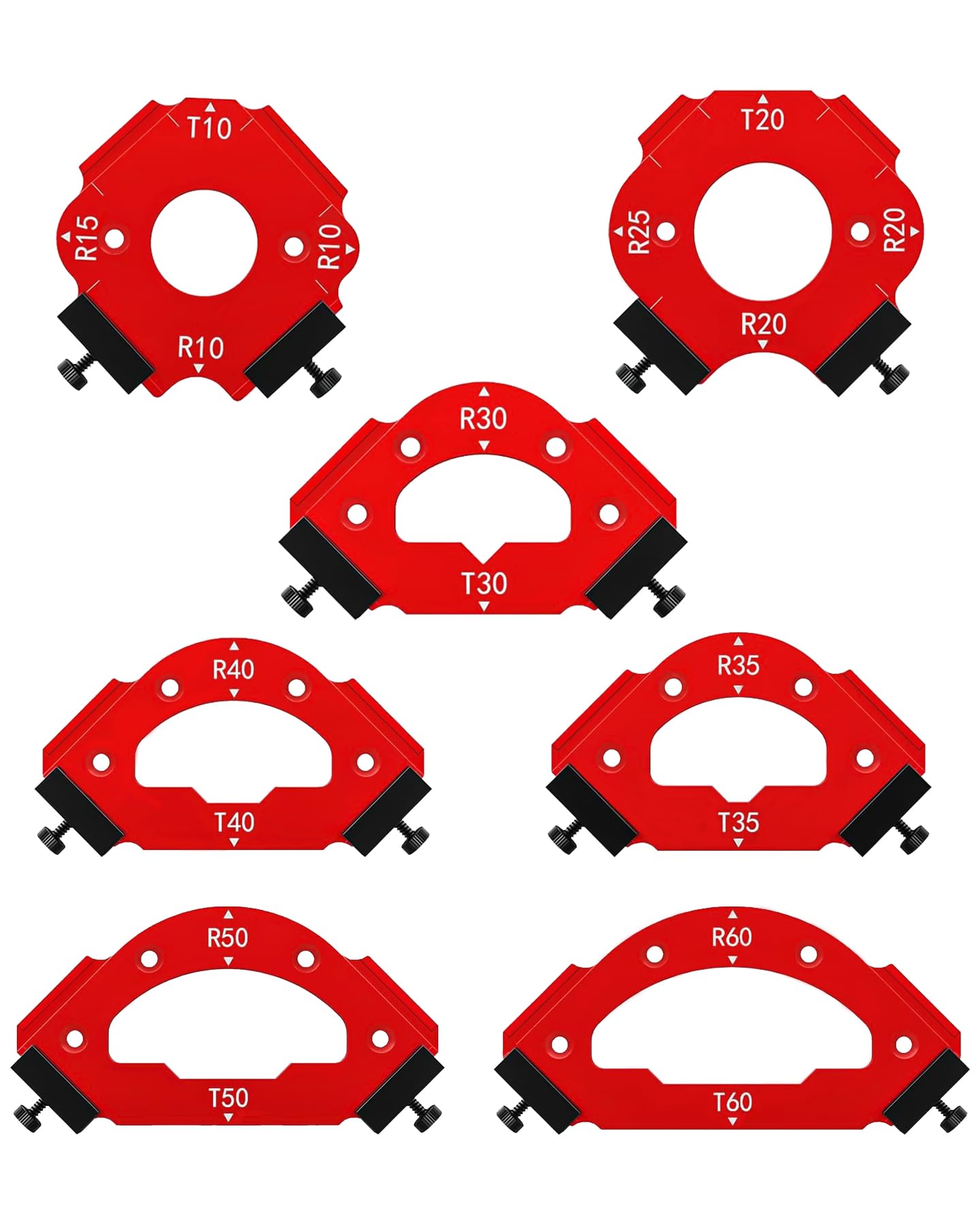
Cutting a rounded corner usually means a jigsaw and a lot of sanding. This set replaces both by clamping a guide rail against the corner and running the router along it. The seven-piece kit carries eighteen radius angles, from R10 up to R60 plus the T10–T60 range, and the three-in-one arc positioning handles oblique, outer round and inner fillet corners in one frame. The aluminum body is CNC-machined (computer-guided cutting for tight tolerance) and anodized for wear resistance.
Compared with the Jasper circle jig above, this is a different job entirely — one cuts full circles, the other rounds off a corner. The two do not overlap, so for a furniture builder they sit side by side on the shelf. Owners find the setup easy: loosen the adjustable stops, tighten them onto the board, and run the router along the edge.
What earns its keep
- Eighteen radius angles from one compact seven-piece set
- Hard aluminum alloy with anodizing for wear resistance
- Adjustable stops make clamping quick
- Fits trim, handheld and table routers
Where it asks for care
- Corner accuracy gets mixed feedback — buyers report cuts off by about a sixteenth of an inch on the flat sides
- Stops need re-checking between boards to stay on the line
The verdict: a smart first corner-radius buy for furniture edges, picture frames and panel trimming.
One real limit: the mixed corner-accuracy reports mean you should test a scrap corner before committing a finished board.
3. BOZXYE 11 Pcs Premium Brass Router Template Guides Set
Eleven brass bushings that let one template guide cut every offset you need.
If you already own a template and want the router to trace it, this is the set that does it. The eleven bushings are solid brass with a surface-tempered, colour-preserving finish, and they step through eight sizes — from a 5/16″ outside diameter with a 1/4″ inside, up to a 1″ outside with a 7/8″ inside. Three nuts and a 1/4″ shank double-edge mill cutter arrive in a black tool box.
Compare this with the TANYO set above and the difference is scale. The TANYO carries seven items, this one 11, and its footprint is leaner — 6.5″L x 1.97″W against the TANYO’s 7.2″L x 5.7″W — so it slips into a drawer more easily. The catch is fit: these bushings are made for a Porter-Cable style sub-base, and a base that does not match that pattern will not take them.
The brass argument: a solid brass bushing holds its shape through repeated contact with a template edge, which is why the material is worth the note. Match the outside diameter to your template opening and the inside diameter to your bit and you get a clean, repeatable offset.
The one thing to verify is your router base pattern before purchase. This kit is not universal — it is built for the Porter-Cable style, and that is the deciding factor, not the bushing count.
Works best for: template-guided routing on a Porter-Cable style base.
Hold off if: your router base does not follow that bolt pattern.
4. Milescraft 1224 Edge & Mortise Guide

One guide arm that turns a router into a mortise, rabbet and edge-finishing machine.
The draw here is reach. A large flat surface runs along straight and curved edges for radial cuts, and the bonus offset base handles narrow boards and edge profiles that a bare router base cannot touch. Two non-marring mortising pins cut mortises in varying board thicknesses, so a hinge recess no longer needs a separate setup. It weighs in at 1.75 pounds and measures 14.5 x 8 x 2.5 inches — a shop-bench tool rather than a pocket jig.
Reliability is the thing owners rate, with versatility close behind. It is a universal fit, so it should clamp to most routers without a bolt-pattern hunt. Compared with the Kreg corner guide further down, it trades corner rounding for edge and mortise work, which makes it the broader tool for cabinet and furniture jobs.
Where it scores
- Large edge surface for straight and curved cuts
- Two mortising pins included
- Offset base handles narrow boards
- Universal fit for most routers
Rough edges to know
- Some owners find the setup difficult, others find it quick
- Cracks in the plastic are reported on some units
- The mounting system can run short on screws
Pick this for: mortises, rabbets, dados and edge finishing on one guide arm.
Factor in: a few owners find setup slow and the plastic less durable than expected — take your time on first assembly.
5. Sigerio 4 in 1 Router Circle Cutting Jig

A one-piece aluminum base with an extension rod long enough to swing a 58-inch circle.
Tabletops, round signs and speaker baffles need reach a compact circle jig cannot give. This jig cuts circles and arcs from 10″ up to 58″ in diameter, and the oversized base with its extension rod supplies that span. The one-piece die-cast aluminum construction resists flex under the router, which keeps the bit on the intended path instead of drifting wide. Multiple mounting-hole patterns on the base let it fit a range of handheld and compact routers.
Owners call it high quality with a rigid aluminum build that installs easily. It also doubles up: paired with the positioner it handles grooving and straight-line routing, so one setup covers circular, curved and linear work. Where the Jasper jig tops out at 18 3⁄16″, this one reaches 58″, which makes the two complementary rather than rivals.
The spec that matters: the oversized base and extension rod are the whole point. That extra reach is what turns a small trim router into a tool that can scribe a large panel, and the die-cast aluminum keeps it stable at full extension.
One thing to verify before ordering: router base designs vary, so check your base size and mounting-hole spacing against the multi-hole pattern. That check is what prevents a return.
Best fit for: oversized circle and arc work on tabletops, signs and furniture panels.
Do this first: confirm your router’s mounting-hole spacing matches the base before you buy.
6. Kreg Corner Routing Guide Set, PRS1000

A corner guide built around a big handle, so your hand holds the line instead of the jig.
Kreg puts the control in your grip. The large handle gives confident steering during the cut, and the GripMaxx surface plus adjustable edge-stop posts hold the workpiece still while the router moves. It creates five radius sizes and three chamfer sizes, and runs on any trim router, handheld router or a router table. The frame is metal and carries 400 g of weight — light enough to move around the bench one-handed.
Functionality and ease of use top the owner feedback: people report it works well across different materials, and one buyer calls it built for real work. Against the TANYO set, the Kreg gives you fewer radius options but a stronger grip-and-handle setup for freehand control. Placement is where it asks for attention: alignment and template alignment generate the most friction, so lock the guide down squarely before a pass.
Why the handle earns a mention: freehand corner routing fails most often when the guide slips. A large handle plus the GripMaxx face keeps pressure on the board, and the adjustable posts let you reset the same corner on the next piece.
The honest caveat is that corner shaping gets mixed feedback — some owners find it easy, others hit snags. Square the guide against the board and lock the edge-stop posts before the first pass.
Reach for this if: you want a large handle and grip face to steer radius and chamfer cuts on a trim or table router.
Watch for: alignment drifted for some owners, so square the guide before the first pass.
7. Milescraft 1232 Corner Cut
Four flip templates that carry eight patterns and a matching trim bit in the box.
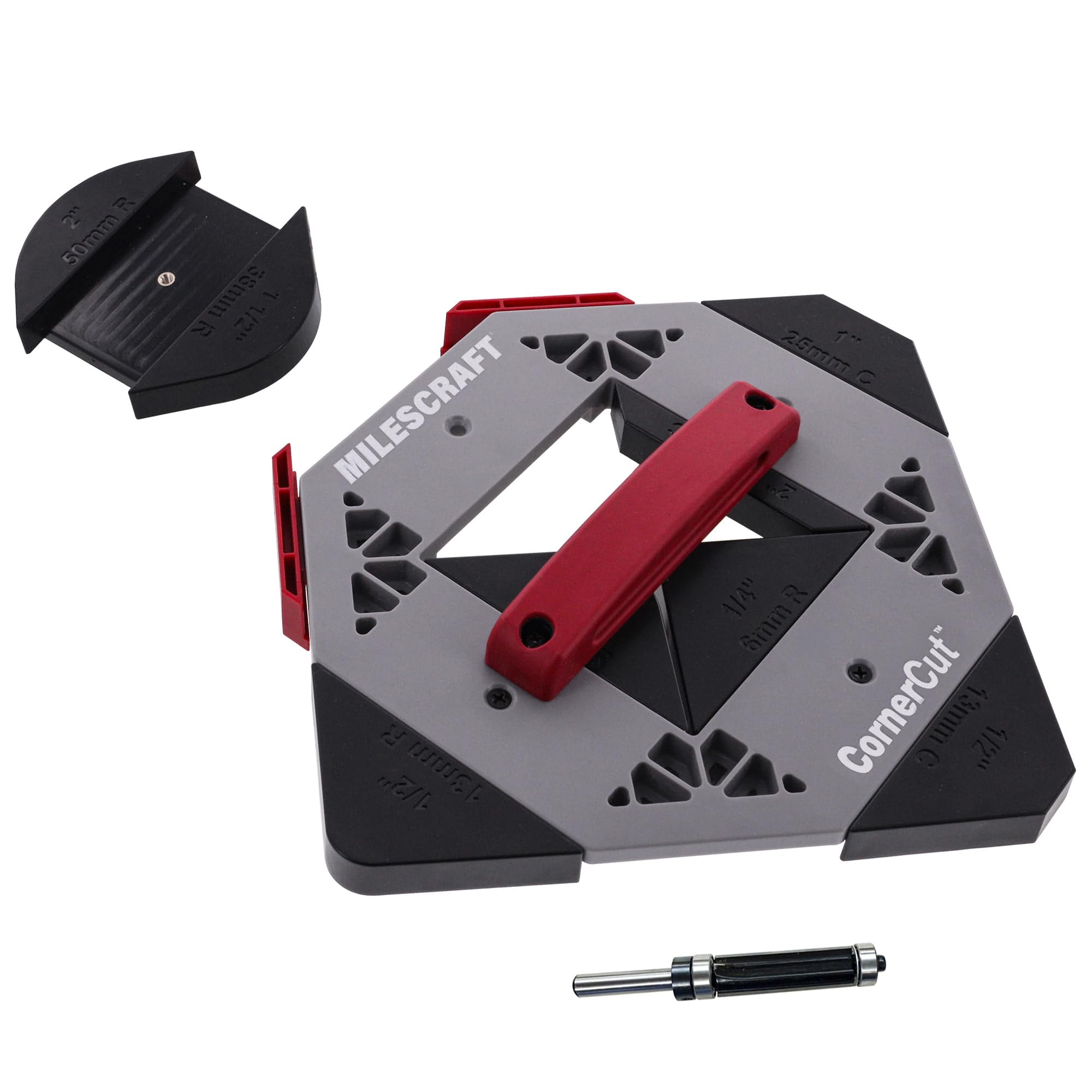
Flip templates are the twist here. Four overlay plates give eight corner patterns without swapping a loose guide, and they cut radiuses of 1/4″, 1/2″, 1″, 1-1/2″ and 2″ plus 45-degree chamfers of 1/2″, 1″ and 2″. The kit ships with a 1/2″ x 1-1/4″ dual-bearing flush-trim router bit on a 1/4″ shank, so you are not hunting for a separate cutter. Adjustable edge guides set the board width, and rubber pads grip the workpiece.
At 1.17 pounds it is light enough to lift and reposition mid-job. The large removable handle gives extra control at the router table, which mirrors the Kreg’s grip-first thinking but with a different mechanism. Both work with a handheld router or a router table, and both cover chamfers as well as radiuses.
What you get
- Four flip templates covering eight patterns
- Dual-bearing flush-trim bit included
- Adjustable edge guides for narrow or wide boards
- Removable handle for router-table control
Skill to bed in
- Flip templates need a square first placement to hold the pattern
- Best results come from setting the rubber pads firmly before routing
The winner for: a beginner or hobbyist who wants radius and chamfer options without buying a bit separately.
Ask yourself: whether four flip plates cover the corners you actually cut, because pattern choice is fixed by the template set.
8. Trend Varijig Adjustable Router Template System

A metal frame that frames the space, so square recesses and inlays land on the line.
This is the one for panel work. The adjustable frame creates square and rectangular recesses, slots and panel layouts, with a capacity of up to 23.6 x 23.6 inches. Once set, it holds its dimensions for inlays, hinge mortises and recesses, which means you can repeat a cut without re-marking the board. An anti-tilt shoe keeps the router level, and at 4.7 pounds the frame stays planted on the bench.
Against a shop-made template, this replaces guesswork with a controlled setup. Quality is the thing owners praise most, and it handles the clean inlay and panel work that a freehand guide struggles with. The caveats are mounting and stability: tiny screws are hard to handle, some owners find it less stable than expected, and the clamps are sold separately.
Where it shines: repeatable square and rectangular recesses in one rigid frame. The dual-scale guide and the 23.6 x 23.6 capacity let you frame a large panel and route inside it without resetting.
Budget for the clamps and be patient with the small mounting screws — that is the trade-off for a frame this accurate once it is set.
Choose it for: inlays, hinge mortises, recesses and panel routing where repeatability matters.
Include in the plan: separate clamps and a patient session with the small mounting screws.
9. Rockler Router Table Box Joint Jig

Brass keys set the finger spacing, so box joints come out even piece after piece.
A box joint lives or dies on uniform finger spacing. This sled uses precision-machined solid brass indexing keys in 1/4″, 3/8″ and 1/2″ widths, swapped in and stored in slots on the sled itself. Long skis keep the sled square to the bit and tabs stop it at the end of the cut. The melamine-coated low-friction MDF platform slides easily, and soft-grip knobs lock it into a 3/4″ miter slot.
Quality lands at the top of the owner feedback and functionality close behind — it makes tight-fitting joints easy. Against the Trend frame above, this is purpose-built for joints while the Trend handles panels; they do not substitute for each other. Set expectation on fit: Craftsman router tables are reported as a poor match, so check your table’s miter slot before ordering.
What the brass keys do: precise indexing is the whole job here. A solid brass key holds its width through repeated passes, which is what keeps finger spacing even across a run of boxes.
Stability gets honest pushback — a 1/16″ wobble in the sled is reported. Tighten the soft-grip knobs into the miter slot and press the skis flat against the table before the first pass.
Made for: small to medium boxes where tight box joints matter on a router table with a 3/4″ miter slot.
Check first: seat the sled firmly and confirm your table fits, since sled wobble and Craftsman fit are the recurring gripes.
Know the Specs
Circle range and increments
A circle jig’s number — like 1½” to 18 3⁄16″ or 10″ to 58″ — tells you the smallest and largest diameters it can swing. The increment, such as 1/16″, tells you how finely you can step between sizes. Match the range to your biggest project, then check the increment so you can hit the exact circle a speaker or inlay needs.
Pivot holes and calibration
The pivot is the fixed point the jig rotates around. CNC-machined pivot holes and a calibration disc hold that centre steady, which is what makes a circle repeat. A jig without a firm pivot can drift, and a drift of a fraction of an inch shows on the finished edge.
Router base mounting pattern
A jig only mounts if its holes line up with your router base. Some are built for compact and trim routers, some for a Porter-Cable style sub-base, and some use a multi-hole pattern to fit several brands. Check your base size and screw spacing first — this is the single most common reason a correct jig gets returned.
Radius and chamfer sizes
Radius is the round on a corner; chamfer is the angled flat cut. A corner template lists both, such as five radius and three chamfer options, so you can shape a table edge or a frame profile. More sizes mean more shapes from one frame, but each still needs a firm edge stop to hold the line.
Bushing outside and inside diameter
A router bushing guide (a ring that rides against a template) is sized by two diameters. The inside diameter must clear your bit, and the outside diameter sets the offset from the template edge. Get either wrong and the cut wanders off the template.
Material and sled fit
Aluminum and brass resist wear; acrylic and MDF are lighter and cheaper. On a box-joint sled, the fit into a 3/4″ miter slot and a solid ski against the bit matter more than the material name, because a wobble in the sled shows up as uneven fingers.
Common Questions
Will the Jasper 290 circle jig fit my router?
Do I need a trim router or a full-size router for these jigs?
What is the difference between a radius and a chamfer on a corner template?
What is a router bushing guide and how does it work?
Can a box joint jig work on any router table?
Which jig is best for cutting very large circles?
How many circle sizes can the Jasper 290 cut?
Is the Trend Varijig good for cutting hinge mortises?
Do these corner jigs come with a router bit included?
Why does a corner template sometimes cut off on the flat sides?
The Bottom Line
For most woodworkers the woodworking router jigs to buy first is the Jasper 290 Circle Jig, because its 268 sizes and calibrated pivot cut perfect circles every time on a compact or trim router. If rounded corners are your job, grab the TANYO 7pcs Corner Radius Template for its 18 radius angles in one aluminum set. And for tight box joints on a router table, the Rockler Box Joint Jig is the one to reach for, with its three brass indexing keys. Buy the jig for the cut you run every week, then add the corner, bushing or box-joint jig when a project calls for it.
How we choose
We do not accept paid placement. Every pick is matched to a real buyer and a real use-case; we do not hands-on test units.
Sources
Specifications: manufacturer listings and product documentation. Review insights: verified customer reviews, as of November 2026. Pricing: not shown on this page (it changes often); check the current price via the retailer link.
As an Amazon Associate, Tactical Gear Guy earns from qualifying purchases. This does not affect which products we feature.