Specs are compiled from manufacturer listings and verified buyer reviews and can change over time — please confirm the key details on the product page before buying.
You want a rotary tool that keeps its speed when the bit bites into oak, and most cheap ones bog down and burn the grain instead. This guide separates the nine rotary tools that actually hold their RPM under load from the ones that stall the second you lean into a cut. Every pick here is a real spindle tool built for carving, sanding, cutting and polishing wood, so you are comparing tools that belong in the same workshop drawer.
This guide is built by comparing the manufacturers’ published specifications and the patterns across verified customer reviews, so you get each pick’s real strengths and trade-offs instead of marketing spin.
The rotary tool section hides more spec-sheet traps than any other small power tool, because a bare top RPM says nothing about how the motor behaves mid-cut. Below you will find the honest breakdown of woodworking rotary tools so you can match torque, speed range and collet size to the work on your bench.
Top Picks
How To Choose The Best Woodworking Rotary Tools
The single deciding factor in a woodworking rotary tool is how it delivers power at low speed, not how high it can spin. Blasting a burr at maximum RPM scorches end grain; the controlled work happens between 8,000 and 20,000 RPM. So the tool’s lowest setting and its speed control mechanism tell you far more about real carving feel than the headline RPM.
Look at the floor of the speed range first
A tool that bottoms out at 5,000 RPM gives you steadier control for detail carving and softwood shaping than one that starts at 8,000 or 10,000. The Dremel 4000 starts at 5,000 RPM and the HARDELL starts at 8,000 RPM, which changes how each one behaves when you need a slow, deliberate pass. A stepped dial with clearly spaced speeds beats a vague continuous knob if you switch materials often.
Match the collet size to the bits you already own
The collet is the collar that clamps the bit shank, and mismatch here means your bits simply will not seat. Rotary tools commonly run 1/8 inch, 1/16 inch, 3/32 inch and occasionally 3/25 inch shanks, so a kit that ships several collets covers more of the bits you already own. The DURATECH takes this further with an adjustable collet spanning 1/32 inch to 1/8 inch, so you are not locked to fixed sizes.
Corded for torque, cordless for reach
A corded tool gives you unlimited run time and steady power at every speed, which matters for long sanding or hogging off material. A cordless tool frees you from the outlet for detail work at the bench or on-site trim, but its battery capacity sets a hard ceiling on session length. Decide which limitation you can live with before you start comparing models.
Side-by-Side Comparison
| Model | Best For | Speed Range | Power Source | Accessories | Amazon |
|---|---|---|---|---|---|
| Dremel 4000-2/32★ Best Overall | All-round workshop work | 5,000-35,000 rpm | Corded | 32 + 2 attachments | Amazon |
| HARDELL 180W Corded KitBest Value | Big accessory spread on a budget | 8,000-35,000 rpm | Corded | 153 | Amazon |
| PHALANX 8V Cordless KitBest for Cordless Reach | Working away from outlets | 5,000-30,000 rpm | Cordless, 2.0Ah | 117 | Amazon |
| HOTO Cordless Kit | Detail work and 3D printing | 5,000-25,000 rpm | Cordless, USB-C | 35 | Amazon |
| PHALANX 200W Kit | Fast material removal | 10,000-38,000 rpm | Corded, 200W | 132 | Amazon |
| DURATECH 12V Cordless | Speed readout on the fly | 5,000-35,000 rpm | Cordless, 2000mAh | 118 | Amazon |
| CRAFTSMAN V20 | Craftsman battery owners | 6,700-34,000 rpm | Cordless, tool only | None | Amazon |
| Dremel 3100-1/15 | First timer sanding and deburring | 5,000-35,000 rpm | Corded, 1.2A | 15 + 1 attachment | Amazon |
| Fanttik F2 Pro Kit | Bench-side detail and storage | 5,000-25,000 rpm | Cordless, 3000mAh | 44 | Amazon |
Detailed Reviews
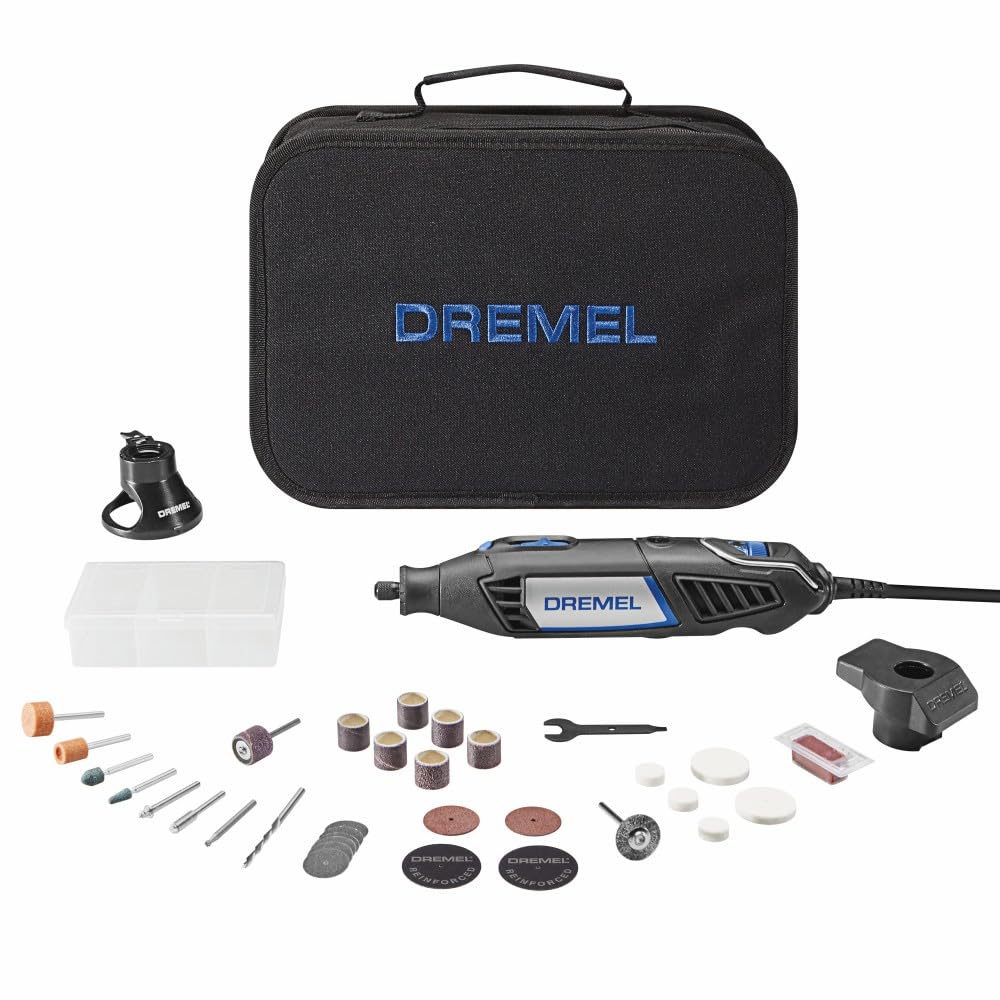
1. Dremel 4000-2/32 Rotary Tool Kit
Our pick — 4.5+★ from 900+ verified ratings; the strongest balance of quality and price.
The corded carving anchor that holds its speed from 5,000 to 35,000 RPM
For work that spans rough hogging and fine detail on the same bench, the Dremel 4000 is the tool the rest of this list gets measured against. Its 1.6 Amp motor drives a 5,000-35,000 RPM range, and the electronic speed control keeps that speed steady under load instead of sagging the moment the burr digs in. That matters in hard wood: a sagging spindle burns the cut and wanders off your line, while a steady one lets you carve a clean edge.
Where the spec sheet goes quiet, the workshop verdict does not. Reviewers consistently praise the build and finish, and that solidity shows up in daily handling rather than the marketing copy. The 360-degree grip zone (a rubberised band that wraps the whole barrel) lets you turn the tool to a comfortable angle rather than fighting it for access in a tight carving. Because it is corded, there is no battery ceiling on long sanding sessions — you can shape a whole bench-full of parts without a recharge break.
Subtract the HARDELL’s accessory count from Dremel’s box and you will notice the difference — 32 included bits and pieces versus the HARDELL’s 153 — so plan to buy the burr set you actually want. The Dremel’s real advantage is the lower 5,000 RPM floor against the HARDELL’s 8,000 RPM, which gives you gentler control for softwood detail and finishing passes. Weigh that control against the smaller starter kit and the choice becomes clear.
Where the Dremel earns its name
- 1.6 Amp motor holds 5,000-35,000 RPM without bogging
- Low 5,000 RPM floor for control in soft wood
- 360-degree grip zone keeps your hand comfortable in tight carving
- Corded power with no battery limit on long sessions
- 32 accessories plus 2 attachments to start
What to plan around
- Far fewer accessories than the high-count budget kits
- Corded, so you work within reach of an outlet
- Heavier in the hand at 3 pounds than the compact cordless picks
Reach for this if: you want one steady corded tool that handles carving, sanding, cutting and polishing on the same bench.
Look elsewhere if: you need the tool to sit in a drawer of pre-loaded bits and start carving without buying more.
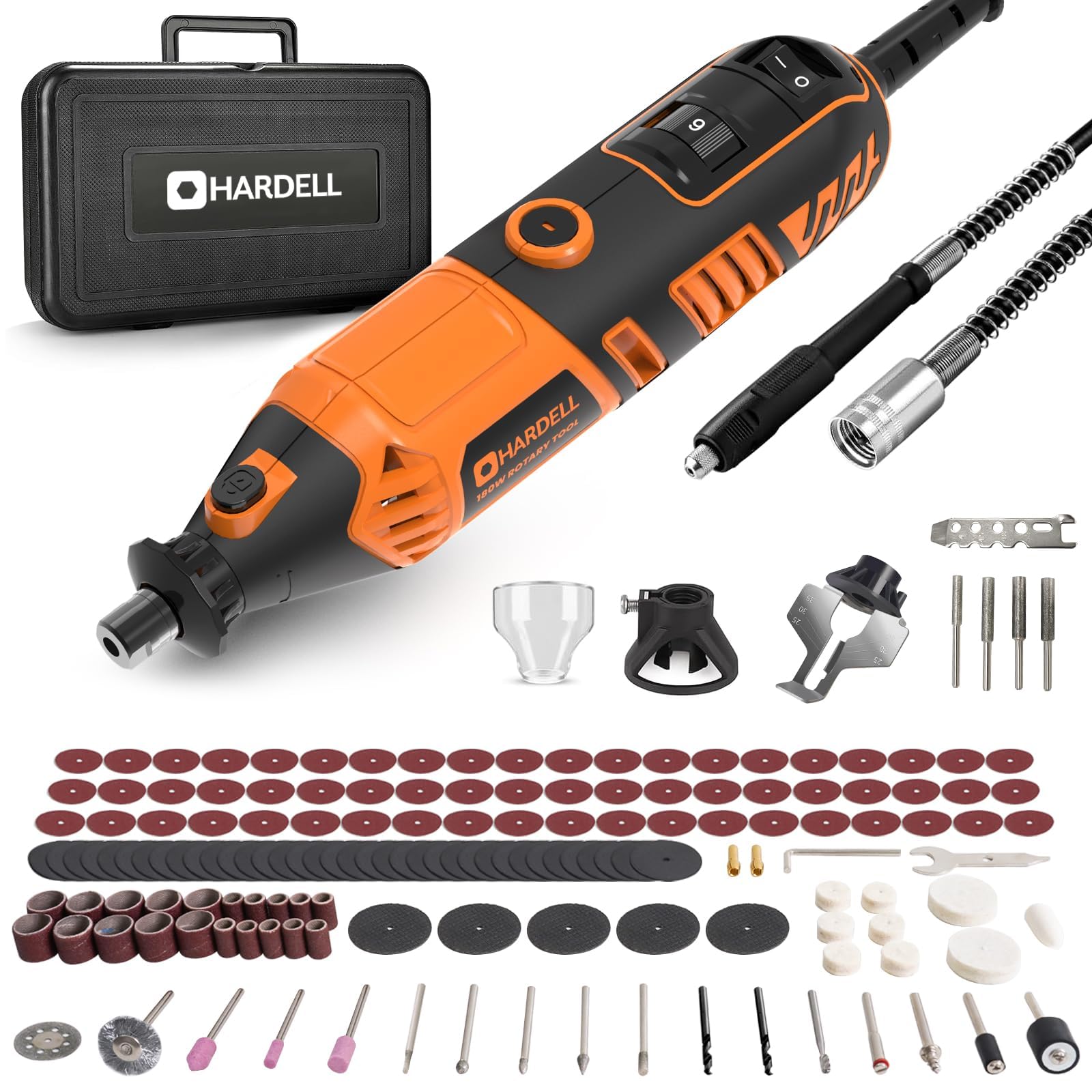
2. HARDELL 180W Corded Rotary Tool Kit with Flex Shaft
A 153-piece starter arsenal for the carver who wants every bit on day one
The number that decides this one is 153. That is the accessory count you get in the box, versus the 32 pieces in the Dremel 4000 kit, so a beginner can rough-carve, sand, polish and cut without a second shopping trip. The 180W corded motor pushes 8,000-35,000 RPM and reaches the same 35,000 RPM ceiling as the Dremel above, but it starts higher at 8,000 RPM.
That higher floor is the honest trade-off. You lose the slow, gentle band a 5,000 RPM start gives you for softwood detail, so this tool prefers shaping and removal over feather-light finishing passes. The 6-speed gear adjustment (a stepped selector rather than a smooth dial) makes it easy to set and repeat a speed, so you can dial in the same setting for every pass. The flex shaft turns the tool into a pencil-style handpiece, so you can carve detail you cannot reach with the full barrel in the way.
What wins people over here is the raw output-for-money — the motor speeds through material and the accessory spread covers almost any job you point it at. The durability picture is honest but mixed: the tool carries a workhorse reputation, though a small minority report failures early, so treat it as a capable budget machine rather than a lifetime investment. For a first tool that comes fully outfitted, that is a fair place to stand.
The flex-shaft payoff: Fitting the flexible shaft converts the tool to a slim handpiece, so you can carve inside a curve or a routed channel where the full body will not fit. It is the single included extra that changes how you work rather than just adding another bit to the pile.
The catch: With a 8,000 RPM floor you trade fine low-speed control for shaping power, so if your work is mostly softwood detail rather than hogging, a lower-starting tool suits you better.
Buy this one if: you want a fully stocked corded kit and do more shaping, cutting and sanding than delicate finishing.
Think twice if: you routinely carve softwood at very low speed and need the gentle bottom end.
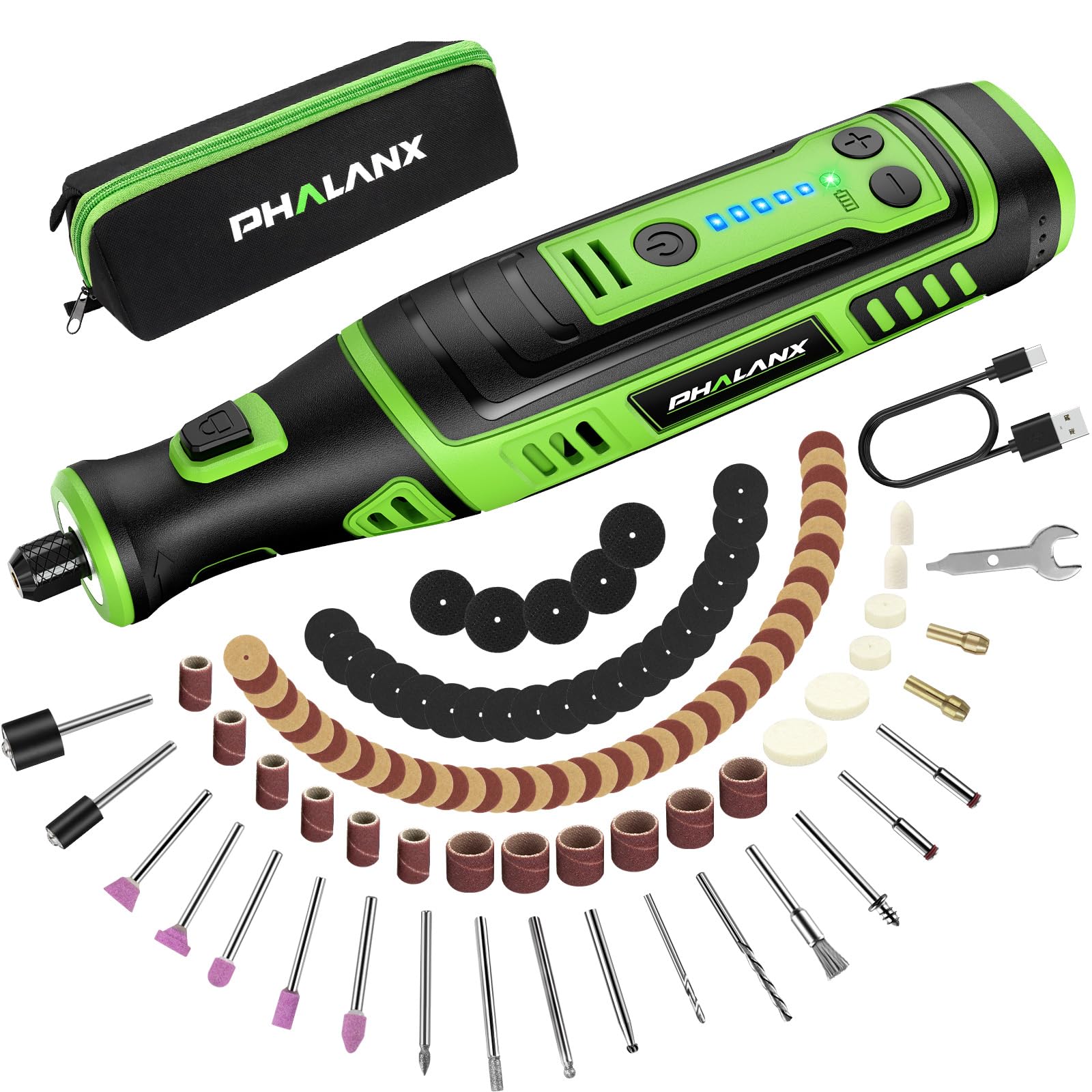
3. PHALANX 8V Cordless Rotary Tool Kit
A pen-light cordless kit that goes where the outlet cannot follow
At 1.4 pounds and 8.66 inches, this tool feels like holding a marker, so it is the pick for trim work in a backyard, a garage without outlets, or a job that moves around. The 8V motor runs a 5,000-30,000 RPM range across 5 speeds, and the 2.0Ah battery frees you from the wall entirely with USB-C charging to top it back up. The speed LEDs show your setting in real time, which helps when you switch from a gentle sanding pass to a cutting pass without guesswork.
Buyers consistently land on reliability and value, and the included 117 accessories give a beginner plenty to start carving, sanding, polishing and engraving. Two details keep it friendly: it always starts at speed 3 so there is no surprise burst when you switch on, and a front LED lights the dark corners of a carving or a jewellery detail. A pet nail grinding attachment is included too, though that is a sideline for a woodworking tool.
The honest limit is runtime and long-term durability. For detail and trim work where an outlet is out of reach, that is a reasonable trade.
Suits you if: the job is detail and trim in a spot with no outlet, and battery sessions of short bursts are fine.
skip it if: you plan long, continuous carving sessions, where the runtime and durability ceiling will bite.
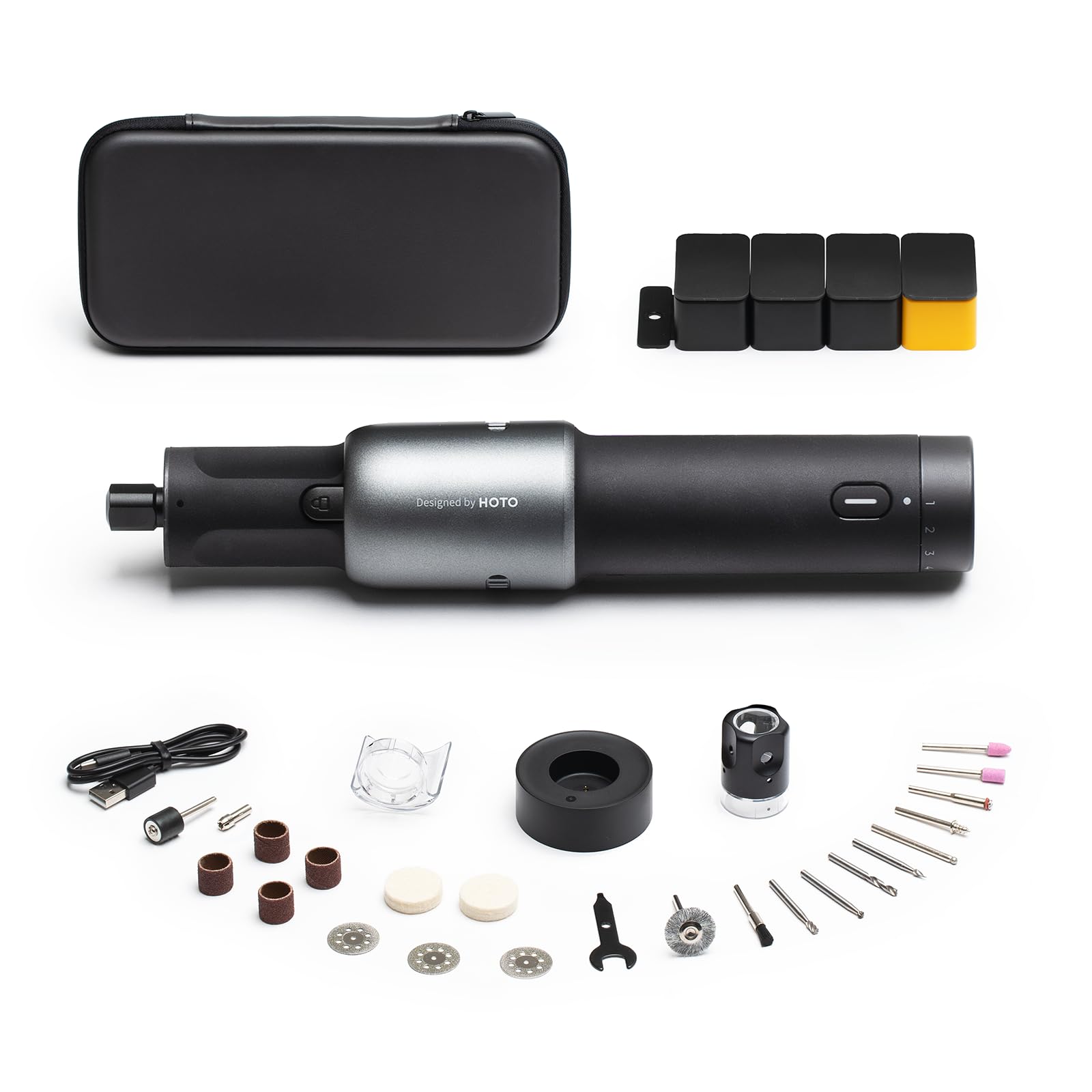
4. HOTO Cordless Rotary Tool Kit
A quiet, pen-style carver built for precision rather than brute force
Set this one against the PHALANX 200W above and the gap is clear: the HOTO tops out at 25,000 RPM while the PHALANX reaches 38,000 RPM, so the HOTO trades raw top speed for control. Its 5 stepped speeds run 5,000-25,000 RPM, which is the range where most detail sanding, engraving and carving actually happens. Red Dot Award-winning design is the headline, but the useful part is the low-vibration, quiet motor that makes it comfortable for desktop work and small workshops.
The features that matter for fine woodwork are the built-in LED, which lights tight detail, and a snap-on dust shield that keeps debris off your hands and the surface while you sand or carve. USB-C charging plus the included charging base makes it easy to keep topped up between sessions, and it supports both 3.2mm and 2.3mm collets, so it accepts most rotary accessories. At 1.7 pounds and 7.48 inches, it sits slim and balanced in one hand for extended detail work.
Buyers appreciate the functionality most, and the battery holds its charge well between uses. The catch is build feel: a minority find the construction less solid than a corded tool, which is expected at this weight class. And with only 35 accessories in the kit, it is a detail specialist rather than a full bench starter.
Detail-first design: The quiet motor and snap-on dust shield pair well with fine engraving and 3D-print finishing, where you want control and visibility rather than speed. The 5,000-25,000 RPM band covers those jobs comfortably.
Know the ceiling: At 25,000 RPM it falls short of the 38,000 RPM cutting tools if you do heavy material removal, and the 35-accessory kit is small, so budget for a few extra bits.
Best matched to: model makers, engravers and 3D-print finishers who value quiet, controlled, low-vibration detail work.
Not the tool for: heavy material removal or anyone who wants a fully stocked kit in the box.
5. PHALANX 200W Rotary Tool Kit
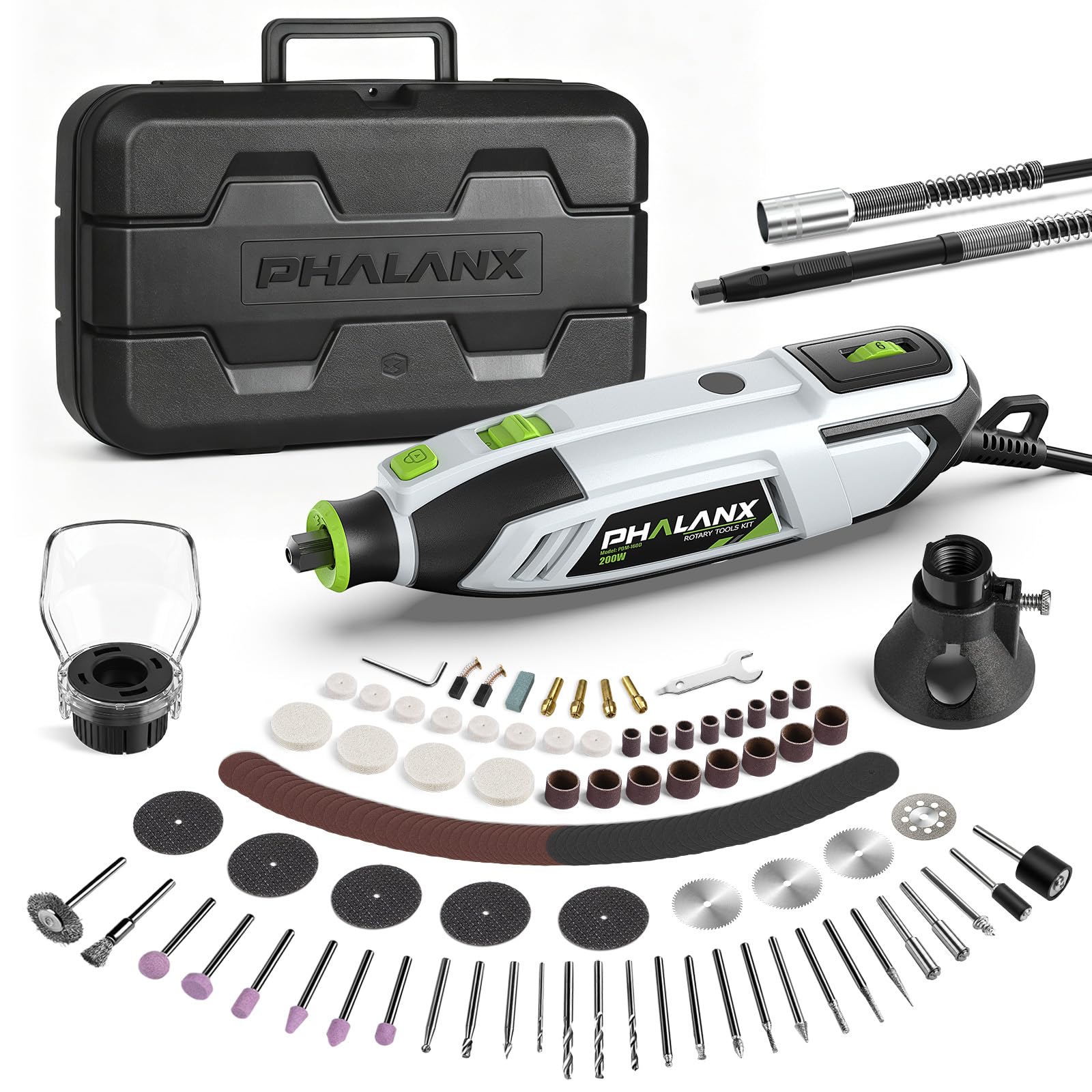
The high-RPM corded brute for fast material removal on bigger projects
Not much in this lineup touches 38,000 RPM, and this 200W corded tool goes there with 6 speeds running 10,000-38,000 RPM. If your work is shaping, grinding and cutting harder stock at speed, the top end of that range gives you the punch. The quick-change keyless chuck is the feature that changes your session, because you swap bits by hand instead of hunting for a wrench, so you spend less time setting up and more time cutting. Four collets (1/8 inch, 1/16 inch, 3/32 inch and 3/25 inch) cover most bits on the market, so you can use the bits you already own.
Buyers notice the build and performance, and the 132-piece accessory kit means you start fully equipped. A Gear Protection Blocker stops accidental speed shifts mid-cut, and the ventilation slots help the motor stay cool through longer sessions. The comfort-grip handle is designed to reduce fatigue when you are running the tool for extended stretches.
The thing to weigh is the 10,000 RPM floor. It is the highest minimum speed on this list, which is fine for grinding and cutting but leaves you without a soft, slow band for delicate finishing or softwood detail. If your work is bulk removal, that top-heavy speed range is a strength rather than a limitation.
Arguing in its favor
- 200W motor with a 10,000-38,000 RPM range
- Keyless chuck swaps bits without a wrench
- 132-piece accessory kit included
- Gear Protection Blocker guards against speed slips
Worth a second thought
- 10,000 RPM minimum leaves no slow finish band
- Corded, so you stay near an outlet
Pick it for: grinding, cutting and shaping where top-end RPM and fast bit changes speed up the job.
Pass on it for: delicate low-speed carving that needs the gentle bottom of the range.
6. DURATECH 12V Cordless Rotary Tool Kit

An onboard screen that tells you your speed and battery before you cut
The detail that sets this pick apart is the LED display, which shows both your current speed and remaining battery so you can adjust before a pass instead of guessing. The 12V tool runs 7 precise speeds from 5,000 to 35,000 RPM, and the 2000mAh battery gives it long enough run time that you are not recharging constantly mid-project. Because it is cordless, it works anywhere, and the separate charger with its indicator light keeps the battery topped up between sessions.
An adjustable collet covering 1/32 inch to 1/8 inch means you are not locked to fixed shank sizes, so most of your bits will seat without an adapter. The kit ships with 118 accessories in a polyester bag you can carry to the job, and it is compatible with most accessories including flex shafts.
Buyers warm to the power and speed control; battery life is the honest split, with some finding it lasts well and others wanting more. Sizing against the corded Dremel 4000, this trades the plug-in certainty for freedom of movement, which for site work or detail in an awkward spot is often the whole point.
Screen-driven control: Watching speed and battery on the display lets you set a pass with confidence and top up before a job, rather than discovering a flat battery mid-cut.
What to expect: Battery life divides opinion, so treat it as a capable detail and trim tool rather than a long-hogging corded substitute.
Good fit for: people who like seeing their exact speed and battery state and want a portable kit that goes to the job.
Less ideal if: you want guaranteed all-day runtime for heavy continuous carving.
7. CRAFTSMAN V20 Cordless Rotary Tool

A bare tool that joins the V20 batteries already in your shop
If you already run Craftsman V20 batteries, this tool slots straight into what you own, and that is the whole reason to look at it. The variable speed dial covers 6,700 to 34,000 RPM, so you can match speed to the project without a fixed preset ladder. At 1.6 pounds it is light in the hand, and the cordless design means you can take it away from the outlet to a shutoff or a garden build.
Portability and convenience are the point here: it runs off your Craftsman batteries, so there is no cable to drag across a workpiece. Buyers lean on the functionality, and the dial makes speed changes quick between tasks.
The honest caveats sit at its feet. This is a tool-only listing, so the battery and charger are a separate buy unless you already own them. And reliability is the mixed note: the tool works well for many, while some report it shutting off under load. If you push it hard into dense stock, expect it to prefer lighter passes.
Worth it when: you already own Craftsman V20 batteries and want a light, portable rotary in that system.
Not worth it when: you are starting from scratch, since a battery and charger are a separate buy, and heavy continuous load is not its strength.
8. Dremel 3100-1/15 Rotary Tool Kit

The straightforward corded starter for sanding, deburring and light carving
For someone stepping into rotary work for the first time, the appeal here is simplicity done well. The 1.2 Amp motor runs 5,000-35,000 RPM with 5 speed settings, so the low floor is there for gentle softwood passes and the ceiling is there when you need to grind or cut. A 6-foot cord keeps the power flowing without a battery to charge, and the air flow system runs cool enough to work through a session without heat build-up getting in your way.
Quality and function are the dependable notes on this tool, and it handles the everyday bench chores — rough edges, deburring, light sanding — that most people buy a rotary tool for. The detent switch makes its speed settings easy to land on exactly, which helps when you need the same setting twice.
One limitation to plan around: the kit includes just one size collet, plus 15 accessories, so you will add collets and bits as you grow the tool into more varied work. It is a starter kit that does the basics cleanly rather than a box that covers every job on day one.
Its real job: Rough edges, deburring and light sanding are where this tool earns its keep, and the 5,000 RPM floor gives a beginner room to learn control before chasing top speed.
Growth path: Budget for extra collets and bits, since the box gives you one collet and 15 accessories — enough to start, not enough to cover everything.
Right for: a first rotary tool where you want corded reliability and simple controls for general bench chores.
Look on if: you want a fully stocked kit or several collet sizes from day one.
9. Fanttik F2 Pro Kit Cordless Rotary Tool Kit

A tidy flip-top case that keeps every bit ordered and the tool charged
The storage is the standout here: a flip-top case with an automatic pop-up rack that presents your bits as you open it and a port for charging the tool while it rests inside. For a bench that gets messy fast, that orderliness is worth real money in saved searching. Under the hood, the motor runs 5,000-25,000 RPM across 5 speeds, and the 3000 mAh battery supports over 30 minutes of continuous grinding (100+ minutes with no load) with a roughly 2-hour charge over 5V 2A USB-C.
Feedback that guides your hand: the rear ring light shows battery and charge status, the side LED strip shows speed and any overload alert, and a top work light brightens detailed tasks. A pressure-sensitive switch gives you 5-speed control for safer fine grinding, and at 0.45 pounds it is light enough for extended detail handling. The body is rated water- and dust-resistant for durability in a working shop.
The obvious counterweight is top speed. Where the PHALANX 200W reaches 38,000 RPM, this tops out at 25,000 RPM, so it suits detail and 3D-print work rather than aggressive removal. Runtime is real but finite, so long hogging sessions still favour a corded tool.
What earns it a spot
- Flip-top case with pop-up rack and in-case charging
- 3000 mAh battery with over 30 minutes of continuous grinding
- Speed and overload alerts on the LED strip
- Light 0.45 lb body for detail sessions
What to weigh
- 25,000 RPM ceiling below the cutting-focused picks
- Finite battery runtime versus a corded tool
Made for: the organised craft bench where detail work, tidy storage and in-case charging matter more than top-end speed.
Not aimed at: heavy removal jobs that need a corded tool and a higher RPM ceiling.
Know the Specs
Speed range and the low end
The speed range is your RPM window, and the number that gets marketed is the top figure. The number that governs control is the minimum: a tool starting at 5,000 RPM gives you a slow band for softwood detail, while one starting at 10,000 RPM is built for removal and cutting rather than gentle finishing. Read both ends before you decide, and remember a stepped dial with clear settings makes it easier to repeat a good pass.
Collet size and bit compatibility
The collet is the collar that grips the bit shank, and its size decides which bits will actually seat in your tool. Common shanks are 1/8 inch, 1/16 inch, 3/32 inch and 3/25 inch, so a kit with several collets covers more of your bit collection. An adjustable collet, like the one on the DURATECH spanning 1/32 inch to 1/8 inch, saves you from hunting adapters when you switch bits.
Common Questions
Will standard Dremel bits fit a non-Dremel rotary tool?
Is a corded or cordless rotary tool better for wood carving?
What is a flex shaft and do I need one?
Can I use a rotary tool to carve hardwoods like oak?
Why does a rotary tool burn wood instead of cutting it?
How long does a cordless rotary tool battery run on a charge?
Do I need several collets or is one enough?
Can these rotary tools handle sanding, polishing and cutting too?
Is a 25,000 RPM tool enough, or do I need 35,000 RPM?
Will a rotary tool reach tight inside corners and grooves?
The Bottom Line
For most people carving and shaping wood, the winner is the Dremel 4000-2/32 — it holds steady speed from 5,000 RPM up to 35,000 RPM with a 1.6 Amp motor, so the same tool handles softwood detail and tougher cutting without bogging down. If a fully stocked box matters more than low-speed control, the HARDELL 180W kit gives you 153 accessories and a flex shaft in one go, so you can start carving without buying extra bits. And for portable detail work away from the outlet, the HOTO cordless kit offers quiet, controlled handling at a light 1.7 pounds, so you can carry it to a project without a cord. One nudge before you buy: weigh the low end of the speed range as carefully as the top, since that is what decides how cleanly you carve.
How we choose
We do not accept paid placement. Every pick is matched to a real buyer and a real use-case; we do not hands-on test units.
Sources
Specifications: manufacturer listings and product documentation. Review insights: verified customer reviews, as of November 2026. Pricing: not shown on this page (it changes often); check the current price via the retailer link.
As an Amazon Associate, Tactical Gear Guy earns from qualifying purchases. This does not affect which products we feature.