Specs are compiled from manufacturer listings and verified buyer reviews and can change over time — please confirm the key details on the product page before buying.
You want joints that pull tight and stay tight — and the fastest way there is a pocket hole jig with hardened guide sleeves that clamp your board solid and hold a fixed 15-degree angle. The tricky part is that these jigs all look similar in photos, yet the cheap ones flex under load and the good ones hold their angle for years. What follows is a short list of jigs with hardened sleeves and solid clamps, sorted by bench use, stock range, and portability.
This guide is built by comparing the manufacturers’ published specifications and the patterns across verified customer reviews, so you get each pick’s real strengths and trade-offs instead of marketing spin.
Below you’ll find the specs that actually matter, a side-by-side table, and honest trade-offs on each pick — the specs, stock ranges, and clamp types that decide which woodworking pocket hole jig fits your bench.
Top Picks


How To Choose The Best Woodworking Pocket Hole Jig
A pocket hole jig does one job: it holds your drill bit at a fixed angle so you can bore a clean pilot hole into a board and drive a screw in at a matching angle. That screw pulls the two boards tight. Everything that goes wrong — a split edge, a screw that spins, a joint that won’t close — traces back to the jig shifting or the guide sleeve wandering.
Match the jig to your bench: a fixed body for cabinet runs, a removable L-base for repairs. If you make cabinets and face frames at a bench, you want a body that stays put. If you’re repairing a fence or fixing a stool in someone’s garage, you want a base you can pull off and carry.
Board thickness and drill guide reach
Every jig here handles a spread of stock, and the printed range tells you what it supports. The Trend Twin covers 1/2 inch to 1-1/2 inch thick timber. The Milescraft 1327 drills boards from 1/2 inch up to 1-1/2 inch, and its guides adjust horizontally to space holes between 3/4 inch and 3 inch apart. The GOINGMAKE handles 1/2 inch up to 1-3/4 inch, the widest range on this list.
How the jig holds the board
A toggle clamp is the lever that pins your workpiece. Some jigs use a self-clamping steel toggle with micro-adjust dials, which lets you dial the pressure for different thicknesses. Others rely on a quick clamp. The clamp is the piece that most often earns a gripe, so read that part of any review carefully. A clamp that pops open mid-drill lets the board creep and throws the pocket angle off.
Guides, sleeves, and the bit
Hardened steel bushing sleeves are what keep your bit running true. A 3/8 inch guide diameter is the common standard, and the drill bit matched to it is typically a stepped bit with a depth stop collar. The collar clamps onto the bit and halts it at the set depth so the tip doesn’t blow through thin stock.
Side-by-Side Comparison
| Model | Best For | Stock Range | Weight | Guide Holes | Amazon |
|---|---|---|---|---|---|
| Trend PH/JIG★ Best Overall | Bench work and cabinets | 1/2″ to 1-1/2″ | 3.8 lb | Twin, 1.14″–2.48″ centers | Amazon |
| WEN WA1527Portable Pick | Portable jobs and 2x4s | Adjustable toggle clamp | 2.07 kg | Single guide, L-base | Amazon |
| Trend PH/JIG/CLightest Pick | Wide and narrow stock | 1/2″ to 1-1/2″ | 0.46 kg | Twin hardened sleeves | Amazon |
| BLEKOO Upgraded Kit | Thick stock over 2″ | Extra slider for 2″+ | 4.31 lb | 3 drilling positions | Amazon |
| GOINGMAKE GMJIGA | Dust-controlled shop work | 1/2″ to 1-3/4″ | 2 kg | 3 holes at once | Amazon |
| Milescraft 1327 | Self-clamping bench setup | 1/2″ to 1-1/2″ | 16 oz | Two 3/8″ guides | Amazon |
| Pro M2 | High-volume shop use | 1/2″ plywood to hardwood | 5.52 lb | Adjustable depth knob | Amazon |
| Kreg 520 | 2×4 builds and DIY | 1/2″ to 1-1/2″ | 2.72 lb | GripMaxx anti-slip clamp | Amazon |
| Kreg 720 | Fast repeatable drilling | 1/2″ to 1-1/2″ | — | Automaxx toggle clamp | Amazon |
Detailed Reviews
1. Trend Pocket Hole Jig Kit PH/JIG
Our pick — 4.5+★ from 1,500+ verified ratings; the strongest balance of quality and price.
Two drill guides that slide from wide to narrow stock without a second jig on the bench.
Here’s the whole idea in one sentence: an adjustable pair of hardened guide sleeves runs from 1.14 inch to 2.48 inch centers, so a cabinet rail and a narrow 1.5 inch face frame use the same setup. You loosen, slide, and lock. No measuring, no math, no swapping jigs mid-project.
The body is all metal, which is why this one stays put while you lean into the drill. A jig that shifts a hair under pressure gives you a pocket that sits a degree off, and the joint never closes clean. Twin hardened bushing sleeves hold the bit true on hardwood, softwood, and sheet goods alike.
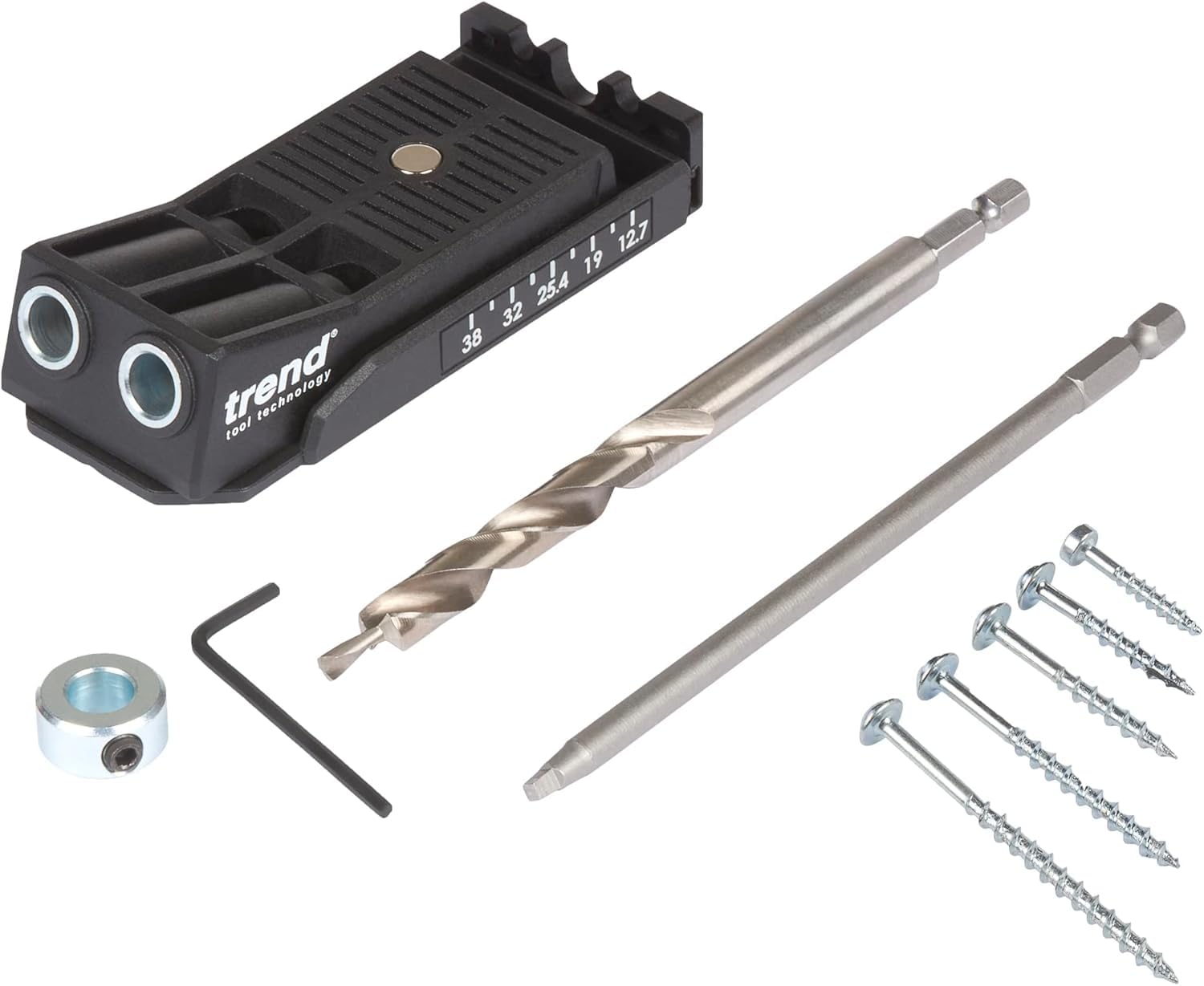
You can start your first build without a separate trip, because the kit is genuinely complete: a dual column jig, a face clamp to pin the workpiece, 100 dome-headed square drive screws, an HSS (high speed steel) drill bit with a depth setting collar, and two square drive bits. At 3.8 pounds it’s a bench tool, not a pocket tool — unlike the Trend Twin PH/JIG/C below, which weighs 0.46 kg and travels light.
What earns it the top spot
- Adjustable centers from 1.14″ to 2.48″ cover both wide panels and 1.5″-wide rails
- All-metal frame with twin hardened sleeves keeps the angle consistent as you drill
- Face clamp plus 100 screws plus two square drive bits means one purchase, one build
Where it asks for patience
- At 3.8 pounds it lives on the bench rather than in a tool bag
- Setting the guide spacing takes a moment each time you switch board widths
Builds cabinets at a bench: the adjustable twin guide and all-metal body suit face frames, aprons, and mitered frames.
Not the travel pick: if the jig rides in a bag to jobsites, the lighter PH/JIG/C fits that life better.
2. WEN Pocket Hole Jig Kit WA1527
The jig that clamps onto a 2×4 where the board already sits.
Fence repair, a quick stool, a shelf bracket bolted to a wall — the jobs where hauling a bench jig makes no sense. The WA1527 answers that with an L-base you mount where you’re working and an adjustable toggle clamp that accepts a range of thicknesses, including standard 2x4s.
The working parts are heavy-duty anodized aluminum with hardened steel drill guides, so the durability sits in the metal rather than the coating. Owners paint it as easy to set up per board size, and that’s the practical bit — the clamp and guide are meant to reset quickly when you move from a thin apron to a full 2×4.
What’s in the box goes further than most kits in this tier: the jig, the L-base and mounting hardware, a 3/8 inch step drill bit with a depth stop collar, 24 pocket hole plugs, and 100 self-tapping screws. That plug count is 24 against the 10 plugs in the Milescraft 1327 — a real gap if you plan to hide your holes rather than leave them open.
The honest weight: at 2.07 kg this is a substantial lump of aluminum. That heft is why it stays planted, but at 2.07 kg against the Trend PH/JIG/C at 0.46 kg, it is not the jig you drop in a jacket pocket.
Reach for this if: your pockets go into 2×4 stock and you want the jig to live on the board.
Look elsewhere if: you mostly drill 1/2″ panels at a fixed bench station.
3. Trend Twin Pocket Hole Jig PH/JIG/C
A twin-guide jig that weighs less than a paperback and drills single or double positions.
Weigh the decision first: 0.46 kg against the WEN’s 2.07 kg is the difference between a jig that rides in a tool bag and one that lives on a bench. If you do repair work at other people’s houses, that number decides it.
The twin hardened drilling sleeves cut at 15 degrees with a 12.7 millimeter cutting diameter, and you can set them for single or double fixing positions. Hard or soft timber from 1/2 inch to 1-1/2 inch thick is the stated range. Cabinets, small furniture, and joinery repairs all fall inside that window.
It takes almost no room in a drawer between projects, thanks to a footprint of 5.24 x 7.99 x 1.38 inches. The kit ships with the twin jig, an HSS (high speed steel) hex shank drill bit with a depth setting collar, a square drive bit, and a selection of pocket hole screws — enough to start the first job without a separate trip.
The trade you make: you get faster setup but less flexibility, because the body stays fixed rather than sliding on a rail. Unlike the Trend PH/JIG above, you are not adjusting guide centers across a wide panel — you are choosing single or double position and drilling.
The travel jig: light, drawer-sized, and ready for cabinet and small-furniture work away from the shop.
Skip if: you need sliding guide centers for wide face frames and want one jig to cover both extremes.
4. Upgraded Pocket Hole Jig Tool Kit

Built for the board that every other jig on this list refuses to swallow.
Most of these jigs top out around 1-1/2 inch. This kit includes an additional slider for materials thicker than 2 inches or 50.8mm, which is the outlier feature here and the reason to consider it at all. If your project uses chunky stock, the others simply won’t reach.
You can set your positions and keep them, because the body is aircraft grade aluminium alloy with laser-etched scales for positioning, and the drill guide runs wear-resistant hardened steel sleeves across 3 drilling positions. You get a 7 inch high-strength titanium-plated stepped drill bit, plus a full kit: two 3/8 inch titanium-plated stepped bits, two magnetic square drive bits in 6 inch and 4 inch lengths, a set of screws and plugs, two drill stop collars, and four Allen wrenches.
Buyers reward function most here, and the setup is quick to get square. The honest caution is durability. Some buyers report the bit failing on the first day, and a few mention the clamp popping open or drill bits stripping — so treat the bit as a wear item and verify the clamp bites before you lean on it.
Why it earns a slot
- The included extra slider reaches stock thicker than 2 inches or 50.8mm
- Aircraft grade aluminium body with laser-etched scales in inches and metric
- Two square drive bits in 6″ and 4″ lengths plus two stop collars
Check before your first build
- Bit durability is the mixed point — some report early failure
- Clamp stability draws criticism on a few units
Best for thick stock: if 2-inch-plus material is in your plans, this is the kit that actually fits it.
Think twice if: you want a drill bit you can set and forget across years of use.
5. GOINGMAKE All Metal Pocket Hole Jig Kit

Three holes in one pass, and a hose port that keeps the sawdust out of your lungs.
Drilling pocket holes throws a plume of fine dust straight at your face, and most jigs on this list just let it fly. This one includes a removable 1-3/8 inch diameter vacuum hose that connects to dust collection. Your bench and your air stay cleaner, and cleanup after a run of shelves gets shorter.
The body is aluminum alloy in a 2-in-1 format. Use it clamped on a bench or table for large projects, or pull it free as a portable drill guide for tight spaces. Three 3/8 inch drill inserts sit at three different spacings, so wide and narrow material both get covered in a single session.
Adjustability runs from 1/2 inch to 1-3/4 inch stock with inch and mm scales printed on the guide — the widest stock range in this group. Value and ease of use are the two things that win people over, and the setup requires no prior experience: measure the workpiece, match the jig, drill.
The catch sits in the small parts. Drill bit quality and the clamp both come in for mixed feedback, so plan on a backup bit if you drill a lot. The footprint of 2.87 x 4.25 x 10.63 inches is also long and narrow compared with the Trend Twin’s 5.24 x 7.99 x 1.38 inches, which changes how it sits in a drawer.
For the dust-conscious shop: the vacuum hose port and three-at-once drilling suit anyone cutting pockets in volume.
Shop around if: you want the clamp and bit to be the standout, rather than the dust control.
6. Milescraft 1327 Pocket Jig 400

A jig with a drawer, because losing the depth stop is half the battle.
Anyone who has hunted for a 3mm Allen wrench mid-project will understand the drawer. A storage bay in the body holds the bit, driver, depth stops, and more, so the kit stays together between builds instead of scattering across the bench.
The clamping is the other headline. Height-adjustable bushing blocks carry two 3/8 inch steel drill guides, and the steel toggle clamp uses micro-adjust clamp-head dials to set pressure for different board thicknesses. That handles boards from 1/2 inch up to 1-1/2 inch thick. Guides adjust horizontally so you can place holes anywhere between 3/4 inch and 3 inch apart, with laser-etched markings in both inches and metric.
Construction is what gets praised most — a solid all-metal build at 16 ounces, light enough to move around the bench without feeling flimsy. The L-base detaches from the main body for mobile repairs, so one jig covers bench and on-site work.
The full kit is thorough: the Pocket Jig 400, a 3/8 inch pocket hole bit, a 3/8 inch split-ring depth stop, a T20 magnetic driver, a 3mm Allen wrench, 60 pocket hole screws, and 10 pocket plugs. That plug count is the one place the WEN edges ahead — 24 plugs to 10.
For the tidy bench: micro-adjust clamping and an onboard drawer suit anyone who resets the jig often.
Look at the WEN instead if: you need a larger plug supply and a clamp that grips 2×4 stock.
7. Pro M2 Pocket Hole Jig

The shop jig that owners keep comparing to a name they already trust.
A 5.52 pound aluminum frame is the number to start with. That mass is why it stays put on a workbench in the shop or garage while you drill and drive — you are not chasing the jig across the surface. The frame is aluminum rather than plastic, and the balance is deliberate.
Setting depth takes seconds with the adjustable knob, and you match it to board thickness from 1/2 inch plywood up to thick hardwood stock. That’s how you dodge the splits and blowout that ruin a face frame. Pre-drill the pilot holes at the consistent angle and the pocket hole system pulls the joint tight — face frames, cabinets, shelves, tabletops, furniture repairs.
A dust spout connector captures loose debris and sawdust as you work, so the surface stays clearer than an open-style jig allows. The accessory set is complete: hex key, stop collar, screws, support bars for longboards, a stepped drill bit, and a T-track slot for clamps.
Quality is the clear consensus among people who buy it — the build and the metal construction are what they keep returning to, and the clamping mechanism holds workpieces securely. A smaller group finds hole quality and the secure hold less than perfect, so check your first few pockets before committing to a full cabinet run.
Where the money goes: into the aluminum mass and the accessory set. At 5.52 pounds it is the heaviest jig on this list, so it is a fixed-station tool rather than something you carry to a repair.
The bench workhorse: buy this if your jig stays clamped in one spot and you want the frame to absorb your body weight.
Not for a tool bag: the mass that makes it stable is exactly what makes it a pain to transport.
8. Kreg Pocket-Hole Jig 520 KPHJ520PRO2
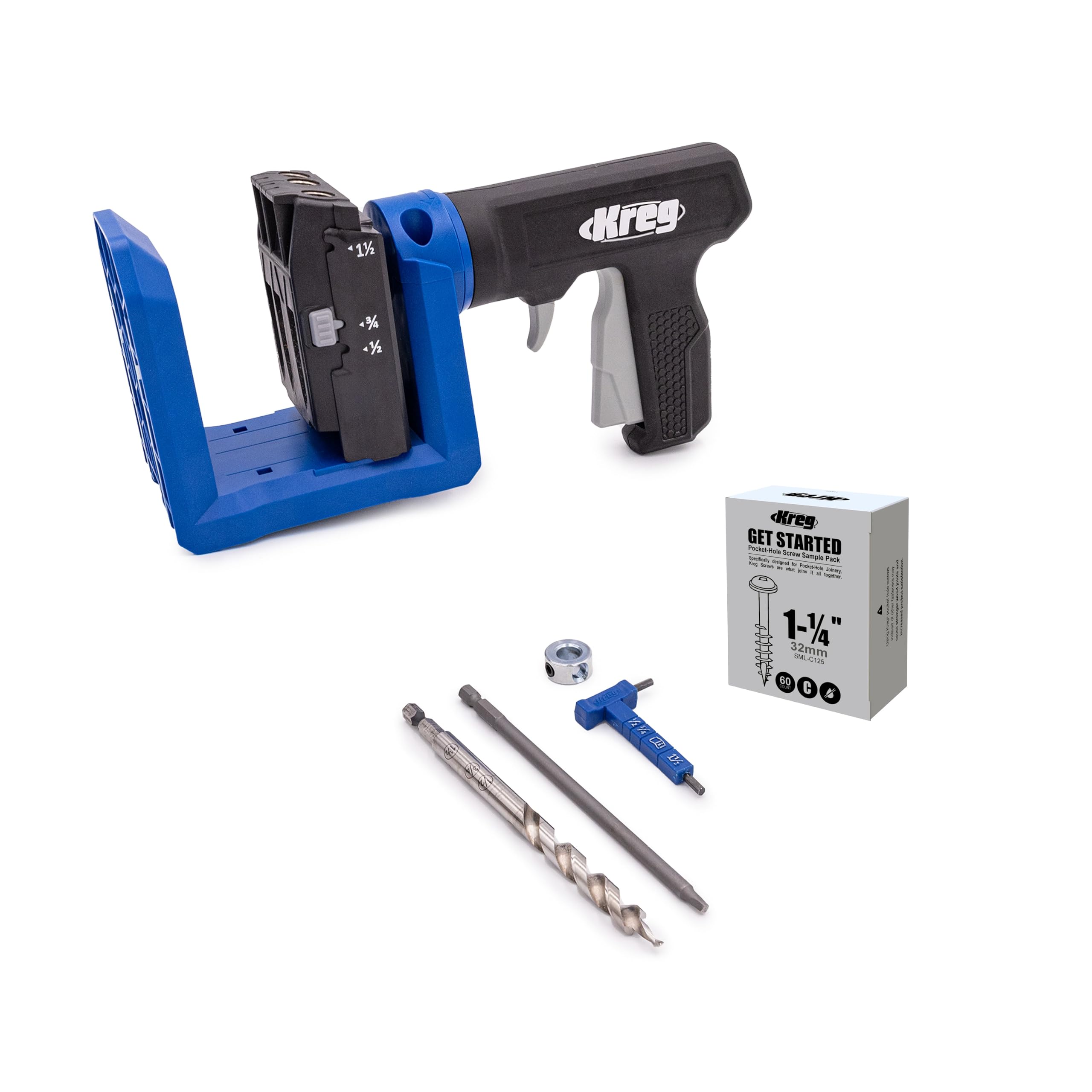
The anti-slip face and rotating handle that make 2×4 work feel almost too easy.
GripMaxx is the feature to understand here: an anti-slip clamping surface that holds the material in place while you clamp. On a slick 2×4 that grip is the difference between a straight pocket and a board that creeps a half inch before the bit bites.
The VersaGrip rotating handle turns a full 360 degrees, so you can work at whatever angle your project demands without fighting the handle’s position. Materials from 1/2 inch to 1-1/2 inch thick are covered, and the frame is impact-resistant polymer with a steel frame inside it.
Quality and ease of use are what carry this jig — setup is quick and the drilling is clean, with 2×4 stock singled out as a balance. At 2.72 pounds it sits in the middle of the weight range, lighter than the Pro M2’s 5.52 pounds but heavier than the Trend Twin’s 0.46 kg.
The kit ships with 60 screws, so you can start immediately. The trade-off is that this is polymer-bodied rather than all-aluminum, which is fine for DIY volume but a step down from the metal frames of the pricier picks.
What makes it shine
- GripMaxx anti-slip surface holds material through the clamp and drill
- 360-degree VersaGrip handle adapts to any project angle
- Impact-resistant polymer with a steel frame keeps weight at 2.72 lb
The honest limit
- Polymer body, not the all-metal build of the premium picks
- 60 screws included rather than a larger supply
For the DIY 2×4 build: cabinets, shelving, and quick frames where grip and handle angle matter more than metal.
Skip if: you want an all-aluminum body that takes years of heavy shop abuse.
9. Kreg Pocket-Hole Jig 720, Woodworking Jig (KPHJ720)

Clamping technology that adjusts itself so you can drill, drive, and move on.
The Automaxx toggle clamp is the reason this jig exists. It’s an automatic clamp that sets itself to the material, so the adjust-for-thickness step disappears between boards. Drill, drive, done — that rhythm is what a long run of shelves or a cabinet carcass actually needs.
The drill guide carries an anti-slip surface of its own, and the clamping technology adjusts for a secure fit. Plywood from 1/2 inch to 1-1/2 inch thick is the stated range, which puts average-sized DIY projects squarely in view.
The body is polymer, and the dimensions are 13.56 x 9.25 x 5.25 inches. Ease of use is the thing people come back to, particularly for beginners, and the build holds up. It’s positioned as the fast, strong, easy route to a joint — the kind of tool that gets used rather than admired.
Against the 520 above, the 720 buys you the automatic clamp and the wider frame, at the cost of bench space and a higher entry point into Kreg’s range. Neither is metal-framed, so if all-aluminum is your line, the Pro M2 is the one to weigh instead.
Who it rewards: a beginner running a first set of cabinets, or anyone who resets material thickness constantly and wants the clamp to think for them.
The beginner’s choice: automatic clamping and a wide frame make pocket holes feel forgiving.
Look to the Pro M2 if: you want an aluminum body and a dust spout rather than self-adjusting clamping.
Know the Specs
Drill guide diameter and sleeve material
The guide is the metal tube your bit passes through. A 3/8 inch diameter is the common standard, and hardened steel sleeves hold that circle true over thousands of holes. A soft sleeve wears oval, your bit drifts, and the pocket angle goes off. When you see hardened bushing sleeves listed, that’s the part doing the work.
Drill angle and depth stop collar
Pocket holes are drilled at an angle so the screw pulls the joint tight. The Trend Twin cuts at 15 degrees. The depth stop collar clamps onto the bit and halts it at the right depth — that’s what keeps the tip from punching through the face of a thin board.
Adjustable guide centers and spacing
Centers are the distance between your two drill guides. The Trend PH/JIG runs 1.14 inch to 2.48 inch centers, which is how it handles both a wide panel and a 1.5 inch rail. The Milescraft 1327 adjusts horizontally to space holes between 3/4 inch and 3 inch apart. Wider spacing suits broader stock; narrow spacing suits thin rails.
Clamping method
A toggle clamp or quick clamp pins the workpiece so the jig and board don’t shift. Self-clamping designs use a lever that locks; some add micro-adjust dials for pressure, as the Milescraft 1327 does. The Kreg 720 goes further with an automatic clamp that sets itself. Whatever the mechanism, the clamp biting hard is what makes the pocket land where you aimed.
Dust collection
Drilling pockets throws fine sawdust. A dust spout or hose port captures it at the source — the GOINGMAKE includes a removable 1-3/8 inch vacuum hose, and the Pro M2 has a dust spout connector. Without a port, fine sawdust from every pocket lands on the bench and in the air.
Stock thickness range
The printed range tells you what boards the jig will accept. Most here cover 1/2 inch to 1-1/2 inch. The GOINGMAKE reaches 1-3/4 inch, and the BLEKOO kit includes an extra slider for stock thicker than 2 inches or 50.8mm. Match this to the material you actually buy.
Common Questions
Will a pocket hole jig work on 2×4 lumber?
What thickness of wood can these jigs handle?
Do I need a face clamp as well as the jig?
What is the difference between a single guide and a twin guide jig?
Does the drill bit type make a difference to hole quality?
Can I use these jigs for cabinet face frames?
Is a dust collection hookup worth having on a pocket hole jig?
How many pocket hole plugs and screws come in a kit?
Can I use a pocket hole jig on plywood?
Which jig is easiest for someone who has never drilled a pocket hole?
The Bottom Line
For most woodworkers, the woodworking pocket hole jig winner is the Trend PH/JIG because its adjustable twin guide runs from 1.14 inch to 2.48 inch centers and the all-metal body holds that angle under load — the highest-rated pick here at 4.5+ stars across 1,600+ owners. If portability is your constraint, grab the Trend Twin PH/JIG/C at 0.46 kg. And for a shop that runs long cabinet sessions, the Pro M2 is the one to reach for, with its 5.52 pound aluminum frame and dust spout connector holding the bench steady while you work.
How we choose
We do not accept paid placement. Every pick is matched to a real buyer and a real use-case; we do not hands-on test units.
Sources
Specifications: manufacturer listings and product documentation. Review insights: verified customer reviews, as of November 2026. Pricing: not shown on this page (it changes often); check the current price via the retailer link.
As an Amazon Associate, Tactical Gear Guy earns from qualifying purchases. This does not affect which products we feature.