Specs are compiled from manufacturer listings and verified buyer reviews and can change over time — please confirm the key details on the product page before buying.
You want boards that come out flat, even, and ready to sand — not chewed-up edges and a dip at each end that ruins your glue-up. That is the whole job of a thickness planer, and the picks below are the ones that actually do it. Every machine here planes stock to a consistent thickness, but they split hard on cutterhead style, snipe control, and how loud they scream in a small shop.
This guide is built by comparing the manufacturers’ published specifications and the patterns across verified customer reviews, so you get each pick’s real strengths and trade-offs instead of marketing spin.
Below you will find the machines ranked by what they deliver on real projects, from a proven mid-range workhorse to a compact jobsite unit that keeps the neighbors calm. This rundown of the best woodworking planer machines sorts out which one fits your shop.
Top Picks


How To Choose The Best Woodworking Planer Machine
The first fork in the road is the cutterhead. Straight-knife machines use long blades bolted across a spinning drum; spiral and helical machines use rows of small square inserts that shear the wood at an angle. The insert style costs more upfront but delivers a smoother surface and lets you rotate a nicked insert instead of replacing a whole blade.
Cutterhead Style and Surface Finish
A three-knife head spinning fast makes a lot of cuts per inch, and that is what turns a rough board into something that feels sanded already. Machines with two feed speeds let you slow the material down for a finer cut on figured wood, or speed it up when you are hogging off thickness on construction lumber.
Spiral and helical heads cut with a slicing action rather than a chopping one, which tends to reduce tear-out on grain that runs in awkward directions. That matters most when you are planing a board with wild figure or a species that chips easily.
Cutting Width and Depth Per Pass
Width capacity tells you the widest board the machine will swallow in one go; anything wider needs a flip and a second pass, or a sled. Depth per pass sets how much material you can remove each time the board runs through — take shallow bites and you get a cleaner surface and less strain on the motor.
Snipe, Support Tables, and Repetition
Snipe is the enemy: the cutterhead tips the board slightly as it enters and exits, leaving a dip at both ends on thinner stock. Long infeed and outfeed tables, a rigid four-post head support, and any built-in snipe-reduction hardware are what keep those ends clean. A repeat depth stop is the other thing to look for if you routinely plane a batch of boards down to matching thickness.
Side-by-Side Comparison
| Model | Best For | Cutting Width | Cutterhead | Cutting Depth | Amazon |
|---|---|---|---|---|---|
| DEWALT Thickness Planer (DW735X)★ Best Overall | All-round shop workhorse | 13 inches | Three-knife, two-speed | 0.13 inches | Amazon |
| WEN PL1252Budget Champion | Budget board milling | 12.5 inches | Two-blade SK5 | 0.09 inches | Amazon |
| WEN PL1326Quietest Spiral | Quiet spiral entry point | 33 centimeters | 26-insert spiral | — | Amazon |
| DEWALT DW734 | Fine finish on a budget | 12.5 inches | Three-knife, 96 CPI | 0.13 inches | Amazon |
| Cutech 40600H | Snipe control and repeat cuts | 13 inches | Spiral, 26 inserts | 0.13 inches | Amazon |
| RIKON 25-135H | Repeatable batch thicknessing | 33 centimeters | 26-insert helical style | 6 inches | Amazon |
| FindBuyTool MB320 | Fine tolerance helical work | 13 inches | 40-insert helical | 0.12 inches | Amazon |
| JET JWP-13BT | Two-speed helical capability | 13 inches | 26-insert helical, two-speed | 0.13 inches | Amazon |
| Makita 2012NB | Quiet jobsite transport | 11.86 inches | Disposable double-edge blades | — | Amazon |
Detailed Reviews
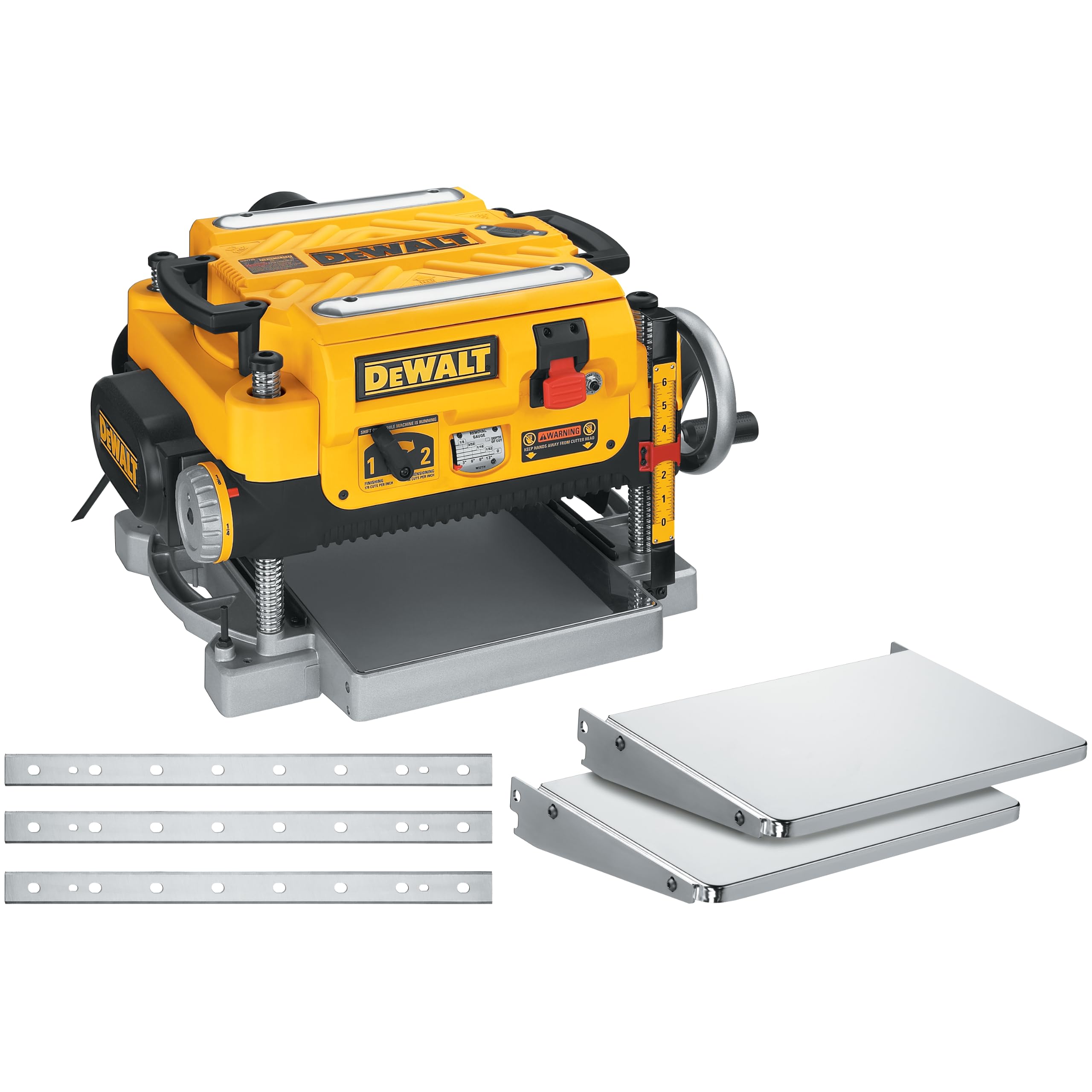
1. DEWALT Thickness Planer (DW735X)
Our pick — 4.5+★ from 7,500+ verified ratings; the strongest balance of quality and price.
Two feed speeds and a 13-inch throat make this the machine most small shops build around.
You can take a deeper bite out of a wide hardwood board without the motor bogging down or leaving chatter marks, thanks to a 15 amp, 20,000 rpm motor driving a three-knife cutterhead at 10,000 rpm. The smarter feature is the two-speed gearbox. It lets you set the feed to 96 or 179 cuts per inch (CPI — how many knife passes land on every inch of surface). The higher number is what puts a genuinely smooth face on figured stock.
The base is a 19-3/4 inch cast aluminum casting, and it carries an automatic carriage lock that clamps the head to cut down snipe without you reaching for a lever. Long folding infeed and outfeed tables come in the box along with an extra set of knives, so you can support a full-length board from day one. On footprint it measures 24.58 by 22 by 20.97 inches, which next to the compact DEWALT DW734 is a noticeably bigger chunk of bench.
What wins people over is the quality of the cut, and it is backed by volume — this is the crowd favorite at 4.5+ stars across 7,000+ owners. Buyers report assembly taking about ten minutes and smooth results at both speeds. The trade-offs are real but sized: the motor is loud enough that ear protection is not optional, blades are known to chip for some users, and dust collection draws mixed marks. Budget for a decent chip collector and treat the knives as a wear item.
Why It Earns The Top Slot
- Two feed speeds (96 or 179 CPI) let you trade speed for a glassier finish on tricky grain.
- Automatic carriage lock reduces snipe with no manual lever work each pass.
- 19-3/4 inch cast aluminum base with folding infeed and outfeed tables included.
- Extra set of knives ships in the box, so you are not caught short on a chipped edge.
The Honest Fine Print
- Loud in a closed shop — hearing protection is a must.
- Knife durability gets mixed marks, with chipping reported.
- It is a heavy benchtop machine at 102 pounds, so plan a permanent home for it.
Built for: the woodworker who planes a wide range of species and wants depth per pass without fighting the motor.
Heads up: the two-speed gearbox and included tables are the value here, but price sits near the top of the mid-range tier.
2. WEN PL1252 Thickness Planer
A cast-iron-bed planer that gets a rough board flat without asking much of your wallet.
Here is what you give up on a two-blade machine versus the three-knife head on the DEWALT above. This WEN runs a 15A motor at 20,000 cuts per minute with a 26 feet per minute feed rate, and its maximum depth per pass is 0.09 inches. Set against the DEWALT DW735X at 0.13 inches, you are taking a shallower bite each time — so wide, thick stock takes an extra pass or two. That is the honest trade for the lower tier, and for a hobbyist feeding cedar and pine it rarely bites.
Two reversible 12.5-inch SK5 blades come installed, and when one edge dulls you flip it over. The machine planes boards up to 6 inches thick and 12.5 inches wide, which covers most furniture and trim work. A cast iron base adds heft that helps it stay planted instead of walking across the bench.
Where the sawdust actually hits the floor is the blades — chipping comes up more often than you would like, so treat the knives as a running cost. Snipe draws mixed feedback and noise is middling. But for volume of work per dollar, this is the easiest machine on the list to justify: turning out multiple cutting boards in a single sitting is the kind of thing owners mention as routine.
Value read: For rough stock and trim, the 26 FPM feed and 12.5-inch throat do the job with money left over for a dust collector and spare blades. If you plane wide, hard, figured boards every week, the shallower 0.09-inch depth per pass and two-knife head will slow you down.
Reach for this if: you are stocking a first shop or planing softwoods and construction-grade stock on a tight budget.
Look elsewhere if: you need maximum depth per pass on wide hardwood in one sitting.
3. WEN PL1326 15-Amp 13-Inch Spiral Benchtop Thickness Planer
A spiral head with 26 rotatable inserts that keeps a small shop from sounding like a sawmill.
The spiral cutterhead uses 26 staggered, rotatable HSS (high-speed steel) blades, and that arrangement is why this machine runs quieter than a straight-knife planer. Instead of two long blades slapping the wood in one blow, the inserts shear it in a staggered pattern — a lighter, smoother action that also leaves fewer tear-out marks. The onboard material removal gauge tells you how much is coming off each pass, so you can dial in your cuts without guessing.
Capacity is 6 inches thick and 13 inches wide, and the 15A motor turns the head at 10,000 RPM with a 26 feet per minute feed rate. The cast iron base gives it enough weight to stay put.
Owners praise the build quality and the smooth, even surfaces it produces right from the start. It feeds multiple 2x4s through without complaint. The volume of feedback is thinner than the two DEWALT machines, so expect a bit less community troubleshooting when something goes off — but on the evidence available, this is the smoothest-and-quietest way into a spiral head.
Spiral payoff: Rotatable inserts mean a nicked edge gets turned in place rather than forcing a full blade swap, and the quieter run is a genuine win in a garage shop. The heft that stabilizes it also makes it a permanent bench resident.
The right fit: anyone stepping up to a spiral cutterhead who wants a quieter, cleaner finish without jumping to the premium tier.
One caveat: the 36.74 kg weight means you will not be lugging it to a jobsite.
4. DEWALT Benchtop Planer (DW734)
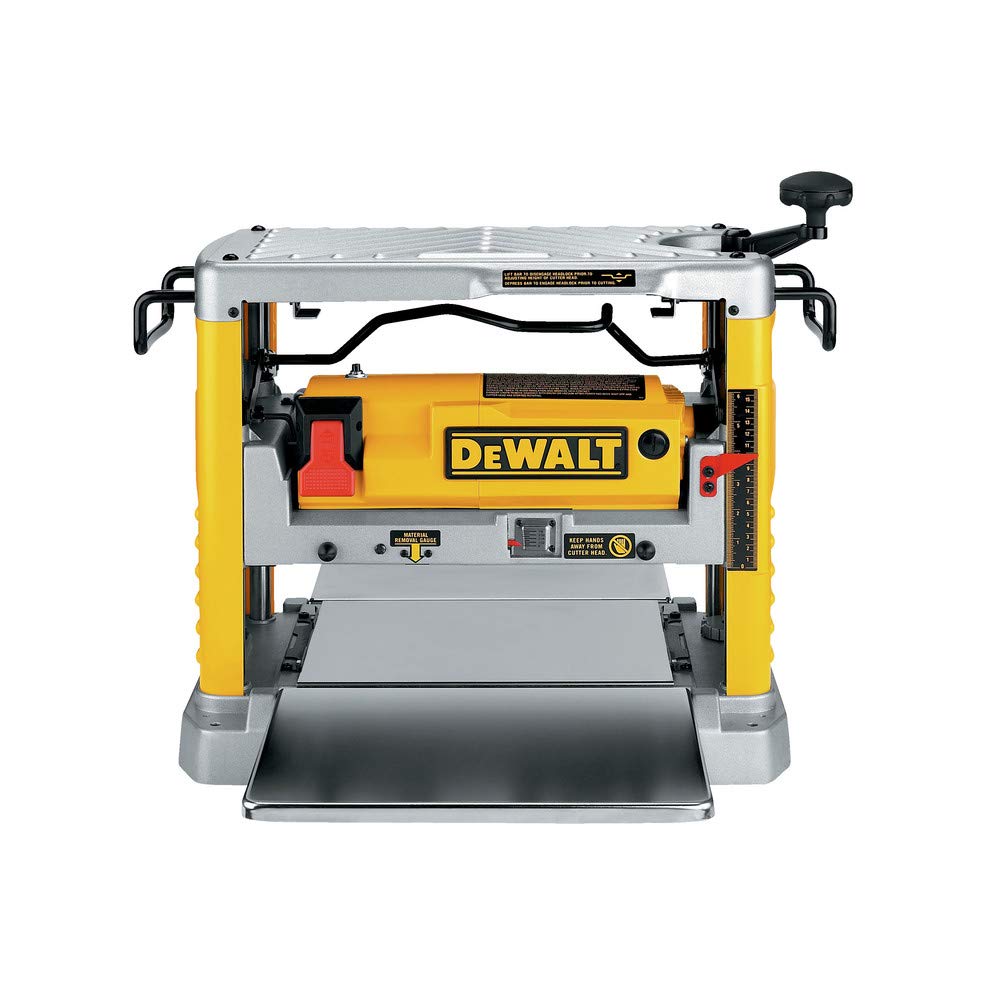
A three-knife head that lays down 96 cuts per inch and leaves a finish that barely needs sanding.
This is the finer-finish sibling of the DW735X, and the spec that sells it is 96 cuts per inch — the number of knife slices that land on every inch of board as it passes through. The 15 amp, 20,000 rpm motor spins the three-knife head at 10,000 rpm, and the result is one of the glassiest surfaces you can pull from a benchtop machine. Feed the stock through at one speed and it comes out looking like it spent time on a drum sander.
The four-column carriage lock is a serious anti-snipe measure: it locks the cutterhead in place from four corners to stop the tipping that causes end dips. Infeed and outfeed tables give you 33-1/2 inches of material support, so a long board stays flat instead of diving off the end. It measures 23.38 by 16.52 by 20.48 inches, which against the DW735X’s 24.58 by 22 by 20.97 inches makes it the tidier bench footprint of the two.
This machine handles species from soft pine all the way to dense ebony without choking. It works from the start with minimal setup, and the four-column lock means you are not fighting snipe on thin stock. DEWALT rates the reversible disposable knives at roughly 30% more blade life than the older style. About 36.29 kg of weight keeps it stable, so reserve a permanent slot.
What Puts It In Contention
- 96 cuts per inch gives a surface finish that needs very little cleanup.
- Four-column carriage lock is the star turn for reducing end snipe.
- 33-1/2 inches of table support keeps long boards level through the machine.
- Handles everything from soft pine to dense ebony.
What To Know First
- Single feed speed, so you cannot slow the material for a finer cut like on the DW735X.
- Heavy benchtop weight means finding a permanent home for it.
- Kicks up enough noise to justify hearing protection.
Pick it when: you want that fine finish and the four-column lock without paying for the two-speed gearbox.
Second thought: the DW735X above adds a second feed speed and a second set of knives — that is the feature you give up here.
5. Cutech 40600H 13-Inch Spiral Cutterhead Benchtop Planer

Snipe minimizer, repeat depth stop, and board return rollers — built around batch work.
The spiral cutterhead here is a 6-row drum holding 26 staggered, two-sided tungsten carbide inserts. Two-sided inserts sit in alignment to keep from skewing while planing, and Cutech says that precision beats four-sided inserts — which matters because a skewed insert leaves a raised line across the whole board. The spiral design also runs with the lowest amp draw of the designs compared here and planes quieter than a straight-knife head.
Snipe control is the headline: four lead screws and a patented coupling design automatically minimize snipe without a separate snipe lock. Cut depth is 0.13 inches, matching the DEWALT DW735X, so you clear thickness fast. An 8-position depth stop lets you thickness a whole batch of boards to the same size, and the onboard scale shows how much the next pass will remove.
Board return rollers on top mean you can send a board back for the next pass without walking around the machine. The flip dust hood lets you direct chips out the back or attach a collector. Feedback volume is light, so you get a shorter track record than the big brands, and adjustability comes up as the mixed point. Engineering quality is what owners talk about most, and it does the basics well.
Batch-work logic: The 8-position depth stop plus return rollers turn thicknessing a stack of boards from a chore into a rhythm. The lighter review history is the trade — this is a less-tested machine than the DEWALTs, so weigh that against its specialty features.
The draw: the snipe minimizer and repeat depth stop are features the big straight-knife machines make you work around.
Worth noting: a spiral cutterhead on a smaller track record — the design holds up, the long-term brand history is thinner.
6. RIKON 25-135H Portable Planer
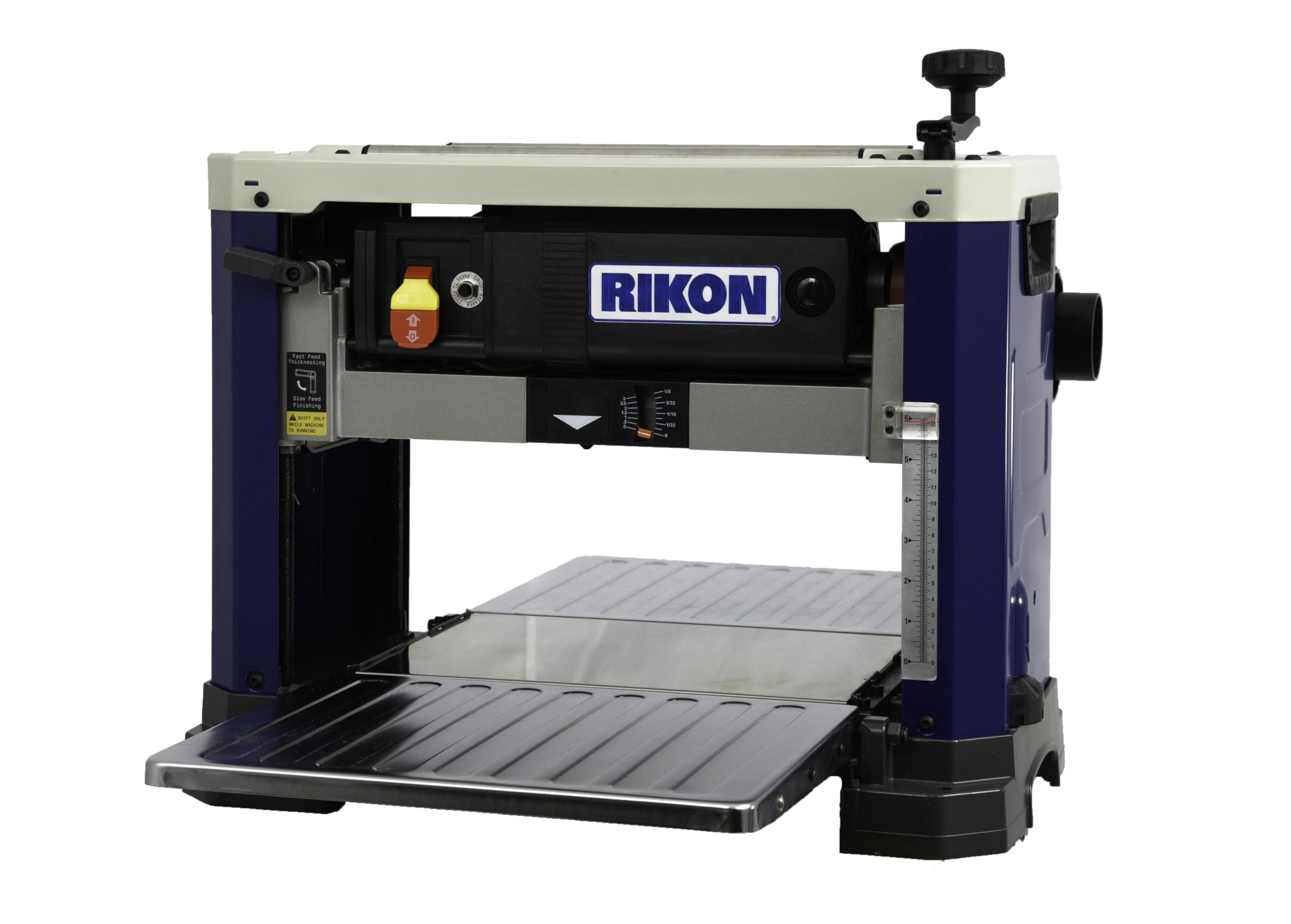
Six rows of rotatable inserts and two feed rates for shops that thickness in batches.
A six-row helical-style cutterhead carries 26 two-edge HSS inserts, and every insert can be rotated when it dulls or gets nicked instead of replaced. That is the practical strength here: maintenance is a turn of the insert, not a knife swap. Two feed speeds — 16 or 26 SFPM (surface feet per minute) — let you run slow for a smoother surface or fast to hog off material.
It handles stock up to 13 inches wide and 6 inches thick, with up to 1/8 inch depth of cut on boards 6 inches wide or less. The threaded 4-post head support, depth gauge, thickness scale, and repeat-cut control combine to keep stock thickness consistent board to board. A dust hood plus a 4 inch to 2-1/2 inch adapter let you hook it to a collector or a shop vacuum.
It leaves boards at roughly a 150 grit surface, and setup takes minutes. Adjustability is the honest catch — the infeed and outfeed tables cannot be adjusted, so you level what you have and work within it. At 67.9 pounds it is portable enough to move, heavy enough to stay still while running.
Repeatability focus: The 16/26 SFPM speed choice and the repeat-cut control are what suit a shop running the same thickness over and over. The fixed infeed and outfeed tables are the one thing to check against your bench setup before you commit.
Best match: a shop that cuts batches to a set thickness and wants rotatable inserts for easy maintenance.
Check first: the tables do not adjust, so confirm the bench and support setup suits your workflow.
7. FindBuyTool MB320 Thickness Planer
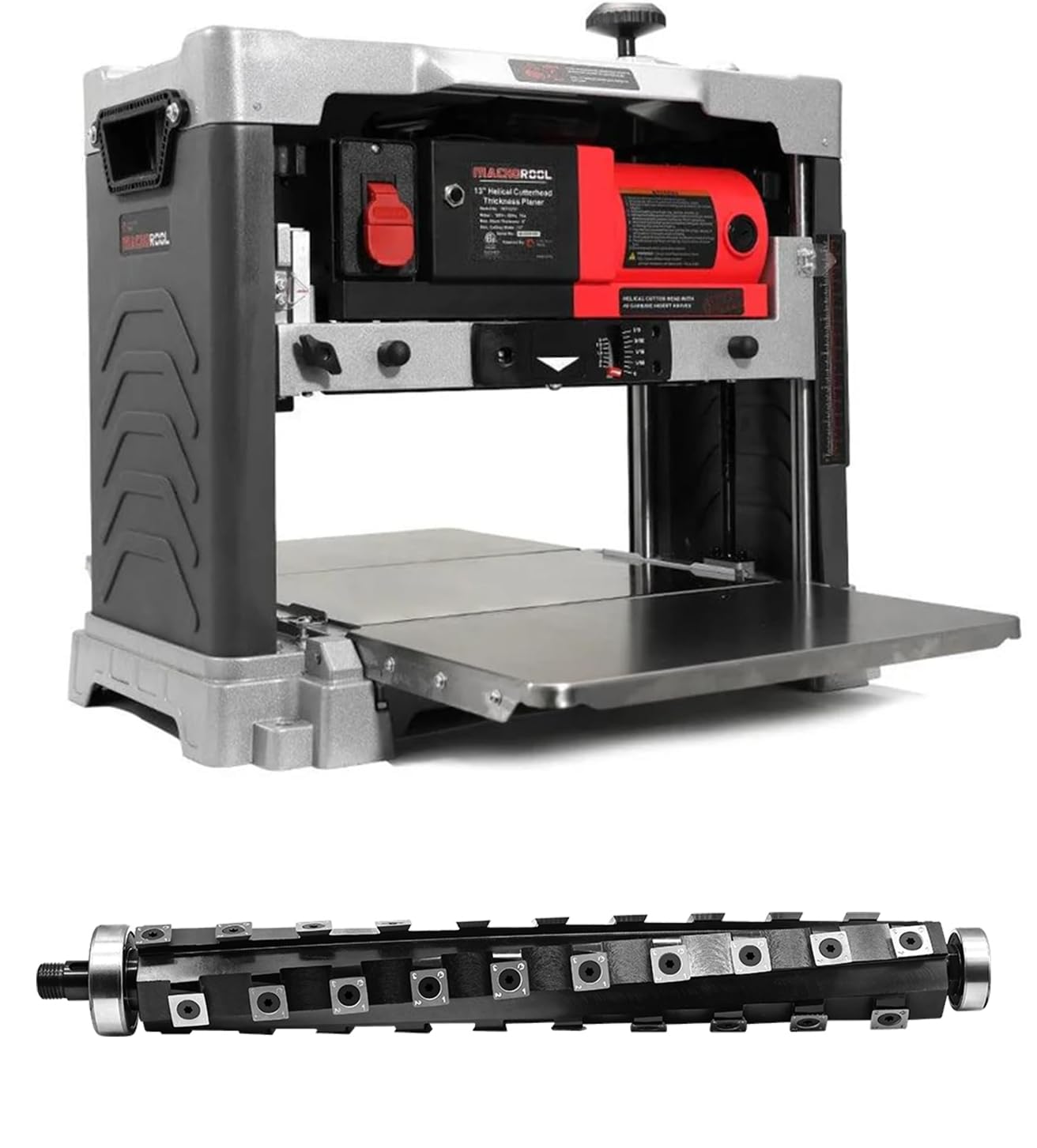
Forty carbide inserts and a sub-millimeter tolerance for woodworkers chasing matched blanks.
Forty tungsten carbide inserts sit in a four-row helical cutterhead, and that density is why this machine shears hardwood and softwood into a fine, low-noise cut. The 120V 15A motor reaches 20,000 RPM with a 27.5 FPM feed rate, so stock moves through efficiently while the inserts do the smoothing. Cutting depth is 0.12 inches across a 13-inch width, with a maximum planing depth of 1/8 inch.
The build is a four-column design on a cast-aluminum base with an anti-wobble footing, and the thickness tolerance is under 0.1 mm. That is the number that matters if you are cutting matching parts — get blanks within a hair of each other and your joinery closes clean. Mounting holes let you bolt it to a workbench so it does not shift during a run.
Eight depth-stop settings match boards to a consistent thickness, and folding extension boards stretch the support to 27.4 inches. Built-in overload protection shuts the motor off under extreme loads to guard against damage. The finish is the standout: boards come off looking sanded, and matched blanks land within a few thousandths of an inch of each other.
Numbers That Matter
- 40 tungsten carbide inserts in a four-row head for a fine, low-noise shear cut.
- Thickness tolerance under 0.1 mm keeps matched parts within a hair of each other.
- 27.5 FPM feed rate and 20,000 RPM motor for efficient stock removal.
- 8-position depth stop and folding extensions to 27.4 inches for batch support.
Before You Commit
- Overload protection cuts the motor if you push heavy passes, so take light bites.
- Lighter review history than the long-established bench brands.
- At 70 pounds it is a bench fixture, not a portable machine.
For the precision-focused: guitar builders, furniture makers, and anyone cutting matching parts who needs matched thickness.
The caveat: heavy passes trip the overload protection, so patience with light passes is the price of that tight tolerance.
8. JET 13-Inch Benchtop Thickness Planer (JWP-13BT)

A 2 HP helical machine with a two-speed feed built to keep boards dead flat.
The helical-style cutterhead runs six rows of 26 individual quick-change high-speed steel inserts, which gives a smoother, quieter cut than straight blades. A 2 HP, 15 amp motor turns the cutterhead at 10,000 RPM, and the two-speed feed — 18 FPM or 26 FPM — lets you pick between a faster pass and a finer surface. Maximum depth of cut is 1/8 inch, with 6 inches of thickness and a 13-inch width capacity.
A precision-machined cast iron bed and steel cover keep boards flat, and a four-post design supports the cutterhead with maximum control to hold down snipe. Adjustable folding infeed and outfeed tables level to the bed and fold away for storage in a tight shop. An adjustable depth stop lets you repeat a set thickness run after run.
Buyer feedback on this one is genuinely split. Some find it quiet and precise, while others report 15 amp fuses blowing repeatedly and blades dulling fast. It is a sturdy machine with heavy-duty parts, but it is a noisier, more finicky ownership experience than the calmer picks here. If you have a dedicated circuit and a taste for two-speed helical work, the capability is there.
Capability vs. patience: The 2 HP motor and two-speed helical feed are the real goods for flattening boards. The split feedback on fuses and blade life is the deciding factor — check your circuit and plan for blade upkeep before you commit.
Choose it if: you want two-speed helical capability and a cast iron bed at the lower end of the premium tier.
Think twice if: you are not prepared to deal with breaker tripping or frequent blade changes.
9. Makita 2012NB 12″ Portable Planer

A compact, jobsite-ready planer that runs at 83dB and travels without a second set of hands.
The figure to know is 83dB — Makita rates it the quietest planer in its class at 83dB, which keeps a garage session tolerable. It is also built compact and light for carrying to the jobsite, so it doubles as a field tool rather than a permanent shop resident. Blade changes are engineered to be fast and easy, using disposable double-edge blades.
A four-post design with diagonal cross supports keeps the head stable, and large table extensions support the workpiece. The cutting width is 11.86 inches — the narrowest on this list, against 13 inches on the DEWALT DW735X — so factor that in if you regularly plane wide panels. Most furniture and trim stock fits, but full-width cabinet panels will need extra passes or a sled.
Customers note glassy-smooth surfaces with little or no snipe straight from the start. The durability story is mixed only on highly figured wood, where tear-out can show up. It weighs 28.07 kg, which is manageable for a benchtop machine and part of why it is the travel pick.
Where it shines: the 83dB rating and portable build make it the machine to throw in the truck. The 11.86-inch width is the cap to respect — measure your widest boards before you decide.
Pick it if: you plane on the jobsite or in a shared garage where noise matters and you favor portability.
The trade-off: the 11.86-inch width and tear-out on wild figure mean it is not the machine for full-width figured panels.
Know the Specs
Cuts Per Inch (CPI) and Feed Speed
CPI counts how many knife passes land on every inch of board — the higher the number, the finer the surface. The DEWALT DW734 runs 96 cuts per inch, while the DW735X lets you switch between 96 and 179. Feed speed in feet per minute (FPM) or surface feet per minute (SFPM) is the rate stock moves through the machine; slower feeds tend to leave a cleaner cut, faster feeds clear material quicker.
Spiral and Helical Insert Heads
These cutterheads hold rows of small square inserts — carbide on the FindBuyTool MB320 and the Cutech 40600H, HSS on the RIKON 25-135H and JET JWP-13BT. When an insert nicks or dulls, you rotate it or swap it, so a damaged edge does not force a full blade change. The slicing angle also tends to reduce tear-out and run quieter than straight knives.
Depth of Cut Per Pass
This is how much material the machine can remove in one trip through. The DEWALT DW735X, the DEWALT DW734, the Cutech 40600H, and the JET JWP-13BT all list 0.13 inches; the WEN PL1252 lists 0.09 inches. Taking lighter passes than the maximum keeps the motor from bogging and the finish cleaner.
Snipe and Head Support
Snipe is the dip left at the start and end of a board when the cutterhead tips it. Four-post head support, a carriage lock, long infeed and outfeed tables, and dedicated snipe hardware all fight it. The DEWALT DW734 uses a four-column carriage lock, and the Cutech 40600H uses four lead screws with a patented coupling design to reduce snipe without a manual lock.
Common Questions
What is snipe on a thickness planer and how do I avoid it?
Is a spiral cutterhead better than a three-knife straight head?
What is the maximum width a benchtop planer can handle?
Can I hook a benchtop planer to a shop vacuum?
How much depth can I take off in one pass?
Do I need a 15-amp circuit for a benchtop planer?
Can I plane boards from and joint the edges too?
Is a quieter planer worth it for a home garage shop?
The Bottom Line
For most woodworkers, the woodworking planer machine to buy is the DEWALT Thickness Planer (DW735X) because its two-speed gearbox, automatic carriage lock, and 13-inch capacity cover the widest range of real shop work with the strongest track record. If you want a smoother finish and the four-column lock without the two-speed price, grab the DEWALT DW734. And for jobsite work in a noise-sensitive neighborhood, the Makita 2012NB at 83dB is the one to reach for. Pick the cutterhead style and snipe control you trust, and the rest of the spec sheet matters less.
How we choose
We do not accept paid placement. Every pick is matched to a real buyer and a real use-case; we do not hands-on test units.
Sources
Specifications: manufacturer listings and product documentation. Review insights: verified customer reviews, as of November 2026. Pricing: not shown on this page (it changes often); check the current price via the retailer link.
As an Amazon Associate, Tactical Gear Guy earns from qualifying purchases. This does not affect which products we feature.