Specs are compiled from manufacturer listings and verified buyer reviews and can change over time — please confirm the key details on the product page before buying.
Most people shopping for a woodworking nail gun end up with the wrong gauge. They buy an 18-gauge brad nailer for door casings that need 16-gauge holding power, or they buy a heavy 16-gauge finish nailer for thin decorative trim that a brad nailer handles fine. The result is split trim, bent nails, or a nailer that stays in its case because it is too heavy to haul out for a five-minute job. This guide sorts that out for you: which gauge suits which job, what air pressure you actually need, and which real nailers hold up when you use them all weekend instead of once a season.
This guide is built by comparing the manufacturers’ published specifications and the patterns across verified customer reviews, so you get each pick’s real strengths and trade-offs instead of marketing spin.
In most shops the nailer that gets grabbed first is the one matched to the fastener, not the one with the best-known name on the body. Below is the full breakdown of the best woodworking nail gun options, ranked for how they actually perform on trim, casing, and cabinet work.
Top Picks


How To Choose The Best Woodworking Nail Gun
Start with the fastener, not the tool. The nail you need to drive decides the gauge, and the gauge decides everything else — the tool’s weight, the lengths it accepts, and how much holding power you get in the wood. Pick the wrong gauge and no depth dial or pressure tweak will keep the nail from splitting thin stock or pulling loose from casing.
Gauge first: 16GA versus 18GA
Gauge is the thickness of the nail, and bigger is thicker here. An 18-gauge brad nailer drives thin nails, typically up to 2 inches, and suits light trim, cabinet backs, and small assemblies where splitting is a risk. A 16-gauge finish nailer drives a thicker nail and typically accepts lengths up to 2-1/2 inches, so it holds heavier casing, baseboard, and door trim without the joint working loose. If you are nailing up crown molding or a doorframe, you want 16-gauge. If you are pinning a face frame or a bit of beadboard, 18-gauge does the job with less splitting.
Air pressure and your compressor
These tools are pneumatic, meaning they run on compressed air rather than a battery or a cord. Each nailer lists an operating pressure range in PSI (pounds per square inch — how hard the air pushes). The 18-gauge nailers here run at roughly 70 to 120 PSI. If your compressor cannot sustain that through a long run of nails, the tool drives shallow and nails start standing proud. Match the nailer’s PSI range to your compressor’s output before you buy, and check whether the kit includes the 1/4-inch air fitting you need.
Depth of drive and jam clearing
Depth-of-drive adjustment controls how far the nail sinks below the surface. Tool-free adjustment means you turn a dial by hand mid-job, which is what you want when you move from soft pine to dense oak. Jam release is the other one to prioritize: a tool-free jam latch lets you clear a misfeed in seconds instead of dismantling the nose. Both features show up on the mid-range and premium picks here and on a few of the value ones too.
Side-by-Side Comparison
| Model | Best For | Gauge | Fastener Length | Weight | Amazon |
|---|---|---|---|---|---|
| BOSTITCH BTFP71917★ Best Overall | All-around finish and trim work | 16GA | 1-1/4″ to 2-1/2″ | 7.3 lb | Amazon |
| Metabo HPT NT50A5Top Performer | All-day pro brad work | 18GA | 5/8″ to 2″ | 2.9 lb | Amazon |
| CRAFTSMAN CMPBN18KOil-Free Pick | Oil-free brad nailing on trim | 18GA | — | 4.4 lb | Amazon |
| SENCO BN31M1P | Light-duty brad work with dry-fire lockout | 18GA | 5/8″ to 2-1/8″ | 3 lb | Amazon |
| DEWALT DWFP71917 | Heavy casing and door trim | 16GA | — | 16 oz | Amazon |
| Finish Nailer 16GA T64C | Budget 16-gauge entry point | 16GA | 1″ to 2-1/2″ | 4.9 lb | Amazon |
| HBT HBT64P | Magnesium-housing 16GA finish work | 16GA | 1″ to 2-1/2″ | 7.44 lb | Amazon |
| SF5040 2-in-1 | Staples and brads from one body | 18GA | 5/8″ to 2″ brads | 3.2 lb | Amazon |
| SENCO PC0947 Combo | Shop starter set with compressor | 18GA | 5/8″ to 2-1/8″ | 3 lb (nailer) | Amazon |
Detailed Reviews
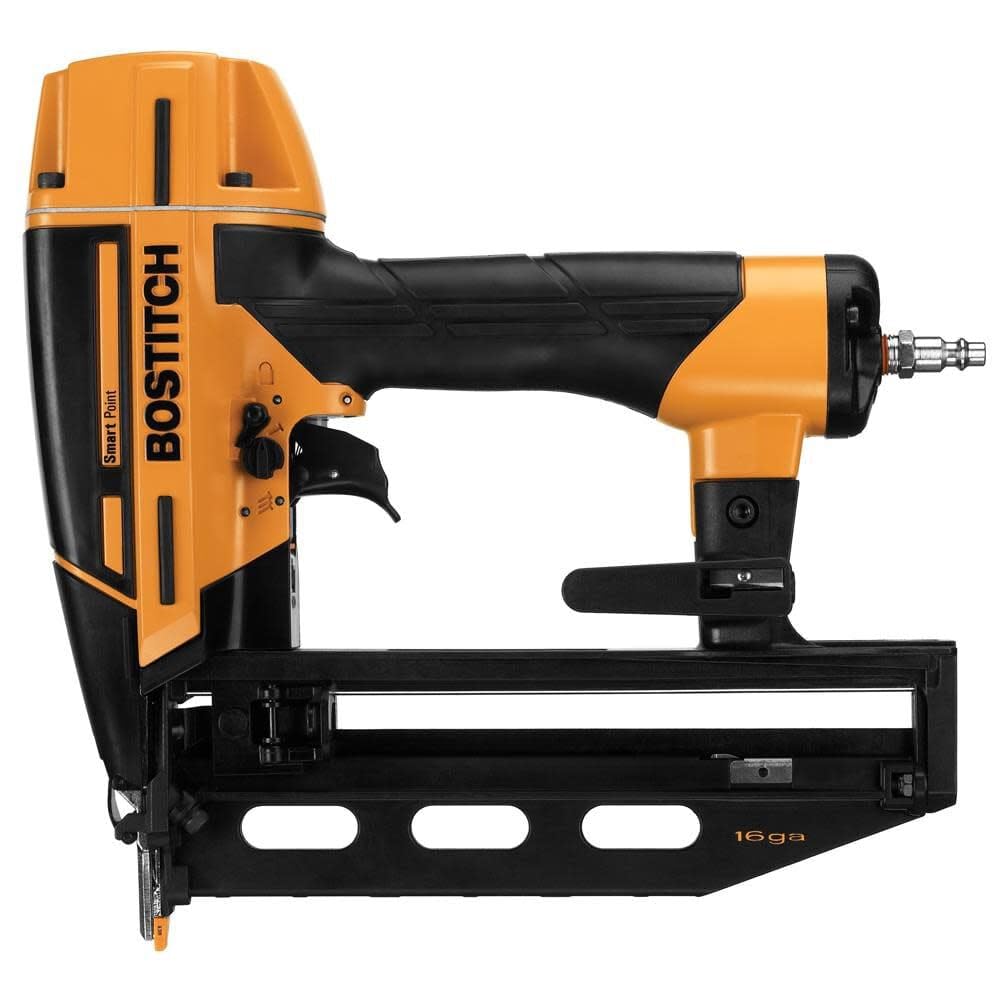
1. BOSTITCH BTFP71917 Finish Nailer Kit
Our pick — 4.5+★ from 550+ verified ratings; the strongest balance of quality and price.
A 16-gauge finish kit whose Smart Point nose resists dimpling the trim you just painted.
If you want one nailer for baseboard, casing, and crown, this 16-gauge finish kit is the sensible place to land. It drives nails from 1-1/4 inches up to 2-1/2 inches, so you get real holding power in a doorframe without stepping up to a framing tool. The 7.3-pound body gives it a planted feel when you are working overhead.
What earns it the top slot is the Smart Point nose. The contact tip is engineered to reduce the dimpling you get when a nailer’s nose presses too hard into softwood, which is why it is the most-praised part of the tool. Detail work shows it plainly — the finish pages are full of molding and baseboard jobs that came out clean. The oil-free motor matters here too: no oil mist means no chance of a stain bleeding into bare or light-stained wood.
You can start working right from the start: the kit includes the nailer, a 1/4-inch air fitting (the connector that plugs the tool into your compressor hose), a carrying case, and spare no-mar tips (soft pads that protect the wood surface), all backed by a 7-year limited warranty. Put it next to the DEWALT below and the gauge is identical — BOSTITCH 16GA vs DEWALT 16GA — so this depends on the nose design and the depth control, and BOSTITCH’s Dial-A-Depth lets you fine-tune countersink (how deep the nail head sits) without tools. Keep in mind the 7.3 pounds is on the heavy side for long overhead stretches, so if you mostly nail overhead and want less arm fatigue, the 2.9-pound Metabo HPT below is the lighter path.
What earns it the top slot
- Smart Point nose resists dimpling on softwood trim
- Dial-A-Depth countersink control with no tools needed
- Oil-free motor keeps finish wood free of oil mist
- Selectable trigger for sequential or bump firing
- Belt hook with an integrated pencil sharpener
Where it gives ground
- At 7.3 pounds it is heavier than the 18-gauge brad nailers here
- Jams come up in the feedback more than the top-rated aspects do
- Needs an air compressor and a sustained PSI supply
Top billing for: anyone building out a finish kit for casing, baseboard, and crown who wants one reliable 16-gauge tool.
Think twice if: your work is all overhead and arm fatigue matters more than holding power.
2. Metabo HPT Brad Nailer, Pneumatic, 18 Gauge, NT50A5
A 2.9-pound brad nailer built for the guy who nails overhead until his arms give out.
Weight is the whole story with this one. At 2.9 pounds it is the lightest 18-gauge in this group, and you feel that most when you are working a ceiling run of crown or pinning cabinet uppers with your arms above your head. The high grade aluminum magazine takes 5/8-inch up to 2-inch 18-gauge brads and is designed to resist jams. Tool-free depth dial and a selective trigger let you switch between bump fire and sequential fire without breaking stride.
The integrated air duster blows sawdust off the joint before you fire, so brads seat flush instead of riding up on debris. An ambidextrous belt hook mounts left or right, and the kit comes with a tool bag, safety glasses, and a no-mar tip so you are not hunting for accessories.
Where the value is clear: the quality of the build is the most-praised part of this tool, and the body work holds up through extended renovation runs. The reliability record is mixed though — some of the feedback reports issues — so treat it as the excellent everyday brad nailer it is, not an indestructible framing tool. It is an 18-gauge brad nailer, so for lengths up to 2 inches and trim-pinning work; for a 16-gauge hold on casing, the BOSTITCH above is the right call. Metabo HPT backs it with a 5-year warranty.
Light-on-the-arms build: the 2.9-pound frame and aluminum magazine make long trim runs easier on your forearms than the 7.3-pound finish nailers here.
One honest caveat: it is an 18-gauge tool, so it pins thin trim and light assemblies rather than holding heavy door casing.
Reach for this if: you spend hours nailing overhead and want the lightest 18-gauge that still feels like a pro tool.
Look elsewhere if: your job list is heavy casing and baseboard that needs a 16-gauge nail.
3. CRAFTSMAN Brad Nailer, 18GA, Pneumatic Nail Gun (CMPBN18K)
An oil-free 18-gauge brad nailer that fires after six months on the shelf without a drop of oil.
Three things define this one, and all three point at convenience. The oil-free motor means no routine lubrication, so you can pull it off the shelf after six months and it should still fire. The tool-free jam release lets you clear a stuck brad without a hex key. And the tool-free depth-of-drive adjustment lets you set nail heads flush or countersunk by hand.
At 4.4 pounds it sits in the middle of the brad nailers here — heavier than the Metabo HPT brad nailer’s 2.9 pounds but lighter than any of the 16-gauge finish tools. It takes 18-gauge brads, so it is built for light trim, cabinet work, and paneling rather than structural holds. The kit ships with a 1/4-inch air fitting and a carrying case.
Gauge note worth keeping straight: this is CRAFTSMAN’s 18GA vs the BOSTITCH finish nailer’s 16 GA — a thinner fastener intended for pinning, not casing. If your plan is doorframes and baseboard, go 16-gauge. If it is face frames, cabinet backs, and small assemblies, this brad nailer keeps it simple and oil-free.
Low-maintenance motor: oil-free operation and a tool-free jam latch mean fewer chores between jobs, and the included case keeps the fitting and tool together.
Honest trade-off: 18-gauge brads only — it pins trim rather than holding heavy casing, so check your fastener first.
Worth grabbing if: you want a fuss-free 18-gauge brad nailer that skips oiling and clears jams by hand.
Not the one if: your jobs call for 16-gauge holding power in door trim and casing.
4. SENCO BN31M1P Pneumatic Brad Nailer 18 Gauge 2-1/8″

A 3-pound brad nailer with a 110-nail magazine and a dry-fire lockout that saves wear.
For trim, decorative molding, baseboard, and small woodworking assemblies, this 18-gauge brad nailer covers light-duty jobs cleanly. It runs brads from 5/8 inch up to 2-1/8 inch, and the 110-nail capacity (how many fasteners load into the magazine at once) means fewer reloads on a long run. The tool itself weighs 3 pounds, so it stays comfortable in one hand.
Dry-fire lockout is one of those features you appreciate after the first empty magazine — it stops the tool firing when there are no nails and indicates it is time to reload, which limits wear on the driver. Tool-free depth adjustment, a quick clear latch, selectable trigger, and a 360-degree adjustable exhaust round out the practical side. Operating pressure runs 70 to 120 PSI.
Build quality is where it shines — it is the aspect that gets praised most here. A rotatable belt hook mounts left or right, and a no-mar pad protects the surface. The durability record is mixed, with some reports of trouble under light-duty jobs, so treat it as the everyday brad nailer it is and don’t expect a framing-tool lifespan. Compared to the CRAFTSMAN brad above, both are 18-gauge, but this one’s dry-fire lockout and 110-nail magazine give it an edge on longer runs.
What it does well
- Dry-fire lockout limits wear when the magazine runs empty
- 110-nail capacity cuts reloads on long trim runs
- Tool-free depth dial plus quick-clear jam latch
- Selectable contact or sequential firing
- 360-degree exhaust and a rotatable belt hook
What to keep in mind
- Durability is mixed in the feedback — light-duty use is the fit
- 18-gauge brads only, so not a casing or framing tool
- Needs a consistent air supply in the 70-120 PSI range
Good match for: trim and molding work where you want dry-fire protection and fewer reloads.
Choose a different gauge if: your project is heavier door casing that needs 16-gauge bite.
5. DEWALT Finish Nailer with Precision Point, 16GA (DWFP71917)
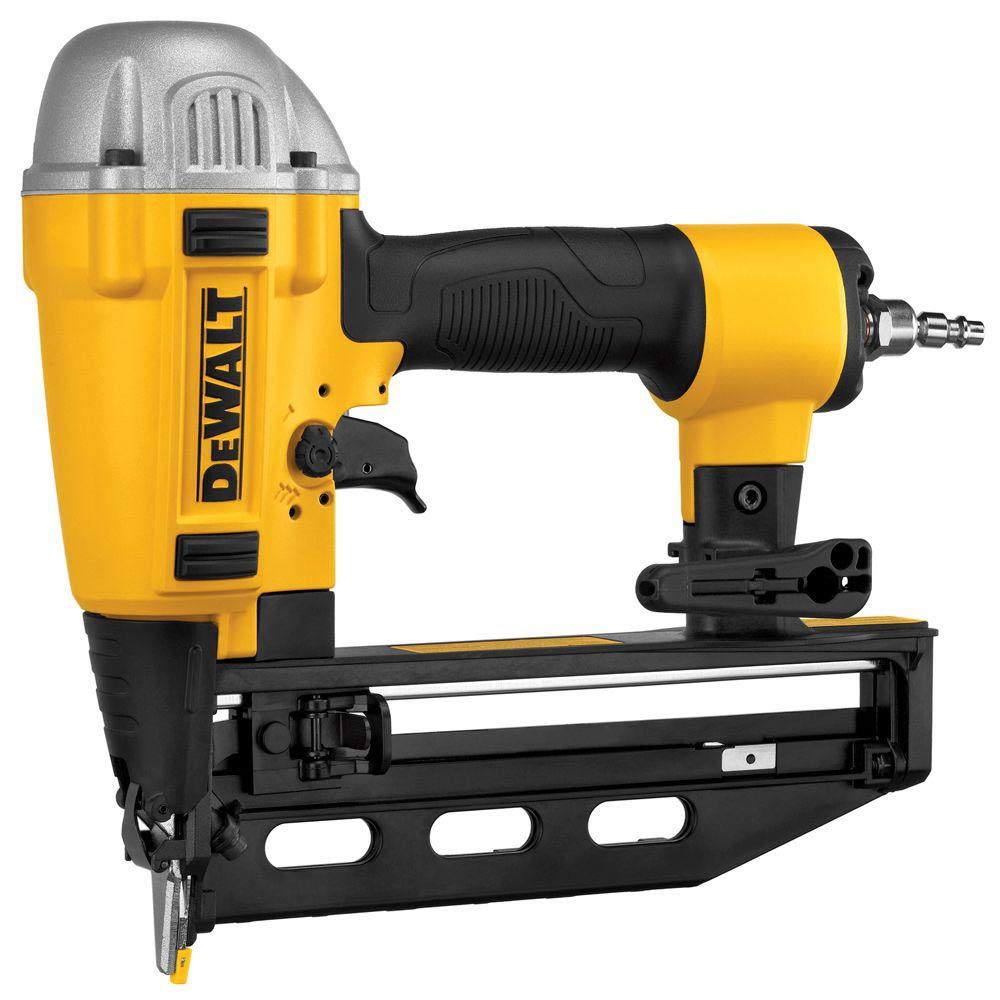
A 16-gauge finish nailer with a precise nose — and a habit of denting softer stock.
This is a tool for heavier trim: casing, doorframes, and baseboard where a thicker 16-gauge finish nail (a thicker fastener than a brad) holds better than a brad. The Precision Point nose is the defining feature, aimed at putting the nail exactly where you place it. In the finish nailer comparison, it is the same gauge as the BOSTITCH above — DEWALT 16GA vs BOSTITCH 16GA — so the two go head to head on nose design, and the DEWALT’s tiny spec weight of 16 ounces makes it a genuinely light 16-gauge on the arm.
Here is the catch you will want to know before you commit. The very precision that makes the tip accurate is also what the feedback flags: the micro tip dents material easily, and jams come up in the same breath. On soft or pre-finished wood, you want to dial the nose pressure back and test on scrap first.
For hard, dense trim and a technician who wants exact placement, the Precision Point pays off. For a beginner working soft pine and painted surfaces, the dents are a real risk. Weigh that against the price point of this one against the more expensive kit SENCO combo below, and decide if you want tip precision or a more forgiving nose.
Precision where it counts: the 16-gauge drive and Precision Point nose give exact placement on dense trim, and a notably light frame for a finish nailer.
The honest catch: the micro tip can dent soft or finished material, and jams appear in the durability feedback — test on scrap and go easy on the nose.
Pick it if: you work dense trim and want pinpoint 16-gauge placement from a light finish nailer.
Pass if: you work mostly soft pine and need a forgiving nose over an exact one.
6. Finish Nailer 16GA Pneumatic Nail Gun

An entry-level 16-gauge that gives you the long nails but asks for patience.
If you need 16-gauge holding power and want an entry-level way in, this tool covers the range: 1-inch up to 2-1/2-inch finish nails, the same span as the BOSTITCH and HBT finish nailers here. Tool-free depth adjustment, tool-free jam release, a sequential trigger, and a 360-degree adjustable exhaust are all on the list. It weighs 4.9 pounds.
Honesty matters on this one. The nail feed is the recurring trouble spot — double feeding comes up, and nails sometimes leave their heads standing 2 to 3 millimeters proud instead of sinking flush. It is the exception rather than the rule, since plenty of buyers call it excellent, but it is the thing to watch for on your first strip.
For a home DIYer taking on one trim project, this gives you 16-gauge reach at the budget end of the group. If you are a working contractor nailing every day, the more established 16-gauge options above and the DEWALT precision tool are the safer long-run buys. This one earns its place as the affordable way to try 16-gauge without committing to a premium kit.
Value entry to 16-gauge: full 1-inch to 2-1/2-inch finish-nail range with tool-free depth and jam release at the budget end of this list.
Watch on your first run: the feed can double-feed or leave nail heads 2 to 3 millimeters proud — test a strip before you commit a whole project to it.
A fit for: the home DIYer who wants 16-gauge capability for one trim job without a premium outlay.
The wrong pick for: daily professional nailing where feed reliability is non-negotiable.
7. HBT HBT64P 16 Gauge Finish Nailer with Magnesium Housing

A magnesium-bodied 16-gauge that shoots 2-inch stainless all day without complaint.
Magnesium housing is the HBT’s defining spec, chosen to cut weight while keeping the body durable. Drive 16-gauge finish nails from 1 inch up to 2-1/2 inches, switch between bump-fire and sequential single fire with a flip of a switch, and adjust depth or clear a jam without tools. A dry-fire lockout tells you when the magazine is empty, and a 360-degree swivel air plug keeps the hose from twisting as you move around the work.
The performance story is solid — it has handled several hundred 2-inch stainless steel nails in real use, and buyers rate it alongside name-brand models. That magnesium body is durable but it is not light in absolute terms: at 7.44 pounds it is the heaviest of the finish nailers here, and putting it against the SF5040 brad nailer’s 3.2 pounds is a reminder of how much heavier a 16-gauge finish tool can be.
For a stationary bench or floor-level trim run, that weight is fine and the magnesium body takes a knock. For a long overhead crown run, you will feel all 7.44 pounds. The spare no-mar tip attached to the tool is a nice touch for keeping delicate stock unmarked, and the case ships with it.
Solid reasons to like it
- Magnesium housing balances durability with a lighter build than steel
- Handled several hundred 2-inch stainless nails in real use
- Tool-free depth and jam release save time mid-job
- Dry-fire lockout and a 360-degree swivel air plug
- Spare no-mar tip attached to the tool
The reasons it might not fit
- At 7.44 pounds it is the heaviest finish nailer here
- Needs an air compressor and steady PSI to perform
- 16-gauge only — no staple or brad switching
Best suited to: bench and floor-level finish work where magnesium durability outweighs a heavier frame.
Weigh the trade: all 7.44 pounds shows up on long overhead runs, so pick a brad nailer for ceiling work.
8. SF5040 Pneumatic Brad Nailer

A single 3.2-pound body that switches between 18-gauge brads and staples, so you skip buying two tools.
For a home project where you want both brads and staples without buying two tools, this 2-in-1 is the practical budget pick. Switch between 18-gauge brads from 5/8 inch to 2 inches and staples from 5/8 inch to 1-5/8 inches. The aluminum body weighs 3.2 pounds, and a removable no-mar rubber tip protects delicate surfaces. The 360-degree adjustable exhaust keeps air off your face.
Against the heavier finish tools, the 3.2-pound frame is a clear weight advantage — compare it to the HBT’s 7.44 pounds and you get why it is easier to wave around for detail work. It ships with two strips of 18-gauge brads and staples, a hard carrying case, and the essential accessories, so you can start a small project right from the start.
The honest side is durability and feeding. It is one of the lowest-priced tools here for good reason, and the feedback notes some units breaking after about 15 uses along with the occasional missed shot. Treat it as a light-duty home tool rather than a daily driver — for a weekend trim job or a one-off reassembly it earns its keep; for steady professional work the mid-range brad nailers above hold up longer.
Two tools in one: brads and staples from a single 3.2-pound body, with a no-mar tip and a hard case, make it a smart budget choice for mixed home projects.
Size the risk: the durability and feeding record is mixed — right for occasional light-duty work, less so for heavy daily use.
A smart buy for: weekend DIYers who want brad and staple capability from one light, affordable tool.
Not for: contractors relying on it day after day where longevity is the priority.
9. SENCO PC0947 Pneumatic Brad Nailer

A start-from-zero bundle: 18-gauge brad nailer, 68 dBA compressor, and 25-foot hose in one box.
If you do not own a compressor yet, this is the pick that removes the guesswork. The kit bundles an 18-gauge brad nailer (the BN31M1P), a PC1010 compressor, a 1/4-inch by 25-foot coil hose, fasteners, and safety glasses. The nailer drives 18-gauge brads from 5/8 inch up to 2-1/8 inch, with an oil-less design, dry-fire lockout, and a selectable trigger.
The compressor is the star of the bundle: an ultra-quiet motor rated at 68 dBA (decibels — a rough measure of how loud it is) that weighs 20 pounds for portability, with an oil-free pump (no oil to check or change) and a max pressure of 135 PSI (pounds per square inch — the air pressure it delivers). That quiet motor is the top reason the set rates well — you can run it in a basement shop or a garage without it dominating the room. Its versatility, quiet operation, light weight, and compact size are what carry the feedback.
The build is where the caveats sit. Durability is mixed — some units reported breaking after less than 10 hours of use — and air pressure issues come up too. This is the most expensive bundle here, so treat it as the start-from-scratch buy for someone who wants the nailer, compressor, and hose matched to work together rather than a long-run professional kit.
Why the bundle works
- Nailer, compressor, 25-foot hose, and fasteners in one box
- 68 dBA compressor runs quiet in a garage or basement shop
- Compressor is light at 20 pounds and compact for moving around
- Oil-free pump and oil-less nailer for low maintenance
- Dry-fire lockout and selectable trigger on the nailer
What to weigh first
- The priciest bundle here — you are paying for the compressor too
- Durability and air pressure show mixed feedback
- 18-gauge brads only, so not a casing or framing tool
A natural start-from-zero set: a matching nailer, quiet 68 dBA compressor, and hose for someone building a shop from nothing.
Hold off if: you already own a compressor, since you would be paying for one you do not need.
Know the Specs
Gauge and Fastener Length
Gauge is the nail’s thickness — 18-gauge is thin, 16-gauge is thicker — and it decides how much hold you get. Length is the second half of that: 18-gauge tools here run from 5/8 inch up to around 2-1/8 inches, while 16-gauge finish nailers go from 1 inch to 2-1/2 inches. Match the gauge and length to the material, or you split thin stock with a heavy nail or watch a casing pull loose from a brad.
Operating Pressure (PSI)
PSI is how hard the air pushes the nail. These are pneumatic tools, so they need a compressor, and each lists a range — for example 70 to 120 PSI on several of the 18-gauge models. If your compressor cannot hold the low or high end of that range, depth of drive suffers and nails stand proud. Check your compressor’s output and whether the kit includes the 1/4-inch air fitting before you plug in.
Tool-Free Depth and Jam Release
Depth of drive is how far the nail head sinks below the surface. Tool-free adjustment lets you change it by hand when you move between soft pine and dense oak. Jam release is how you clear a misfeed — a tool-free latch saves minutes of fiddling on every stuck nail. These two features separate the easy-to-live-with tools from the fussy ones in this group.
Weight and Balance
Weight matters most on overhead work and long runs. The brad nailers here run as light as 2.9 pounds, while the 16-gauge finish tools can weigh well over 7 pounds. A heavier finish nailer feels planted at the bench but tires your arms on a ceiling run. Decide how much overhead nailing your job involves before you pick a gauge and a weight.
Common Questions
Do I need a compressor to run these woodworking nail guns?
Should I use 16-gauge or 18-gauge for baseboard trim?
What does tool-free depth adjustment actually do?
Can a brad nailer shoot staples too?
What is the difference between an oil-free and an oil-lubricated nailer?
What gauge and length does the Metabo HPT NT50A5 accept?
Why do nails leave their heads sticking out of the wood?
How loud is the SENCO PC0947 compressor?
Is a heavier finish nailer better than a lighter brad nailer?
What fasteners come in the box with these nailers?
The Bottom Line
Most people settling on a woodworking nail gun will get the most out of the BOSTITCH BTFP71917 — a 16-gauge finish kit with a Smart Point nose that keeps softwood trim clean, backed by a 7-year warranty and an oil-free motor that will not stain your finish. If you mostly nail overhead and want a lighter tool, reach for the Metabo HPT NT50A5 at 2.9 pounds, a brad nailer that keeps ceiling runs comfortable across its 5/8-inch to 2-inch brad range. And for a shop built from zero, the SENCO PC0947 bundle pairs an 18-gauge brad nailer with a 68 dBA compressor and a 25-foot hose so you can start nailing without hunting for a separate air source. The one honest nudge worth making: if you are still deciding between gauges, buy for the fastener your first real job needs — a 16-gauge finish nailer like the BOSTITCH covers casing and baseboard, while an 18-gauge brad nailer covers trim and cabinet work.
How we choose
We do not accept paid placement. Every pick is matched to a real buyer and a real use-case; we do not hands-on test units.
Sources
Specifications: manufacturer listings and product documentation. Review insights: verified customer reviews, as of November 2026. Pricing: not shown on this page (it changes often); check the current price via the retailer link.
As an Amazon Associate, Tactical Gear Guy earns from qualifying purchases. This does not affect which products we feature.