Specs are compiled from manufacturer listings and verified buyer reviews and can change over time — please confirm the key details on the product page before buying.
You only need one tape for cabinet work, framing and trim, and the short answer is this: buy the Komelon 25-Ft Self Lock if you want the easiest one-handed measuring, or the FastCap ProCarpenter if you work in metric. The rest of this list covers blades that stand out further, read better in dim light, or survive a drop onto concrete. Every tape here measures accurately; the real difference is how each one behaves against a board edge, above your head, or on a ladder.
This guide is built by comparing the manufacturers’ published specifications and the patterns across verified customer reviews, so you get each pick’s real strengths and trade-offs instead of marketing spin.
A woodworking tape lives or dies on three things: how far the blade stands out before it folds, how quickly you can read a fraction, and how it locks while your other hand holds the stock. Below you get all nine picks broken down on exactly those points, plus the plain-English spec guide and the questions buyers actually ask. This is a working comparison of the woodworking measuring tape options worth your tool budget.
Quick Picks
- Komelon 25-Ft Self Lock Dual
- FastCap ProCarpenter Metric/Metric Reverse — Metric Specialist
- Klein Tools 9525 Tape Measure — Compact Pick
- Lufkin 25′ Self-Centering Power Tape – L625SC-02 — Midpoint Finder
- Stanley Hand Tools 33-116 3/4″ X 16′ PowerLock — Featherweight Carry
- DEWALT ATOMIC Compact Series 25′ Tape Measure — Jobsite Workhorse
- Perfect Measuring Tape BrightLine High Contrast — Best Low-Light Read
- WORKPRO Heavy Duty Tape Measure — Two-for-One Value
- Spec Ops Elite Heavy Duty Tape Measure — Long Reach Pick
How To Choose The Best Woodworking Measuring Tape
The mistake most people make is buying on length alone. A 25-foot blade does nothing for you if it folds at six feet and you are measuring a sheet of plywood by yourself. Pick the tape around the three jobs you actually do — marking stock flat on a bench, measuring overhead or on a ladder, and reaching across an open space alone — then let the length follow.
Standout decides whether you can measure solo
Standout is how far the blade stays rigid before it droops. A stiffer, wider blade holds itself out longer, which means you can hook one end and walk the case back without a helper. That is the whole game on a solo measurement across a room. If you mostly measure short trim pieces on a bench, a compact blade is easier to handle and less unwieldy in tight corners.
Fraction markings you can read without leaning in
Woodworking cuts come down to eighths and sixteenths, so the markings need to be bold and clearly broken down. Dual-sided printing lets you read the blade from either edge, which matters when the tape is lying flat on a board. Metric reverse scales flip the numbers so they read correctly from the right or left hand — useful if you switch hands mid-job.
Lock style changes your whole rhythm
An auto-lock holds the blade wherever you stop pulling, then releases with a button, so a single hand does the whole job. A manual slide lock is a deliberate second step but never drifts on you. A finger brake lets you slow the retraction instead of letting the blade snap back at full speed, which protects both your fingertips and the hook.
Side-by-Side Comparison
| Model | Best For | Blade Length | Blade Width | Lock Type | Amazon |
|---|---|---|---|---|---|
| Komelon 25-Ft Self Lock | One-handed measuring | 25 ft | 1 in | Self Lock | Amazon |
| FastCap ProCarpenter | Metric cabinet work | 16 ft | 1 in | Dual | Amazon |
| Klein Tools 9525 | Compact daily carry | 25 ft | — | Slide | Amazon |
| Lufkin L625SC-02 | Finding the midpoint | 25 ft | 1 in | Positive | Amazon |
| Stanley 33-116 PowerLock | Light belt carry | 16 ft | 0.75 in | Slide | Amazon |
| DEWALT ATOMIC 25′ | Daily jobsite use | 25 ft | — | Integrated Finger Brake | Amazon |
| Perfect Measuring Tape BrightLine | Dim light and low ceilings | 18 ft | — | Pawl | Amazon |
| WORKPRO Heavy Duty 2-Pack | Two tapes on one bench | 25 ft | 1.1 in | Positive | Amazon |
| Spec Ops Elite 35′ | Long overhead reach | 35 ft | 1.25 in | Toggle | Amazon |
Detailed Reviews
1. Komelon 25-Ft Self Lock Dual

The tape that holds its own blade so your other hand stays on the board.
Here is the one for the woodworker who is always one hand short. Pull the blade out and it stays exactly where you stopped — that is the self-locking action doing the work for you — so you can hook a board end, walk the case back and read the mark without ever touching the lock button. A second manual lock sits on top for when you need the blade held hard during a long, awkward reach.
The fractions are printed large and clear along a high-visibility blade, which is the part that keeps you from squinting at an eighth-inch line under a bench shadow. Blade width is 1 inch and the case runs on ABS plastic (a tough, impact-resistant plastic), so it shrugs off normal bench knocks. Accuracy is listed at +/- 0.03 in, and backside printing means overhead and extended-reach measurements read correctly when the blade is flipped toward you.
What wins people over is the pure convenience of the auto-lock combined with markings that stay legible in poor light. The trade-off is real but narrow: the self-lock mechanism is the one part that occasionally stops holding on a well-used unit, and at 16 ounces the case has more heft on your belt than a compact tape. If you measure short trim all day and want the lightest possible carry, that weight is the thing to think about.
What earns it the top spot
- Auto-lock holds the blade at any extension for true one-handed measuring
- Backup manual lock adds grip for long overhead reaches
- High-visibility blade with clear fractional graduations stays readable
- Backside printing so overhead reads come out the right way round
Where it asks a little patience
- At 16 ounces the case is heavier on a belt than a compact tape
- The self-lock is the wear point on a heavily used unit
Grab this one if: you measure stock solo and want the blade to hold itself while your hands are busy.
Think twice if: you want the lightest case on your belt — the Stanley below carries far less weight.
2. FastCap ProCarpenter Metric/Metric Reverse Measuring Tape

A flat-back metric blade that reads correctly whichever hand holds it.
If your drawings are in millimetres, this is the tape to reach for. The reverse metric scale is printed so the numbers read the right way up from either your left or right hand — a small thing that saves a lot of head-turning when you are marking a cabinet side. The blade is 16 feet long and 1 inch wide, and accuracy is listed at ±1/16 inch per 10 feet, which is the kind of window you want on casework.
What owners praise most is outright build quality — cabinet makers put this in the same breath as their bench tools. The flat-back design is the other favourite: it lies flush against a surface instead of rocking, so your mark lands where you meant it. A built-in pencil sharpener sits in the case, and a lever-action belt clip keeps it on your apron. The swivel hook is built for corner-to-corner checks on square assemblies.
One honest point on that hook: it is not meant to slide like a conventional end hook, and a few owners find it less rigid than they expected — it is a corner-checking tool first. Also consider the length. Against the DEWALT’s 25-foot blade, this 16-foot blade is 9 feet shorter, which is fine for cabinets and short-run trim but short for room-span measurements. The blade itself is not the stiffest, so treat long solo spans with care.
The cabinet-maker angle: metric reverse printing, a flat back that sits flush and a sharpener built into the case make this feel purpose-made for shop work rather than general construction.
Know before you buy: a 16-foot blade and a swivel hook that does not slide — right for square checks and panel work, not for pacing out a room.
Reach for this if: your plans are metric and you mark cabinet parts flat on a bench all day.
Look elsewhere if: you need a long blade that stands out across an open floor.
3. Klein Tools 9525 Tape Measure

A full 25 feet squeezed into a case the size of a common 16-footer.
Compact is the defining word here, and it is not marketing shorthand. This 25-foot blade packs into a case about the size of a standard 16-foot tape, so it disappears into a tool pouch instead of hanging off your belt. The blade reaches up to 13 feet on its own before it folds, which covers most bench and trim work without a second pair of hands. Bold lines are marked every 1/8-Inch plus an architectural scale on a double-sided hook, so framing and finish measurements both read cleanly.
The finger brake is the feature you will notice first in daily use — it lets you slow the retraction instead of letting the blade snap home, which keeps your fingertips clear. The nylon coating over the steel blade guards it against abrasion as it drags over sawn edges. A five-point reinforced housing adds impact resistance for the inevitable drop off a bench.
Retraction is where opinions split. The blade retracting too fast is the recurring gripe, and the housing takes its share of knocks on a hard job. That said, the compact size and the clear 1/8-inch markings are what people come back for. Think of this as the tape for someone who values a small case over a heavy-duty shell.
Why woodworkers like it: a 25-foot blade in a genuinely small case, with a brake that keeps your fingers away from the tape as it retracts.
The fair caveat: the retraction speed and the housing durability are the two things to watch, so ease the blade back rather than letting it slam home.
Fits you best if: your pouch space is tight but you still want 25 feet of blade.
Second-guess it if: you want a housing that takes hard, repeated drops without complaint.
4. Lufkin 25′ Self-Centering Power Tape – L625SC-02

The blade that hands you the midpoint instead of making you do the math.
Finding the center of a board usually means measuring the full length, dividing it in your head and marking twice. This tape does that step for you — the self-centering blade shows the midpoint of any measurement directly on the tape. On a run of shelves or a row of drawer fronts, that removes a repeated arithmetic step and the errors that come with it. The blade is 25 feet long and 1 inch wide, which is wider than the Stanley’s 0.75-inch blade, so it feels more substantial in hand for long pulls.
What owners love most is that centering trick — it turns a two-step measurement into one. The high-visibility case and name tag make it easy to spot in a pile of tools, and an integrated nail slot lets you hook the tape on a nail for solo measurements across a span. Accuracy is listed at ±1/16 in. The smooth positive lock button is right where your thumb expects it.
At 0.35 kg the case sits in the middle of the pack for weight — lighter than the DEWALT at 0.49 kg. The honest trade-off is precision and build feel: this is a convenience-first tape, and for fine joinery where every sixteenth is critical, a dedicated fine-read tape is the better call.
The real winner: a self-centering blade that marks the middle for you, paired with an integrated nail slot for one-person spans.
The trade-off to weigh: it is built around convenience rather than precision-grade build, so treat it as your layout tape, not your fine-joinery tape.
Pick it up if: you cut a lot of centered hardware and want the midpoint handed to you.
Pass for: precision joinery where you want the stiffest, most exacting blade.
5. Stanley Hand Tools 33-116 PowerLock

A metal-cased classic that barely registers on your belt.
Weight is the headline here. At 5.92 ounces this is the lightest tape on the list — against the Komelon’s 16 ounces, it is the tape you forget is clipped on. The case is metal rather than plastic, the blade is 16 feet long and 0.75 inches wide, and a slide lock holds it in place. It is a simple, honest layout tape for trim, marking and general bench work where you do not need a wide, stiff blade standing out across a room.
What makes it easy to live with is that modest weight and the metal shell — it clips to a pocket and stays out of the way. The narrow 0.75-inch blade is the most compact here, so it drops into a small pouch without complaint and handles short, precise marks nicely. It is not trying to be a framing tape, and it does not need to be.
Accuracy is where the honest note sits. The blade is not a precision-grade performer, so for fine joinery you will want a tape with a tighter, more consistent read. For everyday marking and quick checks, the featherweight feel and metal case are exactly the point.
Best match for: the woodworker who hates a heavy tape dragging on the belt.
Look past it if: your work lives in sixteenths and you want a precision-first read.
6. DEWALT ATOMIC Compact Series 25′ Tape Measure, 1 Pack Bundle

A compact aluminum-cased tape built to take a day of real jobsite knocks.
Day after day on a jobsite is exactly where this one belongs. The case is aluminum rather than plastic, the blade is 25 feet of high carbon steel, and it carries fractional markings printed large enough to read at a glance — big numbers on both sides of the blade. An integrated finger brake lets you control the retraction so the blade does not slam back and bite your hand.
What owners rave about is the build — it feels sturdy in the hand while staying light enough to carry all day. Against the Lufkin’s 0.35 kg case, this one at 0.49 kg carries more weight, but it earns it with a more solid feel. Fractional markings at this clarity are the reason it comes off the belt so often on trim and framing work alike.
The retraction mechanism is the part that draws mixed feedback — some units run smoothly and others want coaxing. Keep the blade clean and it behaves; let grit build up and it can get fussy on the way home.
The crowd, in a line: the aluminum case, the clear fractional markings and the finger brake make this a low-drama everyday tape.
The honest aside: the retraction is the piece to baby — blow the dust out of the blade track and it stays smooth.
Buy this for: daily bench and site work where a solid case matters as much as the markings.
Choose differently if: you want the lightest possible case — the Stanley sheds noticeable weight.
7. Perfect Measuring Tape BrightLine 18ft

White numbers on a black blade so the fractions jump out in dim light.
Crawl spaces, cabinet interiors and late evenings in the shop are where this tape earns its keep. The blade is black nylon-coated steel with white printed numbers and fractions, so the contrast holds up when the light is poor — the markings read the same way a dark-mode screen does. That high contrast is aimed squarely at reducing mis-read marks, and the dual-sided printing lets you read either edge. Blade length is 18 feet, accuracy is listed at +/- 0.05″, and the pawl lock holds the blade where you stop it.
The topside auto-lock button is the other handy bit — a one-finger pull extends the blade and a stop keeps it halted, so you are not fumbling for a second hand. The case has inlaid rubber for grip and drop resistance, and a metal clip hangs it off your belt or pocket. For a woodworker measuring inside a cabinet run, that combination is genuinely useful.
The catch to keep in mind is the auto-lock itself, which on some units does not release cleanly and leaves the blade stuck out. An 18-foot blade is also shorter than the 25-foot tapes here, so it is a bench and detail tape rather than a room-spanning one.
What makes it stand out
- White-on-black blade keeps fractions clear in low light
- Dual-sided printing and bold numbers reduce mis-reads
- One-finger auto-lock and stop for single-handed use
- Inlaid rubber case grips well and resists drops
Keep an eye on
- The auto-lock can fail to release on some units
- 18-foot blade is shorter than the 25-foot picks here
Made for: cabinet work and dim corners where contrast beats a standard yellow blade.
Skip it for: long room spans — 18 feet will not reach as far as the 25-foot tapes.
8. WORKPRO Heavy Duty Tape Measure 2 Pcs 25FT
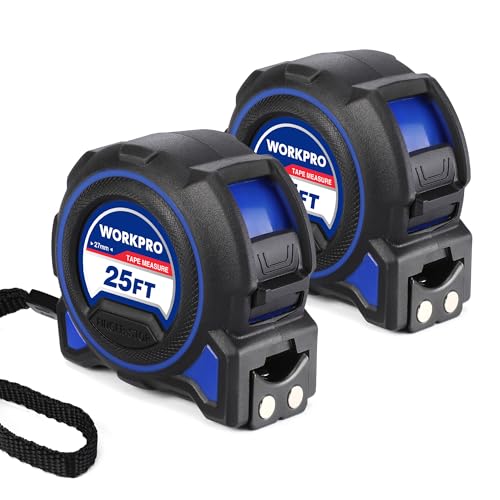
Two 25-foot tapes with a magnetic hook — one on the bench, one in the pouch.
Two tapes means you can leave one clipped to the bench and the other in your tool bag without ever hunting for it. Each is a 25-foot blade in a 1.1-inch width — the widest blade in this lineup, which gives real rigidity, and the blade holds a long stand over 9.8 feet. The magnetic hook is the practical touch: it bites onto steel so you can anchor the tape on a metal bench, stud or machine without a second set of hands.
Markings are yellow with black numbers in an inch scale, and accuracy is listed at 1/32 inch, fine enough for most woodworking layout. A double-brake design puts a retract button both above and below the case, so you can lock and release without turning the tape over. The shell is ABS and TPR rubber, and the nylon-coated blade is built to survive regular wear.
The honest note on accuracy: opinions are split, and the finer 1/32-inch claim is not always matched by what the blade does in a given pull. The case weight of 0.96 kg is also on the heavy side — two of these on a belt is noticeable. Treat them as solid working tapes for layout and framing rather than a fine-joinery reference.
The value case: two 25-foot tapes, a 1.1-inch rigid blade with a 9.8-foot stand-out, and a magnetic hook for one-handed anchoring.
The balanced caveat: the finer accuracy is not the most consistent here, and at 0.96 kg a case is not a light carry.
Good for: the shop that wants one tape at the bench and one ready to grab, with a magnetic hook as a bonus.
Not the best fit if: accuracy in sixteenths is your highest priority.
9. Spec Ops Elite Heavy Duty Tape Measure 35′

The 35-foot blade that reaches where every 25-footer runs out.
When your measurement runs past anything the rest of this list can reach, this is the tape that stays hooked up. The 1.25-inch width makes it the widest blade in the group, which is exactly why it stands out so far before it droops. A rare-earth magnetic hook grips ferrous steel, so metal framing and machines anchor the tape for you.
For reading, the blade is dual-sided with fractional markings and printed black-on-white for high contrast, which holds up in low light or for less-than-perfect eyesight. The blade carries a nylon coating for abrasion resistance, and the housing is composite. Accuracy is listed at 1/16 inch, and a secure fast blade lock keeps the tape where you set it.
The durability story is the one to weigh honestly. It is rated to survive 200-foot drops onto packed dirt, but the blade’s tearing and warping under heavy use is where opinions split, and the return-to-case action draws its share of grumbles. This is a reach and framing tool, and if your work is fine joinery, a stiffer, tighter blade will serve you better.
Where it leads: a 35-foot reversible blade with a 12-foot stand-out and a magnetic hook that anchors to steel for the longest measurements here.
The honest limit: blade durability and retraction are the mixed spots, so this is your reach tape, not your daily fine-marking tape.
Reach for this when: a measurement runs longer than 25 feet and you are working on your own.
Look past it if: you want the most durable blade for repeated fine joinery.
Know the Specs
Blade length versus real reach
Blade length is the total tape you can pull out — 16, 18, 25 or 35 feet. Reach is how far that blade stays out straight before it folds. A wider blade holds itself out longer; a narrow blade folds sooner. Standout is why a wide 1.1 or 1.25-inch blade lets you measure an open span without a helper, while a narrow 0.75-inch blade suits short, close marks.
Blade width and rigidity
Blade width is simply how wide the tape strip is, and it drives stiffness. A 1.25-inch blade is the widest here and stands out furthest; a 0.75-inch blade is the most compact and folds sooner. Pick the width for the job: wide for overhead and long reach, narrow for a light carry and tight spaces.
Lock types explained
An auto-lock (self-lock) holds the blade wherever you stop pulling and releases with a button — one-handed measuring. A slide lock is a deliberate manual hold that does not drift. A finger brake lets you slow the retraction instead of letting the blade snap back. A positive lock and a toggle lock both give a firm hold, varied by how you release them.
Reading the markings
Fractions printed large and bold make eighths and sixteenths easier to hit on a saw mark. Dual-sided printing lets you read either edge when the blade lies flat. A reverse metric or metric scale reads correctly from the right or left hand. High-contrast blades (white on black, black on white) help in dim light or interior work.
Common Questions
How much blade standout do I need for measuring a room alone?
What does auto-lock actually do?
Is metric reverse better than standard metric?
Why does a wider blade stand out further?
How do I read fractions faster on a tape?
What is a magnetic hook good for?
Does blade length affect accuracy?
Which lock style is best for marking a cut one-handed?
Will a heavy tape pull on my belt all day?
Do I need one tape or two in a woodworking shop?
The Bottom Line
For most workshop benches, the Woodworking Measuring Tape that covers the widest range of jobs is the Komelon 25-Ft Self Lock because its auto-lock lets you mark with one hand while the blade holds itself, and the clear fractions keep your cuts honest. If your plans are metric and you mark cabinets flat, the FastCap ProCarpenter reads from either hand and sits flush on the board. And when a measurement runs past 25 feet and you are working solo, the Spec Ops Elite 35′ gives you the longest blade and a magnetic hook to anchor it.
The smart buy is the tape your hand reaches for without thinking, so match the lock style and standout to how you actually work, then let blade width follow. One steady pick — the Komelon’s self-locking, fraction-clear blade — will do more for your accuracy across a day than three tapes you never properly learn.
How we choose
We do not accept paid placement. Every pick is matched to a real buyer and a real use-case; we do not hands-on test units.
Sources
Specifications: manufacturer listings and product documentation. Review insights: verified customer reviews, as of November 2026. Pricing: not shown on this page (it changes often); check the current price via the retailer link.
As an Amazon Associate, Tactical Gear Guy earns from qualifying purchases. This does not affect which products we feature.