Specs are compiled from manufacturer listings and verified buyer reviews and can change over time — please confirm the key details on the product page before buying.
Most ruined cuts in a home shop do not come from a bad saw — they come from a setting you eyeballed and a line you guessed. Set the measurement before the blade touches wood and the cut lands where you planned it. This guide covers the setup blocks, squares, angle finders and edge rules that make that happen, sorted by what each one actually does well.
This guide is built by comparing the manufacturers’ published specifications and the patterns across verified customer reviews, so you get each pick’s real strengths and trade-offs instead of marketing spin.
A blade that ends up a hair off square wastes board after board, so the fix is owning one tool that sets the number for you and checking it with a second. That is exactly how to shop for the woodworking measurement tools that earn a permanent spot on your bench.
Top Picks
How To Choose The Best Woodworking Measurement Tools
You do not need every measuring gadget in the catalog. You need the two or three that set your machine up the same way every time and that you can trust when a joint has to close tight. Start with what you build most, and buy the tool that fixes your biggest recurring error — depth, corners, or saw tilt.
Decide between setup blocks and a square first
Setup blocks are stepped bars of known height, so you set your blade or router bit by resting it on a block instead of measuring with a rule. If you repeat the same cuts, this removes the guesswork entirely. A square handles the other half of the job: checking that a corner is truly 90 degrees before you glue. Buy the block set if your error is depth and height; buy the square if your error is corners that are not square.
Read the tolerance, not the marketing
Tolerance is the allowed variation from dead-on, and it is the number that decides whether a tool belongs in your shop. A tool precise to ±0.001” holds a thousandth of an inch; an angle finder rated ±0.3° holds three-tenths of a degree. Tighter tolerance means a more repeatable cut, but it also costs more. Match the tolerance to your work: fine furniture wants the tight number, framing and rough carpentry do not.
Weigh the graduation and the reading surface
Graduation is how finely the scale is divided — 1/8-inch is coarse, 1/16-inch is standard, and 32nds or 64ths let you read a hair of material. A satin chrome or laser-etched finish keeps that scale legible under shop light and stops it wearing off. If you squint at fine lines, put more weight on the reading surface than on any other feature.
Side-by-Side Comparison
| Model | Best For | Type | Key Accuracy Spec | Material | Amazon |
|---|---|---|---|---|---|
| Blockcision Setup Blocks 16 PCS★ Best Overall | Repeatable blade and bit setup | Setup block set | ±0.001” | Aluminum alloy | Amazon |
| WEN ME810R T-RulerBest Marking Value | Marking across a board edge | T-shaped marking ruler | 1/32-inch marking holes | Anodized aluminum | Amazon |
| WEN ME006L Carpenter’s SquareCompact Square | Quick 90-degree checks | Right-angle square | 1/16-inch scales | Aluminum | Amazon |
| ARTYMASTER WT103B 8-inch Square | Angles and layout in one tool | 3D multi-angle square | 1/16 to 8.0 inch range | Aluminum alloy | Amazon |
| LEXIVON LX-DAF7 Angle Finder | Setting saw blade tilt | Digital angle finder | ±0.3° | Anodized aluminum rule | Amazon |
| Klein Tools 935CSEL Square | Electrical layout and miter setup | Combination square | 1/8 and 1/16-inch increments | Aluminum body, stainless rule | Amazon |
| Klein Tools 935DAF Angle Finder | Miter cut calculations | Digital angle finder | ±0.2-Degree | ABS plastic, stainless steel | Amazon |
| Accusize 0000-8101 Square Set | Fine layout and setup | 4-piece combination square | 4R: 8ths to 64ths | Hardened alloy steel | Amazon |
| Woodpeckers Edge Rule Set | Edge and face marking | Wrap-around edge rule | 0.03-inch graduations | Aluminum | Amazon |
Detailed Reviews
1. Blockcision Setup Blocks Woodworking Tools 16 PCS
Our pick — 4.5+★ from 850+ verified ratings; the strongest balance of quality and price.
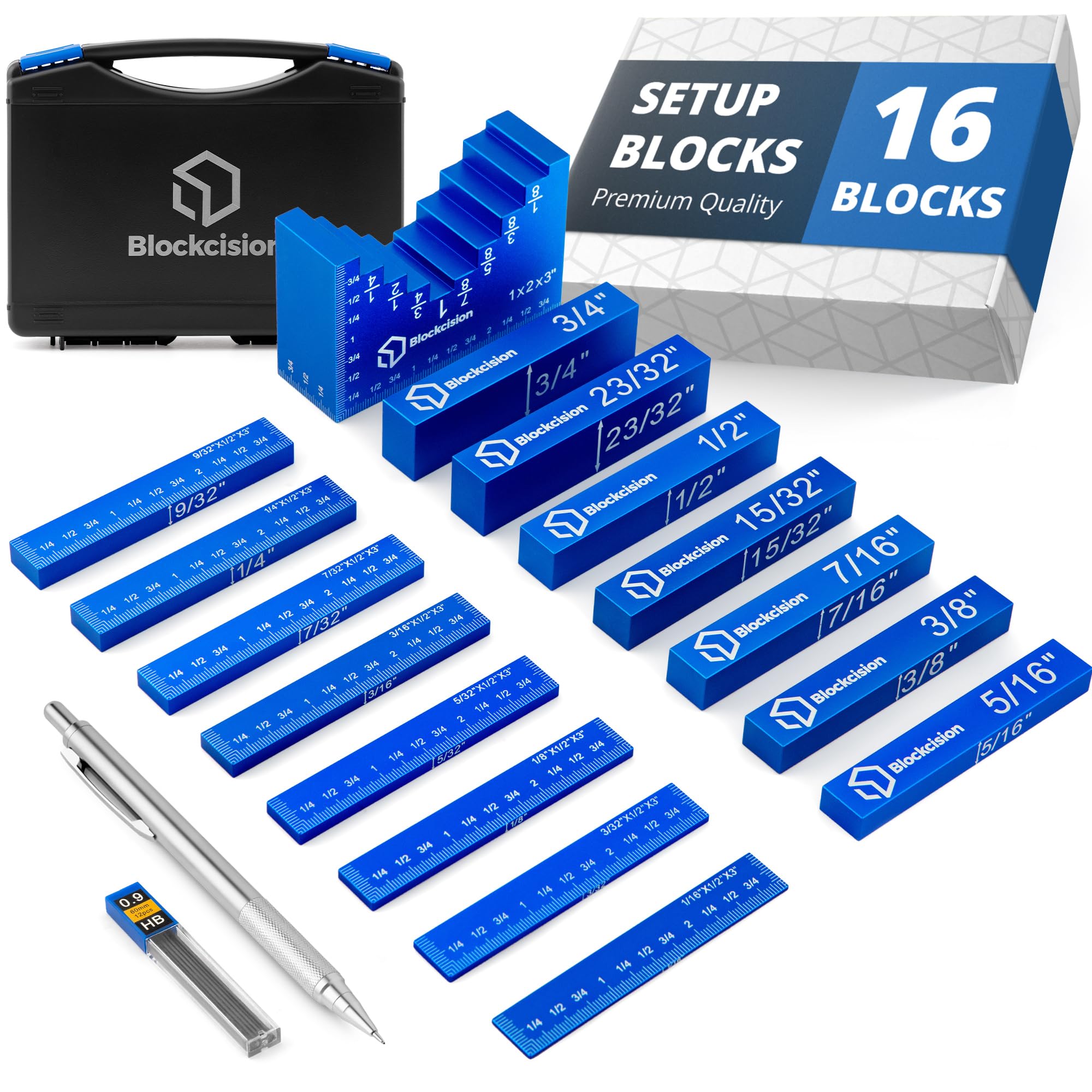
Sixteen marked aluminum bars that turn blade setup into a two-second stack instead of a measuring chore.
Here is the number that earns this set the top spot: each block is precise to ±0.001”, or one thousandth of an inch. That means when you stack blocks to set a table saw blade or a router bit, the height is a real number rather than an eyeballed guess. The set covers any measurement from 1/16” to 1” in 1/32” increments, so most routine cuts fall inside what the blocks can set directly.
What wins people over is the build — the aluminum alloy is dent-resistant and does not dull a cutting edge, and every bar carries laser-engraved markings that will not scratch off. The SpeedStep Multi Height Block adds a stepped profile so you can dial in a height quickly instead of hunting for the right combination. And unlike most setup block sets, every one of the sixteen bars here is ruler-marked, not just the 123 blocks, so you can take a measurement on the fly without reaching for a rule.
This set earns its spot as the crowd favorite on this list at 4.5+ stars across 800+ ratings. The catch is expectations, not quality: a dedicated block set is a specialty purchase. If you make the same two cuts every week, a single pair of blocks may cover you and leave most of this kit in the case. For anyone running a router table or table saw with changing setups, though, having the full spread ready in the included polypropylene case is the reason it earns the recommendation.
Where the Blockcision Pulls Ahead
- Every one of the 16 bars is ruler-marked, so on-the-fly measurement does not require a separate rule
- ±0.001” tolerance covers blade, bit and fence setup on a router table or table saw
- Laser-engraved markings survive regular shop use where printed scales fade
- Ships with a sturdy case and a mechanical pen, so the whole set stays together
What To Know Before You Buy
- A specialty purchase — if you only ever set two heights, most of the set stays in the case
- Aluminum blocks are dent-resistant, not indestructible; heavy drops still demand care
Set it and cut: the right buy if you change blade and bit heights often and want repeatable setups without a rule.
Think twice if: your work is one fixed depth and a single pair of blocks would do everything you need.
2. WEN 10-Inch T-Shaped Marking Ruler (ME810R)
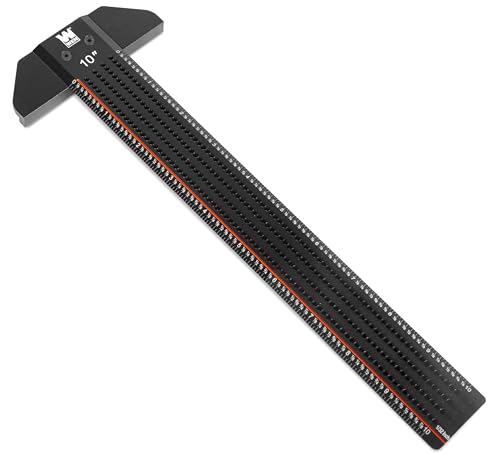
A T-head that hugs the board edge and drops a pencil through a hole exactly where you want it.
If your marking error comes from a ruler that slides while you draw, this is the fix. The T-shaped head sits flush against the edge of your workpiece and stays square as you slide it, so the line you draw is parallel to the edge you are referencing. Precision marking holes spaced every 1/32 inch let you drop a pencil point straight through instead of trying to hold a rule steady and mark at the same time.
It is CNC-machined from anodized aluminum and weighs 6.4 ounces, which is light enough to keep in an apron pocket but heavy enough to feel solid in the hand. The high-contrast scale is laser-etched, so it will not fade with handling the way a printed face does. Quality is the dimension that carries it — 30 owners single it out, with accuracy close behind.
Where the T-ruler shows its limits, the review pages are honest about it: the hole quality and the overall functionality draw split opinions, and a few find the holes less crisp than they expected. Treat this as a marking aid rather than a precision instrument — for cabinet layout and shelf pin lines it is excellent; for machining-tolerance layout you want a hardened square. The T-shape itself gets specific praise for staying square when flush to an edge, which is the whole point of the design.
The marking holes are the draw: spaced every 1/32 inch, they let you place the point by position instead of by eye, so a row of shelf-pin marks lands in a straight line.
Fair warning on the holes: a handful of owners find them less precise than the rest of the tool, so check your first marks against a known square before you commit to a cut.
Worth grabbing if: you draw a lot of parallel lines and want the edge to do the squaring for you.
Pass it over if: you need machinist-grade hole placement for metal, not wood.
3. WEN 6-Inch Carpenter’s Square
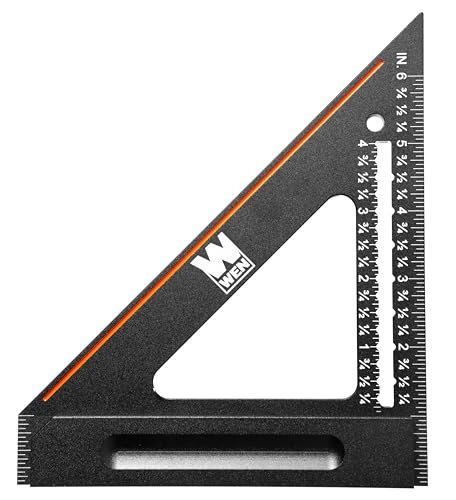
Small enough to live in a tool pouch, squared enough to check the corners you actually cut.
A 6-inch square earns its keep in a different place than a block set: this is the tool you grab to check a cabinet corner before glue-up, not to set a blade height. The aluminum frame resists rust, corrosion and warping, and laser-engraved 1/16-inch scales give you imperial markings that stay readable. Accuracy is the quality that carries it with owners — 36 of them single it out, with value for money right behind at 30.
The grooved base is the detail that makes it pleasant to use: it slides smoothly along the edge of your workpiece instead of catching, so you can walk the square down a long board and trust the line. At 6 inches long by 6 inches wide it is compact, which suits trim work and smaller stock better than sheet goods layout.
Two things to know before you choose it. The markings sit on one side of the blade only, so you cannot flip it and read from the other face — a real limitation if you work from both sides of a board. And the shape and size both draw split verdicts from owners, with one finding it not square over a longer span. For trim carpentry and quick right-angle checks it is a sound, budget-friendly pick; for holding a fine tolerance across a 12-inch run, step up to a longer rule.
Toolbox-sized for a reason: at 6 by 6 inches it handles trim and small stock without hogging space, and the grooved base rides an edge cleanly.
The one-sided scale is the trade: marks live on a single face, so plan your layout so you always read from the same side.
Reach for this if: your priority is a compact right-angle check you can carry and trust for trim work.
Look elsewhere if: you need a square that reads from both faces and holds a fine tolerance across a long board.
4. ARTYMASTER WT103B 8-inch 3D Multi-Angle Measuring Square

A rafter square and a triangle ruler fused into one body, so you can mark an angle without turning the stock.
What makes this the most versatile pick is that it measures in three dimensions. Scales cover length, width and vertical height, plus 0-90 degree angles, so a single tool handles layout that would otherwise take a square and a protractor. You can mark an angle or draw a horizontal line without rotating the square body — a small thing that saves real time when a board is already clamped down.
You get a measurement range from 1/16 inch up to 8.0 inches across an 8 by 7 inch body. Here is where it separates from the compact WEN 6-Inch: at 8″L x 7″W this square reaches across more material than that 6″L x 6″W frame, which is a meaningful gap when you are laying out on wider stock. The laser-engraved scales sit on a thickened aluminum alloy body, so they stay clear and stay put.
Owners talk about quality most — 53 of them flag it as the standout, with functionality next. The kit includes a professional carpenter pencil with a built-in sharpener plus 6 break-resistant 2.8mm refills and an Allen wrench. The honest limit: because it does so many jobs, it does none of them with machinist precision. The assembly is designed to come apart, so check it is seated square before you trust a long line. The anodized finish resists wear and corrosion, which matters in a humid shop.
Why This One Covers The Most Ground
- Reads length, width, height and 0-90° angles from one instrument
- 8 by 7 inch body gives more layout reach than a 6 by 6 inch square
- Pencil, built-in sharpener and 6 refills arrive in the box
Honest Limits
- Assembly comes apart for flexibility — square it up after reassembly
- Broad range does not equal machinist tolerance on fine layout
One tool, many jobs: pick it up if you want angle and length layout from a single square.
Keep looking if: you want the tightest tolerance on fine joinery and never need angle marking.
5. LEXIVON LX-DAF7 Digital Angle Finder Gauge

An oversized LCD that reads your blade tilt to a fraction of a degree, with a lock so it cannot drift.
Setting a 45-degree bevel by eye is the single most common source of joints that do not close. This finder removes the eye from the equation: the extra-large LCD screen reads to 0.05° resolution, and the whole tool is tested to an accuracy standard of ±0.3°. The 360° range with an Angle Lock knob lets you read inside, outside and reverse angles, so beveled trim and compound cuts are covered.
The interface is deliberately plain — four buttons: ZERO to recalibrate at any position, HOLD/FLIP to lock a reading, REV. to show the outside angle, and ON/OFF. That means four labeled buttons instead of a menu, so you spend your time setting the blade. Quality is the aspect that earns the highest share of owner praise here, with accuracy running a very close second, and the anodized aluminum rule with laser-etched millimeter and inch markings does double duty as a 7-inch straightedge.
Compared with the Klein 935DAF below, this one holds the looser published tolerance — ±0.3° versus ±0.2-Degree. Wait, read that the right way round: the Klein’s ±0.2° is the finer figure, so pick LEXIVON for the bigger screen and the lower angle resolution reading, and the Klein when you want the tighter tolerance. The gripe worth knowing is build feel — the body draws split opinions, so store it in the included zippered pouch rather than loose in a bag.
Screen-first design pays off: a large LCD with 0.05° resolution means you read the number, not squint at it, and the HOLD button freezes it while you adjust.
Sized honestly: the plastic-heavy body is the recurring note — the heavy-duty zippered pouch is there for a reason, so use it.
Pick this one for: the clearest readout on the list and a pouch that keeps it honest between jobs.
Not your tool if: you want the tightest published tolerance in the category over screen size.
6. Klein Tools 935CSEL Combination Square Ruler

A combination square built for a panel and a miter saw, with magnets that hold the rule where you set it.
Rare-Earth magnets in the head let you slide the 12-inch rustproof stainless rule and then lock it firmly to the body while you tighten. That makes setting a repeatable measurement on a miter saw faster, and it means the rule does not slip while you carry the square to the cut. The aluminum body has precision-machined 45 and 90-degree edges, so it sets both a square cut and a miter.
The differentiator is the electrical side: a double-sided rule gives 1/8-inch and 1/16-inch increments on one face, with an electrical panel schedule and a conduit layout template on the other. An integrated conduit layout template finds the center knockouts on EMT, and a stainless steel scriber marks any surface with a pinpoint. A large bubble vial window with a reinforced housing rounds out the checks.
Quality is the standout with owners, functionality a distant second, and the magnetic attachment draws a genuinely split verdict — some find the hold strong enough, others want more grip on a slick rule. Deeply etched markings stop the print rubbing off, which matters if the square lives in a tool bag. One honest catch: at 9.92 ounces this is not a featherweight in an apron pocket, so if you want a pocket square, the compact WEN up top is the lighter carry.
Built for two trades: a carpenter gets the 45 and 90-degree edges and a bubble vial, while an electrician gets the panel schedule and conduit template on the reverse face.
Magnet is the swing point: owners split on the hold strength, so test the lock before you trust it on a vertical cut.
Best for the trades: electricians and carpenters who want layout and knockout finding in one square.
Look past it if: you want a light pocket square rather than a 12-inch combination tool.
7. Klein Tools 935DAF Digital Angle Finder

The angle finder that does the miter math for you, then shows the number on a display you can read in low light.
Three jobs in one tool: it measures inside and outside angles, measures lengths, and calculates the miter saw cut angle. That last part is the reason to own it if you cut crown molding or any joint that meets at an angle other than 90 — you measure the wall, the tool tells you the blade setting. Machined ruler edges hold to +/- 0.2-Degree precision, which is the tightest published tolerance in this group and the reason it edges ahead of the LEXIVON above on accuracy alone.
A white LED display keeps the number legible in a dim shop or under a bench, and deeply etched markings on the metallic ruler hold up where printed scales wear. It runs on one included AAA alkaline battery, so it works the day it arrives. Quality is what owners praise most, accuracy close behind, and the feedback about blade leveling and angle checks lines up with what the tool is built to do.
The body combines ABS plastic with stainless steel, so it is a shop tool, not a drop-proof instrument. Value also divides opinion — some owners feel it earns its keep, others less so, which usually depends on how often you actually cut miters. If you cut miters weekly, the built-in miter calculation pays for itself in saved stock.
Where It Wins
- Calculates the miter saw blade angle, so angled joints do not need hand math
- +/- 0.2-Degree precision is the tightest published figure on this list
- White LED display stays readable in a poorly lit shop
Before You Commit
- ABS plastic in the body means it wants a padded spot in the toolbox, not a loose bag
- Value is the split point — worth it mainly if miter cuts are routine
The miter specialist: buy it if angled joints are part of your regular work and you want the saw math done.
Skip the upgrade if: your cuts are all 90 degrees and you rarely need an angle number.
8. Accusize 12” 4 Combination Square Ruler Set

Four hardened steel rules graduated down to 64ths for the layout work that tolerates no slop.
This is the fine-measurement end of the list. The 4R graduation covers 8ths, 16ths, 32nds and 64ths on a satin chrome blade, so you can read a hair of material and mark it cleanly. Satin chrome is the practical choice here — it kills the glare that makes a polished blade hard to read under a shop light, and the micro-fine graduations stay legible.
A fully hardened, tempered blade holds its accuracy for layout, height and depth checks, and the square head carries a level and a scriber point. The four-piece set covers setups, layouts and angle work, which is what makes it a set rather than a single rule. Construction is the strength that shows through — owners describe the setup as solid and extremely accurate, and for a 12-inch rule of premium steel it lives up to the machinist-and-fabricator brief the maker sets out.
The honest caveat is that quality and functionality split hard in the feedback: some find it excellent, others not at all. That spread usually points to expectations rather than a design flaw — this is a budget-friendly route into hardened-steel 4R layout, not a certified inspection-grade instrument. If you need a rule you can hand to an inspector, this is not that tool; if you want fine graduations for cabinet and furniture layout without a large outlay, it delivers.
Fine graduations, honest price: 64ths on satin chrome gives you detail reading most shop rules skip, and the hardened blade holds its edge of accuracy.
Manage the spread: opinions diverge sharply on this set, so check your rule against a known square the day it lands.
The fine-layout pick: for cabinet and furniture work where 32nds and 64ths matter.
Not the tool if: you need certified inspection-grade accuracy signed off for a machine shop.
9. Woodpeckers Edge Rule, Inch Set
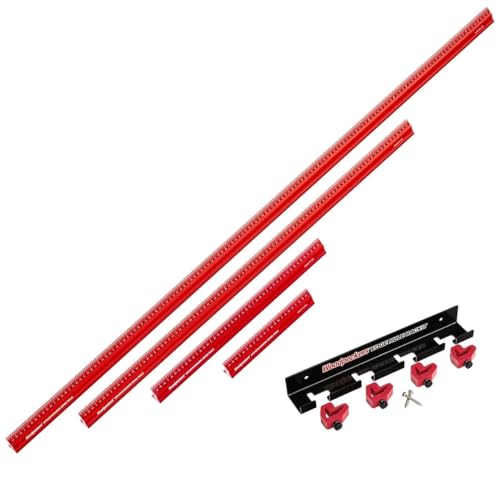
A premium rule that wraps the edge of the board, so you mark the face and the edge at the same dimension.
The defining feature is the wrap-around, dual-sided scale: a short side 3/8″ wide and a long side 3/4″ wide, so the rule folds over the edge of your stock and reads on both faces. That means one measurement marks both the edge and the face — no flipping the board, no second reference. The beveled edges are cut to eliminate parallax error, which is the visual gap you get when a thick rule sits above the surface and your eye reads the wrong line.
A profiled shape makes mid-field measurements possible, and an inside 89° angle accounts for slight deviations in your workpiece, which is how the tool stays accurate when the stock is not perfectly square. Graduations run to 0.03 inches. The set includes 4 rules, a Rack-It storage rack and 4 stops for repetitive marking, so you can lock a measurement and repeat it across multiple pieces. Like all Woodpeckers products it is machined and inspected in Strongsville, Ohio.
This is a premium pick and the honest note follows from that: the owner base here is small — 10+ ratings — so you are buying from trust in the US machining rather than a deep review history. Accuracy and quality both come through cleanly in what feedback exists. If you mark repetitive pieces and want one measurement to carry to the face and the edge, it earns its place; if you cut occasional one-off parts, a standard rule covers you.
The wrap is the whole idea: a 3/8″ short side and 3/4″ long side let one setting travel around the edge, and the beveled edges cut parallax.
Premium math: a specialized, USA-made set with stops and a rack — worth it if repetitive edge marking is a daily habit.
Best for repetitive marking: the pick for shop work where the same dimension travels across many pieces.
Skip the specialty if: your marking is one-off and a plain rule already does the job.
Know the Specs
Tolerance and Accuracy Rating
Tolerance is how far a tool can drift from dead-on. A setup block at ±0.001” holds a thousandth of an inch; a digital angle finder at ±0.2° or ±0.3° holds a fraction of a degree. Tighter tolerance means a more repeatable cut, but it also costs more. Match the number to the job — fine furniture wants the tight figure, and rough carpentry rarely needs it.
Graduation Spacing
Graduation is how finely a scale is divided. Common steps run 1/8-inch, 1/16-inch, 1/32-inch, and on finer rules down to 64ths. Finer graduations let you read and mark small amounts of material, but they demand a legible surface — satin chrome or a laser-etched face keeps fine lines readable under shop light and stops them rubbing off.
Common Questions
Will a setup block set work on both a table saw and a router table?
What angle tolerance do I actually need in a digital angle finder?
Can a digital angle finder replace a combination square for checking corners?
Is a T-shaped marking ruler better than a straight rule for cabinet work?
What does 4R graduation mean on a combination square?
Do the aluminum setup blocks dent or lose their accuracy over time?
What is parallax error and does a beveled edge fix it?
How do I keep a stainless combination rule from slipping while I mark?
Can I mark both the face and the edge of a board with one setting?
Does a battery-powered angle finder need calibration before first use?
The Bottom Line
Measured honestly, the woodworking measurement tools that earn a permanent spot are the ones that set a number you can repeat. The Blockcision setup block set is the pick for most benches — 16 ruler-marked aluminum bars, a ±0.001” tolerance, and a case to keep it all together, which is why it takes the top slot. If your error is corners rather than depths, the ARTYMASTER WT103B covers angle and length layout in one square. For saw tilt, the Klein 935DAF holds the tightest tolerance on the list at +/- 0.2-Degree and does the miter math for you. And for repetitive edge marking, the Woodpeckers Edge Rule wraps the stock so one setting marks the face and the edge.
How we choose
We do not accept paid placement. Every pick is matched to a real buyer and a real use-case; we do not hands-on test units.
Sources
Specifications: manufacturer listings and product documentation. Review insights: verified customer reviews, as of November 2026. Pricing: not shown on this page (it changes often); check the current price via the retailer link.
As an Amazon Associate, Tactical Gear Guy earns from qualifying purchases. This does not affect which products we feature.