Specs are compiled from manufacturer listings and verified buyer reviews and can change over time — please confirm the key details on the product page before buying.
You have probably done this: press a pencil against a board, drag it along a square, and watch the line wander because the lead rode up the edge. Or you scribe a knife line that disappears the moment the sawdust lands on it. A good marking tool does one thing — it puts a fine, unbroken line exactly where you planned the cut. That is what separates these nine tools from the squares already rattling in your drawer.
This guide is built by comparing the manufacturers’ published specifications and the patterns across verified customer reviews, so you get each pick’s real strengths and trade-offs instead of marketing spin.
A marking tool only earns its place if the tip stays sharp and the reference edge stays dead straight. Below are the blades, gauges and squares that working woodworkers keep reaching for instead of the ones that sit in the drawer. Everything you need to pick well is covered in this breakdown of the Best Woodworking Marking Tools.
Top Picks


How To Choose The Best Woodworking Marking Tools
Marking is the cheapest part of any build and the one that decides whether the joint closes tight or shows a gap. You do not need a cabinet full of tools. You need one line-maker you trust and one square you can set against an edge without checking it twice.
Knife line or pencil line
A knife severs the wood fibres so your saw or chisel has a physical wall to drop into — that is the whole point of a marking knife. A pencil lays graphite on top of the surface, which is fine for rough framing and fast layout but blurs once you are working to a 1/32 inch line. Most joinery work wants a knife. Most carpentry wants a pencil. The serious shops carry both.
What blade steel really changes
Harder steel holds a keener edge longer, and softer steel sharpens faster when it dulls. Look for a stated hardness or a named alloy on the listing — a figure like HRC 57 tells you the maker actually hardened the blade rather than stamping it from sheet. A double-bevel blade works pulled toward you with either hand. A single-bevel blade is ground for one hand only, which matters if you are left-handed.
Squares, gauges and what they are for
A square transfers a 90° reference from one edge to another. A marking gauge sets a fixed distance from a face and repeats it down a board, which is why the beam carries graduations — you dial the number once and strike the same line along every piece in the run. If you cut dovetails, a gauge with a fine adjustment lets you sneak up on the baseline instead of hunting for it.
Side-by-Side Comparison
Every row below is comparable on the same three dimensions: the tool type, the material that carries the reference edge or blade, and the size you actually work with.
| Model | Best For | Tool Type | Material | Working Size | Amazon |
|---|---|---|---|---|---|
| DFM Small Square and Center Finder★ Best Overall | Small-part layout and center finding | Square + center finder | Aluminum | 2.63″L x 1.63″W | Amazon |
| Narex Dual Bevel Marking Knife KitBlade-First Pick | Two-handed scribing on joinery | Unhandled marking knife | AISI 420 stainless, HRC 57 | 5-7/8″ blade length | Amazon |
| YOSELIN Dovetail Jig & Wheel Gauge SetBest Starter Set | Starting out with dovetails | Dovetail marker + wheel gauge | Aluminum alloy, brass, stainless | 8-inch beam | Amazon |
| Clarke Brothers Marking Knife | Long sessions with a shaped handle | Double-edged marking knife | High carbon steel, Padauk handle | 5.5 cm blade | Amazon |
| SHALL Rafter & Combination Square Set | Framing layout plus combo-square work | Rafter square + combo square | Aluminum alloy, zinc alloy, stainless | 7″ rafter, 16″ combo | Amazon |
| KAKURI Kiridashi Knife 18mm | Right-handed fine scribing and whittling | Japanese kiridashi knife | Laminated high carbon steel and iron | 18 mm blade width | Amazon |
| Taytools Brass Head Wheel Gauge | Everyday gauge on a budget-minded build | Wheel marking gauge | Solid machined brass head, steel beam | 8-inch beam | Amazon |
| Taytools Micro Adjust Wheel Gauge | Fine baseline setting on dovetails | Wheel gauge, micro adjust | Solid brass head, steel beam | 7-inch beam | Amazon |
| Woodpeckers inDexable Square System | Repeatable layout across many parts | Combination square with indexing | Stainless steel | 0-6 inches | Amazon |
Detailed Reviews
1. Mini Square 11/32″ Center Marking Hole
Our pick — 4.5+★ from 900+ verified ratings; the strongest balance of quality and price.
The pocket square that also finds dead center on a dowel — and wins on the strength of its machining.
Fitting a knob, a dowel or a small bracket starts with knowing where the middle is, and that is the job this little aluminum square was built around. A center marking hole sized at 0.34 inches takes a larger pencil, so you drop it through the hole and trace the true center instead of eyeballing it. The same body gives you a graduated 1/32 inch scale for ordinary square work, so one tool covers two steps at the bench.
What wins people over is the machining. The fit and finish of the aluminum is the thing that gets talked about most, and it shows in how the tool sits flat and reads clean on small parts. At 2.63 inches long and 1.63 inches wide it lives in an apron pocket and comes out for every small layout job, which is exactly the size that gets used instead of the big framing square buried at the back of the bench. Two centerfinding pins ship with it.
Be honest about what it is not: a 2.63-inch reference is a small-part tool, so laying out a full cabinet side belongs with a longer square — see the Woodpeckers further down for that. The narrow format is the trade-off you accept for the pocketability. At 4.5+ stars across 900+ ratings, it is an easy buy for anyone who marks small stock more than once a week.
What earns it first place
- Machined aluminum body reads clean and sits flat on small parts
- 0.34″ center hole takes a larger pencil for legible center marks
- Graduated to 1/32 inch so it doubles as a fine square
- Pocket-sized at 2.63″ x 1.63″ — it actually gets used
- Made in the USA, with two centerfinding pins included
Where it stops
- 2.63-inch reach is too short for cabinet-scale layout
- You need a longer reference square alongside it
Most useful pick: anyone marking dowels, knobs, small brackets or short offcuts who wants square and center in one pocket tool.
Think twice if: your marking happens on full sheets and long boards, where a 2.63-inch reference runs out of reach.
2. Narex Dual Bevel Marking Knife Kit
A blade blank with finger indents — you shape the handle, and you get a knife that fits your grip exactly.
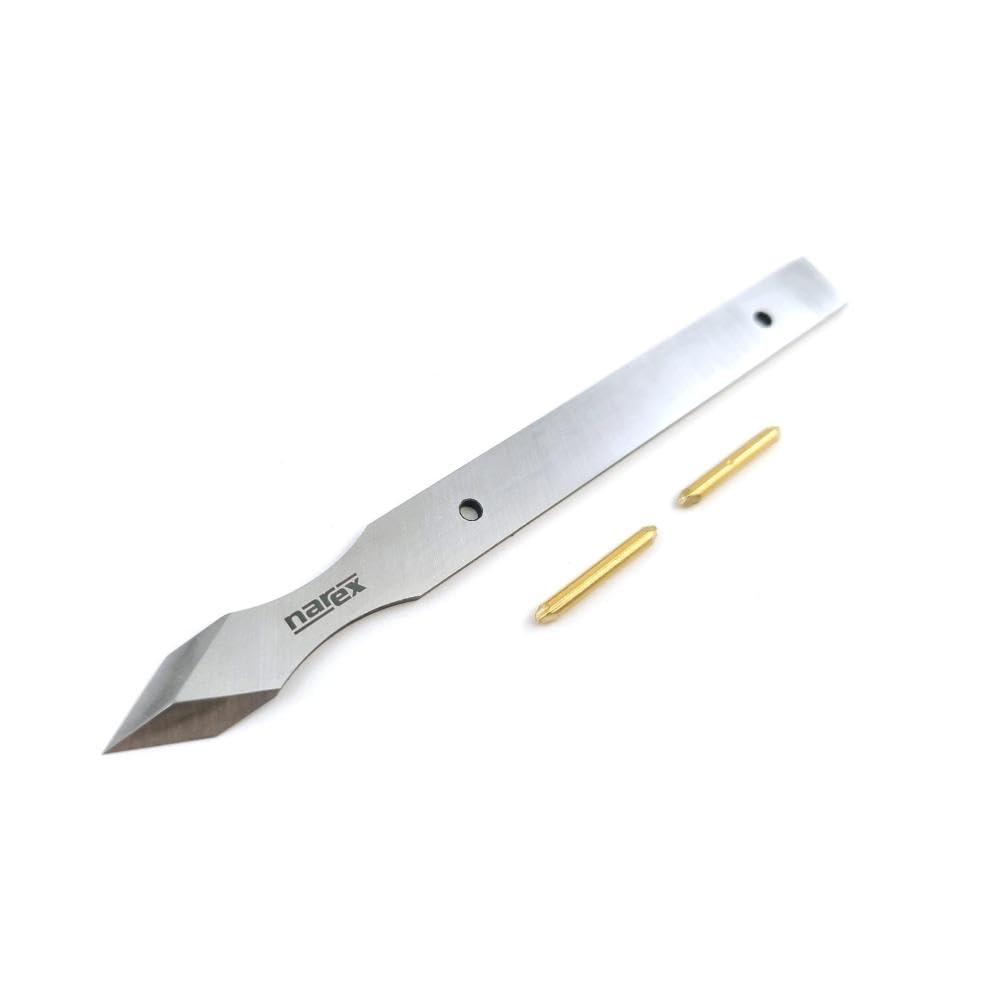
This is the pick for someone who has already decided that a knife line is how they mark joinery. The blade is AISI 420 stainless steel hardened to HRC 57 — that hardness figure is the number that matters, because it means the maker actually heat-treated the steel rather than stamping it out of sheet. The dual bevel grinds on both faces so you can pull it toward you with either hand without turning it around.
Two things stand out in how it gets described by the people using it: the blade itself and the edge it holds. You get a 5-7/8 inch blade at 1/2 inch wide with finger indents cut into the tang, which are there so your fingers register the same grip every pull and the knife does not rotate as you press. The dual-sided design is what gets singled out in use, letting you work an inside corner from either direction.
The catch is right in the name: unhandled. There is no wood on it, so you are turning or buying a handle and fitting the blank yourself. If you want a knife that arrives ready to cut, the Clarke Brothers below comes with a shaped Padauk handle already on. If you enjoy making the tool as much as using it, this blank is the better starting point.
The material story: AISI 420 stainless hardened to HRC 57 is a corrosion-resistant alloy with real hardness behind the edge, so it resists staining as well as dulling.
Plan for the handle: The unhandled format is the one thing to know going in — budget the time or buy a handle to fit.
Reach for this if: you want a hardened dual-bevel blade and you are happy to fit your own handle around it.
Look elsewhere if: you want to open the box and start scribing the same afternoon.
3. YOSELIN Dovetail Marking Jig and Wheel Marking Gauge
One box that hands you the whole dovetail layout — marker, gauge, cutter for each wood type, and a pencil.
Marking a dovetail by eye is where most first attempts fall apart. This set hands you a dovetail marker for the slope plus an 8-inch wheel marking gauge on a precision ground steel rod, and it ships with two cutters — one wheel cutter aimed at hardwood, one bearing wheel cutter for soft wood. That pairing matters because a cutter tuned for hard maple behaves differently in pine, and swapping the wheel is faster than fighting the wrong one.
The beam carries a scale in both 1 mm and 1/25 inch for quick setup, and a knurled knob lets you adjust the setting before the head slides along the workpiece edge. The body is CNC-machined from a solid aluminum billet and anodized, so it stays light in the hand across a long run of joints. A pencil, pencil holder, an M6 hand-tightening screw and a protective case round out the kit.
Sold build quality is what carries this one — it is the aspect that dominates how it is regarded, and the value for the contents follows close behind. One honest note: a wheel gauge rewards a little practice before the lines come out clean, so give yourself a few test joints on scrap. It will not hand you perfect dovetails on the first board, but it gives you every tool you need to get there.
What is in the case: Dovetail marker, wheel marking gauge, screwdriver, pencil, pencil holder, M6 thumbscrew and a protective case — a complete layout kit rather than one tool.
One skill note: The wheel cutters need a few practice joints on scrap before the lines come out crisp.
The right kit for: a woodworker starting dovetails who wants marker, gauge and both cutters in a single purchase.
Hold off if: you already own a dovetail marker and only need the gauge — the set bundles both.
4. Clarke Brothers Marking Knife with Real Leather Sheath

The knife that arrives sharp and stays comfortable through an afternoon of joint-fitting.
Where the Narex above hands you a blank, this one hands you a finished tool. A double-edged high carbon steel blade lets you pull with either hand for a better grip and more control, and the maker names cherry and ash among the hardwoods it will score without complaint. The handle is Padauk with the brand worked into it, shaped so your hand sits the same way every time you pick it up.
The practical case for it is edge retention in hardwood. A carbon steel blade that holds its edge means less time at the stones, and this one arrives sharp enough to scribe cherry and ash straight from the start. It comes with a real leather sheath, which is the difference between a knife that lives safely in a drawer and one that gets tossed loose into a tool bag.
Two honest notes on the mixed side. Blade durability draws a split reaction, and the sheath gets a mixed read as well — treat the leather as a cover, not a hard case, and keep the blade clean and dry between sessions. At 5.5 cm on the blade with a 16 cm overall length, this is a compact scribing knife, not a heavy chopper. For joint layout in hardwood it is exactly the right size.
Why it earns a slot
- High carbon steel double-edged blade works pulled with either hand
- Arrives sharp and ready to scribe hardwood joints
- Shaped Padauk handle keeps a consistent grip
- Real leather sheath keeps the edge protected in a drawer or bag
- 5.5 cm blade length suits precise joinery layout
Read before you buy
- Blade durability gets a mixed reaction — keep the edge clean and dry
- The leather sheath is a cover rather than a rigid case
Pick it for: the woodworker who wants a finished, comfortable knife in hand on day one and a sheath to store it in.
Skip the upgrade urge if: you are left-handed and need a single-bevel blade — this one is ground on both faces.
5. SHALL Rafter Square and Combination Square Tool Set

A framing square and a combo square in one box, with a 16-inch rule that reads in three graduations.
If your marking spans roof pitches and cabinet cases, this set covers both ends of the job. The 7-inch rafter square is heavy-duty aluminum alloy and marks Common, Hip, Valley and Jack rafters — it folds in the features of a framing square, try square, miter square, line scriber and protractor square. The companion combination square is zinc alloy with a 16-inch stainless steel rule graduated at 1/16 inch, 1/32 inch and 1 mm, and it carries three heads: square, protractor and center finder.
The details that make it usable daily are the deep scribe slots, which hold different-sized pencils when you are striking a line, and the broader lipped fence that braces the square flush against the wood for a straighter edge. Markings are laser-etched for high contrast, and the rule’s scale is etched rather than printed so it does not rub away. It makes a good case for itself as the one square that handles both framing and finish layout, which is why versatility shows up alongside quality in how it is regarded.
Be straight about the split on this one. Accuracy and readability both draw a mixed reaction, and the base of the square is the part to check on arrival — a few units have been reported warped, which is a delivery and quality-control issue rather than a design flaw. Inspect the base for flatness the day it lands. For a combo-and-rafter set that covers this much ground, it still earns its place.
What you are buying: A 7-inch aluminum rafter square plus a 16-inch zinc combo square with square, protractor and center finder heads, two carpenter pencils and a scriber.
Check on arrival: Lay the base on a flat reference — a warped base is the known weak point.
Best matched to: contractors and DIYers who need one kit covering both roof layout and cabinet-scale squaring.
Consider another option if: you need guaranteed flatness from the start and can justify a single premium square instead.
6. KAKURI Kiridashi Knife 18mm, Right-Handed
A hand-forged Japanese blade with a hollow-ground back — the one that shaves leather and scores a visible line.
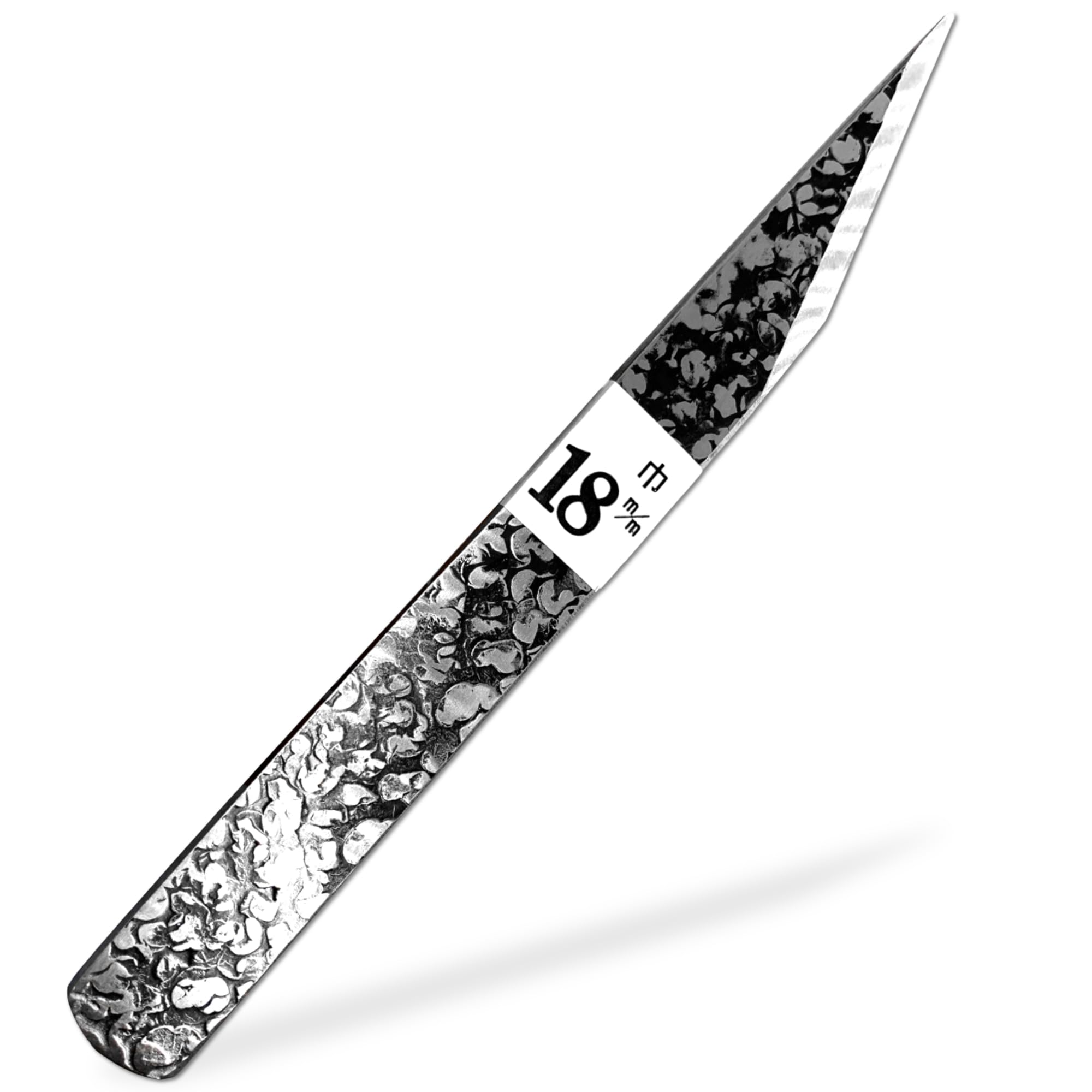
Sharpness is the whole point of this knife, and the laminated hard-steel edge is what delivers it. The blade is a laminated construction — hard Japanese high carbon steel welded to soft iron — so you get a keen, long-wearing edge that still sharpens easily because the soft iron backs it up. A hollow-ground back improves flatness and precision, which means the blade sits flatter against your reference surface and the line lands where you aim it.
The format is traditional and the details show it. Each knife is hand-hammered individually, leaving a tsuchime pattern, so every tool carries a slightly different surface from the one your neighbor gets. The blade and handle are one piece of steel, which means no loose parts and nothing to work loose over time. At 18 mm blade width on a 7.3-inch tool weighing 3.52 ounces, it handles scribing, whittling and marking without feeling like a heavy chisel in the hand.
Two cautions worth knowing. The bevel is single and ground for a right hand, so it is not the fit for left-handed work. And durability draws a mixed response, with the tip reported as the vulnerable point — this is a fine-tipped marking knife, not a pry bar, so treat the point as the delicate end it is. Stroke the folded edge across leather to see the geometry at its best, then keep the tip out of anything it could snap on.
What makes it distinct
- Laminated hard steel and soft iron for a keen edge that sharpens easily
- Hollow-ground back improves flatness and precision
- Hand-hammered tsuchime finish makes each knife individual
- One-piece steel construction, no loose parts
- 18 mm blade width, 3.52 oz — fine control in hand
The fine print
- Single bevel ground for a right hand only
- The fine tip is the weak point — keep it clear of leverage
This is your knife if: you are right-handed and want the sharpest laminated blade on the list for scribing and whittling.
Better to pass if: you work left-handed or you need a blade you can lean on at the tip.
7. Taytools Wheel Marking Gauge with Solid Machined Brass Head

Real solid brass at the head, a hardened 8-inch beam, and three cutters in the box.
Mass is what you notice first. The head is precision machined from solid brass — not plated — and at 6 ounces the whole gauge sits with a settled weight in your hand, which is what keeps the beam tracking steady along an edge instead of skipping. The knurled thumb screw is brass too and locks the head to the beam so your measurement stays put while your hand moves.
The cutter is a 7/16 inch hardened high-speed wheel that leaves a distinct line in both soft and hard wood, with and across the grain, and two extra cutters ship alongside the fitted one. The beam is hardened steel at.310 inch diameter and 8 inches long, giving a full 7-inch maximum cutting depth, and it carries both mm and SAE graduations out to 150 mm or 6 inches so you can set the number straight off the scale. There is a countersink in the head so the cutter retracts fully when parked.
Here is the practical upside: a wheel cutter resharpens by rubbing the flat face on any sharpening medium, so you are not buying fresh wheels every season. The one thing this gauge will not do is micro-adjust — for that step up to the Taytools micro adjust gauge below. If you want a solid brass head at a fair price with cutters to spare, this is the one.
Honest weight: At 6 ounces the solid brass head gives the gauge real mass, and the weight draws a positive reaction for exactly that reason — it steadies the cut.
Setting it: The beam reads in mm and SAE to 150 mm or 6 inches, but the head sets by thumbscrew rather than micro adjustment.
Right for you if: you want a brass-headed wheel gauge with three cutters and a full 7-inch cutting depth without paying premium-tier money.
Not for you if: your joinery work demands a micro-adjustable head for fine baselines.
8. Taytools Solid Brass Wheel Marking Gauge

The gauge you set by a hair, not by a guess — for baselines that have to land exactly.
This is the step-up gauge for anyone who has ever over-shot a dovetail baseline and had to plane the joint back to fit. The head is solid brass at 1.625 inch diameter with a micro adjust lockable mechanism, so you dial the setting in small increments and lock it before cutting. The 7-inch hardened steel beam is grooved to stop the head rotating during adjustment, which keeps the cutter square to the face while you fine-tune.
Cutting side, the hardened 3/8 inch round cutter slices cleanly across the grain, and two extra cutters ship in the box so a dull wheel does not stop your session. The cutter retracts into a countersink in the head when it is not earning its keep — a small thing that saves a knuckle and protects the wheel. Build quality and functionality are what carry this gauge in use, with the solid construction being the thing most noted, and the micro adjustment being the reason people upgrade to it from a plain thumbscrew gauge.
The honest split is stability. Some users report the head slips during use, and the adjustment threads read as coarser than expected — so lock the head firmly and give it a turn past snug. It also weighs 8.8 ounces, the heaviest gauge here, so it suits bench work rather than apron carry. Set it hard, and the fine adjustment is the reason to pick it over the brass value gauge above.
Why upgrade: The 1.625-inch brass micro adjust head and grooved 7-inch beam let you set a baseline in fine increments and keep the head from rotating while you do it.
Lock it well: The head needs a firm lock — slipping during use is the known trade-off.
For the joint-fitter: dovetail and joinery work where the baseline has to land within a hair, with a lockable brass micro adjust head.
Not the travel pick: at 8.8 ounces it belongs on the bench, not in an apron pocket.
9. Woodpeckers inDexable Square System 6 Inch

An indexing head that clicks the same setting every time — for when you mark the same joint on a dozen parts.
The feature that separates this square from every other one here is the indexing system. The stainless steel rule has a sliding head that locks at 1-inch intervals, so once you find the position you want you can return to it exactly on the next part instead of measuring again. Laser-cut scribing guides sit right on 1/16 inch centers, and the graduations are laser-engraved into the steel so they do not rub off or wear through — on a tool you handle daily, that is the difference between a rule that lasts and one that goes blank.
The combo head cuts 45° and 90° angles, turning it into a normal square and a miter square in the same tool, and a sliding tab gives edge support so the square stays against your work and tucks out of the way when you do not need it. The rule covers 0-6 inches. It arrives with a Rack-It wall-mountable holder, and the whole thing is made in the USA.
Where it sits in the lineup is clear against the DFM at the top: this one carries a full 6-inch rule and a combo head rather than a 2.63-inch pocket reference, so it handles the larger layout the DFM cannot reach. The trade-off is the price and the following — quality is what stands out about it, while the cost splits opinion. If you mark the same joint across a run of parts and want repeatable indexing, this earns its keep. If you mark a few joints a month, the mid-range squares do the same job for less.
The repeatability case: 1-inch indexing on a stainless rule with laser-engraved graduations means the same setting returns on every part, and the scale never wears off.
Cost check: The premium tier is real here — value for money divides opinion, so buy it for the indexing and the USA build, not the entry price.
Built for: shop work where the same joint repeats across many parts and you want the position to return exactly each time.
Overkill for: occasional marking where a mid-range combo square covers the same 6 inches of reach.
Know the Specs
Blade Steel and Hardness
A blade’s alloy and hardness decide how long it stays sharp and how easily it comes back. A figure like HRC 57 on the Narex tells you the steel was hardened to a set point on the Rockwell scale — harder steel holds an edge longer, softer steel sharpens faster. Stainless alloys resist corrosion; high carbon steel takes a keener edge but wants cleaning after use. Laminated blades, like the KAKURI’s hard steel backed by soft iron, pair a hard cutting edge with a body that sharpens readily.
Beam Graduations and Cutting Depth
A marking gauge’s beam is the ruler that sets your distance from the reference face. Graduations in both mm and SAE let you work in whichever system your plans use, and the maximum cutting depth is how far from the head the cutter can reach. The Taytools brass value gauge reaches a full 7 inches on an 8-inch beam, while the micro adjust gauge runs a 7-inch beam. A longer beam reaches deeper into a board; a shorter one carries easier.
Bevel Type and Hand Orientation
A double bevel grinds both faces of the blade, so the knife pulls toward you in either hand — the Narex and Clarke Brothers both work this way. A single bevel grinds one face only, which is sharper in use but hands-specific, which is why the KAKURI’s single-bevel blade is ground for a right hand. If you are left-handed, check the bevel before you buy.
Square Heads and Indexing
A plain square head sets a 90° reference only. A combo head adds 45°, turning one tool into a square and a miter square. An indexing system goes further, locking the sliding head at fixed intervals on the rule so the same setting returns every time — the feature that defines the Woodpeckers. More heads and indexing add cost and complexity, so match the head count to the joints you actually cut.
Common Questions
Is a marking knife better than a pencil for cutting joinery?
Can a left-handed woodworker use the KAKURI kiridashi?
What does the center marking hole on the DFM small square do?
Do I need both the Taytools brass gauge and the micro adjust version?
How long does a wheel marking gauge cutter last before it needs sharpening?
What is the difference between a combo square and an indexing square?
Why does the SHALL set have two separate squares?
Will the Narex marking knife fit a standard handle blank?
Should I check anything on a new square before using it?
Do I need a dovetail marker and a wheel gauge, or will one do?
The Bottom Line
The woodworking marking tools winner is the DFM Small Square and Center Finder because it does two jobs in a pocket-sized aluminum body that holds its machining — square layout to 1/32 inch and center finding through a 0.34 inch hole. It carries 4.5+ stars across 900+ ratings, and its 2.63-inch size is what keeps it in your apron rather than the drawer. If you are cutting dovetails, reach for the YOSELIN set — the marker, gauge and both cutters give you a complete layout kit. And for knife work, the Clarke Brothers marking knife arrives sharp with a Padauk handle and a leather sheath, ready to scribe hardwood joints the day it lands.
How we choose
We do not accept paid placement. Every pick is matched to a real buyer and a real use-case; we do not hands-on test units.
Sources
Specifications: manufacturer listings and product documentation. Review insights: verified customer reviews, as of July 2026. Pricing: not shown on this page (it changes often); check the current price via the retailer link.
As an Amazon Associate, Tactical Gear Guy earns from qualifying purchases. This does not affect which products we feature.