Specs are compiled from manufacturer listings and verified buyer reviews and can change over time — please confirm the key details on the product page before buying.
A marking gauge has one job: score a line exactly where you decided, then repeat it on the next board without drifting. A wheel gauge does that with a small hardened disc that slices fibers instead of tearing them, so your line stays visible and your saw follows it. The picks below were sorted by how well each one holds a setting, how it feels in one hand, and how the scale reads under shop light. The Clarke Brothers kit earns the top spot on repeatable accuracy plus two spare cutters in the box.
This guide is built by comparing the manufacturers’ published specifications and the patterns across verified customer reviews, so you get each pick’s real strengths and trade-offs instead of marketing spin.
You will see where a knurled lock nut beats a hand-tightened screw, what a retractable cutter buys you in storage, and which beam lengths actually cover wide joinery. By the end you will know which woodworking marking gauge fits your bench, your grip, and the woods you cut most.
Top Picks


How To Choose The Best Woodworking Marking Gauge
A marking gauge is a bar with a fence that rides the edge of your board and a cutter that scores a parallel line at a set distance. The whole tool is only as good as two things: how firmly the head locks to the beam, and how cleanly the cutter slices. Everything else is comfort.
Locking: the one thing that decides repeatability
A knurled lock nut — a thumb nut with a textured grip you twist by hand — clamps the head so your setting survives a dozen boards. A plain hand-tightened screw can creep under pressure, which is why drifting settings show up as your most common complaint in gauge reviews. Brass knobs and nuts resist galling and stay smooth after years of twisting. If you cut the same joint repeatedly, prioritize the lock over the scale.
Wheel cutter versus pin or knife
A wheel cutter is a small hardened disc that rolls along the wood and severs fibers, leaving a crisp line that holds pencil or knife marks. It works with and across the grain, which a pin gauge struggles with because the pin follows the grain instead of your intent. Hardened high-speed steel holds an edge longer than mild steel, and a retractable wheel tucks into a countersink in the head so it does not get nicked in a drawer. Wheels can be resharpened by rubbing the flat face on a stone, and several gauges here ship with spare cutters.
Beam length, scale, and reach
An 8-inch beam covers most cabinet and joinery layout; a 7-inch beam is fine for dovetails and smaller work. Graduations in both inch and metric save you conversion math, and a 1 mm or 1/32 inch increment is fine enough for furniture tolerances. Laser-engraved scales stay readable longer than printed ones. Check the maximum marking width if you build wide panels — the KAKURI reaches 90 mm, while the wheel gauges rely on beam length.
Side-by-Side Comparison
| Model | Best For | Beam / Length | Head Material | Spare Cutters | Amazon |
|---|---|---|---|---|---|
| Clarke Brothers Wheel Marking Gauge★ Best Overall | All-round layout with spares included | 8 in, 6 in / 150 mm scale | Brass, steel, aluminum | 2 included | Amazon |
| KAKURI Wood Marking GaugeTraditional Choice | Japanese-style scribing in softwoods | 90 mm max width | Natural bamboo | — | Amazon |
| Rockler Wheel Marking GaugeCabinet Maker’s Pick | Cabinet and joinery layout | — | Solid brass | — | Amazon |
| iGaging Wheel Marking Gauge | Fast measurement transfers | 8 in rod, 1 mm / 1/32 in scale | Solid brass | — | Amazon |
| Shop Fox D2822 | Budget entry into wheel gauges | 8 in total length | Brass shoe | — | Amazon |
| YOSELIN Dovetail Jig Set | Beginners learning dovetails | 8 in rod, 1 mm / 1/64 in scale | Brass, aluminum, stainless | — | Amazon |
| Taytools 465494 | Heavy brass head with fine control | 8 in, up to 7 in range | Solid brass | Available separately | Amazon |
| Taytools 464763 | Micro-adjust layout work | 7 in, 5/16 in beam | Solid brass | 2 included | Amazon |
| Woodriver Wheel Marking Gauge | Shop-centerpiece build quality | 7 in | Brass and stainless with bubinga | — | Amazon |
Detailed Reviews
1. Clarke Brothers Wheel Marking Gauge
Our pick — 4.5+★ from 3,000+ verified ratings; the strongest balance of quality and price.
A wheel gauge kit with two spare cutters, so a dull wheel never stops your layout.
What wins people over here is the build — the solid brass, steel and aluminum body takes the most praise of anything on this gauge, and it shows in the hand as a balanced, non-marring tool. The patent-pending roll stop fence has a flat spot machined into it, and that flat spot is what keeps the fence registered against your board edge instead of rolling off it. You get a full 8 inches of graduated bar with marks in both inch and metric up to 6″/150 mm, laser-engraved so they stay legible after years of shop dust and thumbing.
One-handed use is the other reason this tops the list. The knurled grip (a textured, ridged surface that bites your fingers) is ambidextrous, so left- and right-handed cutting both feel natural, and the balance point sits close to the head so it does not fight your wrist during long layout sessions. You can mark mortise and tenon and dovetail joinery without clamping the work first. The graduated bar also doubles as a quick reference when you need a fast measurement transfer between boards, which is the kind of accuracy that matters more in daily work than any single printed number.
The honest catch is that a wheel gauge like this is a dedicated layout tool — it scores lines and reads depths, and it does not replace a marking knife for fine paring work. It is also a hobbyist-and-professional crossover, so the price lands in the mid-range rather than entry. The two extra hardened steel cutters offset that by putting off the day you buy replacements, and the retracting cutter and brass face protect the edge between sessions. It holds its line from soft pine to dense exotics like African blackwood.
Where It Wins
- Roll stop fence with a flat spot keeps the head registered on the board edge
- Two spare hardened steel wheel cutters included, so you can swap a dull wheel immediately
- 8-inch bar with laser-engraved inch and metric graduation to 6″/150 mm
- Ambidextrous knurled grip and balanced body for comfortable one-handed marking
- Corrosion-resistant brass, steel and aluminum construction with a non-marring face
Worth Knowing First
- It scores and reads lines only — a marking knife is still the tool for fine paring
- Mid-range tier rather than entry-level for a hand layout tool
Built for: anyone laying out dovetails, tenons and panel lines who wants spare cutters in the box from day one.
Think twice if: you only need a depth reading once a season and want the simplest possible tool.
2. KAKURI Wood Marking Gauge 3.5″ Japanese KEBIKI
A bamboo-body kebiki that pulls a fine line the old Japanese way.
This is a SUJI KEBIKI — a Japanese marking gauge that sets a width and scores a parallel line from the board edge. You set the width by eye or with a rule, then turn the screws by hand to lock the sliding jig. Move the tool along the edge and the Japanese carbon steel blade draws a straight line at that fixed distance. The scale is metric, the body is natural bamboo, and it is light at 3.1 oz, so it barely loads your hand over a long session.
The blade tucks back into the wooden body when you are done, which matters in a shop where loose edges get chipped. Maximum width is 90 mm. The screw closure holds the setting once you tighten it, and the cylindrical bamboo grip is comfortable in a pinch grip. Reviewers praise the sharp blade that cuts well with and against the grain — the reason a Japanese blade earns its keep is that a clean sever leaves a line your chisel can register against.
Where it gets mixed feedback is on consistency: the quality of the body and the ease of use earn steady praise, but accuracy and marking performance draw split opinions, so treat this as a tool that rewards technique rather than compensating for it. Set it carefully and re-check the width before each critical cut. It also reflects the wood-first philosophy — no brass, no graduated inch scale — so if you want a numeric readout on the bar, a wheel gauge serves you better. For traditional Japanese layout work, the bamboo body and carbon steel blade earn it a place.
Traditional pull: the bamboo body and carbon steel blade give this the feel of a hand tool passed down, and a 90 mm max width covers most rail and stile work.
Reach for this: if you cut Japanese joinery or want a light kebiki that stores safely with its blade retracted.
Look elsewhere: if you want a graduated scale printed on the beam and a lock nut you can flick with a thumb.
3. Rockler Wheel Marking Gauge
A brass-bodied scriber that makes quick work of marking cabinet boards.
The body is precision-machined from solid brass, and that mass is why it feels steady when the cutting wheel meets a tricky grain patch. A knurled lock nut clamps the setting so it holds while you travel the fence. The scale reads in both millimetres and imperial units. At 6.88 ounces it is heavier than the bamboo KAKURI 3.1 oz body, which is the trade you make for a metal tool that will not dent in a toolbox.
What owners point to most is the overall quality and the ease of marking boards — this is a cabinet maker’s gauge that turns layout into a quick, repeatable motion. The wheel glides across the surface, and the retractable steel wheel stays protected in its recess when the tool is idle, preserving sharpness between sessions. Skilled users get repeatable marks across and with the grain, which is the difference between a layout you trust and one you second-guess.
Be realistic about the edge: the cutting wheel draws mixed notes on sharpness, and adjustability sits in the middle too, so treat this as a solid daily-use gauge rather than a razor. If you want the keenest possible line on hard exotics, budget time to hone the wheel flat on a stone. For most cabinet and joinery layout, the solid brass body is what carries this gauge.
On the bench: the solid brass body and knurled lock nut give you a setting that holds, and the 1 mm graduation range covers fine joinery tolerances.
Fair caveat: wheel sharpness is the soft spot — it will mark, but a few owners want a keener edge for dense hardwoods.
The fit: cabinet and joinery work where you want a brass gauge that you can lock, set, and forget until the next board.
Not the fit: precision layout on the hardest exotics where you expect a factory-fresh razor wheel from the start.
4. iGaging Wheel Marking Gauge
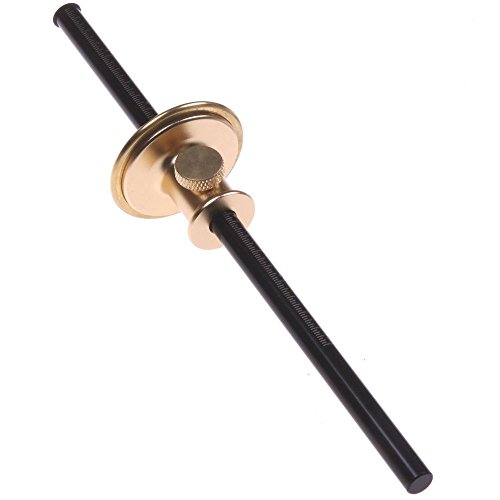
Weighs 4.96 ounces — lighter in the pocket than the Shop Fox by a clear margin.
Here is the number that matters: this gauge weighs 4.96 ounces against the Shop Fox D2822 at 7.04 ounces. That is the verified comparison, and it matters because a marking gauge gets carried, sleeve-parked and held one-handed. The iGaging keeps a solid-brass head and a knurled lock nut, so it does not feel flimsy despite its low weight.
The 8-inch steel rod is graduated in 1 mm and 1/32 inch increments, and the shaft can also serve as a depth gauge — a second use that saves you a separate measurement tool when setting blade height or checking a mortise. Transfer measurements between boards quickly; the wheel marks with and across the grain, and the brass head gives a crisp, repeatable line.
Where it slips is stability: while the lock nut holds, the screw that secures the wheel can loosen over time, and there are reports of the wheel breaking with hard use. That is a maintenance note rather than a deal-breaker — check the wheel screw tightness before each project and keep a spare on hand if you swing it hard. At 4.96 ounces and its price, it is the value pick for fine 1/32 inch graduations without a heavy tool.
What Earns Its Keep
- Lighter than the Shop Fox at 4.96 ounces vs 7.04 ounces
- 8-inch steel rod graduated in 1 mm and 1/32 inch increments
- Solid brass body with a knurled lock nut for a secure setting
- Doubles as a depth gauge for quick measurement transfers
Where It Needs Care
- The screw holding the wheel can loosen with use — check it before each project
- Some wheels break under heavy pressure; go lighter on the downforce
Who it suits: a woodworker who wants fine graduations and a light carry tool without moving up the price tiers.
The trade: you give up a little ruggedness for the weight savings, so gentle wheel pressure and routine screw checks keep this gauge alive.
5. Shop Fox D2822 Wheel Marking Gauge

An 8-inch brass shoe gauge that works well for dovetail layout on a tight budget.
The Shop Fox D2822 gives you a precision-ground brass shoe and a knurled brass knob on an 8-inch body. It functions — dovetail layout is precisely what it gets used for, and the brass face glides over the board edge. The problem is what happens afterward: the value for money splits cleanly, with roughly equal numbers of owners calling it a bargain and a waste, and the stability and blade-holding mechanism draw the most flak, with the wheel drifting under use and screws stripping over time.
Unlike the iGaging above, this one is the heavier tool at 7.04 ounces, but the extra mass has not translated into the grip that matters — the lock and the wheel retention. The good news is that it is the least expensive entry into a wheel gauge, so it is a fair first gauge for a woodworker who is still learning to mark dovetails and has not settled on a layout method.
If you buy it, treat it as a learning tool: check the blade seating before each use, and back the screws gently rather than cranking them down. It will score a decent line on a backer rail or drawer side. It is simply the tool to upgrade from once you trust your layout enough to want a gauge that holds a setting without fiddling.
The budget reality: a precision-ground brass shoe and knurled knob at the lowest tier — ideal for beginners marking a first dovetail.
Watch for: the wheel drifts and the screws need a light touch, so recheck the setting before critical cuts.
Right for: a first marking gauge for a hobbyist learning dovetail layout on a shoestring.
skip it if: you have already learned your layout and need a gauge that holds a setting without checking it twice.
6. YOSELIN Dovetail Jig Wheel Marking Gauge Set

A dovetail jig and wheel gauge in one box, with a pencil holder for beginners.
Two wheel cutters is the point here: one bearing wheel cutter for softwood, one locked wheel cutter for hardwood. Swap based on the wood on the bench and the cut follows suit. The body is machined from solid aluminium billet and anodized, which keeps it light and resistant to shop moisture. An 8-inch precision-ground steel rod carries a 1 mm / 1/64 inch scale and works as a depth gauge too.
What sets this apart from the other wheel gauges is the kit content. There is a dovetail marker for laying out the slope, plus a screwdriver, a pencil, a pencil holder and an M6 hand-tightening screw, all in a protective case. The included accessories mean a beginner can go from opening the box to marking a dovetail joint without a separate shopping trip. The build quality is what buyers praise most, and the value for money ranks close behind — the case and accessories are part of why.
The honest limit is depth: this is the tool for someone starting out on dovetails who wants the jig, the marker and the pencils in one place. If you only need a bare wheel gauge for general cabinet layout, you are paying for accessories you may not touch. For dovetail-focused work, the included marker removes the guesswork from the slope in one package.
Kit thinking: one bearing cutter for softwood, one locked cutter for hardwood, plus a dovetail marker, pencil, pencil holder, M6 thumbscrew and case.
The limit: the accessory bundle suits dovetail learners, not woodworkers who just want a bare gauge for cabinet layout.
Choose this: to start dovetail joinery with the slope marker and marking tool already matched.
Pass on it: if you already own a dovetail jig and only want another wheel gauge in the drawer.
7. Taytools 465494 Wheel Marking Gauge

The measurement spec carries this one: ±0.001 inch accuracy on a 6-ounce brass body.
The head is machined from solid brass — not plated — at 1-9/16 inch diameter and 1-3/16 inch tall, with a knurled solid brass thumb screw that locks the head to the hardened.310 inch diameter beam. The stated accuracy is ±0.001 inches, which is furniture-grade tolerance and keeps your tenon cheek lines consistent panel after panel. Range runs up to 7 inches, and the whole tool measures 8 inches overall.
The cutter is a 7/16 inch hardened high-speed steel wheel that leaves a distinct line in both softwood and hardwood, with and across the grain. When it dulls, you can resharpen it by rubbing the flat face on any sharpening medium, and replacement cutters are available. A countersink in the head lets the cutter retract fully into the brass for safe storage. At 6 ounces the mass is deliberate: the head sits in the hand and steadies the roll.
The trade-off is reach versus the 8-inch kit gauges — 7 inches of range is plenty for dovetails and rail-and-stile, but a wide panel line may run tight. It also trades the graduated bar of the Clarke Brothers for a solid beam with no printed scale, so you set distance with a separate rule. For layout where a thousandth matters, that is a fair swap.
Where It Pays Off
- Stated accuracy of ±0.001 inches for furniture-grade layout
- Solid brass head with knurled solid brass thumb screw
- Hardened high-speed steel 7/16 inch wheel, resharpenable and replaceable
- Countersink lets the cutter retract fully into the brass head
- Range up to 7 inches on a hardened.310 inch diameter beam
Before You Commit
- No graduated markings on the beam — you set distance with a rule
- Range tops out at 7 inches, tighter than the 8-inch kit gauges
Made for: furniture layout where you need a setting you can trust to the thousandth.
Consider the Clarke Brothers instead: if a printed inch and metric scale on the bar matters more to you than the tolerance figure.
8. Taytools 464763 Brass Wheel Marking Gauge

A micro-adjust head on a grooved beam, plus two spare cutters in the box.
The head here measures 1.625 inches in diameter and is machined from solid brass with a micro-adjust lockable mechanism and a knurled adjustment knob and tail. The beam is 7 inches long at 5/16 inch diameter, hardened steel, and it is grooved — that groove keeps the head from rotating while you dial in a setting, which is the kind of detail that prevents a skewed fence. The hardened 3/8 inch round cutter slices across the grain, and the cutter retracts into a countersink in the head for safe storage.
This is the pick for a woodworker who wants to nudge a setting by a hair without disturbing the fence. Owners praise the value and functionality, and the build, sturdiness, and micro-adjust mechanism draw consistent positive notes. The adjustment threads are not as fine as every user expects, so dial with patience. Two extra cutters ship with it, so a dull edge does not stop the job.
The one flag to weigh: stability divides opinion, with some reporting it slips under pressure. The grooved beam helps, but the honest guidance is to seat the lock fully before you commit to a critical line. For micro-adjust joinery where you need to creep up on a dimension, this belongs on the bench; if you want a set-and-leave tool for long panel runs, the Clarke Brothers is steadier.
The micro-adjust angle: a 1.625 inch solid brass lockable head with a knurled knob and tail lets you creep up on a setting without breaking the fence reference.
Grip note: seat the lock firmly — the gauge can shift if you rely on light torque alone.
Best when: you need to fine-tune a setting by small degrees and want two spare cutters on hand.
Look at the Taytools 465494 first: if a simple, rock-solid lock with a printed accuracy spec matters more than micro-dialing.
9. Woodriver Wheel Marking Gauge

The one with heft and bubinga wood accents — a gauge that feels made to be kept.
The Woodriver measures 7 inches and builds its body from solid brass and stainless steel, with bubinga wood accents added for grip and easy handling. Heft is what owners talk about most: at 10.4 ounces it is the heaviest gauge in this group, and that mass sits in the hand and steadies the roll. The blade retracts into the fence for safe storage, so the edge is protected when the tool is not cutting.
For precise scribes, the tool delivers — it slices cleanly through both soft and hard woods, and the weight keeps the wheel tracking where you aim it. The stainless steel and brass construction resists moisture in an unheated shop, and the bubinga scales give a warm, secure hold. This is a premium-tier gauge for someone who wants a tool that looks as good as it works.
The real question is whether the premium tier earns it for your work. The Clarke Brothers kit ships two spare cutters and a graduated bar for less, and the Taytools 465494 states a ±0.001 inch accuracy figure. The Woodriver has neither a printed scale nor included spares — what it has is mass, materials, and a blade that retracts into the fence. If you value feel and finish over extras, this is the one that sits on your bench and gets picked up every session.
The materials argument: solid brass and stainless steel with bubinga accents, 7 inches long, and a blade that retracts into the fence.
What you give up: no spare cutters and no graduated bar, so this is the premium choice for feel over extras.
The right buyer: a woodworker who wants a heavier, materials-forward gauge and will pay for heft and finish.
The alternative: if you want spare cutters and a printed scale in the box, the Clarke Brothers serves that need better.
Know the Specs
Beam Length and Range
The beam is the bar the head slides along, and its length sets how far from the board edge you can mark. A 7-inch beam covers dovetails, mortise and tenon, and most cabinet joinery. An 8-inch beam gives extra reach for wider panels and drawer sides. If you build large casework, plan your layout around the reach you actually need.
Scale Graduations
The scale tells you the distance the head sits from the fence. Common increments are 1 mm, 1/32 inch, and 1/64 inch, with some gauges reading both metric and imperial. Finer increments help when you set a tenon cheek by measurement instead of by rule. Laser-engraved marks tend to hold up better than printed ones under daily shop handling.
Head Material and Lock
The head carries the cutter and rides the board edge. Solid brass heads resist galling, hold weight in the hand, and keep a smooth face against the wood. A knurled lock nut — a textured thumb nut you twist — clamps the setting far more reliably than a plain screw. If your layout demands repeated identical lines, the lock and the head material matter more than the scale printing.
Cutter Type and Storage
A wheel cutter is a hardened disc that severs fibers and leaves a crisp line with or against the grain. Hardened high-speed steel holds an edge longer than mild steel. A retractable wheel tucks into a countersink in the head, protecting the edge between sessions. Wheels can usually be resharpened by rubbing the flat face on a stone, and some kits ship with spare cutters.
Common Questions
Will a wheel marking gauge work on hardwood like oak and maple?
Should I buy a pin gauge or a wheel marking gauge?
How do I stop the head from slipping during a cut?
What is the difference between measuring in 1 mm and 1/32 inch increments?
Can I use a marking gauge as a depth gauge?
How long does the wheel cutter last before it needs replacing?
Is a heavier marking gauge easier to use?
Do I need a 7-inch or an 8-inch marking gauge for dovetails?
How should I store a marking gauge to keep the cutter sharp?
Can a marking gauge replace a marking knife?
The Bottom Line
For most woodworkers, the woodworking marking gauge winner is the Clarke Brothers Wheel Marking Gauge because it pairs a graduated 8-inch bar with a roll stop fence and two spare cutters — the setting holds and a dull wheel does not stop you. If you want micro-adjust control, grab the Taytools 464763 and dial in by feel. And for dovetail beginners, the YOSELIN Dovetail Jig Set puts the marker and the gauge in one case.
How we choose
We do not accept paid placement. Every pick is matched to a real buyer and a real use-case; we do not hands-on test units.
Sources
Specifications: manufacturer listings and product documentation. Review insights: verified customer reviews, as of November 2026. Pricing: not shown on this page (it changes often); check the current price via the retailer link.
As an Amazon Associate, Tactical Gear Guy earns from qualifying purchases. This does not affect which products we feature.