Specs are compiled from manufacturer listings and verified buyer reviews and can change over time — please confirm the key details on the product page before buying.
Every crooked cabinet, gappy joint, and wandering table saw fence starts the same way — with a layout mark you trusted that wasn’t true. Layout tools are the only gear in your shop that has to be perfect before any other tool does its job. This guide cuts past the marketing and lines up nine tools that actually hold their accuracy, from a tiny center-finding square to a machinist-grade double square.
This guide is built by comparing the manufacturers’ published specifications and the patterns across verified customer reviews, so you get each pick’s real strengths and trade-offs instead of marketing spin.
You’ll see where a 1/16-inch scale beats a 1/8-inch one, why a wheel gauge cuts wood fibers instead of tearing them, and which squares are worth reaching for first. Whether you are framing a shed or fitting a dovetail, this breakdown of the best woodworking layout tools shows you where the real accuracy lives.
Top Picks


How To Choose The Best Woodworking Layout Tools
The square or gauge you draw a line with sets the accuracy of every cut that follows. A square that is out by a hair over 8 inches is out by far more over a full cabinet side. So the questions that matter are simple: how fine is the scale, how stable is the body, and does the shape fit the job in front of you.
Scale graduation is the first filter
Graduation is the size of the smallest marked step on the rule. A 1/16-inch scale gives you markings at each sixteenth of an inch. A 1/64-inch scale splits the inch far finer, so you can read a measurement to a much smaller step. For rough framing a 1/8-inch scale is fine. For joinery, finer graduation means fewer guess-and-split marks.
One-piece versus assembled bodies
A square milled from a single block of aluminum or steel holds its true corner better than one bolted together from a separate ruler and handle. Look at how the tool is built, not just its size. A solid body also resists the knocks and drops that come with daily shop use.
Match the shape to the task
A small square fits inside drawers and small boxes. A rafter square handles roof pitch and angle settings. A marking gauge runs a line parallel to an edge. A center finder locates the middle of a round or square blank. Buy for the layouts you actually do: framing, joinery, or center-finding on small stock.
Side-by-Side Comparison
| Model | Best For | Graduation | Material | Key Size | Amazon |
|---|---|---|---|---|---|
| DFM Small Square & Center Finder★ Best Overall | Small projects & center marking | 1/32 in | Aluminum | 2.63″L x 1.63″W | Amazon |
| Preciva Carpenter Square SetBest Value Set | General carpentry & rafter work | 1/16 in | Aluminum | 12 in and 7 in | Amazon |
| iGaging Wheel Marking GaugeBest for Fine Lines | Fine parallel lines | 1/32 in & 1 mm | Brass & Steel | 6″ shaft | Amazon |
| Trend Point-2-Point | Evenly spaced hole layouts | — | Stainless Steel | 3.3 in to 28 in | Amazon |
| Taytools Brass Wheel Gauge | Precision joinery marking | — | Brass & Steel | 7″ beam | Amazon |
| Britton Square 7″ | Angles & roof framing | 7 in | Aluminum | 10″ heel | Amazon |
| iGaging Bench Square Set | Machine setup & joinery layout | 1/16 in | Stainless Steel | 4 in and 7 in | Amazon |
| Woodpeckers 8″ Square | Cabinet & machine setup | 1/16 in | Aluminum | 8 in | Amazon |
| Starrett Double Square | Machinist-grade layout | 1/64 in | Alloy Steel | 6″ blade | Amazon |
Detailed Reviews
1. DFM Small Square and Center Finder
Our pick — 4.5+★ from 900+ verified ratings; the strongest balance of quality and price.
Two tools in one tiny aluminum body, and owners keep coming back to the same word: machined.
If your layouts live inside small boxes, drawers, and narrow stock, this is the square that fits where a full-size one won’t. The body measures 2.63 inches long by 1.63 inches wide, so it slips into tight corners other squares can’t reach. The scale reads down to 1/32 inch — one step finer than a standard 1/16-inch rule, so you can split a sixteenth without eyeballing it.
The center finder is the part that changes how you work. A 0.34-inch hole in the tool is sized for larger pencils, so you can locate the true center of a blank and mark it in one motion. Drop the included centerfinding pins (quantity two) in and transferring hole centers onto a matched part becomes a two-second job. For anyone laying out dowel joints or lamp blanks by eye before, this alone is worth it.
What wins people over is the machining. The aluminum body comes across as well-finished and dead-square, and the size and portability earn almost as much attention as the build. Because it’s a small tool, don’t expect to lay out a full sheet of plywood with it. And the marking hole is built for fatter pencils, so a fine mechanical pencil won’t center as cleanly. Think of it as the precision instrument for small work, not a replacement for a full-size framing square.
Where it pulls ahead
- Two functions in one: a small square and a center finder
- 1/32-inch scale for splitting marks finer than a 1/16 rule
- Compact 2.63″ x 1.63″ footprint reaches into tight corners
- Made in the USA with an aluminum body
Where it stops short
- Small size limits it to lighter, smaller projects
- Center hole is sized for larger pencils, not fine lead
Reach for it when: you need a true square and quick center marks on small stock, drawers, and boxes — the crowd favorite sits at 4.5+ stars across 900+ ratings.
Pass on it if: your layouts are full sheet goods and you need long-scale readings.
2. Preciva Carpenter Square Set
Two aluminum squares that cover the wall and the workbench, one with a finer scale than the other.
This set is the honest two-tool kit most carpenters end up building themselves anyway. You get a 12-inch square (12x12x17 inches on a 1/16-inch scale) and a 7-inch rafter square (7x7x10 inches on a 1/8-inch scale). That’s a much broader spread than the compact DFM above — this pair lives on full studs and rafters, while the DFM handles small boxes.
Preciva laser-calibrates the scales and uses aluminum alloy for a scratch-resistant body. Readability earns real praise — buyers find the markings easy to pick out without squinting. The 1/16-inch rafter scale is the detail that separates this from a plain square, because it reads finer than the 1/8-inch scale on most standard carpenter squares. That extra step matters when you’re pulling a cut line or setting a saw height.
One square in this set does measuring, tracing, angle marking, and drilling positioning, which is a lot of jobs for a two-piece kit. The catch is that a 12-inch square is big for tight work — that’s exactly where the small square in the reviews earns its place. And an aluminum body is light and tough, but aluminum bends where steel won’t, so treat the corners kindly.
Two-tool spread: a fine 1/16-inch 12-inch square plus a 1/8-inch 7-inch rafter square covers framing and fine layout in one set, and buyers report the markings read clean and the tool stays accurate.
The gap to know: the 7-inch unit is a coarser 1/8-inch scale, so the fine readings come from the larger square.
Buy it for: a first serious square set that reads fine and covers the wall.
Think twice if: you mostly work in tight, small stock where the 12-inch unit won’t fit.
3. iGaging Wheel Marking Gauge
A spinning wheel that slices wood fibers clean instead of tearing a ragged pencil groove.
A pencil line fuzzes and widens, so it drifts off the mark. A marking gauge runs a line exactly parallel to an edge, and a wheel gauge does it without tearing. The hardened wheel on this one spins free and cuts the fibers instead of bruising them, so your line stays crisp right where you need the chisel. The brass head sits on a 6-inch steel shaft graduated in both 1/32-inch and 1-millimeter steps, and the body is precision-machined solid brass with a knurled lock nut.
What buyers notice is the micro-adjust. Turning the fine adjustment lets you creep the cutter up on a line instead of hunting for it in quarter turns. The double-locking arrangement holds a setting once it’s dialed in. It also works as a depth gauge for quick transfers, which explains why owners treat it as more than one-job tool.
The honest trade-off: a brass wheel gauge is a hand-fitted instrument, and the mortise-and-tenon crowd will tell you a clean single line still beats a fine cut when you’re scribing around a corner. It ships as a two-piece set, so keep the components together. Where it shines is repetitive layout — twenty identical drawer sides marked with the same offset line.
Earned praise
- Free-spinning wheel cuts fibers rather than tearing them
- Micro-adjust knob dials in fine offsets
- Dual graduation in 1/32 inch and 1 mm
- Doubles as a depth gauge
Fair cautions
- A wheel score line needs a clean chisel pass to seat
- Brass and steel body deserves careful handling
Made for: anyone cutting dozens of identical joint lines who wants them dead even.
skip it if: you wanted a simple pencil-and-rule gauge and don’t need a wheel cut.
4. Trend Point-2-Point Equidistant Measuring Tool

For the job no square can do: marking evenly spaced holes across a board in one pass.
This is the layout tool you grab when “just eyeball it” stops working. The Point-2-Point spreads across the width or length of any board from 3.3 inches to 28 inches and marks multiple equally spaced points in one pass. Dowel holes, biscuit slots, shelf pins, drawer pulls — anything that has to be even gets dialed in fast. It’s a compact stainless steel and metal build at 4.8 ounces, so it disappears into an apron pocket.
What it nails is speed and the count of jobs it covers. Versatility earns steady praise from owners, and multi-hole layouts are where it does the most work. You set the spread, lock it, and walk it down the board.
The catch — and this is the one to weigh — is that accuracy is mixed. Some owners find it spot-on, others say it’s not super-accurate. The locking mechanism and the spacing are both contested too, so a loose setting is the real risk. Treat it as a fast layout helper for spacing that tolerates a little slop, not a precision gauge. For critical dowel centers, check the marks before you drill.
Takes the tedium out: the 3.3-inch-to-28-inch range marks multiple even points in one setting, which is what makes the build quality and functionality earn their praise.
It’s your pick if: evenly spaced shelf pins and dowel holes are a weekly job and you want the layout done in one pass.
Look elsewhere if: every mark has to be dead-nuts exact — this is a helper, not a precision instrument.
5. Taytools Brass Wheel Marking Gauge

An 8.8-ounce brass head with a knurled micro-adjust knob and two spare cutters in the box.
At 8.8 ounces this is the weightier of the two wheel gauges here — compare that to the 4.8-ounce Trend spacer, and the Taytools clearly trades portability for that planted, solid feeling. The 1.625-inch-diameter brass head has a knurled knob and tail for micro adjustment, and a hardened 3/8-inch round cutter that slices clean across the grain. The 7-inch hardened steel beam is grooved so the head can’t rotate while you set it, which is the detail that keeps your line straight.
Three cutters come with it — one in the head plus two spares — and the cutter retracts into a countersink in the head to protect the edge when it’s stowed. That’s the kind of thinking that keeps a gauge sharp for years. Owners consistently call this out as a solid, well-made tool that does the job.
Here’s the honest part. The micro-adjustment is a point of contention — some find the adjustment threads aren’t as fine as they’d like — and stability is the recurring gripe. The head can slip on the beam under pressure, so clamp down the lock and check before each stroke. It’s a value story, not a surgical instrument. For most joinery, though, it marks a clean line and feels great in the hand.
What you feel first: that 8.8-ounce brass head and grooved beam give it a planted, solid feel, and the value for the money is the part owners bring up most.
Where it wobbles: the head can slip if the lock isn’t snug, and the adjustment threads are coarser than some expect.
Suits you if: you want a brass-bodied wheel gauge with spare cutters and a solid feel without paying machinist prices.
Not for you if: you need hair-fine, repeatable micro adjustments at every pass.
6. Britton Square 7″ Rafter Square
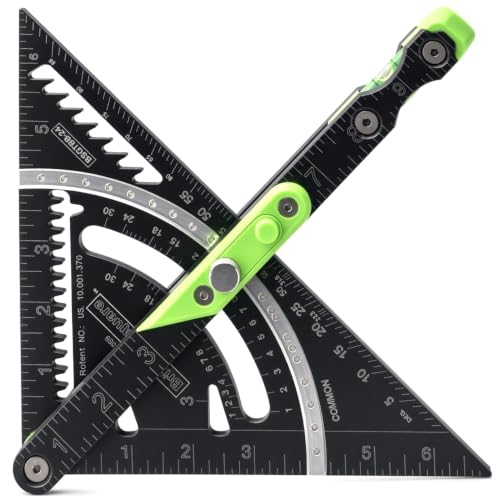
A rafter square with a locking arm and three vials, built for angles rather than just square.
Most squares give you 90 degrees and nothing else. This one adds a pivoting arm with a machined track and 21 indexed angle presets, so you can lock an angle and hold it while you mark. A 10-inch heel and two level vials plus a bullseye plumbing vial let you set and read plumb at the same time. For roof pitch, stair angles, and fencing runs, that’s a different class of layout than a plain 90-degree rule.
The build earns the praise — thick aluminum and stainless steel, and owners describe it as a well-made addition that’s handy around the shop. Plenty buy it to set up their saw and their roof cuts in the same morning. It also locks into its home position as a standard square, so there’s no learning curve when you don’t need an angle.
The honest heads-up: two things divide opinion. Some owners find the angle workflow easy, others say it’s overcomplicated. And the value question follows — this costs real money for a 7-inch square, so it earns its keep only if angle work is what you actually do. If your layouts are all 90 degrees, a plain 7-inch square will do the same job.
Why angle chasers like it
- Locking pivot arm with 21 indexed angle presets
- Two level vials plus a bullseye plumbing vial
- Thick aluminum and stainless steel build
- Functions as a standard square in the locked home position
What to weigh
- Angle workflow is overcomplicated for some owners
- Premium price for a 7-inch tool — worth it only for real angle work
Worth it for: roofers, framers, and anyone setting pitches and stair angles who wants the angle locked and held.
Overkill if: every layout you do is square and a plain rafter square already covers it.
7. iGaging Bench Square Set
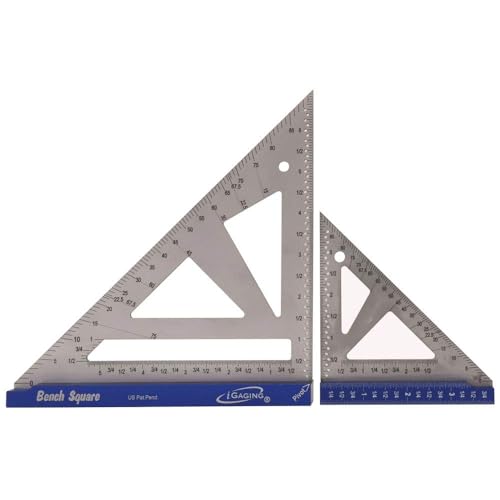
Two stainless bench squares with angle markings built in, from try square to protractor.
This is the square set that lives next to the router and the table saw, not on a jobsite. You get a 4-inch and a 7-inch bench square with stainless steel blades set into blue anodized CNC aluminum bases. The bases are laser-engraved, and the blades are offset at 1/4-inch/5 mm and 3/8-inch/8 mm with 1/32-inch/1 mm graduations to let you work to the edge of a board. A pivot point on the other side turns either square into a protractor.
The engraved markings are the deep feature here. You get 0-to-90-degree markings in 1-degree steps, plus 22.5 and 67.5 degrees, and the center cutouts carry 15, 22.5, 30, 45, 60, 67.5, and 75-degree angle markings. The stainless straight edge is drilled every 1/8 inch, so scribing a line and finding a pivot happen in the same motion. It ships in a fitted case with room for the included mechanical pencil and lead refills.
Owners rate the overall quality highly, and the value-per-square comes up almost as often. The one honest note: squareness earns mixed marks, so check true on the day it arrives and trust the setup after that. It’s built for shop use and machine setup rather than swinging around a jobsite.
The trick it hides: those 1-degree markings and the 15°, 22.5°, 30°, 45°, 60°, 67.5°, and 75° cutouts turn a try square into an angle finder without a second tool.
Pick it if: you set router fences and table saw blades and want angle markings built into the square.
Steer clear if: you need a rugged jobsite square that shrugs off drops.
8. Woodpeckers 8″ Precision Square

A single block of aluminum machined to hold square to within a thousandth of an inch.
This is where square means square to within 0.001 inch. The 8-inch square is accurate to within 0.001 inch along its full length, which is the kind of tolerance you expect in a machine shop, not a woodworking bench. It’s milled from a solid piece of cast aluminum tool plate in one piece, then finished in high-RPM passes on CNC equipment. Two precision-machined cheeks joined by stainless steel dowel pins keep the handle rigid — no separate ruler and handle parts to drift out of alignment.
The details are what cabinet makers feel. A shoulder on the inside edge lets the square lay flat so you can mark off either edge of the rule. The thick base stands the rule upright on its own, so checking a table saw blade or jointer fence for square is hands-free. A milled notch at the inside corner lets you zero your layout line all the way to the edge of the workpiece. Scales are laser-etched in 1/16-inch increments on both sides, and a Rack-It wall mount comes in the box.
It’s a serious tool with a matching price, and it’s USA-made. What it asks in return is care — an aluminum square this precise is an instrument, so keep it out of the drop drawer. Those who buy it treat it as the reference square that checks the rest of their squares.
The tolerance that matters: 0.001-inch accuracy along the whole 8-inch length is what separates this from every assembled square on this list — the DFM and Preciva are honest workhorses, but neither claims that number.
Reach for this if: your squares are your reference tools and you want one that reads true to a thousandth of an inch.
Not the pick if: you want a beat-around square and don’t need sub-thousandth tolerance.
9. Starrett Steel Double Square

The 1/64-inch scale and sliding steel blade that toolmakers reach for first.
The Starrett Double Square comes from a company that has machined steel squares since 1880. The 6-inch hardened steel blade slides in the handle and locks where you need it, so you can set it to any depth and read a clean line against the work. The 4R graduation reads quick in 8ths, 16ths, 32nds, and 64ths — far finer than the 1/16-inch scales most woodworking squares give you. That’s four steps of scale in one rule.
The steel body carries a satin chrome finish that resists wear, rough handling, and shock, and the 90-degree angle between blade and handle holds dead accurate. Owners describe it as an genuinely useful tool that is built to last. Smooth operation gets a consistent nod — the blade slides and fastens cleanly, so a setting stays found.
The trade-off to weigh honestly is price and value perception. This is a machinist’s tool sold at a machinist’s premium, and a few owners say it carries sharp edges when it arrives, so run a finger carefully before you trust it. If you make furniture and only need 1/16-inch marks, the scale here is finer than you’ll use.
Four scales, one rule: the 4R graduation reads 8ths, 16ths, 32nds, and 64ths — finer than any other square in this group — and the steel finish shrugs off workshop abuse.
Price and edge caution: the value-for-money mark is mixed, and a few find the edges sharp from the start.
Best for: toolmakers, machinists, and woodworkers who want a sliding double square that reads to 1/64 inch and lasts.
Better to look elsewhere if: 1/16-inch woodworking marks are your ceiling and you don’t need machinist tolerance.
Know the Specs
Graduation Range
Graduation is the size of the smallest marked step on the rule. A 1/16-inch scale marks each sixteenth of an inch, so it’s fine enough for framing and most cabinets. A 1/64-inch scale (on the Starrett 13C) splits the inch far finer, which is what machinists and precision jointers want. The finer the graduation, the less you have to eyeball between marks — but the harder the scale is to read at arm’s length. Match the graduation to the tolerance you actually need.
Wheel versus Pencil Marking
A wheel marking gauge cuts a line with a spinning cutter instead of drawing with lead. The cutter slices the wood fibers cleanly, so the line holds its edge and doesn’t widen. Pencil lines are easier to read but fuzz and widen over time. The wheel gauge (iGaging or Taytools) is best for joinery where a chisel follows the line. A pencil rule still wins for quick reference marks, especially with a larger pencil in a center-finding hole like the DFM’s 0.34-inch opening.
One-Piece versus Assembled Bodies
A square milled from one solid block (like the Woodpeckers, machined from a single piece of cast aluminum) is machined true and stays true. A square built from a separate ruler and handle has a joint where two parts meet, and that joint is where drift begins. You pay for the one-piece build, but you get accuracy over the full length instead of at one spot.
Center-Finding Holes
A center finder locates the middle of a round or square blank in one motion. The DFM square runs a 0.34-inch marking hole, sized for larger pencils, so you can register the true center of a blank without measuring two edges. That’s the fastest way to find a dowel center or lamp-blank middle before drilling.
Common Questions
What scale graduation do I actually need for woodworking?
Will a 12-inch carpenter square fit inside a small box or drawer?
What is the difference between a marking gauge and a square?
How does a center finder hole work?
Is a wheel marking gauge better than a knife or pin gauge?
How do I check whether a square is actually true?
Can a rafter square with a locking arm replace a standard framing square?
What is 4R graduation on a Square?
Do I need stainless steel blades or is aluminum fine?
How do I set out evenly spaced dowel holes on a wide board?
The Bottom Line
For most woodworkers, the woodworking layout tools winner is the DFM Small Square and Center Finder. It pairs a fine 1/32-inch scale with a center-finding hole in a compact aluminum body, and it’s the one you’ll reach for on every small layout. If you want a bigger set that covers both the wall and the bench, grab the Preciva Carpenter Square Set. And for reference-grade truth on your machine setup, the Woodpeckers 8″ Precision Square holds true to within 0.001 inch along its full length. Each of these holds its accuracy on the bench; pick the one whose scale and shape match your most common layout.
How we choose
We do not accept paid placement. Every pick is matched to a real buyer and a real use-case; we do not hands-on test units.
Sources
Specifications: manufacturer listings and product documentation. Review insights: verified customer reviews, as of November 2026. Pricing: not shown on this page (it changes often); check the current price via the retailer link.
As an Amazon Associate, Tactical Gear Guy earns from qualifying purchases. This does not affect which products we feature.