Specs are compiled from manufacturer listings and verified buyer reviews and can change over time — please confirm the key details on the product page before buying.
If you want one hand plane that finishes wood cleanly without a fight, buy the KAKURI 60mm Japanese plane. It is the crowd favorite here — 4.5+ stars across 200+ ratings — and its hand-sharpened laminated steel blade takes a 50 mm cut from a 60 mm iron. Everything else on this list is a different answer to a different question: the cheapest way in, the Western bench plane you already know, or the small block plane for trimming end grain.
This guide is built by comparing the manufacturers’ published specifications and the patterns across verified customer reviews, so you get each pick’s real strengths and trade-offs instead of marketing spin.
Hand planing rewards one thing above all: a sole that is actually flat and a blade you can control. Below you will find nine real planes sorted by what they do best, plus the setup quirks worth knowing before you spend a single dollar on woodworking hand planes.
Top Picks


How To Choose The Best Woodworking Hand Planes
The first decision is not brand or price — it is whether you pull the plane or push it. A Japanese kanna is drawn toward your body, which gives you a controlled, consistent cut with less arm strain. A Western bench plane is pushed away from you and steers with a screw-adjustable frog. Both smooth wood. They just demand different muscle memory.
Push stroke or pull stroke
Japanese planes have no adjusting screws at all. You set the blade depth by tapping the iron with a hammer — a little at a time — and tap the body to retract it. That sounds crude until you try it; the control is immediate and repeatable once you learn the feel. Western planes give you a knob for depth and a lever for lateral alignment, which is far more forgiving for a first-timer.
Blade steel and what it changes
Softer steel sharpens fast but dulls fast. Harder, laminated steels — like the Blue Paper Steel on the KAKURI professional model — hold an edge longer and take a keener polish, but they take more patience on a whetstone. If you are still learning to sharpen, a blade you can bring back quickly matters more than one that stays sharp for weeks.
Sole flatness and cutting width
A plane is only as good as the bottom it rides on. A sole that is not flat will rock and leave ridges no amount of sharpening fixes. Cutting width is the second number to check: a 45 mm cutter is a compact smoother, while a 60 mm blade covers more board per pass. Wider is not automatically better — a narrower iron is easier to push through a tough grain.
Side-by-Side Comparison
| Model | Best For | Cutting Width | Body Material | Weight | Amazon |
|---|---|---|---|---|---|
| KAKURI Japanese Large Hand Plane 60mm★ Best Overall | All-round smoothing | 50 mm | Oil-finished white oak | 2.2 pounds | Amazon |
| Groz 39700 SP/3 Smoothing Plane No. 3Budget Entry | Budget entry | 45 mm | Grey cast iron | 3.5 pounds | Amazon |
| STANLEY No. 4 Adjustable Bench PlaneFamiliar Control | Familiar Western control | 2 inches | Cast iron | 2.8 pounds | Amazon |
| Spear & Jackson CSP4 No. 4 | Cabinet and joinery work | 50 mm | Ductile cast iron | 4 pounds | Amazon |
| SUIZAN Kanna 2″ Double Blade | Small-hand pull planing | 43 mm | Oak | 0.65 kg | Amazon |
| JORGENSEN No.4 10″ Wood Plane | Heavy use and hard woods | — | Ductile iron | 2.24 kg | Amazon |
| Taytools 469614 No. 4 | Lapped sole from the start | 2 inches | Ductile cast iron | 4.1 pounds | Amazon |
| KAKURI Professional 58mm Blue Paper Steel | Finest finish work | 50 mm | Japanese white oak | 2 pounds | Amazon |
| Woodriver Low Angle Block Plane | Trimming and end grain | 1.63 inches | Ductile iron | 2 pounds | Amazon |
Detailed Reviews
1. KAKURI Japanese Large Hand Plane 60mm
Our pick — 4.5+★ from 200+ verified ratings; the strongest balance of quality and price.
The pull-stroke plane that turns a rough board glassy with far less arm work.
What lands this plane at the top is the blade. It is laminated Japanese high carbon steel with a soft iron backing, hand-sharpened by the maker, and it sits in a 60 mm wide iron that takes a 50 mm cut. Owners describe the pull stroke leaving glassy surfaces with little arm effort. The chipbreaker sits close behind the edge to control tear-out, which is exactly what you want on figured grain that would otherwise tear into fuzz.
The body is Japanese white oak with an oil finish, and that oil does two jobs. It helps the sole glide across the board, and it slows down warping from moisture and humidity. At 2.2 pounds it is light enough to pull for long stretches without your wrists complaining. Compare that to the Spear & Jackson at 4 pounds and the difference in your forearm after an hour of smoothing is obvious.
The catch every new Japanese-plane buyer hits: there are no adjusting screws. You set depth by tapping the blade with a hammer, and lateral alignment takes the same gentle tapping. Owners rate adjustability and setup as mixed in the reviews, so budget an evening to learn the feel before you judge the plane. Get past that and the plane rewards you with the smoothest finish in this group.
Where it earns its keep
- Hand-sharpened laminated steel blade takes a 50 mm cut from a 60 mm iron.
- Oil-finished white oak body glides well and resists moisture warping.
- Chipbreaker cuts tear-out and gives you control over the shaving.
- At 2.2 pounds it stays comfortable through long smoothing sessions.
What to plan around
- No depth screws — setup is hammer taps and takes practice.
- Pull-stroke technique is the opposite of what Western-plane users are used to.
Reach for this if: you want the finest smoothing finish here and are willing to learn the hammer-tap setup.
Leave it for later if: you have never sharpened or set a plane and want screw adjustment from day one.
2. Groz 39700 SP/3 Smoothing Plane No. 3 with 45 mm Cutter
A cast-iron smoother that gives you a real plane for the least money here.
The measuring stick on this one is sole flatness, and Groz publishes a tolerance of up to 0.003 inch across the machined grey cast iron base. That is the number that decides whether a plane leaves a ridge or a smooth pass, and it is a serious spec for an entry-level tool. The spring steel cutter is hardened and seated to cut down on blade chatter, which keeps the edge steadier in tougher grain.
You get a fully adjustable frog, so you can set the mouth to suit the job rather than living with one fixed opening. The hardwood handle and knob give your hands something to grip. It is a compact No. 3 size with a 45 mm cutter, which makes it a lighter smoother than the bigger No. 4 bench planes on this list. Owners who click with it call the 45 mm cutter sharp out of the gate and the plane good value.
The honest split: opinions on how well it works run hot and cold. Some users get great results; others report rough machine work on the unit they received. That is the risk with an entry-level cast plane — the design is sound, and consistency between individual units is where the money went. Treat it as a starting smoother you may need to fettle, not a finished tool.
Who this suits: someone learning to plane who wants a machined cast-iron body and an adjustable frog without spending much, and does not mind a little setup tinkering.
What to watch: check the sole and cutter seating as soon as it arrives, because the individual unit is the variable here.
A sensible starting point for the curious beginner.
Not for you if: you expect a fettle-free, perfectly machined plane straight from the box.
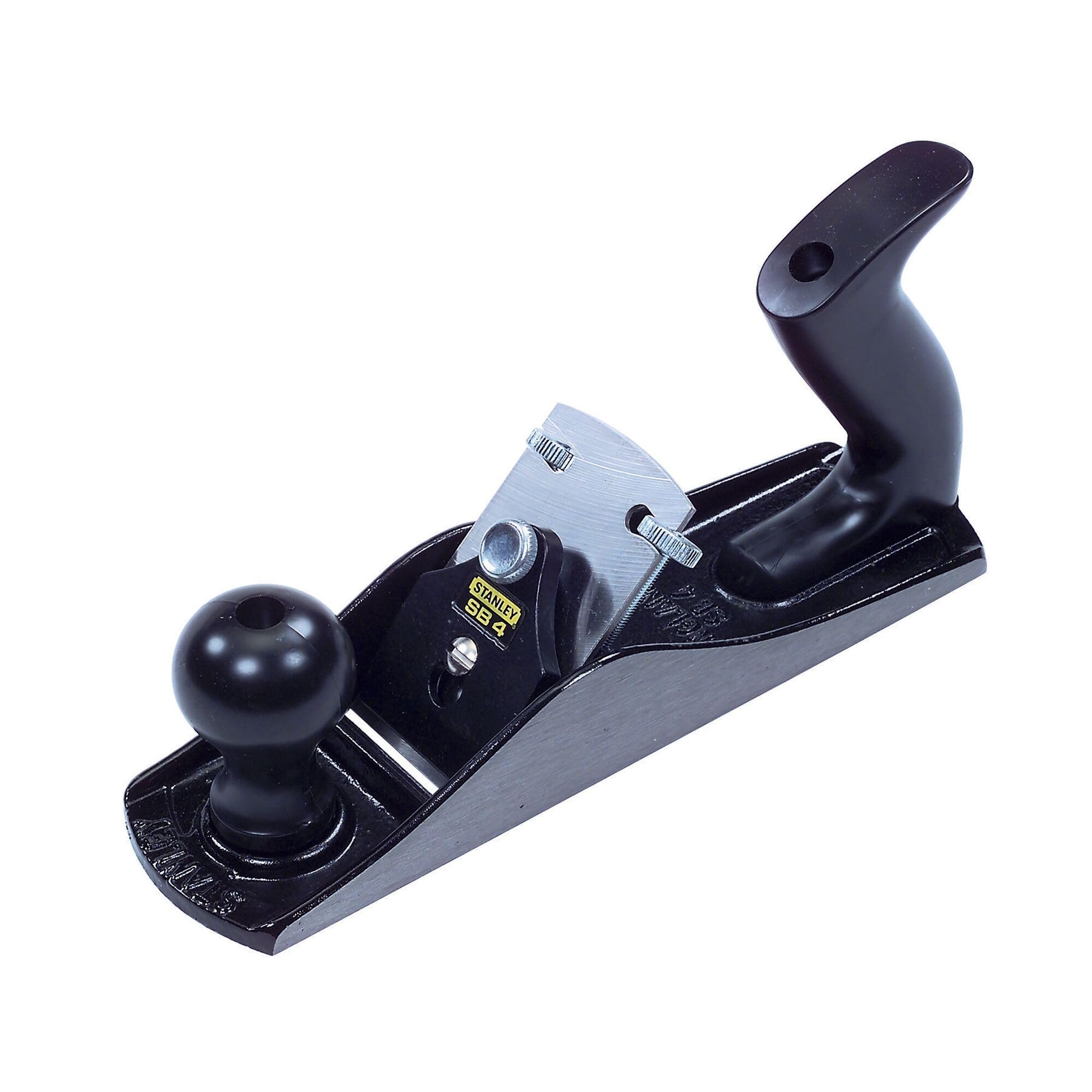
3. STANLEY No. 4 Adjustable Bench Plane (12-404)
The bench plane most people picture, with screw adjustment and a lifetime warranty.
If you grew up pushing a plane, this is the shape your hands expect. The cutter adjusts manually for depth and alignment — no hammer needed — and the quick-release cam-lock makes pulling the iron out for sharpening or a quick depth change a simple move. The cast-iron base has precision-ground sides and bottom for a stable ride.
Quality is the aspect owners praise most, and the contoured, polished polymer handles keep your grip comfortable during longer sessions. It carries a limited lifetime warranty, which is more backing than most planes here offer. At 2.8 pounds it sits between the featherweight KAKURI and the heavier Spear & Jackson. Its footprint is 10.7 inches long and 2.8 inches wide — compact enough to keep on a bench without eating your whole workspace.
Two things to know before you buy. Blade adjustment gets the most negative feedback on this model, and some owners say the sole needs work before it planes true. Also, this is not a quick setup: getting it purring can take real patience on the first session. Buy it for the familiar controls and the warranty, and go in expecting a tuning session, not a plug-and-play tool.
Strengths worth the money
- Manual depth and alignment adjustment — the Western-control learning curve stays gentle.
- Quick-release cam-lock makes iron changes and resharpening fast.
- Limited lifetime warranty backs the cast-iron build.
- 2-inch cutter in a familiar No. 4 bench-plane form.
Where it tests you
- Blade adjustment is the most-complained-about part of this model.
- Sole flatness is not guaranteed, so check it before serious work.
The pick for anyone who wants a push-style bench plane with a warranty behind it.
Know going in: expect to spend time dialing in the blade and checking the sole.
4. Spear & Jackson CSP4 No. 4 Smoothing Plane

A substantial cast-iron smoother aimed squarely at cabinet work and joinery.
The spec that matters on the Spear & Jackson is the blade: 2 inches wide, high carbon steel, in a precision milled ductile cast iron body. Ductile iron takes knocks better than plain cast, and the milled base and faces are meant to stay true under use. The brass adjusting screw gives you a finer-feeling depth control than a basic threaded knob.
At 4 pounds it is one of the heavier planes here, and that mass does real work — it carries momentum through a cut so you push less. Pair that weight with a 248 mm base length and you get a plane that bridges across small dips in the board. It is built for trimming joints and cleaning up cabinet parts where a stable, flat pass matters.
This is not a plane that flatters you from the start. The sole flatness and overall quality are both rated mixed in owner feedback, and depth adjustment gets the most negative noise. Owners who like it often find the milled sole surprisingly flat and the 4-pound body steadier than expected; others find it is not suited to fine work. If your goal is show-quality finish right away, look at the KAKURI instead. If you want heft and a milled base for joinery, the weight works for you.
Heft as a feature: the 4-pound body and 248 mm base stabilize each pass, which suits cabinet and joint work where control beats finesse.
Be honest about the tuning: depth adjustment and sole flatness vary unit to unit, so check both before you commit it to finish work.
Buy it if: you want a weighty, milled cast-iron smoother for joinery and can fettle it to taste.
Pass if: you need a fine-finish plane that behaves straight from the start.
5. SUIZAN Kanna Japanese Wood Planer 2″ Double Blade
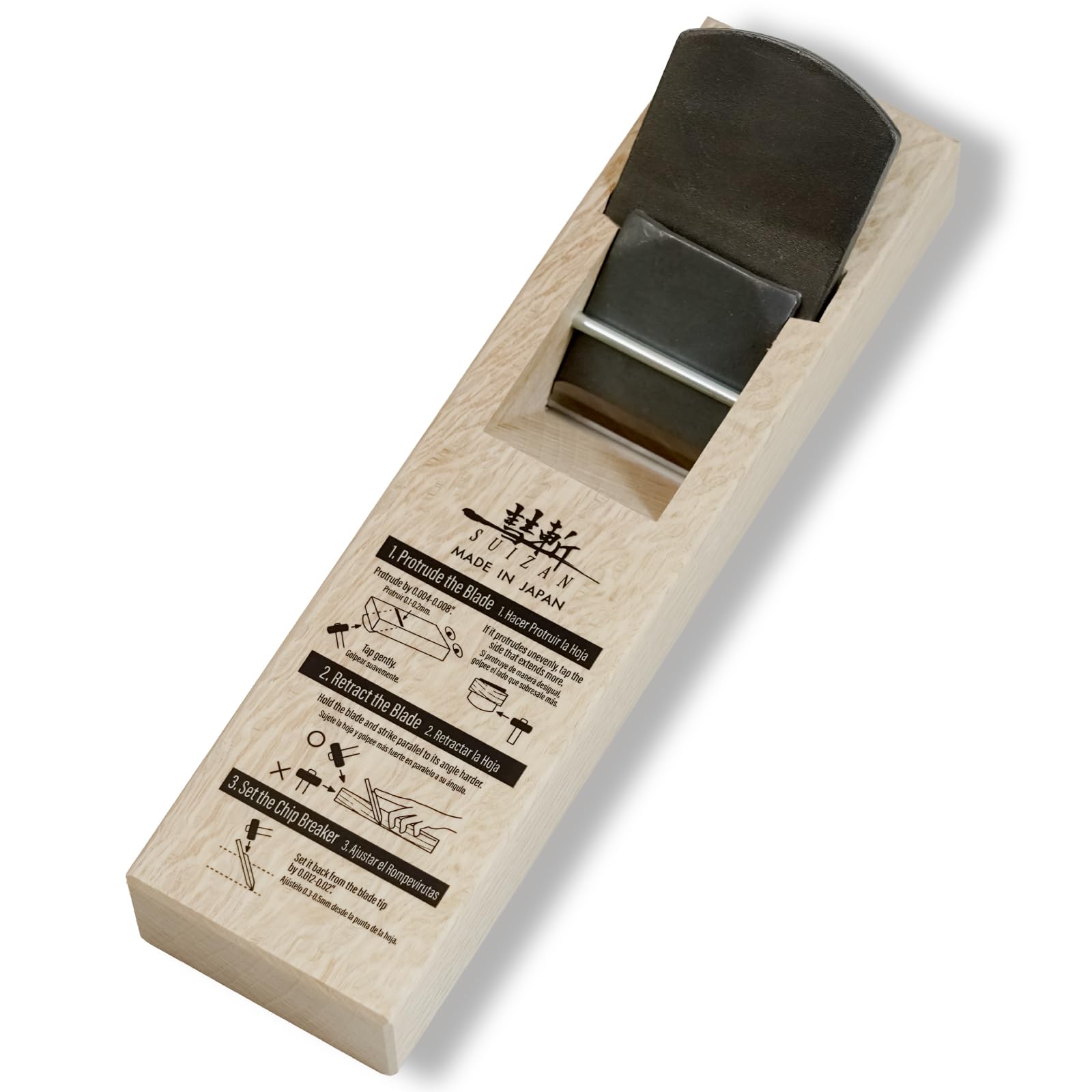
A compact pull-stroke kanna sized for small hands and tight work areas.
Pick this one up and the first thing you notice is the size. The oak body is 9.45 inches long and 2.48 inches wide, and the whole plane weighs 650 grams — light enough to guide precisely through chamfers and short flattening passes. The blade is Japanese steel, 1.97 inches wide, cutting a 1.69 inch swath.
The double-blade setup is really one iron plus a metal chipbreaker, and the chipbreaker sits close to the edge to control how the shaving leaves the board. Where it differs from the bigger KAKURI: there are no adjusting screws here either, so depth is set by tapping the blade and tapping the body to pull it back. The bonus is that its 1.97-inch Japanese steel blade comes genuinely sharp and is quick to get working — owners describe it gliding smoothly on both hard and soft wood.
The trade-off is capacity. A 43 mm cutting width is narrower than the 50 mm cut on the KAKURI and Spear & Jackson, so it covers less surface per pass on a large panel. It also needs whetstone sharpening when the edge dulls, same as any Japanese blade. For small parts and chamfers that is no burden at all; for flattening a tabletop it means more passes.
Why the size wins
- 650 grams and a 9.45 inch body keep it easy to control by hand.
- Japanese steel blade arrives sharp and ready to work.
- Chipbreaker close to the edge gives clean shaving control.
- Pull stroke delivers steady, repeatable cuts on soft and hard wood alike.
The honest limits
- 1.69 inch cutting width means more passes on wide boards.
- Blade setting is hammer taps, not screws.
The one to grab for chamfers, small parts, and hands that prefer a lighter tool.
Look elsewhere if: you mainly flatten wide panels and want maximum coverage per stroke.
6. JORGENSEN No.4 10″ Wood Plane

Built to shrug off heavy use, with a tool-steel blade that keeps coming back.
The blade here is professional-level O1 tool steel, and that choice matters for anyone planing tough stock. O1 holds an edge well, sharpens predictably, and — because it can be repeatedly resharpened and adjusted — gives you a long working life rather than a quick replacement cycle. The O1 tool steel blade is finely sharpened from the start, and owners describe it shaving hard stock like butter.
The body is ductile iron, drop-tested by the maker for rugged durability, with an aluminum alloy lever cap. This is a plane that expects to be used hard. The beech handle is high-density and polished smooth, and the meticulously polished flat bottom is what lets it glide across the board without fighting you. Cutting depth adjusts by turning a knob, so setting the blade is straightforward.
Here is the real-world catch: it is heavy, listed at 2.24 kg, and that weight needs a solid bench to feel right. It is also a dedicated No. 4 smoother — so do not buy it hoping to trim end grain like the small Woodriver block plane on this list. The weight is exactly why some buyers love it, and exactly why others find it tiring for long, delicate passes.
The materials story: O1 tool steel, ductile iron, and an aluminum alloy lever cap make this the most knock-around-durable plane here.
Weigh the weight: 2.24 kg is a lot to push for fine, repeated passes, so it suits heavy stock removal and rugged use more than delicate finesse work.
A great match if: your work is heavy, your bench is solid, and you want a blade that sharpens back to life again and again.
Skip if: you do long, light finishing sessions where a lighter plane would tire you less.
7. Taytools 469614 Smoothing Bench Hand Plane #4

The plane that arrives flat, so you can skip the sole-flattening chore.
Most planes on this list ask you to check the sole before you trust it. The Taytools answers that up front: the sole is precision ground to within the British Standard of 0.003 inch over its entire length, and the sides are lapped too. Owners confirm the lapped sole is the part that wins them over — it works right from the start and needs minimal setup.
The body and frog are ductile cast iron; the tote and knob are premium grade oiled and hand-rubbed Sapele. The iron is 0.120 inches thick and 2 inches wide, made from tool steel hardened and tempered to 55-60 on the Rockwell C scale. That thickness resists chatter, and the 9-3/4 inch sole length with a 2-1/2 inch width makes it a proper bench smoother at 4.11 pounds.
The blade is the honest wrinkle. While it is decently sharp as delivered, some owners hit a wall trying to properly sharpen it, and blade adjustment gets mixed feedback. Long-term durability and alignment also draw some criticism. For the money, this is a flat, solid platform to build on — just be ready to spend time on the edge rather than the sole.
The headline claim holds: a sole ground to 0.003 inch over its full length means you skip the lapping most planes need, and a 0.120 inch iron resists chatter during smoothing.
Where to budget your time: the blade — decently sharp but stubborn to resharpen — plus mixed adjustment feedback means this plane wants care at the cutting edge.
Worth it if: a flat sole and heavy, thick iron from the start matter more to you than a blade that sharpens easily.
Not ideal if: you would rather not fuss over a tool-steel edge that resists your whetstone.
8. KAKURI Professional Japanese Hand Plane 58mm

The premium kanna for woodworkers chasing the cleanest possible surface.
Skip to the steel: this is Hitachi Yasuki Aogami Blue Steel #2, one of the highest-grade Japanese carbon steels, laminated to soft iron in a two-layer construction. That lamination is a gift to anyone who sharpens — the soft backing makes the whole blade easier to bring back on a whetstone while the hard edge holds its keenness and resists dulling. The 58 mm blade cuts a 50 mm swath in a body of durable Japanese white oak.
The Blue Paper Steel #2 edge is very sharp from the start and easy to get going — owners describe it cutting like butter and appreciate the Japanese craftsmanship. At 2 pounds it stays light in hand, and the pull stroke gives you that controlled, consistent cut through the board. This is the step-up model over the standard KAKURI large plane, and the difference is in the cutting steel and the finish quality.
The trade-off is steep for a beginner. Blue Paper Steel is not forgiving of a bad angle on the stone, and the no-screws hammer-tap setup still applies. If you cannot yet hold a consistent bevel, you will blunt this blade faster than a cheaper one and spend longer restoring it. The upside is that a well-kept Blue Paper edge can give you the crispest surface here. This is the plane you grow into.
What the premium buys
- Blue Paper Steel #2 edge — sharpness and edge-holding that budget blades cannot match.
- Laminated two-layer blade is easier to sharpen than a solid hardened block.
- Durable Japanese white oak body at a light 2 pounds.
- Ready to cut — sharp from the start, as owners describe it.
The price of admission
- Sharpening needs a steady hand and a proper whetstone routine.
- Hammer-tap depth setting, no adjuster screws.
The pick for an experienced sharpener who wants the best finish steel in this group.
Hold off if: you are still learning to hold an angle on a whetstone — cheaper blades forgive more.
9. Woodriver Low Angle Block Plane With Adjustable Mouth

A trim-sized block plane built on a classic low-angle design for end grain.
This is not a smoothing bench plane — it is the one-hand block plane you reach for to true up a joint, break an edge, or shave end grain. The 12-degree bed angle is what makes it suit that work: a low angle slices across end grain rather than scraping at it. The high carbon tool blade runs at a 25-degree angle, and the adjustable mouth lets you narrow the opening for fine shavings on tricky wood.
It is compact, 7.85 inches long, and light at 2 pounds, so it sits in the hand and works one-handed on small parts. The knuckle-style lever cap is one of the things owners like — the cam clamping action locks the blade depth firmly when set. It is also a plane that sharpens fast and stays sharp; the tool steel takes a keen edge without much grinding.
The mixed feedback centers on adjustment and durability. The blade adjustment mechanism is rated mixed, and a few owners note the flatness and setup need attention on the unit they got. The longer-term durability also gets a split verdict. It is still a well-made plane for trimming work — just check the sole and mouth before your first cut. Do not expect it to flatten a tabletop; this is a detail tool, and judged as one, it holds up well.
Built for edges: the 12-degree bed and 25-degree tool-steel blade suit end grain and trimming, and the adjustable mouth and knuckle cap lock the setting firmly.
Set expectations: blade adjustment, flatness, and long-term durability draw mixed notes, so verify flatness and setup before relying on it for precision joints.
Sort your edges and end grain with this.
Reconsider if: you need a smoother for large surfaces — this is a small detail plane, and it behaves like one.
Know the Specs
Cutting Width and Blade Width
Cutting width is the swath the blade actually shaves — the number that tells you how much board one pass covers. A wider cut (like the 50 mm shared by the KAKURI and Spear & Jackson) means fewer passes for the same surface, but a wider iron is also harder to keep flat and needs more muscle. A narrow cutter such as the 45 mm on the Groz is lighter to control and easier for a beginner to steer through tough grain.
Blade Steel and Edge Retention
Blade steel sets how sharp your plane gets and how long it stays that way. Softer carbon steels sharpen quickly and forgive a bad angle; harder, alloyed steels like O1 tool steel or Blue Paper Steel #2 hold a keener edge much longer but demand more care on the whetstone. Laminated blades — a hard edge fused to soft iron — are the compromise: easy to sharpen but still tough where it cuts. Match the steel to your sharpening comfort, not the other way around.
Sole Flatness
Sole flatness is the single most important build spec. A bottom that is not flat will rock across the board and leave a ridge no sharpening can fix. Makers quote flatness as a tolerance — for example, 0.003 inch over the length — and tighter is better. A plane that is lapped and ground within that spec saves you hours of work with a sharpening stone before the first real cut.
Bed Angle and Frog
Bed angle is the slope the blade sits on. A low angle (around 12 degrees) is designed to slice across end grain and works well in a small block plane; a standard smoother holds the blade more upright to control tear-out on flat surfaces. The frog is the movable block the blade rests against — an adjustable frog lets you open or close the mouth to suit rough or fine work. Fixed-frog planes are simpler; adjustable ones are more versatile.
Common Questions
What is the difference between a Japanese kanna and a Western bench plane?
Why does sole flatness matter so much on a hand plane?
Do I have to sharpen the blade on a new hand plane?
Can a hand plane replace a power planer for flattening a board?
What cutting width should I start with?
Is a low-angle block plane better than a bench plane for end grain?
How heavy a plane should I buy?
How do I set the blade depth on a Japanese plane with no screws?
Does a cast iron or wooden plane body last longer?
What blade steel should I look for in a hand plane?
The Bottom Line
For most people buying a hand plane, the woodworking hand planes pick is the KAKURI Japanese Large Hand Plane 60mm, because it pairs a hand-sharpened laminated blade and an oil-finished oak body with a light 2.2 pounds that lets you pull all afternoon without fatigue. If you prefer a push stroke and a screw-adjustable frog, reach for the STANLEY No. 4 and lean on its lifetime warranty. And for trimming joints and end grain, the small Woodriver Low Angle Block Plane is the one to keep within arm’s reach. One honest nudge: the “What you’ll learn” list above is the shortcut every new buyer should read — check the sole before you trust any plane, and a flatter, better-fettled tool will beat a fancier one every time.
How we choose
We do not accept paid placement. Every pick is matched to a real buyer and a real use-case; we do not hands-on test units.
Sources
Specifications: manufacturer listings and product documentation. Review insights: verified customer reviews, as of November 2026. Pricing: not shown on this page (it changes often); check the current price via the retailer link.
As an Amazon Associate, Tactical Gear Guy earns from qualifying purchases. This does not affect which products we feature.