Specs are compiled from manufacturer listings and verified buyer reviews and can change over time — please confirm the key details on the product page before buying.
Buying a dust collector is really about one question: how much air can it move, and how small a particle can it catch? Get those two numbers right and your shop stops coating every surface in fine dust. Get them wrong and you have paid for a noisy box that leaves the fines floating in your shop air. This guide covers seven real machines, matched to the kind of work you actually do.
This guide is built by comparing the manufacturers’ published specifications and the patterns across verified customer reviews, so you get each pick’s real strengths and trade-offs instead of marketing spin.
You will see how airflow in CFM, filtration in microns, and bag capacity in gallons decide which machine suits a garage hobby bench versus a full cabinet shop. Below is the honest shortlist for woodworking dust collection.
Top Picks


How To Choose The Best Woodworking Dust Collection
Most first-time buyers think a bigger motor means better dust pickup. That assumption is wrong, and it costs buyers money. A collector is judged by how much air it pulls through the hose at the tool, and a long run of narrow hose chokes a big motor as surely as a small one.
Start with airflow, not horsepower
Airflow is measured in CFM (cubic feet per minute — the volume of air the machine moves in sixty seconds). The machines here range from 560 CFM to 1,300 CFM. If you only ever run one short hose to a table saw, a 560 CFM wall unit is plenty. If you plan to branch a duct run across a shop, the higher CFM number is what keeps suction alive at the far end.
Then read the micron number
A micron is one millionth of a meter, and the rating tells you the size of particle the filter bag or canister stops. The finest dust from sanding is the part that hangs in the air longest. A 1-micron bag or canister traps far more of that than a 5-micron bag, which is why shop air quality changes noticeably when you move up.
Decide between rolling and wall-mounted
You get two mounting styles here, and the right one depends on your shop. A rolling unit with casters (small wheels) follows you around the shop and stores against a wall. A wall-mount frees floor space but pins the machine in one spot, so your hose run gets longer. Pick based on whether floor space or hose length is the tighter constraint in your shop.
Side-by-Side Comparison
| Model | Best For | Airflow | Filtration | Bag Capacity | Amazon |
|---|---|---|---|---|---|
| WEN DC1300★ Best Overall | Whole-shop airflow | 1,300 CFM | 5 micron | 50 gallons | Amazon |
| WEN DC3401Best Value | Small-shop budget | 660 CFM | 5 micron | 12 gallons | Amazon |
| VEVOR Wall Mount | Wall-mount value | 560 CFM | 2.5 micron | 21 gallons | Amazon |
| POWERTEC DC5371 | Fine-dust filtration | 560 CFM | 1 micron | — | Amazon |
| FoxAlien HFS-800 | Desktop CNC benches | — | HEPA + carbon | — | Amazon |
| Jet Vortex Cone 708659K | Full cabinet shops | 1,100 CFM | 2 micron | 39.6 gallons | Amazon |
Detailed Reviews
1. WEN DC1300 1,300 CFM 14-Amp Dust Collector
Our pick — 4.5+★ from 200+ verified ratings; the strongest balance of quality and price.
Two tools at once, one huge bag, and airflow that dwarfs everything else on this list.
The number that decides this whole article is 1,300 CFM. That is cubic feet of air moved per minute, at 1,300 CFM versus the 560 CFM of the VEVOR wall unit below. In plain terms, this collector keeps suction alive at the end of a long duct run in a way the smaller machines cannot. The 14-amp motor spins a 10-inch steel impeller up to 3450 RPM to make that happen.
The 50-gallon vertical collection bag is the other headline. Compare it to the 12 gallons on the WEN DC3401 — 50 gallons versus 12 gallons. On a heavy cutting day that is the difference between working through a project and stopping twice to swap bags. Dual 4-inch air inlets let you leave two machines hooked up at the same time, so a table saw and a planer can both stay connected.
Mobility is handled by the included mobile base with four swivel casters, so the whole unit rolls out of the corner when you need it. What wins people over most is the build quality, with the quiet running a close second — a closed garage door swallows most of the sound. The honest catch is durability and the manual: both draw mixed feedback, so treat the bag and fittings with some care and expect to work out a few details yourself rather than from the directions.
Where it earns its place
- 1,300 CFM moves far more air than any other pick here
- 50-gallon bag means fewer emptying stops on big jobs
- Dual 4-inch inlets keep two tools connected
- Four swivel casters roll it wherever the work is
What to weigh first
- Durability draws mixed feedback — handle the bag assembly gently
- Instructions are thin in places, so plan on some figuring out
- A 5-micron bag is coarser than the 1-micron POWERTEC bag
Built for: shops running several machines or long duct runs where airflow has to survive the distance.
Think twice if: your bench is a single small table saw — the compact WEN DC3401 covers that for far less machinery.
2. WEN DC3401 5.7-Amp Dust Collector with 12-Gallon Bag
The compact roller that clips onto a miter saw and disappears into a corner afterward.
If your shop is half a garage, this is where most people should start. The 5.7-amp brushed motor and 6-inch impeller move up to 660 CFM, which is more air than the VEVOR and POWERTEC wall units manage at 560 CFM. A single 4-inch dust port connects straight to your tools, and lockable swivel casters let you park it and lock it down.
The 12-gallon 5-micron zippered collection bag is the whole trade-off in one line. In exchange you get a unit that weighs 8.8 kg and carries on an onboard handle, plus an optional wall mount if you would rather hang it out of the way.
Owners consistently report it working well on miter saws and table saws, and the compact size comes up as a genuine plus rather than a compromise. Cleaning performance splits opinion — some find it clearly better than the shop vac it replaced, others do not. A two-year warranty backs it. Judge it as a dedicated chip collector for one tool, not a whole-shop system, and it makes a lot of sense.
The fit: hobby benches and single-tool setups where a miter saw or small table saw makes most of the mess.
The limit: the 12-gallon bag fills fast under heavy cutting, and the 5-micron bag lets more fine sanding dust pass than a 1-micron bag.
Right call for: a first collector in a tight garage shop that needs to move between tools.
Move on if: you sand heavily and want the finest dust held — the POWERTEC bag below filters tighter.
3. VEVOR Wall Mount Dust Collector, 1 HP, 560 CFM
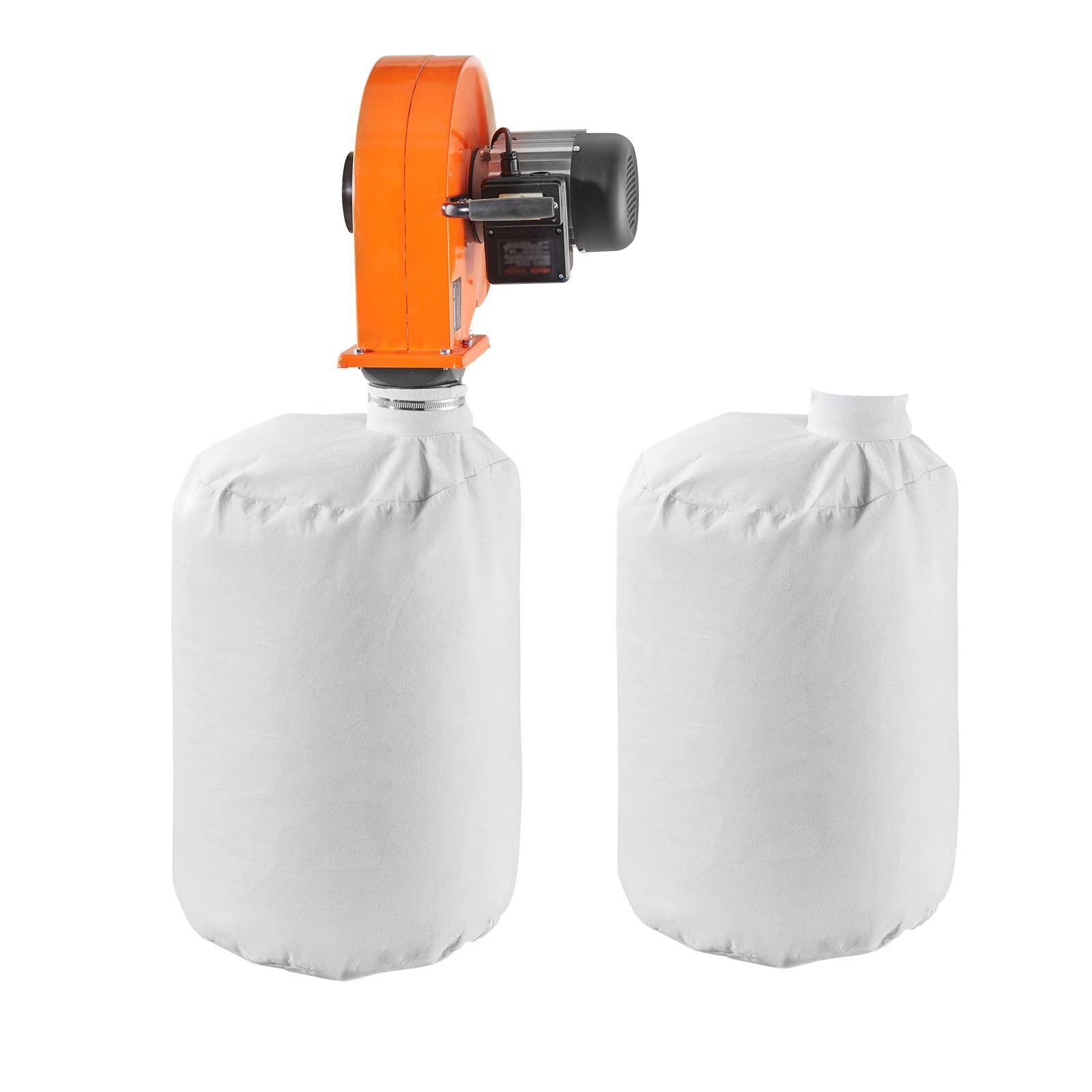
Hangs on the wall, holds 21 gallons, and filters finer than the WEN bags at 2.5 microns.
Floor space is the thing this machine gives back. At 24 pounds it mounts on a wall bracket and stays out of the way, pulling 560 CFM through a 1 HP induction motor.
Filtration is the number worth pausing on. At 2.5 microns it is finer than the 5-micron bags on the WEN machines, so more of the sanding dust stays inside the bag instead of drifting into the room. The bag has a bottom zipper, which means you unzip it to empty without detaching anything.
The 1 HP induction motor is rated at or below 90 dB and described by VEVOR as overload-resistant, holding steady airflow across longer sessions. It is a newer listing with a short track record, and its high rating rests on a modest sample — promising rather than proven. For a small or medium shop that wants a wall-mounted unit with fine filtration, it is a strong fit.
Best when: you want the collector off the floor and finer dust capture than a standard 5-micron bag.
Hold off if: you need a long, well-proven service history — this one has fewer buyers behind it than the others here.
4. POWERTEC DC5371 1 HP Wall Mount Dust Collector

The 1-micron bag that catches the fine sanding dust the others let slip.
Here is the direct comparison that matters: this bag filters at 1 micron, against 2.5 microns on the VEVOR. If you sand a lot and the workshop air leaves a film on your shelves, that gap is the whole reason to pick this machine. The bag has a built-in window so you can see the dust level and a zipper for emptying without a fight.
Airflow is 560 CFM from a 1 HP induction motor at 3450 RPM, running on dual voltages — 12 amp at 120V or 6 amp at 240V if you have that circuit. It hangs on a mounting bracket with a 4-inch inlet that accepts a hose directly to your machine. Noise is rated at 80 dB, which keeps it from dominating a small shop.
An internal Vortex Base guides airflow to cut turbulence, and POWERTEC cites improved efficiency over a comparable model. Suction and size each draw a split read from owners, so set expectations there. One maintenance note worth knowing: a grate guards the inlet, and debris can gather around it over time — pull the hose and check the port periodically to keep performance up. What owners praise most is performance on table saws, sanders, and routers.
Standout strengths
- 1-micron bag filters far finer than the 5-micron WEN bags
- Runs on 120V or 240V — 12 amp or 6 amp your choice
- Built-in window and zipper make emptying simple
- Wall bracket frees floor space in a small shop
Keep in mind
- Inlet grate collects debris over time and needs occasional clearing
- Suction and size feedback are mixed rather than unanimous
- At 560 CFM it moves less air than the DC1300 or Jet
Pick this when: fine sanding dust is your main concern and you want the tightest bag filtration in the lineup.
Look past it if: you need maximum airflow for a long duct run — a higher-CFM machine serves that better.
5. FoxAlien HFS-800 Desktop Dust Collector

Not a shop collector at all — a desktop unit built to sit beside a CNC machine.
This one asks a different question, so answer it honestly before you buy. It is not a 4-inch port chip collector for a table saw. It is a 800W desktop vacuum for CNC work, sized to sit on a bench rather than roll across a floor. It ships with a standard 1.5-inch (38mm) hose on 6.56 feet of length, plug-and-play with the FoxAlien dust shoe and most desktop CNC brands.
Filtration is where it earns its keep for CNC cutting. A HEPA filter traps micro-dust, and an activated carbon filter neutralizes the smell and fumes from cutting acrylic, MDF, and resin. A dedicated cyclone separator catches large debris before it reaches the main unit, which keeps clogs down and stretches the life of the HEPA filters so you replace them less often.
An adjustment knob lets you dial airflow up for heavy carving or down for delicate passes, and that also gives you a way to manage noise. Rated at 85 dB, it is not silent, and at 27.5 pounds it is heavier than a shop-vac style unit of similar size. It needs 220 volts, which is a real installation consideration in a North American shop — check your outlet before committing.
A different job: fume and micro-dust control right at the CNC spindle, with a cyclone keeping the costly HEPA filter cleaner.
Not a substitute: it is not meant to pull chips from a table saw — the smaller hose and desktop frame suit CNC, not shop-wide collection.
Reach for this if: you run a desktop CNC and want dust and fumes handled at the cutter head.
skip it if: you need a 4-inch machine for big stationary tools — the WEN or Jet serve that job.
6. Jet Vortex Cone Dust Collector, 2-Micron Canister, 1-1/2 HP
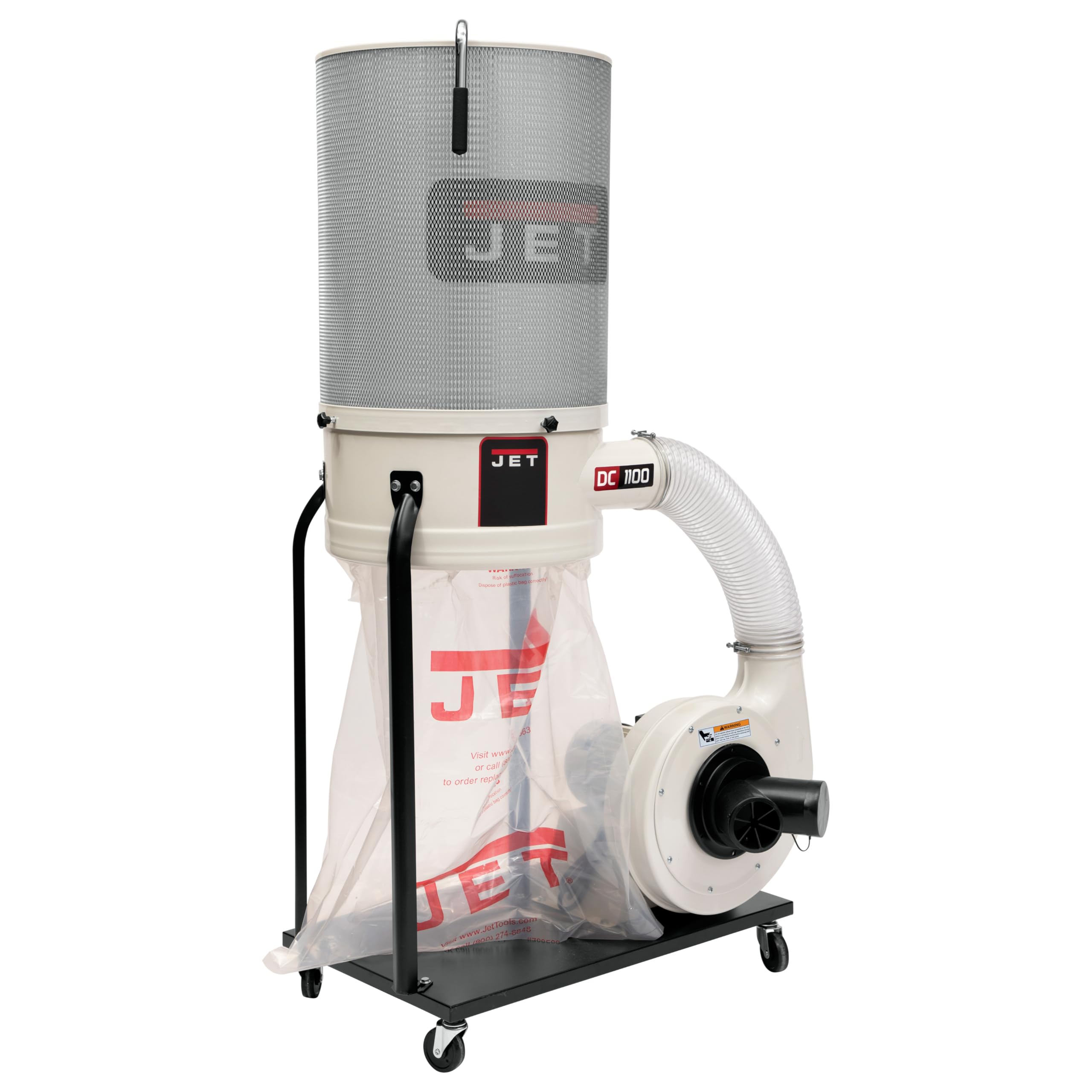
A canister you clean with a turn of a handle, and a cone that keeps the filter breathing.
The feature that sets this machine apart is mechanical, not marketing. JET’s Vortex Cone sits below the filter chamber and keeps 98% of wood chips from clogging the filter, dropping them into the collector bag so mostly fine dust reaches the canister. That sustains airflow between cleanings and packs the bag more densely, so you change bags less often.
The canister is a pleated filter rated to capture 98% of 2-micron and 86% of 1-micron particles. Cleaning it takes a couple of rotations of the top handle — internal scrapers knock dust off the pleats into the bag below with no filter removal. A clear collector bag shows when it is time to empty. Capacity is 39.6 gallons, against the 50 gallons on the DC1300 above and well past the 15-gallon WEN DC3474.
Airflow is 1,100 CFM with 10-1/2 inches of static pressure and 8,464 FPM at 4 inches, from an 11-inch steel impeller and a continuous-duty 1-1/2 HP motor. It ships prewired for 115V and wants a 20A circuit, running at 70-80 dB at 3 feet. It connects to table saws, planers, and jointers through one 6-inch inlet or two 4-inch inlets, with a 70-inch hose in the box. Remote control is sold separately, and durability draws a mixed read. A 5-year warranty backs it, and owners describe it as exceeding expectations.
what separates it
- Vortex Cone keeps 98% of chips off the filter
- Canister cleans with a turn of the handle, no removal
- 1,100 CFM from a continuous-duty 1-1/2 HP motor
- One 6-inch inlet or two 4-inch inlets for big machines
- 5-year warranty
Weigh before buying
- Ships 115V but needs a 20A circuit
- Remote control is sold separately
- Durability draws a mixed read
Made for: full cabinet and home shops running table saws, planers, and jointers off a fixed duct run.
Overkill if: you only run one small tool and want a bag you empty by hand — the WEN or VEVOR fit that better.
Know the Specs
Airflow in CFM
CFM stands for cubic feet per minute — the volume of air a collector moves in a minute. It is the single best guide to how a machine behaves at the end of a hose. A 1,300 CFM unit like the WEN DC1300 keeps suction strong across a long duct run, while a 560 CFM wall unit does fine on a short hose to one tool.
Filtration in Microns
A micron is one millionth of a meter, and the rating tells you the size of particle the bag or canister stops. Finer dust from sanding hangs in the air longest, so a 1-micron bag like the POWERTEC’s catches more of it than a 5-micron bag on the WEN machines. The lower the number, the finer the capture.
Bag Capacity in Gallons
Capacity tells you how much debris you hold before emptying. A 50-gallon bag on the WEN DC1300 runs a long time between stops, while a 12-gallon bag on the DC3401 fills quickly under heavy cutting. Bigger capacity means fewer interruptions, but a heavier load to move when it is full.
Motor Type and Amperage
Induction motors, like the 7.4-amp unit in the WEN DC3474 and the 1-1/2 HP motor in the Jet, are the longer-running type with no brushes to wear. Brushed motors, like the 5.7-amp in the DC3401, are lighter and cheaper. Amperage tells you how much current the machine draws, and the Jet’s 20A circuit requirement is a wiring detail to check before it arrives.
Common Questions
Will a dust collector work with my table saw’s 4-inch port?
Is a dust collector better than a shop vac for sawdust?
How often will I need to check for clogs around the inlet?
What is the difference between a 1-micron bag and a 5-micron bag?
Do I need a 240V circuit for a wall-mount dust collector?
Can a dust collector handle acrylic or MDF dust from CNC work?
How does the Jet’s Vortex Cone reduce bag changes?
Will an induction motor dust collector run quieter than a brushed one?
Can I hook up two tools to one dust collector at the same time?
What hose length and size does the FoxAlien use?
The Bottom Line
For most shops, the woodworking dust collection winner is the WEN DC1300 — its 1,300 CFM keeps suction alive across long runs, and the 50-gallon bag stops the emptying interruptions that bog down a smaller unit. If finer air is your priority, the POWERTEC DC5371 filters down to 1 micron and hangs on the wall out of the way. And when you want a full cabinet-shop machine that cleans its own filter with a turn of the handle, the Jet Vortex Cone earns the premium spot with its 1,100 CFM and 2-micron canister.
How we choose
We do not accept paid placement. Every pick is matched to a real buyer and a real use-case; we do not hands-on test units.
Sources
Specifications: manufacturer listings and product documentation. Review insights: verified customer reviews, as of November 2026. Pricing: not shown on this page (it changes often); check the current price via the retailer link.
As an Amazon Associate, Tactical Gear Guy earns from qualifying purchases. This does not affect which products we feature.