Specs are compiled from manufacturer listings and verified buyer reviews and can change over time — please confirm the key details on the product page before buying.
You want a saw that puts the blade exactly where your pencil line is — every single time — without dragging a cord across the shop floor. That is the whole job of a woodworking chop saw, and it is also where most cheap units fail you. The eleven saws below are sorted by what they do best: cordless freedom, repeatable miter detents, sliding crosscut capacity for wide boards, or a footprint small enough to store against a wall.
This guide is built by comparing the manufacturers’ published specifications and the patterns across verified customer reviews, so you get each pick’s real strengths and trade-offs instead of marketing spin.
Trim carpenters chase repeatable angles, deck builders want crosscut reach, and home woodworkers mostly want a saw that does not eat half the garage. Every pick here has been matched to one of those jobs. Here is how to pick the right woodworking chop saw for the way you actually build.
Top Picks

How To Choose The Best Woodworking Chop Saw
The saw you buy should be decided by the widest board you actually cut and the angle you repeat most often. Get those two wrong and you will be fighting the tool on every project. Get both right and the saw stops being something you fight.
Decide between a fixed-head chop saw and a slider
A fixed-head compound saw pivots down on one hinge and crosscuts what its blade diameter allows. Those are the lighter, cheaper, more compact machines — good for trim, framing studs, and shop work where boards stay under the blade’s reach. A sliding saw runs the motor head forward on rails so the blade travels through wide stock, which is what lets a 10-inch slider cut stock a fixed 10-inch saw cannot touch. Sliders cost more bench depth and more weight.
Match the blade size to your stock
Blade diameter sets your maximum depth of cut. A 7-1/4-inch blade handles 2×4 framing and baseboard. A 10-inch blade adds crown molding and thicker trim. A 12-inch blade opens up wide crosscuts and taller nested molding. Do not buy more blade than your work demands — the bigger the blade, the heavier the saw and the more bench space it claims.
Understand miter and bevel, separately
Miter swings the whole head left or right to crosscut at an angle — that is the number that matters for picture frames and corner trim. Bevel tips the motor head over sideways to cut a slope, which is what you need for crown molding against a ceiling. A single-bevel saw tips one direction only. A dual-bevel saw tips both ways, so you never flip the workpiece to cut the mirror angle. Look for positive stops at the common angles so the saw clicks into place instead of relying on a printed scale and your eye.
Weigh the cut-line system
You need to see where the blade will land before it lands. A laser guide throws a red line on the workpiece. A shadow line casts the blade’s own silhouette onto the wood, so what you see is the actual kerf. Both beat guessing at a notch on the base plate. Lasers need occasional alignment and batteries; shadow lines need nothing but the light already on the saw.
Side-by-Side Comparison
| Model | Best For | Blade Size | Miter Range | Weight | Amazon |
|---|---|---|---|---|---|
| DEWALT DCS361M1 20V MAX*★ Best Overall | Cordless trim work | 7.25 in. | 48° | 31.6 lbs. | Amazon |
| Metabo HPT C10FCG2Best Value | First saw on a budget | 10 in. | 52° | 24.2 lbs. | Amazon |
| Genesis GMS1015LCCompact Pick | Home projects and storage | 10 in. | 45° | — | Amazon |
| DOVAMAN DMS01A | Mixed wood, PVC and soft metal | 10 in. | 45° | — | Amazon |
| SKIL MS6305-00 | Wide stock and 2×12 stock | 10 in. | 50° | 39.4 lbs. | Amazon |
| Delta S26-263L | Room-to-room portability | 10 in. | 45° | 30 lbs. | Amazon |
| WEN MM1215 | Cutting wide 12-inch stock | 12 in. | 45° | — | Amazon |
| Makita LS1040 | Simple repeatable trim cuts | 10 in. | 52° | — | Amazon |
| DEWALT DWS716 | Baseboard and crown runs | 12 in. | 50° | 48.3 lbs. | Amazon |
| BOSCH CM10GD | Small shops, tight benches | 10 in. | 47° left / 47° right | 64 lbs. | Amazon |
| Makita LS1019L | Finish carpentry cuts | 10 in. | 90° | 72.8 lbs. | Amazon |
Detailed Reviews
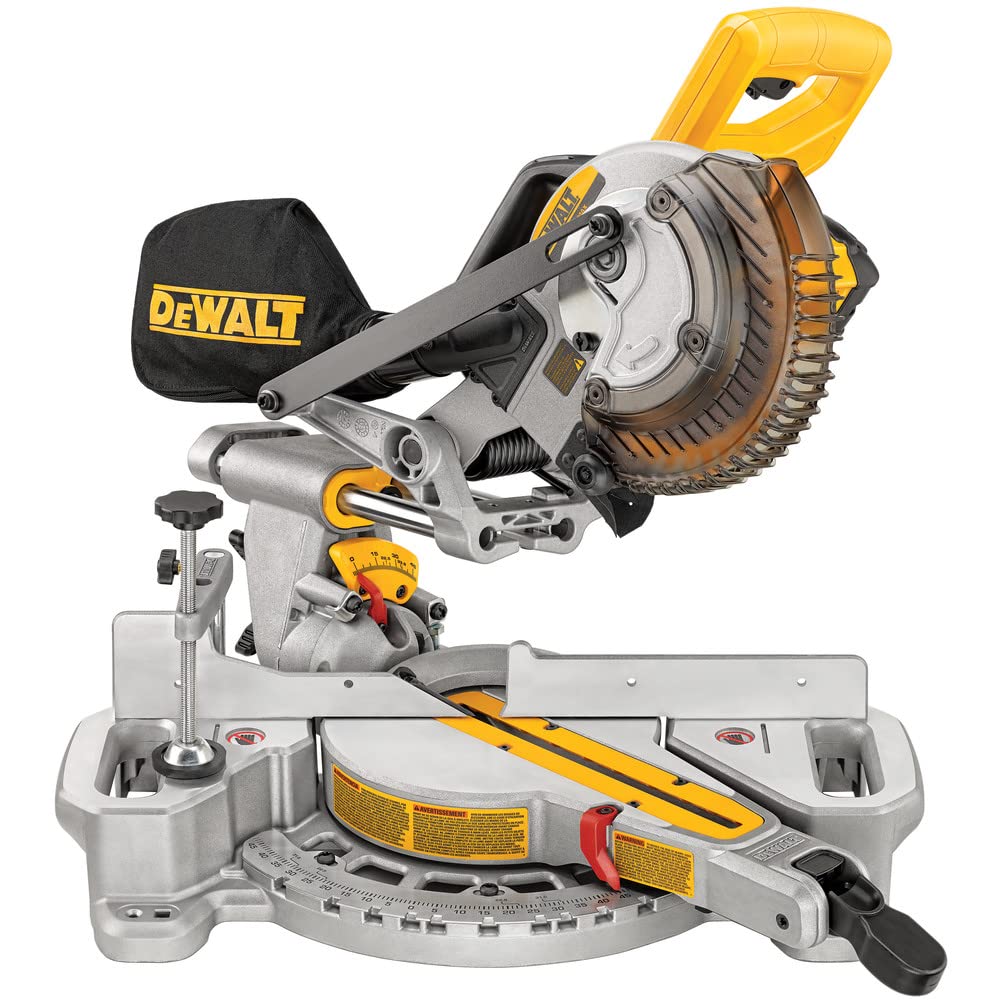
1. DEWALT 20V MAX* 7-1/4-Inch Miter Saw, Cordless (DCS361M1)
Our pick — 4.5+★ from 800+ verified ratings; the strongest balance of quality and price.
No cord, no outlet hunt, and a cut line you never have to recalibrate.
The saw that wins this list is the one that removes the two things that actually slow a woodworker down: dragging an extension cord and re-checking where the blade will land. This DEWALT runs on a 20V MAX* battery pack (the DCB204 included in the box) and, by the maker’s own figure, that pack delivers on average 183 cuts of 2×4 pine or 275 cuts of 3-1/4 pine baseboard. Translation: you can frame a wall or run a full room of baseboard without hunting for a receptacle.
The integrated cut line cross-cut positioning system shows your cut line without adjustment, so accuracy comes from the saw instead of from your eye. The stainless steel miter detent plate carries 11 positive stops — those are preset angle notches that click the head into the common angles so repeat cuts stay identical. An oversized bevel scale makes the tilt angles readable at a glance rather than squinted at. And it will cup 3-5/8-inch nested crown and 3-1/2-inch base vertically, which is the capacity that matters when you are running molding against a fence.
Here is the honest trade. At 31.6 lbs it is portable, but it is not a pocket tool, and at a 7.25-inch blade it is the smallest cutter in this lineup — the SKIL below runs a 10-inch blade, roughly a 38% larger blade, which buys noticeably deeper crosscuts in thick stock. If your work is trim, framing, and shop cuts, that gap never bites. If you regularly crosscut 2×12, it will. What wins people over on this saw is the size and the battery life together — owners consistently describe it as a saw that cuts all day on a pack and still moves from truck to bench without a second trip.
cordless jobsite freedom
- 183 cuts of 2×4 pine or 275 cuts of baseboard on the included 20V MAX* pack
- 11 positive miter stops mean repeat angles need zero re-checking
- Adjustment-free cut line indicator for visibility on every pass
- Cupping capacity for 3-5/8″ nested crown and 3-1/2″ base vertically
battery not included
- 31.6 lbs travels fine but is not one-hand light
- Smallest blade here at 7.25 in., so deep stock is out of reach
- Cordless means battery management on long production days
grab the kit: trim carpenters and remodelers who move between rooms and hate extension cords.
needs outlets: if your weekly work includes wide 2×12 crosscuts — go bigger blade.
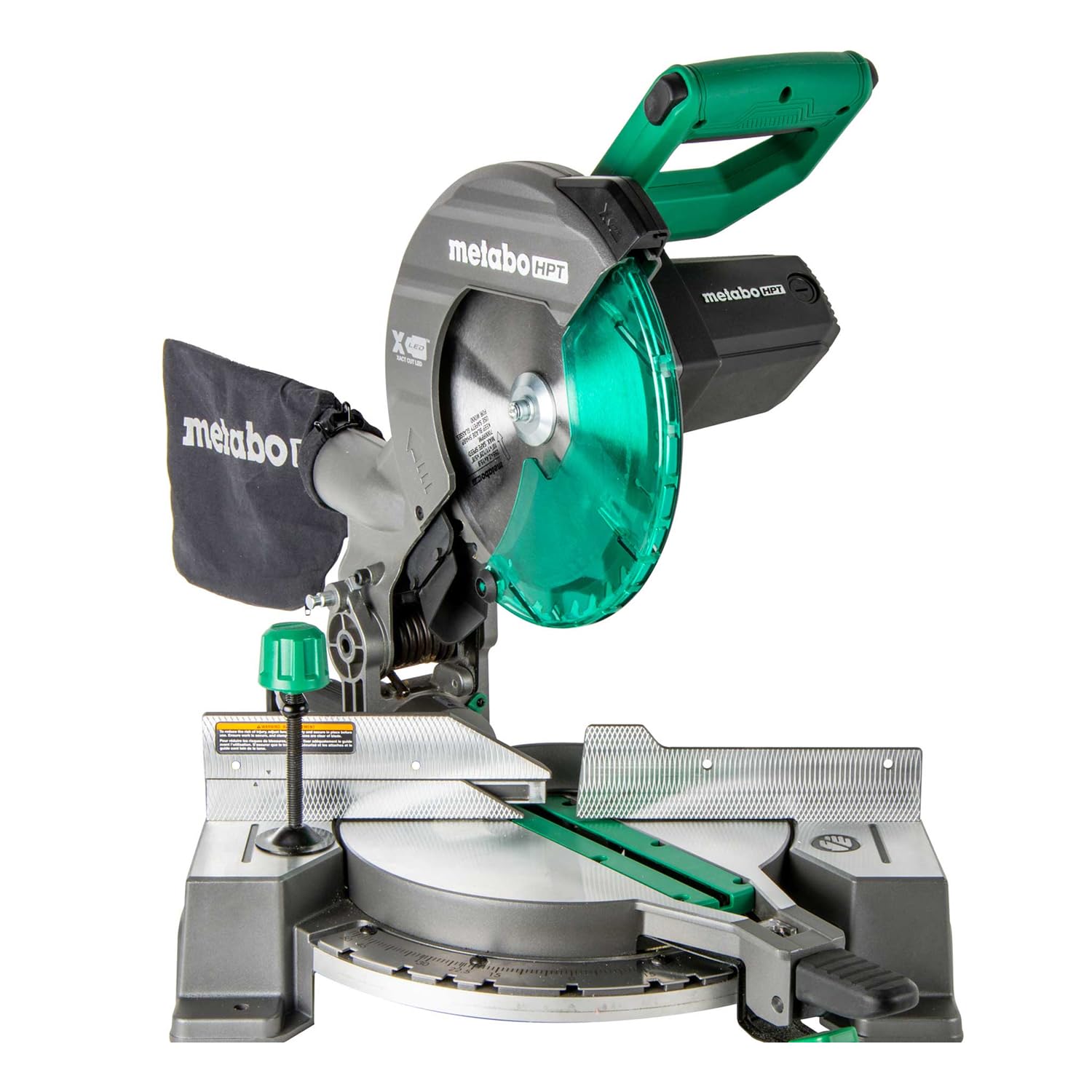
2. Metabo HPT C10FCG2 Miter Saw
A 10-inch saw that swings wider than most sliders and weighs less than a loaded tool bag.
Start with the number that does the work: 52 degrees of miter swing, left and right. A 15-Amp motor turning up to 5,000 RPM with a 24-tooth tungsten carbide blade in the box gives you enough bite for 4×4 posts and 2×6 stock without bogging down.
At 24.2 lbs this is the lightest corded saw on this list, and it sits 63% below the SKIL’s 39.4 pounds. That is a real difference at the end of a day when you are carrying the saw up a stairwell or stowing it on a shelf. The vice clamping system holds the workpiece down instead of asking your off hand to do it. A 0-45° bevel range to the left with adjustable bevel stops covers the common slope cuts, and the large table surface gives longer stock better support before it reaches the blade.
steady single-bevel cuts: quality and the money-to-performance ratio are the two things this saw gets praised for most — owners talk about it cutting straight and beveled passes cleanly, and it is often described as a strong first miter saw for someone who has never owned one.
bevel stays fixed: this is a single-bevel machine, so the motor head only tips one direction. If your work involves crown molding or any cut where you need the mirror bevel angle without flipping the board, you will feel that limit. Adjustability and long-term durability are also the softer spots owners mention — treat the detents as something to check rather than assume.
budget bench pick: you want a light, fast 10-inch saw for framing, trim, and general shop work without stretching the budget.
needs dual bevel: dual bevel is on your must-have list for molding work.
3. Genesis GMS1015LC Miter Saw
A bench-top saw that stores on a shelf and still throws a laser where the cut goes.
If your shop is a corner of the garage, footprint is the spec that wins. This Genesis measures 19.5 inches long by 16.25 inches wide by 15 inches tall, against the SKIL’s 35.43 by 22.44 by 14.17 — a dramatically smaller bench and shelf footprint for the same 10-inch blade. A die-cast aluminum base keeps it accurate without adding bulk, and the whole thing lifts off the bench when the car needs the bay back.
A 15-Amp motor and a 60-tooth carbide blade in the box give it a fine-tooth cut right out of the carton, which is why it handles 2×4 stock cleanly on home projects. Nine positive detent stops lock into the common miter angles so setup is quick rather than measured by eye. The electric brake stops the blade in seconds once you release the trigger, and the arbor lock makes blade swaps a one-wrench job. Two extension wings and a hold-down clamp come in the box too, so you are not buying accessories on day one.
Miter travel runs to 45 degrees left and right with a 45-degree left bevel, so compound cuts for crown molding, shadow boxes, and picture frames are within reach. Max capacity at 45° x 45° is H 1-3/8 inches by W 3-5/16 inches — check that against your molding depth before you commit. The persistent gripe with this saw is the laser itself: getting the beam to sit exactly on the cut takes fussing, and it does not always stay put. If you rely on the laser as your primary guide, budget some patience. If you use it only to confirm your own pencil line, the drift is tolerable.
starter saw: a genuinely small 10-inch compound saw for home projects where bench real estate is scarce.
pros look away: the laser guide needs realignment more than once before it earns your trust.
4. DOVAMAN 10-Inch Sliding Miter Saw

Three blades, two speeds, and an ambidextrous layout — a saw built for one shop doing several materials.
Most saws here cut wood and stop there. This one arrives with two 40-tooth and one 48-tooth carbide-tipped (TCT) 10-inch blade, and a dual-speed setting at 5,000 RPM or 3,200 RPM, so the slower speed suits PVC and soft metals while the faster speed handles wood. The 13-inch sliding rail with extendable side tables gives you a stated cutting range up to 4 by 13 inches, which is how a 10-inch slider reaches stock a fixed-head 10-inch saw cannot touch.
The ambidextrous design is worth naming plainly: the controls are laid out so a left-handed operator does not have to reach across the blade. A laser guide shows the cut line, and a 15-Amp pure copper motor carries the load. The arbor and the base are set up for 0-45° bevel cuts, with 9 positive stops for the common miter angles. Two spare carbon brushes ship in the box, which is the kind of thing that keeps a motor running years in.
What buyers report most is the overall build — this reads as a well-made tool rather than a bargain-bin one, and it handles composite 1/2 x 12 fascia without complaint. The friction point is spin-up: the motor takes a beat to reach speed, and that lag is the single most-criticized trait. Accuracy and blade durability are the softer data points too, so plan on squaring the fence and checking a test cut rather than trusting the factory setting. The reward for that patience is a saw that will cut wood, PVC, and soft metal in the same afternoon.
cuts metal and wood
- Three TCT blades included — two 40-tooth and one 48-tooth
- Dual speed at 5,000 RPM or 3,200 RPM for wood, PVC, and soft metals
- 13-inch slide rail with a stated 4 x 13-inch cutting range
- Ambidextrous controls plus two spare carbon brushes in the box
slower feed rate
- Motor spins up slowly compared with the other saws here
- Accuracy from the start needs verification with a test cut
- Blade-life feedback is split, so expect to swap blades sooner than on premium saws
mixed material work: the one-shop woodworker who also cuts PVC trim and light metal and needs a slider without a slider’s usual price jump.
speed matters: the slow spin-up will irritate anyone doing rapid repetitive cuts.
5. SKIL 10″ Dual Bevel Sliding Compound Miter Saw-MS6305-00

A 15-Amp dual-bevel slider that crosscuts 2×12 at 90 degrees and still shows you the kerf.
Here is the spec that decides it: this saw crosscuts lumber up to 2×12 at 90 degrees and 2×8 at 45 degrees. That is sliding-rail capacity at a fixed-head price point, and it is why this saw earns its place over the fixed 10-inch machines above. A 15-Amp motor delivers 4,800 RPM, the miter head swings up to 50 degrees left and right with 11 positive stops, and dual bevel lets you cut at 48 and 45 degrees left, 0, and 45 right without flipping the board.
The LED shadow line is the sleeper feature. Instead of a laser dot, it throws the blade’s own shadow onto the workpiece so what you see is the true kerf — no alignment drift and no batteries to chase. On hardwood, that translates to cuts that land where you eyeballed them. The dust bag, hex key, clamp, and extension rods all come in the box, so the saw is ready to run on the first day.
That said, this is the heavy one. At 39.4 lbs it is the second-heaviest saw here, and moving it between rooms is a two-hand lift with a plan. Adjustability is the trait owners are most divided on — the bevel adjustments are convenient when they cooperate, but dialing in a fresh angle can be fiddly. Precision, meanwhile, is where the saw shines most after quality: this is a saw that cuts hardwood straight and holds the setting. On a fixed bench, that 39.4 lbs keeps the head from walking through a cut. If you carry it daily, the lighter Metabo above deserves a hard look.
value slider: anyone who leaves a saw on a bench and wants true 2×12 slider capacity without stepping to a 12-inch blade.
precision demands: if you carry a saw up stairs every morning — 39.4 lbs is a commitment.
6. Delta 10 in. Compound Sliding Miter Saw

The fastest spinning saw on this bench — and the one with the cleverest cord routing.
5,500 RPM is the highest spindle speed in this whole lineup, and for clean cuts through softwood trim, speed is what keeps the teeth moving instead of tearing. A 15-Amp motor runs on 120V, the blade is a 10-inch round with a 5/8-inch arbor, and it weighs 29-1/2 lbs, light enough to move room to room without a hand truck. The sliding rail gives it compound capability, and the bevel goes 0 to 45 degrees left, cutting nominal 2×12 at full bevel.
The small design choice that sticks with you is the cord: it exits out the rear of the slide bar, so as the head travels forward the cord never drapes into the blade path. That is the kind of detail you only appreciate after you have caught a cord once. A spindle lock holds the arbor steady while you break the blade nut loose, so blade swaps are a single-wrench job. The aluminum and plastic handle is comfortable over a long trim run.
What has to be said plainly: cutting performance on this saw is the split trait. Some owners get straight, true cuts, and others find the saw needs real dialing in — and the angle adjustment controls are the least-loved part of the package. One unit’s plastic throat plate cracked on first use, which is the sort of thing a careful hand and a squared fence prevent. Treat this as a saw that needs a square fence and a test cut before it cuts true. If you want a machine that is dead-on from the carton, the Makita LS1040 above is the safer bet.
solid cast base: 5,500 RPM is the fastest spindle speed here, and the rear cord exit keeps the blade path clear.
blade swap fiddly: verify the fence is square and run a test cut before you trust the detents on a real job.
shop workhorse: you want a light 10-inch slider with the highest RPM here for site work at speed.
portable needs: you expect factory accuracy and never want to touch the angle controls.
7. WEN MM1215 12-Inch Miter Saw

A 12-inch slider that pushes boards 13.25 inches wide through its blade and still parks flush to a wall.
A 15-Amp motor crosscuts up to 13.25 inches wide and 4.5 inches thick, which is the kind of reach you buy a 12-inch slider for in the first place. The unique part is the dual-rail slide system — it lets the saw operate flush against a wall, so it eats a narrower strip of your bench than a conventional slider while still sliding forward through wide stock. The 80-tooth carbide-tipped blade with a 1-inch arbor ships installed, ready for finish-grade cuts.
Miter and bevel go up to 45 degrees in either direction, with 9 miter stops at the common angles. The onboard LED cutline guides the blade path so you can line up the kerf before the motor drops. Two quick-lock table extension support arms, two adjustable support fences, and a quick-clamp assembly come with it, plus a dust port, dust bag, and a carrying handle. The whole package is covered by a two-year warranty.
The one honest caveat with this saw is the cutting performance — it earned a split verdict from owners, with the LED cutline and the assembly process getting consistent praise while the actual cut quality is the softer point. What buyers do agree on is the included blade: 80 teeth with a 1-inch arbor means the cut starts clean. If you run wide molding and fascia boards and want 13.25-inch crosscut reach without a premium price, this hits the mark. If your work is precision joinery where every degree counts, step up to the Makita LS1019L.
wide board cuts: for trim and fascia work on stock wider than a 10-inch fixed saw can reach.
small shop: if dead-on cut precision is your non-negotiable and a 12-inch blade is not strictly required.
8. Makita LS1040 10″ Compound Miter Saw

A fixed-head 10-inch saw that cuts soft start, runs 4,600 RPM, and lasts long enough to earn its keep.
This is the saw you buy when you know your angles and want a machine that repeats them for years. A 15-Amp direct-drive motor turns at 4,600 RPM with soft start — the ramp-up keeps the head from jerking when you pull the trigger, which keeps the blade on your line. The dual-post compound pivoting arm keeps the head rigid through the cut so the blade runs true rather than flexing.
Miter travels 0-45 degrees left and 0-52 degrees right, with 9 positive stops at 15, 22.5, 30, 45, and 0 degrees — those are the angles a trim carpenter hits all day. Bevel cuts to 45 degrees left. The machined aluminum base with dual slide rails is the reason this saw feels heavier than its cast counterpart when you set a board down on it: it is not flexing under your stock. A vertical vise, blade, wrench, and triangular rule all come in the box, and it is covered by a 1-year warranty.
Where this saw shines is cutting performance and durability — owners describe a blade that cuts clean and smooth and a saw that takes the abuse of a real shop and keeps going. Weight is another positive: it is light enough that the machine does not push back on your bench, and ease of use is high because the layout is simple. Adjustability is the mixed trait — the detents and scales are the part that needs a careful set rather than a confident click. This is a fixed-head saw, so wide boards are off the table; you are trading crosscut reach for a rigid, repeatable cut in the stock it can take.
light and precise
- 9 positive stops at 15, 22.5, 30, 45, and 0 degrees
- Soft start and 4,600 RPM for a controlled, clean cut
- Machined aluminum base and dual slide rails
- Vertical vise, blade, wrench, and triangular rule included
no bevel detents
- Fixed head, so wide stock cannot be crosscut
- Adjustability needs a careful setup pass
- 1-year warranty is the shortest coverage here
trim carpenter pick: production trim work where the same 15, 22.5, 30, and 45 degree cuts repeat all week.
crown molding: wide boards and this saw do not mix — its head does not slide.
9. DEWALT DWS716 Miter Saw

Tall fences and a stainless detent plate — a 12-inch machine built to run molding all day.
Molding is where this saw makes its case. The tall sliding fences support crown molding up to 6-5/8 inches nested and base molding up to 6-1/2 inches vertically against the fence, so you can stand tall trim upright the way it will sit in the room. The stainless steel miter detent plate carries 14 positive stops, and the cam lock miter handle with detent override lets you lock a preset angle quickly and release it just as fast.
The double-bevel design bevels 0 to 48 degrees left and right with positive stops at 0, 22.5, 33.9, and 45 degrees — so the mirror angle on an outside corner is a head tilt rather than a board flip. Miter capacity runs 0 to 50 degrees left and right, and the 15-Amp motor runs off 120V. A 12-inch carbide-tipped blade, wrench, dust bag, and vertical clamp all come with it.
The rub is weight and adjustability. At 48.3 lbs this is the second-heaviest saw here, and it is not a machine you want to be hauling up a ladder for one cut. Owners are also divided on how easy it is to dial in the angles — the detents land well, but fine-tuning between them takes real attention. On the other hand, the productivity story is solid: this is a saw that can run a whole room of baseboards on its first outing without you fighting the machine. That is a fair trade for 48.3 lbs — as long as the saw lives on a bench.
powerful 15-amp motor: 6-5/8-inch nested crown capacity plus 14 positive stops makes this the molding specialist here.
dust collection weak: 48.3 lbs stays on the bench; fine angle work needs a steady hand on the cam lock.
framing cuts: finish carpenters cutting crown and base who want a 12-inch double-bevel on a dedicated station.
clean shop: anyone needing a portable saw to move between sites each day.
10. BOSCH 15.0 Amp CM10GD 10 In. Dual-Bevel Glide Miter Saw
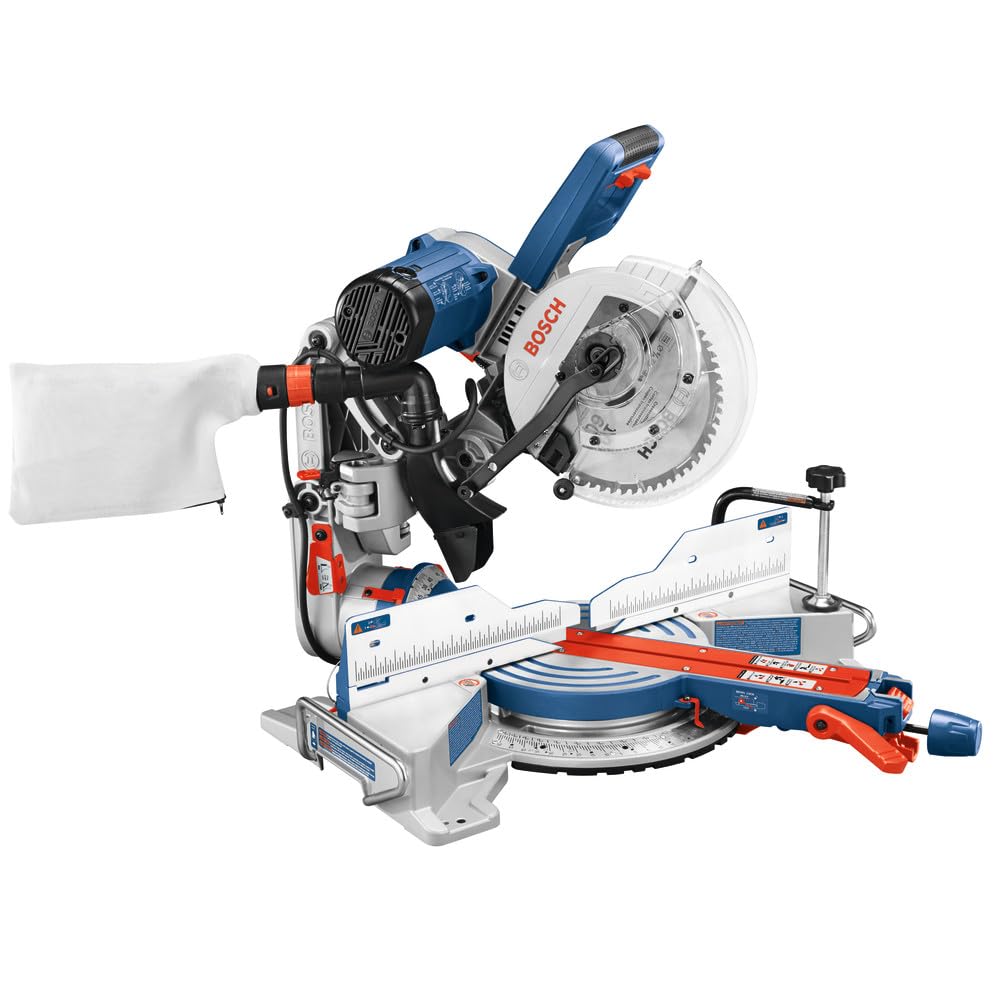
The glide saw that reclaims ten inches of bench by folding its arms instead of sliding on rails.
Conventional sliders need clear space behind the saw for rails to travel. This Bosch uses articulated hinge arms instead, and those arms reduce the front-to-back footprint by up to 10 inches compared with slide saws of similar capacity. That is why it fits a narrow shop bench where a rail saw would crowd the wall. The Axial-Glide system is built around that hinge, and it moves the head smoothly without the wear points of side rails.
Capacities are serious: 12-inch horizontal cut capacity, 5-1/2-inch vertical baseboard capacity against the fence, and 6-inch crown capacity nested against the fence. The 15-Amp motor delivers 4,800 no-load RPM. Tall sliding 4-1/4-inch fences support those large trim cuts. The bevel lock lever and range selector sit up front, so you are not reaching behind the saw between cuts. A wide 47 left/47 right bevel range with detents at 0, 33.9, and 45 degrees both ways covers the common bevel angles, and miter detents include 0, 15, 22.5, 31.6, 45, and 60 degrees.
What this saw does better than any other here is feel smooth and precise out of the carton. Accuracy and quality are the traits owners talk about most — angles land right on the first check and the bevel and miter adjustments move cleanly. Ergonomics and value are the softer notes: at 64 lbs this is a heavy saw, and it costs a premium for the glide system. If you want a saw that stays planted and moves cleanly between bevel and miter settings, the glide mechanism justifies its price. If you move your saw daily, it does not.
glide arm saves space
- Articulated arms cut the front-to-back footprint by up to 10 inches
- 12-inch horizontal cut, 5-1/2-inch baseboard, and 6-inch crown capacity
- 47/47 bevel range plus miter detents at 0, 15, 22.5, 31.6, 45, and 60 degrees
- Front-mounted bevel lock and range selector
premium price tag
- 64 lbs stationary — set it and leave it
- Premium pricing for the glide mechanism
- Ergonomics gets a divided read from owners
tight workshop: in a tight shop where bench depth is the constraint and you want angle changes to feel easy.
budget build: if you need a portable saw or want the lowest entry point into dual-bevel cutting.
11. Makita LS1019L Miter Saw

A 10-inch slider that carries the crown capacity of a 12-inch and slides on steel ball bearings.
Buying a 10-inch saw that cuts like a 12-inch is the whole point of this machine. It carries 6-5/8-inch nested crown molding capacity plus 5-1/4-inch vertical cutting capacity — the direct-drive gearbox and guard system is what creates that extra vertical room. A linear ball bearing slide system on a 2-steel rail design gives you single slide-glide motion, and because the rail layout lets the saw operate flush against a wall, it uses less bench than a conventional slider.
The blade is a 10-inch by 5/8-inch 60-tooth micro-polished miter saw blade shipped installed, along with a hex wrench, triangular rule, and vertical vise. That 60-tooth count is the finish-carpentry detail: fine teeth leave a cleaner edge on trim and molding than a coarse framing blade. The whole saw weighs 72.8 lbs, which is the heaviest here, and that mass is what keeps the head steady when you slide through a wide board.
What this saw is known for is smooth operation and dust collection — the slide feels controlled from the top of the stroke to the bottom, and the dust system captures more spoil than most saws in this lineup. The split data is 45-degree bevel accuracy, which some owners find off and others do not, and value, which is split both ways depending on what you compare it to. If finish trim is your living and you want the smoothest slide and best dust handling available here, this is the saw. If you split your time between rough framing and finish work, the SKIL above gives you more capacity per dollar.
finish carpentry: if you cut finish trim and molding professionally and want the smoothest slide and dust collection on this list.
rough framing: 72.8 lbs and the highest cost here, plus a 45-degree bevel that needs checking.
Know the Specs
Amps, RPM, and What TheyDo For You
Amps measure how much electrical current the motor draws — more amps generally means more resistance to bogging down in thick or hard stock. A 15-Amp motor is the standard in this lineup, and that current is what keeps the blade turning through a wet pressure-treated 2×6. RPM, or revolutions per minute, is how fast the blade spins. The Delta S7 at 5,500 RPM is the fastest here, while the WEN and SKIL run 4,800. Higher RPM tends to mean a cleaner cut in softwood because the teeth take smaller bites per pass; lower RPM with more torque tends to suit hard stock.
Positive Stops and Detents
A positive stop (also called a detent) is a preset notch in the miter plate that the head clicks into at a common angle — 0, 15, 22.5, 30, 45 degrees and so on. Every time you need a repeat angle, you swing the head to the detent and lock it, and the cut lands in the same place as the last one. The SKIL carries 11 positive stops and the DEWALT DWS716 carries 14, which is how you get through a room of baseboard without re-measuring between pieces. Between stops you rely on the scale, and that is where fine adjustment work happens.
Common Questions
Can a woodworking chop saw cut metal or PVC?
What blade size do I need for cutting 2×4 stock?
Do I need dual bevel or is single bevel enough?
How much bench space does a sliding miter saw need?
Is a cordless chop saw strong enough for real woodworking?
What is a shadow line and is it better than a laser?
How much crown molding can each saw cut?
Can I cut crown molding flat on the table instead of nested?
How loud is a 15-amp miter saw and do I need hearing protection?
Does the laser guide on a miter saw ever need adjusting?
The Bottom Line
For most woodworkers, the woodworking chop saw winner is the DEWALT 20V MAX* DCS361M1 — because it delivers 183 cuts of 2×4 pine or 275 cuts of 3-1/4 pine baseboard per pack, plus 11 positive stops and an adjustment-free cut line, all in a saw you can move without a second trip to the truck. If you want a light corded 10-inch machine instead, the Metabo HPT C10FCG2 gives you 52 degrees of miter swing at 24.2 lbs. And for a dedicated finishing bench, the BOSCH CM10GD folds its arms to save up to 10 inches of depth and holds its angles dead on.
One last pointer: the crowd has already done the sorting. The SKIL MS6305-00 sits at 4.5+ stars across 2,000+ owners — the highest rating count of any saw here — and the 10-inch blade with true 2×12 crosscut capacity is why. Whichever saw you land on, buy once by matching blade size, bevel direction, and bench space to the work you do most.
How we choose
We do not accept paid placement. Every pick is matched to a real buyer and a real use-case; we do not hands-on test units.
Sources
Specifications: manufacturer listings and product documentation. Review insights: verified customer reviews, as of November 2026. Pricing: not shown on this page (it changes often); check the current price via the retailer link.
As an Amazon Associate, Tactical Gear Guy earns from qualifying purchases. This does not affect which products we feature.