Specs are compiled from manufacturer listings and verified buyer reviews and can change over time — please confirm the key details on the product page before buying.
Most lathe disappointment does not come from the lathe. It comes from a chisel that will not hold an edge, a tool rest that flexes, or a chuck that lets go halfway through a bowl. If you want the short answer: get a solid carbide turning set, a rigid tool rest, and a chuck that fits your spindle thread — the rest is refinement. This guide sorts the nine accessories that actually change how a project turns.
This guide is built by comparing the manufacturers’ published specifications and the patterns across verified customer reviews, so you get each pick’s real strengths and trade-offs instead of marketing spin.
Carbide inserts skip the grinding bench entirely, while traditional M2 high speed steel (a steel blend that keeps its edge under heat) rewards a sharpen-and-go rhythm. Below you’ll find the accessories that make the difference on the lathe, including what to check before you buy any woodturning lathe accessories.
Top Picks


How To Choose The Best Woodturning Lathe Accessories
The accessory that ruins more evenings than any other is the wrong chuck thread. A chuck is the round gripping head that holds your blank on the spindle. If its thread does not match your lathe spindle, it never mounts — no adapter saves you. Measure your spindle before you shop for anything that screws on.
Match the spindle thread and stem diameter first
Chucks come threaded in common sizes like 1″ x 8TPI (threads per inch) and 3/4″ x 16TPI. Tool rests sit on a metal post called a stem, and that stem has its own diameter — a 1″(25.4mm) post only fits a banjo (the clamp that holds the rest) sized for it. Write both numbers down before you open a product page.
Decide between carbide inserts and traditional steel
Carbide inserts are small replaceable cutting tips that you rotate or swap instead of sharpening. They flatten the learning curve for a new turner. Traditional M2 high speed steel chisels cut cleanly but need a grinder and a jig to stay sharp. Pick one rhythm and build around it rather than buying both at once.
Think about what you actually turn
Pen blanks and small pulls want a short rest and a smaller chuck. Deep bowls want long-handled scrapers and a chuck with real gripping force. Buying a heavy bowl setup for pen turning wastes money and gets in the way of the tailstock.
Side-by-Side Comparison
| Model | Best For | Type | Key Size | Material | Amazon |
|---|---|---|---|---|---|
| YUFUTOL Carbide Mini 3-Piece Set★ Best Overall | Small to mid-size projects | Carbide insert tools | 12.6″ overall length | High carbon steel bar, wood handle | Amazon |
| BMWOOD 12″ Tool RestRigid Support | Rigid support on Jet lathes | Tool rest | 12″ with 1″ post | Cast iron | Amazon |
| PSI LCSIDE2 Scraper SetHollowing Specialist | Deep hollowing and bowl interiors | Scraper chisels | 19″ and 16″ overall | M2 high speed steel | Amazon |
| NNBWKIXI 6″ 4-Jaw Chuck | Large blanks and square stock | Lathe chuck | 6″ body, 1″ x 8TPI | Alloy steel | Amazon |
| Aogbra Carbide 6-in-1 System | Beginners building a first kit | Carbide tool system | 11″ handle plus 9.8″ extension | Stainless steel, aluminum handle | Amazon |
| VINWOX SCR4-4 4″ Chuck | Mini and midi lathes | Lathe chuck | 4″ body, 1″ x 8TPI or 3/4″ x 16TPI | K1045 steel, nickel plated | Amazon |
| BMWOOD BG-GRIND4 Jig System | Sharpening gouges and skews | Grinding jig | 4-piece set | Steel | Amazon |
| DEEFIINE 8-Piece HSS Chisel Set | One-box traditional tool kit | HSS chisels | 11.6″ handles | M2 high speed steel, beech handles | Amazon |
Detailed Reviews
1. YUFUTOL Carbide Woodturning Tool Mini 3-Piece Set
Our pick — 4.5+★ from 650+ verified ratings; the strongest balance of quality and price.
Three tools, six cutters, no complicated angles to learn — the shortcut into turning.
If you have never touched a lathe, this is where to start. The set gives you a finisher, a rougher and a detailer, plus two round 12mm cutters, two square 11mm cutters and two diamond cutters with a radius edge. The whole point of a carbide insert is that you do not sharpen it — you spin it to a fresh face or swap it. No grinder, no jig, no angle gauge.
The numbers that matter are the working length. Each bar runs 4.72″ (120mm), the wood handle adds 7.87″ (200mm), and the tool measures 12.6″ (320mm) end to end. That is a small tool — and it is meant to be. It lives on a short tool rest for pens, handles and small bowls. The manufacturer says to keep the shaft flat on the rest and level to the floor, which is exactly how carbide wants to be held. Compared with the Aogbra 6-in-1 system further down, this set is shorter, lighter and simpler: no extension shaft, no swan neck.
Owners consistently praise how cleanly the fresh carbide edges cut. Owners describe sharp blades that cut very well and extra cutters in the box — the practical version of never stopping mid-project. A recurring note is that these cut best on a smooth tool rest, so pair this set with the BMWOOD cast iron rest below and the difference is immediate. The limit is reach: a 4.72″ shaft bottoms out inside anything deeper than a small bowl. Turn a 10-inch bowl with a 4.72″ shaft and you will feel the reach run out. Think of it as the tool you grab for everything under a few inches.
Why turners keep reaching for it
- Six cutters included — two round 12mm, two square 11mm, two diamond
- Rotate or swap inserts instead of sharpening
- 12.6″ (320mm) overall with a 7.87″ (200mm) wood handle
- No complicated angles to learn, which shortens the first-project curve
Where it stops
- 4.72″ (120mm) shaft is short for deep bowl work
- Cutting quality depends on a smooth tool rest
- Mini scale means small projects only
Buy this if: you want to turn pens, knobs and small blanks without owning a grinder.
Bowl turners look elsewhere: the short shaft runs out of reach inside a deep form.
2. BMWOOD Integrated 12″ Tool Rest with 1″ Post
Chatter usually traces to a flexing tool rest, not a dull chisel — a cast iron rest fixes it for less than a new gouge.
Tool flex shows up as a rippled surface and a tool that wants to skate. BMWOOD answers that with a cast iron body weighing 2.64 pounds, cut with a 45° slope that lets you use several grip styles while keeping close control. The top is rounded, so a chisel glides along the length instead of catching on a hard corner. For reference, that 2.64 pounds is very close to the 2.7-pound PSI scraper set below — this is a substantial lump of metal, not stamped sheet.
The fit question decides everything. This rest has a 1″(25.4mm) diameter stem with a length of 80mm. The manufacturer is direct about it: measure your existing stem before ordering. A rest that wobbles in the banjo is worse than the stock one. Get the diameter right and the payoff is a 12″ working length that suits most midi and full-size lathes.
The cast iron build is what owners praise — it drops onto Jet lathes and fits as it should. It drops onto Jet lathes and fits as it should. The trade-off is length as much as anything: a 12″ rest gets in the way of the tailstock when you turn pens or light pulls, and a long spindle means moving the banjo to reposition. That is geometry, not a defect — which is why owning more than one rest length is normal.
The case for cast iron: a 12″ rest with a 45° slope and a rounded top gives you control and glide in one piece, and 2.64 pounds keeps it planted.
The measurement you must make: the 1″(25.4mm) stem and 80mm length only work if your banjo matches — check yours first.
Reach for this if: your stock rest flexes and you turn spindle work on a lathe with a 1″ banjo opening.
Wrong tool for: pen turners who need a short rest clear of the tailstock.
3. PSI Woodworking LCSIDE2 Round End Inboard Scraper 2pc Set
Thick M2 blades built to lean into a bowl wall without shaking.
Inside a deep form, the tool is where the vibration comes from. PSI fights that with blade thickness: the larger scraper carries a 1″ wide, 3/8″ thick blade on a 6″ blade length and 13″ handle, for 19″ overall. The smaller one runs a 3/4″ wide, 5/16″ thick blade with a 6″ blade and 10″ handle, 16″ overall. Stiff blades let you cut aggressively instead of nibbling.
These serve a specific job — blending the parallel side wall into the curved bottom of a vessel, final cuts inside bowls, and undercutting the rim of a small bowl. Both are M2 high speed steel, which holds its edge under the heat of a heavy cut. The set measures 26.3″ long by 4.09″ wide laid out, and weighs 2.7 pounds, so it feels like a serious tool in the hand rather than a light gouge.
Length is the catch: a 19″ scraper is awkward on a mini lathe and useless on a pen blank. Long handles give control and leverage, but a 19″ scraper is awkward on a mini lathe and overkill for a pen blank. This is a bowl-and-box set, and it wants a lathe that can swing the work. The two sizes cover most of what you would hollow: reach for the big one on a deep form, the small one when the wall closes in.
Built for the inside of a bowl
- M2 high speed steel blades on both tools
- Thick 3/8″ and 5/16″ blades resist vibration on aggressive cuts
- 19″ and 16″ overall lengths for reach and leverage
- 2.7 pounds between the pair, with wood handles
Know before you order
- 19″ length is unwieldy on a mini lathe
- Scrapers want a light final pass, not rough shaping
- Handle length makes them a poor match for pen turning
Made for: bowl and box turners who need a clean interior wall and a stiff blade.
Pass on it if: your lathe is small and your projects are pen-sized.
4. NNBWKIXI 6 Inch 4-Jaw Self-Centering Lathe Chuck

A six-inch body for square stock and big blanks, with the jaws to reverse.
Self-centering means turning one adjuster closes all four jaws evenly around the work — a four-jaw scroll design rather than independent jaws. This one has a 6″ body, 6.3″ capacity, and the jaws mount in either direction to grip a round or square blank from the inside or the outside. It threads onto a 1 x 8TPI spindle. The body is alloy steel, CNC cast, and it ships with two tightening levers and a set of installation tools.
At 3.7 kg it is the heaviest chuck in this group, and that mass is the point when you hang a large blank off the spindle. Fit is the thing that gets praised hardest and the thing to verify first: check your spindle thread before you order, because 1 x 8TPI is the only option here.
Here is the trade-off, and it is worth knowing before you commit. The jaw tightening mechanism draws mixed feedback — the mechanism can feel sloppy — and ease of use splits both ways. It is a workable chuck at a sensible mid-range tier, not a precision instrument. If you want a chuck with a smoother action and a wider thread choice, the VINWOOD below is the alternative; if you want maximum gripping surface for oversized blanks, this is it.
Grip where it counts: a 6.3″ capacity body with reversible jaws clamps square and round blanks from either side.
The catch: the jaw action feels loose to some hands, and only 1 x 8TPI spindles will accept it.
Suits you when: you hold large or square blanks and your lathe runs a 1 x 8TPI spindle.
Consider the alternative: if you need 3/4″ x 16TPI compatibility or a tighter-feeling jaw mechanism.
5. Aogbra Carbide Tipped 6-in-1 Wood Turning Tool System

One handle, four shafts, and a swan neck for hollowing — the whole kit in a case.
The design idea is sound: a single 11″ aluminum handle with a 9.8″ extension takes three carbide cutter shafts — circle, square and diamond — plus a swan neck hollowing tool. You change the shaft, not the tool. That variable-length arrangement is what makes it valuable to a beginner, because one purchase covers roughing, finishing and hollowing, and it all packs into an aluminum protective case with a foam insert. The kit also includes a T15 wrench and an Allen wrench.
The shafts are CNC machined from square high carbon steel, and the square profile is the quiet advantage — it sits flat on the tool rest and cannot roll away mid-cut the way a round shaft will. Carbide cutters are indexable, meaning you rotate to a fresh edge or replace the insert when it dulls. For a first turning kit, that removes the grinder from your shopping list.
Two things to plan around. The learning curve is real, and the handle screws can work loose during use — check them at the start of each session, not mid-project. It also weighs 4.29 pounds in the case, so it is a bench kit rather than something to toss in a bag for a class. Compare it with the YUFUTOL set at the top: the Aogbra gives you reach and hollowing capability, while the YUFUTOL gives you a lighter, simpler two-handed feel.
What makes it a smart first buy
- Four shafts on one 11″ handle plus a 9.8″ extension
- Swan neck hollowing tool and indexable carbide cutters included
- Square steel shafts stay put on the tool rest
- Aluminum protective case with foam insert
Watch these
- Handle screws can loosen during a session
- Expect a learning curve before cuts feel clean
- 4.29 pounds in the case is not a travel kit
Go for this if: you want one kit that covers roughing, finishing and hollowing from day one.
Skip the complexity: if you only turn small blanks, the mini set higher up is simpler.
6. VINWOX SCR4-4 4-Inch Self-Centering Wood Lathe Chuck

Threads onto 1″ x 8TPI or 3/4″ x 16TPI — an adapter does the switching.
VINWOX solves the biggest chuck frustration before it starts. The set includes an adapter that converts 1″ x 8TPI to 3/4″ x 16TPI, so it fits either spindle from the start. The body is 4″ in diameter, machined from K1045 steel and nickel plated for rust resistance, with both the jaw teeth and guides ground. The included 2″ dovetail jaws grip workpieces from 1-1/2″ to 3″ internally, or 2″ to 3-5/8″ externally — plus a screw chuck adds another hold.
It is sized for mini, midi and heavy duty lathes up to 14″ swing, and the manufacturer rates it for turning up to a 12″ bowl. In this lineup that is the chuck to reach for when you want a smaller body than the 6″ NNBWKIXI but a more refined fit. The self-locking system is meant to hold its grip after you tighten, and it also accepts the wider VINWOX chuck accessory range.
The K1045 steel body and included thread adapter are what justify the price. Tightness draws mixed feedback: some owners find the jaws hold solid, others report them loosening over time. Keep the jaw guides clean and it behaves. Confirm your spindle thread before ordering; VINWOX is blunt that other threads simply will not mount.
Two lathes, one chuck: the included adapter covers 1″ x 8TPI and 3/4″ x 16TPI, which is why it suits mini, midi and full-size lathes alike.
Realistic expectation: tighten firmly each session — grip can loosen, and that is the trade-off at this tier.
Your chuck if: you want a 4″ body with a rust-resistant finish and both common spindle threads covered.
Look to the 6″ chuck instead: if your blanks are large enough to want more gripping diameter.
7. BMWOOD BG-GRIND4 Complete Grinding Jig System
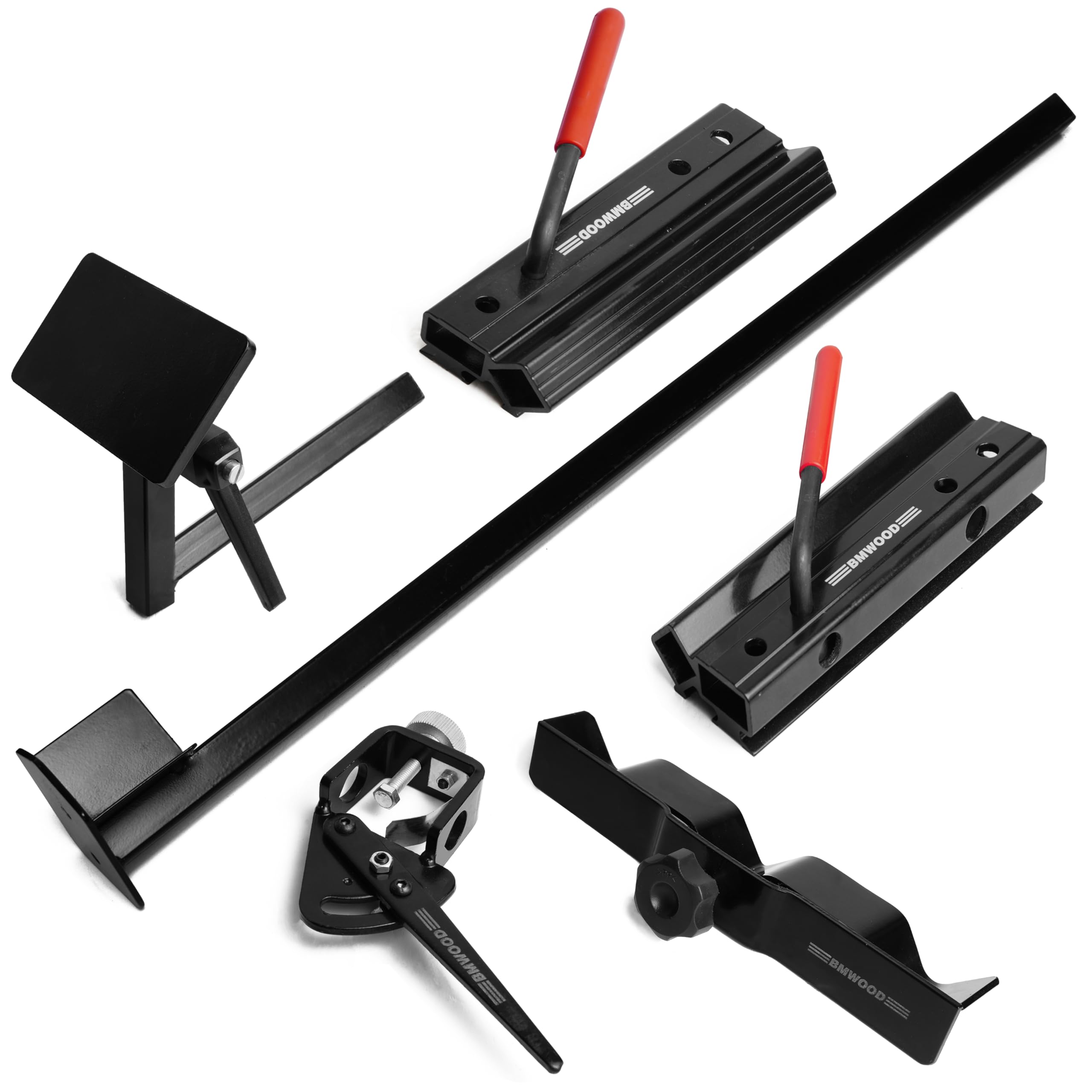
Replaces your grinder’s flimsy tool rests with a proper sharpening platform.
If you own M2 chisels, you own a sharpening job. This four-piece jig bolts two bases under each grinding wheel of your grinder, replacing the light-duty tool rests with a platform that holds a consistent angle. The v-arm holder supports a chisel at a constant angle, and the fingernail gouge jig upgrades it to a three-position tool holder for shallow spindle gouges and deep-fluted bowl gouges.
The setup is the part that earns praise. The platform repositions to different angles via an adjustable lock lever, and each base locks in place after you slide it in or out. Clear setup instructions come with it, and the whole system weighs 10.83 pounds, so it stays put on the bench. Performance on bowl gouges is exactly the task it was built for.
The gap is alignment: some units arrive out of true, and no angle guides are included. Some units arrive noticeably out of true, and the system does not include angle guides, so you have to set your own references. Check square before your first grind rather than after your first ruined edge. It is a bench tool, not a box you tuck away — this one lives on the grinder full time.
What it does well: holds a constant angle across gouges with a v-arm, fingernail jig and a repositionable platform locked by lever.
Check on arrival: verify alignment from the start and bring your own angle references.
The upgrade to make if: your grinder still wears factory rests and your gouges sharpen unevenly.
Only for bench grinders: there is nothing here to sharpen a tool without a grinder under it.
8. DEEFIINE 8-Piece M2 HSS Wood Lathe Chisel Set

The full traditional kit in one box — roughing gouge to skew, sharpened and ready.
This is the opposite philosophy to carbide. Eight tools cover the classic range: roughing gouge, spindle gouge, bowl gouge, scraper, parting tool and skew chisel, which handles bowls, pens and most wooden crafts. Every blade is M2 high speed steel — the same blend PSI uses in its scrapers above — chosen for hardness and heat resistance so it holds an edge through hardwood and exotic wood.
The handles are the standout. Each is an 11.6″ polished hardwood piece with a brass ferrule (the metal collar that stops the handle splitting), which gives you leverage and cuts hand fatigue. Longer handles also reduce kickback risk, because the tool stays braced against your body. Every chisel arrives pre-sharpened, so you can turn the day it lands, and M2 steel takes repeated sharpening without giving up.
The catch is the natural one for traditional tools: they will need resharpening, and doing that well means a grinder and something like the BMWOOD jig above. The reinforced structure resists deforming or breaking, and the set fits most bench and floor lathes. If you want zero maintenance, buy carbide; if you want the traditional feel and control of a bevel rubbing the wood, this is your set.
Why traditional turners choose it
- Eight tools from roughing gouge to skew chisel
- M2 high speed steel blades hold an edge under heat
- 11.6″ beech handles with brass ferrules
- Pre-sharpened and ready for the first cut
Plan for this
- Needs resharpening, so a grinder and jig are on the list
- Bevel control takes practice compared with carbide
Pick this set if: you want the traditional cutting feel and a full kit with long handles.
Different route: if sharpening is off the table, carbide inserts are the easier path.
Know the Specs
Spindle Thread (TPI)
A chuck screws onto the lathe spindle, and that thread is measured in threads per inch, written like 1″ x 8TPI or 3/4″ x 16TPI. The number must match exactly. A 1″ x 8TPI chuck will not mount on a 1″ x 12TPI spindle, and no adapter in the box changes that. Confirm the thread on your lathe first, then shop.
Carbide Inserts
Carbide inserts are replaceable cutting tips — round, square or diamond — held by a screw on a steel shaft. Instead of grinding an edge, you rotate the tip to a fresh face or fit a new one. They shorten the learning curve, but they are consumable, so a refill set belongs on the shelf.
HSS Steel
M2 high speed steel is a steel blend built to hold hardness when it gets hot from a heavy cut. It keeps an edge longer than standard carbon steel and sharpens back up repeatedly, which is why traditional gouges and scrapers use it.
Tool Rest Stem and Banjo
A tool rest sits on a metal post called the stem, and the banjo is the clamp that holds it. The stem diameter — like 1″(25.4mm) — has to fit your banjo opening. Measure the stem you already own before ordering a replacement rest.
Common Questions
How do I know my lathe spindle thread size?
Do carbide inserts fit any carbide tool?
Will a 12″ tool rest fit my lathe?
What is the difference between a scraper and a gouge?
Can I use carbide tools without a grinder?
How big a bowl can a 4″ chuck turn?
Why do my carbide inserts keep breaking?
Do I need a grinding jig for sharpening lathe chisels?
Which is better for a beginner, carbide or HSS?
Can I use a 6″ chuck on a mini lathe?
The Bottom Line
For most turners, the best woodturning lathe accessories starting point is the YUFUTOL Carbide Mini 3-Piece Set — six cutters, no sharpening, and the shortest path to a clean cut. If your tool rest flexes, add the BMWOOD 12″ Tool Rest and the chatter stops. And if you decide to go traditional, the DEEFIINE 8-Piece HSS Set with its 11.6″ beech handles is the one to reach for.
How we choose
We do not accept paid placement. Every pick is matched to a real buyer and a real use-case; we do not hands-on test units.
Sources
Specifications: manufacturer listings and product documentation. Review insights: verified customer reviews, as of November 2026. Pricing: not shown on this page (it changes often); check the current price via the retailer link.
As an Amazon Associate, Tactical Gear Guy earns from qualifying purchases. This does not affect which products we feature.