Specs are compiled from manufacturer listings and verified buyer reviews and can change over time — please confirm the key details on the product page before buying.
Here is the short answer: buy the Fein Turbo I Set if you want one machine that actually moves the dust and does not scream at you while it does it. Every other machine here trades something away — more airflow, a bigger bag, a built-in cyclone, or a lower entry point. Below you get what each machine pulls, how loud it gets, and who it was really built for, so you can pick the trade-off that fits how you work wood.
This guide is built by comparing the manufacturers’ published specifications and the patterns across verified customer reviews, so you get each pick’s real strengths and trade-offs instead of marketing spin.
The core problem is that shop vacuums and dust collectors get sold on one big airflow number, and airflow alone will not keep fine sanding dust out of your lungs or your rags. What matters is the whole chain: how much air the machine moves at the tool, how small a particle the filter actually traps, and how loud the whole thing is when it runs for an hour. The picks below are picked on that chain, and this woodshop vacuum system breakdown shows you where each one stops and the next one starts.
Top Picks


How To Choose The Best Woodshop Vacuum System
Most people buying their first woodshop vacuum system are shopping for the wrong thing. They read a big CFM figure on the box and assume that is the whole story. It is not. The number you get at the machine is only the starting point, and every fitting between the vacuum and the tool eats into it. A machine rated at 660 CFM can feel weak behind a long, narrow hose, while a smaller unit with a short 13-foot hose can feel strong. Read the airflow, then read the hose diameter and the filter, and only then decide.
Start with the job, not the motor
If you run a table saw, a router, or a belt sander in a garage, you need airflow that stays up while the tool is running. If you do small work — carving, engraving, scroll saw, a CNC router bed — you need a machine that catches fine particles close to the work, and a compact footprint matters more than raw volume. If you are cleaning up chips and sweepings as well as dust, a wet and dry unit with a bag earns its keep. Match the machine to the biggest job you actually do, not the biggest one you might do.
Why micron ratings matter more than you think
A micron is a millionth of a metre, and the fine dust your sander throws is the part that stays in the air the longest. A 2.5-micron bag catches a good chunk of it. A 1-micron bag catches more. A machine rated for HEPA filtration (High Efficiency Particulate Air, a filter standard for trapping the tiniest particles) is a further step. If you work with board after board and the garage goes hazy, filtration is the spec to chase — not the CFM figure.
Decide if you want an extractor or a collector
These two names get used interchangeably, and they are not the same machine. A dust extractor is built around a hose and a hand tool — quieter, more focused suction, and often a HEPA filter. A dust collector is built around a big bag and a wide inlet — more volume, louder, and better at pulling chips from a fixed machine. Some of the picks on this list do one job beautifully and the other poorly. Know which one you need before you start reading.
Side-by-Side Comparison
| Model | Best For | Airflow | Capacity | Noise Level | Amazon |
|---|---|---|---|---|---|
| Fein Turbo I Set★ Best Overall | All-round shop extractor | 151 CFM | 5.8 gallons | 66 dB | Amazon |
| WEN DC3401Best Value | Budget chip collection | 660 CFM | 12 gallons | — | Amazon |
| WIZMAKER CNC VacuumBest for CNC | CNC router beds | 16kPa suction | 2 x 10 liters | — | Amazon |
| Oneida Dust Deputy Low-Pro | Cyclone upgrade for any vac | Fits 2.5 in hose | 5 gallons | — | Amazon |
| Abestorm DecDust 780S | Timed air cleaning | 100 watts | MERV-13 filter | — | Amazon |
| VEVOR 560CFM Wall Mount | Wall-mounted chip collection | 560 CFM | 21 gallons | ≤ 90 dB | Amazon |
| ShopMax 20 Gal. | High-volume chip hauling | 677 CFM | 20 gallons | — | Amazon |
| PSI DC725 | Portable tabletop capture | 725 CFM | 2 x 10 x 20 in filter | Quiet fans | Amazon |
| POWERTEC DC5371 | Small-shop wall mount | 560 CFM | 1 micron bag | 80 db | Amazon |
| Festool CT 15 | HEPA tool extraction | — | 15 liters | — | Amazon |
| DEWALT DWV010 | Self-cleaning HEPA extraction | 150 CFM | 8 gallons | — | Amazon |
Detailed Reviews
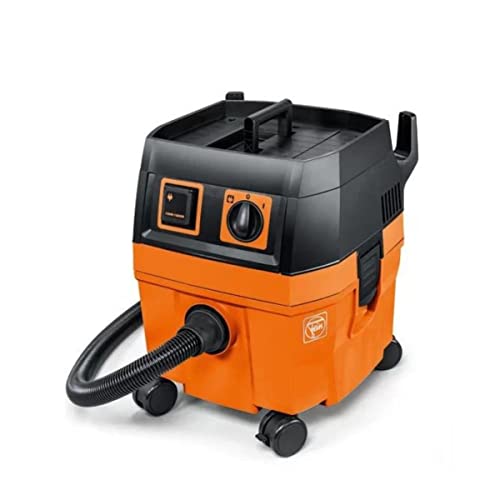
1. Fein Turbo I Set Wet/Dry Dust Extractor 5.8-Gallon Capacity
Our pick — 4.5+★ from 450+ verified ratings; the strongest balance of quality and price.
The quiet one that moves serious air — 151 CFM at just 66 dB.
You plug a sander into the autostart outlet on this machine and the vacuum wakes up when the tool does. That outlet has a built-in power-on delay, which stops the current spike that can trip a breaker when two hungry machines start at the same moment. That single feature is why this is the pick for anyone who runs a tool for an hour at a time and does not want to think about the vacuum again. The suction comes from an 1100W turbine (the fan-and-motor assembly that creates the pull) rated at 151 CFM (cubic feet per minute, a measure of how much air it moves) and 98 inches of water lift (a measure of how hard it pulls). That lift figure is what matters when you work through a long hose with a narrow nozzle, because it keeps the pull strong at the far end.
Reach is the other thing this handles. A 19.7-foot power cord and a 13-foot hose means you can work from one outlet across most of a two-car garage without stopping to hunt for a plug. The hose ships with a tool coupling that has suction control, so you can dial the pull down when you are working near a delicate edge. And if the garage goes dry and staticky in winter, the anti-static function with optional accessories helps stop electrostatic buildup.
Now the honest part. The 5.8-gallon capacity is small for a full day of planing and jointing — you will be emptying it more often than you would with a 12- or 21-gallon collector. The HEPA filter and the quiet design are what you are paying for here, not the bag size. This is a machine you buy because it filters and it shuts up. If your priority is emptying less often, look at the WEN DC3401 below, which holds 12 gallons to this unit’s 5.8 — though that machine is a different animal entirely in noise and filtration.
What owners keep talking about
- Performance is the thing that gets praised most — 151 CFM through an 1100W turbine holds steady behind a sander, and 98 inches of water lift means the pull holds up through a long hose.
- 66 dB is genuinely quiet for a machine moving this much air — quiet enough to hold a conversation over it in a garage.
- Tool-activated autostart syncs the vacuum to your tool, so there is no separate switch to flip with dusty hands.
- A 19.7-foot cord plus a 13-foot hose means you work from one outlet instead of chasing sockets.
Where it stops earning its keep
- 5.8 gallons fills fast on planing and jointing runs — you will empty it more often than a collector with a 12- or 21-gallon bag.
- The HEPA filter and quiet turbine carry the cost here, so budget buyers pay for filtration they may not need.
- Build durability is the one thing the review pages argue about — treat the hose and fittings with care.
Buy this if: you run a sander, router, or track saw on a hose and you want the pull to hold and the noise to stay low.
But know: the 5.8-gallon bag is the real limit — heavy stock removal means frequent emptying.
2. WEN Woodworking Dust Collector DC3401
The entry point that actually pulls 660 CFM for chip duty.
If you want a lot of air moving for very little money, this is the one. A 5.7-amp brushed motor spins a 6-inch impeller that moves up to 660 cubic feet of air per minute, and that is a real number for chip collection at a table saw or planer. The 4-inch dust port is the standard size that mates with most woodworking machines, so you are not hunting for an adapter on day one. The bag is 12 gallons — 2.1 times the 5.8-gallon capacity of the Fein Turbo above — which means fewer emptying stops on a run of boards.
The practical side is well thought out for a garage. It has a carrying handle on top, lockable swivel casters so you can roll it to the tool and lock it in place, and an optional wall mount if floor space is tight. The 5-micron zippered collection bag is fine for chips and heavier debris, and a two-year warranty backs the machine. For someone setting up a first shop, this is the cheapest way to get real airflow at the machine rather than a shop vac pretending to be a collector.
The catch is filtration and the sound. A foam filter and a 5-micron bag are built for chips, not for the fine dust a random orbital sander throws — and this is not a quiet machine. The cleaning performance is also the most debated part of the picture: some owners find it better than a shop vac, others find it worse. Neither is wrong; it depends on what they were vacuuming before. If you sand a lot and breathe the air, this is not the machine. If you cut and plane and want chips out of the way cheaply, it is.
My read: 660 CFM and a 12-gallon bag at the entry tier is a lot of chip-moving for the money, and the 4-inch port plus lockable casters make it a proper machine rather than a toy.
Trade-off to weigh: the 5-micron bag and foam filter are chip-grade, so fine sanding dust passes through — pair it with a separator if you sand heavily.
Reach for this if: you are setting up a first shop and want airflow at the machine without paying premium money.
Look elsewhere if: fine sanding dust and quiet operation are your priorities — this one is loud and chip-focused.
3. WIZMAKER CNC Vacuum Cleaner
Built for the router bed, not the garage floor.
This is not a general shop vacuum and it does not pretend to be. It is a dust collector designed to sit on a CNC router (a computer-controlled cutting machine) and catch debris right at the cutter, built around an 800W high-power motor that generates 16kPa of suction force (a pressure measure of how hard it pulls). That suction number is a pressure figure, not an airflow figure — it tells you how hard the machine pulls through a narrow opening. That is exactly what you want when dust comes off a spinning bit in a tight pocket. It ships with a 38mm diameter hose and two 10-liter storage bins, so you get secondary separation (a first bin that drops the big chips before they reach the filter) without buying a cyclone lid separately.
The feature nobody else on this list has is the built-in high-brightness LED auxiliar light. It lights the engraving surface directly, so you can watch the cut line in real time and catch a visual deviation before it ruins the piece. Vacuuming and lighting at the same time sounds like a small thing until you have carved with a headlamp strapped to your forehead. It is a genuinely useful pairing for anyone whose work is small, precise, and lit poorly under a shop light.
What you give up is scale. Two 10-liter bins are far smaller than the 12-gallon bag on the WEN above, so you empty them more often on a long cut. The whole machine weighs 11.38 pounds — light enough to lift onto a bed, which tells you it is not built for a full day of planing oak. This is a dedicated CNC accessory. If you want one machine for the whole shop, this is not it. If your CNC is the tool you run most, this was made for you.
For the CNC crowd: 16kPa of suction through a 38mm hose plus a built-in LED aimed at the cut line solves the two hardest problems on a router bed — keeping the pocket clear and seeing what the bit is doing.
The honest limit: two 10-liter bins and 11.38 pounds of machine mean small jobs, not big stock removal.
Suits: the CNC owner who wants debris gone and the cut line lit in one unit.
Wrong tool for: anyone who needs a whole-shop collector with a big bag and long runtime.
4. Oneida Dust Deputy Low-Pro Deluxe Lid Dust Separator Kit

Turns any shop vac into a two-stage dust machine with one lid.
If you already own a wet/dry vacuum, this is the upgrade that makes it behave like a proper dust collector. A cyclone separator uses the spin of the incoming air to drop heavy debris into a bucket before it ever reaches your vacuum’s filter, and Oneida rates this lid at up to 99.9% separation of dust and debris before the vacuum’s filter. The whole point is that your vacuum’s filter stays clean, so it keeps pulling the way it did on day one instead of choking on chips after a few hours of planing.
The design is low-profile — just 4 inches tall — which is why it fits under a workbench where a full cyclone stack would not. The bucket is clear, so you can see the fill level at a glance and empty it before it backs up into the vacuum. The caster base adds stability and has built-in slots to keep your hose fittings and attachments organized and close to hand. It fits a 2.5-inch shop vacuum hose with 2.25-inch inside-diameter ports, which covers most wet/dry vacuums. The kit includes the lid, latches, the 5-gallon bucket, four caster mounts, the wheels, a 3-foot hose with swivel cuffs, and a 2.5-inch hose elbow adapter. It handles wood dust, drywall dust, concrete, metal shavings, pet hair, and water. And it is made in the USA.
The trade-off is setup. Putting the lid, latches, and caster base together is the part the reviews argue about — some find it straightforward, others find the required assembly fiddly. The other thing to weigh is that this is an add-on, not a machine. Without a vacuum underneath it, it does nothing. But if you already have a shop vac you like, this is a far cheaper way to get cyclone separation (a spinning funnel that drops dust before it reaches the filter) than buying a two-stage machine outright — and it handles wet pickups too, which a dust collector will not.
Why it earns a slot: Oneida rates the lid at up to 99.9% separation before the filter, which is what keeps a shop vac pulling instead of fading as chips pack the pleats — plus the 4-inch-tall lid slides under a bench where nothing else fits.
Where the friction is: the assembly is fiddly for some buyers, and it only works bolted to a vacuum you already own.
The right buy when: you have a wet/dry vac you trust and want two-stage separation without a two-stage machine.
The wrong buy when: you want a complete dust system in one box.
5. Abestorm DecDust 780S Tabletop Dust Collector with Timer
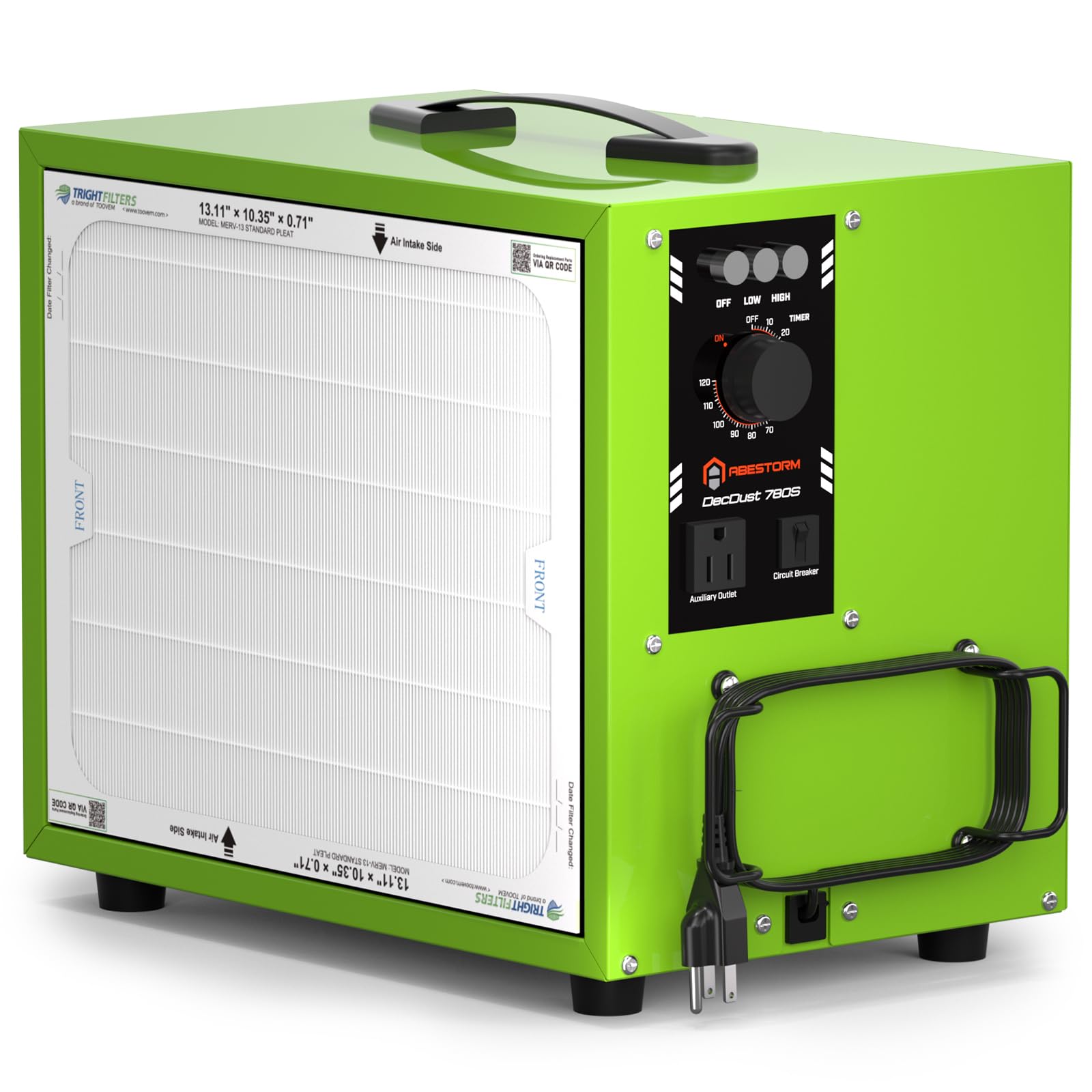
A filter that keeps working after you have put the tools down.
Most dust machines only help while the tool is running. This one is built around a timer that runs up to 120 minutes, so you can switch it on, walk away, and let it scrub the air in a garage that is still hazy with sanding dust. It runs a high-efficiency backward-tilt motor rated at 100 watts on 115 volts, with a circuit breaker that cuts power automatically if the current goes beyond its safe range. A piano key switch makes it quick to start and stop, and there is 11.5 feet of cord with a side wrap for storage.
The filter is a MERV-13 (a filter rating that captures finer particles than a basic shop filter), and it lasts up to 6 months. There is also an auxiliary outlet under the control panel so you can power another Abestorm shop dust collector from the same unit.
What it is not is a chip collector. There is no big bag and no wide inlet for a planer. It cleans air; it does not swallow a planer’s worth of shavings. The air filtration and noise level are the two areas where opinions split — some find the airflow strong enough, others want more, and the sound level is a matter of tolerance. If you have a dust-maker you cannot fully capture at the source, this runs in the background and keeps the visible haze down. If your problem is chips under the bench, look at the collectors instead.
The case for it: a 120-minute timer plus a MERV-13 filter means the machine keeps cleaning after the last cut — the part of dust control most people forget.
The catch: it is an air cleaner, not a chip collector, and the noise level is a matter of tolerance.
Made for: the carver, turner, or renovator who wants the air scrubbed on a timer after the work is done.
Not made for: hauling planer chips — there is no big bag and no wide inlet.
6. VEVOR 1 HP Wall Mount Dust Collector, 560 CFM
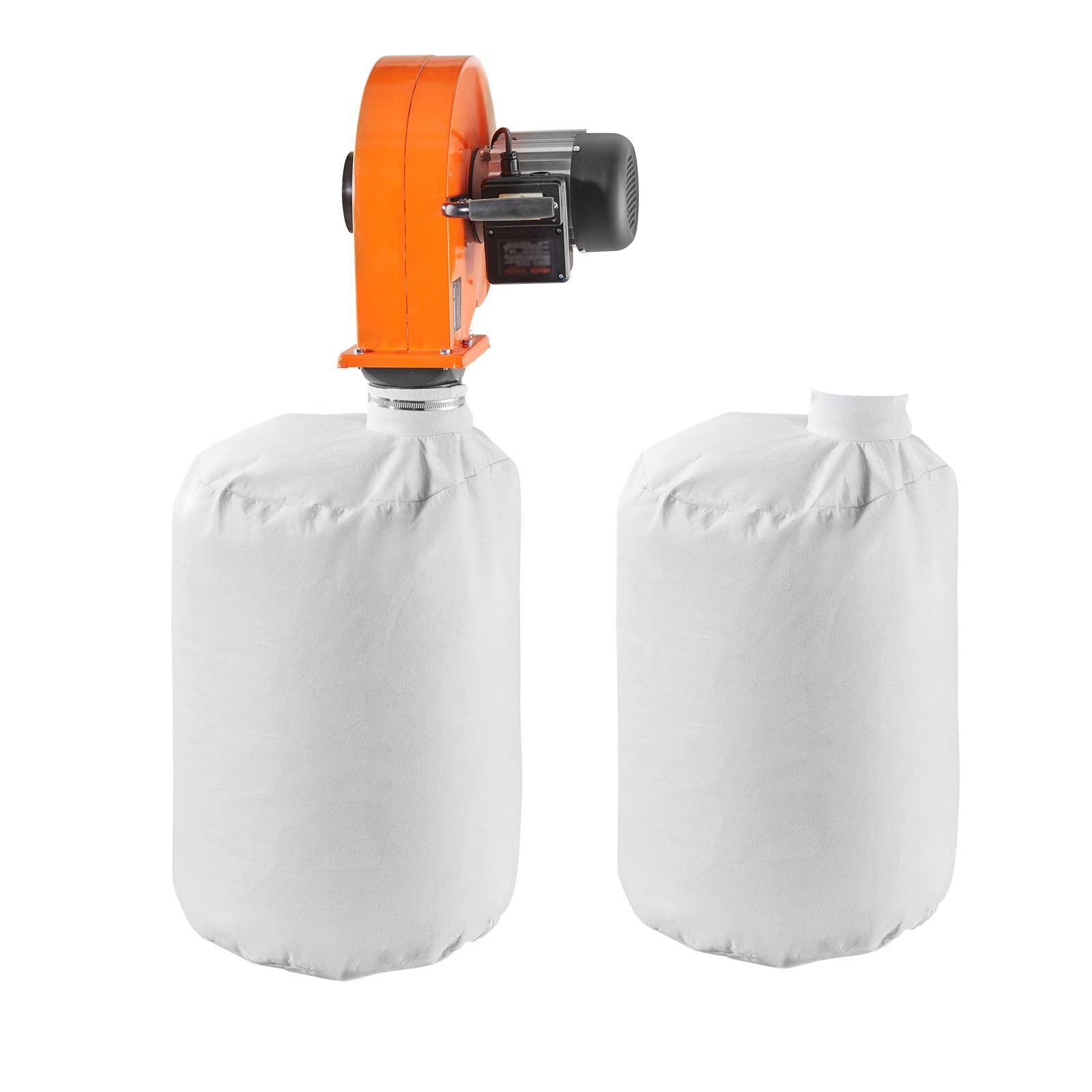
A big 21-gallon bag that hangs on the wall and stays out of the way.
Wall mounting is the smartest space move in a small shop, and this machine pairs that with a genuinely large bag. A 1HP high-performance induction motor (a motor type that runs cooler and steadier than a brushed one) delivers 560 CFM of airflow (cubic feet per minute, a measure of how much air it moves). The 21-gallon non-woven collection bag — 80 liters — means you are not emptying it every hour. It handles both coarse sawdust and fine sanding dust, and the overload-resistant design keeps airflow consistent over long sessions.
Filtration is the standout detail. A 2.5-micron bag catches fine wood dust that a 5-micron bag lets through, so the air in the shop stays cleaner while you work. The bag has a bottom zipper, so you unzip to empty it without detaching the whole bag or reaching for tools. Sound runs at ≤ 90 dB, which is a working-shop level — you will want hearing protection anyway, and this will not add to the problem much beyond that.
The trade-off is the mounting itself. A wall-mounted collector needs a solid wall and a location with room for the hose run, and at 24 pounds this one wants studs, not drywall anchors. It also comes as a unit only — one dust collector in the box — so you are supplying the hose and fittings to reach your tools. If you have wall space and a fixed tool layout, this is a clean way to keep the floor clear and the bag big. If your tools move around the shop, a rolling collector makes more sense.
What sells it: 21 gallons of capacity and a 2.5-micron bag at 560 CFM, all off the floor — that combination is rare at this level.
What to plan for: a solid wall and room for the hose run, since the machine ships without a hose.
Choose it if: your tools stay put and you want the bag and the motor off the floor.
Pass if: you roll your tools around the shop or have no suitable wall to mount to.
7. ShopMax 20 Gallon 6.3-Amp Dust Collector
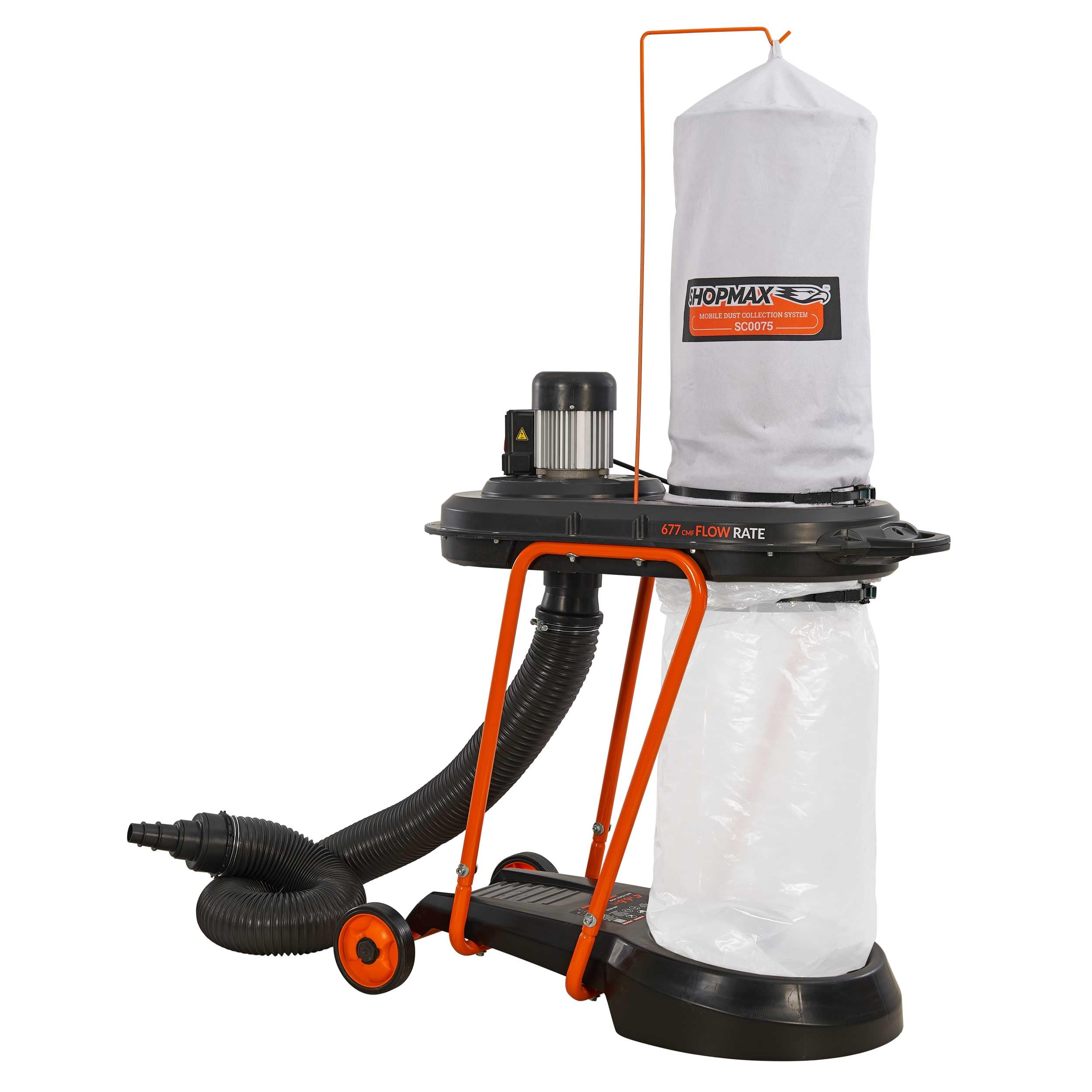
More airflow and more bag than almost anything else here.
On raw numbers this machine is the biggest chip hauler on the list. A 6.3-amp motor drives a 12-inch impeller (a larger fan that moves more air per turn) to a maximum airflow of 677 CFM, and the bag holds 20 gallons — 75 liters — of dust. That combination means you can set it next to a planer and run for a long time before you stop to empty it. Five hose adapters are included, so it connects to a range of woodworking machines and captures dust right at the source rather than letting it spread.
The practical build is straightforward: sturdy construction, a convenient on/off switch, two wheels, and an onboard carrying handle so you can move it around the shop. For a shop that produces volume — a lot of stock removal, a lot of chips — this is the machine that keeps up without constant emptying. The 12-inch impeller is the reason the airflow holds, and it is why this pulls harder at the machine than the smaller collectors.
Where it asks you to compromise is filtration and weight. The listing detail on the filter is thin, so if you sand fine dust all day you should assume this is a chip machine first and check the filtration before you buy. At 55 pounds it is not something you lift onto a shelf — it lives on its wheels. This is a collector for volume, not a fine-dust extractor for a sander. Buy it for the bag and the airflow, and plan a separate filter solution for finishing work.
The value read: 677 CFM into a 20-gallon bag with five adapters in the box is a lot of chip-hauling for a mid-tier machine.
The honest limit: 55 pounds on two wheels, and the filtration detail is thin — treat it as a chip collector.
Built for: high-volume shops that want to empty the bag once, not five times, in an afternoon.
Think twice if: you need proven fine-dust filtration or you have to carry the machine up stairs.
8. PSI Woodworking DC725 Portable Tabletop Dust Collector
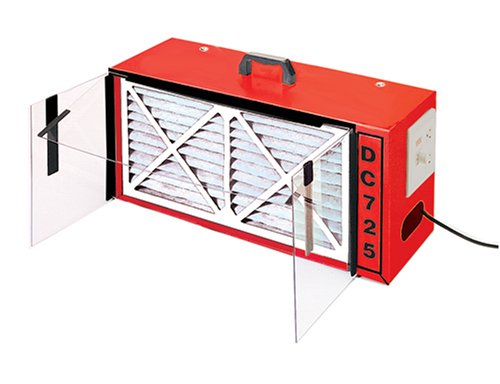
Three quiet fans and an adjustable hood that aims the air where you need it.
This is the one for the carver, the turner, and the person doing small work at a bench. Three computer-grade fans pull dust in, each on its own 110V variable speed motor, with a maximum airflow of 725 CFM and a total running draw of just 1.29 amps. Those fans are quiet and maintenance free — the kind of thing you can leave running next to you for hours without it becoming the loudest thing in the room. The steel impeller and the clear polycarbonate top hood and side doors let you direct the airflow where the dust is coming from, which is what makes a tabletop unit actually work.
The footprint is 23 inches by 8 inches and the height is 10.5 inches, so it sits on a bench without crowding your work. A carrying handle on top makes it easy to move from bench to bench, and there are two grounded 115V outlets on the side panel — plug your Dremel or woodburner straight into it. The variable speed knob lets you dial the pull down for delicate work. A 2-inch by 10-inch by 20-inch filter catches the dust, and one filter is included. It carries a two-year warranty for normal use.
The limit is clear once you look at the whole picture. A tabletop unit with a 2-inch-by-10-inch filter is built for fine dust off small work, not for bulk chips off a planer. The dust control and the noise level are the two things that make it worth owning — it catches sawdust and stays quiet enough to live with. What it will not do is replace a bag-and-hose collector for a big tool. Buy it to keep a bench clean and your lungs clear while you do small work, and keep the big collector for the big cuts.
Why owners like it: three variable-speed fans and an adjustable hood aim the pull right at the dust instead of hoping it drifts in, and the two side outlets keep tools close.
Where it stops: a 2-inch-by-10-inch filter is fine-dust gear, not a chip hauler.
Best fit: the bench worker who wants dust pulled away and the noise kept low while they carve, turn, or sand small pieces.
Not a fit: anyone expecting it to clear chips from a planer or a table saw.
9. POWERTEC DC5371 1 HP, 560 CFM Wall Mount Dust Collector

A 1-micron bag and a vortex base in a small-shop wall unit.
Fine dust is the reason this machine exists. It ships with a 1-micron filter bag — finer than the 2.5-micron bag on the VEVOR above — so it stops smaller wood particles from going back into the air. There is a built-in window so you can see the dust level, and a zipper for easy disposal. A 1HP induction motor delivers 560 CFM at 3450 RPM, and the motor runs on dual voltages, 120V or 240V, at 12 amps on 120V and 6 amps on 240V. If you have a 240V circuit in the shop, that second option runs the machine cooler.
The 4-inch inlet port mates directly to a dust-collector hose, so you can connect it to whatever machine you are running. A vortex base design guides the airflow in a controlled way to reduce turbulence and moves more dust — POWERTEC rates the vortex base at up to 10% better efficiency than a comparative model. Noise runs at 80 dB, which is a normal shop level. It hangs from a mounting bracket and comes in a steel blue finish, and at 35.5 pounds it wants a solid wall. Owners run it on table saws, sanders, and routers, and it is quiet enough to work beside.
One maintenance note is worth reading before you buy. The 4-inch port on the side has a built-in grate to stop large debris from damaging the impeller. Over time, debris can collect around that port and reduce efficiency, so the hose should come off regularly and the port checked for clogs. It is a small habit that keeps the machine pulling. Suction is the area where opinions split — 560 CFM is solid for a small shop, but if you expect a cyclone-style pull you will find it short. For a hobby or small pro shop on a wall, it earns its place.
The strongest points
- A 1-micron bag stops finer dust than a 2.5-micron bag — the difference you notice when the shop air stays clear.
- Dual voltage means 120V or 240V operation, so a 240V circuit runs it at 6 amps instead of 12.
- A vortex base guides the airflow to cut turbulence, and POWERTEC rates it up to 10% more efficient than a comparative model.
- 80 dB is a working-shop level that lets you run it alongside a table saw or router without shouting.
What to keep in mind
- The 4-inch port grate collects debris over time — pull the hose and check it regularly or efficiency drops.
- Suction is the point of disagreement; 560 CFM is solid for a small shop but not a cyclone-grade pull.
- At 35.5 pounds it needs a solid wall and a fixed tool layout.
Worth it for: the small shop that runs fixed tools against a wall and wants a 1-micron bag at 560 CFM.
The maintenance habit: clear the port grate regularly — ignore it and the airflow fades.
10. Festool 578441 CT 15 Dust Extractor
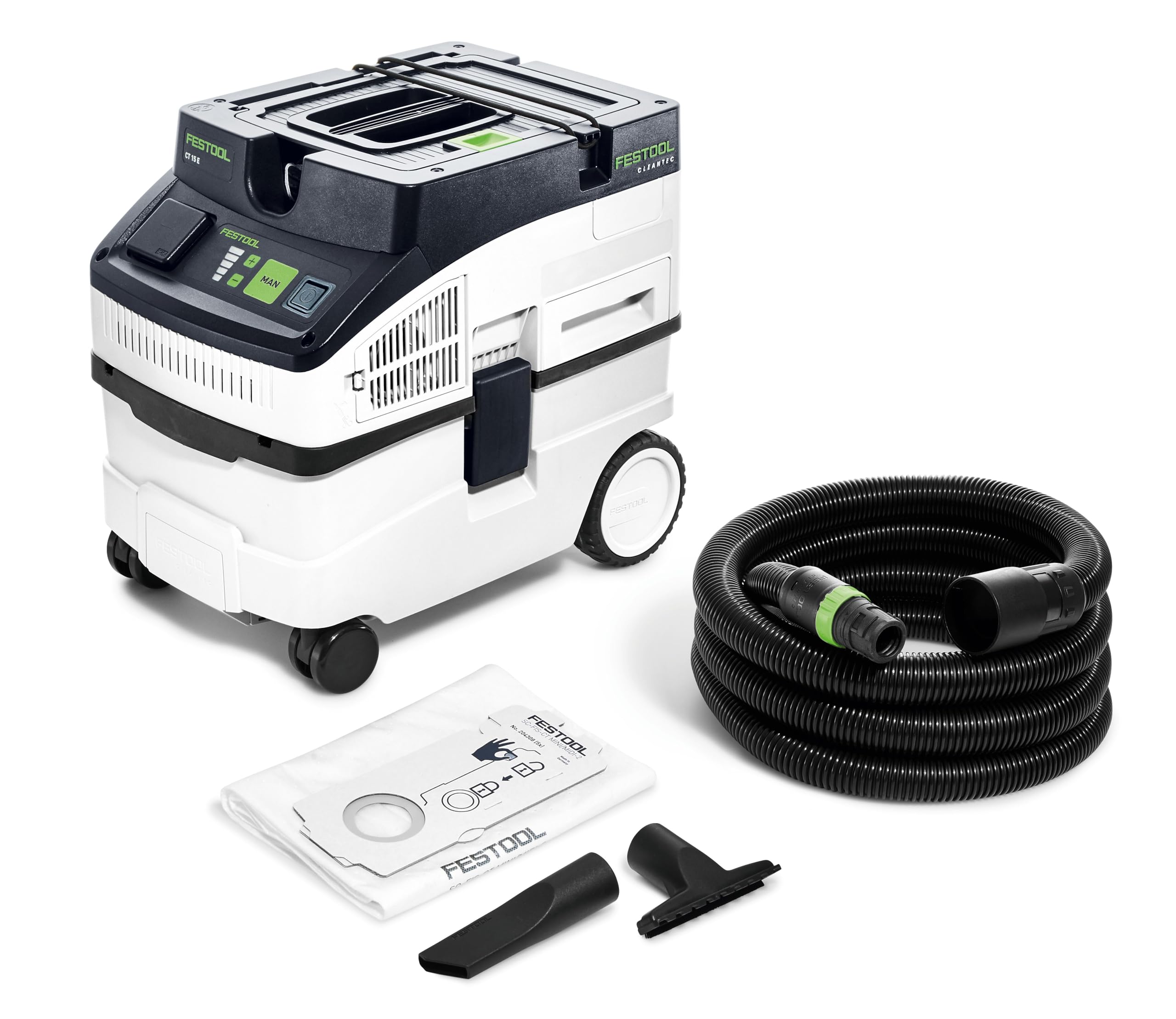
The HEPA-certified extractor that starts when your tool does.
This is the pick for someone whose priority is the air they breathe, not the size of the bag. The CT 15 is HEPA certified — a filter standard for trapping the finest particles — with an adjustable high-performance turbine and automatic tool start, so the vacuum runs when the tool does and stops when it does. The container holds 3.96 gallons (15 liters), which is small compared to the 20-gallon ShopMax above, but the point of this machine is filtration and control, not volume.
Festool builds it to travel. The dimensions are compact, the weight is low, and the chassis has steel axles on a stable footprint, so it moves around a job site without fighting you. Touch operation makes it intuitive to run, and the flat top of the storage means you can set work materials and other tools on it and they stay within reach. The crevice nozzle and upholstery brush are included and store inside the unit. A three-year comprehensive warranty covers it, wear and tear included, which is a longer promise than any other machine on this list.
The catch is capacity and price tier. At 3.96 gallons, a long planing session will have you emptying it, and this is a premium-priced extractor — you are paying for HEPA certification, tool start, and the warranty. It is also a single-power-level machine, so there is no dialing it down for delicate work. If your work is finishing, sanding, and cutting board goods where the dust is fine and the air matters, this is the pick. If you are hogging off material by the bin, a bigger collector does that job better.
The premium read: HEPA certification plus automatic tool start plus a three-year comprehensive warranty is the tightest dust-and-air package here.
What it costs you: 3.96 gallons of capacity and a single power level — this is a finishing machine, not a chip hauler.
The pick for: the finisher and cabinet maker who breathes the dust and wants HEPA filtration and tool start.
Not the pick for: heavy stock removal where a bigger bag and more airflow matter more than certification.
11. DEWALT DWV010 HEPA Dust Extractor, 8-Gallon
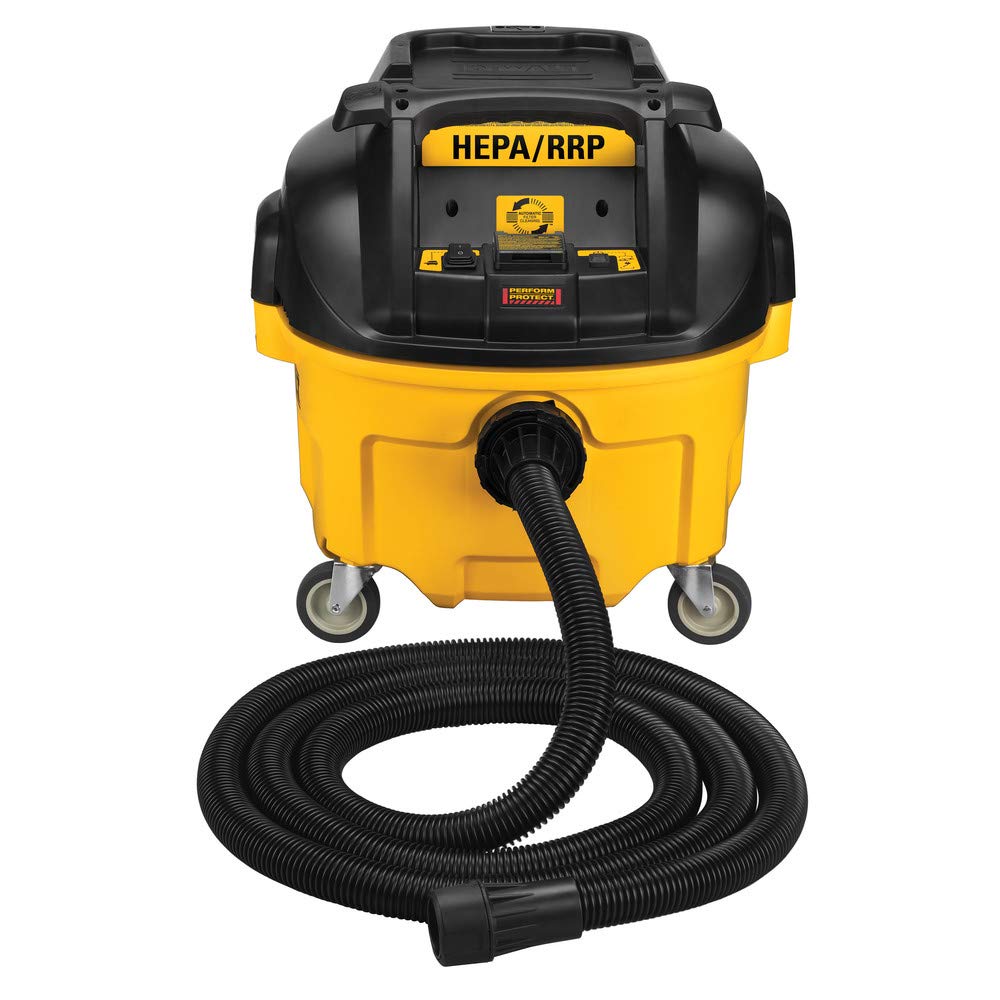
It pulses its own filter every 30 seconds so you never stop to clean it.
The feature that makes this machine worth owning is the automatic filter clean. It pulses the filter every 30 seconds, so you keep working instead of stopping to knock dust off. That matters on long sanding runs where a clogged filter kills the pull halfway through. A 15-amp motor delivers 150 CFM of airflow, and power tool actuation controls the on and off with the tool — plug a sander in and it starts when you do. The 8-galloncapacity sits between the small Festool CT 15 and the big ShopMax, and the universal hose connector provides a secure connection with swivel capability. A 15-foot anti-static hose with a 1.25-inch diameter gives you real reach across a bench.
Built for a job site, this machine rolls on heavy-duty wheels and casters. The 20-inch by 19-inch by 20-inch body weighs 22 pounds, so it moves without a struggle. It also meets the EPA Lead Related Renovations, Repair and Painting (RRP) rule for HEPA vacuums, but only with the DWV9330 filters fitted — so if lead or plaster dust is part of your work, check the filter part number before you rely on that.
The honest trade-offs are weight of purchase and a couple of split opinions. This is a premium-tier extractor, so you pay for the HEPA filter and the self-cleaning function. Suction and connectivity are the two areas where opinions divide — some find the 150 CFM and the hose connection exactly right, others want more pull or a different fitting. Durability is the one recurring gripe, so treat the casters and hose with care. For a remodeler working in occupied homes, the self-cleaning and the HEPA filter together are the reason to choose it over a cheaper collector.
Why it stands out: automatic filter cleaning every 30 seconds plus a 15-amp motor at 150 CFM means the pull stays strong through a long sanding session.
What to weigh: suction and connectivity divide opinion, and the EPA RRP claim holds only with the DWV9330 filters fitted.
Suits best: the remodeler or finisher who runs long sanding sessions and wants the filter cleaning itself.
Second thoughts if: you want proven suction above all else or you need the widest hose compatibility.
Know the Specs
CFM and Water Lift: Two Different Kinds of Pull
CFM (cubic feet per minute) measures how much air volume a machine moves — that is what clears a wide stream of chips off a table saw. Water lift measures how hard the machine pulls through a narrow opening — that is what matters at the end of a long, thin hose or a small sander port. A collector with high CFM and modest lift can feel weak at a small tool, while a unit with high lift moves less air overall. Read both figures when a listing gives them. The Fein Turbo I Set, for example, publishes 151 CFM and 98 inches of water lift, which is why it holds its pull behind a hand tool. CNC units often publish a pressure figure like 16kPa instead — that is a lift-style number, aimed at narrow ports.
Micron Ratings and HEPA: What the Filter Actually Traps
A micron rating tells you the largest particle a filter bag will let pass. A 5-micron bag catches chips and heavier debris. A 2.5-micron bag catches more of the sanding dust. A 1-micron bag catches finer still. HEPA filtration is a separate certification standard for trapping the finest particles, and it appears on the Fein Turbo I Set, the Festool CT 15, and the DEWALT DWV010. If you sand board goods and work in a closed garage, chase the smaller micron number or HEPA. If you cut and plane and the dust falls to the floor, a larger-micron bag is fine and cheaper.
Cyclone Separation and Two-Stage Systems
A cyclone separator spins the incoming air so heavy debris drops into a bucket before it reaches the vacuum filter. The Oneida Dust Deputy Low-Pro does this with a 4-inch-tall lid and a 5-gallon clear bucket, and it claims to capture up to 99.9% of dust and debris. The benefit is that your filter stays clean and your airflow stays strong instead of fading as chips pack the pleats. A two-stage setup — a separator plus your vacuum — is often cheaper than a purpose-built two-stage machine and handles wet pickups too.
Decibels, Motor Types, and Runtime
A decibel (dB) is a measure of sound pressure, and the scale is not linear — a few dB is a noticeable difference. The Fein Turbo I Set runs at 66 dB, the POWERTEC DC5371 at 80 dB, and the VEVOR at ≤ 90 dB. Induction motors, used on the VEVOR and POWERTEC wall units, tend to run cooler and longer than brushed motors. The POWERTEC also runs on dual voltages, 120V or 240V, at 12 amps or 6 amps — the higher voltage draws less current. Match the motor and the sound level to how long you run the machine at a stretch.
Common Questions
Will a shop vacuum work as a woodshop dust collector?
What CFM do I actually need at the tool?
Is a 1-micron bag worth it over a 5-micron bag?
Do I need HEPA filtration in a woodshop?
Can I run two machines from one auxiliary outlet?
How often do I need to empty the bag or bucket?
Can a dust collector handle wet pickup and drywall dust?
Is a quieter extractor worth paying more for?
Will a wall mount dust collector work in a small garage?
How do I stop a dust collector clogging at the port?
The Bottom Line
For most woodworkers, the woodshop vacuum system winner is the Fein Turbo I Set, because it moves 151 CFM and 98 inches of water lift at just 66 dB (a measure of sound level) with a HEPA filter and tool-activated start — that combination of pull, filtration, and quiet is what the whole list is measured against. If you want more bag and more airflow at the entry tier, the WEN DC3401 gives you 660 CFM into a 12-gallon bag. And if you already own a shop vac, the Oneida Dust Deputy Low-Pro is the cheapest way to turn it into a cyclone-equipped dust machine — the single smartest move you can make without buying a whole new vacuum.
The right pick depends on what you actually run. Fixed tools against a wall want the VEVOR wall mount or the POWERTEC DC5371 with its 1-micron bag. A CNC router wants the WIZMAKER CNC vacuum. A finishing bench wants the PSI DC725 or the timed Abestorm DecDust 780S. And if fine dust and air quality are the priority, the Festool CT 15 and the self-cleaning DEWALT DWV010 are where the money goes on filtration. Pick the machine that matches the biggest job you actually do, and the shop stays clean.
How we choose
We do not accept paid placement. Every pick is matched to a real buyer and a real use-case; we do not hands-on test units.
Sources
Specifications: manufacturer listings and product documentation. Review insights: verified customer reviews, as of November 2026. Pricing: not shown on this page (it changes often); check the current price via the retailer link.
As an Amazon Associate, Tactical Gear Guy earns from qualifying purchases. This does not affect which products we feature.