Specs are compiled from manufacturer listings and verified buyer reviews and can change over time — please confirm the key details on the product page before buying.
Buying Woods mower parts is a matching game, not a shopping spree. The single most useful thing you can do is read the OEM part number (the manufacturer’s original part number) off your old belt, blade, or idler and match it exactly — a 72-inch deck belt will not run on a 60-inch deck no matter what the listing photo suggests. This guide covers nine replacement parts that genuinely fit Woods decks and cutters, with the real deck sizes and part numbers spelled out so you can cross-check before you order.
This guide is built by comparing the manufacturers’ published specifications and the patterns across verified customer reviews, so you get each pick’s real strengths and trade-offs instead of marketing spin.
Below you will find belts measured to the inch, blades measured to the fraction, and honest notes on where each part is at its best. The result is a straight read on woods mower parts so you can order once and get back to cutting.
Top Picks

How To Choose Woods Mower Parts
Most wrong orders happen for one boring reason: the buyer matched the mower brand but not the deck size. Woods builds finishing mowers, turf batwings, and rear-discharge decks in several widths, and each width takes a different belt length. Before you buy anything, find the deck width stamped on your machine and the OEM number printed on the part you are replacing.
Match the part number first, the brand second
A belt listed for Woods 18879 and 18879RP is the same physical belt under two numbers, and both cross to a 72-inch deck. If your deck is a 60-inch RM-59, that belt is the wrong length entirely. Write your OEM number on a sticky note and check it against every listing’s compatibility line before you add to cart.
Read belt measurements in inches, not in model names
The two numbers that decide whether a belt runs are length and width. A 5/8-inch width is the common deck-drive profile on these Woods decks. Length is where decks split apart — 134 inches and 118 inches are two very different belts for two very different machines, and neither will substitute for the other. Some listings also publish a tolerance such as ±0.40 inches, which is a normal manufacturing allowance and not a defect.
Know what the belt material buys you
Aramid cord is the reinforcement layer inside a belt — think of it as the strength weave that keeps the belt from stretching under load. Belts with an aramid cord layer hold their length better under heat and heavy grass. A plain rubber body with a two-layer wrapping cover is the outer shell that takes the abrasion against the pulley.
Blades are a separate measurement puzzle
Blade length, center hole diameter, side hole size, and thickness all have to line up. A 24.94-inch blade with a 1-inch center hole and 1/2-inch side holes is a different animal from a 20 3/16-inch blade with a 5/8-inch center hole. Get any one of those four numbers wrong and the blade either will not mount or will not clear the deck housing.
Side-by-Side Comparison
| Model | Best For | Part Type | Key Size | Deck Fit | Amazon |
|---|---|---|---|---|---|
| 18879RP 72″ Deck Drive Belt (Kuumai)★ Best Overall | 72-inch decks needing a long-wearing drive belt | V-belt | 5/8″ x 134″ | RD72, RD7200, PRD72, PRD7200, RM660, GM1072R | Amazon |
| UDC Parts 18879 BeltMost Documented | Buyers who want published tolerance and support terms | Flat belt, aramid cord | 5/8″ x 134.13″ | RD72, RD7200, PRD7200, TBW240, TBW180 | Amazon |
| TGmaoyi 18879 BeltKevlar Build | Budget-conscious 72-inch deck owners | V-belt, Kevlar | 5/8″ x 134.13″ | RD72, RD7200, PRD7200 | Amazon |
| 5WP1001244 Drive Belt (GEATaaT) | RD6000 finish mower owners | Deck belt, aramid cord | 5/8″ x 118″ | RD6000, GM1060R | Amazon |
| 8TEN LawnRAZOR 23825 3-Pack | 60-inch BMB Woods decks needing three blades | Mulching blades | 20 3/16″ L, 5/8″ center hole | RM-59, 60″ decks | Amazon |
| WOODS OEM 53595 Flat Idler | Turf batwing and deck owners wanting a genuine OEM pulley | Flat idler pulley | 5.0″ diameter | 7144RD-2, 9180, 9204, PRD/RD6000-8400, MX series | Amazon |
| 1008199 Heavy Duty Blade 3-Pack | 72-inch decks with heavy grass and chipping concerns | Heat-treated blades | 24.94″ L x 2.5″ W x 0.25″ T | RD72, RD7200, RD7200-2, PRD7200 | Amazon |
| Oregon 91-585 3-Pack | Oregon-name buyers on 72-inch Woods decks | Lawn mower blades | 3-blade set, 91-585 profile | PRD7200, RD72, RD7200 | Amazon |
| SCITOO PTO Clutch | Deck control replacement on Grasshopper and Woods machines | Electric PTO clutch | 12.18 lb unit | Grasshopper 388740, Woods 388740, Warner 5218-165/225 | Amazon |
Detailed Reviews
1. 18879RP Deck Drive Belt
Our pick — 4.0+★ from 2,500+ verified ratings; the strongest balance of quality and price.
A 134-inch aramid V-belt that covers the widest spread of 72-inch Woods decks in this list.
If you run a 72-inch finishing deck, this is the belt that fits the most machines for the least fuss. It measures 5/8 inch wide by 134 inches long — the width is the profile that seats into the deck pulleys, and the 134-inch length is what a 72-inch deck needs to wrap the full pulley route without slipping off. It replaces Woods 18879 and 18879RP, so one part number covers both.
The compatibility list is the reason it takes the top spot: Woods PRD72, PRD7200, RD72, RD7200, and RM660, plus the Frontier GM1072R finishing mower. That is a broad swath of the 72-inch fleet under a single part. The aramid reinforcement inside the belt is the strength layer that resists stretch when the blades hit thick grass.
What wins people over here is the combination of heavy-duty build and a fit that lands right on the model — the belt is consistently described as heavy-duty, and buyers report that it works across a range of machines rather than one narrow model. That makes it a sensible shelf spare for a 72-inch deck.
Where this belt earns its place
- One part number replaces both Woods 18879 and 18879RP
- 134-inch length matches the full 72-inch deck pulley route
- Covers PRD72, PRD7200, RD72, RD7200, RM660, and Frontier GM1072R
- 5/8-inch width is the standard deck-drive profile on these decks
The honest boundaries
- Wrong belt entirely for 60-inch or 118-inch decks
- Sold as a single belt, so a full-season spare means ordering twice
Made for: anyone running a 72-inch Woods or Frontier finishing deck who wants one belt that cross-references cleanly.
Look elsewhere if: your deck tape says 60 inches or your old belt measures 118 inches.
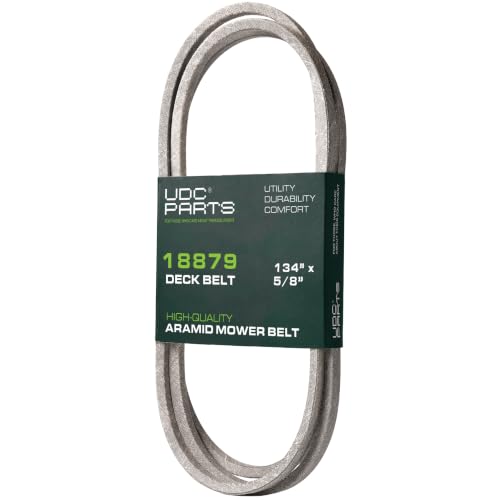
2. UDC Parts 18879 Deck Belt
The belt listing that publishes its own tolerance — 134.13 inches, plus or minus 0.40 inch.
Most belt listings give you a length and hope. This one tells you the manufacturing allowance: 134.13 inches long by 0.63 inch wide, built to a tolerance of ±0.40 inch (the allowed variation in length). That number matters because it explains the single most common complaint on long deck belts — a belt that measures a hair over or under is normal, not a shipping error, and it does not change how the belt performs around the pulleys.
Construction is spelled out more completely than any other belt here: aramid tensile cords for the strength layer, a natural rubber body, and a two-layer wrapping cover for abrasion resistance. Aramid is the reinforcement fibre that keeps a belt from stretching out of shape under heat and load. The listing also carries a one-year product support term covering manufacturing defects. Where the Kuumai belt above fits the Frontier GM1072R, this one adds the TBW240 and TBW180 rear-deck applications to its compatibility list.
Set expectations on lifespan honestly. This is the most-discussed belt in the group, and the talk is split — quality and fit draw the heaviest positive weight, while durability is the recurring argument, with some belts giving out well inside a season. Weight the odds with your own conditions: sharp pulleys and correct tension get far more hours out of any belt than a misaligned deck does.
What the spec sheet gives you: published tolerance, a named rubber body, aramid cords, and a support term — details most belt sellers skip. If you want the full construction detail before ordering, this listing publishes it.
The trade-off to weigh: that same popularity means the durability debate is loud. Inspect your pulleys and idlers for grooves or play before you install, because a worn pulley eats a new belt fast.
Worth it when: you want full construction detail and a stated tolerance on a 72-inch deck belt.
Think twice if: your pulleys are original and grooved — fix the pulley before spending on a belt.
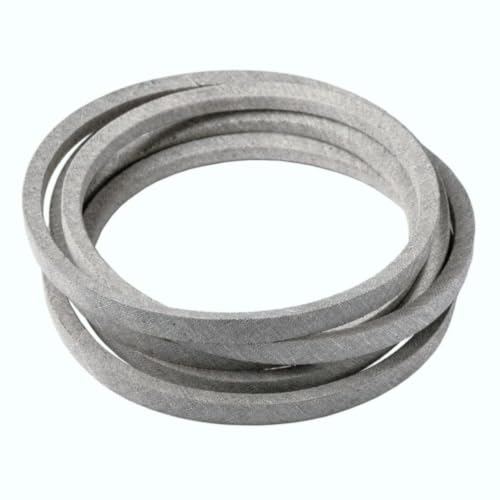
3. 18879 Belt
Same 134.13-inch measurement as the UDC belt, built with Kevlar cord and weighing 3.2 ounces.
Here is a case where the measurements line up almost exactly with a belt higher on this list. This one runs 5/8 inch wide by 134.13 inches long and replaces Woods 18879 and 18879RP, with compatibility listed for RD72, RD7200, and PRD7200 finish mowers. The 0.63-inch width reading on the spec sheet is simply the decimal form of that 5/8-inch profile.
The material line says Kevlar, which is the aramid family of synthetic fibre used as the cord layer inside a belt — the same job the aramid cords do in the UDC belt. At 3.2 ounces it is a light belt to ship and to handle, though weight tells you nothing about how long it lasts.
What owners mention here splits down the middle. Fit is the thing praised most — the belt lands right on the listed decks and does its job. Quality and durability are where opinions divide sharply, with some belts shredding early in the season and others holding up fine. Read that as a part with real variance: check the belt the day it arrives, and keep the receipt inside the return window while you run the first mowing.
Why it still earns a slot: the 134.13-inch length and 5/8-inch width make it a true cross-reference for RD72, RD7200, and PRD7200 decks, and the Kevlar cord is the right strength layer for deck-drive duty.
If you want the tighter construction story, the UDC listing documents more; if you are already ordering several parts, adding this one as a backup makes sense.
Reach for this if: you want a Kevlar-cord 134.13-inch belt as a shelf spare for an RD72 or PRD7200.
Better served by: the UDC belt if consistent construction quality is your priority over the material name.
4. 5WP1001244 Mower Drive Belt
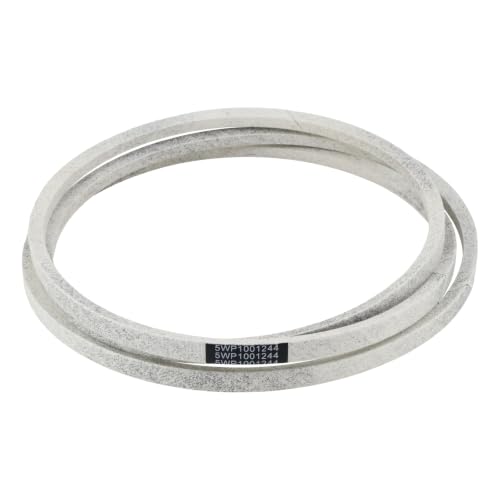
It is 118 inches, not 134 — and that 16-inch difference is the whole point of this pick.
Every other belt in this article is a 134-inch part for a 72-inch deck. This one measures 5/8 inch wide by 118 inches long and is built for the Woods RD6000 finish mower and the John Deere GM1060R. If your deck is an RD6000, none of the longer belts will work, and this is the one that will.
It is a direct replacement for OEM numbers 5WP1001244, 1001244, and 31615, so you can cross-check three ways before ordering. The construction uses a layer of aramid cords for tensile strength — the pull-apart resistance that keeps the belt from snapping when the deck loads up — along with heat resistance for long, hot mowing sessions. The belt is meant to hold deck speed steady as grass load changes, which is what keeps the cut even instead of scalloped.
The fit story is what carries this belt. It is the section owners call out most, and the install is a straightforward swap rather than a wrestling match. The honest caveat is durability — some belts run for seasons, others fail around the three-month mark, and sizing has drawn mixed reaction. Check the printed length against your old belt before you install, and inspect the tensioner while the deck is open.
What lands well
- 118-inch length is correct for the RD6000 and GM1060R decks
- Cross-references three OEM numbers: 5WP1001244, 1001244, 31615
- Aramid cord layer for tensile strength and heat resistance
- Easy install on the listed decks
What to keep in mind
- Durability results vary widely in owner experience
- Not a substitute for any 134-inch 72-inch deck belt
Buy this one if: your machine is an RD6000 or GM1060R and the old belt measured 118 inches.
Not the one for: 72-inch deck owners — that deck needs a 134-inch belt.
5. 8TEN LawnRAZOR Mower Blade 3-Pack

Three mulching blades in one box for a 60-inch deck — a full deck set in a single order.
Deck blades wear as a set, so buying one at a time leaves you with an uneven cut. This pack puts three in the box, which is exactly the number a 60-inch BMB Woods deck needs — the listing notes the deck requires 3 for a 60-inch cut. It replaces Woods 23825, 23825KT, 31359, and 31359KT, and fits the RM-59 deck.
The blade numbers are 20 3/16 inches long, 5/8-inch center hole, 2-inch width, and 0.197-inch thickness. The center hole is what the spindle bolt passes through, so getting that 5/8-inch figure right is what keeps the blade seated and balanced. The set weighs 6.3 pounds across three blades, and that mass is what gives a mulching blade the momentum to recut clippings instead of throwing them.
These carry an 810-day limited warranty from 8TEN, which is a longer stated term than any other part here. For a 60-inch deck owner replacing the whole set at once, that is a sensible combination of coverage and completeness.
The case for the full set: matching blade length and center hole across all three means a balanced, even cut, and the 810-day warranty covers the set together rather than one blade at a time.
Confirm before ordering: this is a 60-inch deck part. If your Woods deck is a 72-inch unit, you need the 24.94-inch blades further down this list instead.
Best matched to: RM-59 and 60-inch BMB Woods deck owners who want the whole set replaced at once.
Wrong size for: 72-inch deck owners — those decks take a much longer blade.
6. WOODS OEM 53595 Flat Idler

The only part in this article stamped with the Woods name — and it weighs just 1.5 pounds.
An idler pulley is the smooth wheel a belt wraps around to keep tension and routing correct. When an idler seizes or wears a groove, it shreds new belts — which is often the real reason a belt failed in the first place. This is the genuine Woods 53595, a 5.0-inch flat idler at 1.5 pounds, made by Woods for its own decks rather than by a third party.
Its compatibility spread is enormous: 7144, 9180, and 9204 turf batwings, the MX54, MX54T, MX61, and MX61T Mow’n Machine decks, the PRD6000, PRD7200, and PRD8400, the RD6000, RD7200, and RD8400, plus RM550, RM660, and the TBW144, TBW180, and TBW204 batwings. If you own more than one Woods machine, this single part number likely covers several of them. Compare that 1.5 pounds with the 6.3 pounds of the 8TEN blade set and you get a sense of how small this component is against the loads it carries.
If your deck already eats belts, replace the idler with this OEM part first — a worn pulley shortens the life of any belt.
Why go genuine
- Manufactured by Woods for its own decks
- 5.0-inch diameter matches the original routing
- Fits turf batwings, Mow’n Machine decks, and PRD/RD finishing mowers
- Only 1.5 pounds, so it is simple to swap
Before you add it
- Priced above aftermarket idlers, so it pays off only if you value the OEM match
- Confirm the idler position and diameter on your specific deck first
Go genuine here if: you have already replaced a belt twice and suspect the pulley is the culprit.
Hold off if: you have not yet verified that your deck’s tension side uses a 5.0-inch flat idler.
7. 1008199 Heavy Duty Blades 3 Pack
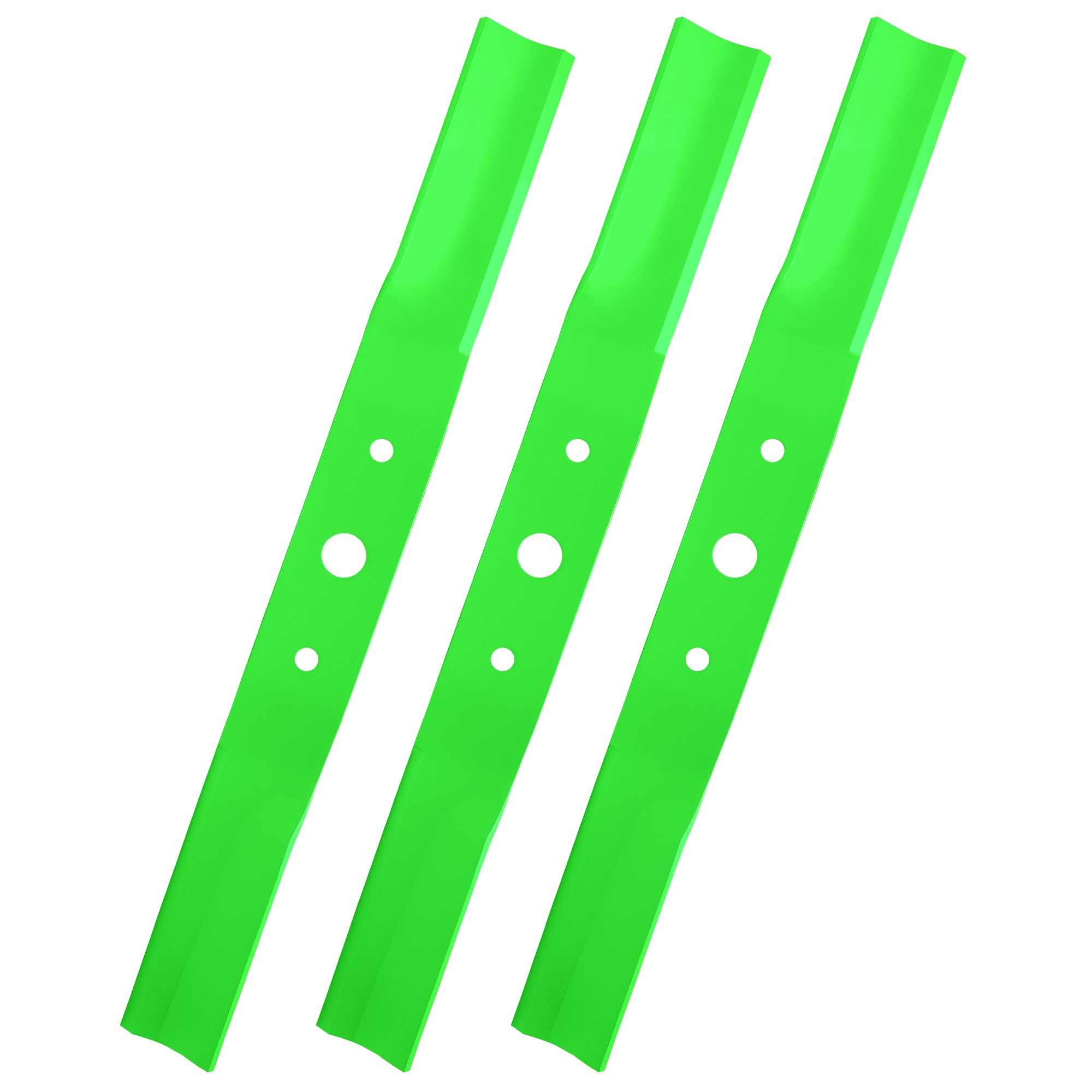
A 24.94-inch heat-treated blade set for 72-inch decks, with an anti-rust coating.
For a 72-inch Woods deck, this is the blade length you are after. Each blade measures 24.94 inches long, 2.5 inches wide, and 0.25 inch thick, with a 1-inch center hole and 1/2-inch side holes. Twelve blades’ worth of steel would be heavy — three of these come to 10.93 pounds, and that thickness is what lets the blade hold an edge through tough turf.
It replaces Woods 1008199 and 1008199KT, John Deere 5WP1008199K2 and 5WP1008199KT, and Stens 345-085. The fitment list covers RD72, RD7200, RD7200-2, and PRD7200 for 72-inch standard decks, plus the compact tractor models built to take Woods 72-inch rear and mid-mounted decks. Heat-treated high-carbon steel with an anti-rust coating is the material story — heat treatment is what hardens the cutting edge so it resists chipping instead of rolling over on a rock strike.
Sharpness and blade quality are what owners notice most, with the edge holding well across a season. The one thing to check carefully is fitment — reports split on whether these drop straight onto every listed deck, so measure your old blade’s center hole against the 1-inch figure before you commit. Comparing blade length is a useful sanity check: these 24.94-inch blades run noticeably longer than the 20 3/16-inch 8TEN set built for 60-inch decks, and they are not interchangeable.
Where the value sits: heat-treated high-carbon steel, a 72-inch deck match, and three blades in one box — plus cross-references to Woods, John Deere, and Stens numbers.
The fitment question: verify the 1-inch center hole against your spindle before ordering, since fit is the one point owners disagree on.
Pick these if: you run a 72-inch RD or PRD deck and want a hardened blade set with a rust-resisting coating.
Double-check first: your spindle center hole and side hole spacing, because fitment reports are not unanimous.
8. 3PK Oregon Lawn Mower Blades 91-585

A three-blade Oregon 91-585 set that crosses to the same 72-inch Woods decks as the hardened set above.
If the name on the blade matters to you, this is the Oregon-profile option here. The 91-585 part number is the cross-reference to keep in mind: it is the blade shape that fits Woods 72-inch PRD7200, RD72, and RD7200 decks, replacing 1008199, 1008199KT, and 10081899KT2. Three blades ship together, so one order covers the whole deck.
Where the hardened set above spells out length, width, thickness, and hole sizes down to the fraction, this listing leans on the Oregon part number instead. That is genuinely useful if you already trust the 91-585 profile — you know what you are getting without decoding the measurements. If you have never run Oregon blades before, the more detailed spec sheet on the set above is easier to verify against your old blade.
Quality is the theme in owner feedback, with the blades described as matching the original ones and holding their edge. The metal construction is stated plainly, and the value read is strong for a three-blade set at this tier. For a 72-inch deck owner who trusts the Oregon 91-585 number over a spec table, this is the simpler order.
The quiet argument for this set: the 91-585 number is a known cross-reference across Woods, so you are buying a documented profile rather than an unlabelled blade, and three come in the pack.
What you give up: less dimensional detail in the listing than the hardened set, which makes it harder to verify fit if your deck has been modified.
Reach for this if: you want the Oregon 91-585 profile for a 72-inch Woods deck and trust the part number over a spec table.
skip it if: you need to compare blade thickness and hole sizes before buying.
9. SCITOO Electric Lawnmower PTO Clutch

Not a belt and not a blade — the electric clutch that engages your deck in the first place.
The PTO clutch is the part that spins the deck up and brakes it to a stop, controlled from the operator’s seat. When it fails, the blades stop engaging and no new belt will fix it. This one is a 12.18-pound unit cross-referenced to Grasshopper 388740, Woods 388740, Warner 5218-165 and 5218-225, and Stens 255-865, and it arrives as a one-piece design with no adjustments to make on install.
The build notes say the clutch and brake functions sit in one compact housing, with the parts often e-coated for corrosion protection. A clutch brake is what brings the blades to a halt — and the listing states the high-temperature bearing grease is rated more than twice what is required. Plan roughly 15 minutes if your bolt pattern is the standard one, since most of the work is removing the old unit and bolting the new one in place.
Fit and install are the strongest parts of this clutch’s record, and it is frequently described as nearly identical to the original. The honest caveat is the electrical side: the coil has been reported to fail during use in some cases, and connections have drawn mixed notes. Check the harness and grounds during the swap, since a poor ground is a common cause of early clutch failure.
Why it makes the list
- Cross-references Grasshopper, Woods, Warner, and Stens numbers
- 12.18-pound one-piece unit with no field adjustments
- Compact housing combining clutch and brake functions
- Install runs about 15 minutes on a matching bolt pattern
The bits to watch
- Coil failures have been reported in use
- Electrical connection feedback is mixed, so inspect the harness
The right part when: your deck has stopped engaging and the 388740 number matches your machine.
Not your fix if: the belt is simply slipping — start with the belt and idler before replacing the clutch.
Know the Specs
Belt length and width
Width is the belt profile that seats into the pulley groove — 5/8 inch is the common deck-drive size on these Woods decks. Length is what actually separates one belt from another, and it must match your deck: 134 inches for a 72-inch deck and 118 inches for an RD6000 are not interchangeable. A belt that is a fraction over or under its stated length is within normal manufacturing tolerance and does not mean you got the wrong part.
Aramid versus plain rubber
Aramid cord is the reinforcement inside a belt — the strength layer that resists stretching under heat and load. A natural rubber body with a wrapping cover handles abrasion against the pulleys. Belts listing an aramid or Kevlar cord are built for deck-drive duty where the belt has to hold its length through heavy grass. The outer cover is what takes the wear, so a frayed cover is the first sign to watch.
Blade dimensions that decide fit
Four numbers matter on a deck blade: length, center hole, side holes, and thickness. The center hole is where the spindle bolt passes through, so a 1-inch hole and a 5/8-inch hole are not swappable. Length has to clear the deck housing — 24.94 inches for a 72-inch deck versus 20 3/16 inches for a 60-inch deck. Thickness affects how long the edge lasts and how the blade balances.
Idlers and PTO clutches
An idler pulley is the smooth wheel that routes and tensions the belt; a worn or seized idler shreds new belts. The 53595 flat idler is a 5.0-inch genuine Woods part that fits a long list of decks and batwings. A PTO clutch is the electric unit that engages and brakes the deck from the seat — it is a separate failure point from the belt, and when it goes, the blades stop turning regardless of belt condition.
Common Questions
How do I know which deck belt length my Woods mower needs?
Will a 18879 belt fit a 60-inch Woods deck?
What does an aramid cord actually do in a mower belt?
Why do my belts keep breaking before the season ends?
Can I use the same blades on a 60-inch and a 72-inch deck?
What is the difference between an idler pulley and a PTO clutch?
Are Oregon 91-585 blades the same as the Woods 1008199 blades?
How long should a replacement deck belt last?
Does the SCITOO PTO clutch need adjusting after install?
Can I replace just one blade instead of the whole set?
How we choose
We do not accept paid placement. Every pick is matched to a real buyer and a real use-case; we do not hands-on test units.
Sources
Specifications: manufacturer listings and product documentation. Review insights: verified customer reviews. Pricing: not shown on this page (it changes often); check the current price via the retailer link.
As an Amazon Associate, Tactical Gear Guy earns from qualifying purchases. This does not affect which products we feature.