Specs are compiled from manufacturer listings and verified buyer reviews and can change over time — please confirm the key details on the product page before buying.
You want a wooden trellis garden screen whose riveted joints hold their shape through a full growing season — not one that droops by July. The buying decision really boils down to three things: whether the panels expand and lock where you set them, whether the wood is treated for weather, and whether the joinery is rivets or flimsy wire. This guide covers six expandable wooden trellises — willow, pine, and carbonized wood — and tells you which span, mounting, and vine load each one suits.
This guide is built by comparing the manufacturers’ published specifications and the patterns across verified customer reviews, so you get each pick’s real strengths and trade-offs instead of marketing spin.
Expanding panels disguise a simple truth: cheap hinges and staples give out long before the wood does, so the joinery is the first thing to inspect. Below you’ll find six wooden trellis garden options ranked by joinery quality, expanded span, and how well the wood weathers.
Top Picks


How To Choose The Best Wooden Trellis Garden
An expandable trellis is a lattice of thin wood slats held together at every crossing point, so it opens like a fan. That single mechanism is why two panels that look identical in a photo behave completely differently after a season of rain and wind. Start with the joinery, then work outward to size, material, and mounting.
Inspect the joinery first
Each crossing point carries load every time the panel flexes in wind. Rivets — small metal pins punched through the wood — hold far better than staples or glue. A panel described as having “high-strength stitching” or “strong rivet connections” at the joints is telling you the maker thought about the part that fails first. Skip a lattice with exposed wire ties if you plan to mount it on an exposed wall.
Match the expanded size to the job
A trellis is bought at its open size, not its folded size. A panel that closes to roughly 11 by 17 inches and opens to 13.4 by 78.8 inches is doing a lot of travel, which is great for a narrow wall gap and terrible for a wide fence line. Measure the span you want covered, then compare it to the fully expanded figure, not the picture.
Willow versus pine versus carbonized wood
Willow wicker panels are handmade from natural branches, so they bend and weave with a cottage look but stay flexible. Pine lattice panels hold a straighter line and take screws cleanly. Carbonized wood has been heat-treated to resist cracking, which matters on a south-facing wall that bakes all afternoon. None of these are permanent structures — they are season-to-season screens, and the honest expectation is a few good years with care.
Think about what climbs it
Morning glories, ivy, clematis, jasmine, cucumbers, and roses all climb differently. Heavy vines want a panel with more support points and a firmer frame. Light annuals can scramble up a flexible willow grid without complaint. If you are hanging small pots or string lights instead of growing vines, a stiffer wooden lattice with strong joints is the better base.
Side-by-Side Comparison
| Model | Best For | Expanded Size | Pack Count | Material | Amazon |
|---|---|---|---|---|---|
| 2Pcs 13×78 Expandable Wood Wall Trellis★ Best Overall | All-round wall and fence use | 78″W x 13″H per panel | 2 | Thickened anti-corrosion wood | Amazon |
| Nature Willow Trellis ExpandableWidest Stretch | Natural-looking screens and light vines | 22″W x 120″H fully expanded | 1 | Willow Wood | Amazon |
| Expandable Garden Trellis 13″x68″ | Flower-bed borders with stakes | 13″ x 68″ | 2 | Pine wood | Amazon |
| Expandable Wooden Lattice Fence Panel 2.2 x 5.2 Ft | Privacy screening and backdrop decor | 2.2 x 5.2 Ft | 1 | Carbonized wood | Amazon |
| Wood Lattice Fence Panels 13.4″x78.8″ 4 Pcs | Covering a long wall run | 13.4″W x 78.8″H per panel | 4 | Natural wood | Amazon |
Detailed Reviews
1. 2Pcs 13×78 Expandable Wood Wall Trellis
Our pick — 4.5+★ from 400+ verified ratings; the strongest balance of quality and price.
Two panels, one price, and a lattice that opens from a tight 17-inch block to a long 78-inch run.
What makes this the pick to beat is the pairing: you get a full 13-inch width at 78 inches tall out of each panel, and there are two of them in the box. That means one panel can dress a house wall while the other becomes a garden fence, or both combine into a longer planter screen. The frame is thickened anti-corrosion wood, finished unfinished so it takes stain or paint if you want to match a fence. At 16 ounces per panel, hanging it is a one-person job.
What wins people over is the two-pack arithmetic: one 78-inch panel dresses a house wall while the second becomes a garden fence or planter screen. Expanding and contracting is smooth because of the connection design at each junction, and it settles into place instead of fighting you. Beyond vines, owners use the pair as a wall-mounted flower pot shelf, a garden fence, and a frame for string lights or family photos on a porch.
Here is the honest part. For a garden feature that lives outdoors, that is a fair trade rather than a hidden flaw — but treat the connections gently when you resize it, and anchor the top corners if your site catches wind. Decide for yourself whether a two-season screen is enough or if you want something heavier.
What makes it the default pick
- Two panels in the box — one wall, one fence, or a longer combined run
- Opens from 17 x 10 inches closed to 78 x 13 inches expanded, so it fits tight gaps and long walls
- Thickened anti-corrosion wood with a warm rustic finish for indoor or outdoor use
- Only 16 ounces per panel, so mounting solo is realistic
The part to plan around
- Construction quality gets mixed reactions — some panels feel well-made, others flimsier than expected
- Durability splits the same way, so expect a few seasons rather than a decade
- The unfinished wood will need a seal or stain if you leave it fully exposed
Reach for this if: you want one order that covers a wall and a bed without buying twice, and you value a two-pack over a single panel.
Plan around: the lattice is a lightweight screen, not a structural fence, so brace the top for windy spots.
2. Nature Willow Trellis 36×92 Inch
A handmade willow grid that pulls out to 120 inches wide — the longest horizontal reach on this list.
For covering a wide span with something that looks grown rather than built, the willow is the one. It measures 120 inches wide by 22 inches tall fully open, against the 13-inch width of the ANPHSIN two-pack — a nine-times-wider footprint that turns a bare patio wall into a screen in one panel. Closed, it shrinks to 11 by 47 inches, which is small enough to store behind a shed door between seasons. The slats are joined by rivets rather than wire, so they turn smoothly as you fan it open.
One 120-inch willow panel covers many jobs — a fence, a room divider, a climbing support, or a frame for fairy lights at the holidays — and keeps its natural willow look in each spot. It’s 100% handmade with no chemical addition, so it suits a garden where you’d rather not introduce treated timber. Add zip ties and it’s up in minutes.
The trade-off worth knowing is that real willow is a soft, living material, and a screen this light can feel fragile if you handle it roughly or leave it in punishing wind. Expect a few seasons of charm rather than a permanent structure. If you’re planting something heavy like wisteria, choose a stiffer pine lattice instead.
Why the willow wins: that 120-inch open width is the widest span in this list, and the rivet joints (metal pins that let the panels pivot) let it move without snapping.
Pair it with: light climbers like morning glories or ivy, or a decorative role as a holiday light backdrop.
Best suited to: a wide, low wall or balcony rail where you want a soft natural screen, not a rigid fence.
Not for: heavyweight vines or exposed coastal wind — the soft willow flexes rather than holds firm.
3. Expandable Garden Trellis 13″x68″
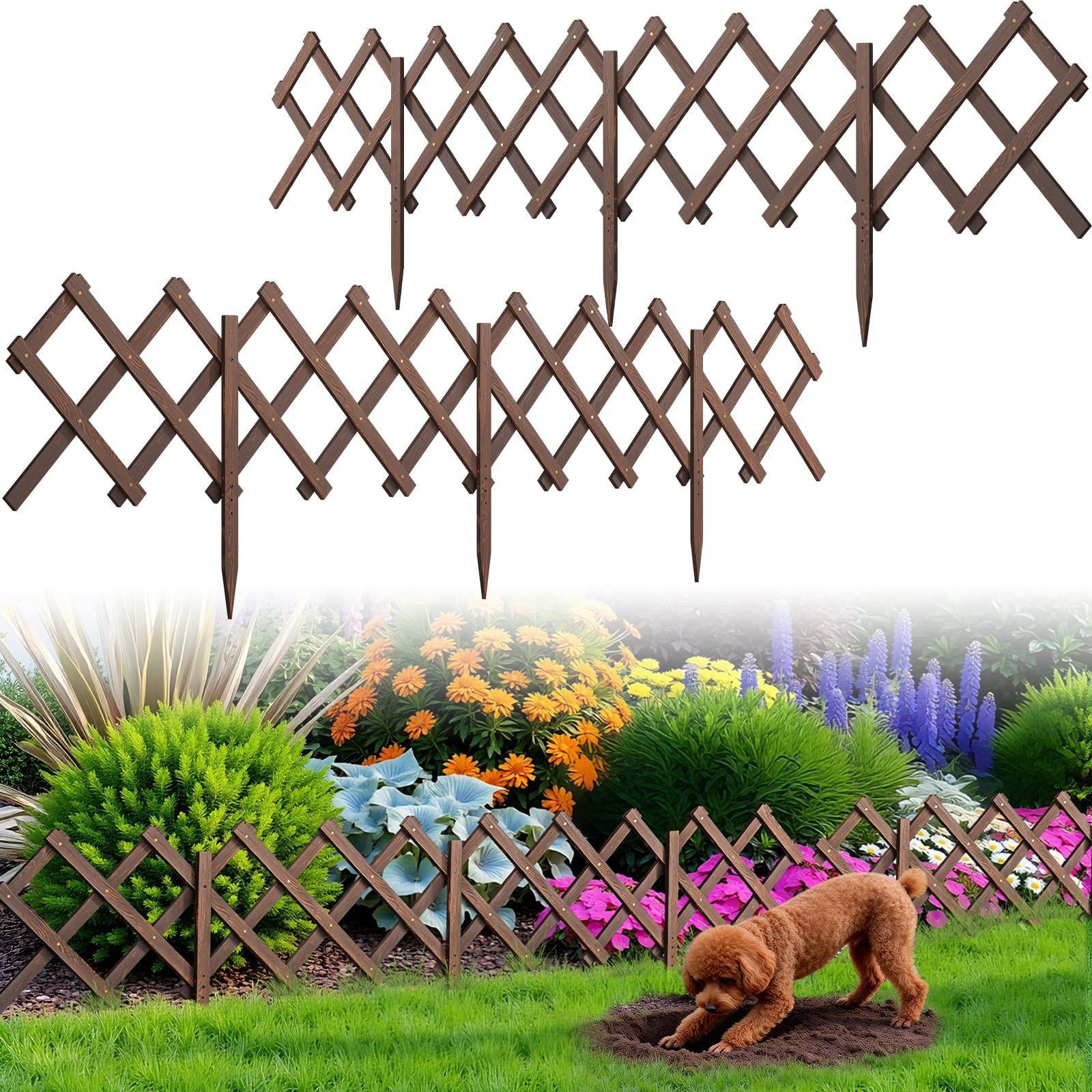
Three ground stakes turn this pine lattice into a stand-up bed border instead of a wall mount.
Most panels on this list want a wall behind them. This one plants its own feet. You position the three wooden stakes at your chosen height, screw them into pre-drilled holes, and the diamond lattice stands on its own to define a flower bed, edge a path, or accent a patio. It opens to approximately 13 by 68 inches and contracts to a compact size for off-season storage, and you get two panels in the pack.
The pine body has visible natural grain and a classic diamond pattern, so it reads as garden lattice rather than a metal fence. Ivy, roses, clematis, and jasmine get plenty of points to climb, and the vertical coverage guides stems upward while framing whatever is behind them. Setup is genuinely quick once the stakes are positioned, so re-arranging beds between plantings is easy.
The fair caveat: the pine is light and the stands are only as firm as the ground you push them into. In a windy spot, or where a heavy vine loads the top, it can lean until you add a tie. That’s the honest limit of a staked lattice — for a low border it’s perfectly sound, for a tall windbreak it isn’t the right tool.
The setup edge: freestanding ground stakes mean no drilling into your house or railing — a real advantage for renters and rented plots.
The lean factor: give it a brace or extra tie if the site is gusty.
Reach for it if: you want a garden border that goes in without a wall bracket and still looks like real timber.
Look elsewhere if: you need a tall, rigid screen — this staked pine wants to be low and supported.
4. Expandable Wooden Lattice Fence Panel, 1 Pack, 2.2 x 5.2 Ft

Heat-treated wood and reinforced rivets, built for patios and balconies where looks count.
The wood here gets a high-temperature carbonizing treatment, which is a heat process that improves resistance to cracking and helps it hold shape outdoors. It opens to 2.2 x 5.2 feet and closes back down for storage, so the same panel becomes a garden trellis in summer and a balcony privacy screen the rest of the year. Reinforced rivet connections at the joints are what keep it stable as you stretch it wide.
It works as a garden fence, plant support, privacy screen, wall decoration, wedding backdrop, holiday display, or a base for a DIY project. Drape it with ivy or roses, or use it to screen a balcony rail without growing anything at all. It’s lightweight and secures with zip ties, rope, hooks, or screws (hardware sold separately), and it installs vertically or horizontally.
What to weigh: sturdiness opinions split — some builds feel solid, others noticeably flimsy. As a decorative privacy layer that’s fine; as a true wind barrier it isn’t. Treat it as decor that holds, not a fence that endures, and you’ll be happy with it.
Reasons it earns the patio spot
- Carbonized wood resists cracking and holds up in long outdoor exposure
- Reinforced rivet joints for stability as it expands to 2.2 x 5.2 feet
- Style covers privacy screening, trellis, backdrop, and holiday decor
- Light 2.2 pounds — hang with zip ties, rope, hooks, or screws
Where it comes up short
- Sturdiness is mixed — some units feel flimsier than the photos suggest
- Hardware for mounting isn’t included, so budget for your own ties
- Not a structural windbreak — it’s a decorative panel
Choose it for: a balcony or patio where you want a carbonized-wood panel that doubles as decor.
Weigh carefully if: you’re relying on it to stand against strong wind — it screens, it doesn’t brace.
5. Wood Lattice Fence Panels 13.4″x78.8″ 4 Pcs

Four panels at 78.8 inches tall each — the way to clad a whole wall without a second order.
If your job is a long garden wall or a big patio run, the four-pack is the arithmetic that matters. Each panel opens to 13.4 by 78.8 inches and closes to 11.4 by 17.3 inches, so four of them cover a serious stretch and still stack away small in winter. The wood is natural, from a renewable source, and keeps its original color and grain — so the wall looks timbered rather than painted.
Sturdiness is the consistent note of confidence here — the natural wood is hard and not easily damaged, and the joints are high-strength stitched so the panels stretch and contract smoothly rather than binding. Hang potted plants from one as a vertical garden, mount others as wall trellis frames for ivy and roses, and use the leftovers to hang lights or garden tools. With four panels in hand, you can mix jobs in one project instead of rationing.
The one behavior to anticipate: with a panel this tall and light, keeping it perfectly upright over time takes a firm top fixing. Where the mounting is solid, the lattice holds a straight line; where it isn’t, it can drift crooked. Plan your anchors before you open the box and this is a strong, good-looking wall solution.
The four-panel logic: at 13.4 by 78.8 inches per panel, the pack covers a long wall in one go without mismatched batches.
Anchor it properly: tall, light panels want solid top fixings to stay true.
Best for: a full wall or patio run where you want four matching panels and a natural, untreated-wood look.
Skip if: you only need a single accent panel — one cedar-toned piece beats a four-pack you can’t store.
Know the Specs
Expanded vs Closed Size
Buy a trellis by its open span, because that’s the coverage you actually get. The closed figure tells you how small it stores and how far the joins have to travel each time you resize — a panel that closes to 11 by 17 inches and opens to 13.4 by 78.8 inches is doing a lot of work, which is why strong joints matter. Measure the wall or bed, then check the open number against it.
Joinery: Rivets vs Wire vs Stitching
Every crossing point on the lattice carries load. Rivets — metal pins punched through the wood — and “high-strength stitching” at joints hold up better than exposed wire ties. This is the fastest quality tell on any expandable trellis: flex it in your hand and watch whether the joins bind or turn smoothly.
Wood Treatment: Willow, Pine, Carbonized, Anti-Corrosion
Willow wicker is handmade and flexible; pine takes screws and holds a straighter line; carbonized wood has been heat-treated to resist cracking outdoors. Anti-corrosion treatment helps any of them last through weather. None of these are permanent structures — plan for a few seasons with care rather than a decade of service.
Mounting: Stakes, Zip Ties, Hooks, and Screws
Some panels stand on their own with ground stakes for bed borders; others tie onto a wall or rail with zip ties, rope, hooks, or screws. Hardware is often not included, so check what you’ll need before install, and give tall lightweight panels a solid top fixing so they don’t drift crooked in wind.
Common Questions
Will a wooden trellis hold morning glories and ivy?
How tall and wide can an expandable trellis get?
Do I need to treat or seal unfinished wooden trellises?
Can a wooden trellis serve as a balcony privacy screen?
What’s the difference between a trellis with stakes and a wall-mounted one?
Is carbonized wood better for outdoor trellises?
How many panels do I need to cover a long wall?
Will a soft willow trellis last as long as a pine one?
Can I hang pots or string lights on a wooden trellis?
The Bottom Line
For most gardens, the wooden trellis garden pick that covers the most ground without a second order is the 2Pcs 13×78 Expandable Wood Wall Trellis — two panels, a 78-inch run each, and anti-corrosion wood that suits a wall or a fence. If wide, natural-looking coverage is the goal, the Nature Willow Trellis reaches 120 inches wide on riveted joints. And for a bed border that stands on its own stakes, the Expandable Garden Trellis 13″x68″ is the one to reach for. Pick by the span you need to cover and whether you’re bracketing a wall or planting into soil, and you’ll land on the right panel for your garden.
How we choose
We do not accept paid placement. Every pick is matched to a real buyer and a real use-case; we do not hands-on test units.
Sources
Specifications: manufacturer listings and product documentation. Review insights: verified customer reviews, as of November 2026. Pricing: not shown on this page (it changes often); check the current price via the retailer link.
As an Amazon Associate, Tactical Gear Guy earns from qualifying purchases. This does not affect which products we feature.