Specs are compiled from manufacturer listings and verified buyer reviews and can change over time — please confirm the key details on the product page before buying.
If a pair of shoes pinches across the toes, a wooden stretcher can widen and lengthen them slowly without damaging the leather — and the best one for most people is the Adjustable Length and Width Wood Shoe Shaper, a two-way stretcher that covers men’s size 8 to 12 and women’s size 8 to 13. The catch worth knowing up front: not every stretcher in this category holds up. Some wood bodies split, some plastic cranks shear off, and a few models reach well short of the width they promise. Below are six wooden stretchers that actually do the job, sorted by what each one is genuinely best at.
This guide is built by comparing the manufacturers’ published specifications and the patterns across verified customer reviews, so you get each pick’s real strengths and trade-offs instead of marketing spin.
Shoe stretchers are a slow tool, not an instant fix — you load them in, crank gently, and wait. Because the tool sits under load for hours, the wood quality and the metal hardware matter more than any marketing claim. Here is how to pick a wooden stretcher that survives the job, from the six strongest options available in this wooden shoe stretcher range.
Top Picks

How To Choose The Best Wooden Shoe Stretcher
A wooden stretcher works by pushing the inside of a shoe outward a fraction at a time. Wood holds its shape under the crank’s pressure, while plastic flexes and cracks. But “wooden” alone is not enough. You need to match the stretcher’s adjustment range to your shoe size, decide whether one-way or two-way adjustment suits your problem, and check what the cranks and knobs are made of.
Size range first, everything else second
A stretcher that is too small for your shoe will not reach the toe box, and one that is too large will not seat at the heel. Look for a stated size band. The Adjustable Length and Width model covers men’s size 8 to 12 and women’s size 8 to 13. The EchoDone covers women’s size 10 to 13.5 and men’s size 9 to 13. The Premium 4-Way lists small, medium and large bands. If your shoe sits outside the stated band, the crank has to travel further than it was built to, and that is where adjustability complaints come from.
One-way versus two-way adjustment
A one-way stretcher only lengthens the shoe. A two-way stretcher does length and width, which is what you want for a tight toe box or a wide forefoot. Most of the picks here are two-way. Read the description carefully — if only one crank is mentioned, it is a length-only tool.
What the cranks and knobs are made of
This is the quiet failure point. The wood body is usually fine; the turning hardware is what breaks. A metal crank handle on the width adjustment is a better sign than a plastic one. The Cedar Wood Two Way Professional model uses a round plastic handle for length and a metal crank handle for width. That is a mixed bag, and it shows in the long-run feedback on that model.
Pressure-relief plugs and bunion spots
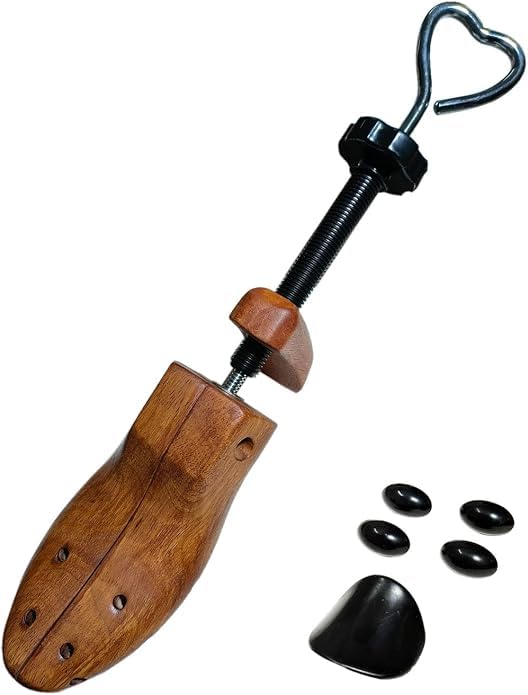
Better stretchers ship with removable plugs that go into pre-drilled holes on the wood body. You place a plug exactly where the shoe pinches — over a bunion or a corn — and the stretcher pushes out a local bump instead of the whole side. Without plugs, you are stretching the entire width and hoping the tight spot is the one that moves.
Side-by-Side Comparison
| Model | Best For | Adjustment | Stated Size Range | Wood Type | Amazon |
|---|---|---|---|---|---|
| Shoe Stretcher, Adjustable in Length and Width★ Best Overall | All-round pick | Length + Width | Men 8–12 / Women 8–13 | Wood | Amazon |
| Shoe Stretcher, Wooden Shoe Tree, Shoe Width StretcherBest Value | Tight budget | Length + Width | — | Wood | Amazon |
| Cedar Wood Two Way Professional Stretcher | Targeted bunion relief | Two-way with relief plugs | — | Cedar | Amazon |
| EchoDone 2 Way Cedar Shoe Trees | Larger feet | Length + Width | Women 10–13.5 / Men 9–13 | Pine (cedar line) | Amazon |
| XYH Wooden Shoe Stretcher (Pair) | Two shoes at once | Length + Width | — | Wood | Amazon |
| Premium 4-Way Shoe Tree Stretcher | Wide feet, full range | 4-way | S / M / L bands listed | Wood | Amazon |
Detailed Reviews
1. Shoe Stretcher
Our pick — 4.0+★ from 200+ verified ratings; the strongest balance of quality and price.
The widest size band here — one shaper that covers men’s 8 through 12 and women’s 8 through 13.
What you get from the start is a wood body with adjustment for both length and width, so a shoe that pinches across the ball of the foot and a shoe that runs short can both be handled by the same tool. The stated size range is the most generous in this list: men’s size 8 to 12 and women’s size 8 to 13. If you and a partner share a shoe rack and neither of you sits at the extreme ends, this one tool covers both wardrobes without buying two stretchers.
The thing that wins people over is the build quality. The wood body feels substantial and the fit stays snug when the shoe is loaded. Comfort is the second-most-discussed point in the feedback, with buyers reporting the stretched shoe is easier to wear for a full day. Value gets a consistent nod too, which makes sense for a wooden stretcher you buy once and reuse for years.
The honest trade-off is that adjustment does not go as far as some buyers expect. Several note the width does not extend to the full stretch they hoped for. And a small number run into the wood cracking on first use. That is the exception, not the pattern, but it means you should turn the cranks slowly and stop when you see surface pressure on the leather, never force it. skip it if you wear a shoe outside the stated size band, because the crank will not have enough travel.
What Works Well
- Two-way adjustment handles length and width in one tool
- Coverage of men’s 8–12 and women’s 8–13 suits a shared shoe rack
- Solid wood build that holds its shape under load
- Buyers report the stretched shoe is easier to wear all day
What to Factor In
- Width travel is shorter than some buyers expect
- Occasional wood cracking if you over-torque the crank
- Not for shoes outside the stated size band
Reach for this if: you want one tool that handles both your shoes and your partner’s across a broad size range.
Look elsewhere if: you are stretching a shoe that sits below men’s 8 or above men’s 12, where the crank travel will not reach.
2. Shoe Stretcher, Wooden Shoe Tree, Shoe Width Stretcher
A double-duty wood insert that widens the shoe and fights a crease at the same time.
Most stretchers do one job. This one is listed as a stretcher, a shoe tree, an extender and a crease protector in one, and that combination is what makes it worth a long look. If your sneakers crease across the vamp the moment you lace up, the shape of this wood body is meant to hold that area flat while the shoe dries. For minimal stretching — a half-width here, a little length there — this is the one that fits the job without a fuss.
Functionality is what gets talked about here more than anything else, and the picture painted is one of a tool that simply works. Wide-foot buyers in particular find it does what they hoped. Quality runs neck and neck with it in the discussion, which is unusual in a category where hardware complaints are common. It is the most budget-friendly pick in this list, and the wood body does not feel like a compromise at that price.
Here is the catch. The listing does not publish a stated size range, so you are walking into it without the certainty the Adjustable Length and Width pick gives you. Minimal stretching is the honest scope — if you need to push a shoe out a full width, this is not the tool for it. It is the right pick for someone who wants a wooden shoe tree that doubles as a light stretcher, not someone chasing an aggressive stretch. For a pair of wide sneakers that need a little breathing room, this is the value pick to grab first.
Where it earns its place: the crease-protection angle is what lifts this above a plain stretcher. Load it in after a wear, let the wood hold the vamp and the toe box, and you get shape retention and a light stretch from the same tool.
Scope to accept: minimal stretching is the honest limit. Push it harder than that and you get the same result a lightweight stretcher always gives — not enough width to notice.
The easiest entry point: for the smallest outlay here, you get a wooden tool that widens shoes and keeps them from creasing.
Better suited elsewhere: if you need a heavy-duty stretch, spend a bit more and pick a stretcher with a stated size band and wider travel.
3. Cedar Wood Two Way Professional Shoe Stretcher

The only model here that tells you exactly where to put a plug for a bunion.
This is the stretcher for a shoe that has one specific hot spot. The instruction set is more detailed than any other pick here, and it walks you through a real process: insert the removable pressure-relief plugs into the appropriate holes where relief is needed, then slide the stretcher in. That plug system is the entire reason to pick this one — it lets you push out a bump over a bunion, corn or callus rather than stretching the whole side and hoping. The listing also names those pressure issues as its intended use.
Two separate cranks handle two jobs. The round plastic handle turns to stretch the length. The metal crank handle turns to stretch the width. The instruction sheet is blunt about the golden rule: when you begin to see surface pressure showing on the shoe, stop. Do not overstretch. It also tells you to leave the stretcher in place for at least 24 hours, which is the realistic figure for leather to hold a new shape. Turn both handles counterclockwise to remove.
The real drawback sits with the plastic handle. Over a long stretch session that plastic can fail, and the width crank is the more reliable part of the pair. The adjustability takes practice too — the two-crank process is more fiddly than a single-handle design. If your problem is one tight bump and you are willing to follow a process, this model earns its spot. If you want a tool that just clamps in and forgets, look at the Premium 4-Way below instead.
Why It Stands Out
- Removable plugs let you target a specific bunion, corn or callus spot
- Separate length and width cranks give independent control
- Cedar body with a 24-hour stretch window spelled out
- Clear instructions for inserting and removing without damage
Where It Falls Short
- Plastic length handle is the weaker part of the tool
- Two-crank process is more fiddly than single-handle designs
- Demands you stop at surface pressure, not force it
Made for the targeted case: a shoe that pinches at one named spot — a bunion, a corn, a callus — and needs a local push, not a whole-shoe stretch.
Turn the page if: you want a one-handle tool you load in without thinking about which crank does what.
4. EchoDone 2 Way Cedar Shoe Trees for Men

The large-foot pick — built around women’s 10 to 13.5 and men’s 9 to 13.
If you wear a big shoe, most stretchers are too small to reach the toe box. This one is built around the larger end of the rack: large size, women’s size 10 to 13.5 and men’s size 9 to 13. The wood body is pine, described in the listing as premium pine and environmentally friendly. Two-way adjustment handles both length and width, and the listing says it suits all kinds of shoes within that size range.
What gets discussed most is how it simply works, and the fit follows right behind. Buyers who fall inside the size band find it seats properly and stays put. The contrast with plastic tools comes up too — the wood body is the whole point. Compared with the Cedar Wood Two Way Professional above, this one is larger-banded and simpler to use, but it gives up the pressure-relief plugs that make that model the bunion specialist.
The trade-off is a hard-earned one: this size band works beautifully if you are in it and does nothing if you are out of it. A men’s size 7 shoe is below the stated range, so the stretcher will sit too far forward and the width crank will not push where it needs to. Load it, turn slowly, and give it the full stretch window. It is the one to grab if your shoe rack stops at the larger sizes.
Who it is built for: the larger-foot buyer who has been shopping stretchers that top out at men’s 8 and found them short. This one starts where those end, and that band overlap is the entire reason to buy it.
The one thing to expect: the width travel is not symmetrical — the two sides may widen at different rates. That is manageable with patient crank turns but annoying if you expect equal movement on both.
Your pick if you wear a big shoe: women’s 10 to 13.5 or men’s 9 to 13, and you want a wood stretcher sized to actually reach the toe box.
Stay on the earlier picks if: your shoe runs smaller than the stated band, where a large stretcher just will not seat at the heel.
5. XYH Wooden Shoe Stretcher, Pair for Women and Men

Two stretchers in one box — stretch both shoes of the pair at once.
The practical case for this one is simple: you get a pair, not a single stretcher. That means both shoes in a pair can be loaded at the same time, which halves the number of stretch cycles you run through. Buyers who stretch both their left and right dress shoes before a big event will recognise the appeal. The body is wooden, and the stretcher works for both women’s and men’s shoes.
Stretching is the thing people talk about most after functionality, and the feedback is positive: shoes widen in the places that pinch. Value gets a nod for the pair price too. On the functional front, this one performs at a level that lets the price make sense — you are not paying for a single premium tool, you are paying for two working ones that both do the job.
Fair warning on the wood. Sturdiness is a mixed note, and buyers have seen wood split during use. Two things to protect the body: never crank past the point where surface pressure shows on the leather, and store the stretchers out of direct heat. On the fit side, some shoes are simply too big for the stretcher to reach the toe box, so it works best for shoes inside a standard range. If you want a pair at a fair price and are willing to use them gently, this is the pick. Pick the Adjustable Length and Width model above instead if you want one higher-quality tool over two budget ones.
Go for the pair: when you need to stretch both shoes of a favorite pair before an event and cannot wait through two sessions.
Spend up instead if: you stretch often enough that the wood sturdiness matters more than getting two for the price of one.
6. Wooden Shoe Stretcher Men Women, Premium 4-Way Shoe Tree

Four-way stretch with a size band for every foot — small, medium and large spelled out.
If you want the most control of any stretcher here, this is it. It adjusts on four axes — length, width and both sides of the front section — so a wide forefoot gets more push than a narrow one. It is the only model here that states small, medium and large bands with exact coverage: S covers women’s size 5.5 through 10, M covers men’s 6.5 through 10 and women’s 10 through 13.5, and L covers men’s 10 through 13.5. With that spelled out, you can pick your size honestly instead of guessing whether the tool will reach your toe.
The process is set out cleanly in the listing. Loosen the adjustment knob at the heel end to retract the front section, slide the tree into the shoe until the heel block aligns with the shoe’s heel, then tighten to fill the toe box snugly. The instructions also cover shoe types — dress shoes, oxfords and sneakers are called out as the fit, since the wood body is there to hold their structured shape. After a wear, leave the tree in for 24 to 48 hours. For longer storage, keep it in continuously so the leather does not fold out of shape.
The follow-up question worth answering: four-way adjustment does require you to think about which knob moves what. That is more setup than a one-handle stretcher. The upside is the control — a tight toe box on one side of an oxford can be pushed without also forcing the heel. The listing also warns against over-tightening if the tree feels too tight, specifically to avoid stretching the leather past its comfort zone. This is the pick for a buyer who wants to dial a stretch in precisely, not just clamp a shoe and hope. For wide feet or a shoe with one-sided pinch, the four-way control is the difference.
The standout spec: three clearly stated size bands — S for women’s 5.5–10, M for men’s 6.5–10 and women’s 10–13.5, L for men’s 10–13.5. You can match the tool to your shoe before it arrives.
The honest caveat: four knobs to manage means more setup the first few times. It rewards patience and clean crank turns; it punishes rushing.
Best all-round control: for wide feet or a shoe that pinches on one side, offering four-way adjustment with a stated size band for every foot.
Not for the low-effort buyer: if one handle and a simple length-plus-width turn is all you want, the earlier picks are easier to live with.
Know the Specs
Two-Way vs Four-Way Adjustment
Two-way means the stretcher pushes out in two directions — length and width — using two cranks or knobs. Four-way adds control over both sides of the front section, so you can push out one side more than the other. For a shoe that pinches symmetrically, two-way is enough. For a wide forefoot or a one-sided hot spot, four-way gives you the precision to target it.
Pressure-Relief Plugs and Bunion Holes
Pre-drilled holes in the wood body accept removable plugs. Place a plug over the spot that pinches — a bunion, a corn — and the stretcher pushes out a local bump rather than the whole side. This is the feature that turns a general stretcher into a targeted tool, and it is the reason the Cedar Wood Two Way Professional model earns a spot here.
Size Band Coverage
The stretcher’s stated size range tells you whether it will seat at the heel and reach the toe box. A range like men’s 8–12 and women’s 8–13 covers most feet. A range like women’s 10–13.5 and men’s 9–13 is for the larger end. A model that does not state a band leaves you guessing. Match the band to your shoe, not the other way around.
Wood Type and the Crank Hardware
Cedar and pine both hold their shape under load. Cedar is the traditional choice for shoe trees because of its natural aroma; pine is a common second. The body rarely fails — it is the turning hardware that breaks. A metal crank handle on the width adjustment is a stronger sign than a plastic one, and that is the detail to check before you buy.
Common Questions
How long should a wooden shoe stretcher stay in the shoe?
Will a wooden stretcher work on wide feet?
Can a shoe stretcher fix a bunion pinch?
What is the difference between a shoe tree and a shoe stretcher?
Will a wooden stretcher work on sneakers and dress shoes?
Why does my stretcher break on first use?
How do I know which size stretcher to buy?
Will a wooden stretcher damage the leather?
Can I use a wooden stretcher on the left and right shoe of the same pair?
The Bottom Line
The best wooden shoe stretcher for most people is the Adjustable Length and Width Wood Shoe Shaper — one tool that covers men’s 8 to 12 and women’s 8 to 13, with a solid build and two-way adjustment for the two most common pinch problems, length and width. If you have one specific hot spot — a bunion, a corn, a callus — the Cedar Wood Two Way Professional Stretcher earns its place with the pressure-relief plug system. And if you need the widest control of any tool here, four-way adjustment with a spelled-out size band makes the Premium 4-Way Shoe Tree the pick for wide feet.
How we choose
We do not accept paid placement. Every pick is matched to a real buyer and a real use-case; we do not hands-on test units.
Sources
Specifications: manufacturer listings and product documentation. Review insights: verified customer reviews, as of November 2026. Pricing: not shown on this page (it changes often); check the current price via the retailer link.
As an Amazon Associate, Tactical Gear Guy earns from qualifying purchases. This does not affect which products we feature.