Specs are compiled from manufacturer listings and verified buyer reviews and can change over time — please confirm the key details on the product page before buying.
You can buy one wooden plyometric box and jump at three different heights, just by flipping it onto a different side. A three-in-one box replaces three fixed-height boxes, so it saves floor space and money. The harder question is which box stays put when you land on it at speed. That depends on three things: the plywood thickness (how thick the wood sheets are), the joint style (how the panels lock together) and whether the edges are sanded smooth (so your shins don’t catch on rough corners). Below are the picks that hold up, plus the honest catch on each one.
This guide is built by comparing the manufacturers’ published specifications and the patterns across verified customer reviews, so you get each pick’s real strengths and trade-offs instead of marketing spin.
The right pick depends on your height ceiling, your floor surface and how often you plan to move it, and this best wooden plyometric box breakdown lines up the strongest options side by side.
Top Picks


How To Choose The Best Wooden Plyometric Box
A wooden plyometric box is a rigid platform you jump onto, step onto, or press your hands against during push-ups. The wood matters because a solid box does not flex or sag under a landing the way a foam or soft-sided box can. What most first-time buyers get wrong is chasing the tallest box available instead of the box whose lowest side matches the height they can currently land cleanly.
Start With Your Lowest Height, Not Your Highest
A 3-in-1 box gives you three jump heights from one piece of equipment, so you always have a lower side to drop back to on a tired day. If you cannot land softly and quietly on the lowest side, a taller box just adds risk. Pick a box where the lowest height feels comfortable, then work upward as your landing gets quieter.
Plywood Thickness Keeps The Box From Flexing
The plywood is the whole structure of the box, so a thicker sheet resists the bow and rattle that show up after months of jumps. A thin panel can feel fine on day one and then develop a creak under a hard landing. Larger boxes often add internal bracing, which is a second layer of support inside the box to stop the panels from flexing. If you plan to jump rather than just step, put plywood quality and bracing ahead of the finish.
Joint Style And Hardware Decide How Long It Stays Tight
Puzzle joints interlock the panels so they hold their shape, and countersunk screws sit flush with the surface instead of poking up. Pre-drilled holes make assembly faster and keep the wood from splitting when you drive a screw in. Assembly quality is the most repeated topic in owner feedback on these boxes, and the boxes that hold tight over time are the ones with solid joints and decent hardware.
Edges, Surface Grip And Portability
Sanded, rounded edges protect your shins when you catch a jump a little short. A textured or coated top surface adds traction so your shoes do not slide on the landing. Think about weight too, because you may want to drag the box between the garage and the living room. A lighter box moves easily but can shift on a hard floor, while a heavy box stays planted but is a chore to reposition. Side handles make the difference either way.
Side-by-Side Comparison
| Model | Best For | Heights | Weight Capacity | Item Weight | Amazon |
|---|---|---|---|---|---|
| Yes4All 3-in-1 Wooden Plyo Box★ Best Overall | Most home gyms | 3 levels, max 12 in | — | 14 lb | Amazon |
| Philosophy Gym 3-in-1 Wooden Plyo BoxHeavy Jumper Pick | Heavy jumpers | 3 levels, max 20 in | 300 lb | 27.4 lb | Amazon |
| CAP Barbell 3-in-1 Plyometric BoxTall Reach Pick | Tall box jumps | 24 / 20 / 16 in | 300 lb | 15.88 kg | Amazon |
| CAELUM 3-in-1 Wood Plyo Box | Grip on sweaty days | 16 / 18 / 20 in | 400 lb | 10.8 kg package | Amazon |
| Signature Fitness Wooden Plyo Box | All-level training | 30 / 24 / 20 in | — | 20 lb package | Amazon |
| Fitvids 3 in 1 Wooden Plyo Box | Tallest single box | 30 / 24 / 20 in | — | — | Amazon |
| ProsourceFit 3-in-1 Wood Plyometric Jump Box | CrossFit style WODs | 3 levels, max 20 in | 300 lb | 16.49 kg | Amazon |
| Synergee 3 in 1 Plyometric Box | Heavy daily use | 24 / 20 / 16 in | 450 lb | 31.3 lb | Amazon |
| Bells of Steel Plyo Box | Anti-slip safety | 3 levels, max 24 in | — | — | Amazon |
Detailed Reviews
1. Yes4All 3-in-1 Wooden Plyo Box for Home Gym
Our pick — 4.5+★ from 6,500+ verified ratings; the strongest balance of quality and price.
The box most home gyms end up with, because it does the basics without fuss.
At 14 pounds this is the lightest box in the lineup, versus 27.4 pounds for the Philosophy Gym box. That weight matters if you plan to carry the box from a closet to the garage every session. It is the one you can tuck against a wall and drag out one-handed.
The dimensions are 16″L x 14″W x 12″H, so the top height tops out at 12 inches. That is a true beginner-to-intermediate ceiling, and it lines up against the Philosophy Gym’s 20-inch maximum. If you already land 20-inch jumps cleanly, this box will feel short within a month.
What wins people over is the woodwork and the build quality — it is the design that gets the loudest praise in owner feedback. Assembly is the next most-discussed plus, and the box comes with everything needed to put it together. It is also offered in Natural Wood, Espresso and Moss Brown if you want it to blend with the room. The recurring gripe is stability on the highest setting, so keep your landings clean until you learn how it sits on your floor.
What earns its spot
- Light at 14 pounds, easy to move and store
- Plywood build that owners consistently rate well
- Three colors so it fits a home space, not just a garage
- Straightforward assembly with hardware included
Where it holds back
- 12-inch maximum height caps how far it can grow with you
- Stability on the top setting is the repeated gripe
Grab it for: a compact home setup where the box lives in a corner and comes out for step-ups, squats and beginner jumps.
Think twice if: you are already clearing 20 inches and want one box to last years of progress.
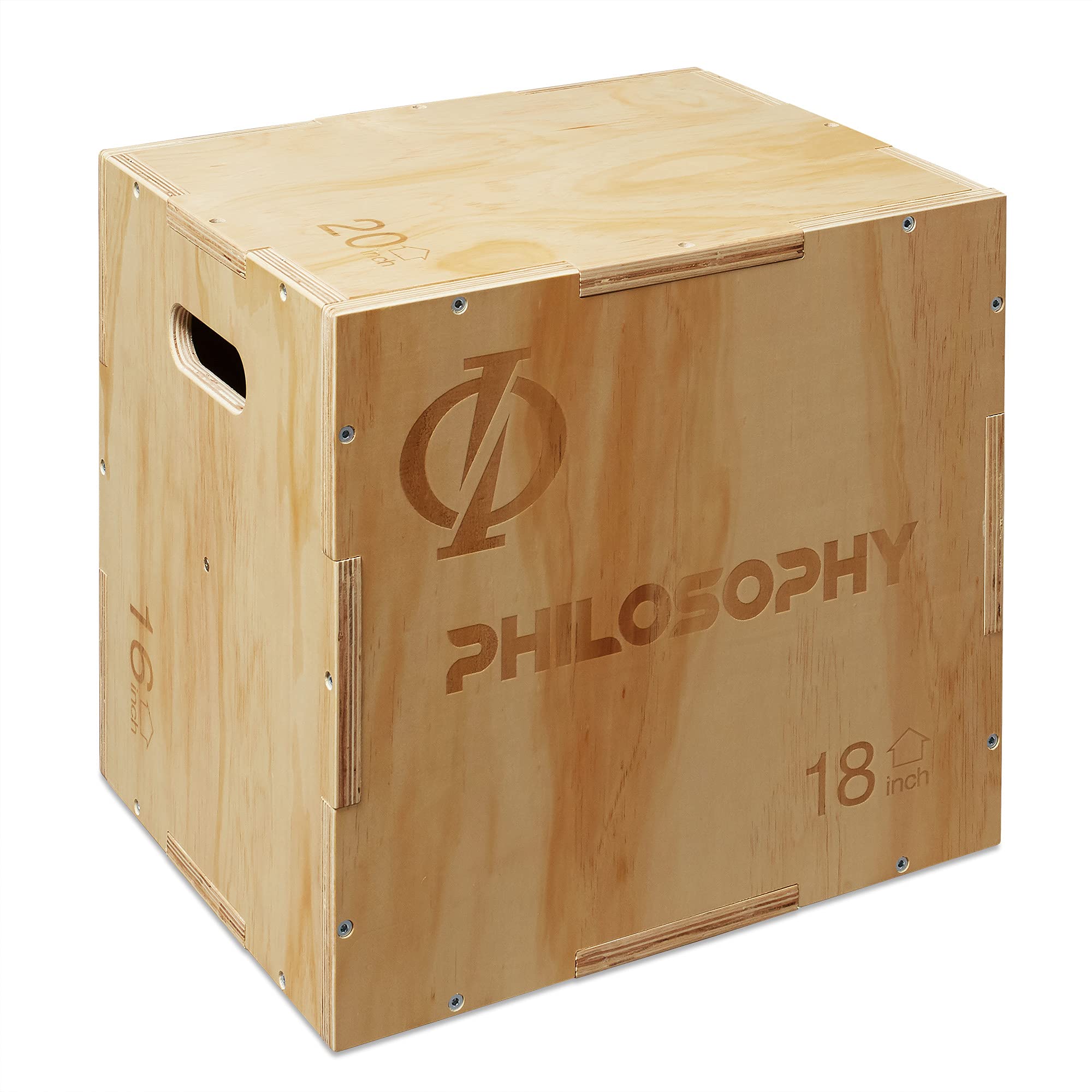
2. Philosophy Gym 3-in-1 Wooden Plyo Box
Built to take a hard landing from a heavier athlete without a wobble.
A 300-pound weight limit is the headline, and it comes backed by internal bracing on the three largest sizes — extra wood inside the box that reinforces the panels against forceful jumps. The size here is 20″L x 18″W x 16″H with a maximum height of 20 inches.
That 20-inch top sits above the Yes4All’s 12-inch ceiling, which is what pushes this box toward intermediate and advanced jumpers. Smooth, sanded edges soften the miss when a foot clips the box instead of landing on top, and pre-drilled holes plus an included assembly guide keep setup quick.
There is no skimping on structure, and that structure adds heft — 27.4 pounds, versus 14 pounds for the Yes4All. On a hard garage floor that weight keeps it planted; it also means you will not be carrying it up stairs casually. Add push-ups, step-ups and squats to its uses and it earns a place in a serious home setup.
The trade-off to know: heft is the price of stability here. You get a box that sits still under a landing, but it is not the one you toss in a car for a park workout.
Worth it for: athletic jumpers who want a 20-inch box that stays put and are fine leaving it in place.
Keep looking if: you need something you can lift and store daily.
3. CAP Barbell 3-in-1 Plyometric Box
The box that opens up 24-inch jumps and still takes the rough handling.
Rotate this one onto its sides and you train at 24, 20 or 16 inches — the full spread of heights from a single box. At 20″L x 18″W x 24″H its top setting reaches 24 inches versus the Philosophy Gym’s 20-inch maximum, which is the difference between an intermediate box and a box that keeps up with an advanced jumper.
Interlocking panels and countersunk screws build a secure platform, with the screw heads sunk flush so nothing catches your shoe. The wood is CARB-compliant engineered wood rated to a 300-pound maximum. Rounded edges and recessed hardware cut the snag points, and wide built-in carry handles make it easier to move between exercises.
The build is the story owners come back to — the sturdiness and the overall quality get the most love, and the box specifically does not tip during workouts. A wrench is even tucked into the box for the screws. The recurring note is that the taller box can feel big if your space is tight, so give yourself room to land on all three faces.
Honest read: this is the pick for anyone whose current box has become too short. The 24-inch face gives you room to grow, and the interlocking build keeps it tight over time.
Choose this if: you are ready for 24-inch jumps and want one box to cover your whole progression.
One thing to plan for: the tall footprint needs a clear space for all three landing faces.
4. CAELUM 3-in-1 Wood Plyo Box

A honeycomb-textured top aimed straight at sweaty-shoe slippage.
The honeycomb-textured surface is the differentiator here — a raised pattern across the top that bites into your shoe and reduces slipping when your feet are damp. Puzzle joints lock the plywood panels together instead of relying on screws alone, and the whole thing is rated to handle up to 400 pounds without wobbling.
Three heights — 16, 18 and 20 inches — cover step-ups, box jumps, push-ups and dips in one footprint of 20″ x 18″ x 16″. Pre-drilled pilot holes and included screws make setup a matter of minutes, and side handles let you reposition it between sets. Sanded edges round off the corners so a short landing does not cut you.
The durability holds up under real jump training, with owners describing seasons of use and loads of 250 pounds without a creak. What keeps this from being spotless is that slip resistance is argued about — some find it traction-ready, others say it is not as grippy as the listing claims. If you sweat heavily or train on a slick floor, wear shoes with real tread and you will get the best of it.
Where it shines: the textured surface and 400-pound rating make it a strong pick for intense sessions.
Room to improve: grip is the debated point, so treat the non-slip claim as a mild assist rather than a guarantee.
Made for: high-intensity jumpers who want a grippy surface and a high weight rating.
Look elsewhere if: you need certainty on slip resistance and train barefoot on a smooth floor.
5. Signature Fitness Non-Slip Wooden Plyo Box

One box that reaches 30 inches for advanced jumpers and still starts low.
Three heights in one — 30, 24 and 20 inches — make this the box for a household where abilities differ. The lowest face suits a newer jumper, and the 30-inch face gives a strong athlete something to chase. Non-slip surfacing runs across the top to hold your footing on jumps, and the wood construction is meant to take repeated hard landings.
Owners give the sturdiness and the overall quality the most praise, and the box works as expected right out of the gate. Owners rate the design and the value highly. The recurring friction is assembly — instructions can be vague, so plan a little patience, and the grip gets debated between the non-slip surface and a slick feel on some units. A two-year manufacturer warranty backs the whole thing.
Value read: you get three heights spanning a huge range plus a two-year warranty, which is more coverage than most boxes here offer.
Pick it if: several people share the box or you want one box that spans from starter to advanced.
Brace for: a fiddlier build and a grip that varies unit to unit.
6. Fitvids 3 in 1 Wooden Plyo Box

Same three-height blueprint as the Signature Fitness, in a black finish.
Thirty, 24 and 20 inches — this is the tallest box in the lineup, matched only by the Signature Fitness on the top face. The three-in-one design covers box jumps, step-ups and other plyometric work in one piece of wood, and the non-slip surface is meant to steady your footing on landings. A two-year manufacturer warranty covers it.
The quality and the sturdiness are what hold up best here, and the box comes in black if a dark finish fits your space. The friction is assembly — it can be easy or trying depending on the box you get, and the included instructions get called out as weak. If you are handy with a screwdriver and a diagram, assembly is a minor hurdle. If not, recruit a helper and set aside an evening for the build.
Right for: experienced jumpers who want a tall box and don’t mind putting in the assembly effort.
Not for: anyone hoping for a take-it-out-and-jump experience.
7. ProsourceFit 3-in-1 Wood Plyometric Jump Box

Flipped on its sides for three heights, built for CrossFit-style conditioning days.
Turn the box onto whichever side you need and you get a different jumping height each time. This one ships in a 24″ x 16″ x 20″ size with a maximum height of 20 inches. The plywood is rated to hold up to 300 pounds, and the larger sizes add an internal brace for extra support under hard jumps.
Rounded, sanded edges are built in for safety, and all screws come with pre-drilled holes plus detailed assembly instructions. It is designed for WODs, vertical jump training, step-ups, dips and decline push-ups — the sort of mixed conditioning a box gets used for in a timed circuit.
Assembly and build quality both come through well in owner feedback, and the wood feels solid once it is together. The one to flag: if you go for a larger size, the internal brace is what keeps the panels from flexing, so confirm you are getting a size with that reinforcement before you buy. For mixed conditioning circuits at home, it covers jumps, dips and step-ups in one box.
The draw: a sturdy 300-pound plywood box built for mixed conditioning work.
Fits best: CrossFit-style training where the box serves jumps, dips and step-ups in one session.
Check first: whether your chosen size includes the internal brace.
8. Synergee 3 in 1 Plyometric Box

Thick plywood and a 450-pound rating for jumpers who go hard.
Built from 3/4-inch high-quality plywood and rated to withstand up to 450 pounds, this is the heaviest-duty box in the lineup by capacity. At 24″ x 20″ x 16″ it gives three working heights — 24, 20 and 16 inches — from one box, and it weighs 31.3 pounds. That mass is what keeps it planted when you land hard.
Inner supports, screws and pre-drilled holes are all included for assembly. The box is designed for explosive leg work and a full menu of exercises: decline push-ups, split squats and around-the-box planks among them. At 31.3 pounds, it is built to stay in one spot in a garage or basement gym.
Buyers report the box goes together easily and feels solid once assembled, so you are not worrying about it tipping mid-workout. The one repeated complaint is the screw quality. Treat the included screws as a starting point and swap them out if you want confidence. Apart from the screws, the 3/4-inch plywood holds up to hard use.
Muscle of the group: 3/4-inch plywood and a 450-pound capacity make it the strongest box for punishing sessions.
The catch: the hardware is the weak link — upgrade the screws and you have a box that lasts.
Made for: heavy, frequent training where you want the highest capacity and don’t mind a permanent spot.
Weigh the trade-off: 31.3 pounds is a lot to move, and the stock screws may need replacing.
9. Bells of Steel Plyo Box

A thin anti-slip layer and trimmed corners, made to take the fear out of a missed jump.
An extra thin layer of anti-slip PVC is the safety detail here — a rubbery coating that helps prevent slips and the lost training time that comes with them. The corners are trimmed to minimize the risk of a painful miss when a foot catches an edge. With three heights and a 24-inch maximum, the box scales each exercise’s difficulty up or down, and it’s solid enough to use for box squats as well as improve push-ups and box jumps.
The wood construction is meant for a range of skill levels, and the three-in-one design covers a whole workout from a single piece of equipment. It is the priciest box in the lineup, and it earns that mostly on the safety features — the anti-slip surface and trimmed corners are extras you won’t find on most boxes here. If you have ever bruised a shin on a sharp corner, the trimmed edges are worth the extra cost.
Best for: anyone who prioritizes safety and has caught a shin on a box corner before.
Trading off: the safety extras cost more than the stripped-down boxes, so budget-minded buyers may look at a cheaper pick.
Know the Specs
Height Range And The 3-in-1 Design
A 3-in-1 box gives you three jump heights from one box because you flip it onto a different side for each. That means you don’t buy three separate boxes as you progress. Pick a box where the lowest face matches what you can land cleanly today, then move up as your landing gets quieter. A box with a 12-inch maximum tops out early for advanced jumpers, while a 30-inch box gives you room to grow.
Weight Capacity And Plywood Thickness
The weight-capacity number tells you how much load the box is built to handle under a landing. A 300-pound rating is a common baseline, while 400- and 450-pound ratings point to thicker panels and stronger internal bracing. Plywood thickness is the underlying reason — a thicker sheet resists flexing, which is what keeps the box from creaking under repeated jumps.
Joint Style, Screws And Assembly
Puzzle joints and interlocking panels hold the wood in its shape, while countersunk or pre-drilled screws keep the assembly tight. Assembly is the detail that separates a frustration from a quick setup, so look for pre-drilled holes and included hardware. The included screws are worth a quick inspection — if you plan years of hard jumps, upgrading them is a smart little insurance policy.
Surface Grip And Edge Finish
A non-slip, textured or anti-slip PVC surface adds traction so shoes don’t slide on landing. Sanded, rounded or trimmed edges protect your shins when a jump falls short. These two details are the ones owners notice most on sweaty training days. Neither makes the box stronger, but both make a missed jump less punishing.
Common Questions
How do I pick the right height for a wooden plyo box?
Will a wooden plyo box scratch or dent my floor?
What weight capacity should I look for when jumping on the box?
Is a wooden plyo box better than a foam or soft-sided box?
Can I use a wooden plyo box for step-ups and push-ups too?
Do these boxes come fully assembled?
Will a non-slip surface actually stop me slipping on the box?
Are the corners and edges safe if I miss a jump?
How much space do I need for a 3-in-1 plyo box?
Can I use a wooden plyo box outside or in a garage?
The Bottom Line
For most home gyms, the best wooden plyometric box winner is the Yes4All 3-in-1 Wooden Plyo Box — a 14-pound box with a plywood build that owners rate well and enough height range for beginner and intermediate jumps. If you plan to grow into 20-inch jumps, the Philosophy Gym 3-in-1 Wooden Plyo Box gives you that with a 300-pound rating and internal bracing. And if 24-inch jumps are already in reach, the CAP Barbell 3-in-1 Plyometric Box is the one to reach for, with its 24 / 20 / 16-inch height range and wide carry handles.
How we choose
We do not accept paid placement. Every pick is matched to a real buyer and a real use-case; we do not hands-on test units.
Sources
Specifications: manufacturer listings and product documentation. Review insights: verified customer reviews, as of November 2026. Pricing: not shown on this page (it changes often); check the current price via the retailer link.
As an Amazon Associate, Tactical Gear Guy earns from qualifying purchases. This does not affect which products we feature.