Specs are compiled from manufacturer listings and verified buyer reviews and can change over time — please confirm the key details on the product page before buying.
The hardest part of homemade pizza is getting a topped pie off the counter and onto a hot stone. It is getting a fully loaded pie off your counter and onto a hot stone without folding it in half. A wooden pizza board with a tapered front edge solves that: the thin lip slides under the dough, and the handle gives you room to move before the crust sets. The list below covers eight boards that do this reliably, from a bamboo peel that doubles as a serving platter to an acacia board that arrives with its own cutter.
This guide is built by comparing the manufacturers’ published specifications and the patterns across verified customer reviews, so you get each pick’s real strengths and trade-offs instead of marketing spin.
Most pizza-board failures come down to three things: a front edge too thick to slide under the dough, a board that warps after a few damp wipes, or a surface that grabs flour instead of letting it glide. Below you’ll see which boards handle each of those points and which ones ask you to work around them, so picking the best wooden pizza board depends on matching one to your oven.
Top Picks

How To Choose The Best Wooden Pizza Board
You are buying two things at once: a tool for moving raw dough into a hot oven, and a flat, clean surface to serve on afterward. A board that does one well but not the other will end up in a cabinet. These are the four points that decide which camp a board lands in.
The Front Edge Is the Whole Job
A tapered edge (a front lip that slopes thin toward the tip) is what lets the board slide under a dusted dough without squashing it. Without that slope, the dough catches, stretches, and your toppings slide off before you reach the oven. Look for wording like “tapered edges” or “beveled edge” in the listing, because that thin lip is the difference between a smooth launch and a rescue mission.
Bamboo, Birch, or Acacia
Bamboo is a grass, not a hardwood, and it is pressed into boards that tend to stay flat and shrug off moisture. Birch is a light hardwood that some Italian makers use for a traditional peel feel. Acacia is a dense hardwood that looks richer on the table but wants careful hand washing. None of the three is wrong — pick bamboo for weekly launches, birch for a traditional thin peel, acacia for a board that lives on the counter.
Size Against Your Oven Opening
A board wider than your oven door will not fit through it at an angle, no matter how nice the wood looks. A 12-inch board suits most home ovens and small outdoor ovens. A larger surface, around 17 inches wide with the handle included, gives you more room for a bigger pie but takes more cabinet space. Measure your oven shelf and your cabinet before you commit.
Care Comes Before Looks
Every board on this list is hand wash only, and that is by design — a dishwasher cycle strips the oil finish and pushes water into the grain, which is how a board splits or warps. Wiping with a damp cloth and air drying keeps the surface smooth. If you know you will not hand wash it, buy the cheapest board on this list rather than a hardwood one.
Side-by-Side Comparison
| Model | Best For | Material | Board Size | Weight | Amazon |
|---|---|---|---|---|---|
| Zulay Kitchen Bamboo Pizza Peel★ Best Overall | Overall balance of launch and serve | Bamboo | 19.6″ x 12″ x 0.47″ | 703 g | Amazon |
| Loftern Wooden Pizza Peel 12 InchBest Value | Guided slicing and dough shaping | Bamboo | 12″ wide, 0.5″ thick | 1.17 kg | Amazon |
| Fiery Chef 12” Bamboo Pizza PeelEven-Slice Pick | Even slices in one pass | Bamboo laminate | 17.3″ x 12.2″ x 0.47″ | 16 oz | Amazon |
| Eppicotispai Birchwood Pizza Peel | Wide, thin Italian-style peel | Birch wood | 19.7″ x 14.75″ x 0.5″ | 560 g | Amazon |
| Solo Stove Bamboo Pizza Peel | Matching an outdoor pizza oven | Laminated bamboo | 19″ x 11.75″ | 1.4 lbs | Amazon |
| homish Bamboo Pizza Peel with Size Markings | Shaping dough to exact sizes | Moso bamboo | 22″ x 14″ x 0.5″ | 1.02 kg | Amazon |
| TJ POP Acacia Pizza Board | Cutter and server in one box | Acacia wood | 17″ x 12″ x 0.6″ | 0.92 kg | Amazon |
| Gozney 12″ Acacia Wood Peel and Server | Table presentation and hard wood | Acacia wood | 12″ x 12″ x 0.5″ | — | Amazon |
Detailed Reviews
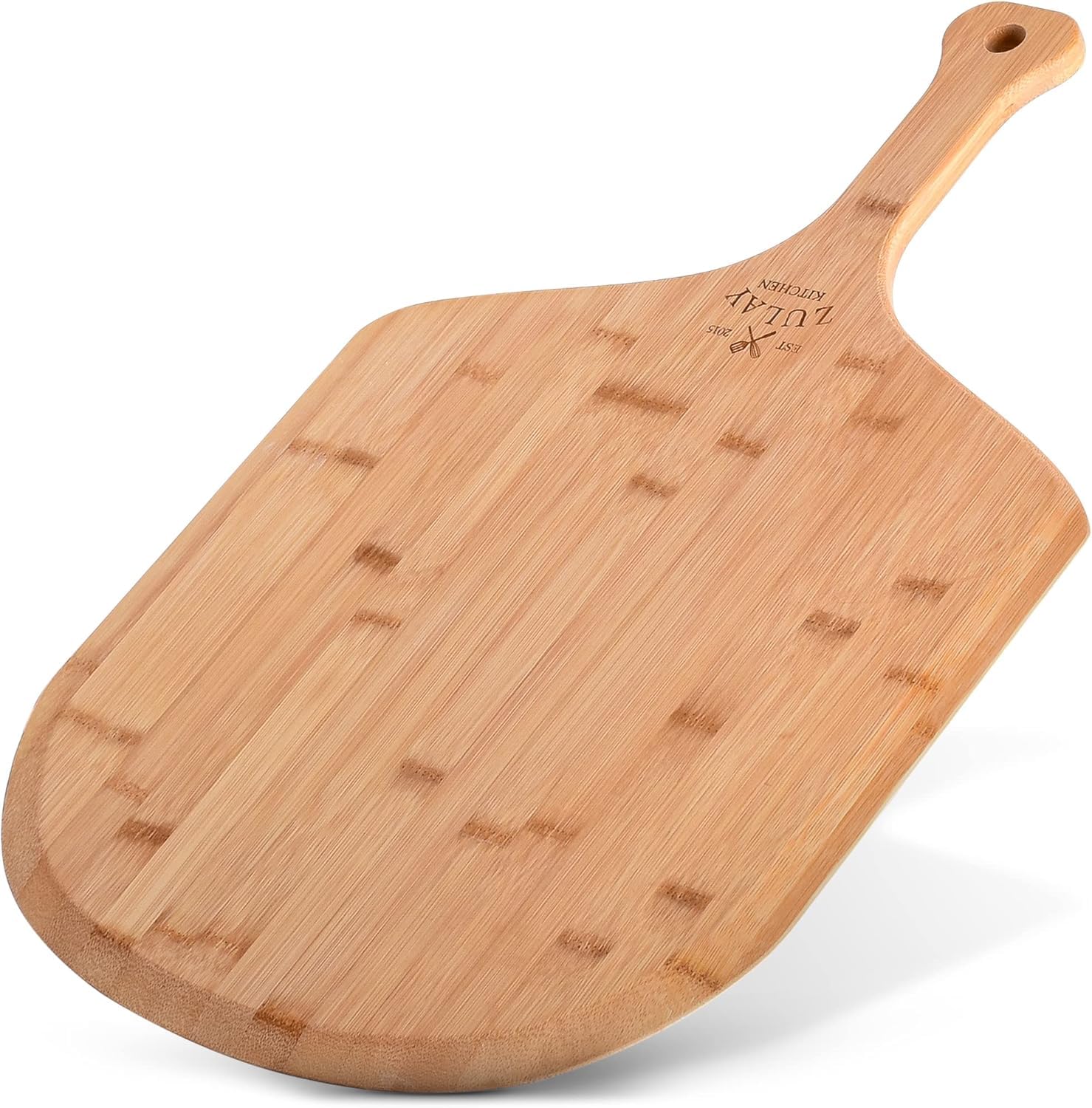
1. Zulay Kitchen Bamboo Pizza Peel Medium 12”
Our pick — 4.5+★ from 900+ verified ratings; the strongest balance of quality and price.
The board that gets a loaded pie from counter to stone without tearing the dough.
The number that defines this peel is 12 inches — the diameter of the paddle surface. That is the size that fits a small outdoor oven or a standard home shelf without snagging the walls, and it is the reason this board keeps showing up in kitchens with modest ovens. The beveled edge (a front lip polished thin and sloping down to the tip) is what actually does the work: it slides beneath a dusted dough ball and lets you transfer the whole thing in one motion.
The surface is bamboo polished smooth, and that finish is the second thing you notice. Dough tends to slide off rather than grip, which is the entire point. What wins people over most is the size, and the second most-discussed point is how little effort it takes to wipe clean. Both make sense for a board that spends as much time as a serving tray as it does as a launching tool. You can also flip it over for fruit, cheese, or charcuterie when guests show up.
The weight is where the honest trade-off sits. At 703 grams this is noticeably heavier than the Eppicotispai birch peel at 560 g, so a full arm extension over a hot stone takes a steadier hand. The non-stick performance also splits opinion — some surfaces grab more than others, which usually means a light dusting of flour or semolina before you load. Neither issue undermines the board; they just tell you to dust generously and launch close to the oven mouth.
What earns it the top slot
- 12-inch surface fits small outdoor ovens and standard home shelves
- Beveled front edge slides under dough cleanly
- Polished bamboo surface releases dough without sticking
- Doubles as a serving or charcuterie board
- Hanging hole in the handle keeps it off the counter
Where it asks more of you
- 703 g makes full extension over a hot stone tiring
- Surface grip varies, so flour the board before loading
- Hand wash only — a dishwasher cycle will shorten its life
Made for you if: you bake in a compact oven and want one board for launching and serving.
Bring flour: the surface can grab, so dust it before the dough touches down.
2. Loftern Wooden Pizza Peel 12 Inch Board with Engraved Sizes
The board that measures your dough for you before you ever reach the oven.
Most peels leave you eyeballing whether the base will fit. This one has engraved circle rings for 8-inch, 10-inch, and 12-inch pizzas pressed right into the bamboo, so you stretch the dough to a visible line instead of guessing. There are also slice lines that divide the finished pie into six even portions. You shape the dough to the ring, launch it on the same board, and cut along the engraved lines without a separate guide.
The tapered edges mirror what the best peels do — a thin front lip that slides under the dough and a handle you can grip with a full hand. The handle carries a hanging hole, so storage does not eat a cabinet shelf. Bamboo is the material here as well, and the maker recommends seasoning the board before first use to bring out the best of the surface.
Weight is the point to know before buying. At 1.17 kg this is the heaviest board on the list, and it wants both hands for any launch across a deep oven. The board is also reversible, so one side serves as the launching tool and the other as a cheese or charcuterie board. Hand wash only, as with every board here, and a light oiling will keep the rings readable.
The ring system works: engraved guides at 8, 10, and 12 inches remove the guesswork from dough shaping.
Heft is the gap: 1.17 kg is a lot of board to hold steady over a hot stone.
Reach for this if: you want portion consistency and slice guides built into the board itself.
Look elsewhere if: you launch one-handed or have a deep oven that calls for a lighter peel.
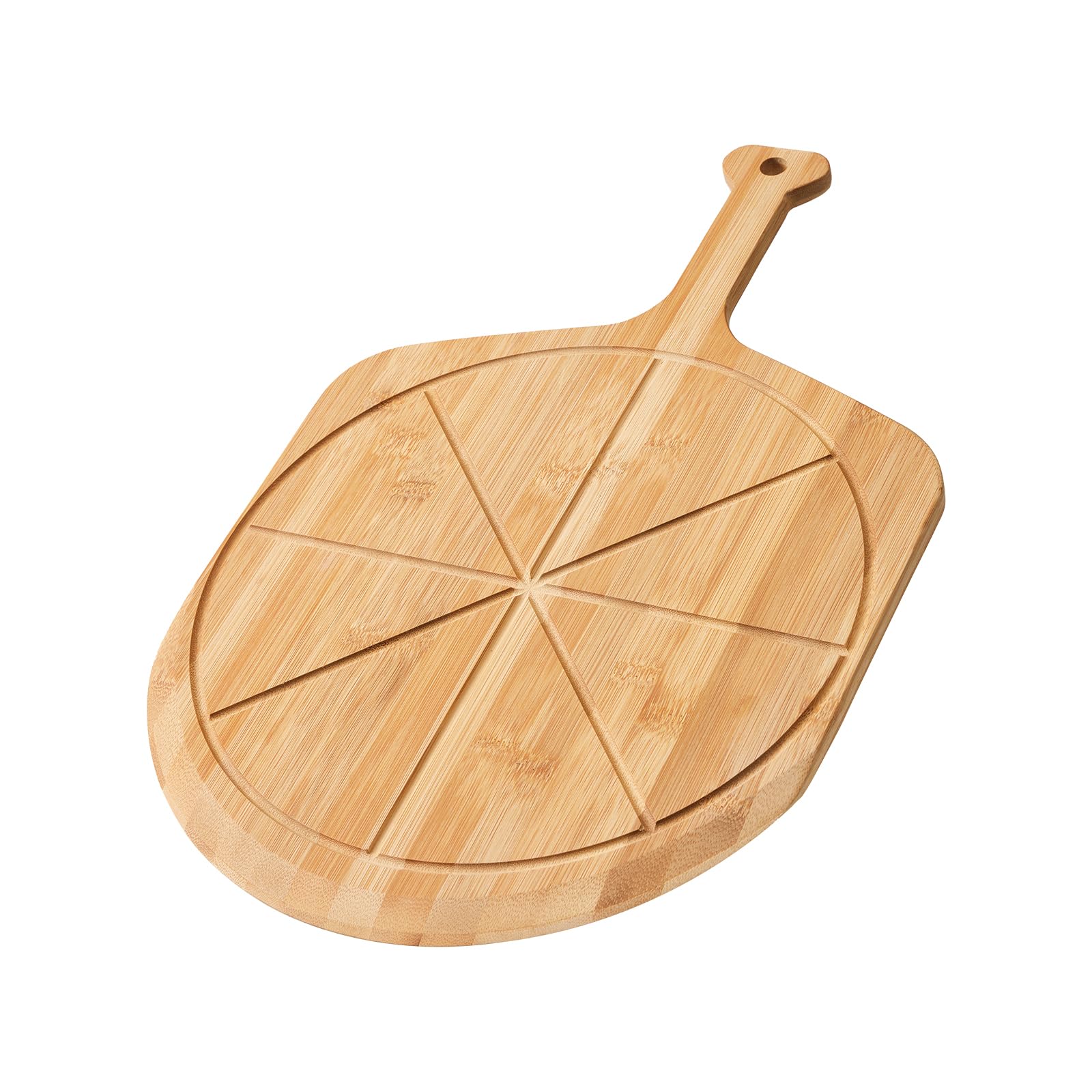
3. Fiery Chef 12” Bamboo Pizza Peel with 8 Slice Grooves
Eight grooved slices pressed into the surface, so every cut lands the same width.
Cutting a pizza into even pieces is a skill most cooks never quite master. This board sidesteps it: V-shaped grooves are milled into the surface to guide the knife into eight equal slices. You press the knife into the channel and follow it across, and the result is far tidier than freehand slicing. The peel surface itself measures roughly 12 by 12 inches, while the full board runs 17.3 inches long and 12.2 inches wide including the handle.
Three layers of natural bamboo laminate hold the shape together, which is the fix for the cracking and warping that single-piece boards sometimes develop. The maker describes the bamboo as harder than maple and lighter than oak, and ships the surface oiled and smooth. At 16 ounces it stays easy to hold over the oven mouth, and a wall-hanging hole keeps storage simple.
The board also pulls double duty as a bread, cheese, or serving board, and the finish looks presentable enough to put on the table. What buyers notice first is the appearance, followed closely by the size. Durability is the mixed note — a laminated board kept dry and hand washed will last well, but leaving it to soak is exactly the kind of care that shortens the life of any bamboo peel.
Why the grooves matter
- V-grooves guide eight equal slices every time
- 17.3″ overall length gives real handle reach
- Three-layer bamboo laminate resists cracking
- 16 oz stays light for one-handed launches
Keep it dry
- Never soak it — water shortens a bamboo board’s life
- Grooves collect flour, so brush them out after each use
Prefer this one if: presentation and portion consistency matter as much as the launch.
The catch: you must commit to hand washing and prompt drying to keep the laminate tight.
4. Eppicotispai Birchwood Pizza Peel (14.75″ x 19.70″)

The widest board here, built from natural birchwood and made in Italy.
At 14.75 inches wide and 19.7 inches long, this peel offers more flat surface than the Zulay board’s 12-inch paddle. That extra width is what you want for a larger pie or for sliding a frozen pizza onto a stone in one clean push. The birchwood handle is contoured for a comfortable hand position, and the board measures 0.5 inches thick — thin enough to feel responsive, thick enough not to bow mid-transfer.
On weight, this is the lightest board in the list at 560 grams. Compared with the Zulay at 703 g, that difference shows up exactly where it matters: a long reach across a hot oven floor. Natural birch is the material, and it is hand wash only, so it wants the same treatment as every other board here.
The honest limit is the material spec. This is a plywood-style birch construction rather than a solid slab, and it reads fairly thin in hand — that is the most-flagged concern. A few boards arrive flatter than others, and sturdiness opinions split. Treat it as a launching tool rather than a serving platter you pass around with a hot pie on it, and it performs well, particularly on frozen pizzas and slide-on transfers to a stone.
Wide and light: 14.75″ of width at just 560 g gives you surface and reach together.
Thin construction: the birch is laminated and fairly thin, so it works best as a peel rather than a table server.
The match for: bakers who want a wide launching surface and do not need a dining board.
Think twice if: you plan to carry a hot pie to the table on the board itself.
5. Solo Stove Bamboo Pizza Peel

Built to match the mouth of a backyard pizza oven, flame handle and all.
This peel slides a pizza into a Pi oven square rather than at an angle, because Solo Stove sized it to that oven’s mouth: 11.75 inches across and 19 inches long. The surface is laminated bamboo (thin bamboo layers glued into a sturdy board), and the tapered front edge lets a topped dough slide forward without catching.
The maker says the bamboo absorbs excess moisture from the dough, so a wetter dough firms up slightly on the board before it hits the stone. At 1.4 pounds, the peel stays manageable for the two-hand launch most outdoor ovens require. The handle carries Solo Stove’s signature flame detail, and the board looks intentional sitting on a table when you carry the finished pizza out.
The trade-off is scope. If you own a Pi oven, the sizing is a genuine advantage. If your oven is a different brand or a standard indoor unit, you are paying extra for a matching width you may not need. Hand wash only, and keep the laminated layers dry to preserve the surface.
Buy it with: a backyard pizza oven where the 11.75″ width lines up with the opening.
Pass if: your oven is a different make and you want the widest board for your money.
6. homish Bamboo Pizza Peel 10” 12” 14 inch

Three size rings pressed into Moso bamboo, built for anyone who bakes by the number.
You shape the dough to a set size before launch, thanks to inch markings at 10, 12, and 14 inches — that cuts the guesswork that gives you a base too big for the stone or too small for the toppings. Those sizing guides are the feature that earns the premium tier. The board runs 22 inches long and 14 inches wide at 0.5 inches thick, giving you the largest working surface on this list.
Moso bamboo is the material, chosen for a combination of lightness and stiffness that suits a peel in and out of a hot oven repeatedly. The bamboo is FSC certified, which refers to a forestry certification scheme for responsibly sourced timber. An easy-grip handle keeps control steady when the board is loaded, and the same board works as a serving tray for bread, pastries, or charcuterie once the pizza is done.
At 1.02 kg this is on the heavier side, just under the Loftern’s 1.17 kg, so a two-hand launch is the sensible approach for a deep oven. It is hand wash only, and the sector shape — a paddle that widens toward the tip — gives you more usable flat area than a narrow paddle of the same length.
Size marking advantage: 10, 12, and 14-inch guides let you bake consistent pizzas without measuring tools.
Weight note: at 1.02 kg it rewards a steady two-hand launch.
For the planner: bakers who want the dough shaped to a target size every single time.
Not for the minimalist: the 22″ length needs cabinet room, and the markings are only useful if you actually follow them.
7. TJ POP Pizza Peel 12 Inch Acacia Wood

An acacia board that arrives with the cutter and server already in the box.
Buying a peel usually means buying a cutter separately. This board skips that step: it ships with a stainless steel pizza cutter and a server spatula, so the slicing and serving tools are already covered. The board is natural acacia wood, a dense hardwood the maker calls more durable than bamboo and healthier than plastic, with a unique wood color on each piece.
The dimensions are 17 by 12 inches at 0.6 inches thick, with a shape modeled on a ping pong paddle. The handle is smooth for a comfortable grip, and a hanging hole lets you store it on a wall hook instead of in a drawer. Flip it over and the other side handles fruit, vegetables, cheese, and bread, or works as a charcuterie board at a party. Acacia takes a hand wash only — as with every board here — and the wood looks good enough to give as a gift around the holidays.
The 0.6-inch thickness is the heaviest spec among the boards here, though the acacia is only 0.92 kg. That thicker stock is part of why the board works as a serving surface, and it is the part to watch when you launch — the lip is less forgiving than the thinnest tapered peels on this list.
Ready to use: cutter and server spatula are included, so nothing extra to buy.
Thick stock: 0.6″ makes it a better server than a delicate launcher.
Best for: anyone who wants one box that covers launch, slice, and serve in acacia.
Skip if: you already own a cutter and prefer the thinnest possible front lip.
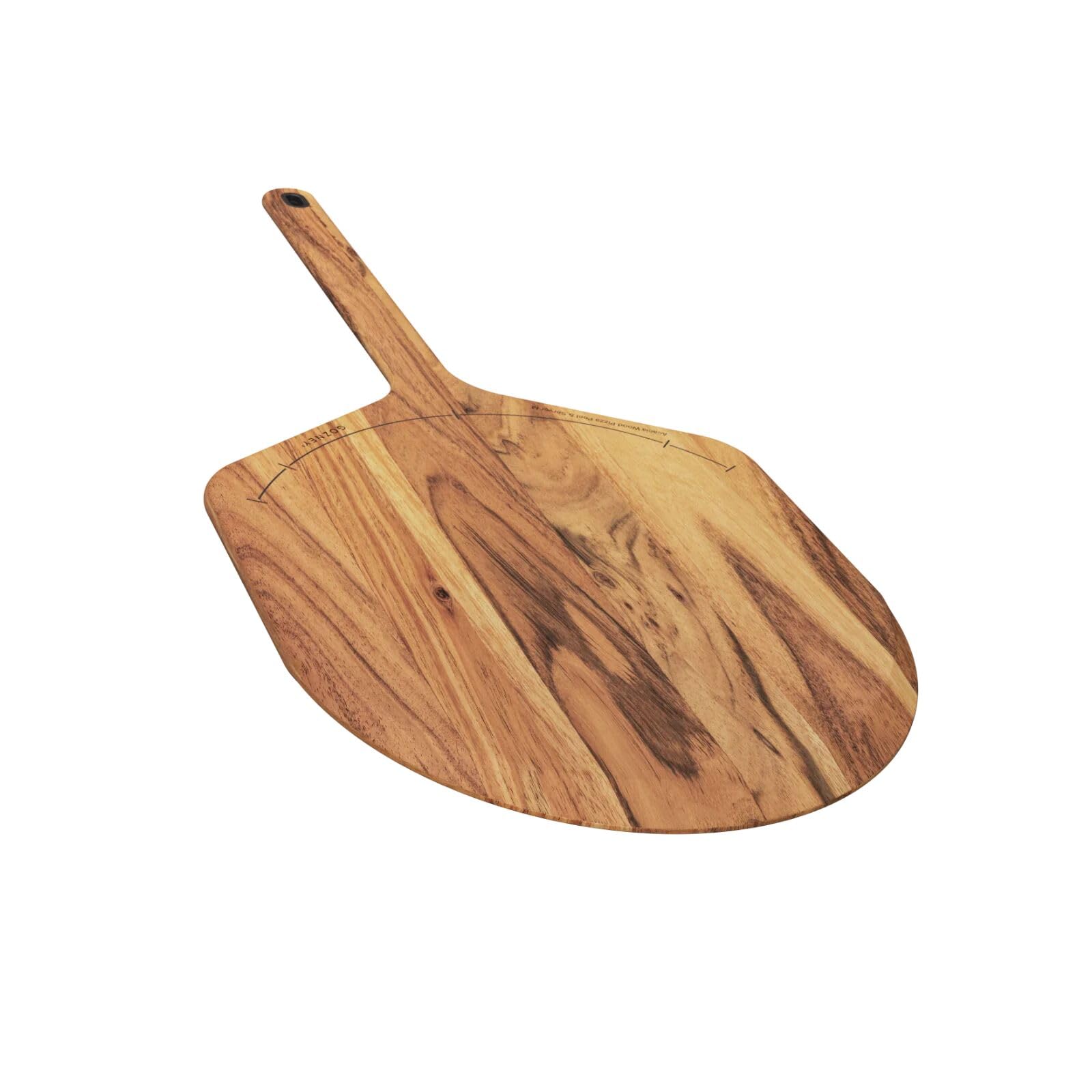
8. Gozney 12″ Acacia Wood Pizza Placement Peel and Server
A round acacia peel sized for a 12-inch pie, meant to double as a server.
The shape is what sets this apart: a 12 by 12-inch round board at 0.5 inches thick, sized for pizzas up to 12 inches. A round board mirrors the pie, so you can cut and serve on the same surface without working around corners. The natural acacia surface is described as easy to slide pizza onto — acacia is a dense hardwood, and the finish keeps the dough moving. A metal hanging loop means it stores on a wall hook rather than in a drawer.
Where this board gives you something the others do not is the clear care guidance. The maker states acacia is not meant for dishwashers and asks you to hand wash with soap and water and air dry. Follow that, and the surface keeps its look. Ignore it, and you will see the wood dull quickly. The board is built as both a placement peel for the oven and a serving board for the table.
Functionality works well — launching pizzas gets noticeably easier with a round board that matches the pie. The stickiness of the surface is the uneven part, and a dusting of flour before loading fixes most of it. This is the pick for someone who wants a hardwood serving piece first and a launching tool second.
The round advantage: 12″ x 12″ matches the pie, so cutting and serving happen on one surface.
Care matters: acacia dulls fast if you skip the hand wash and air dry step.
For the table-first cook: a hardwood board that looks right under a finished 12-inch pie.
Keep looking if: you launch large pies and need more surface than 12 inches square.
Know the Specs
Paddle Surface and Diameter
The paddle surface is the flat working area where your dough sits. A 12-inch board suits small outdoor ovens and most home shelves, while a wider 14.75-inch board gives you room for a larger pie. Measure your oven hook or shelf so the board fits through without turning sideways.
Weight and Your Arm
Weight decides how steady you stay over a hot stone. A 560-gram board is light enough for one hand; a 1.17-kilogram board wants two. If you launch over a deep oven, pick the lighter option and let the board do less lifting.
Wood Species and Construction
Bamboo is pressed grass that tends to stay flat and shed moisture; birch is a light hardwood used for traditional Italian peels; acacia is a dense hardwood that looks stronger on the table. Laminated boards — three layers bonded together — resist cracking better than a single slab.
Edge Taper and Release
The tapered front edge is the lip that slides under a dough ball. Thinner and smoother means less sticking. A beveled edge polishes that lip down so the dough glides off. If the lip feels thick or rough, expect to flour the surface more generously before every launch.
Common Questions
Can I use a wooden pizza board directly in a hot oven?
Bamboo or acacia: which wooden pizza board lasts longer?
Will a 12-inch board fit my outdoor pizza oven?
How do I stop dough sticking to the board?
Can I put a wooden pizza board in the dishwasher?
How often should I oil a bamboo pizza board?
Do I need a separate cutter if the board has slice grooves?
Is a wooden pizza board heavier than a metal peel?
Can a wooden pizza board double as a charcuterie board?
The Bottom Line
For most kitchens, the wooden pizza board to start with is the Zulay Kitchen Bamboo Pizza Peel, because its 12-inch beveled edge handles the launch cleanly and the polished bamboo surface works just as well as a serving board. If you want every slice to match, the Fiery Chef and its eight V-grooves make portion consistency easy. And for a backyard oven setup, the Solo Stove Bamboo Pizza Peel is sized to line up with the oven mouth. Start with the front-edge taper and the board’s weight in your hand; the rest follows.
How we choose
We do not accept paid placement. Every pick is matched to a real buyer and a real use-case; we do not hands-on test units.
Sources
Specifications: manufacturer listings and product documentation. Review insights: verified customer reviews, as of November 2026. Pricing: not shown on this page (it changes often); check the current price via the retailer link.
As an Amazon Associate, Tactical Gear Guy earns from qualifying purchases. This does not affect which products we feature.