Specs are compiled from manufacturer listings and verified buyer reviews and can change over time — please confirm the key details on the product page before buying.
You want a keyboard that feels solid under your fingers and looks like furniture instead of plastic. One thing to know first: a wooden keyboard case is rarely a finished keyboard — most are bare shells or full kits you build yourself. Fit matters too: a case cut for a 60% board (a compact layout with no number pad or arrow keys) will not fit a 65% one (the same layout plus arrow keys and a few extra keys). Below, each shell’s real wood is separated from veneer, and each one’s accepted PCB layouts (the circuit board that carries the keys) are spelled out, so you can pick the one that suits your build.
This guide is built by comparing the manufacturers’ published specifications and the patterns across verified customer reviews, so you get each pick’s real strengths and trade-offs instead of marketing spin.
Below you will find the honest differences between five real wood options, so you can pick the right one for a wooden keyboard case build before you spend a cent.
Top Picks


How To Choose The Best Wooden Keyboard Case
The first thing that decides whether a wooden case works for you is whether the shell was cut for your PCB, not the wood. A 60% shell takes a 60-key board. A 64 or 65% shell takes a board with arrow keys or a function row. Get that match wrong and the finish does not matter.
Match the layout code to your PCB first
Listings name the boards they fit for a reason. A case built for GH60, DZ60, or Poker layouts follows the screw holes and the USB port cutout of those boards. If your board is a Poker 2 or a Pok3r with USB-C, check the listing notes — some shells explicitly state that model will not fit, while a Poker 3 RGB may work on a GH60 layout. Read that line twice before you buy.
Decide if you want a shell or a full kit
A bare case is just the wood top and bottom, and you supply the PCB, plate, and switches. A kit bundles the case with a PCB, a plate, stabilizers, feet, and screws, which saves you hunting for parts that fit together. A bare shell suits you if you already own a working 60% board and only want to change the housing. A kit suits a first-time builder who wants everything in one box.
Weigh the feel of the wood against the finish
Solid walnut and bamboo both feel denser and warmer than plastic, but each wooden shell carries its own grain pattern. Some listings openly say every case differs because the wood itself differs, and an oiled surface protects it. If you want a matching pair of boards, that natural variation is something to accept up front rather than discover later.
Side-by-Side Comparison
| Model | Best For | Type | Layout / Keys | Weight | Amazon |
|---|---|---|---|---|---|
| kbdfans Bamboo Wood case 60%★ Best Overall | Dropping a new shell onto an existing 60% board | Bare case only | 60% | 0.5 kg | Amazon |
| YMDK Handcraft GH60 Solid Wooden CasePremium Pick | Walnut lovers building a 60% from scratch | Shell, top + bottom | 60% | 0.3 kg | Amazon |
| NPKC GH60 Solid Wooden Case Wrist Rest | Buyers who want a palm rest in the same walnut | Case with wrist rest | 60 keys | 0.24 kg | Amazon |
| XVX MU68 FujiWave Wood Keyboard | A finished walnut board with no building required | Complete keyboard | 68 keys | 866.2 g | Amazon |
| YMDK GK64 GK64x Wood Kit | Builders who want the PCB, plate, and stabs in the box | Full kit | 64 keys | 1 kg | Amazon |
Detailed Reviews
1. kbdfans Bamboo Wood case 60%
Our pick — 4.0+★ from 100+ verified ratings; the strongest balance of quality and price.
The bamboo shell that turns a plain 60% board into something you leave on the desk on purpose.
This is the pick for anyone who already owns a working 60% keyboard and only wants to swap the housing. It takes the GH60, POKER, and DZ60 layouts, so the screw holes and port cutout line up with the boards most people build. The shell alone is what arrives — no PCB, no plate, no switches — and it weighs 0.5 kg, so it sits planted rather than skidding when you type hard.
What wins people over is the look of the grain, with the build quality running a close second in how owners talk about it. Bamboo gives a tight, warm tone that photographs well and stays honest as it ages. The case measures 13.39 inches long by 5.51 inches wide by 1.97 inches high, which is compact enough that it will not crowd a small desk. You keep your own stabilizers and plate, so the typing character stays exactly as it was — only the housing changes.
The catch is that this is a shell, not a whole keyboard, so a beginner who expects to plug in and type will be disappointed. If your board is a 65% with arrow keys, it will not fit — this is strictly a 60% cut. Owners generally find it a fair value for a real bamboo housing, and it holds 4.0+ stars across 100+ ratings.
What earns its keep
- Real bamboo shell that takes GH60, POKER, and DZ60 boards
- 0.5 kg weight keeps it planted on the desk
- Compact footprint at 13.39″ x 5.51″ x 1.97″
- Swaps onto an existing board without touching your plate or switches
Where it asks for patience
- Case only — no PCB, plate, or switches included
- 60% only, so 65% boards with arrow keys will not fit
Go for this if: you own a 60% board and want a real bamboo housing around it.
Pass if: you want a finished keyboard from the start — this is the shell alone.
2. YMDK Handcraft GH60 Solid Wooden Case (Walnut Box)
Solid walnut, a full lid and base, and rubber feet already in the box.
If you want the warm dark look of walnut rather than bamboo, this is the shell to shortlist. You get a full box — one top cover plus one bottom case — so the board is enclosed front and back rather than open at the top. It comes in at 0.3 kg, and rubber feet are included, so it sits level without you hunting for pads.
Fit is the part to read carefully. It works with GH60 PCBs, and it will take GK61 and GK64 boards only if you use a GH60 plate to make everything line up. Two common boards are ruled out on the listing itself — a new Poker 2 with USB-C and a Poker 3 RGB will not fit. If either of those is your board, this is not your shell.
The maker describes the walnut as waterproof, which matters if you keep a drink near the desk. Between this and the bamboo case above, the material is the whole choice: bamboo for a light, tidy look, walnut for a darker, heavier-grained finish. It holds a 4.5+ rating, though on a small set of reviews. It is the darker, quieter option for a walnut build.
Why walnut wins here: a full top-and-bottom shell in solid wood, with rubber feet included and a waterproof treatment on the finish. That combination is rare among bare cases.
Fit check before you click: GH60 works, GK61 and GK64 need a GH60 plate, and the new Poker 2 with USB-C plus the Poker 3 RGB are both out.
Right shell for: a GH60 build in walnut where you want the board fully enclosed.
Wrong shell for: a Poker 2 USB-C or Poker 3 RGB owner — the listing rules both out.
3. NPKC GH60 Solid Wooden Case Wrist Rest (Walnut)
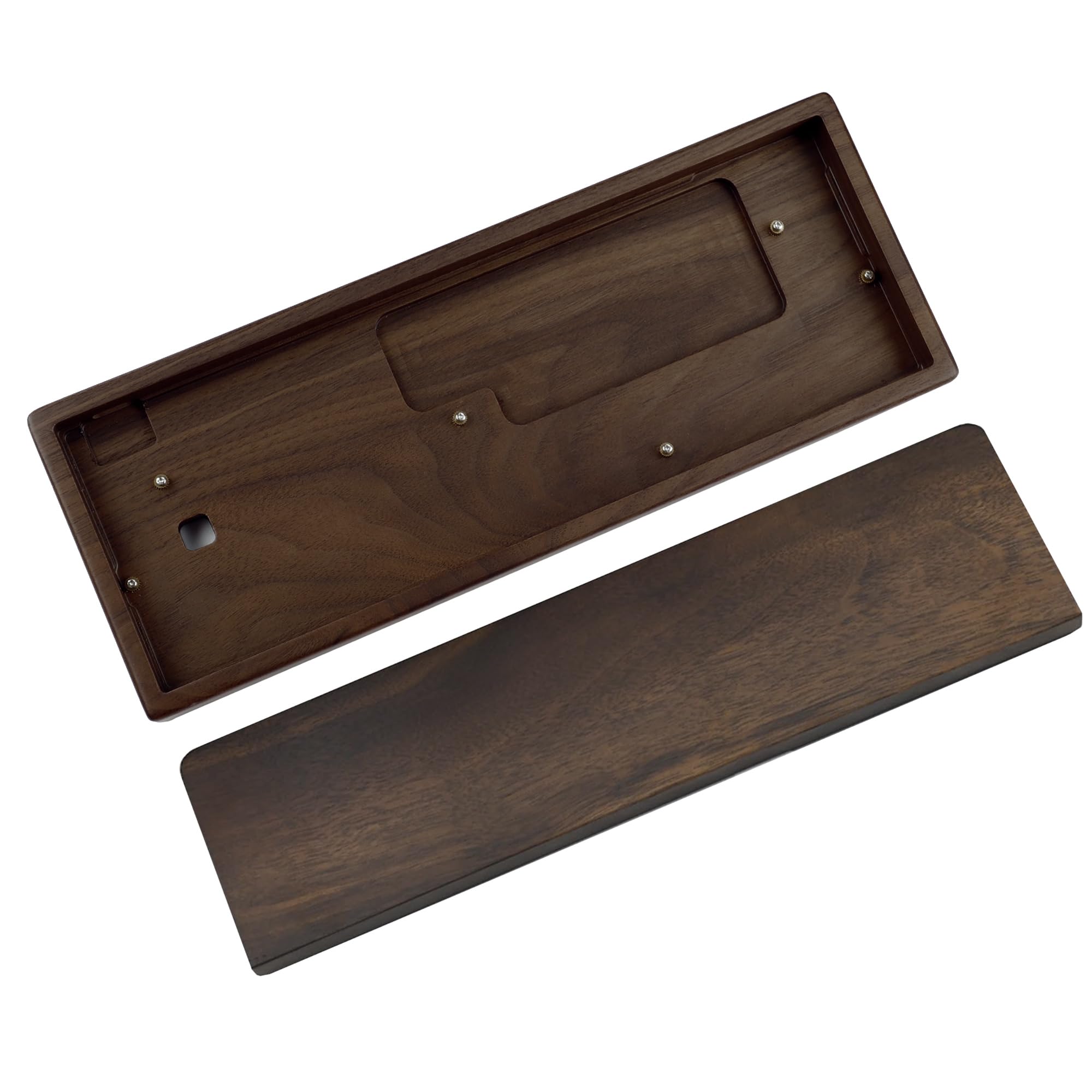
A walnut shell that brings its own palm rest, so your wrists stop hovering.
Long typing sessions are the reason to look at this one. It pairs the wooden shell with a wrist rest in the same walnut, so your hands rest on matching wood instead of the desk edge. At 0.24 kg it is the lightest case in this group by a wide margin — lighter than the YMDK GK64 kit, which comes in at 1 kg.
The compatibility list is broad on paper: Poker 1, Faceu 60, GH60, 64 PCB plate, DZ60, YD60, XD60, and similar 60-key boards all work. One exception is stated plainly — Poker 2 cannot use it. The case is oiled after production to protect the surface, and a keycap puller is included in the box, which helps when you move your keycaps across.
Here is the honest part about wood: no two cases look the same, and the listing says so outright. Each shell follows the grain of its own piece, so a slight difference in tone or pattern is normal, not a flaw. If mismatched grain would bother you, think carefully. For everyone else this is the natural pairing — walnut under your keys and walnut under your palms — and it suits builders who want both in one order. The appearance draws the most praise, with the build quality close behind.
The practical pairing: case plus matching walnut wrist rest in a single order, with the surface oiled to protect it and a keycap puller in the box.
What to expect from the wood: every shell follows its own grain, so no two are identical in tone or pattern. Natural variation is part of the deal.
Reach for this if: you want a walnut shell and a matching wrist rest together.
Look elsewhere if: your board is a Poker 2, which the listing says cannot use this case.
4. XVX MU68 FujiWave Wood Keyboard
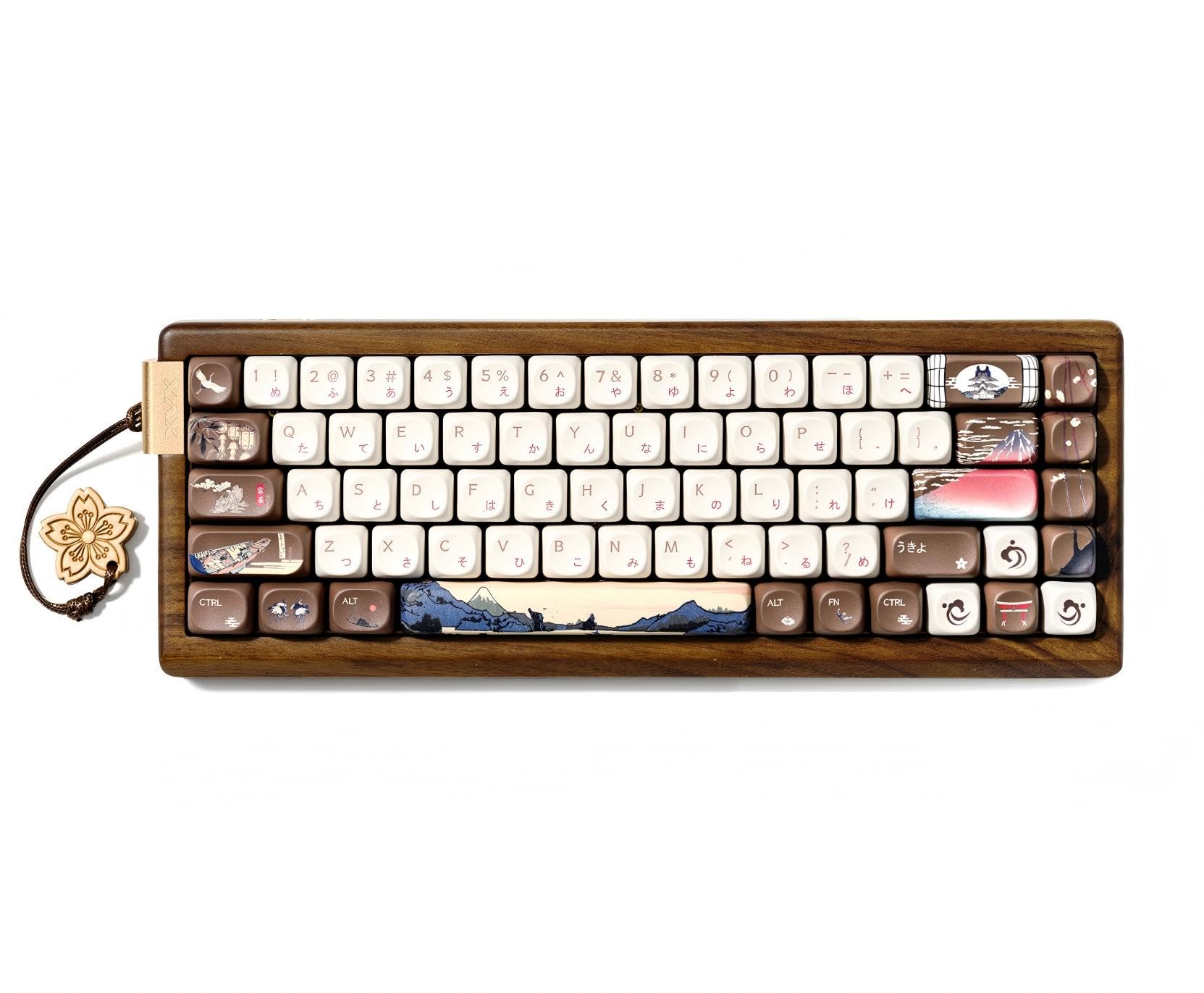
The one you type on the day it arrives — real walnut, no screwdriver required.
This is the only finished keyboard in this group, which makes it the easy answer for anyone who does not want to build. It has a solid walnut case cut from real wood, with a matte oil finish that keeps fingerprints from showing. The 65% body holds 68 keys, so you keep arrow keys and a function row while giving up less desk space than a full board.
Where it pulls ahead of the bare shells is connectivity. It runs on three modes — 2.4G wireless, Bluetooth, and USB-C — and pairs up to three devices with a keystroke, so the same board follows you between desktop, laptop, and tablet. There is a 4000mAh battery behind it. The mode switch hides under the CapsLock keycap, which keeps the edges clean. It weighs 866.2g with keycaps on, so it is sturdy on the desk but still portable.
You can remap keys and build macros through VIA software, which suits programmers and gamers who want custom layouts. It is fully compatible with Windows and macOS, and it uses a tray-mount build with foam dampening inside to reduce noise. The honest caveat is that this is a 68-key board: if you want the classic compact 60% feel, it is wider than the shells above. The 65% layout here holds 68 keys against the 60 keys of the NPKC case, so plan your desk space accordingly.
The reasons it draws attention
- Finished walnut keyboard — no building or soldering
- Three modes: 2.4G, Bluetooth, and USB-C wired
- 4000mAh battery with a hidden mode switch under CapsLock
- Hot-swap and programmable via VIA for custom macros
What to weigh first
- 68 keys on a 65% body is wider than a true 60% shell
- Tray-mount feel differs from a plate-mounted bare case
- A 3.5+ rating suggests mixed early reception
Pick this one if: you want real walnut and wireless, with zero assembly.
Think twice if: you want the smallest possible footprint — 68 keys take more desk than a 60% shell.
5. YMDK GK64 GK64x Keyboard Kit

Everything in one box: wood case, PCB, plate, and stabilizers for a 64-key build.
This is the kit to buy if you want to build once and not chase parts. The box holds the CNC wood case, feet, screws, the GK64x PCB, a plate, and plate-mounted stabilizers. The PCB uses a Type C connector, and the plate is FR4 — a material the maker describes as softer and quieter, so your typing sound lands on the quiet side. It is the heaviest option here at 1 kg, well above the 0.24 kg NPKC case, and that heft is part of why it feels planted.
Assembly has a trick worth knowing before you start. You attach the plate to the PCB using the switches themselves, so install four or five switches into the plate and then into the PCB socket first to line everything up. Do that and the rest follows. The stabilizers are genuine plate-mounted units, which matters for keeping long keys like the spacebar from rattling.
Quality is what buyers praise most about this kit, with value for money right behind it. It is aimed at the builder who is comfortable seating switches, not the plug-and-play shopper. The 64 keys give you a compact board with a little more room than a 60%, and the wood case wraps the whole thing. If you want a walnut build with the internals supplied, this saves you the parts hunt — just budget for switches and keycaps, which are not in the box.
The build-in-one-box appeal: CNC wood case, GK64x PCB, FR4 plate, plate stabilizers, feet, and screws all arrive together, so nothing is missing at the bench.
The honest bill of materials: switches and keycaps are not included, and the plate-to-PCB step needs four or five switches seated first to align everything.
Built for: the builder who wants a walnut 64-key board with the PCB and plate already in the box.
Not for: anyone who wants to plug in and type — you supply switches and keycaps.
Know the Specs
Layout and key count
The percentage or key count on a listing tells you which PCBs will drop in cleanly. A 60% shell centres on 60 keys and fits GH60, DZ60, and Poker layouts. A 64-key kit adds a little more room, and a 65% board with 68 keys keeps arrow keys and a function row. Check the number on your own board against the listing before anything else — a mismatch is the most common reason a wooden case goes back.
Case type: shell, kit, or finished board
A bare shell is wood only, so you supply the PCB, plate, and switches. A kit bundles the case with a PCB, plate, and stabilizers, which suits a first build. A finished keyboard arrives ready to type and typically adds wireless modes and software. Choose by how much work you want: swapping a shell onto a working board is the least effort, a full kit is the most, and a finished board needs none.
Wood type and weight
Bamboo and walnut are the two woods here, and each shell carries its own grain, so no two are identical. Weight tells you how planted the case feels on the desk: the bare cases run from 0.24 kg to 0.5 kg, a finished board sits at 866.2g, and the full kit reaches 1 kg. Lighter cases suit portability, heavier kits stay put while you type.
Mounting and stabilizers
Tray-mount builds clamp the plate firmly and give a solid feedback, while FR4 plates are described as softer and quieter. Plate-mounted stabilizers are the standard for keeping long keys steady. A bare shell keeps your existing plate and stabilizers, so your typing feel stays the same — a kit or finished board sets that feel for you.
Common Questions
Will a 60% wooden case fit my 65% keyboard?
Does a wooden keyboard case come with the keyboard inside?
Which boards work with the kbdfans bamboo 60% case?
Can I use a Poker 2 with these walnut cases?
Why does my wooden case look slightly different from the photo?
Is the XVX MU68 good for someone who has never built a keyboard?
What is the difference between a bare case and the YMDK GK64 kit?
Do I need to solder when I move my board into a wooden case?
How do I keep a walnut case looking good over time?
Does a wooden case change how my keyboard sounds?
The Bottom Line
For most buyers, the right wooden keyboard case is the kbdfans Bamboo 60% case because it drops straight onto a GH60, POKER, or DZ60 board with no extra parts. If you want a matching wrist rest and walnut under your palms, the NPKC GH60 walnut case gives you both in one order. And if you would rather not build at all, the XVX MU68 hands you a finished walnut board with wireless modes and VIA remapping on day one. Whichever you pick, check the layout code against your PCB first — that single match decides whether your build goes together or goes back.
How we choose
We do not accept paid placement. Every pick is matched to a real buyer and a real use-case; we do not hands-on test units.
Sources
Specifications: manufacturer listings and product documentation. Review insights: verified customer reviews, as of July 2026. Pricing: not shown on this page (it changes often); check the current price via the retailer link.
As an Amazon Associate, Tactical Gear Guy earns from qualifying purchases. This does not affect which products we feature.