Specs are compiled from manufacturer listings and verified buyer reviews and can change over time — please confirm the key details on the product page before buying.
A wooden handle hand saw is only as good as the steel bolted to it — and the wrong tooth count will fight you on every stroke. If you are cross-cutting trim, you want fine teeth. If you are ripping a board down its length, you want coarse ones. Get that match right and a hand saw beats a power tool on small jobs. This guide lines up nine saws with real wood grips and matches each one to the job it actually does well.
This guide is built by comparing the manufacturers’ published specifications and the patterns across verified customer reviews, so you get each pick’s real strengths and trade-offs instead of marketing spin.
Blade length, teeth per inch and handle material decide most of the outcome before you ever make a cut. Below you will find the sharpest fit for your bench and your budget with this wooden handle hand saw breakdown.
Top Picks


How To Choose The Best Wooden Handle Hand Saw
Most buyers pick a saw by how it looks on the shelf. That is backwards. The blade and its tooth pattern decide how the tool behaves, and the wooden handle only decides how long you can keep working without your palm aching. Start with the job, then match the steel.
Teeth per inch decides the cut, not the saw’s size
Teeth per inch, usually shortened to TPI, is simply how many tooth points sit in one inch of blade. A high count like 15 TPI leaves a fine, smooth surface and suits joinery and trim. A low count like 4.5 TPI chews through wood fast and suits ripping boards along the grain. Buying a fine-tooth saw for fast framing work is the most common mistake, and it makes a sharp saw feel dull.
Skew back, brass back or straight back
The spine of the blade adds stiffness. A skew back tapers the top edge so the blade is narrower at the tip, which lowers friction and keeps the saw balanced in your hand. A brass back on a tenon saw adds weight up top so the blade stays dead straight through a joint. Neither is better — one is for freehand cross-cutting and the other is for accurate joinery in a vise.
Handle wood and how it is fixed
Beech is the common choice because it is dense and closed-grained, so it resists splitting around the rivets. Check how the handle attaches. Brass-riveted or screwed handles hold tight over years of use, while a loose grip is the first thing to fail on a cheap saw. A shaped handle matters as much as the steel, because a bad grip makes the saw wander off your line.
Resharpening and long-term cost
You get decades of use from a resharpenable blade, far longer than from a hardened disposable one. Cross-ground teeth (teeth shaped so a file can cut a fresh edge back into them) can be filed sharp again, which is why traditional saws stay in workshops for decades. Hardened impulse teeth (factory-sharpened teeth that are hard to file) stay sharp longer from the start, but they are harder to file yourself. Decide up front if you want a saw you file or a saw you replace.
Side-by-Side Comparison
| Model | Best For | Blade Length | Tooth Count | Handle Material | Amazon |
|---|---|---|---|---|---|
| Spear & Jackson Saw Skew Back★ Best Overall | All-round bench work | 22 inches | 10 ppi | Wood | Amazon |
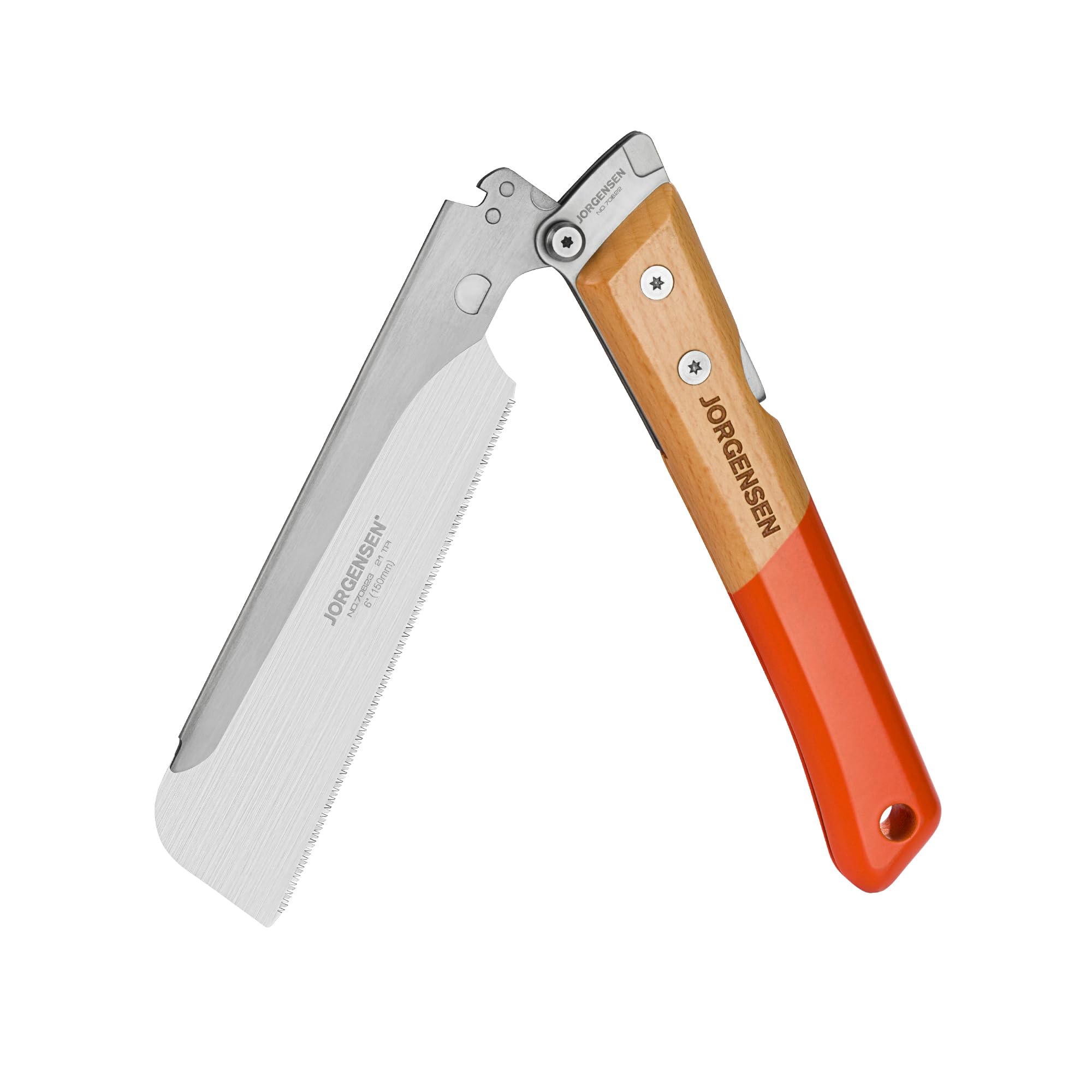
| JORGENSEN Japanese Pull SawTop Performer | Fine joinery and travel | 6 inches | 21 TPI | Beechwood | Amazon |
| Robert Sorby RS-9500R Skew BackTraditional Build | Traditional hand tool fans | 22 inches (559mm) | 10 TPI | Wood | Amazon |
| Japanese Kataba Convex Blade | Precision pull cutting | 265 mm | 1.8 mm tooth spacing | Wood | Amazon |
| Samurai W-330-LH Curved Saw | Green wood and pruning | 13 inches | 6 | Wood | Amazon |
| Spear & Jackson Saw Tenon | Joint cutting | 10 inches | 15 ppi | Wood | Amazon |
| Lynx Garlick Thomas Flinn Rip Saw | Ripping boards by hand | 20 inches | 4.5 TPI | Beechwood | Amazon |
| Bellota 4572-10 Saw | Reaching tight spots | 25 centimeters | — | Wood | Amazon |
| IVY Classic 11114 Miter Back Saw | Miter box trim work | 14 inches | 12 ppi | Wood | Amazon |
Detailed Reviews
1. Spear & Jackson Saw Skew Back 22 inch x 10 ppi
Our pick — 4.5+★ from 700+ verified ratings; the strongest balance of quality and price.
One 22-inch blade that cross-cuts trim and rips a shelf board without swapping tools.
Here is the saw most workshops end up reaching for first. The 22-inch carbon steel blade and 10 ppi teeth sit right in the middle of the range — fine enough for clean trim work, coarse enough to move through a plank without a fight. The skew back tapers the top edge of the blade, which cuts friction and keeps the saw balanced so it tracks where you point it. It carries 4.5+ stars across 700+ ratings, and the thing that wins people over is plain build quality. For a first wooden handle hand saw, this is the one to beat.
Compared with the JORGENSEN pull saw below, the gap is length versus finesse: this Spear & Jackson runs a 22-inch blade to the JORGENSEN’s 6 inches, and weighs 0.58 kg against the 0.26 kg of that folding saw. The long plate means long, level strokes on wide boards. Its 10 ppi teeth handle both along and across the grain, so chipboard and plywood sheets are fair game too.
The honest catch is the cutting performance itself, which is the mixed note across its feedback — some buyers find it needs a light touch to stay on a pencil line rather than aggressive pushing. Teeth are cross-ground and can be resharpened, which is the real long-term value here. Push it hard and it will punish you with a rough edge; let the saw do the work and the cut stays clean.
Skew back tracking
- 22-inch carbon steel blade handles trim, plywood and chipboard with one saw
- 10 ppi teeth split the difference between fine finish and fast removal
- Skew back removes friction and keeps the blade balanced in your hand
- Teeth can be resharpened, so the blade lasts past its first dulling
Needs saw sharpening
- Cutting performance splits opinion — it rewards a light touch on the line
- Riveted wooden handle is fixed, not shaped to your own grip
Pick for crosscuts: you want a single general-purpose wooden saw that covers general carpentry, trim and sheet goods.
Skip if power tools: you need fine joinery cuts — the 10 ppi tooth spacing is not a dovetail saw.
2. JORGENSEN Japanese Pull Saw, 6 Inch Pro Folding Dovetail Saw
A 6-inch folding dovetail saw with an ultra-thin 0.3 mm blade that slices where full-size saws cannot reach.
A pull saw cuts on the back stroke, so the thin blade stays straight instead of buckling — that is the whole trick. This JORGENSEN packs 21 TPI on a hardened SK5 Japanese steel blade, giving you 126 teeth on a 6-inch plate for genuinely fine work like dovetails, tenons and instrument repairs. Blade quality is what the feedback keeps coming back to. The handle is European beech with a smooth finish, sized small so you can run it one-handed.
Against the Samurai curved saw below, the tooth count is the headline — 126 teeth here versus 6 on the Samurai, which tells you instantly which is built for fine joinery and which is built for slicing branches. The blade shape also differs: rectangular and extra thin at 0.3 mm versus a curved serrated plate. For the precision side of the shop, this is the answer.
Portability is the other half of the pitch. Tool-less blade changes and a folding spine mean it slips into an apron pocket or a toolbox without a sheath. The catch: a 6-inch plate is a deliberate specialist, not a saw you reach for to cut a 2×4 to length. It also lives or dies on technique — the thin blade will not forgive a twisting wrist the way a thick-backed saw will.
Made for joinery: the furniture restorer or instrument builder who needs a fine kerf and a blade that folds away.
Not for framing: framing lumber or rough sizing — 6 inches of blade will not span a stud.
3. Robert Sorby Select RS-9500R Skew Back Handsaw
A brass-riveted skew back saw built the old way, for the woodworker who wants a tool that outlives the project.
Two features make this saw worth the premium tier. First, it cuts on both the forward and backward stroke, so you get two cutting passes for every full arm movement. Second, the handle is brass-riveted into a wooden grip rather than pinned cheaply — that is the joint that decides whether a saw lasts a decade or a season. The 22-inch (559 mm) hardened carbon steel blade with 10 TPI cross-ground teeth is a classic general-purpose setup. The skew back adds stability and balance.
Where the Spear & Jackson above shares the same 22-inch, 10 TPI format, this one adds a professional finish and a heavier 575 g build. That extra heft is not dead weight — it steadies the stroke on long cuts. The blade takes a resharpen, so a worn edge becomes a fresh one instead of a replacement purchase.
What to expect honestly: this is a traditional saw shape, so it wants a deliberate, practiced stroke. Beginners who lean on the blade will find the skew back less forgiving than a stiff-backed miter saw in a box. The wooden handle is finished for looks and feel, and that means you should keep it dry and store it off concrete. Treat it like a good hand tool and it will hold up.
Traditional British build: a resharpenable 10 TPI blade, brass-riveted wooden handle and a skew back that keeps the saw steady — a lifer’s tool, not a starter disposable.
Premium price tag: the traditional shape and 575 g weight suit practiced hands; a novice after easy tolerance may find a stiff-backed saw more forgiving.
Choose for heritage if you value brass rivets, a resharp-fileable edge and a classic skew back shape.
Pass on budget if you want the lightest saw in the drawer or a miter-box companion.
4. Japanese Kataba Carpenter Woodworking Saw Convex Blade 265mm

A Kataba-style pull saw with 156 teeth on a curved-back plate, made for surfacing cuts that stay flat.
Kataba saws skip the stiff spine that a Western back saw relies on, so the plate can flex into the cut and follow a long, shallow line. This one runs a 265 mm blade with 1.8 mm tooth spacing and 156 teeth, a tooth count dense enough for fine cross-grain work. The blade is high carbon steel with a convex shape, and it can bevel. What that buys you: a saw that leaves a smoother shoulder on a tenon and keeps cutting without a heavy push.
Built in Japan and running through a wooden handle, it has more in common with the JORGENSEN above than with the Western saws on this list. Both are pull saws with fine teeth — but this one uses a 265 mm blade against the JORGENSEN’s 6 inches, plus 156 teeth against 126. If you want more saw plate for longer cuts, this is the step up. It is a precision instrument, not a demolition tool.
The realistic trade-off: a thin, spined-less plate demands a straight arm and a light grip. Twist the wrist and you will feel the blade wander. It also does not fold, so you need a sheath or a safe spot for it on the bench. Stick with smooth strokes and the finish quality shows.
Best match carpentry: the hand-tool woodworker who wants a long Kataba plate for flat, accurate cross-grain cuts.
Wrong tool ripping: anyone needing a protective case or a saw that shrugs off rough, forceful use.
5. Samurai W-330-LH Curved Hand Saw

A curved Japanese blade with six big teeth, built to take limbs off trees rather than trim a door frame.
This is the saw in the lineup that leaves the shop. The curved serrated plate with a 330 mm (13-inch) blade and a 4 mm tooth pitch is shaped for green wood — tree limbs, palm fronds, overgrown branches. Buyers report it slicing through three-inch palm trunks and taking off large branches without a struggle. That is a different job from cabinet work, and the 14.4-ounce weight keeps it comfortable for a long session of pruning.
Set it against the Kataba above and the tooth gap is stark: this Samurai carries 6 teeth to the Kataba’s 156. One is a pruning tool, the other a precision instrument. Made in Japan with a wooden handle and a carrying case in the box, it also holds a 4.5+ rating across dozens of owners. If you need a saw that lives in a tool bag for yard work, this is the fit.
The catch is scope. Six coarse teeth will not give you a clean joinery edge, and the curved plate is not designed for flat bench cuts. This is a cutting-out tool, and treating it as a cabinet saw will disappoint. Used for its real purpose, a wooden handle hand saw for the garden, it does that job well and the case keeps the teeth protected between uses.
Go for green wood when the task is branches, saplings and green growth, and you want a light Japanese blade with a guard case.
Avoid on plywood if your work is dimensional lumber and joinery — the coarse pitch is wrong for both.
6. Spear & Jackson Saw Tenon 10 inch x 15 ppi

A 10-inch brass-backed tenon saw whose dense 15 ppi teeth hold straight through joint work.
Tenon saws earn their keep on a single trait: a blade that stays rigid under the cut. The brass back on this Spear & Jackson supplies that stiffness, and the dense 15 ppi high carbon steel blade is set up for joint cutting and small pieces. Blade quality is the thing that carries the reputation here — it is the saw’s strongest attribute by a wide margin. The wooden handle is fixed with rivets, so it stays put through years of use.
There is a real difference between this and the 22-inch skew back above, even though both wear the Spear & Jackson name. That one is a freehand cross-cutter; this one is a vise-and-miter companion with a shorter 10-inch plate and finer 15 ppi teeth. The brass back also adds a satisfying heft to the stroke — the weight you feel is what keeps the blade tracking a straight line.
The honest note is that comfort and cutting performance are the two areas reviewers split on. Some find the grip less shaped than they expected, and the dense teeth want a measured pace rather than a sprint. That is the nature of a fine-tooth tenon saw — it trades speed for accuracy. If you mostly build joints and want a saw that can be resharpened, this one fits the bill.
Tenon cheek accuracy
- Brass back keeps the blade rigid for straight, accurate joint cuts
- 15 ppi high carbon steel blade is built for clean joinery edges
- Handle is riveted on for a grip that will not work loose
Slow on long boards
- Comfort and cutting speed draw mixed feedback — it favors care over pace
- 10-inch plate is short for sizing boards; it is a joinery saw first
For the joint builder: a rigid, resharpable tenon saw that stays dead straight in a vise or miter box.
Off the list if rushing: you want one saw to cut lumber to size — that is the 22-inch saw’s job.
7. Lynx Garlick Thomas Flinn 20” Rip Saw

A taper-ground Sheffield rip saw filed at 4.5 TPI to eat along the grain instead of across it.
Ripping is the job most hand saws fake and few do well, and this is the specialist for it. The 20-inch plate carries 4.5 TPI filed for rip cutting, so each coarse tooth scoops out long shavings along the grain. The plate is taper-ground, thinning gradually by about 0.005 inches from the teeth to the back, which greatly reduces binding on deep cuts. Made in Sheffield by Thomas Flinn, the traditional saw maker behind the Lynx brand.
The handle is stained European beech fixed with brass button screws — the kind that lets you tighten the grip over time rather than watch it loosen. Sharpness and build quality are what owners talk about most, with the aggressive tooth setup doing exactly what it should. Against the 22-inch cross-cutters above, this saw is aimed at a different stroke: long, deliberate rips down the length of a board rather than crisp cross-grain trim.
The cost of that specialization: 4.5 TPI leaves a rougher surface than fine teeth, and it is a heavy saw at 1.4 pounds. This is a bench saw for turning thick stock into boards by hand, not a tool for trimming a cabinet face. Buy it for the grain-ripping job and the taper grind pays you back in smoother, bind-free cuts.
Rip with confidence if you rip boards by hand and want a taper-ground Sheffield plate that stays free of the cut.
Too much for trim if your work is finish cutting — the coarse rip teeth leave a rough edge by design.
8. Bellota 4572-10 Saw 250 mm Wooden Handle

A tapered 25-centimeter blade with a pointed tip, built to get into places a full saw cannot.
Bellota’s design leans into reach. The blade tapers to what the listing calls a pointed fox tail tip, so the saw slides into a slot or a tight corner where a rectangular plate would jam. The 25-centimeter high carbon steel blade is integrally tempered with double teeth tempering on the cutting edge for edge retention, and the teeth are triple-sided Japanese style for easier cutting. An ergonomic wooden handle is shaped to carry force down into the teeth.
This is a different animal from the broad cross-cutters higher up the list — it is a detail and access saw, not a bench saw. Where the 22-inch saws give you long strokes, this gives you the ability to reach where a long plate physically will not fit. The triple-sided teeth also help it cut in more than one direction, which suits trimming in place.
The honest limit is that a short, pointed blade is a specialist’s tool. It will not replace a full plate for sizing boards, and the smaller format means more strokes on big cuts. But for the job it is built for — reaching into a gap and making a controlled cut — that taper is exactly what you want. The listing rates its sharpening life as long lasting.
Buy for orchard work if you need a saw that gets into tight corners and follows a pointed line.
Not for fine joinery if you want a single general-purpose saw — this one is a reach specialist.
9. IVY Classic 11114 14″ Miter Back Saw, Hardwood Handle

A 14-inch miter box saw with tri-edge teeth that cut on both strokes and 12 ppi for clean trim.
If your plan is to drop a saw into a miter box and make dead-straight trim cuts, this is the low-cost entry that does it. A reinforced steel back keeps the blade straight, and the precision ground tri-edge teeth cut on both the push and pull stroke — the maker rates it 50% faster than conventional saws. The 12 ppi tooth count is fine enough for house trim. Blade length is 14 inches with a 3-3/8 inch cutting depth, and a reusable plastic blade guard comes in the box. Sharpness is what stands out most about it.
Set it beside the 22-inch Spear & Jackson above and the split is purpose: this IVY Classic is a miter-box saw first, sized to fit a box and cut trim on a squared line. Where that full-size saw roams the whole bench, this one stays put and makes repeatable cuts. The electro-oil impulse hardened and tempered alloy-steel blade is built for straight, accurate cuts in soft and hard wood.
The catch is straightforward: it is a miter-box tool, so treating it as a freehand ripsaw will frustrate you. The 3-3/8 inch cutting depth also limits how thick a piece it can handle in one pass. Used within those bounds, the hardwood handle and safety guard make it a sensible budget bench addition.
Miter hardwood grip: precision ground tri-edge teeth that cut on both strokes and a reinforced back that keeps the blade true in a miter box.
Short back depth: a 14-inch plate with a 3-3/8 inch cutting depth is a trim saw — it will not size thick stock.
Sharpest point trim the weekend trim job with a miter box, where a guarded, budget-friendly saw gets the line cut clean.
Fair warning heavy if you need a long-plate saw for cutting sheets and lumber down to size.
Know the Specs
Teeth per inch (TPI)
TPI is the number of tooth points in one inch of blade. Higher counts leave a finer, smoother edge and suit joinery and trim; lower counts cut faster and suit ripping along the grain. Match the count to the job and a wooden handle hand saw feels sharp and controlled; mismatch it and the tool fights you.
Taper grinding
Taper grinding thins the saw plate progressively from the teeth back toward the spine. On a hand saw, that means the cutting edge is the widest point, so the plate clears wood behind it and binds far less in a deep cut. A taper-ground blade tracks straighter and needs less force to push through a long rip.
Skew back and brass back
A skew back tapers the top edge so the blade is narrower at the toe, lowering friction and keeping the saw balanced. A brass back runs along the top of the plate for maximum rigidity, which is what a tenon saw needs for dead-straight joint cuts. One is for freehand work, the other for accurate joinery.
Handle material and fixing
Beech and hardwood are common because they resist splitting around rivets and screws. Look at how the handle attaches — brass-riveted or screwed Gips hold over time, while a loose grip is the first failure on a cheap saw. A shaped wooden handle also transfers force into the stroke without hot spots.
Common Questions
Do I need a cross-cut saw or a rip saw for general work?
What does teeth per inch actually change on a hand saw?
Can I resharpen a wooden handle hand saw at home?
What is the difference between a tenon saw and a regular hand saw?
Will a Japanese pull saw cut Western hardwoods?
Why does a taper ground blade bind less in a deep cut?
How do I keep a wooden handle from cracking?
Is a curved Japanese saw good for pruning branches?
What blade length covers most household jobs?
Does a miter back saw work without a miter box?
The Bottom Line
The wooden handle hand saw worth owning first is the Spear & Jackson Saw Skew Back 22 inch, because its 22-inch universal blade and 10 ppi teeth cover trim, plywood and general carpentry in one tool. If fine joinery is the goal, reach for the JORGENSEN Japanese Pull Saw with its 21 TPI folding blade. For ripping boards by hand, the Lynx Garlick Thomas Flinn Rip Saw with its taper-ground 4.5 TPI plate is the specialist that ends the search.
How we choose
We do not accept paid placement. Every pick is matched to a real buyer and a real use-case; we do not hands-on test units.
Sources
Specifications: manufacturer listings and product documentation. Review insights: verified customer reviews, as of November 2026. Pricing: not shown on this page (it changes often); check the current price via the retailer link.
As an Amazon Associate, Tactical Gear Guy earns from qualifying purchases. This does not affect which products we feature.