Specs are compiled from manufacturer listings and verified buyer reviews and can change over time — please confirm the key details on the product page before buying.
The right flooring tool keeps your plank seams tight, your finished boards unmarked, and your back out of trouble; the wrong one turns a two-day install into a week of re-cutting. This guide splits the field properly: pneumatic nailers and staplers for solid and engineered hardwood, a rolling cutter for laminate and vinyl planks, and a hand-tool kit for the tapping, spacing, and pulling that every install needs. Match the tool type to your floor first, then compare brands.
This guide is built by comparing the manufacturers’ published specifications and the patterns across verified customer reviews, so you get each pick’s real strengths and trade-offs instead of marketing spin.
You will see exactly which fasteners each gun fires, which flooring thickness it actually fits, and where a cheaper tool quietly gives up. By the end you will know which wooden floor installation tools match your floor type and your grip.
Top Picks


How To Choose The Best Wooden Floor Installation Tools
Your floor type decides which tool you need: an air-powered gun, a rolling cutter, or a hand-tool kit. Pick the wrong type and the install fights you, no matter the brand.
Match the fastener to your plank
Solid and engineered hardwood is held down by fasteners driven through the tongue at an angle. Those fasteners come in three main types: 16 gauge T-cleats, 16 gauge L-cleats, and 15.5 gauge 1/2″ crown staples. A gun that fires all three is the flexible choice, because you can switch fastener type without buying another tool.
Thickness matters just as much. Most hardwood guns here are built for 1/2″ to 3/4″ flooring, and the interchangeable base plates are what let the tool sit at the correct angle on each thickness. Bagged or floating laminate and vinyl planks are a different job entirely — they get cut, not nailed.
Know when air is required
Every nailer and stapler in this list runs on compressed air from a separate compressor, not on a battery. That means you also need an air hose and enough compressor output to keep up. The upside is consistent driving force: an air gun sets a fastener to depth with one strike, which is why installers reach for them on whole-room jobs.
If you have no compressor, a rolling floor cutter and a hand-tool kit will carry a laminate job on their own. They just will not fasten solid hardwood.
The hand tools you will still need
Even with a nailer, three jobs stay manual: tapping each board tight before you fasten it, holding an expansion gap at every wall, and pulling the final row into place where the gun no longer fits. A tapping block, spacers, and a pull bar cover those jobs. Skip them and you get visible gaps and a first row that creeps.
Side-by-Side Comparison
| Model | Best For | Fastener / Cut Type | Flooring Range | Weight / Capacity | Amazon |
|---|---|---|---|---|---|
| Freeman Pneumatic 3-in-1 2″ Flooring Nailer (PFL618BR)★ Best Overall | Whole-room hardwood installs | 16 ga T-cleats, 16 ga L-cleats, 15.5 ga 1/2″ crown staples | 1/2″ – 3/4″ tongue and groove | 11.5 pounds / 120 fasteners | Amazon |
| Saker 107-Piece Flooring Installation KitComplete Kit | Hand tools for tapping and spacing | Tapping block, pull bar, 100 spacers, contour gauge | Laminate and hardwood | 1/4″ and 1/2″ spacers | Amazon |
| 3PLUS HFS509040SP 4-in-1 Pneumatic Stapler/NailerFeatherweight Air | Light, portable hardwood fastening | 18 ga brad nails, 18 ga 1/4″ crown staples | 1/4″ – 5/8″ engineered or solid | 3.5 pounds / full strip | Amazon |
| WEN 61741K 4-in-1 Pneumatic Nailer and Stapler | Beginners on a first hardwood job | 18 ga brad nails, 18 ga 1/4″ crown staples | Nails 5/8″ – 2″; staples 1/2″ – 1-5/8″ | 3.37 kg / 100 fasteners | Amazon |
| NAACOO 13in Laminate Floor Cutter with Wheel | Dust-free plank cutting | Tungsten steel blade, 0°/15°/30°/45° angles | 13″ cutting width, 13 mm thickness | 18.26 pounds / hand powered | Amazon |
| 3PLUS HFSNSP 2-in-1 Pneumatic Nailer/Stapler | Budget air fastening for hardwood | 15-1/2 ga staples, 16 ga L-cleats | 1-1/2″ – 2″ fasteners | 3.28 kg / full strip | Amazon |
| BOSTITCH 2-in-1 Flooring Nailer (BTFP12569) | Standing-up pros | 15.5 ga staples, 16 ga L-cleats | 1/2″ – 3/4″ (12.7 – 19.1 mm) | 14.7 pounds / mallet-actuated | Amazon |
| DEWALT 2-in-1 Flooring Stapler (DWFP12569) | Low-air-demand everyday reliability | 15.5 ga staples, 16 ga L-cleat nails | 1/2″, 5/8″, 3/4″ base plates | 14.7 pounds / full strip | Amazon |
| Freeman Lightweight Pneumatic 3-in-1 (PDX50C) | Long shifts with less fatigue | 16 ga T-cleats, 16 ga L-cleats, 15.5 ga 1/2″ crown staples | 1/2″ – 3/4″ tongue and groove | 10 pounds / full strip | Amazon |
Detailed Reviews
1. Freeman Pneumatic 3-in-1 2″ Flooring Nailer | PFL618BR
Our pick — 4.5+★ from 950+ verified ratings; the strongest balance of quality and price.
One tool that fires T-cleats, L-cleats, and crown staples — the reason rental counters see this gun so often.
If you are laying solid or engineered tongue and groove across a whole room, this is the gun that stops you from renting twice. It handles 16 gauge T-cleats, 16 gauge L-cleats, and 15.5 gauge 1/2″ crown staples, all in 1-1/2″ to 2″ lengths, so the fastener choice belongs to your flooring spec rather than your tool budget.
One purchase replaces three specialty guns with this 3-in-1 design. The aluminum body and anodized aluminum magazine (a rust-resistant metal) keep the tool from feeling like a brick. Two interchangeable no-mar base plates (non-scratch pads) let it sit correctly on 1/2″ through 3/4″ flooring, so you won’t scar a prefinished face. A semi-quick jam release gives fast access to the drive blade. An extended-reach handle with a light strike bumper cuts fatigue. A long-reach fiberglass mallet with a padded grip comes in the blow molded case. Buyers back the spec sheet: 4.5+ stars across 900+ ratings.
The honest trade-off is weight and air supply. At 11.5 pounds this is a heavy tool to swing all afternoon, and it needs a compressor with enough output to keep pace — there is no battery option here. The jam release also implies what any air gun owner knows: fasteners can misfeed, and you will use that release eventually.
What earns it the top spot
- Fires 16 ga T-cleats, 16 ga L-cleats, and 15.5 ga 1/2″ crown staples in 1-1/2″ – 2″ lengths from one gun
- Two no-mar base plates cover 1/2″ to 3/4″ flooring without scratching finished boards
- 120-fastener magazine outlasts the 100-capacity WEN 61741K on long rows
- Ships with a long reach fiberglass mallet, padded grip, and blow molded case
Where it asks something of you
- 11.5 pounds gets tiring over a full day of swinging
- Requires a separate air compressor and hose — no cordless option
- The semi-quick jam release exists because misfeeds happen
Reach for this if: you are fastening 1/2″ to 3/4″ tongue and groove hardwood across a whole room and want one gun for every fastener type.
Look elsewhere if: you have no compressor or your floor is thin engineered stock — the 3PLUS HFS509040SP handles 1/4″ to 5/8″ at 3.5 pounds.
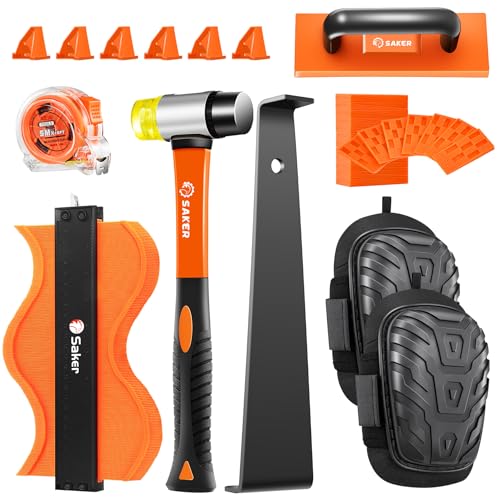
2. Saker 107-Piece Flooring Installation Kit
The bucket of small parts that decides whether your seams close tight or stay visibly open.
Every flooring job has a stretch where the gun is useless — the first row against the wall, the last row under the trim, and any board that needs a nudge to close a joint. That is the work this 107-piece Saker kit is built for. It carries a tapping block with a handle, a pull bar, 100 flooring spacers, a 10″ contour gauge with lock, a double-faced rubber mallet, a tape measure, and protective knee pads.
Two spacer sizes matter: 1/4 inch and 1/2 inch. They hold the expansion gap (the small gap that lets the floor move) your specific floor calls for. Thin spacers in other sets slip and tip; the big triangle design here is meant to stay put. The pull bar is 45# steel with frosted and matt coating and soft pads on the back to protect the plank while you lever the final row home. The contour gauge locks its shape so you can trace odd corners and pipe cuts. Buyers keep coming back to one point: one set covers the whole install.
What it will not do is fasten anything. There is no nailer here, so on solid hardwood you will pair this with a pneumatic gun. The tapping block is PP at roughly 7 x 2-3/4 x 3/4 inches — solid for the job, not a substitute for a proper dead-blow hammer on stubborn boards.
Best part of the package: the 100 spacers in two real sizes and the padded pull bar, which together solve the wall-gap and last-row problems that slow every install.
Keep in mind: it is a hand-tool set only — budget for a nailer, cutter, or both depending on your floor.
The pick for: laminate or hardwood installers who want the tapping, spacing, and pulling handled in one box.
Not the whole answer: no fastening or cutting capability is included.
3. 3PLUS HFS509040SP Pneumatic Flooring Stapler/Nailer
At 3.5 pounds it is the one your arm stops noticing — and the one that fits thin engineered boards.
Weight is the first spec an installer feels, and the gap here is real: 3.5 pounds against the 11.5-pound Freeman PFL618BR. Hold a gun above your head height for a few hundred boards and you understand what that difference does to your shoulder by late afternoon.
It fires 18 gauge brad nails from 3/4″ to 2″ and 18 gauge narrow crown staples with a 1/4″ crown from 5/8″ to 1-1/2″. The flooring window is 1/4″ to 5/8″ engineered or solid hardwood — narrower than the Freeman’s 1/2″ to 3/4″ span, so check your plank thickness before buying. It converts to a conventional combination stapler/brad nailer for other jobs, the exhaust cover rotates a full 360° to blow air away from your face, and depth control adjusts without tools. Buyers praise its quality and value, and one owner reports laying 2400 square feet without issues.
Jam-free running is mixed rather than guaranteed — some users never see a misfeed, others hit several. That is a tool you learn, not a defect you return. Also note the adjustability feedback leans negative, so expect a short learning curve on depth setting.
Why light wins here
- 3.5 pounds against the 11.5-pound Freeman PFL618BR is a huge difference over a long day
- 360° rotating exhaust keeps air blast out of your working line of sight
- Tool-free depth control plus a quick clear jam release
- Converts to a standard combination stapler/brad nailer between flooring jobs
The bits worth knowing first
- Fits 1/4″ – 5/8″ flooring, so thicker 3/4″ stock is out
- Jamming reports split both ways
- Depth adjustment takes some dialing in
Ideal for: engineered or thin solid hardwood and anyone whose arms object to a heavy gun.
Check your plank first: 3/4″ flooring falls outside its 1/4″ – 5/8″ range.
4. WEN 61741K Pneumatic Flooring Nailer and Stapler

A spring-loaded shoe angles fasteners at 45 degrees so a first flooring job starts on the right geometry.
Here is the entry point for someone doing their first hardwood room. The removable spring loaded flooring shoe sets fasteners at 45 degrees through the tongue, which is the angle the job requires — get that wrong and you split boards. Drive 18 gauge brad nails from 5/8 to 2 inches, or shoot 1/4-inch narrow crown staples from 1/2 to 1-5/8 inches, and switch between them as your flooring calls for it.
The accessories lean toward a beginner’s needs: a carrying case, two hex keys, a removable non-mar tip for finishing work, and oil. The quick-release nose deals with jams and the exhaust is adjustable. Capacity sits at 100 fasteners, which trails the 120 in the Freeman PFL618BR — so plan on one more reload per long row.
Capacity is the split opinion on this tool, not the driving quality. Fastener seating can need attention depending on the stock, and the smaller magazine means more stops. Buyers of this gun mostly praise the value and the fact it never jams; it is a starter gun you grow out of, not the last one you buy.
The honest read: a sensible first pneumatic nailer with the 45-degree shoe, hex keys, and non-mar tip a new installer forgets to buy.
Where it trails: the 100-fastener magazine against 120 on the Freeman, and depth setting that takes some dialing.
Choose it when: this is your first room and you want a full-featured nailer without a top-tier commitment.
Not for you if: you are doing whole-house work where fewer reloads and more capacity pay off.
5. 13in Laminate Floor Cutter
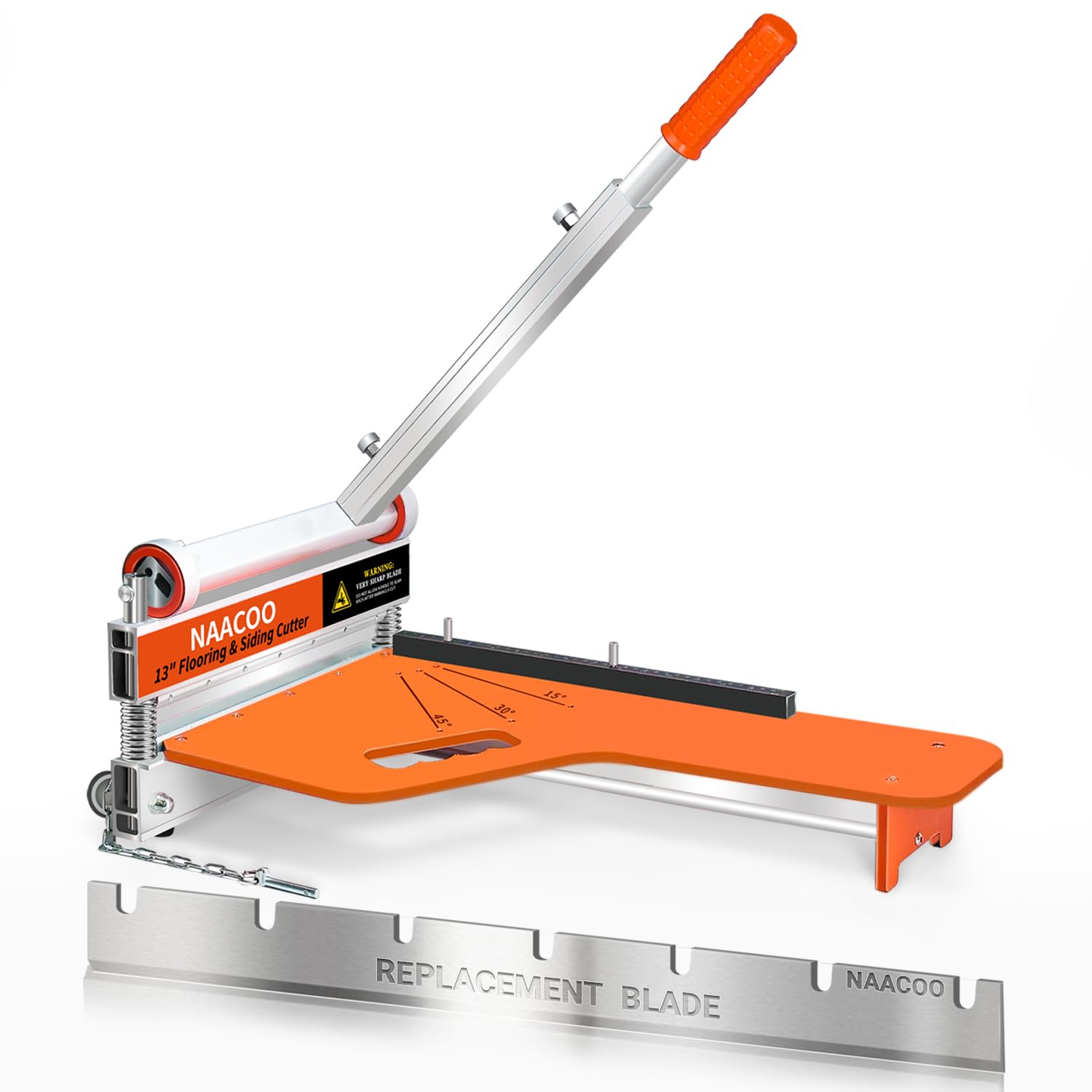
Score, snap, move on — the plank cutter that turns a saw-and-sweep job into a quiet, dustless one.
For laminate and vinyl planks this replaces the power saw outright. It cuts up to 13 inches wide and 13 mm thick, at 0°, 15°, 30°, and 45° angles, so doorways and borders with angled cuts stay on the same tool. The body is aluminum alloy and HDPE with a tungsten steel blade, and it comes with an extra replaceable blade so a dull edge does not stop the day.
One-step alignment saves time: angle and length align in the same pass, so you are not measuring twice and cutting twice. A clear angle marking line, a movable aluminum strip with inches and centimetres, rubber wheels, a hand hole, an extendable handle, and a chain brake bar (locks the blade into a no-cut position when not in use) round out the tool. It handles laminate, vinyl, VCT (vinyl composition tile), SPC (stone plastic composite), WPC (wood plastic composite), LVP (luxury vinyl plank), LVT (luxury vinyl tile), bamboo, parquet, engineered wood, and solid wood.
Two things to accept: it is hand powered at 18.26 pounds, and it is not a tile saw. It should never touch porcelain tile, and the build quality is the most debated point on this tool — likely because it is asked to do work a saw would normally handle.
The standout spec: 13-inch width with four cutting angles and a spare tungsten steel blade, which keeps a plank job flowing without a single dust cloud.
The limit to respect: it is a hand-powered plank cutter — porcelain tile is off limits and thick hardwood cuts harder than laminate.
Made for: laminate, vinyl, LVP, or bamboo jobs where dust and saw noise are the enemy.
Wrong tool if: you are installing solid oak and need a saw’s cutting power.
6. 3PLUS HFSNSP 2-in-1 Pneumatic Flooring Nailer/Stapler

A two-fastener hardwood gun with a removable long reach handle and a mallet in the box.
This is the practical middle step for hardwood: 15-1/2 gauge staples and 16 gauge L-cleats, both in 1-1/2″ to 2″ lengths. When you load L-cleats, the nail head goes into the slot on the magazine — a small detail, but the one that trips up first-time users. Interchangeable flooring plates let it sit on different flooring sizes, and the long reach handle comes off for tight spots.
Performance is the trait that stands out when you read what buyers report, and the reviews back that this holds up against pricier models on a real job. Build quality earns similar praise: alloy steel, aluminum, and rubber construction with a mallet included. That combination is why it makes sense as a first air nailer without stretching to premium tiers.
The honest catch is jams. Some owners mention a clean run and others mention the tool jams once or twice, and nail placement and compatibility also draw mixed notes. None of that turns it into a bad gun, but it asks for attention rather than set-and-forget trust.
Where the value shows
- Handles 15-1/2 ga staples and 16 ga L-cleats in 1-1/2″ – 2″ lengths
- Removable long reach handle for awkward edges
- Includes a white rubber mallet so the swing setup is complete
- Interchangeable flooring plates fit multiple flooring sizes
What to expect going in
- Jamming reports split between clean runs and occasional misfeeds
- Nail placement and compatibility are less settled than on premium guns
- Loading L-cleats requires aligning the nail head to the magazine slot
Buy this if: you want a hardwood nailer that undercuts premium pricing while still driving 2″ fasteners.
Think twice if: a jam in the middle of a long row would frustrate you — check the premium picks first.
7. BOSTITCH Flooring Nailer, 2-in-1 (BTFP12569)

Strike the bumper with a mallet and the gun fires — no trigger, no crouching over the plank.
The mechanism is the story here. Mallet-actuated pneumatic driving means you swing the included mallet at the bumper and the fastener fires, which is why hardwood installers can stay upright and keep their knees out of the equation. It drives 15.5 gauge flooring staples or 16 gauge L-cleats from 1-1/2″ to 2″, and the non-marring interchangeable base plates cover 1/2″ (12.7 mm) through 3/4″ (19.1 mm) flooring.
The ergonomic long handle with a rubber grip pairs with the standing posture, and the durability holds up in real installations — prefinished flooring takes no surface damage according to the word from owners. Quality and performance carry the reputation here, and the tool costs less than renting a nailer for a multi-room job.
At 14.7 pounds, this is a heavy tool to carry through a house, and handling draws mixed remarks since the long handle is great in the open and awkward in closets. Jams also show up in the mix. Overall it is a professional-habit choice, not a light-duty one.
Why installers like it: mallet-actuated driving keeps you standing, and the interchangeable plates handle 1/2″ through 3/4″ flooring without marring the surface.
Where it asks more: 14.7 pounds of tool plus the long handle makes tight corners and closets fussier.
Goes to: installers who want to stay upright and drive fasteners with a mallet swing all day.
Look elsewhere if: your rooms are full of tight closets and corners — the shorter-handle 3PLUS HFSNSP fits those better.
8. DEWALT Flooring Stapler, 2-in-1 Tool (DWFP12569)
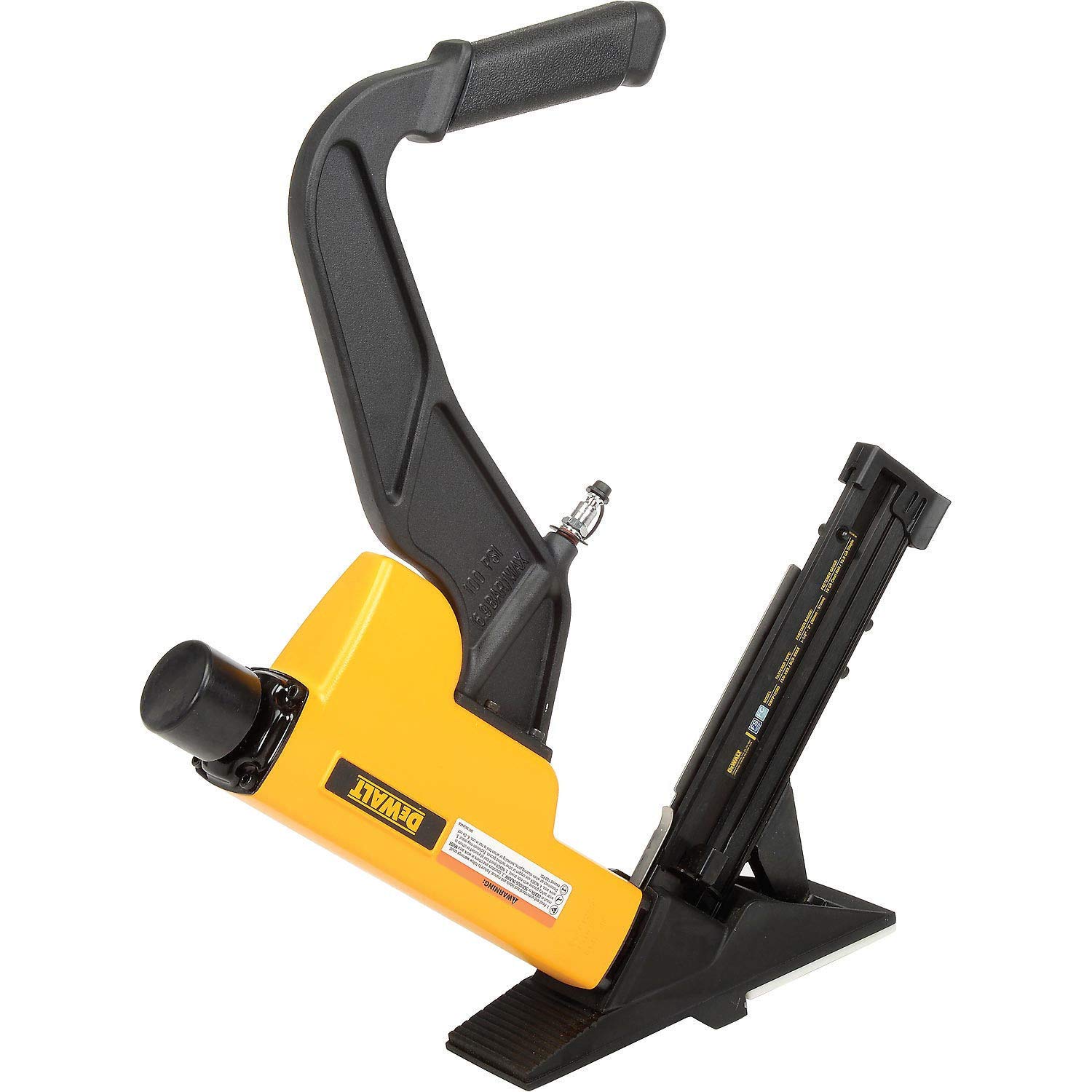
Lower CFM requirements mean a smaller compressor can keep up with this one.
Compressor duty is the spec most buyers miss, and this tool is built to reduce it. Lower CFM requirements — the airflow a tool demands per minute — mean less compressor run-time and a smaller tank can keep pace. It fires 15.5 gauge staples and 16 gauge L-cleat nails, both common solid flooring fasteners, and comes with 1/2″, 5/8″, and 3/4″ interchangeable base plates plus a mallet, wrenches, and a 1/4″ air fitting.
Reliability is what this gun is known for. The reports are consistent: it performs well on real jobs, with 1000 square feet completed without issues noted in its favor. Zero jams during use is the common experience, jamming resistance draws its own praise, and it is described as well-built and easy to use with a longer handle and rubber grip. That reliability plus the low air demand is why it holds its own in the premium tier.
The durability story is split, which is worth knowing up front: some customers note it holding up well while others mention breakage during use. At 14.7 pounds it is heavy like the BOSTITCH, so it favors the same standing install.
The dependable details
- Lower CFM means less compressor run-time and a smaller tank keeps up
- Three base plates (1/2″, 5/8″, 3/4″) cover the common solid flooring sizes
- Zero jams is the typical experience and jamming resistance rates well
- Ships with a mallet, wrenches, and a 1/4″ air fitting
What to weigh honestly
- 14.7 pounds is a lot to carry through a house
- Durability experiences split between solid and breaking during use
Fits you if: your compressor is small or you want proven jam resistance with zero air-supply drama.
Not the first pick if: you need the lightest tool in the room.
9. Freeman PDX50C Flooring Nailer/Stapler

Same three-fastener flexibility as the Freeman flagship, with the weight trimmed to 10 pounds.
Built for cherry, oak, maple, and walnut tongue and groove, this gun fires 16 gauge T-cleats, 16 gauge L-cleats, and 15.5 gauge 1/2″ crown staples from 1-1/2″ to 2″ — the same three-fastener span as the PFL618BR above. The difference is what you are holding: the maker states it is lighter than comparable flooring nailers, and the actual figure is 10 pounds against the PFL618BR’s 11.5 pounds. Over a long shift, the cut-away ergonomic handle and light strike bumper are the parts that count.
Two interchangeable no-mar base plates protect finished boards and adjust to 1/2″ through 3/4″ flooring. A long reach fiberglass mallet with a padded grip and rubber head is included along with air tool oil and adjustment tools. Owners describe the reliability as the strong point — a 95 psi run with no trouble is the kind of experience people mention, and it is called well-built and easy to use on hardwood.
Jams and durability are the split notes. Some runs are clean and others need the jam cleared, and while many say it will last a long time, a few have had durability questions. Worth knowing before you commit to it for a whole house.
The number that sells it: 10 pounds against the 11.5-pound Freeman PFL618BR, with the same three-fastener range — a difference you feel by the end of a long shift.
The split note: jam-free running and durability get mixed reviews, so treat it as a dependable tool that may need occasional clearing.
The one to grab: when you want the Freeman three-fastener flexibility with less weight in your hands.
Weigh the other side: its jam and durability record is less settled than the DEWALT’s zero-jam pattern.
Know the Specs
Fastener Gauge and Type
Gauge is the wire thickness of a fastener — a lower number means a thicker nail. Flooring guns here use 15.5, 16, or 18 gauge, and the type matters as much as the number: T-cleats and L-cleats are angled nails, while crown staples are wider and grip more board. A gun that fires all three gives you the freedom to match your flooring spec. A 4-in-1 or 3-in-1 tool simply means it can switch between those fastener styles.
Flooring Thickness and Base Plates
Base plates are the interchangeable feet that set the gun’s angle on the plank. The wrong plate means the fastener sits too deep or too shallow. Most hardwood guns in this list cover 1/2″ to 3/4″ flooring, while the lighter 18 gauge tools narrow to 1/4″ to 5/8″ engineered or solid stock. Check your plank thickness before buying — it is the fastest way to rule a gun in or out.
Compressor and CFM
Every pneumatic tool here needs a separate air compressor. CFM is the airflow a tool demands per minute, and lower CFM means a smaller compressor can keep pace with less run-time. If your tank is modest, a low-CFM gun will save you waiting for pressure to rebuild mid-row. There is no battery option in this group, so air supply is a real purchase requirement.
Expansion Gaps and Hand Tools
Wood flooring moves, so every wall needs a gap — often 1/4 inch or 1/2 inch depending on the product. Spacers hold that gap while the boards set, a tapping block closes joints without damaging the tongue, and a pull bar brings the final row in where a gun will not fit. These are the jobs no nailer does, which is why a hand-tool kit belongs in every install.
Common Questions
Do I need a different nailer for solid hardwood and engineered flooring?
Can I use a flooring nailer without an air compressor?
What is the difference between T-cleats, L-cleats, and crown staples?
Will a laminate floor cutter handle solid hardwood planks?
How much expansion gap should I leave at the walls?
Why does a flooring gun jam, and how do I clear it?
Is a mallet-actuated nailer better than a trigger-fired one?
What weight should I look for in a flooring nailer?
Do I still need a tapping block if I have a nailer?
Can one of these nailers fasten the last row against a wall?
The Bottom Line
Start with your floor type, not the brand, and the shortlist narrows itself. For solid or engineered tongue and groove in 1/2″ to 3/4″, the Freeman Pneumatic 3-in-1 PFL618BR is the safest bet — it fires three fastener types, holds 120 fasteners, and carries a 4.5+ star reputation across hundreds of installs. If your arms or your plank thickness push you lighter, the 3PLUS HFS509040SP at 3.5 pounds covers 1/4″ to 5/8″ stock with far less fatigue. For laminate, vinyl, or LVP, the NAACOO 13in Laminate Floor Cutter replaces the saw and keeps the room dust-free, and the Saker 107-Piece Installation Kit handles the tapping, spacing, and last-row pulling that no gun can do.
Before you commit, note that the top picks here hold higher scores than most of the field. The Freeman PFL618BR’s 4.5+ stars across 900+ ratings is the pattern that repeats on review pages: a gun that drives fasteners and protects finished boards, room after room. Buy the fastener type your flooring spec names and confirm the thickness range fits your plank.
How we choose
We do not accept paid placement. Every pick is matched to a real buyer and a real use-case; we do not hands-on test units.
Sources
Specifications: manufacturer listings and product documentation. Review insights: verified customer reviews, as of November 2026. Pricing: not shown on this page (it changes often); check the current price via the retailer link.
As an Amazon Associate, Tactical Gear Guy earns from qualifying purchases. This does not affect which products we feature.