Specs are compiled from manufacturer listings and verified buyer reviews and can change over time — please confirm the key details on the product page before buying.
A drafting table earns its keep on three things: a surface that tilts to a real angle, legs that stay still while you work, and wood thick enough not to flex under your hand. Get those right and you can draw for hours without craning your neck at a flat desk. Get them wrong and you own a wobbly shelf with a pencil ledge. The eight tables below are all genuine wood builds, and the top pick is the one that balances tilt range, height range and build quality better than anything else here.
This guide is built by comparing the manufacturers’ published specifications and the patterns across verified customer reviews, so you get each pick’s real strengths and trade-offs instead of marketing spin.
What separates a table you use every day from one you fold into a closet is usually the tilt mechanism (the hinge that angles the top toward you) and the leg bracing (the crossbars that stop the frame wobbling). Below you’ll find honest trade-offs on each, so you can pick the right wooden drawing table for your studio, spare room or dorm.
Top Picks


How To Choose The Best Wooden Drawing Table
A wooden drawing table is furniture, not an accessory. You will sit at it for hours, lean your forearm on it, and drag a T-square (a straight edge you slide across the board to draw parallel lines) over it. That is why the buying decision depends on four physical things: how far the top tilts, how high the frame goes, how the legs are braced, and what the surface is actually made of.
Tilt Range Decides Your Neck
Drawing flat forces you to hunch forward. A top that tilts to a steep angle lets you sit more upright and keep your paper closer to eye level. The tables here range from a 45° maximum tilt up to a full 90° vertical position. If you sketch or paint, more tilt gives you more working positions. If you mainly write or type, a moderate tilt is plenty.
Height Range Matters More Than You Think
A table that only sits at one height either fits you or it does not. Adjustable frames let you match the surface to your chair and your own posture. Check the low and high ends of the range before you buy, because a table whose lowest setting is still high will leave your feet dangling or your shoulders raised.
Leg Bracing Is the Anti-Wobble Story
Wobble is the number one complaint about cheap drafting desks. The fix is structural: an H-frame layout or a cross-support brace ties the two side legs together and kills sideways movement. Thickened legs and traditional wood joints add to that rigidity. When you read a listing, look for how the legs connect, not just what they are made of.
Wood Type and Finish
Solid beech and pine are the common frame woods here, with particle board or MDF used for some tops under a wood veneer or finish. Solid wood legs carry load better. A polished or oil finish makes the surface smooth enough for pencil work and easier to wipe clean. A built-in pencil ledge stops tools rolling onto the floor when the top is tilted.
Side-by-Side Comparison
| Model | Best For | Tabletop Size | Height Range | Max Tilt | Amazon |
|---|---|---|---|---|---|
| MEEDEN Wood Adjustable Drafting Table★ Best Overall | Most buyers | 35.5″ x 23.5″ | 29.7″ to 38.4″ | 60° | Amazon |
| conda Wood Drafting TableBest Value | Compact studios | 35.4″ x 23.6″ | 31.5″ to 37″ | 45° | Amazon |
| MEEDEN Vintage Wooden Drafting TableTop Performer | Warm wood looks | 35.5″ x 23.5″ | 32.7″ to 38″ | 90° | Amazon |
| VISWIN 24″ x 35″ Pine Drafting Table | Budget-first setups | 35″ x 24″ | 34″ | 70° | Amazon |
| DJAR 42×30 Adjustable Drafting Table | Large-format work | 42″ x 30″ | 34″ to 38.9″ | 25° (330° rotation) | Amazon |
| VISWIN 30″ x 42″ Extra-Large Drafting Table | Big boards on a budget | 42″ x 30″ | 34″ to 38″ | 70° | Amazon |
| GatherHome Drafting Table with Storage Cabinet | Storage-heavy rooms | 47.2″ x 23.6″ | 43.7″ overall height | 80° | Amazon |
Detailed Reviews
1. MEEDEN Wood Adjustable Drafting Table
Our pick — 4.5+★ from 900+ verified ratings; the strongest balance of quality and price.
The one that gets the wobble, height range and assembly right so the drawing part is easy.
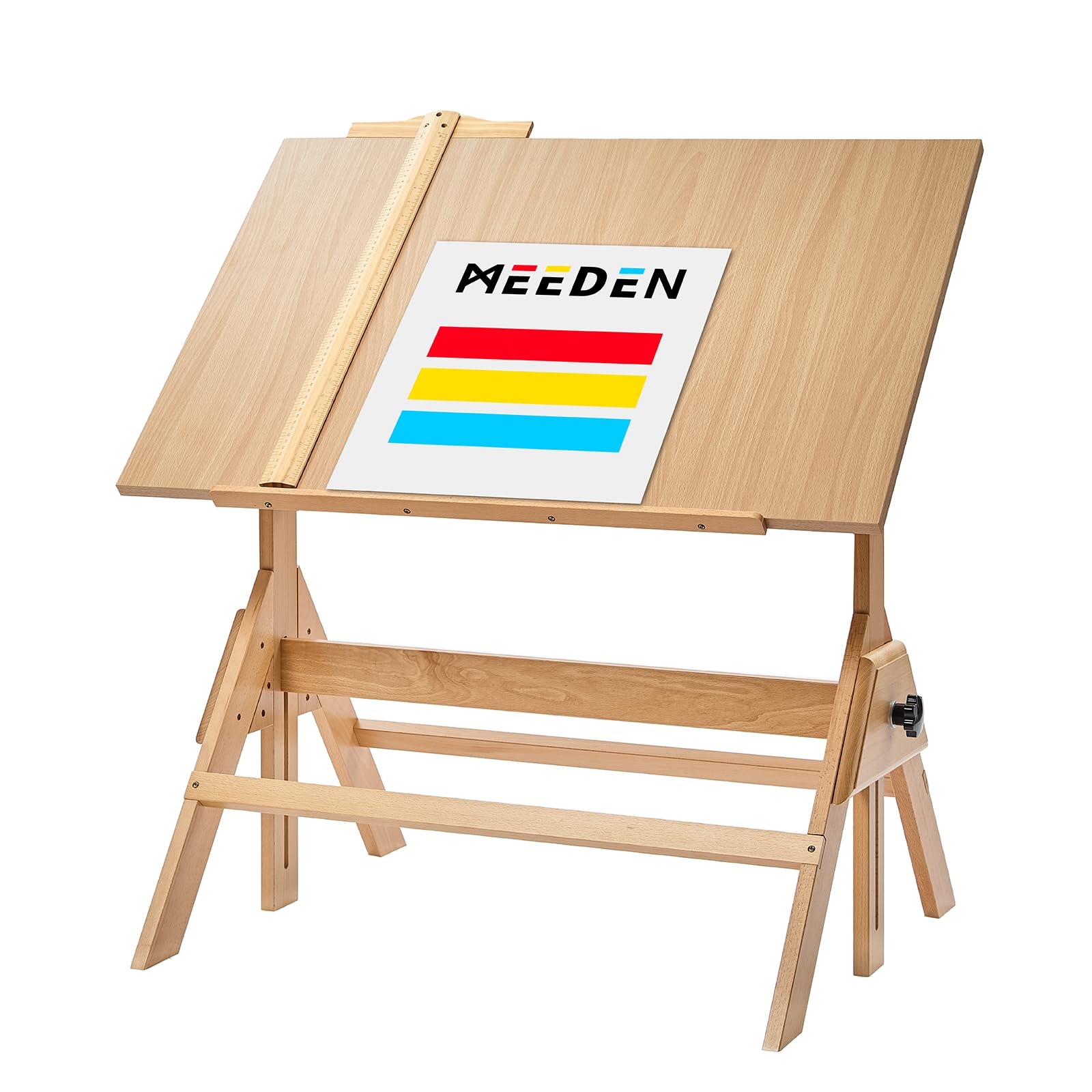
You get a 23.5-inch deep by 35.5-inch wide worktop — that is 35.5″ x 23.5″ of usable flat space — on high-quality beech legs. The top tilts from flat up to 60°, and the frame rises from 29.7 inches to 38.4 inches, so it can serve a child at the low end and a standing adult at the top. A 25-inch built-in pencil ledge catches your tools when the surface is angled.
Stability is where this table has quietly earned its reputation. The cross-support design and the two strong side legs brace the top against lateral movement, which is the sideways shift that ruins a fine pencil line. What owners talk about most is simply how good the piece feels — the finish, the real wood, the sense that it is furniture rather than a folded-up trestle. Assembly gets its own wave of praise: parts come in separate labeled bags, a tool is included, and two people can have it standing in about 20 minutes.
The honest caveat is adjustability. It works, but it is not the slickest mechanism on this list, and a few people find the angle changes take more effort than they expected. Note the tilt ceiling too: 60° is generous for drawing and writing, but it stops short of the near-vertical 90° you get on the MEEDEN Vintage above it in this list. The bonus 24-inch T-square with both inch and metric calibrations is a genuinely useful extra, not filler.
What earns it the top slot
- Beechwood legs with cross support keep the top from shifting sideways while you work
- Height moves from 29.7″ to 38.4″, covering kids and adults at one desk
- Built-in 25″ pencil ledge holds tools on the tilted surface
- Includes a 24″ T-square with inch and metric scales
- Two-person setup in about 20 minutes with sorted parts and tools included
Where it asks for patience
- Tilt stops at 60° rather than the full 90° some rival tables reach
- Changing the angle takes a little more effort than the smoothest designs here
Buy it if: you want one wood table that works for a sketching teenager and a working adult without wobble.
Look past it if: you need near-vertical 90° tilt for large-scale standing work.
2. conda Wood Drafting Table
A compact solid wood table with a ruler built straight into the tabletop.
The surface here is a natural wood slab measuring 35.4″ x 23.6″, and it arrives with a pencil ledge plus a built-in ruler. That ruler is the small detail you notice every single session — no scrabbling for a straightedge when you need a quick measurement. Height runs from 31.5 inches up to 37 inches, and the top tilts anywhere from 0° to 45°.
Compared with the top pick, this one gives up 15° of tilt and a little height at the top end, which is why it sits below it. What it gives back is a compact footprint and a solid wood frame described as steady under daily creative work. Assembly is the standout: pre-sorted parts, printed instructions, tools in the box, and a support team that responds within 24 hours if something is missing.
Owners describe it as easy to build and easy to shift around the room, which suits renters and anyone who reworks their studio layout often. The 45° tilt ceiling is the real limit — fine for sketching and writing, less so for full standing easel work. Wood tone varies between units, so treat the grain in the photos as a guide rather than a promise.
The ruler detail: a built-in measuring edge on the tabletop saves time on layout and drafting work, and it is unusual at this level.
The ceiling to know: 0° to 45° of tilt covers writing and sketching comfortably but will not stand a large board upright.
Reach for this if: you want solid wood, a built-in ruler and quick assembly in a compact studio space.
Think twice if: your work needs steep, near-vertical tilt angles.
3. MEEDEN Vintage Wooden Drafting Table
Seven tilt positions up to 90° and a walnut finish that looks like it cost more.
Measure the flexibility first. This table tilts through 7 angles from flat all the way to 90°, and the height steps through 6 settings between 32.7 inches and 38 inches, spaced 1-1/5 inches apart. Against the MEEDEN Wood Adjustable table, that is 30° more tilt at the top end and a slightly higher low end. The top itself is a walnut-colored particle board panel on thickened beechwood legs, with an H-frame layout and a built-in pencil ledge to stop tools sliding off a steep angle.
Looks carry a lot of weight in the reviews, and for good reason — the visible grain, the semicircle iron sheet detail and the matte walnut tone read as studio furniture rather than office surplus. The hardware is the other telling detail: a new mould design for the threaded holes is aimed squarely at reducing tabletop shake. A 24-inch T-square with inch and metric calibrations ships in the box.
Adjustability is the split opinion here. Plenty of people set the angle easily; others find the mechanism stiffer than they would like, especially on the steeper settings. Size and material also draw a mixed word or two. It is a table you adjust to a setting and then leave for a while, rather than one you flip up and down between tasks.
The visual read: real wood grain, a walnut finish and an industrial iron accent make this the best-looking table in its price tier.
Honest adjustment note: with 7 angles and 6 heights, the flexibility is real, but the mechanism can feel stiff when you push it to the top of its range.
Best for: anyone who wants studio-grade looks and a full 90° working position without stepping into premium territory.
Not the pick for: buyers who plan to change the tilt constantly through the day.
4. DJAR 42×30 Adjustable Wooden Drafting Table

A 42″ x 30″ walnut-toned board that spins 330° so you barely move your arm.
Start with the surface, because that is the whole pitch. This is a 42-inch by 30-inch tabletop with a walnut finish — noticeably wider than the 35.5-inch tops on several picks here — and it rotates a full 330°. That rotation is different from plain tilt. It means a large drawing board can swing round to meet your hand rather than you leaning across it, which matters on oversized work.
Height adjusts from 34 inches to 38.9 inches, the broadest high end on this list, and the double semi-circular frame supports tilt in 25° increments. Solid pine legs and an H-frame carry the load. Owners call it sturdy and well-made, and the assembly story is calm — simple steps, clear instructions, no improvisation needed. Anyone working on 18×24 paper will find the space generous.
Here is the trade-off that keeps it out of the top spots. Tilt in 25° increments is coarse compared with the fine angle choices on the MEEDEN tables, and the move to each setting takes effort, so this is not a desk you tilt and re-tilt every hour. The industrial walnut look will not suit a pale minimal room.
Why it earns its place
- 42″ x 30″ top gives the most drawing room outside the storage model
- 330° rotation swings large boards to your hand instead of the reverse
- Height tops out at 38.9″, the highest on this list
- Solid pine legs and H-frame keep the big surface from shaking
What you trade for the size
- 25° tilt steps are coarse next to the finer angle ranges on the MEEDEN tables
- Resetting the tilt takes effort, so it suits set-and-work rather than constant changes
Pick this one when: you draw on large sheets and want the board to come to you at 330°.
Pass if: you need fine, frequent angle changes or a light-coloured room aesthetic.
5. VISWIN 30″ x 42″ Extra-Large Wood Drafting Table

A 42″ x 30″ pine surface with a genuinely wide 0° to 70° tilt swing.
This is the bigger sibling of the pine table further down this list, and the numbers tell the story. The surface measures 42 inches by 30 inches — that is 6 inches deeper and 7 inches wider than the 35″ x 24″ version — and the height adjusts from 34 inches to 38 inches.
Construction follows the premium pine playbook: an H-frame that resists shaking, thickened wood legs for load-bearing, and hand-polished corners with no burrs or sharp edges. A professional oil finish keeps the surface smooth and easy to wipe down. Owners respond to the design first — it is repeatedly called better-looking than expected — and the size draws approving notes from people who needed space for real boards.
Now the practical warning, and it is the one note that repeats. The desk sits high, and several owners found it too tall to pair with an ordinary computer chair. If you mostly draw on a stool, that is no problem. If you planned to swap it into desk duty with a standard office chair, measure your chair height against the 34-inch low setting before ordering.
The size case: 42″ x 30″ of pine gives you room for large sketch pads and reference sheets at the same time.
The height catch: the 34″ minimum is tall for a computer chair, so this suits drafting stools better than a swivel office setup.
Worth it for: artists who need a genuinely large board surface and a steep tilt without paying the highest tier.
Measure first if: you intend to use it as a sit-down desk with a standard chair.
6. VISWIN 24″ x 35″ Pine Wood Drafting Table

The entry ticket: a 35″ x 24″ pine top, 70° of tilt, and a fixed 34-inch height.
If you want the lowest outlay here, this is it. The top measures 35 inches by 24 inches and tilts from 0° all the way to 70° — a wider angle range than the conda table, despite sitting lower on the ladder. The frame is premium pine with H-frame construction and thickened legs, and the corners are hand-polished with no burrs or sharp edges. A professional oil finish keeps the surface smooth for sketch work.
The one number that decides it for many buyers is the height: this table stands at a fixed 34 inches. There is no adjustment in the low-to-high sense, so it either fits your stool and your posture or it does not. For a standing-height drawing post it works well. For anyone who wants to fine-tune the surface to their chair, the adjustable MEEDEN and conda tables are the better conversation.
Setup is straightforward — instructions, labeled parts and tools all ship together — and the retro-look pine reads warmer in a room than a painted metal frame would. Treat it as a dedicated drawing station rather than a full-time computer desk.
The entry-level win
- 0° to 70° tilt is broader than several pricier tables here
- 35″ x 24″ pine top with hand-polished, burr-free corners
- H-frame and thickened legs hold the surface steady
- Oil finish keeps maintenance simple
The fixed-height reality
- Height is a single 34-inch setting with no adjustment range
- Not the pick if you want to dial the surface in to your own chair
Best fit if: you want maximum tilt for the least money and know a 34-inch height suits you.
Go adjustable instead if: you share the desk or want room to tune the height.
7. GatherHome Drafting Table with Storage Cabinet & Drawers
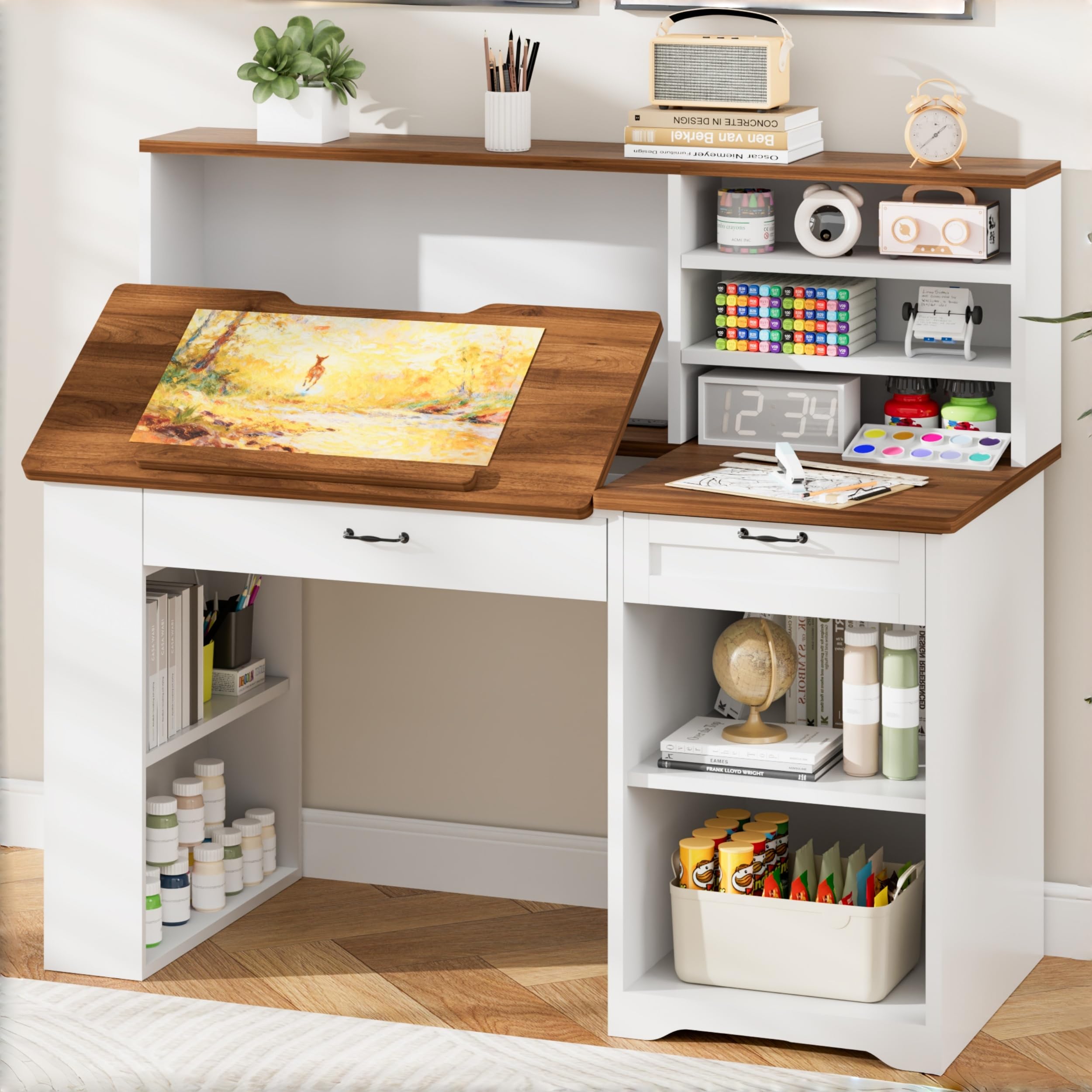
The only one here with drawers, shelves and a cabinet, so supplies go inside instead of across your floor.
Every other table on this list gives you a surface and a pencil ledge. This one gives you a storage cabinet, 3 drawers and 3 tiers of open shelves on top of a 47.2-inch by 23.6-inch top. The angle adjusts from 0° to 80°, so it switches from a flat everyday desk to a steep art station in one motion.
Frame construction is premium MDF — an engineered wood, meaning wood fibre pressed and bonded into panels — rated for a stable, wobble-free surface even under heavy drawing boards. Owners back that up: the build is described as solid, and assembly gets a warm word for its user-friendly instructions. The white finish and 43.7-inch overall height let it sit in a bedroom or craft corner without dominating the room.
Two honest notes. At 99 pounds this is furniture you position once and leave; it is not the table you drag around the studio. And engineered wood is not the same material as the solid beech and pine frames elsewhere here, so the long-term feel differs. What you gain in return is the only genuinely organised station on this list.
Why storage changes the deal
- 3 drawers, 3 open shelves and a cabinet hold pads, paints and tools out of sight
- 0° to 80° tilt covers both flat desk duty and steep easel work
- Wide 47.2″ x 23.6″ top with a stable, load-bearing MDF frame
- Straightforward assembly with clear instructions
The practical limits
- At 99 lb it is a fixed piece of furniture, not a portable desk
- Engineered wood frame rather than the solid beech and pine used elsewhere here
Choose it if: your supplies have outgrown a pencil ledge and you want everything in one footprint.
skip it if: you move your desk between rooms or want a solid hardwood frame.
Know the Specs
Tilt Angle and Rotation
Tilt angle describes how far the tabletop leans back from flat. A listing that says 0° to 45° means the surface can go from dead flat to a moderate slant. A range up to 90° gets you to near-vertical, which suits large boards and standing work. Some tables add rotation instead of more tilt — the DJAR offers 330° rotation, letting the board swing round to your hand rather than you reaching across it. Match the number to how you actually work: writing needs little tilt, sketching wants more, painting on a big board wants the most.
Height Range and Frame Bracing
Height range is the span between the lowest and highest setting, given as two numbers such as 29.7 inches to 38.4 inches. A wide range lets one table serve a child and an adult, and lets you raise the surface to suit a stool or a standing position. A single fixed height, like the 34-inch setting on the smaller VISWIN table, only works if it suits your chair. Frame bracing is the anti-wobble structure: an H-frame ties the two side legs together, and cross support stops lateral movement. Thickened legs and traditional wood joints add rigidity.
Common Questions
What tilt angle do I need for sketching versus painting on a large board?
Will a wooden drafting table hold a heavy drawing board or light table without shaking?
Is a 35-inch tabletop wide enough for an 18×24 drawing pad?
What is the difference between a table that rotates and one that only tilts?
How much room should I leave around a wooden drawing table?
Does a fixed-height drafting table work as a normal desk?
How long does assembly take, and do I need a second person?
Particle board, pine, beech or MDF — which tabletop material should I pick?
How do I stop tools sliding off a tilted surface?
What does the included T-square actually measure?
The Bottom Line
The strongest overall wooden drawing table here is the MEEDEN Wood Adjustable Drafting Table, because it gets the fundamentals right. Its cross-braced beech legs (beech is a hard, dense wood, and the crossbars keep the frame steady) mean less wobble while you draw. A 29.7″ to 38.4″ height range fits kids and adults, so one table serves the whole household. A 60° tilt (the top angles up to 60 degrees toward you) lets you work standing or seated, and the sorted parts go together in about 20 minutes. If you want the full 90° working position and a walnut finish that belongs in a studio, the MEEDEN Vintage Wooden Drafting Table gives you 7 tilt angles and 6 height settings. For large boards that need to swing round to your hand, the DJAR 42×30 brings a 42″ x 30″ surface and 330° rotation (the board spins almost all the way around, so you can pull a far corner toward you without standing up). And if your supplies have outgrown a pencil ledge, the GatherHome table is the only pick with drawers, shelves and a cabinet built in. Work out which of those four needs matters most to you, and the decision makes itself.
How we choose
We do not accept paid placement. Every pick is matched to a real buyer and a real use-case; we do not hands-on test units.
Sources
Specifications: manufacturer listings and product documentation. Review insights: verified customer reviews, as of November 2026. Pricing: not shown on this page (it changes often); check the current price via the retailer link.
As an Amazon Associate, Tactical Gear Guy earns from qualifying purchases. This does not affect which products we feature.